
There is a particular stillness in the way a braid catches light along the scalp, where the parting narrows and the plait thickens into its own architecture. A cornrow curving behind an ear, a twist catching copper at its lowest point, a box braid pulling weight toward the shoulder — each one holds a decision about line, direction, and proportion. These are the quiet details that give hairstyle ideas for Black women their real character, the ones that separate a look from a silhouette.
What makes a hairstyle work is rarely one thing. It is the relationship between several variables operating at once: the shape of the braid pattern against the scalp, the contrast between tight structure at the root and loose movement at the ends, the placement of color or accessories along the length, and the overall proportion of volume to frame. Throughout this article, each section examines one image on those terms — how texture meets structure, where weight sits, what role color plays, and how the finishing details either sharpen or soften the design. The goal is not to prescribe a single direction but to read each style as a set of visual choices that carry their own internal logic, choices that can be adapted, shifted, or borrowed depending on someone’s own hair, face, and preferences.
1. Curved Cornrows With Thick Trailing Plaits
The hair is braided into large, sweeping cornrows that follow a curved path from the front hairline back and slightly downward. The braids are thick and tightly woven, with clean parts between each row. They gather at the nape and continue as individual hanging plaits that fall past the shoulder. Gold hoop earrings and glasses sit at the edge of the frame. The overall palette stays dark with warm undertones.
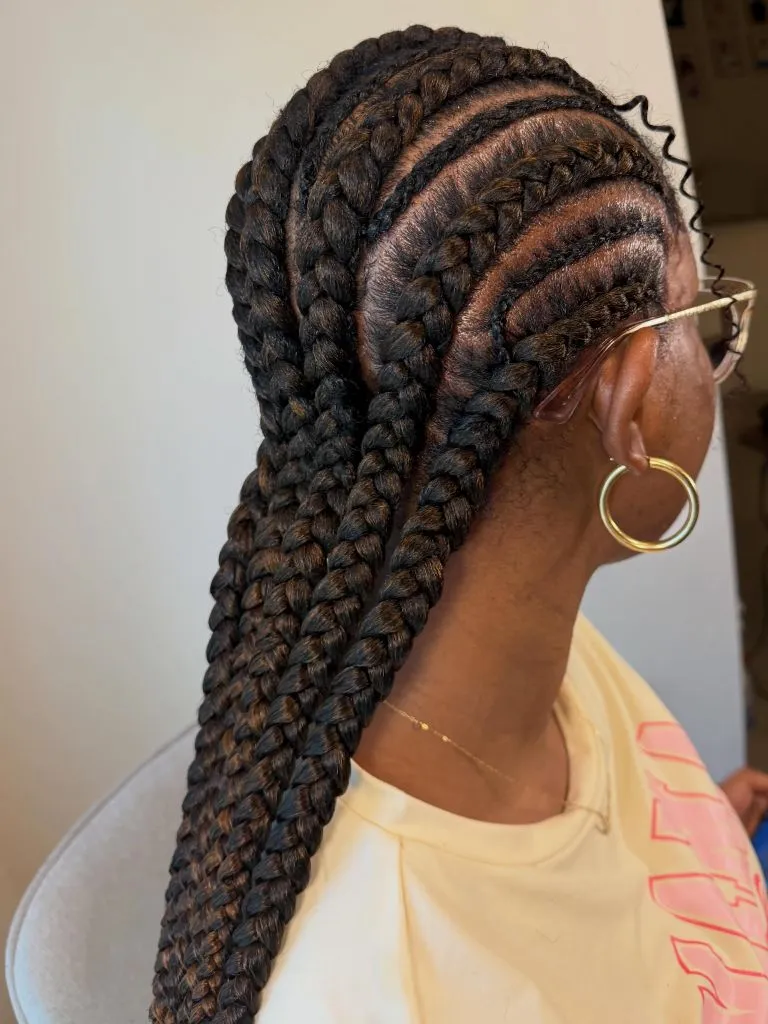
Photo via Instagram
The power of this look sits in the scale of the braids relative to the head. Each cornrow is wide enough to read as a design element on its own, and the curved parting creates a sense of movement even though everything is tightly secured. The trailing plaits add vertical length and weight, pulling the eye downward past the ear and along the neck. The gold hoop acts as a small interruption — a circle against all the linear rhythm — without competing with the braid pattern. The restraint in color keeps the structure legible.
The reader takeaway is that oversized cornrows rely on clean, consistent parting to hold their visual weight. When the braids are this thick, the parts between them become as important as the braids themselves. That contrast of skin and plait is what gives the pattern its graphic quality, and keeping accessories minimal — a single hoop, a thin chain — lets the architecture stay in focus without cluttering the frame.
2. Knotless Box Braids With Deep Wave Curls in Black
Small to medium knotless box braids begin at neat diamond-shaped parts across the crown and transition into long, deep wave curls that fall well past the shoulders. The hair is entirely black with no visible color variation. The person sits in a pink salon chair wearing a leopard-print top. The curls create dense, cascading volume from about mid-length downward, while the braided roots remain flat and structured.
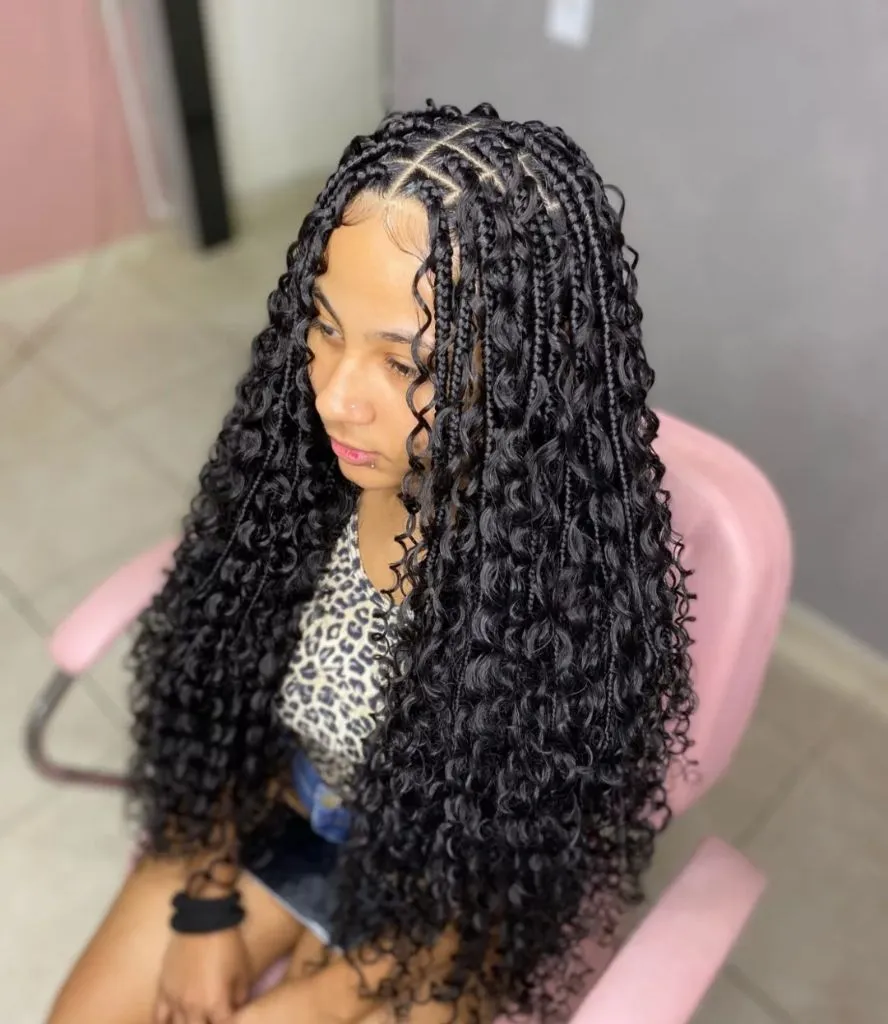
Photo via Instagram
The transition point is what drives the whole look. The braids at the scalp are tight, flat, and geometric, and then the curls bloom outward with volume and texture that feels almost unrelated to the root structure. That shift from order to looseness gives the style its visual energy. The all-black color palette keeps both zones unified, so the contrast stays textural rather than tonal. The density of the curls at the ends creates a dramatic silhouette worth studying against the controlled flatness of the crown.
The useful move here is to let the braided section and the curl section do completely different jobs. The roots provide structure and neat geometry while the ends carry all the movement. Because the color stays consistent throughout, the eye reads one continuous style rather than two competing ones, and the length of the curls amplifies the effect without requiring additional color or accessories.
3. Honey-Highlighted Braids With Loose Spiral Curls
Medium knotless braids sit in clean, angular parts across the top of the head and transition into loose spiral curls from mid-shaft downward. The color shifts from a dark brown at the roots into warm honey and caramel tones through the braids and curls. The person is seated in a pink salon chair wearing a black top. The curls hang past the chest and carry visible shine, with the lighter tones concentrated through the lower half.
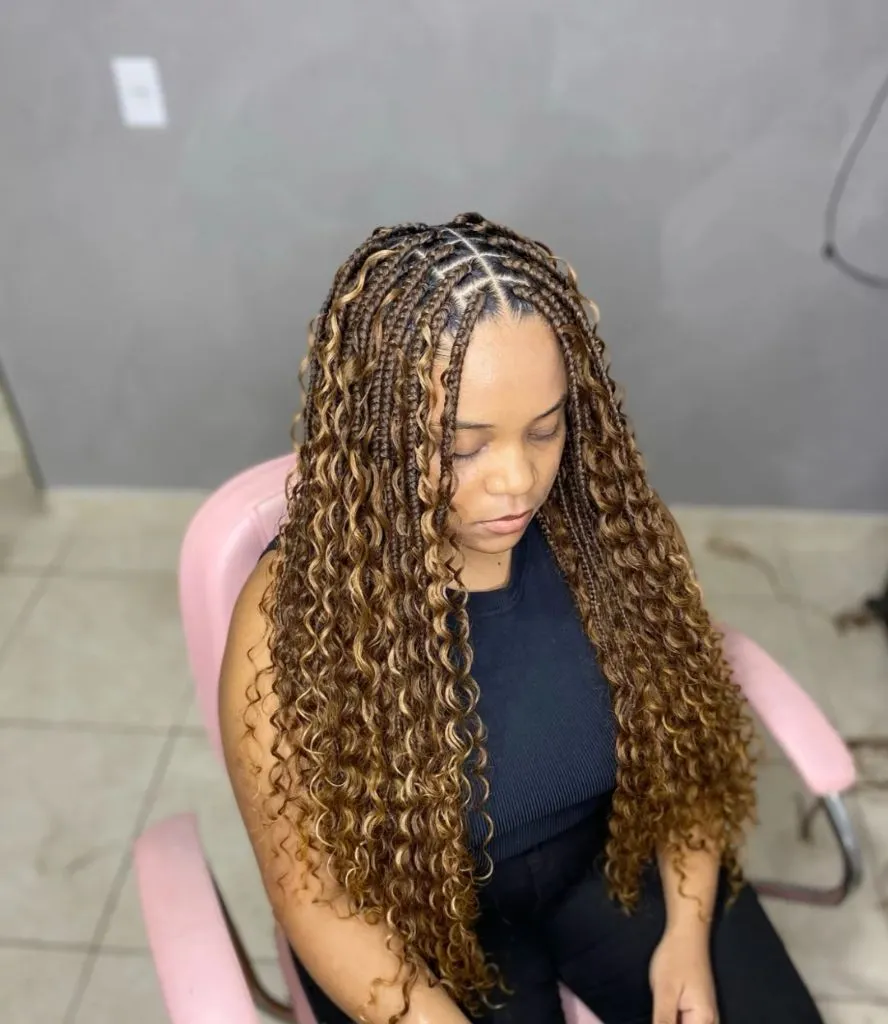
Photo via Instagram
Color placement does most of the work here. The dark roots anchor the look close to the scalp, and the honey tones build gradually, reaching their lightest point at the curl ends. That gradient creates a natural-looking warmth without any harsh line of demarcation. The spiral curls catch light along their ridges, making the blonde and caramel tones appear brighter and more dimensional than they might on a flat surface. The overall silhouette is long and narrow, with volume distributed evenly rather than concentrated at any one point.
The strongest lesson is that color gradient and curl texture amplify each other. When highlights are placed through the curled section rather than through the flat braid, they gain movement and dimension from the curl pattern. The dark root zone grounds the whole design, preventing the lighter tones from floating free, and the result reads as deliberate rather than random.
4. Short Cornrows With Beaded Braid Ends
The hair is braided into several medium-width cornrows that sit flat against the scalp and end in individual braids just past the collarbone. Each braid tip is finished with clusters of wooden beads in natural tones — brown, cream, and dark wood. The person wears a blue crewneck top and a small gold hoop earring. Baby hairs are visible along the forehead, and the overall length is moderate rather than long.
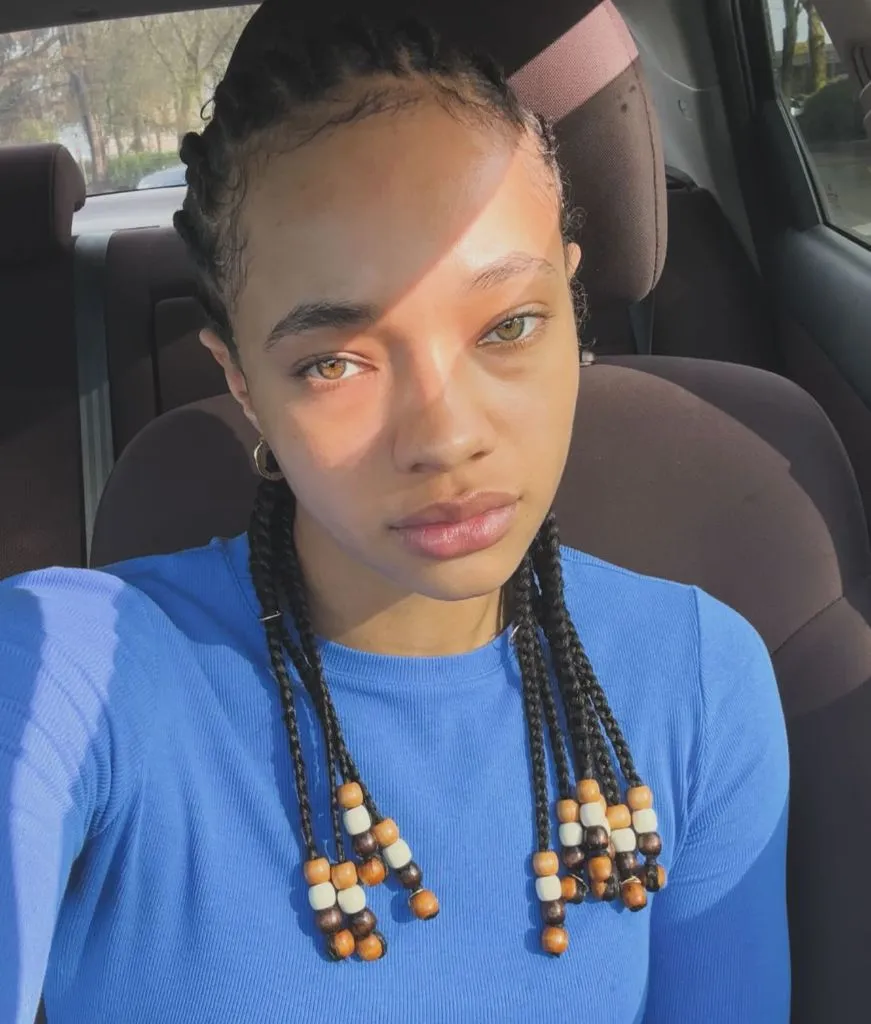
Photo via Instagram
The beads transform the silhouette entirely. Without them, the braids would end cleanly and quietly, but the wooden clusters add both weight and visual punctuation at each tip. The natural tones of the beads echo the warm undertones in the skin and the gold of the earring, creating a tonal family that holds together without being overly matched. The moderate length keeps the look contained, and the beads provide the same kind of finishing detail that well-chosen hair accessories often bring to simpler styles. The blue top adds a cooler interruption that prevents the warm palette from becoming monotone.
What stands out most is the proportional balance between the braids and the beads. The beads are large enough to register as a deliberate choice but not so heavy that they dominate the frame. Each cluster reads as a small sculptural accent, and the variation in bead color — cream against brown against dark wood — adds a subtle rhythm that keeps the endings interesting rather than uniform.
5. Fine Knotless Braids Falling Straight and Long
Fine knotless braids fall straight from neat parts across the crown, hanging past the shoulders in a smooth, even curtain. The braids are uniform in thickness and sit close to the head through the root section before hanging freely. The person wears a white tee and a gold chain necklace, and the image is taken from slightly below, framing the braids against a car interior. The overall look is clean, minimal, and unadorned.
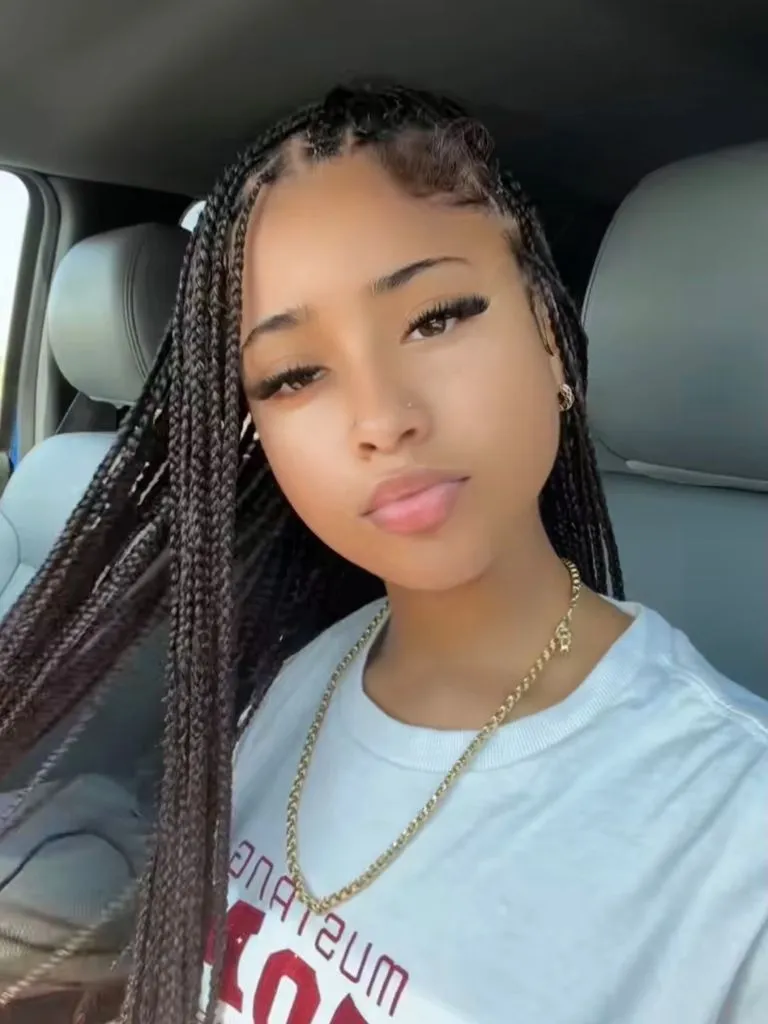
Photo via Instagram
The simplicity here is the design. With no curls, beads, or color variation, the style depends entirely on the uniformity and neatness of the braids themselves. The fine width gives the look a soft, fluid quality — the braids move as a group rather than as individual heavy strands. The gold chain adds just enough shine to anchor the neckline without competing with the hair, and the white tee keeps everything low-contrast and quiet. The straight hang emphasizes length and carries the eye downward in a single, uninterrupted direction.
The best move here is recognizing that fine braids in a single tone create their impact through consistency rather than variety. When every braid matches in width and tension, the overall silhouette reads as considered and intentional. That kind of minimal approach to braided protective styles works because the discipline of the installation becomes the statement, and the absence of embellishment feels like a deliberate choice rather than an oversight.
6. Highlighted Sew-In With Layered Body Waves
Long, body-waved hair falls past the shoulders in layered, sweeping sections. The base color is a deep chocolate brown with visible honey and caramel highlights concentrated through the mid-lengths and face-framing pieces. The hair has a glossy finish with soft movement through the ends. The person wears glasses with translucent frames and a dark graphic tee. A sign reading “The Hair Healer By Heaven” is partially visible on the wall behind.
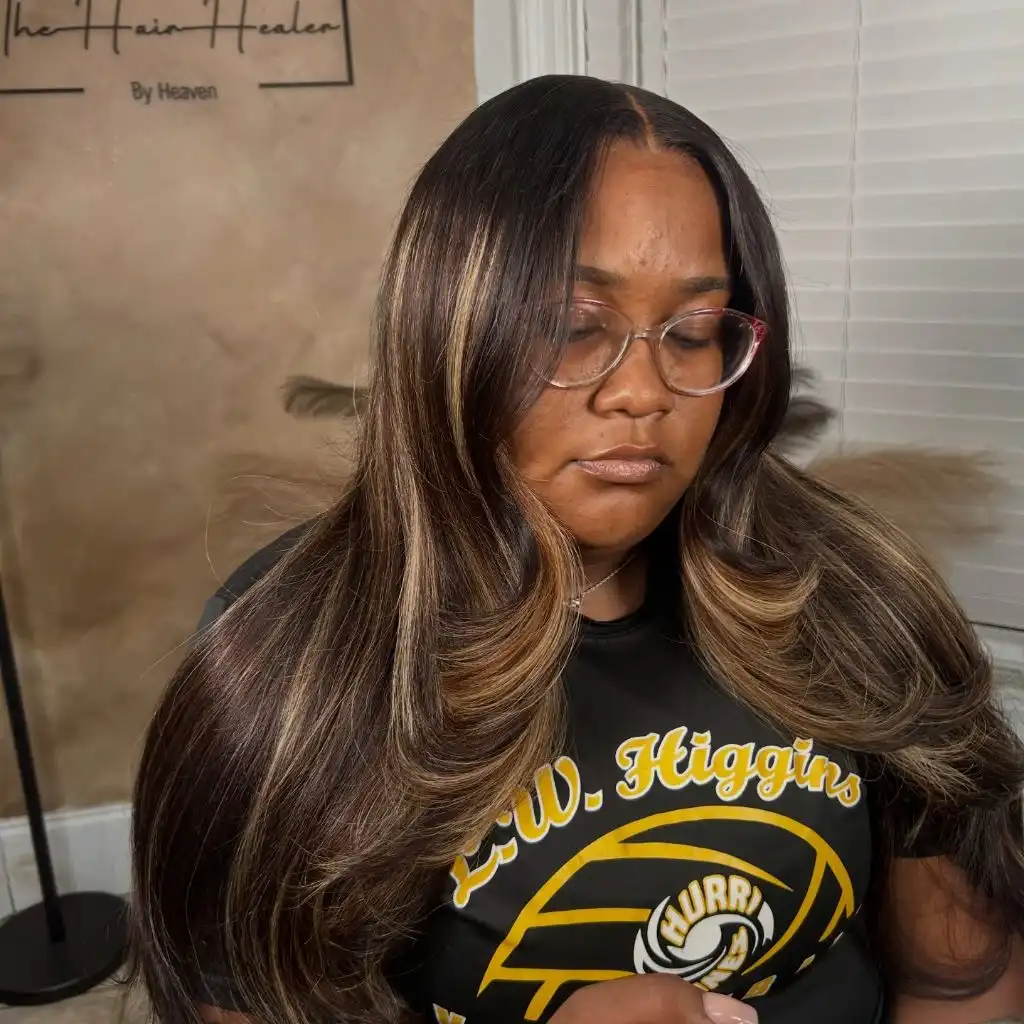
Photo via Instagram
The highlight placement does the architectural work. The lightest pieces sit around the face and through the mid-lengths, which means every time the waves curve, the highlighted sections catch light differently from the darker base. That creates depth and dimension without the hair appearing overly processed. The layered ends add movement — they flip and curve outward rather than hanging flat — which amplifies the color variation. The translucent glasses bring a soft, warm accent near the face that mirrors the honey tones without matching them exactly.
The useful idea is that highlights in waved hair function differently from highlights in straight hair. The wave pattern creates peaks and valleys where light gathers or recedes, making even a few strategically placed lighter pieces feel like a full transformation. Placing the strongest contrast near the face ensures the effect reads even in low light, and this approach to color and texture pairing gives volume the appearance of being even more pronounced than it is.
7. Two-Tone Passion Twists With Warm Brown Tips
The hair is styled in medium passion twists that start at the scalp with a dark brown base and transition into a warmer, reddish-brown tone through the lower half. The twists have a slightly textured, imperfect curl pattern that gives them a soft, lived-in quality. The person is smiling in a car selfie, wearing a beige ribbed mock-neck top, silver hoop earrings, and white nail polish. The twists fall past the shoulders.
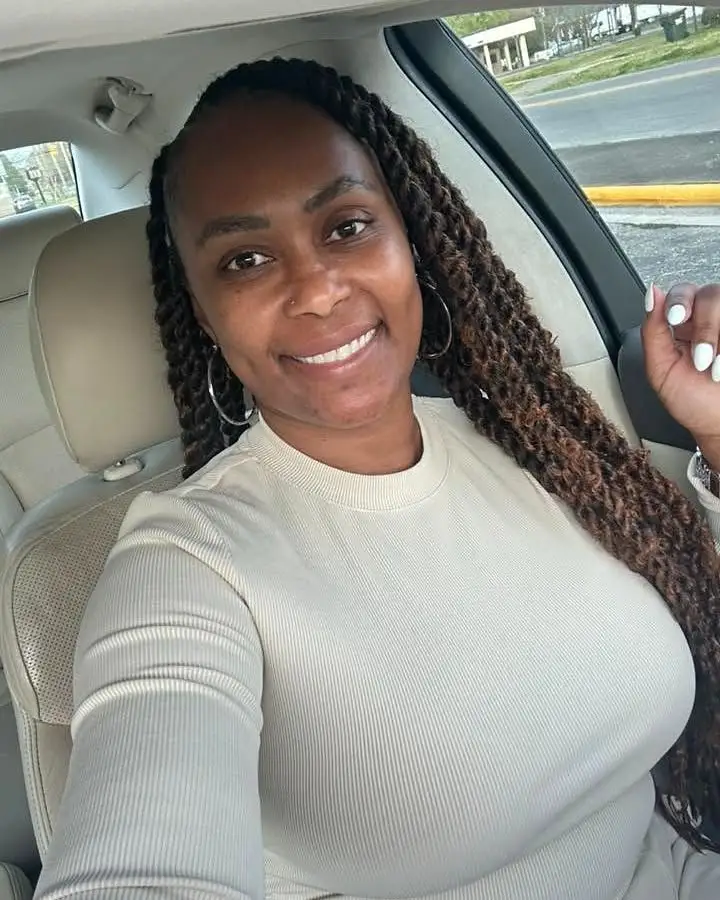
Photo via Instagram
The two-tone effect works because the shift is gradual rather than abrupt. The dark roots provide a grounding point while the warmer tips introduce a sense of lightness and movement at the ends. The textured twist pattern catches both tones at once along each individual twist, so the color appears woven through rather than painted on. The beige top sits in the same warm family as the lighter hair tones, and the silver hoops provide a small cool-metal interruption that keeps the overall warmth from becoming flat.
The reader takeaway is that passion twists carry color differently from smooth braids. Because the twist texture creates tiny peaks and shadows along each strand, color variation appears more complex and organic than it would in a sleeker style. The principle is straightforward: textured styles amplify subtle color shifts, so even a modest two-tone blend can deliver significant depth when the base technique already has built-in dimension.
8. Blonde Boho Braids With Curly Fringe Pieces
Small braids start from defined parts across the scalp and transition into blonde curly extensions that frame the face and cascade over both shoulders. The color is a golden blonde that darkens slightly at the roots where the natural hair begins. Curly fringe pieces at the front are left loose, blending with the braids. The person wears a blue-grey fuzzy sweater and a small colorful earring. The overall texture is soft and voluminous.
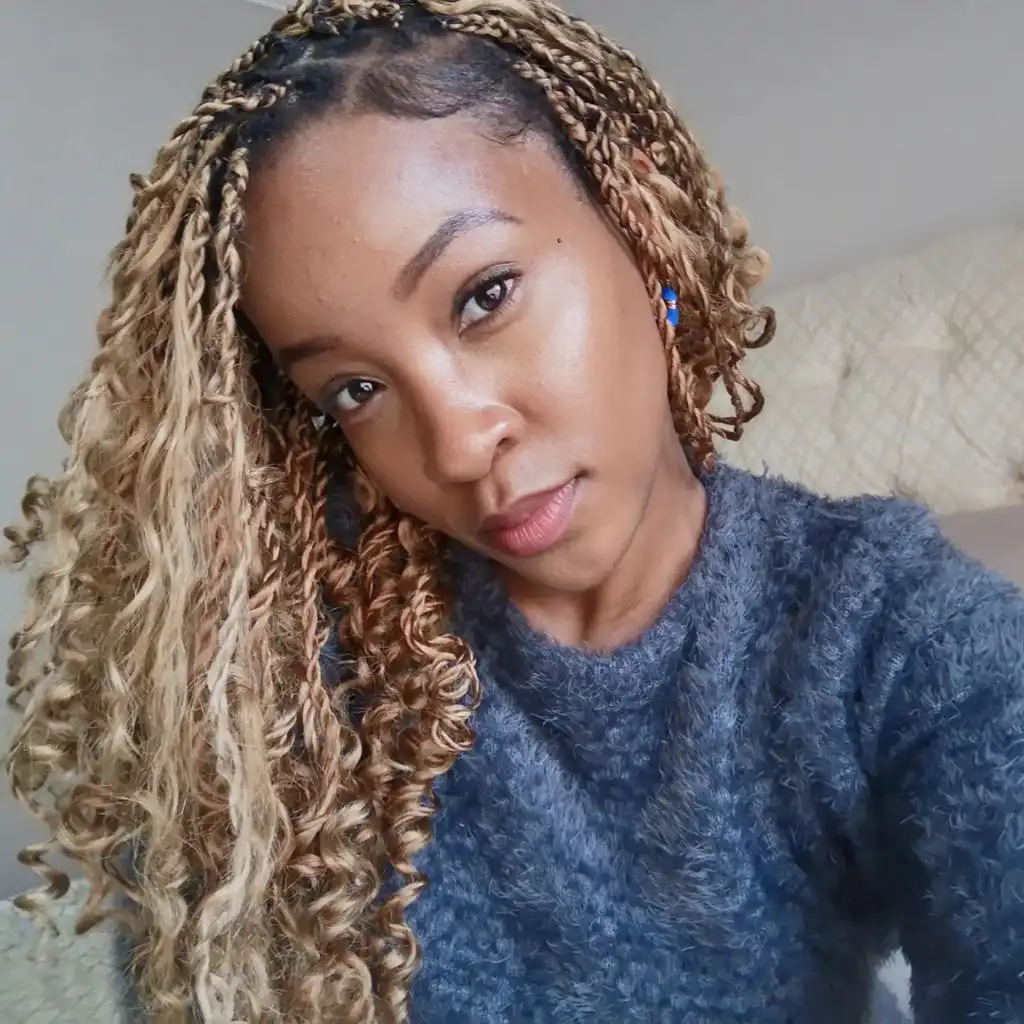
Photo via Instagram
The loose face-framing curls are the critical detail. They soften the transition between braids and skin, creating a halo effect that blurs the hairline rather than defining it sharply. The golden blonde color reads as warm and sun-touched, and because the curls vary in size and direction, they generate more visual texture than the braids alone would provide. The blue sweater creates a complementary contrast — warm gold against cool blue — that makes the hair color appear even richer. This kind of boho braid styling gets its personality from the imperfection of the curly pieces rather than the precision of the parts.
The beauty of this is that the loose pieces at the front do more work than any single structural element in the braids. They break the boundary between styled and unstyled, which gives the whole look an effortless quality. The takeaway principle is that a few deliberately unbraided sections near the face can transform a structured protective style into something that reads as relaxed and organic.
9. Large Feed-In Braids With Gold Cuffs and Wrapped Accents
Large feed-in braids radiate from the crown in a sunburst pattern, with gold braid cuffs placed at intervals along several strands and X-shaped gold thread wrapping visible on others. The braids are long and hang past the shoulders, with the person’s hand partially covering the face to show blue and pink nail polish. The outfit is a black long-sleeve top, and the background is plain white. The braids are uniformly dark with no color variation in the hair itself.
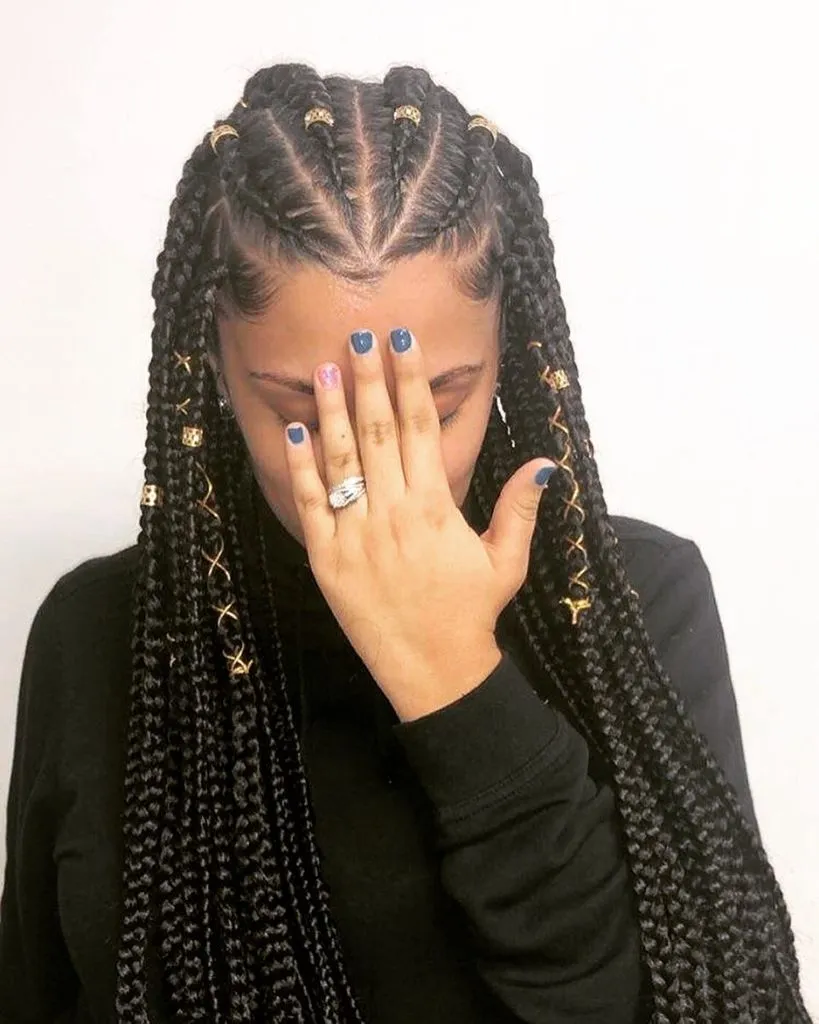
Photo via Instagram
The accessories do the talking here. The braids themselves are structurally simple — large, clean, and uniformly black — but the gold cuffs and thread wraps introduce metallic interruptions along the length that draw the eye from root to tip. The gold sits against the dark hair with high contrast, and because the cuffs are placed at slightly irregular intervals rather than perfectly spaced, they feel intentional without looking rigid. The nail polish adds an unexpected secondary color note — blue and pink against all the black and gold — that reads as a personal accent rather than a coordinated choice.
The strongest lesson is that hardware on braids functions like jewelry on an outfit. It introduces a second material — metal against fiber — and that material contrast creates visual interest where there might otherwise be uniformity. The principle is to place accessories where they will catch movement, since cuffs near the mid-length swing and flash as the braids shift, giving static hair a kinetic quality.
10. Shoulder-Length Knotless Braids With Curly Auburn Ends
Medium knotless braids are parted in neat squares across the crown and hang to shoulder length, where they transition into defined curls at the tips. The base tone is a warm dark brown, and the curly ends carry auburn and reddish-copper highlights that catch the light. The person wears a cream-white ribbed top and looks directly at the camera. The braids frame the face symmetrically, and the curls add softness around the jawline and shoulders.
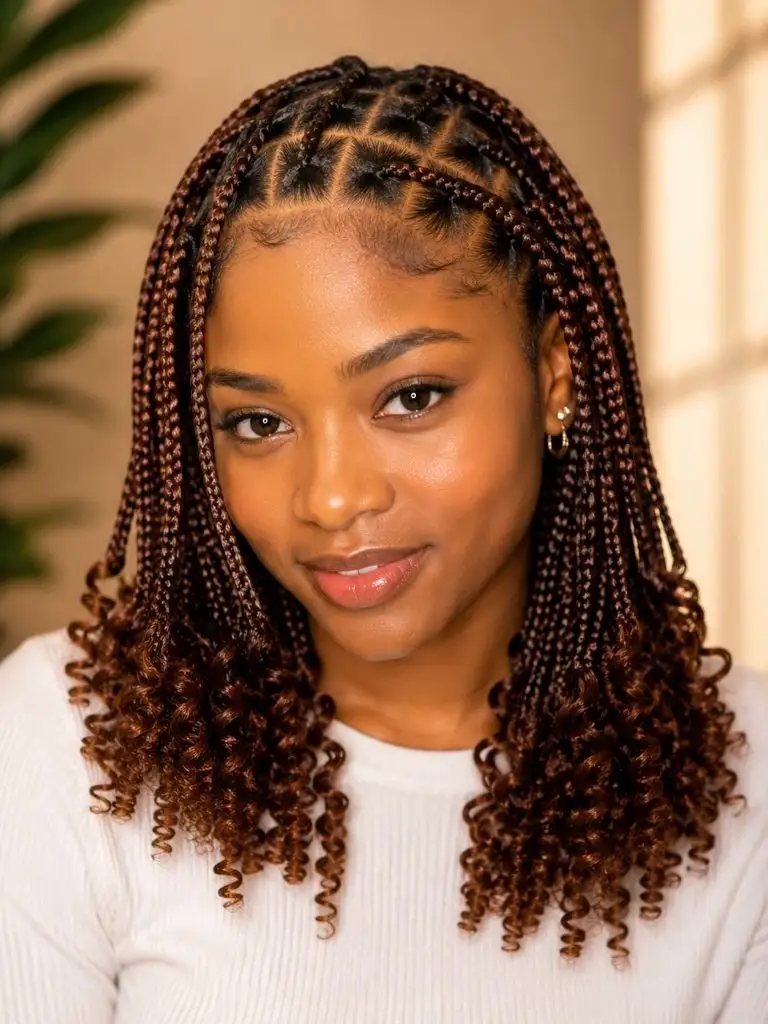
Photo via Instagram
The length is the smart variable here. At shoulder length, the braids sit close to the face without overwhelming it, and the curly ends provide a border of texture that softens the overall shape. The auburn tone in the curls introduces warmth exactly where the eye naturally rests — at the frame line near the jawline and collarbone. The square parts across the crown provide geometric contrast against the organic curl pattern below. This balance between structured braiding and soft finishing creates a silhouette that reads as polished without being rigid.
What stands out most is the proportion between braid length and curl volume. The braids are short enough that the curls account for a significant portion of the total length, which means the texture change happens early and dominates the visual impression. The principle is that shorter braids give more relative weight to the finishing detail — whether that is curls, beads, or color — making the ending the focal point rather than the midsection.
11. Waist-Length Boho Knotless Braids With Loose Wave Ends
Long knotless braids extend past the waist, with the lower third transitioning into loose, flowing waves. The braids are medium-width and uniformly dark, parted in clean lines across the scalp. The person wears a light grey hoodie and jeans, standing in front of sheer curtains. The waves add width and softness at the bottom of the silhouette, creating a tapered-to-wide shape from crown to hem. The overall tone is monochromatic — dark hair against light neutral clothing.
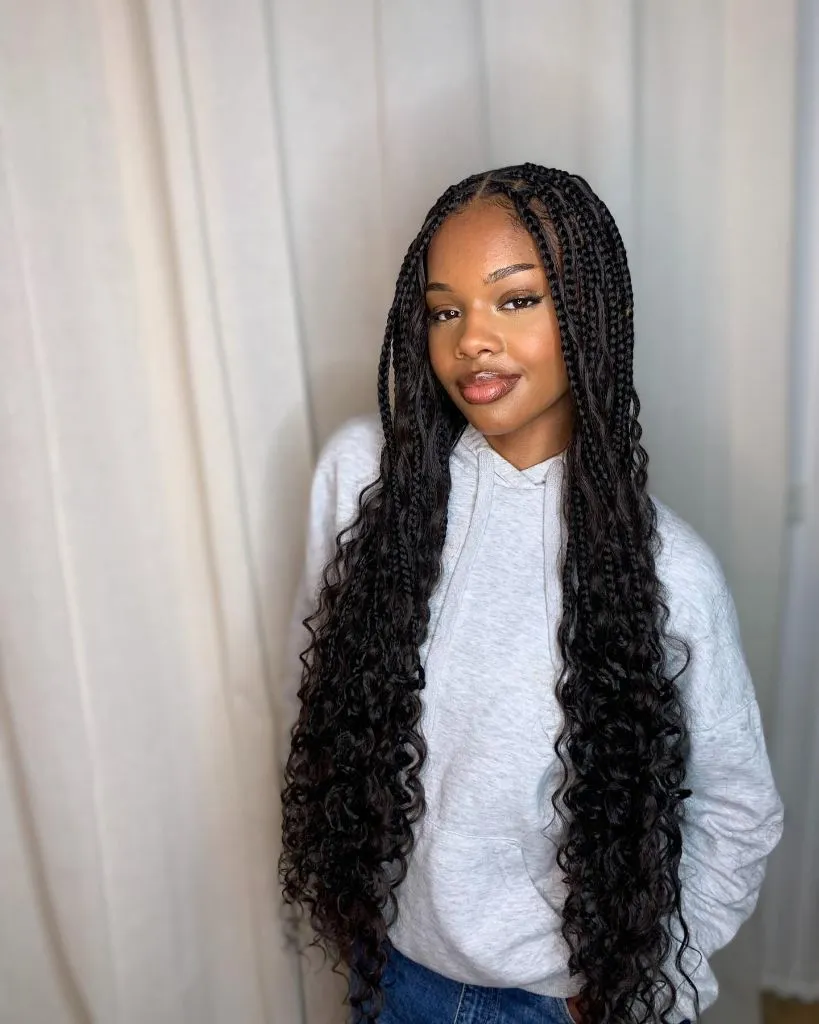
Photo via Instagram
Length creates its own proportional statement here. The braids are long enough that the body becomes part of the frame — the hair occupies the same vertical space as the torso. The wave transition at the lower third adds width exactly where the silhouette might otherwise taper to nothing, giving the style a bell-shaped ending that prevents the length from reading as thin or wispy. The monochromatic palette — dark hair, grey hoodie, neutral background — keeps the focus entirely on shape and movement rather than color. The way the braids catch the soft light through sheer fabric adds dimension without any overt styling.
The useful move here is understanding how finishing texture affects perceived length. Waves at the ends create the impression of even more length than straight-hanging braids would, because the width they add draws the eye laterally before it exits the frame. The transferable principle is that the shape of the ending — whether wavy, curled, or blunt — changes how the entire length of a style is perceived, even when the actual measurement stays the same.
12. Zigzag Cornrow Pattern With Curly Hanging Ends
A complex pattern of cornrows covers the scalp in alternating straight and zigzag lines, transitioning into individual braids and curly extensions at the back. The braids hang to mid-back length with textured, curly tips. The person is seen from a side-top angle, wearing a white top with a gold chain necklace visible. The parting pattern creates a geometric design across the crown that is distinct from standard straight-back cornrows.
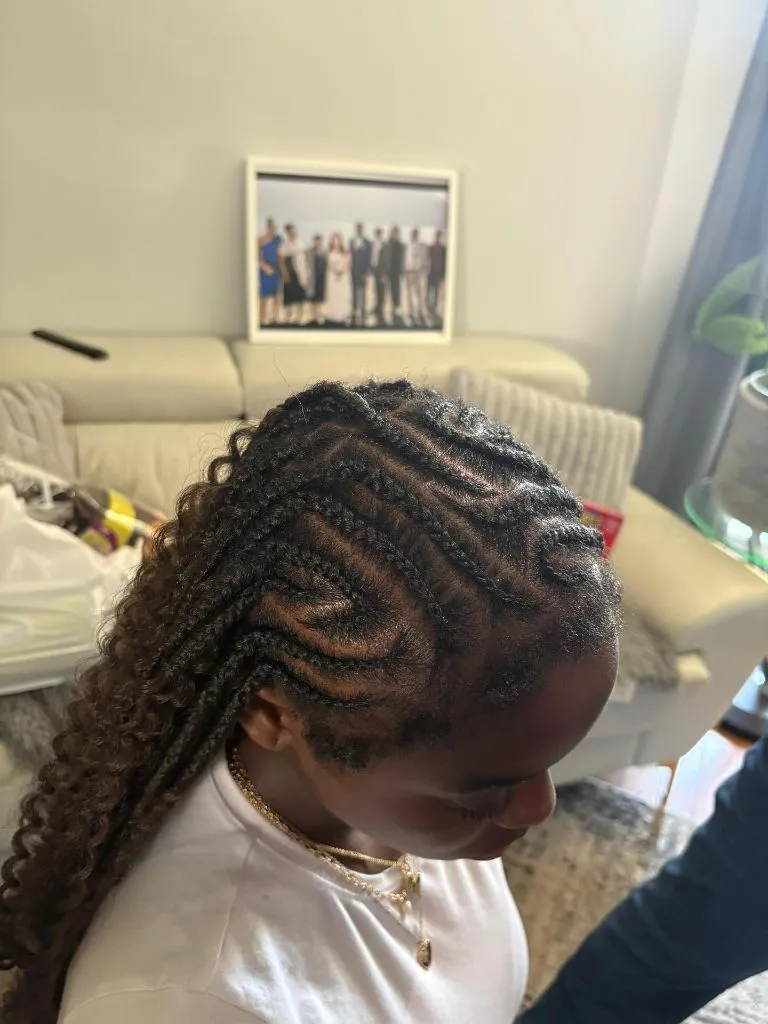
Photo via Instagram
I like how the parting pattern becomes the centerpiece rather than the braids themselves. The zigzag lines across the scalp create a rhythm of angles and curves that turns the head into a canvas — the visible skin between rows is as much a part of the design as the cornrows. The curly hanging ends provide textural release after all that precision, and the shift from tight geometric roots to loose organic tips creates the same kind of tension-to-relaxation arc visible in many of the most compelling cornrow-based protective styles. The gold chain at the neck sits quietly below without competing with the scalp design above.
The best move here is recognizing that the parting pattern is itself a design decision, not merely a structural necessity. Zigzag parts add a second layer of visual information on top of the braids, and because they are visible from above and from the sides, they give the style a three-dimensional quality that straight parts do not. The principle is that the spaces between braids deserve as much creative attention as the braids themselves.
13. Copper Ombre Micro Braids With Curled Tips
Small micro braids are installed across the scalp in straight-back parts, with the color transitioning from a dark base near the roots to a warm copper and auburn ombre through the lengths. The braids hang past the mid-back and end in small curled tips. The image shows the back view, with the person seated in a wooden chair wearing a dark top. The density of the braids creates a heavy, curtain-like silhouette, and the copper tone intensifies toward the bottom.
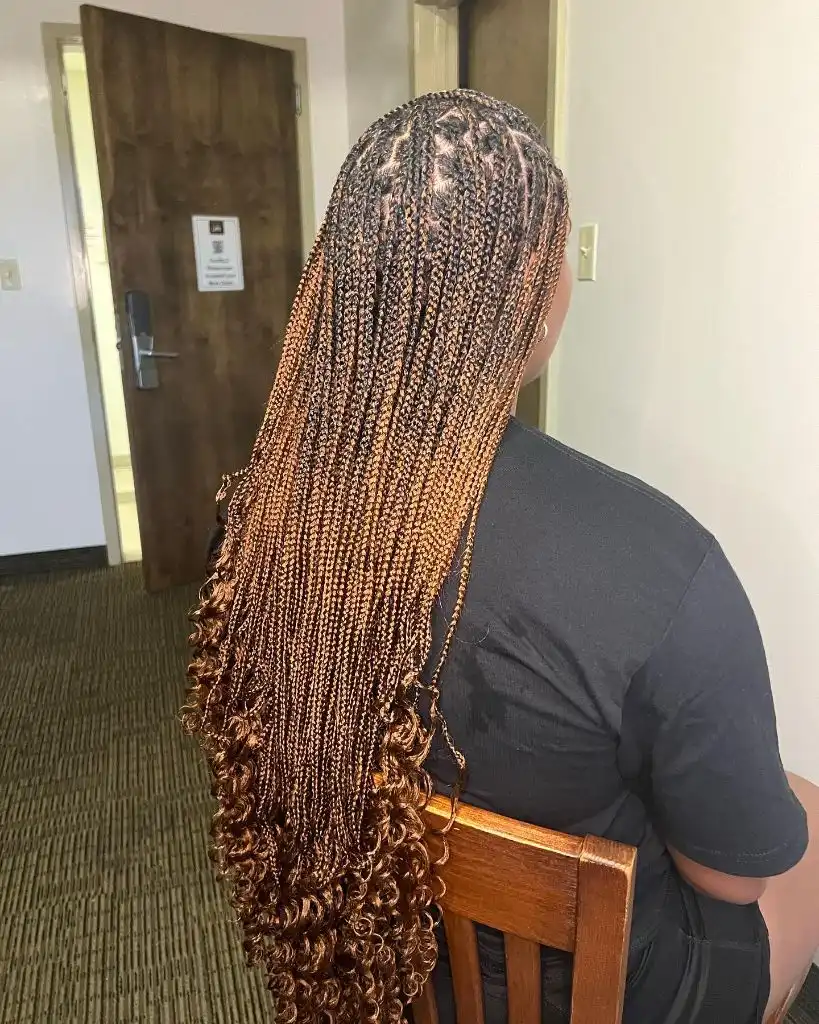
Photo via Instagram
The ombre reads as a gradient of light itself. The dark roots absorb attention at the top, and the copper sections glow more intensely as they descend, so the eye is pulled naturally downward through the length of the hair. Micro braids amplify this effect because each individual braid carries its own sliver of the color transition, and the sheer number of strands means the gradient appears smooth and continuous rather than streaky. The curled tips add a soft finish that prevents the heavy, dense silhouette from ending abruptly, giving the bottom edge a dissolving quality.
The reader takeaway is that ombre gains dimension in direct proportion to the number of strands carrying it. Micro braids break the color transition into dozens of parallel channels, and each one catches light at a slightly different angle, making the gradient appear richer than it would in thicker braids or in loose hair. The principle is that fine braids and color gradients work together as a system — the technique amplifies the color and the color rewards the technique.
14. Deep Side Part With Curly Lace Front
The hair sits in a deep side part with dense, tight curls falling to one side of the face and just past the shoulder on the other. The curls are uniformly dark black with a glossy finish, and the parting appears clean with a natural-looking hairline. The person wears a leopard-print off-shoulder top with black spaghetti straps and a small cross pendant necklace. The curls are voluminous and well-defined, with a consistent curl pattern throughout.
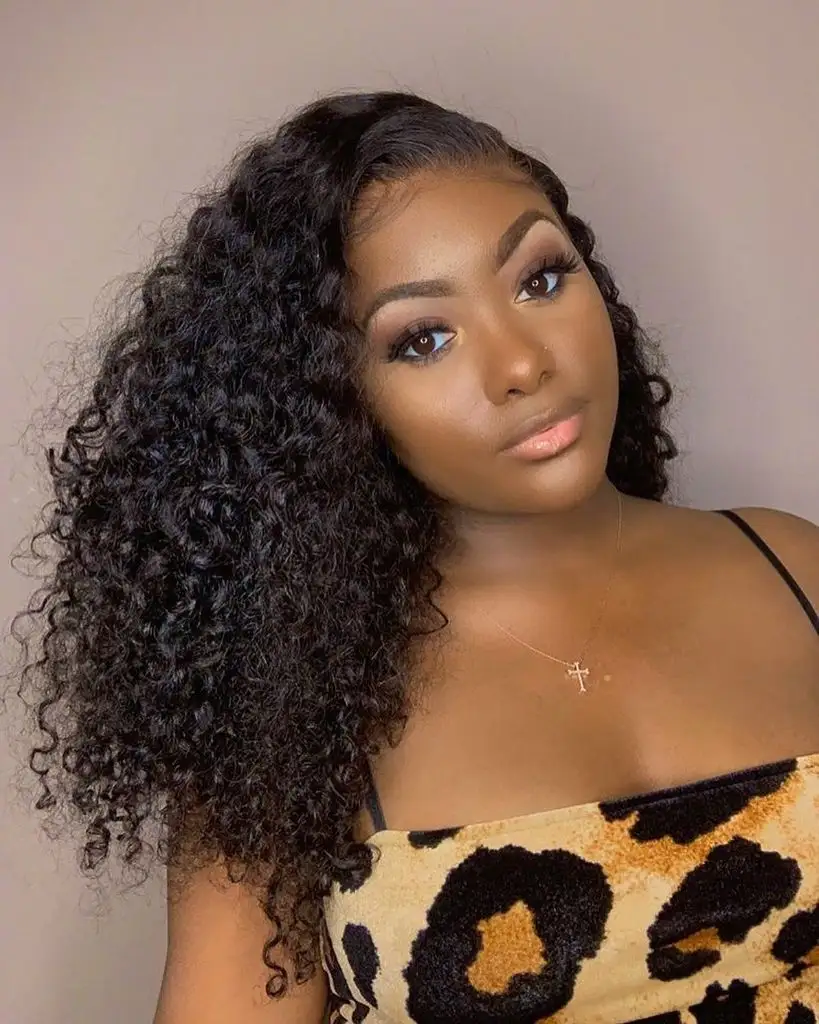
Photo via Instagram
The asymmetry created by the deep side part is the structural anchor. Most of the curl volume falls to one side, which creates a visual weight imbalance that feels dramatic without being unruly. The glossy finish on the curls catches light along every ridge and valley, adding brightness to the all-black color. The leopard print of the top introduces pattern and movement below the hair, but because the hair itself is unpatterned and monochrome, the two textures coexist without competing. The cross pendant provides a small vertical element at center chest that reads as a quiet focal point beneath the hair.
The useful idea is that a deep side part does the same work as asymmetric tailoring — it introduces imbalance that the eye finds interesting. When paired with uniform curl definition and a single consistent color tone, the asymmetry becomes the primary design gesture. The principle is that sometimes a single parting decision carries more visual weight than any combination of color, accessories, or length.
15. Vibrant Orange Curly Crochet Style
Short to medium-length curly crochet hair in a vivid orange-red tone frames the face, with darker roots visible at the base. The curls are tight and springy, creating a rounded, voluminous silhouette that sits above the shoulders. The person wears a royal blue blouse and a long gold necklace with small colorful pendants. Pink-toned eyeshadow complements the warm hair color. The background has a blue border that echoes the clothing.
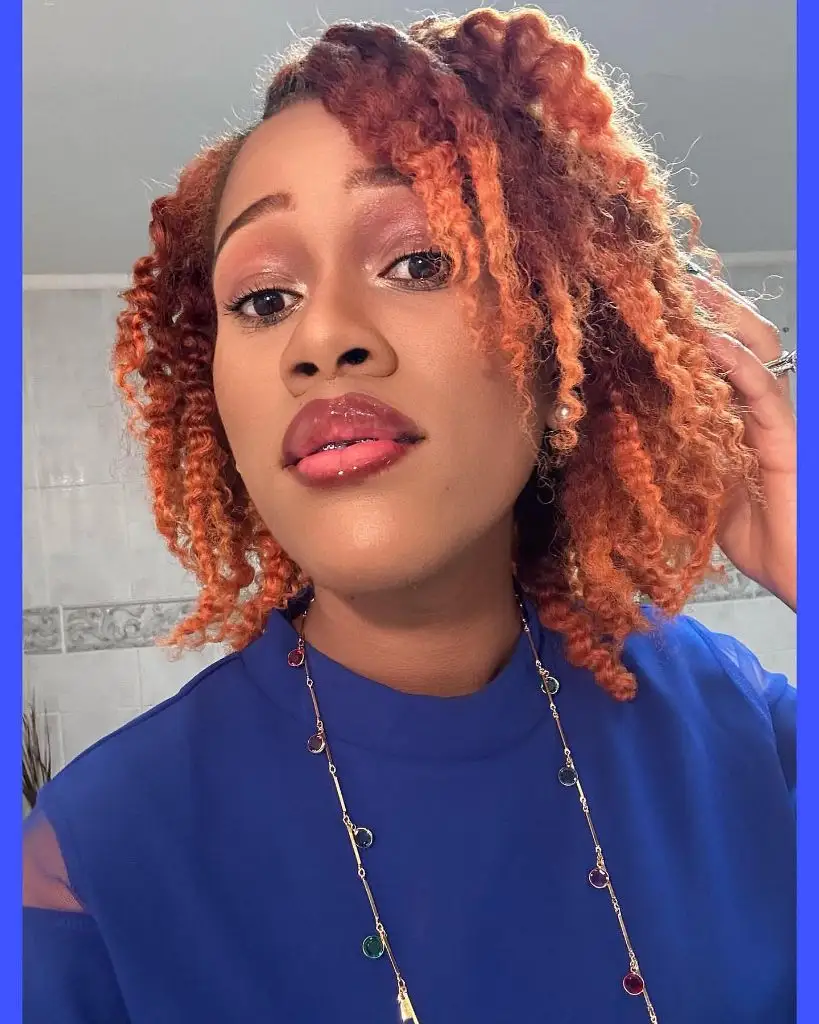
Photo via Instagram
Color contrast is doing all the heavy lifting. The orange hair against the blue top creates a complementary color pairing that is as bold as anything in these images, and the pink eyeshadow bridges the two by sitting in the warm family with the hair while being cool enough to acknowledge the blue below. The dark roots provide a grounding strip at the scalp that prevents the orange from floating free, and the rounded silhouette of the curls creates a soft frame around the face. The gold necklace with its small colored pendants adds a third layer of color that keeps the palette feeling intentional rather than chaotic.
The strongest lesson is that bold hair color works best when the rest of the palette responds to it. The blue top is not random — it is the complement that makes the orange appear more vivid. The principle is that choosing clothing and makeup tones in deliberate relationship to an unusual hair color turns a potentially isolated statement into a coordinated design decision where every element reinforces the others.
16. Small Cornrows Gathered Into a Top Bun
Small, tightly braided cornrows cover the scalp and gather upward into a compact bun at the crown. The braids are uniform in width and follow a front-to-back pattern. Small gold-colored rings are visible where the braids meet the bun. The person wears a black-and-white striped sleeveless top and a crystal stud earring. Baby hairs are slightly visible at the hairline, and the overall look is clean and structured with minimal accessories.
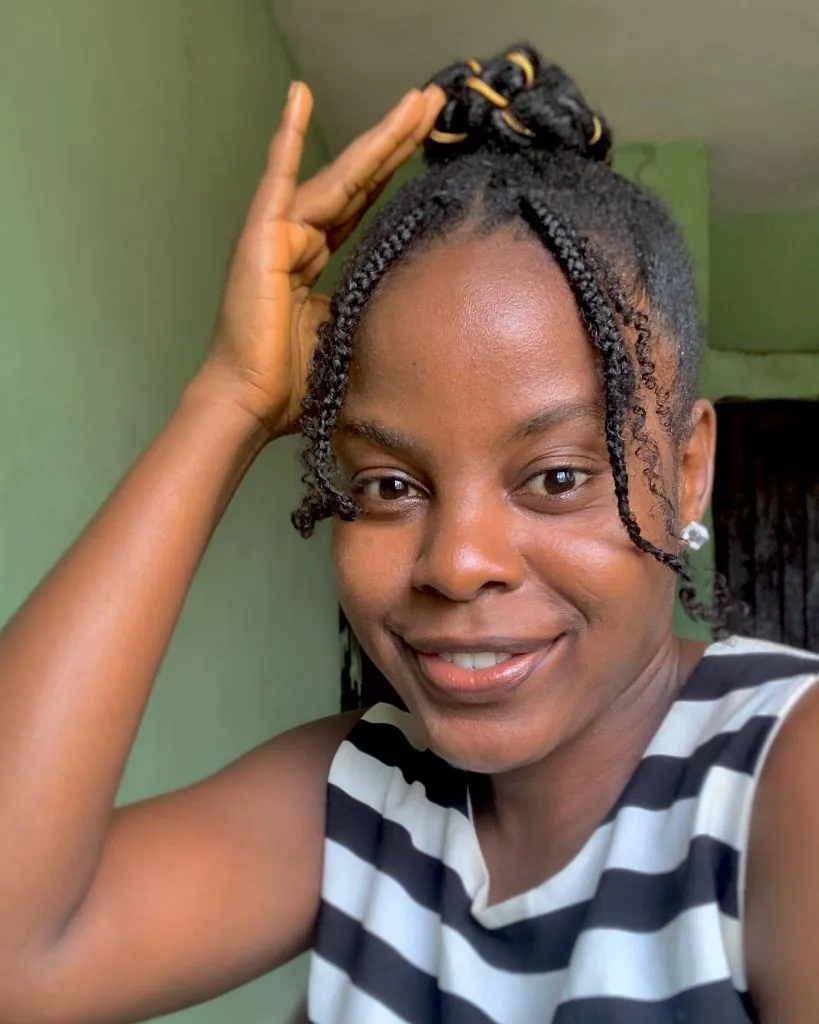
Photo via Instagram
The upward direction changes the entire relationship between the hair and the face. Where most styles in this collection pull the eye downward with length and hang, this one lifts everything to the crown, exposing the neck, ears, and jawline completely. The small gold rings at the bun junction act as tiny metallic accents that signal where the cornrows end and the gathered mass begins. The crystal earring picks up light from a different angle than the gold rings, creating a subtle material contrast — faceted stone against smooth metal. The striped top adds horizontal rhythm below all the vertical lines of the braids.
The beauty of this is that an updo changes the proportional rules entirely. When the hair is lifted, the face becomes the primary canvas and the hair becomes the frame’s upper boundary rather than its curtain. The principle is that the same cornrow technique reads completely differently depending on where the braids terminate — downward for drama and length, upward for openness and structure.
17. Long Boho Box Braids With Wavy Loose Ends
Long box braids extend well below the waist, with wavy and curly loose pieces emerging from between the braids and at the ends. The hair is entirely dark with no visible color variation. The person stands with their back to the camera in front of a green wall decorated with colorful letters and butterflies. The braids are medium-width, and the loose, wavy sections create a textured, bohemian silhouette that softens the overall density. A pink strap is visible at the shoulder.
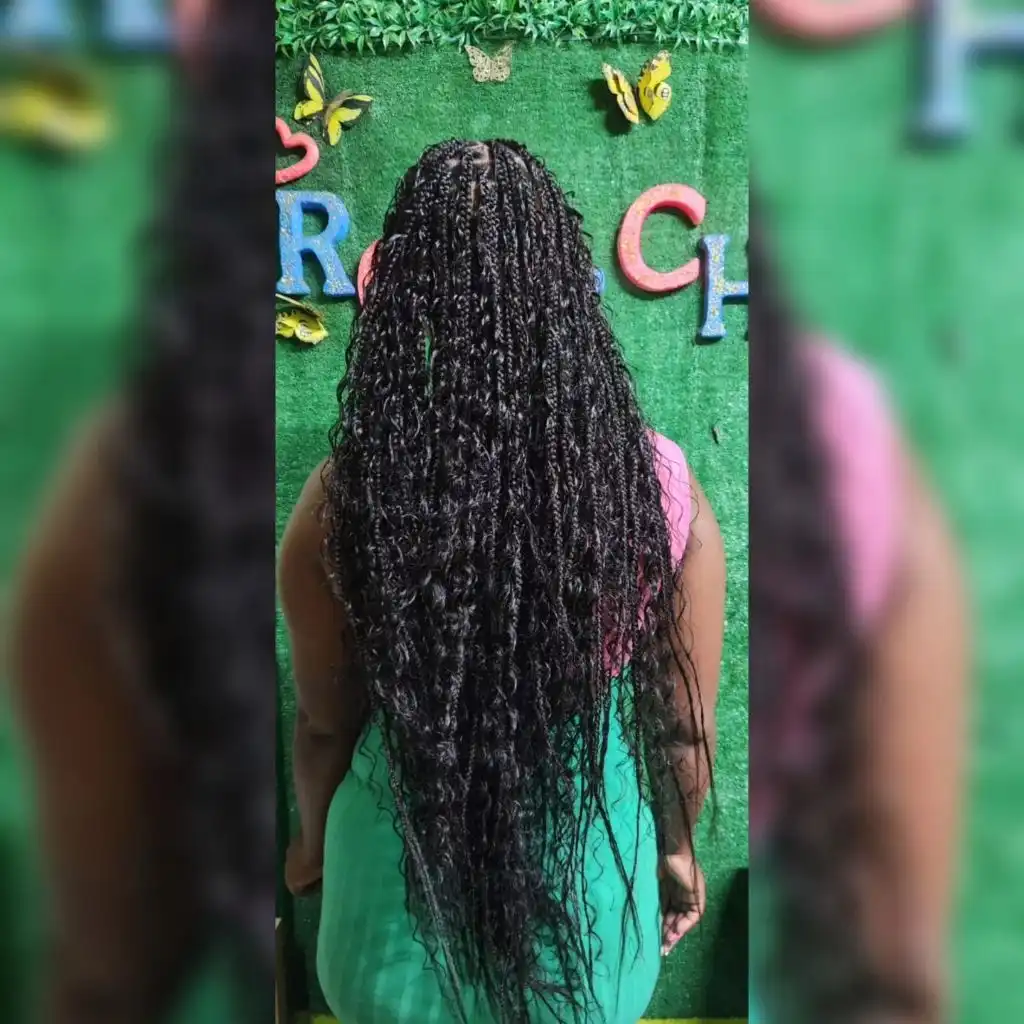
Photo via Instagram
The extreme length makes the loose, wavy pieces essential rather than decorative. Without them, braids at this length might read as heavy and uniform, but the wispy sections break up the visual density and introduce movement along the entire cascade. Seen from behind, the style creates a curtain effect where structured braids and unstructured waves coexist in the same vertical plane. The colorful background provides contrast that makes the dark hair pop, and the overall silhouette reads as relaxed and free-flowing despite the considerable technical work involved in the installation.
The useful move here is that boho-style loose pieces serve a structural purpose beyond aesthetics. They lighten the visual weight of dense braids by introducing air and negative space between strands. The principle is that very long styles benefit from textural variation — when the length itself is the statement, adding a second texture prevents uniformity from becoming monotony and keeps the eye engaged from root to tip.
18. Short Box Braids With Curly Ends at Shoulder Length
Short box braids sit at shoulder length or slightly above, with curly ends that create a bobbed silhouette. The braids are dark with a slightly shiny finish, and the curly tips add volume at the bottom edge. The image shows a back-and-side view with the person’s head slightly tilted. The person wears a grey top, and the background is a dimly lit bedroom. The overall shape is compact and rounded, distinct from the longer styles elsewhere in this collection.
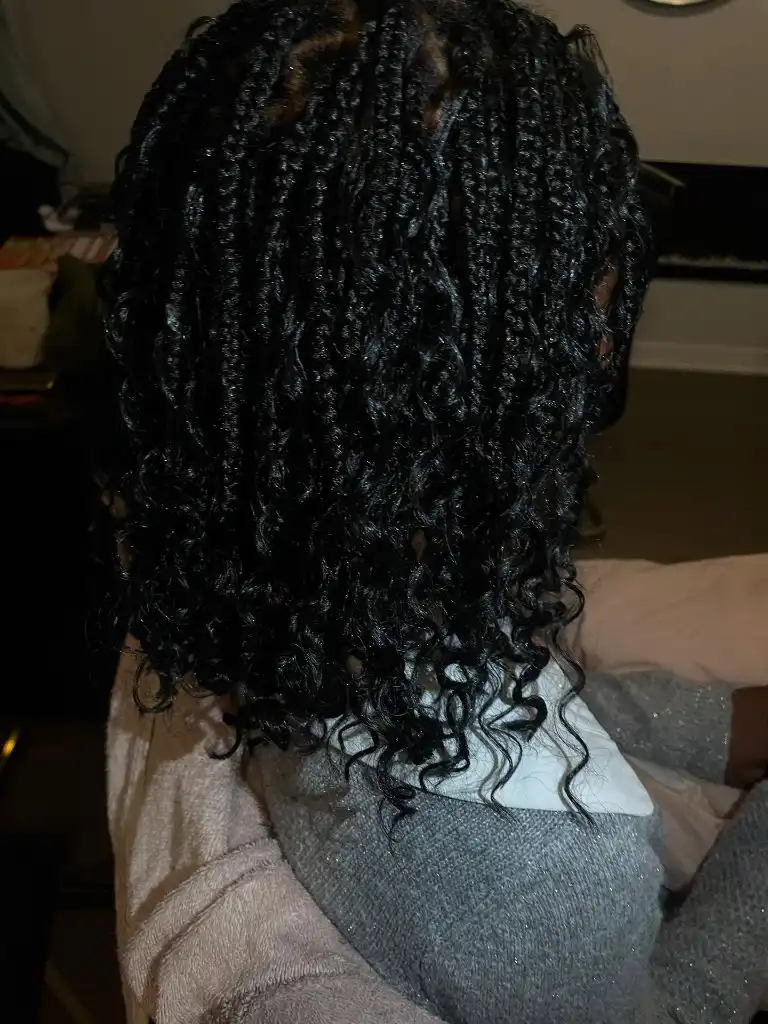
Photo via Instagram
The shortened length concentrates all the textural energy into a small zone. Where longer styles can distribute their curl transition across a foot or more of length, this bob puts the curly ends immediately adjacent to the braided sections, creating an abrupt but pleasing shift from straight to curly in a compressed space. The result is a shape that has the neatness of a structured bob at the top and the softness of natural curl at the bottom. The compact silhouette keeps the focus tight and close to the head, and the dark monotone color lets shape take priority over everything else.
The reader takeaway is that short protective styles carry their proportional decisions more visibly than long ones. Every detail — the length of the braid before the curl begins, the tightness of the curl, the overall shape of the bob — has outsized impact because there is less length to absorb or dilute any single choice. The principle is that shorter styles demand more precise calibration of where texture changes occur, because the transition point defines the entire silhouette.
19. Silver-Grey Curly Bob With Volume
A short, voluminous curly bob in silver-grey sits above the shoulders with loose, defined curls that frame the face and neck. The curls are layered and have visible variation in curl size, creating an organic, dynamic shape. The person is shown from a three-quarter back view wearing a cream off-shoulder top. The color is a salt-and-pepper grey with lighter silver tones through the outer layers and slightly darker roots. The background is a clean, neutral grey.
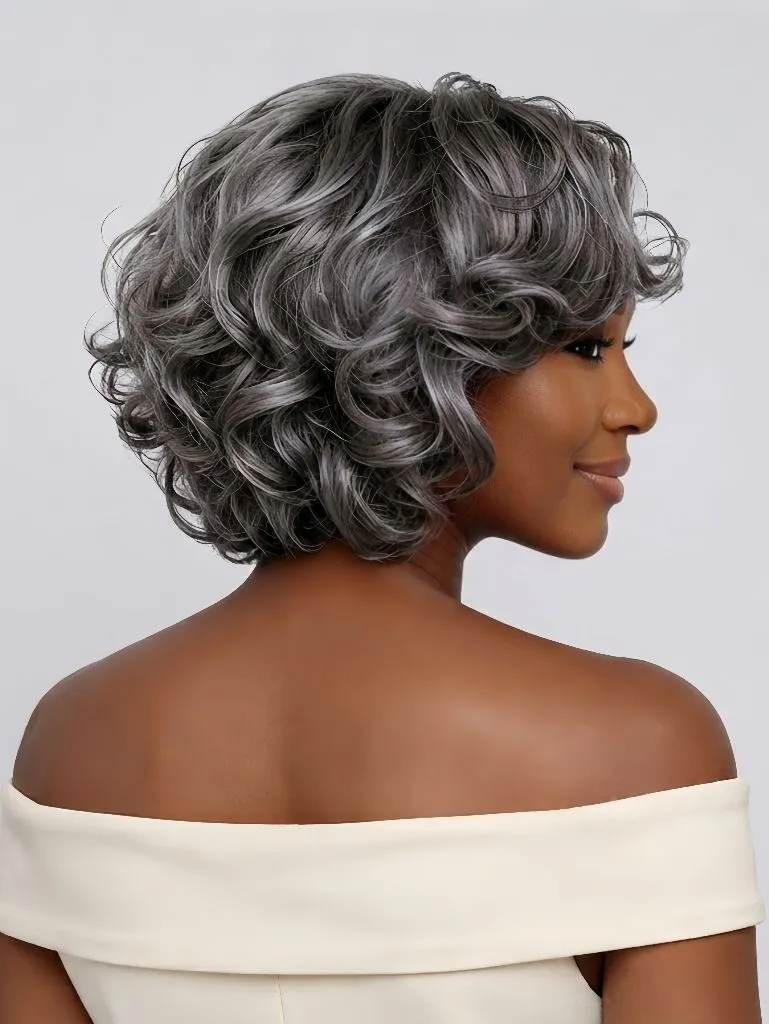
Photo via Instagram
The grey tone itself functions as a statement color here. Rather than reading as an absence of color, the silver carries its own cool luminosity that contrasts with the warm skin tone visible at the shoulders and neck. The curls vary in direction and tightness, which creates a textured surface that catches light unevenly — some curls gleam while others recede into shadow, giving the bob a three-dimensional quality. The layered structure of the curly cut adds height at the crown and width at the sides, creating a rounded shape that frames the face generously without extending past the shoulders.
What stands out most is how the silver tone changes the emotional register of the style. A curly bob in black or brown might read as playful or casual, but the silver gives it a sense of sophistication and intentionality. The principle is that color temperature — cool grey versus warm brown — can shift the entire character of a hairstyle without changing the cut, length, or texture, making color choice one of the most powerful variables in overall styling.
20. High Curly Ponytail With Natural Edges
The hair is pulled into a high ponytail with curly or wavy extensions creating volume and movement from the tie point downward. The natural hairline is visible, with baby hairs smoothed along the forehead. The image is a composite showing two angles — one from the back highlighting the curl pattern and one from the side showing the smooth slicked-back section and edge detail. The person wears a white tee, and the setting is a warm-toned bedroom. A claw clip or similar accessory secures the ponytail at the crown.
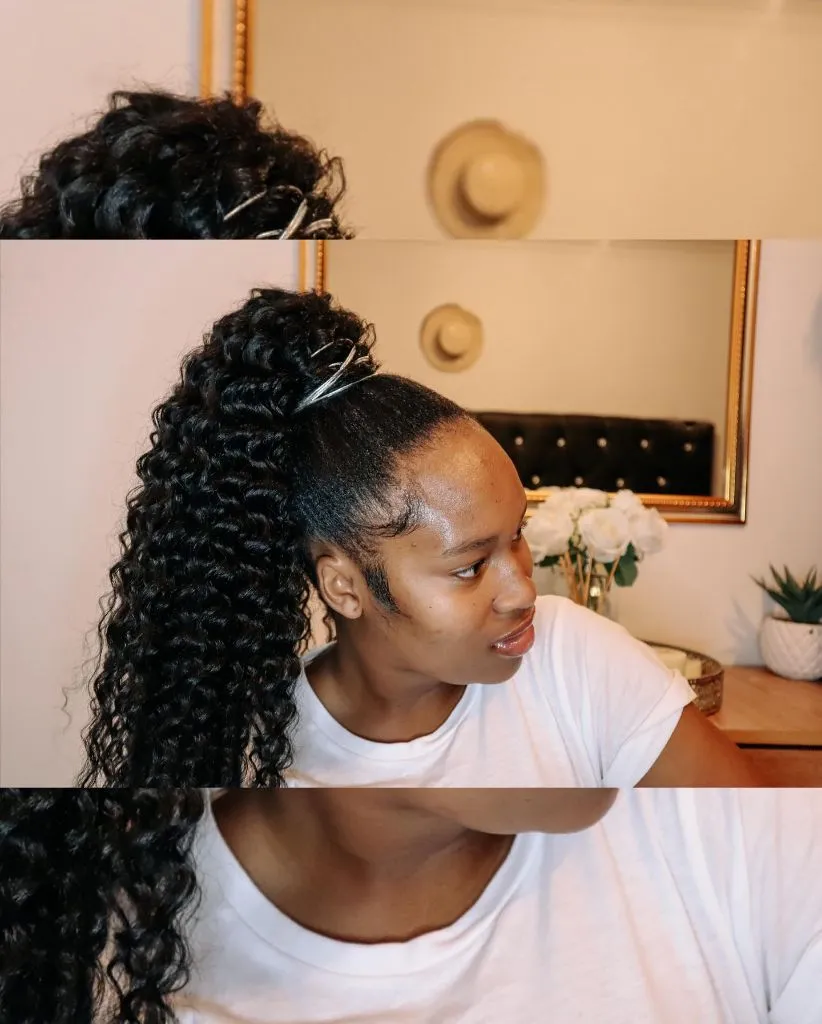
Photo via Instagram
The contrast between the slicked front and the voluminous back creates a before-and-after effect on the same head. The smooth, flat zone from hairline to crown acts as a runway that leads the eye upward and then releases it into the cascading curls above. The baby hairs at the forehead add a decorative detail to the transition point. The claw clip is functional but also visible enough to read as an accessory choice. The two-angle presentation makes the architectural nature of the style especially clear — this kind of ponytail relies on distinct texture zones to generate visual interest.
The best move here is the deliberate separation of the head into two contrasting zones. The smooth section provides sleekness and control while the ponytail delivers volume and organic movement. The transferable principle is that a high ponytail gains drama from maximizing the contrast between its slicked section and its textured section — the flatter and smoother the front, the more impactful the curly volume at the back appears.
21. Sleek Side-Swept Straightened Ponytail
Long, straightened hair is pulled into a smooth, high side ponytail that sweeps over one shoulder. The texture appears relaxed or straightened with a glossy, healthy sheen. The edges along the forehead are sleek and flat. The person wears a black lace-detailed sleeveless top and small gold hoop earrings, and is smiling directly at the camera. The background suggests an interior room with grey-toned furniture. The overall silhouette is long and narrow, with the hair reading as a single uninterrupted sheet.
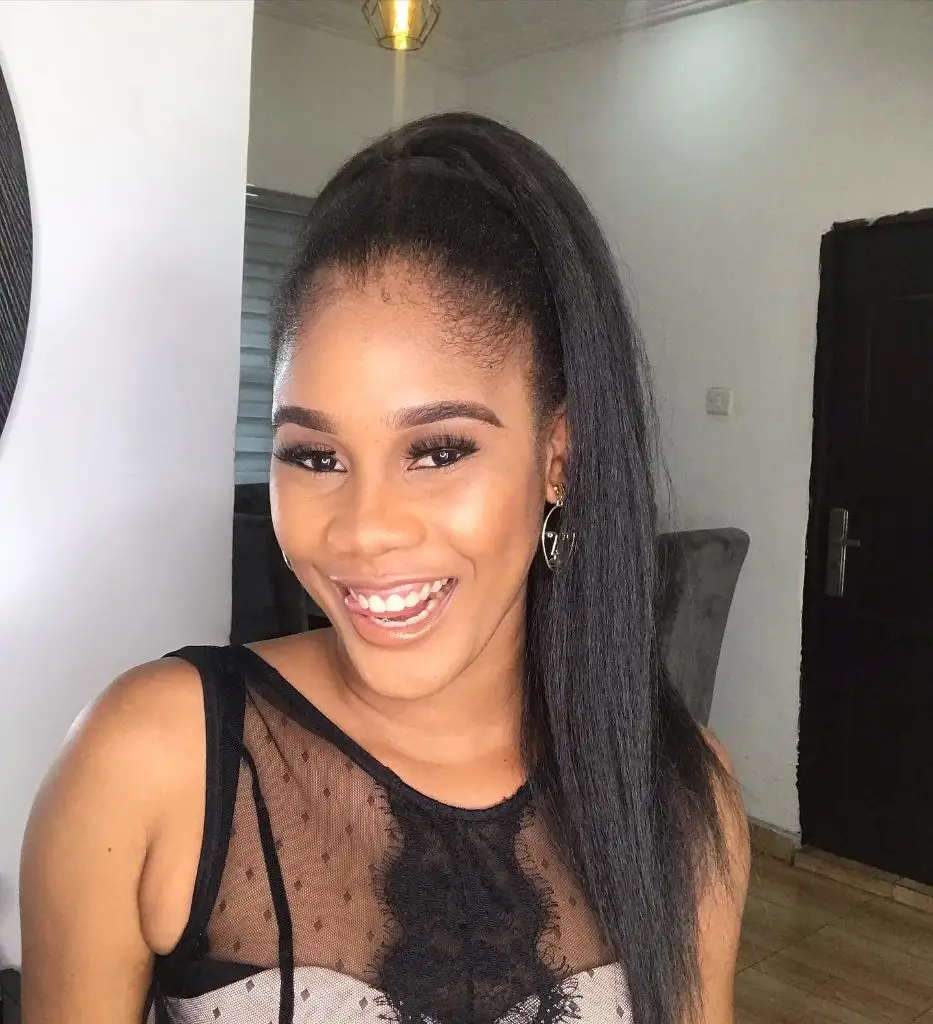
Photo via Instagram
The glossy finish is the dominant feature. Every surface of the hair reflects light in a continuous strip, giving the straightened texture an almost liquid quality. The side-swept direction means the hair falls over one shoulder and leaves the other exposed, which creates an asymmetry that adds visual interest to what might otherwise be a simple straight style. The black lace top introduces pattern and texture below the hair that contrasts with the hair’s smoothness. The small gold hoops are visible precisely because the swept hair clears the ear on one side, making them a framing accent rather than a hidden detail.
The useful idea is that straight, uninterrupted texture makes its statement through surface quality rather than shape or structure. When the hair has no curl, wave, or braid to break its surface, the shine, smoothness, and sweep become the only variables. The principle is that straightened styles demand attention to finish — the glossier and smoother the surface, the more intentional and polished the overall impression becomes.
22. High Natural Bun With Sculpted Edges
The hair is gathered into a high bun at the crown, with the natural texture visible in the bun’s rounded, slightly uneven shape. The edges along the forehead and temples are smoothed and sculpted into gentle curves. The person wears a black button-up shirt, small beaded hoop earrings, and a thin gold chain necklace. The skin has a glowing, dewy finish, and the eyes are closed or cast downward. The background is a soft blue-grey. The bun sits directly on top of the head, creating a vertical emphasis.
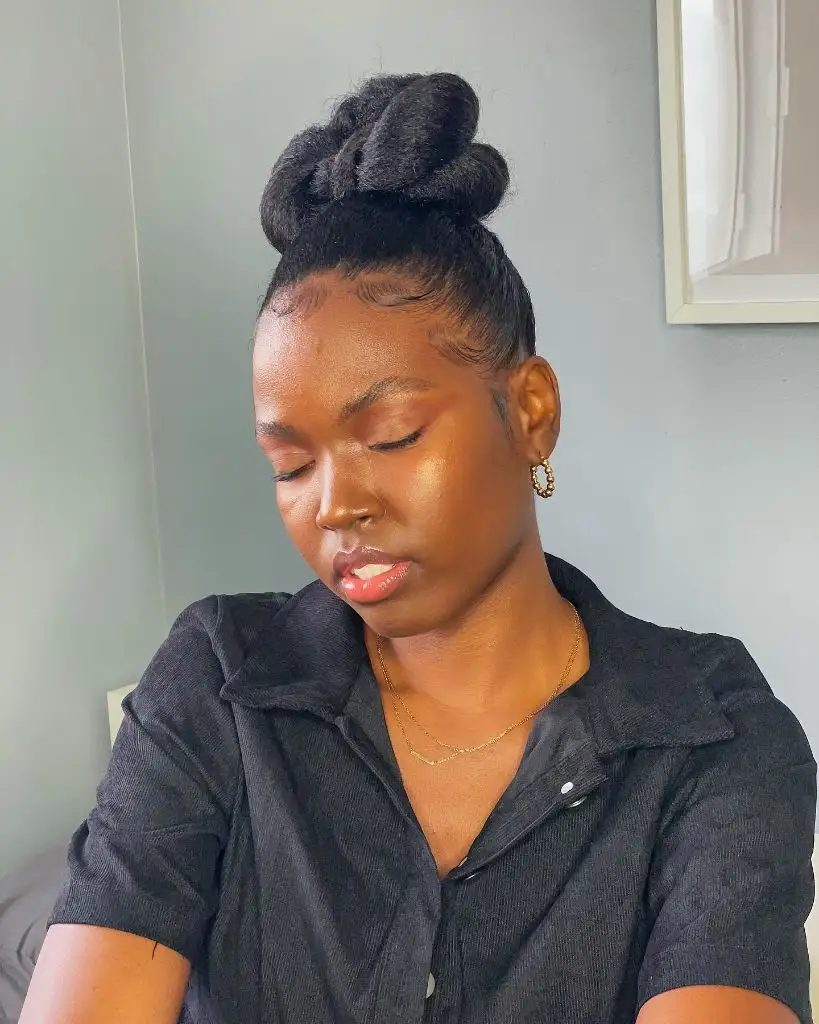
Photo via Instagram
The bun and the edges operate as two separate but connected design zones. The bun is organic, textured, and slightly irregular — it reads as natural hair gathered rather than shaped into a perfect sphere. The edges, by contrast, are controlled and deliberate, with smooth curves that follow the forehead and temple in a way that feels like calligraphy. Together, they create a tension between control and naturalness that gives the protective updo its character. The beaded hoop earrings add a small textural accent at the ear that echoes the organic quality of the bun without matching it literally. The black shirt and minimal jewelry keep the palette restrained, ensuring the hair and skin remain the primary surfaces.
The strongest lesson is that edge styling functions as its own art form within an updo. When the hair above is textured and natural, sculpted edges provide the precision that balances the whole composition. The principle is that the hairline zone — often an afterthought — becomes the finishing detail that signals intentionality, turning a simple high bun into a considered, complete style.

Hi, I’m Zoey Mitchell, the creator of ChicStyle Blog.
I share simple, wearable outfit ideas, hairstyles, nail trends, and beauty tips that feel natural and easy to recreate.
This blog is where I explore everything that makes a woman feel put together and confident every day. I’m not an expert — just a woman who genuinely loves style, mixing looks, and discovering what works.
If you love effortless fashion with a personal touch, you’ll feel at home here.