
Finding the right trendy winter business casual outfits often means choosing between warmth and a sharp silhouette, and most people end up sacrificing one for the other. The principle that solves this is proportion. A longer outer layer paired with a narrower lower half, or a structured shoulder balanced by a relaxed trouser, keeps the composition intact even when heavier fabrics enter the frame. The goal is visual weight distribution, not decoration.
Trendy winter business casual outfits become easier to build when you stop thinking in rigid formulas and start reading how each piece relates to the one beside it. Notice where volume sits, where color repeats, and where a single interruption changes the entire reading of a look. Compare the width of a lapel to the width of a trouser leg, or the darkness of a coat to the lightness of a shirt beneath it. These relationships do the work that trend lists never quite explain.
1. Gray Double-Breasted Blazer Cinched With Black Belt
A double-breasted blazer in medium gray sits over a white collared shirt and a narrow black tie, the whole upper half cinched at the waist by a slim black belt. The trousers are dark, wide enough to read as tailored but not oversized. A gold-toned watch and gold blazer buttons catch light against the muted palette. The shot is taken from a three-quarter front angle on a European-looking street with green window frames visible behind.
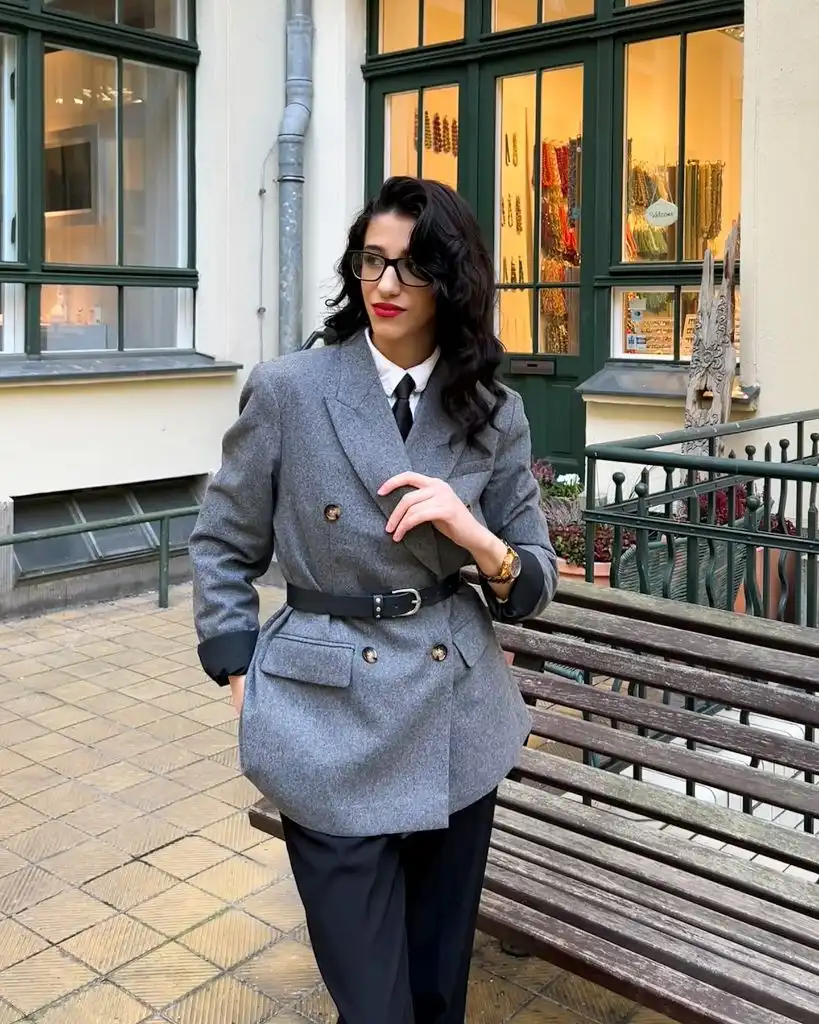
The belt is the organizing device here, creating a clear break between the structured upper body and the softer fall of the trousers. Without it, the blazer would read as a boxy rectangle. With it, the silhouette narrows at the center and then widens again below, producing an hourglass outline that gives the outfit readable shape. The gold buttons echo the watch, adding a second layer of repetition that ties small details together.
The strongest proportion here is the ratio between the belted waist and the shoulder width. If you pull this idea into your own closet, keep the belt slim and dark so it acts as a dividing line rather than a competing focal point. The tie adds vertical emphasis through the center, but it works because it shares the belt’s darkness and thinness.
2. All-Black Suit With Textured Top and Pointed Heels
An elongated black blazer with satin-looking lapels falls past the hips, layered over a textured-looking dark top and straight-leg black trousers cropped just above the ankle. Black pointed kitten heels with bow-like details finish the lower line. A small chain-strap bag with metallic-looking embellishment hangs from one hand. The frame is full-length, shot against pale stone architecture with warm overhead light.
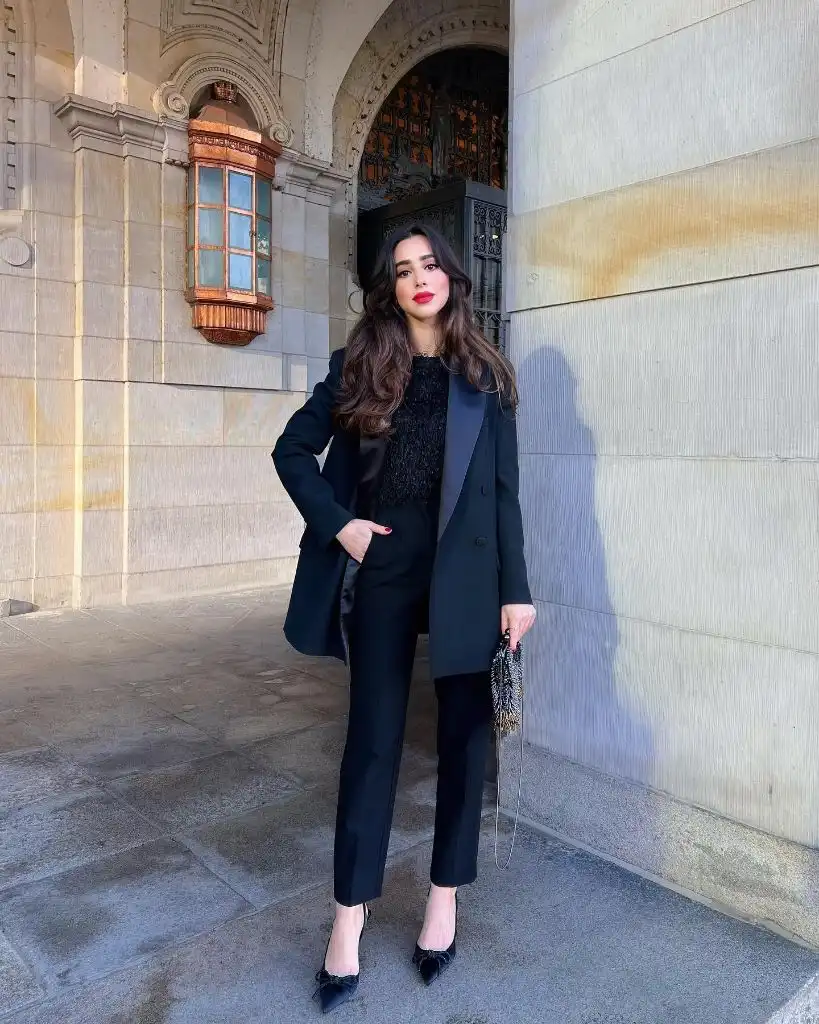
When every garment shares the same value, texture becomes the only source of contrast. The satin-looking lapel catches light differently than the nubby surface of the top, and both differ from the flat matte of the trouser fabric. This is how a monochrome outfit avoids looking like a uniform. The ankle crop introduces a sliver of skin that breaks the column just enough to signal intention rather than accident.
The single most useful detail is the trouser length. Cropping black trousers a centimeter or two above the ankle bone gives pointed heels room to be seen and prevents the dark column from pooling at the floor. If you prefer a flat shoe, letting the hem touch the shoe still works, but you lose that small interruption that sharpens the bottom of the silhouette.
3. Tan Cropped Jacket Over Crochet-Look Midi Skirt
A short tan jacket with a slightly structured shoulder sits over a long skirt in an open crochet-looking pattern, the skirt reaching just above the ankle in a cream or off-white shade. Flat shoes in a similar pale tone continue the light lower half. A conference-style lanyard and badge hang at the center. This is a mirror selfie taken in a tiled restroom, the phone partially obscuring the face.
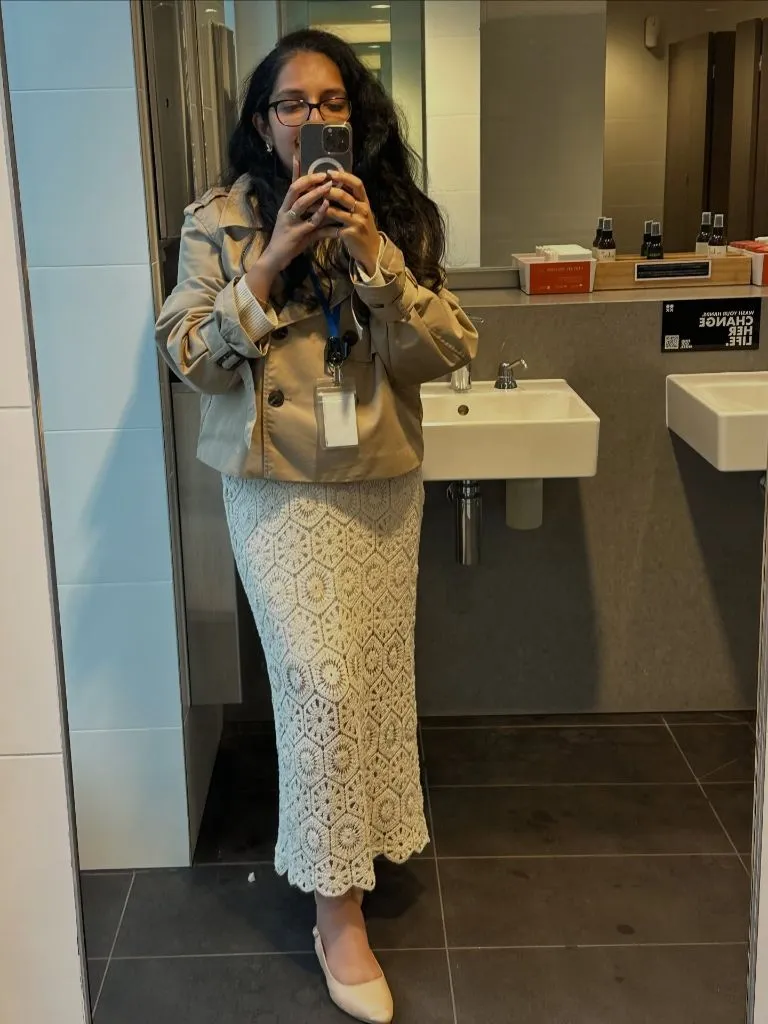
The proportion argument here is top-to-bottom ratio. The jacket ends near the natural waist, and the skirt takes over from there, occupying roughly two-thirds of the visible body length. This uneven split is what makes the outfit feel composed rather than halved. A fifty-fifty divide between jacket and skirt would flatten the reading, but the short-over-long arrangement creates directional movement downward through the lighter fabric.
The adaptation worth noting is the skirt’s open-weave texture. It adds surface interest to what would otherwise be a plain cream column. If you swap in a solid midi skirt instead, consider adding texture elsewhere, perhaps in the jacket fabric or a bag, so the outfit retains at least one textural interruption. The flat shoe keeps the whole look grounded in the same tonal family.
4. Yellow-Tan Blazer Framing White Hoodie and Jeans
A soft yellow-tan blazer with dark buttons sits open over a white drawstring hoodie, paired with light-wash distressed jeans. A small black round bag hangs from one hand. Dark angular sunglasses and a chain necklace add sharpness to the relaxed layers. The shot is taken against a gray brick wall, cropped at mid-thigh.
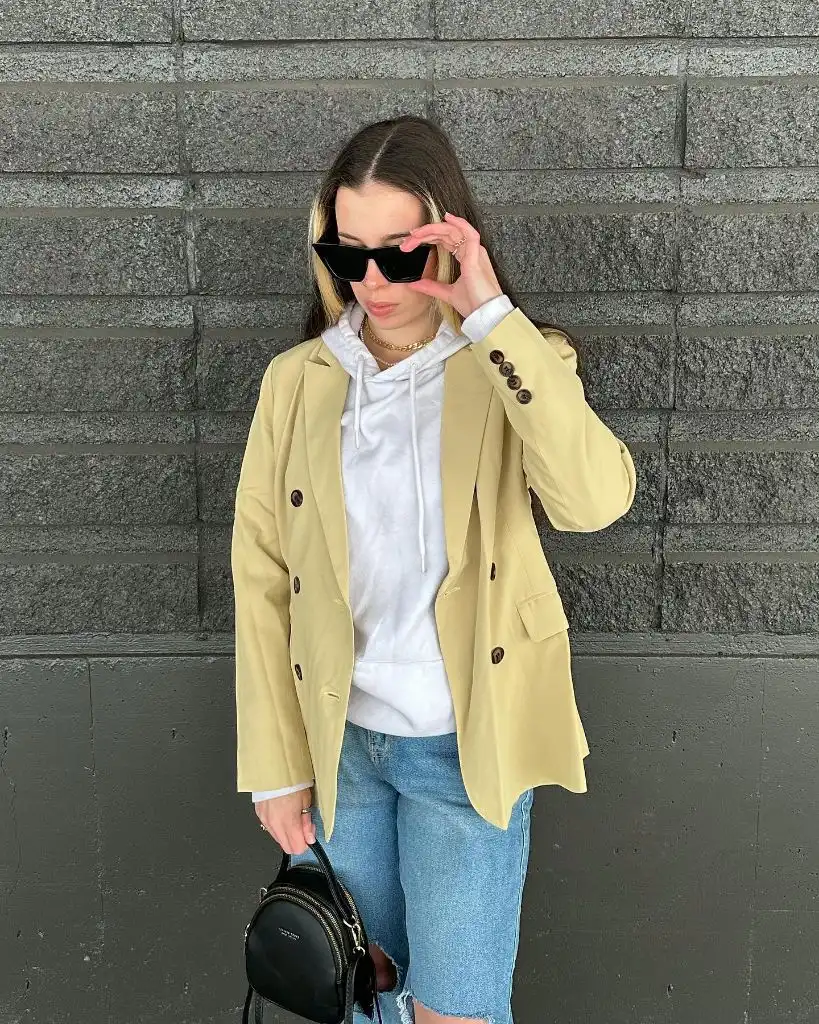
This outfit works through a deliberate clash of formality codes. The blazer carries structured tailoring signals while the hoodie underneath reads as loungewear, and the tension between those two registers is what holds attention. The blazer does not overpower the hoodie because both are left open and relaxed in posture. The light denim bridges the gap between the warm blazer tone and the bright white center, acting as a mid-value buffer that keeps the composition from splitting into two disconnected halves.
The strongest proportion here is the blazer length relative to the hoodie. The blazer sits just below the hip while the hoodie peeks out at the neckline and hem, framing the structured layer with casual edges. This is a useful formula for trendy winter business casual outfits that lean relaxed: keep the tailored piece as the middle layer and let something softer show above and below it.
5. Teal Suit With Matching Blazer and Wide Trousers
A single-breasted blazer and wide-leg trousers in the same deep teal form a matched set, worn over what appears to be a teal or dark top underneath. The blazer has a notch lapel and structured shoulders. One hand holds a water bottle and papers, the other holds a phone with a flame-design case. This is a full-length mirror selfie in a room with a yellow door and patterned carpet.
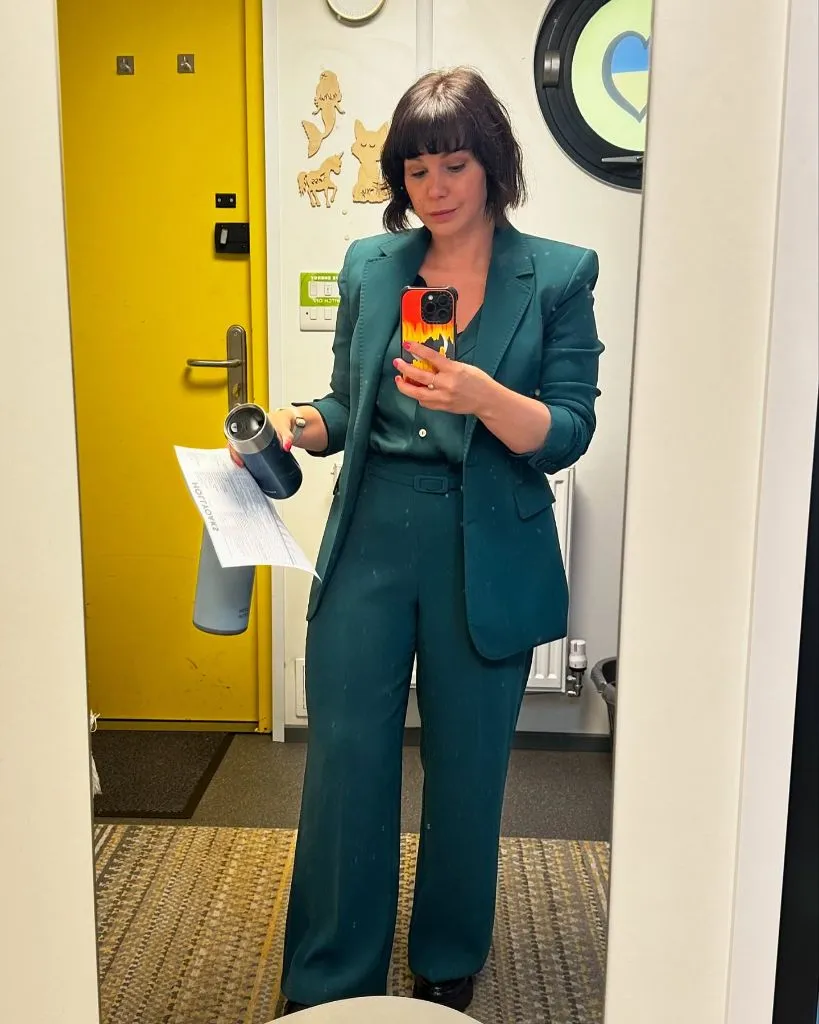
A head-to-toe color match eliminates the need for color contrast entirely, and the outfit instead relies on silhouette outline as its primary argument. The structured shoulder creates width at the top, the waist narrows slightly, and the wide trouser leg fans out again at the bottom. This produces an angular, almost architectural shape that reads as intentional without any color interruption. The teal itself is saturated enough to carry the full-body commitment without looking washed out.
If you build a monochrome suit look like this, the fit of the trouser hem matters more than usual. The wide leg needs to clear the shoe cleanly so the fabric line stays crisp at the bottom. When there is no color shift to redirect the eye, any pooling or bunching at the ankle becomes the most visible element in the composition.
6. Blue Linen-Look Suit With Rope Trim and White Shirt
A double-breasted blazer in a blue denim-looking or linen-looking fabric features white rope-like trim along the lapels, pocket flaps, and front edges. Matching wide-leg trousers carry the same fabric. A white ruffled shirt opens at the chest underneath. The accessories include a structured cream-colored satchel and oversized dark sunglasses. The shot is nearly full-length, taken outdoors in front of glass doors.
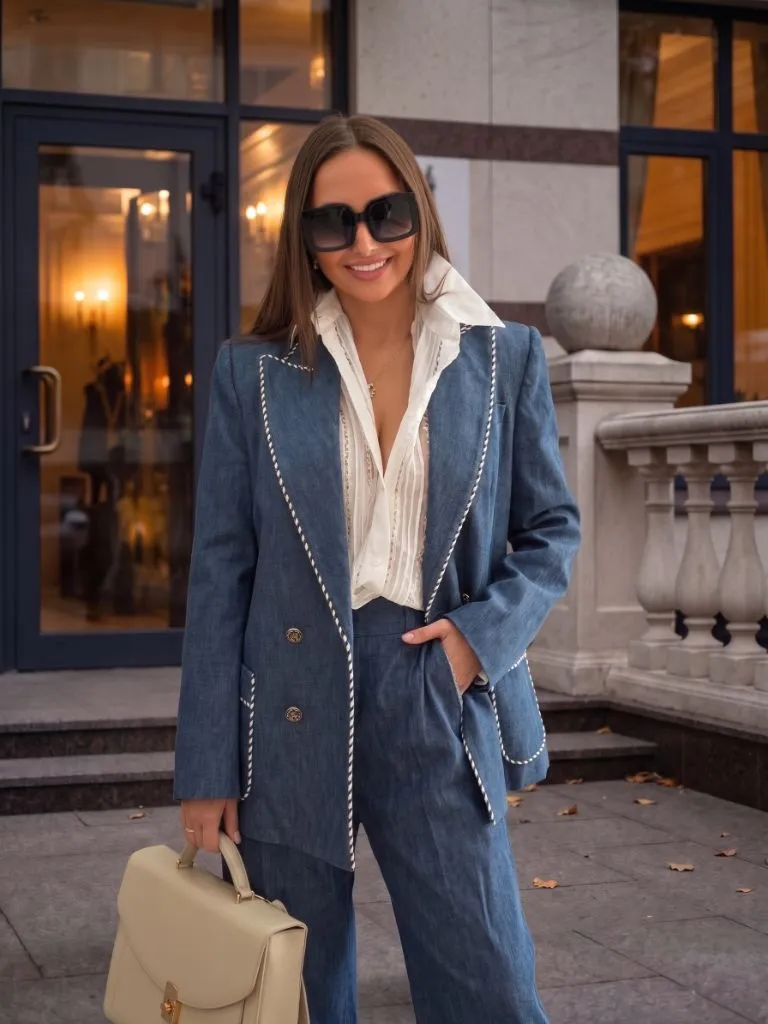
The rope trim is the organizing accent. It traces the edges of the blazer, turning every seam line into a visible design element and drawing the eye along the lapel, down the front, and across the pocket. This transforms a relatively simple suit silhouette into something with graphic clarity. The white shirt echoes the white trim, creating a repetition loop: white at the neckline, white along the lapel edge, white at the pocket, then neutral at the bag. That rhythm of echo and pause is what keeps the outfit readable from a distance.
The cream satchel is the only warm-toned element, and its placement low in the frame anchors the composition by pulling attention downward. If you were to carry a blue or white bag instead, the outfit would lose that grounding point and risk feeling top-heavy. A single off-palette accessory, kept small and below the waist, often does more structural work than a larger one.
7. Brown Overcoat Over White Top and Gray Trousers
A long overcoat in a warm brown, falling below the knee, drapes open over a white or cream top and wide gray trousers. Black square-toed boots and a black woven-looking clutch sit at the lower half. Slim sunglasses, gold hoop earrings, and layered gold necklaces concentrate all the metallic detail near the face. The figure is seated on a low ledge, shot from slightly above, against a dark window shutter backdrop.
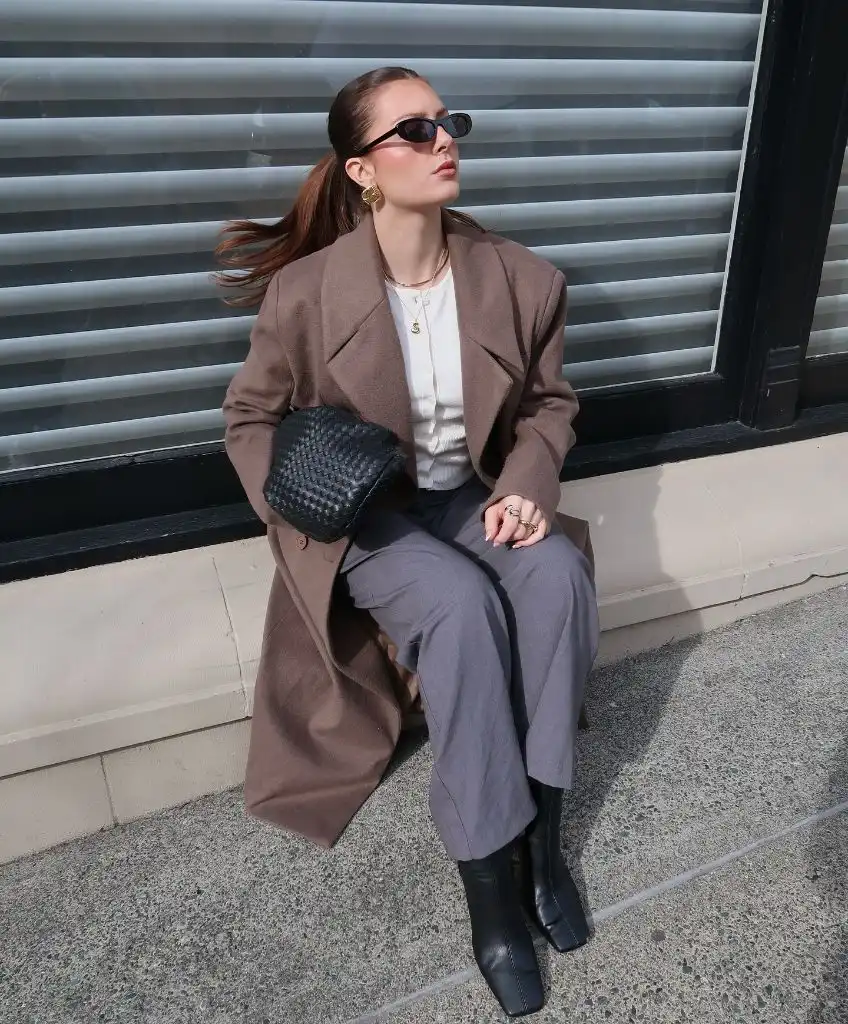
This is a study in tonal layering. Three distinct values occupy the frame: dark at the extremities with boots and clutch, mid-tone in the brown coat, and light at the center with the white top. The gray trousers sit between the dark and mid values, acting as a bridge. This gradient effect means the eye moves smoothly from one zone to the next without any jarring jump, which is why the outfit looks calm despite involving four different color families.
The seated angle changes how the coat reads. Standing, this coat would form a long vertical column, but seated it fans out at the sides and reveals more of the gray trouser and the boot shaft. If you wear a similar coat and find yourself photographed or seen while seated often, the interior layers matter more than they would standing, so keep the under-layers coordinated.
8. Pale Yellow Sweater Above White Pleated Maxi Skirt
A soft pale yellow crewneck sweater in a knit-looking fabric is tucked loosely into a white pleated maxi skirt that reaches the ankles. A small black bag with gold chain and pearl-looking handle details sits at the side, its dark surface providing the only high-contrast element. Round dark sunglasses, small gold earrings, and a delicate chain necklace keep the accessories minimal. The shot is taken outdoors in bright light against a dark glass and white wall backdrop.
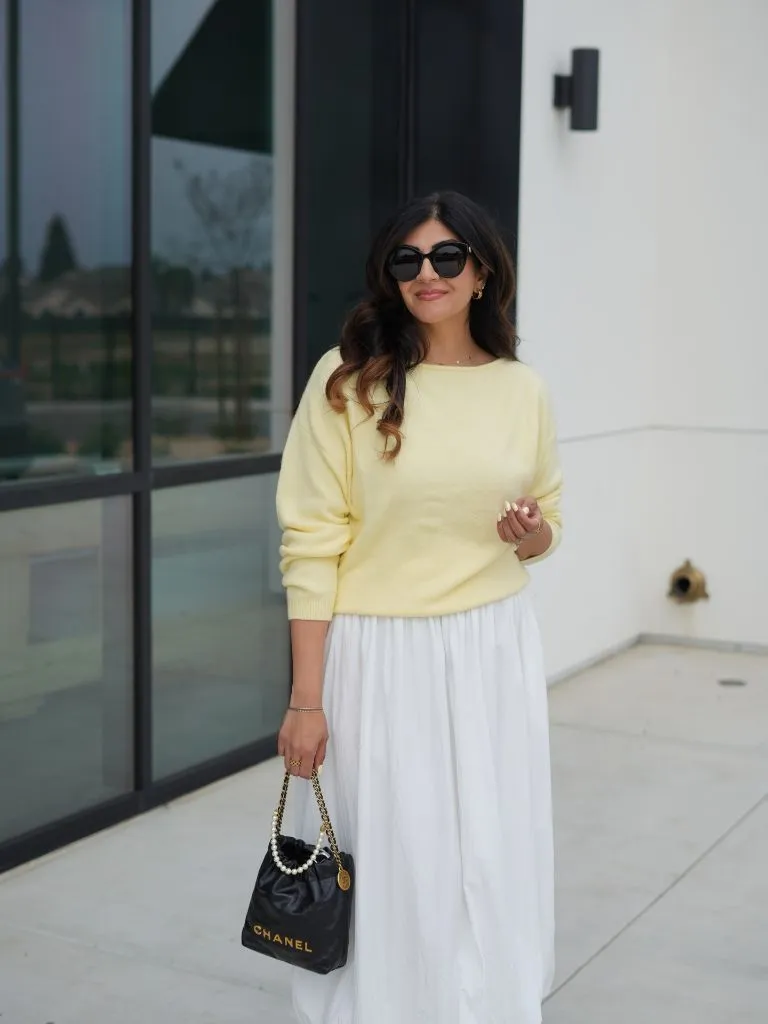
Negative space is the dominant principle. The pale yellow and white occupy almost the entire visible area with very little visual interruption, and the black bag becomes a sharp punctuation mark precisely because everything around it is so light. If the bag were also pale, the outfit would dissolve into a single pastel wash with no anchor. The one dark object gives the eye a place to land and creates a ratio of roughly ninety percent light to ten percent dark, which is a high-contrast strategy achieved through restraint rather than boldness.
The pleated skirt contributes vertical lines that add structure to the otherwise soft, rounded shapes of the sweater and bag. Without those pleats, the lower half would read as a flat white surface. The adaptation here is simple: when working with trendy winter business casual outfits in very light tones, one dark accessory below the waist often provides all the definition the outfit needs.
9. White Ruffle Blouse With Denim and Layered Bracelets
A white blouse with cascading ruffle details down the front center is paired with medium-wash denim visible at the waist. Sunglasses rest on the head, and a phone with a lemon-print case is held up for a mirror selfie. A gold watch, a beaded bracelet, a chain bracelet, and small gold hoop earrings distribute detail across both wrists and ears. The shot is cropped at the waist in a white-tiled restroom.
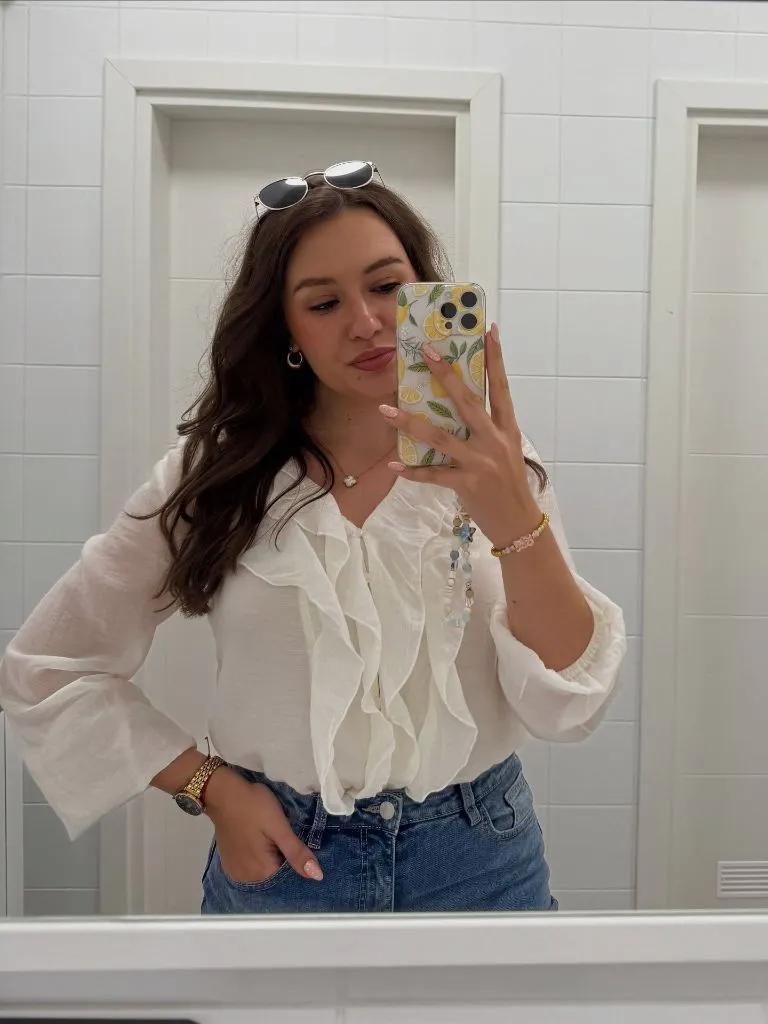
The ruffles run vertically down the center of the blouse, creating a textural spine that divides the torso into two symmetrical halves. This is a placement argument: the detail is concentrated along the center axis rather than spread across the whole surface, which keeps the blouse from reading as busy. The bracelets and watch cluster on the wrists, creating secondary zones of interest at the frame edges, so the eye moves between center and periphery rather than scanning randomly.
The most useful detail here is the density of the ruffle. A tight, layered ruffle like this one reads as structured even in a lightweight-looking fabric. If your blouse has a sparser ruffle, the center line effect weakens and the piece reads more as a casual peasant top. The degree of ruffle density shifts the entire formality reading of the same basic garment.
10. Burgundy Leather-Look Coat Over Blue Striped Shirt and Tie
A long burgundy leather-looking coat hangs open over a blue-and-white striped button-down shirt, a burgundy patterned tie, and dark trousers. A large black envelope clutch with a gold-toned clasp is held against the torso. The shot is taken from a three-quarter angle near ornate stone columns and a decorative bronze-looking lamppost, with warm afternoon light.
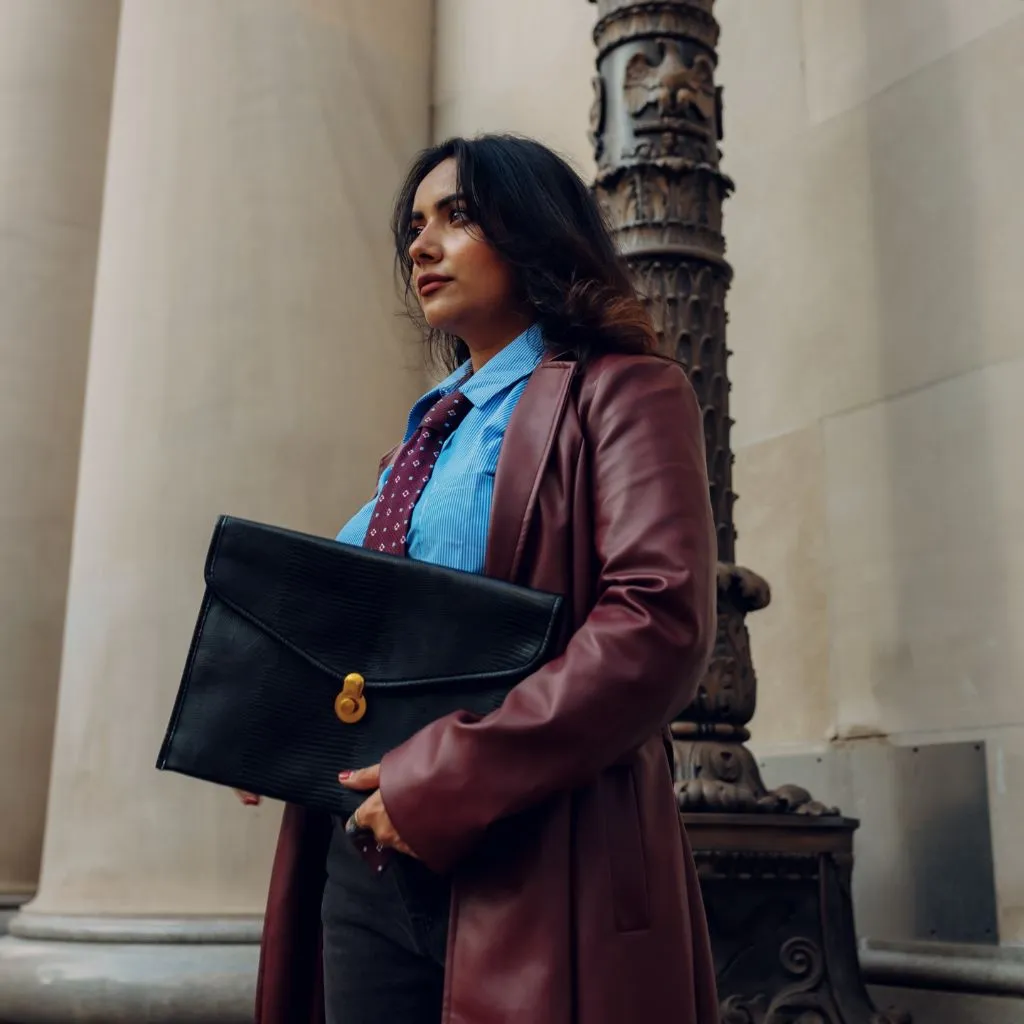
Color echo drives this outfit. The burgundy of the coat reappears in the tie, creating a frame-within-a-frame effect: the outer layer and the innermost visible accessory share a hue while the blue shirt sits between them as a contrasting middle. This sandwich structure means the blue does not float untethered but instead is held in place by matching tones on either side. The black clutch and dark trousers anchor the lower half without competing with the color conversation happening above.
The scale of the clutch matters. It is large enough to read as a deliberate compositional element rather than a small afterthought, and its flat, geometric shape contrasts with the soft drape of the coat. If you carry a structured flat bag like this, hold it against the body at waist height so it acts as a horizontal bar that interrupts the vertical fall of a long coat.
11. Navy Overcoat Over Olive Sweater and Dark Trousers
A long, oversized navy overcoat with a wide collar falls well past the knees, worn open over an olive or moss green knit-looking sweater and dark trousers. A white shirt collar peeks out above the sweater neckline. Black chunky-soled shoes and a large brown leather-looking tote bag complete the lower composition. The figure stands in front of a Tudor-style half-timbered wall with a round heritage plaque visible above.
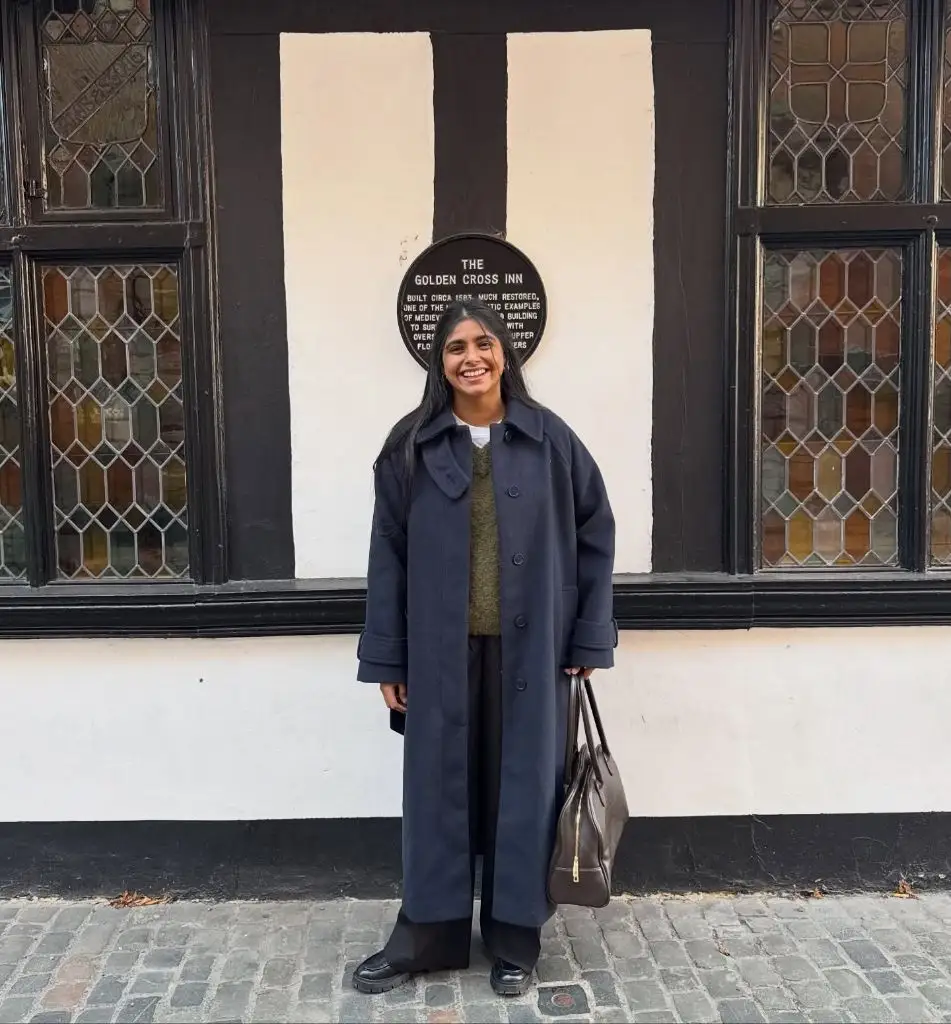
This is a layering depth study. Four visible layers stack from inside to outside: white shirt, olive sweater, navy coat, and the tote bag acting almost as a fifth plane. Each layer is darker or more saturated than the one beneath it except for the bag, which breaks the progression with a warm brown. That interruption is important because without it the outfit would darken uniformly from center to edge, which can look heavy. The brown bag introduces a temperature shift that lightens the overall reading.
The overcoat’s volume is the structural anchor. Its width at the shoulders and length past the knees create a vertical rectangle that dominates the frame. Everything else, the sweater, the collar, the trousers, operates within that rectangle as secondary detail. If you wear a coat this long and wide, keep the trousers straight or slightly wide to maintain the columnar reading rather than introducing a taper that would conflict with the coat’s shape.
12. Striped Button-Down With Gold Buttons and Gray Trousers
A white-and-gray or white-and-navy striped button-down shirt with prominent gold-toned buttons is tucked into high-waisted, wide-leg gray trousers secured with a dark belt featuring a gold buckle. Small gold drop earrings provide the only additional accessory. The shirt sleeves are rolled slightly, showing clean cuffs. The shot is taken from a slightly low angle against a neutral gray interior wall, cropped at mid-thigh.
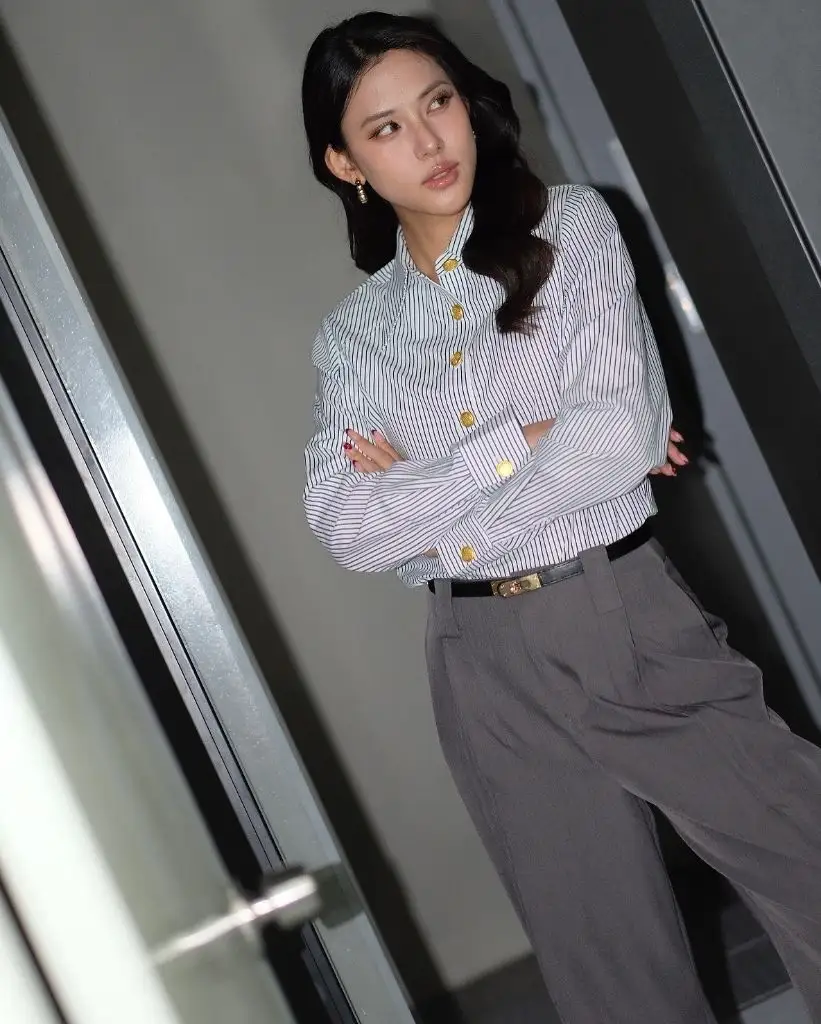
The gold buttons are the accent that organizes the entire outfit. They create a vertical dotted line from collar to waist, drawing the eye downward through the center of the shirt and then handing off to the gold belt buckle, which anchors the transition from shirt to trouser. This is a placement strategy: small repeated metallic details along a single axis produce a reading path that feels structured without any large statement piece. The stripe pattern of the shirt adds horizontal rhythm that counters the vertical button line.
The restraint in accessories is what makes the gold read so clearly. Two earrings, a belt buckle, and buttons are the entire metallic inventory, and because they all share the same gold tone, they function as one coordinated system rather than competing elements. If you add a gold watch or bracelet to this kind of outfit, it should match the existing gold closely, or the system fractures and each metallic piece starts competing for attention.
13. Tan Blazer Over Printed Shirt With Dark Wide Trousers
A tan or camel single-breasted blazer is layered over a printed button-down shirt in warm earth tones featuring what appears to be a pictorial or art-inspired pattern. Dark chocolate or black wide-leg trousers with a drawstring or tie waist pair below. Burgundy or oxblood patent-looking flat shoes and a tan leather-looking handbag with a round charm sit at the bottom of the frame. Round tortoiseshell-looking sunglasses complete the accessories. The shot is full-length, taken on what looks like a rooftop with a city skyline behind.
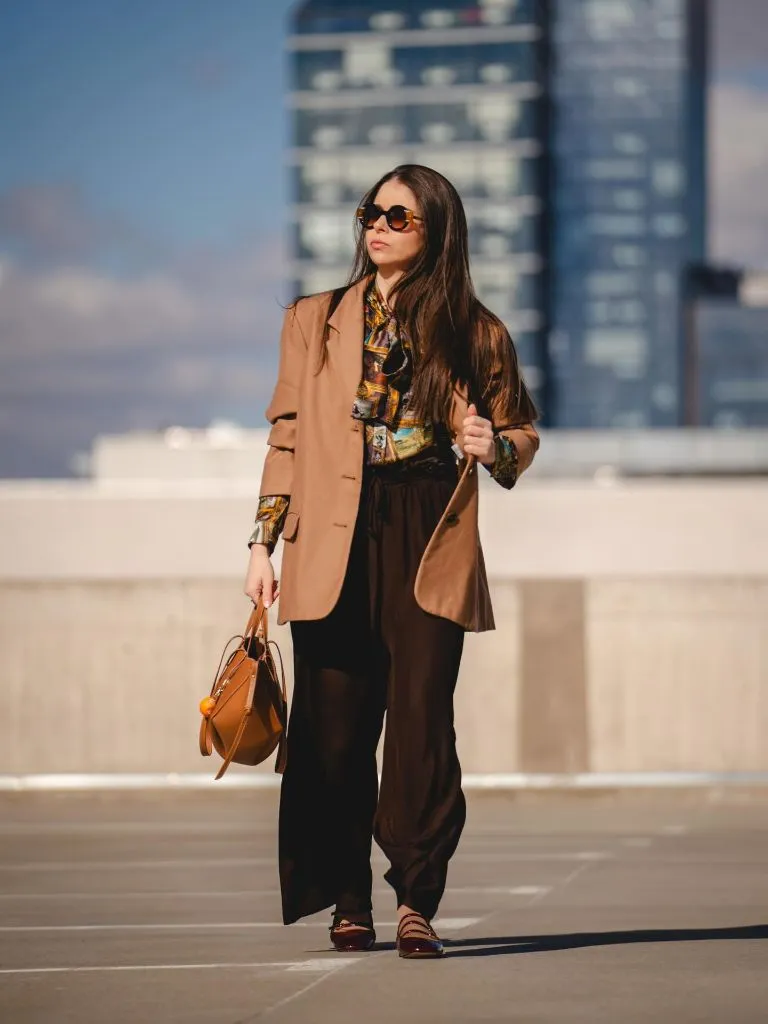
The printed shirt is the most visually complex element, and the blazer frames it by providing solid, uninterrupted fabric on either side. This framing effect contains the pattern so it reads as a curated center panel rather than an overwhelming surface. The dark trousers below act as a visual rest, absorbing attention and giving the eye a break after the busy midsection. The tan of the blazer and the tan of the bag echo each other across the outfit’s top and bottom, stitching the composition together.
The shoe color is worth noting. Choosing a burgundy or oxblood shade rather than matching the tan or the dark trouser introduces a third tonal family that keeps the palette from becoming predictably two-toned. If you work with earth tones often, one reddish accent in a small item like a shoe or a bag strap can add warmth without disrupting the overall neutral scheme.
14. Black Turtleneck With Beige Pleated Trousers and Crossbody Bag
A fitted black ribbed turtleneck is tucked into high-waisted beige or khaki pleated trousers with a straight leg. A small black crossbody bag on a chain strap sits at the hip. White sneakers finish the lower line. The outfit is shot full-length in front of a glass-fronted commercial building, with trees reflected in the glass behind.
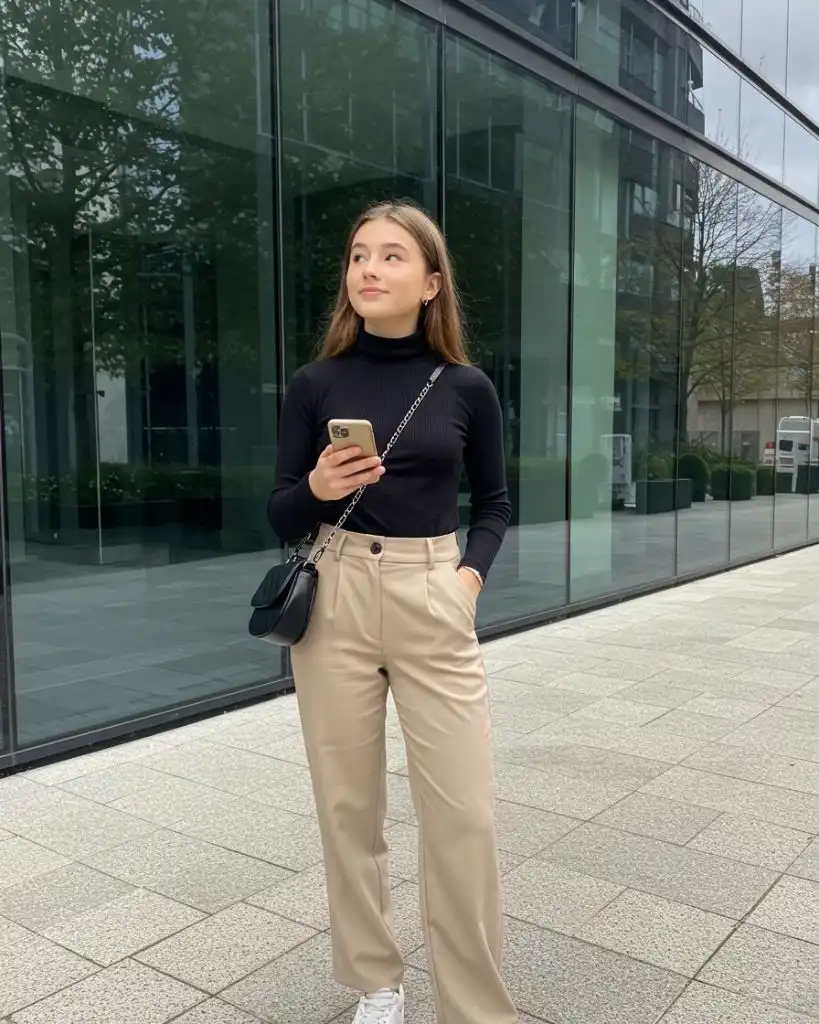
The contrast in value between the black top and beige bottom creates a clean two-block composition split at the natural waist. This is one of the simplest and most legible structures in outfit-building: dark above, light below, with a hard edge where they meet. The white sneakers introduce a third value at the very bottom of the frame, and because white is even lighter than beige, they create a subtle gradient effect that moves from dark at the top through mid-tone in the center to bright at the feet.
The pleats add vertical lines to the trouser surface, which elongates the lower half and gives the beige fabric some dimensional interest it would lack if the trousers were flat-front. For trendy winter business casual outfits with this kind of stark two-tone split, the trouser detail is what separates a composed outfit from one that looks like mismatched separates grabbed in the dark.
15. Purple Velvet-Look Double-Breasted Suit With Blue Shirt
A deep purple velvet-looking double-breasted blazer with gold buttons pairs with matching wide-leg trousers in the same fabric. A light blue button-down shirt, unbuttoned at the collar, sits underneath. A purple knit-looking beanie and red gloves add color to the extremities. Dark flat shoes anchor the bottom. The shot is full-length against a warm beige studio-like backdrop.
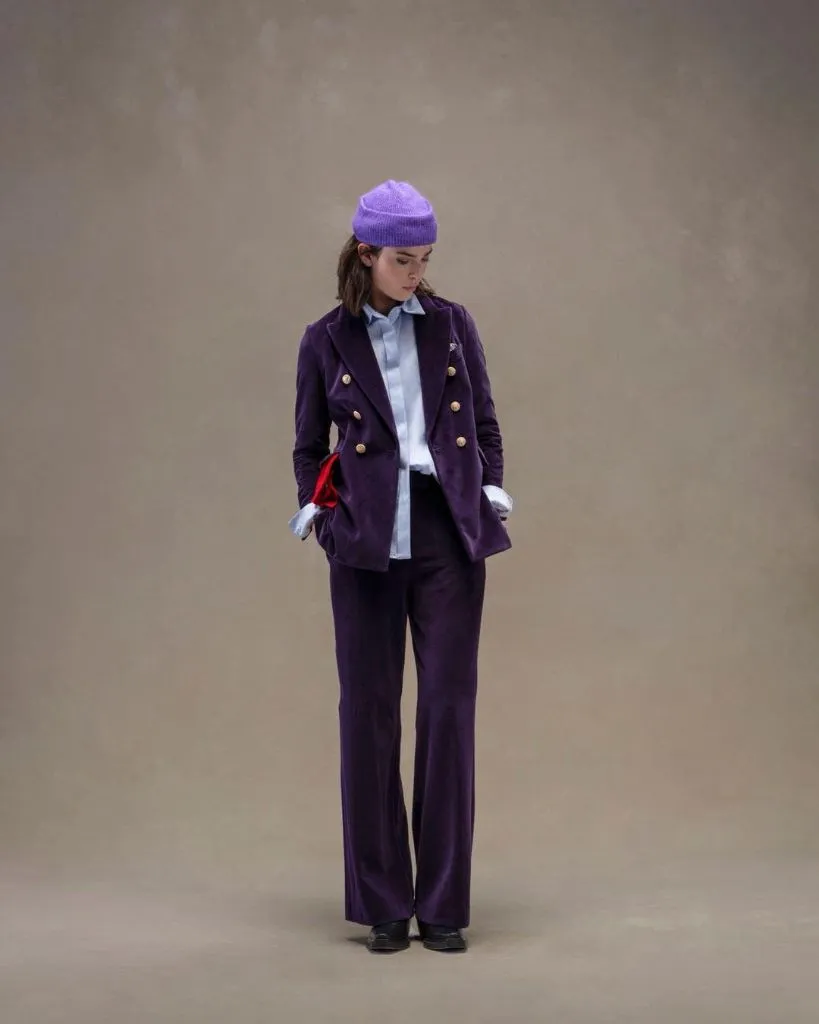
The velvet-looking surface is doing the heaviest work here. Its pile catches light unevenly across the blazer and trousers, creating subtle shifts in value within what is nominally a single color. This means the suit never looks flat even though the color match is exact. The light blue shirt provides a cool-toned interruption at the center that prevents the purple from becoming visually dense, and the red gloves act as a small, high-saturation accent that draws the eye to the hands without competing with the suit’s overall presence.
The gold buttons repeat in a double column down the blazer front, and their warm metallic tone sits opposite the cool purple on the color wheel, which is why they pop so clearly. If you wear a richly colored suit like this, limiting the accessories to one unexpected color, here the red gloves, keeps the outfit from tipping into costume. The beanie matches the suit, reinforcing the dominant hue rather than introducing yet another variable.
16. Brown Plaid Blazer Draped Over Vest With Camel Trousers
A dark brown plaid blazer is draped over one shoulder, revealing a matching fitted vest layered over a white crewneck underneath. Wide-leg camel trousers fall cleanly to the shoe. Red gloves are held in one hand, and dark flat shoes sit at the base. The setting is the same warm beige studio backdrop, and the shot is full-length with a straight-on angle.
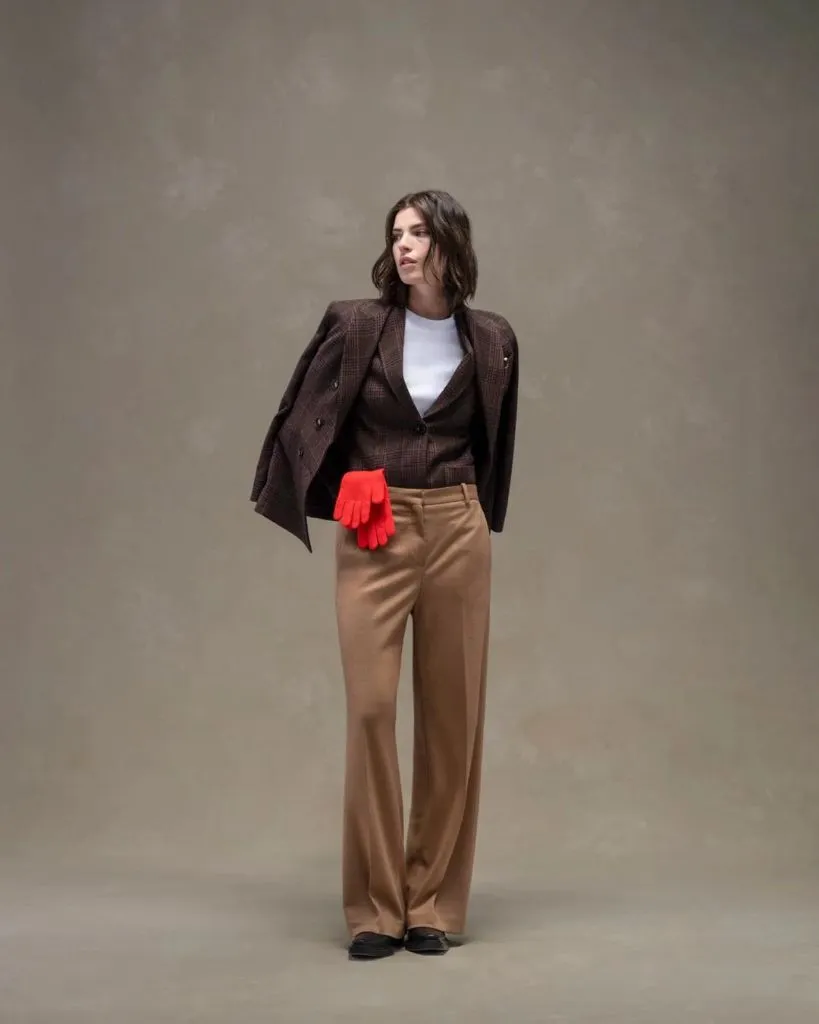
Draping the blazer over one shoulder rather than wearing it conventionally transforms it from a structural garment into a compositional prop. It sits asymmetrically, breaking the otherwise symmetrical vest-and-trouser arrangement and adding a diagonal line to a look that would otherwise be purely vertical. This asymmetry is the dominant visual argument: it signals that the outfit was assembled with awareness rather than routine. The vest, visible because of the drape, adds a third layer of tonal depth between the white shirt and the dark plaid.
The camel trousers are the lightest large surface area in the frame, and they pull attention downward to balance the visual weight of the dark blazer sitting high on the shoulder. If you attempt the shoulder-drape styling, the blazer needs enough structure in its fabric to hold shape without collapsing. Softer fabrics will slide off. Choose a blazer with some body in the shoulder and lapel so it sits on the shoulder as a deliberate silhouette element.
17. Blue Striped Shirt With Black Trousers and Crossbody
A blue-and-white pinstriped button-down shirt, slightly oversized, is tucked into high-waisted black trousers with a clean straight leg. A small black crossbody bag with gold hardware hangs on a long strap across the torso. The shot is a mirror selfie taken in a home interior, cropped at mid-thigh, with a round mirror partially framing the composition.
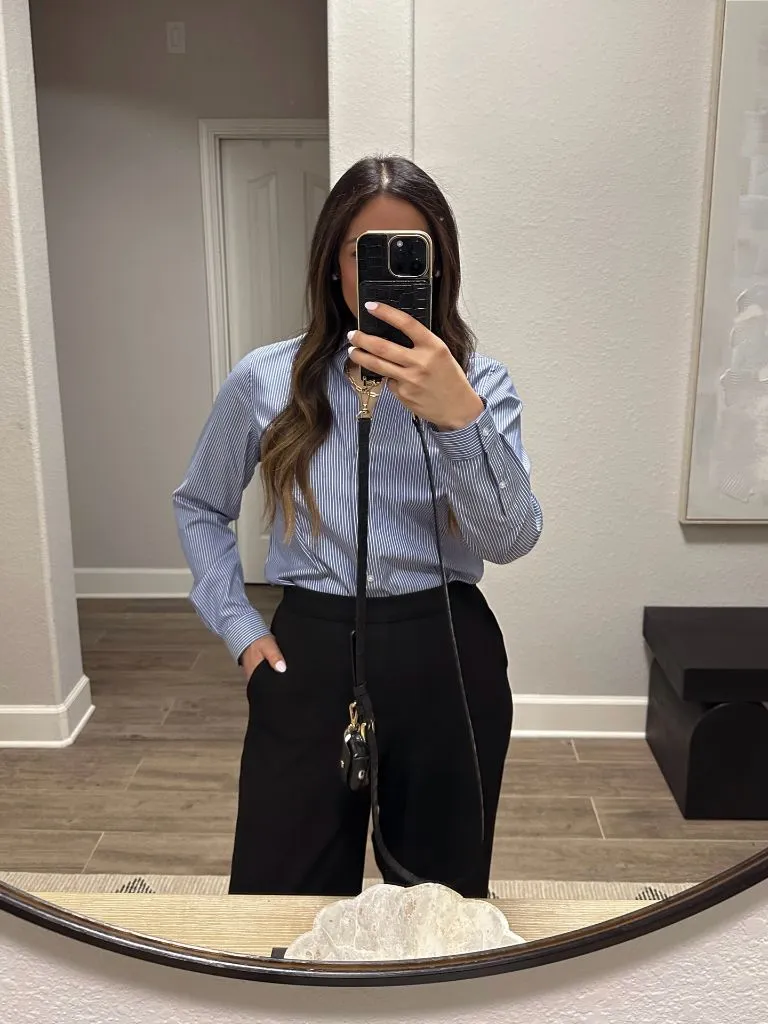
The pinstripe introduces a fine, repetitive vertical pattern that adds visual texture to the upper half without any color complexity. Against the solid black trousers, the striped shirt reads as the active element while the lower half provides a quiet ground. This figure-ground relationship is straightforward but effective: the eye knows immediately where to focus and where to rest. The crossbody strap adds one diagonal line that cuts across the vertical stripes, providing a small directional interruption.
The slight oversize of the shirt is the detail that shifts this from rigid to relaxed. A fitted pinstripe shirt would push the reading closer to uniform territory, but the extra fabric through the body softens the formality just enough. If you tuck an oversized shirt like this, pulling a small billow of fabric above the waistband keeps it from looking like the shirt simply does not fit. That intentional blousing is what signals styling rather than sizing error.
18. White Shirt With Gray Cardigan Draped and Dark Wide Trousers
A white button-down shirt, open at the collar, pairs with dark navy or black wide-leg trousers belted at the waist with a dark belt featuring a visible buckle. A gray knit-looking cardigan or sweater is draped over the shoulders. A work lanyard with an ID badge hangs at the hip. Sneakers with a striped sole design, resembling a well-known athletic silhouette, finish the look. This is a full-length mirror selfie in a commercial restroom with tiled walls and stall partitions.
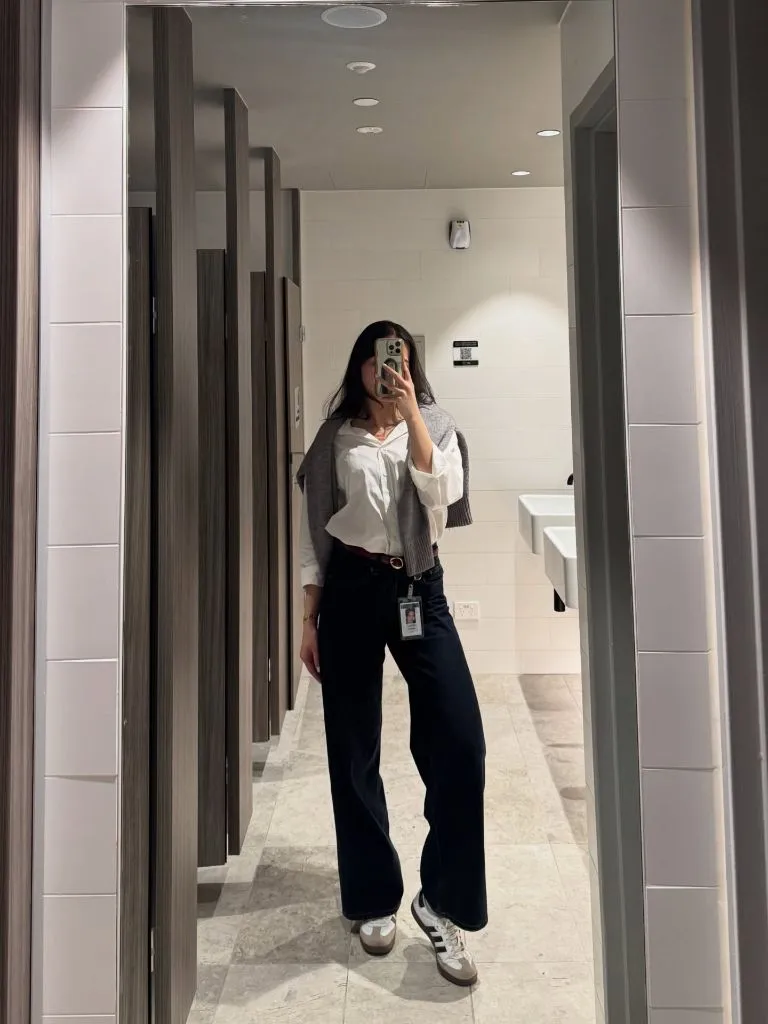
The sneaker choice is the key interruption. Every other element, the white shirt, the gray knit, the dark trousers, belongs to a tailored vocabulary, and then the sneakers shift the register at the very last moment. This works because the sneakers share the color palette of the rest of the outfit rather than introducing a new hue. They echo the gray of the cardigan and the white of the shirt, so the formality shift happens without a color conflict. The lanyard reads as incidental context rather than a styling choice, grounding the outfit in a real-wear setting.
The draped cardigan sitting on the shoulders adds a soft horizontal emphasis across the upper back and chest that widens the top of the frame. Below, the wide-leg trousers echo that width. Between them, the belted waist provides the narrowest point. This creates a balanced hourglass silhouette even with relaxed garments, which is the quiet structural achievement of this outfit.
19. White Ruffle-Collar Button-Down With Light Denim
A crisp white button-down shirt with a small ruffle or frill at the collar sits slightly oversized over the frame, the cuffs folded back once. The lower half shows light-wash denim at the very bottom of the crop. The fabric looks like cotton poplin or a similar smooth, matte-surfaced material. The shot is tightly cropped from chest to waist against a soft gray-white background, with no accessories visible.
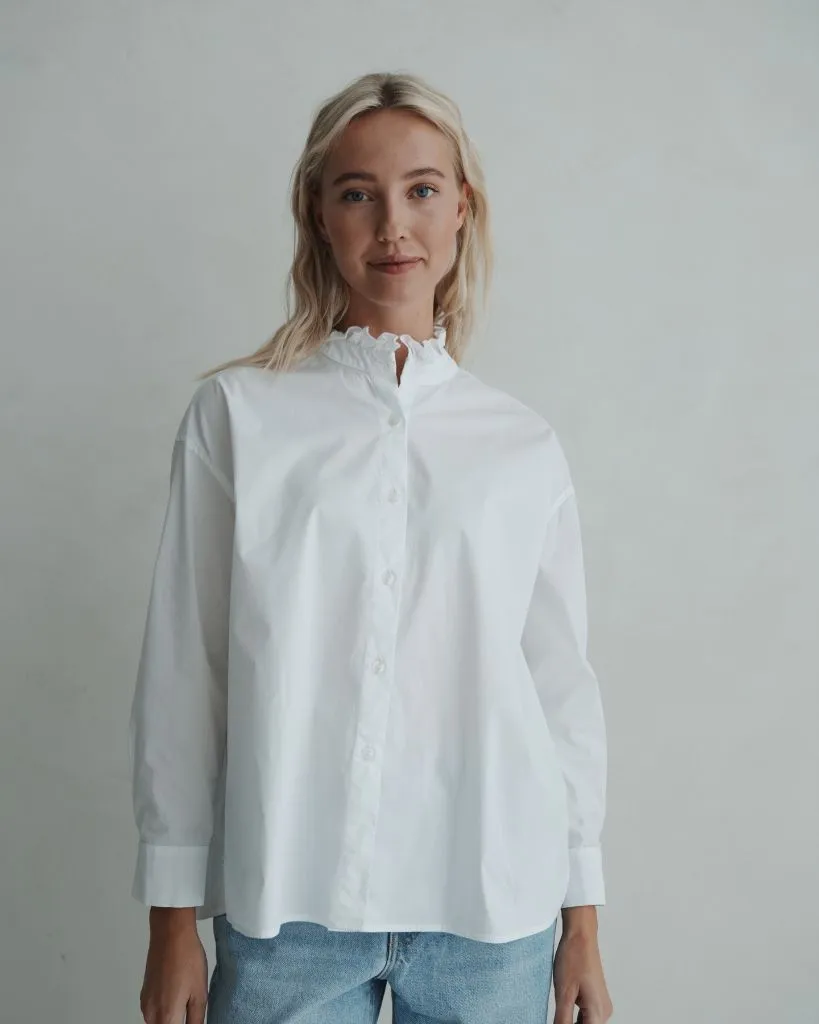
With almost no color or accessory information available, the shirt itself becomes the entire composition, and the ruffle collar is the sole point of interest. This is an exercise in restraint taken to its logical end: one garment, one detail, everything else stripped away. The ruffle is small enough that it reads as a subtle texture shift at the neckline rather than a dramatic embellishment. Against the smooth, matte body of the shirt, even that tiny dimensional change registers clearly.
The folded cuff is the only other styling gesture, and it serves a proportional purpose by shortening the visual length of the sleeve and revealing a bit of wrist. If you own a white shirt with a detail this subtle, let it be the only textured element in the outfit. Layering a textured necklace or a patterned scarf over a ruffle collar would cancel out the collar’s quiet presence rather than amplifying it.
20. Taupe Suit With Dark Pointed Shoes and Hydrangeas
A matching taupe or warm-gray blazer and wide-leg trousers form a relaxed suit silhouette, with the blazer left unbuttoned over what appears to be a dark top underneath. Dark pointed shoes with a low profile anchor the bottom. Tortoiseshell-looking sunglasses and a sleek ponytail keep the upper frame clean. A large bouquet of dried-looking mauve hydrangeas is held in one arm. The shot is full-length on a sidewalk against a dark-painted building facade with white signage.
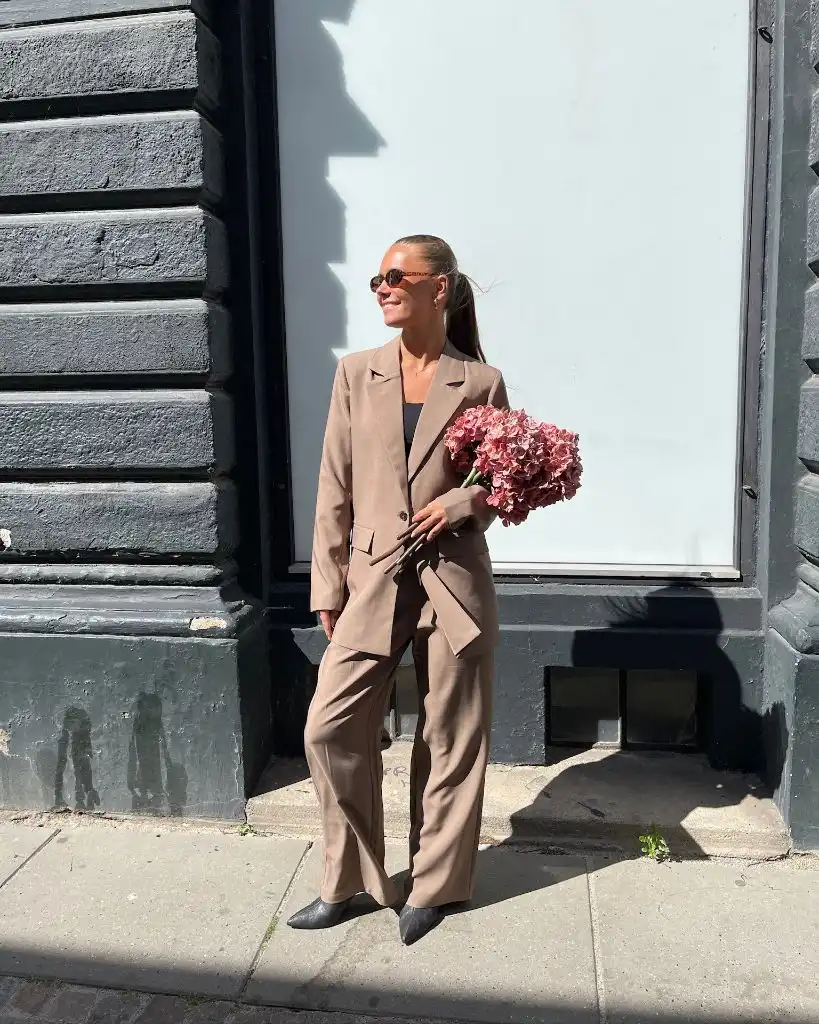
The hydrangeas are not an accessory in the traditional sense, but they function as a color block in the composition. Their mauve tone introduces a cooler, more saturated note against the warm taupe, and because the bouquet is large, it occupies enough of the frame to actually shift the outfit’s color balance. Without the flowers, this would be a quiet monochrome suit study. With them, it becomes a two-tone composition where the organic shape of the blooms contrasts with the straight lines of the tailoring.
The suit fabric appears to have a soft, slightly unstructured drape, which gives the shoulders and trouser legs a gentle curve rather than a hard edge. This softness echoes the rounded shapes of the flower heads. If you take any visual prop into an outfit photo, matching its color temperature or texture to something already in the outfit prevents it from looking random. Here the mauve flowers relate to the cool undertone in the taupe, and that connection is what makes the whole image feel cohesive.
21. Dark Pinstripe Blazer Over White Skirt From the Side
A dark charcoal blazer with fine pinstripes is seen from the side, its structured shoulder and single back vent visible. Below, a white pleated or crinkled skirt extends past the blazer hem. Long blonde hair falls forward over the shoulder. One hand adjusts sunglasses near the face. The background is a patinated copper or bronze-looking door with graffiti-like markings, set in a cobblestone walkway.
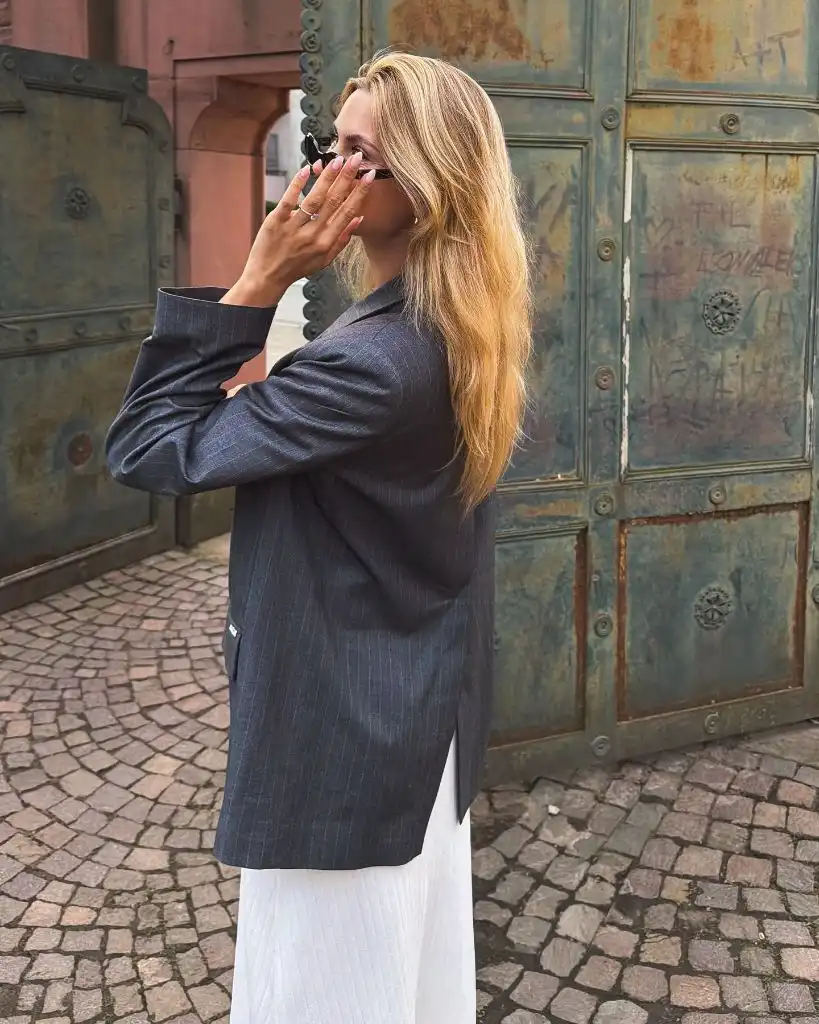
From the side, the blazer and skirt create a layered silhouette that reveals how the two garments relate in length. The blazer ends at the upper hip, and the white skirt continues well below it, so the eye reads a dark rectangle sitting on top of a lighter, longer rectangle. This stacking of different values at different lengths is the structural core of the outfit. The side angle also shows the blazer’s back vent, which allows the fabric to move independently of the skirt, keeping each layer distinct even in motion.
The pinstripe is barely visible at this angle and from this distance, which means it functions as surface texture rather than overt pattern. That subtlety is worth preserving. If you pair a blazer like this with a white bottom, the contrast in value between dark top and light bottom is already strong enough to carry the outfit. The pinstripe adds a quiet secondary detail that rewards closer viewing without cluttering the initial impression.
22. Olive Blazer Over Cream Top With Black Ankle Trousers
An olive or dark sage green blazer sits open over a cream or ivory top, paired with black ankle-length trousers and pointed tan or cognac flats. A long gold chain necklace hangs from the neck, providing a single vertical metallic line. The shot is a full-length mirror selfie in a bright home hallway, with natural light coming through window blinds on one side.
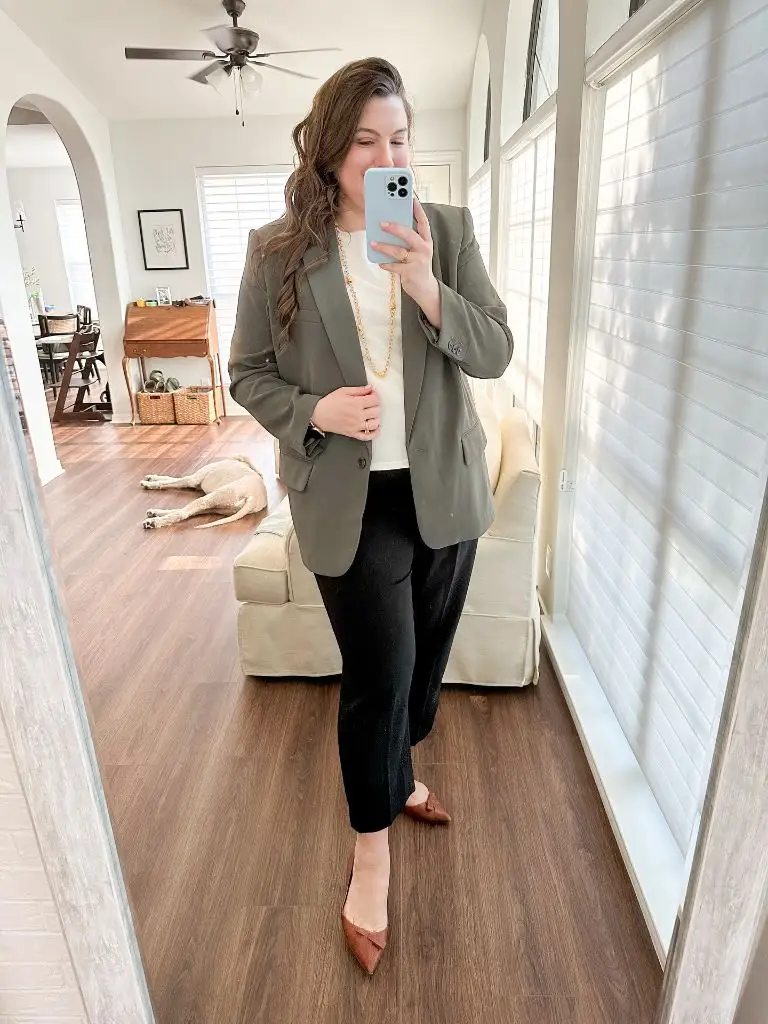
Three zones of distinct color divide the torso into clear horizontal bands: olive at the shoulders, cream at the center, and black from the waist down. The flats then introduce a fourth tone, warm cognac, at the very bottom. This four-part color structure gives the outfit a sense of deliberate progression rather than random pairing. Each transition, from olive to cream to black to cognac, moves to a different part of the spectrum, so no two adjacent zones share a hue. That variety across a small vertical space is what keeps a simple combination of basics from reading as plain.
The gold necklace is the single accent, and its length matters. It falls roughly to the sternum, sitting inside the cream zone, which means it adds metallic detail to the lightest area of the outfit where it will be most visible. A shorter necklace would sit against the olive blazer lapel and lose visibility. A longer one would cross into the dark trouser zone and disappear. The placement, cream background behind gold chain, is what makes this small detail actually register.
23. Pink Cable-Knit Vest Over Plaid Shirt With Black Wide Trousers
A pink cable-knit-looking vest sits over a light gray-and-white plaid button-down shirt, the shirt collar and sleeves visible around the vest edges. Black wide-leg trousers with a high waist and deep pleats form the lower half. Pink pointed-toe pumps echo the vest color at the feet. A brown leather-looking tote bag hangs from one shoulder, and round oversized sunglasses with thin frames sit on the face. The shot is full-length on a sidewalk with a modern low building and green grass behind.
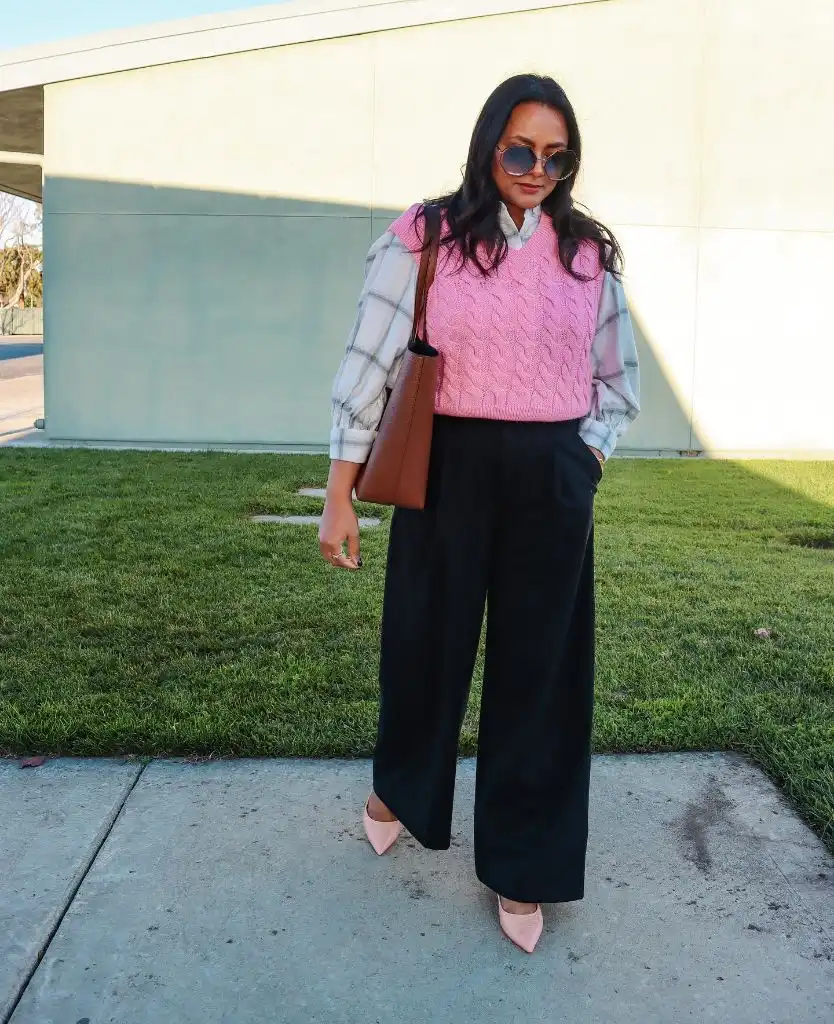
Color repetition between the vest and the shoes is the mechanism that turns this into a coordinated outfit rather than a pile of separates. The pink appears at the top of the torso and again at the floor, bookending the black trousers and creating a visual frame. Everything between those two pink points, the plaid shirt sleeves, the black trouser column, the brown bag, exists inside that frame. The plaid pattern is low-contrast enough that it acts as a textured neutral rather than a competing pattern, so the pink never has to fight for dominance.
The cable-knit texture of the vest is important because it prevents the pink from reading as flat or juvenile. The dimensional surface adds shadow and highlight variation within the pink, giving it depth. If the vest were smooth and matte, the same pink might read as less sophisticated. Texture is often what separates a bold color choice that works in a professional-leaning context from one that does not.

Hi, I’m Zoey Mitchell, the creator of ChicStyle Blog.
I share simple, wearable outfit ideas, hairstyles, nail trends, and beauty tips that feel natural and easy to recreate.
This blog is where I explore everything that makes a woman feel put together and confident every day. I’m not an expert — just a woman who genuinely loves style, mixing looks, and discovering what works.
If you love effortless fashion with a personal touch, you’ll feel at home here.