
Winter outfits aesthetic becomes harder to build when every layer adds bulk without adding structure. The instinct is to pile on volume everywhere, but proportion works differently in cold-weather clothing. A single oversized piece reads as intentional when everything around it stays narrow or fitted. The relationship between one wide shape and one slim shape is what turns layering into composition, not just coverage against low temperatures.
Reading winter outfits aesthetic as a set of visual relationships changes the way you evaluate what works. Instead of asking whether a coat is warm enough or trendy enough, compare its length to where your pants break, or notice how a color repeated in two places connects pieces that differ in texture. The images below are organized around these comparisons, and the strongest detail in each one is almost always the proportion between the largest piece and the smallest.
1. White Fur-Like Coat Against Snowy Concrete
A plush-looking white coat with a high collar dominates this front-facing composition, paired with black leggings and cream knit-looking leg warmers that bunch above tan platform shoes. The left arm is raised, revealing a matching cream knit-looking sleeve extending from beneath the coat. White fluffy earmuffs and dark oversized sunglasses sit near the top of the frame. Snow covers the walkway and ledges of what appears to be a concrete balcony or ramp between buildings.
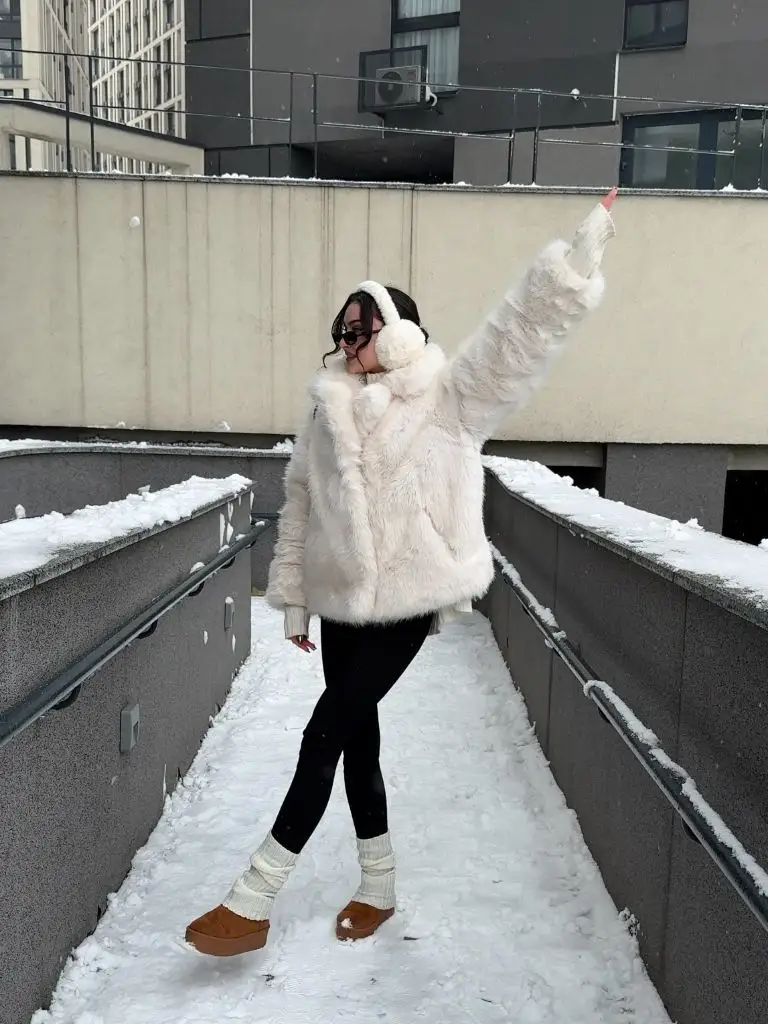
The proportion here is top-heavy by design, and that is exactly why it holds together. The coat spans from shoulder to mid-thigh with maximum volume, while everything below the knee narrows sharply into fitted leg warmers and compact shoes. The dark leggings act as a visual break between two zones of cream and white, preventing the upper and lower halves from merging into one undifferentiated block. Without that dark interruption, the outfit would flatten.
The strongest proportion here is the ratio between the wide, voluminous coat and the tight lower leg. If you shift the coat even slightly shorter, the leg warmers would need to rise to compensate, or the visual weight drops too suddenly. Keep the narrowest point at the ankle when the widest point is at the shoulder.
2. Navy Coat Cinched at the Waist
A long navy coat falls to mid-calf, belted at the waist with what appears to be a gold-buckled belt. The coat is structured, with clean lapels and a straight hemline. Underneath, a dark top is barely visible. Black leather-looking ankle boots with a slight heel ground the outfit. A small black quilted-looking bag with a chain strap hangs at the hip. The background shows ornate wooden double doors and pale stone architecture.
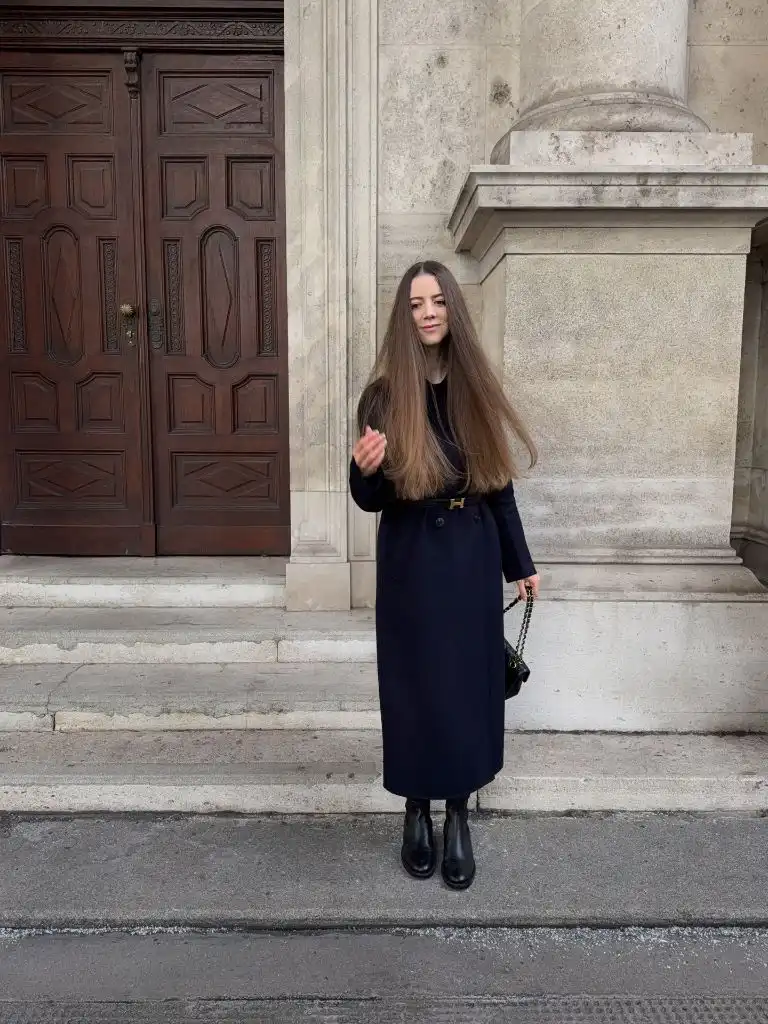
This is a study in vertical line. The coat creates one unbroken dark column from shoulder to shin, and the belt does not interrupt that line so much as it pinches it inward at a single point. The narrowing at the waist gives the column an hourglass silhouette without breaking the color continuity. The gold buckle is the only warm-toned accent in the frame, and because it sits at the body’s midpoint, it anchors the eye before the gaze travels down.
The single most useful detail is the belt placement. It sits exactly at the natural waist, not low on the hip, which is what keeps the vertical proportion reading as elongated rather than bisected. Move that belt down two inches and the coat would visually shorten the torso while lengthening the skirt portion unevenly.
3. Plum Puffer Over Wide Denim
A cropped plum-colored leather-looking puffer jacket with a high stand collar frames the upper body. Beneath it, a gray ribbed knit-looking hood or balaclava is pulled up, and a crossbody bag on a tan strap cuts diagonally across the torso. Wide-leg medium-wash denim-looking pants extend to the ankle, where flat tan suede-looking shoes are partially visible. Dark sunglasses sit above the hood line. The backdrop shows European-style architecture with tram tracks running through a paved square.
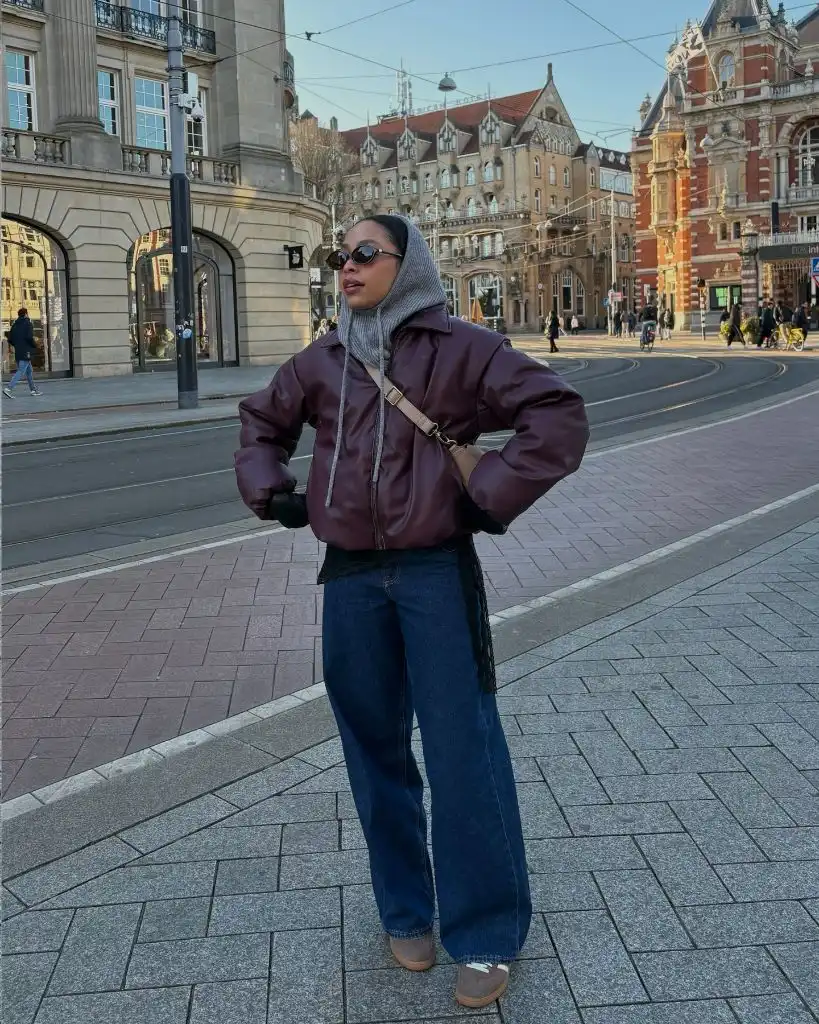
The mechanism that holds this together is contrast in scale. The puffer jacket is short and wide at the shoulder, creating a broad upper block, while the wide-leg denim mirrors that width below but extends it into a long, unbroken panel. Between the two wide zones, the natural waist and the diagonal bag strap provide a narrow transitional moment. The color shift from deep plum to pale denim also separates upper and lower halves cleanly, preventing the wideness from reading as shapeless.
If you want to adapt this shape, the key is matching the volume above and below while keeping the midsection visually compressed. A longer jacket would merge with the wide pants and lose the proportional contrast entirely. The crop is what makes the width readable in two distinct sections.
4. Shearling-Trimmed Coat Over Leather-Looking Shorts
A long tan suede-looking coat with heavy cream-colored fur-like trim along the lapels, hem, and cuffs hangs open over a fitted black turtleneck and dark leather-looking shorts. Sheer black knee-high stockings and pointed black heels continue the dark lower half. A structured black handbag is held in one hand. Curly blonde hair and a dark headband frame the face, with dark angular sunglasses adding a geometric note. The setting features stone columns and cobblestone underfoot.
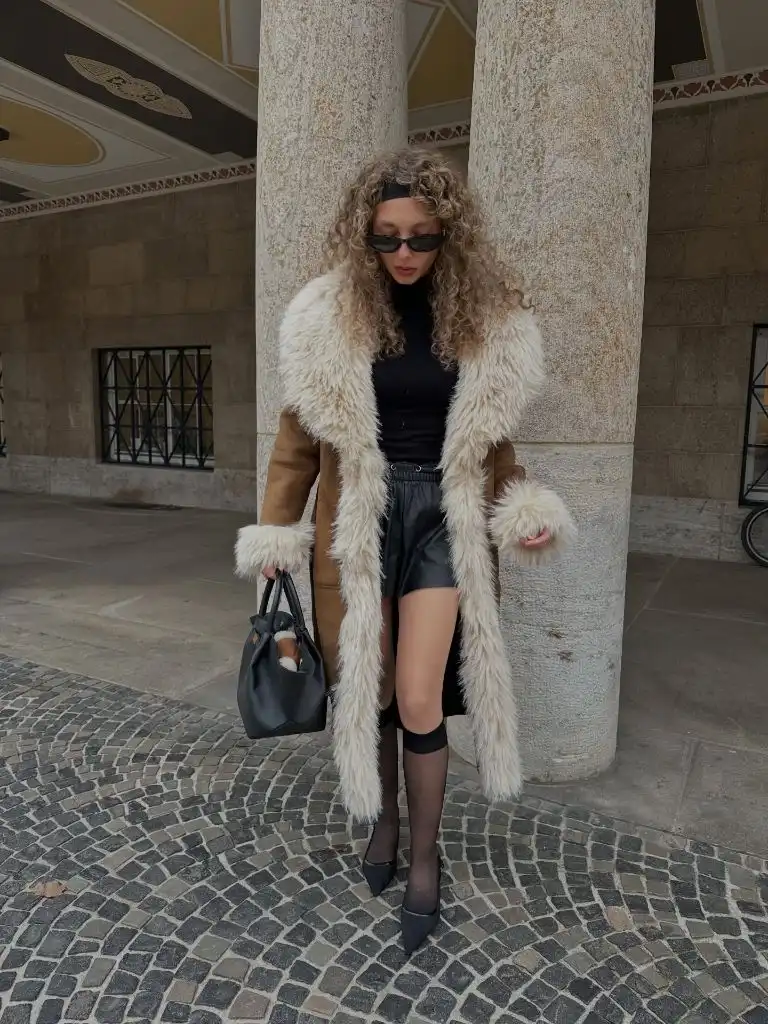
This works through texture against smoothness. The fur-like trim is the most visually active surface in the frame, and it surrounds a core of smooth, matte black pieces that absorb light rather than reflect it. The shorts and turtleneck act as a quiet center, while the coat’s textured edges create a frame around them. This is where winter outfits aesthetic classy works naturally, through a heavy outer layer that reads as decorative while the inner layer stays minimal and dark.
The strongest proportion here is the exposed leg between the short hemline and the knee-high stockings. That strip of skin is the only break in an otherwise covered silhouette, and it pulls attention precisely because everything else is wrapped in heavy texture. Shortening the coat or lengthening the shorts would eliminate that gap and flatten the visual rhythm.
5. Beige Fur-Like Jacket With Iced Coffee
This is a close-crop composition, cutting off the frame at the upper chest and just below the knee. A plush beige fur-like jacket with deep, shaggy texture dominates the upper two-thirds. Beneath it, light-wash relaxed-fit denim-looking pants fall straight. One hand holds a clear iced coffee cup, the other rests near the jacket’s front. A tan leather-looking tote bag with a visible brand patch hangs from the forearm. Gold rings are visible on several fingers. The ground is red brick.
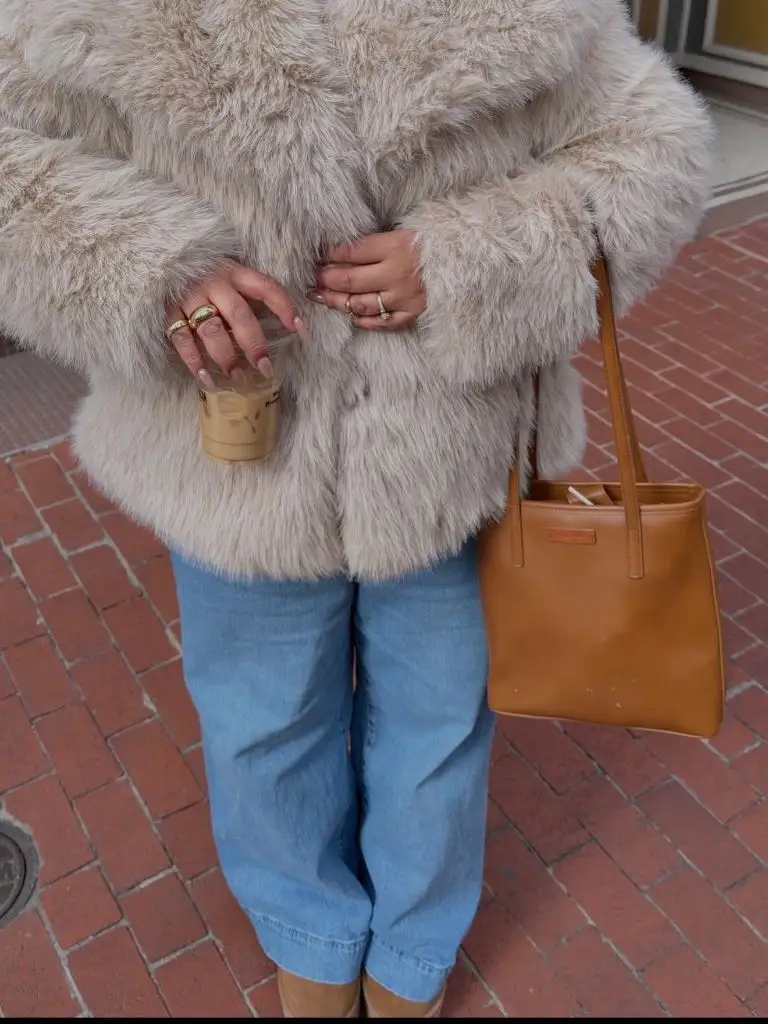
The close crop forces you to read texture and color echo instead of full-body proportion. The beige of the jacket, the caramel of the coffee, and the tan of the tote bag all sit within the same warm tonal family, creating a palette that repeats without matching exactly. The light denim below introduces a cooler undertone that prevents the warm tones from becoming monotonous. The gold rings pick up the warmth one more time at a much smaller scale.
The adaptation worth noting is the tonal layering strategy. Three items in the same color family but at slightly different saturations, one plush, one smooth, one liquid, create visual interest without relying on contrast. If you replaced the tan tote with a black one, the repetition chain would break and the outfit would split into two unrelated halves.
6. Cream Fur-Like Coat With Pink Cap
A voluminous cream-colored fur-like jacket with shaggy, open texture is worn over light-wash wide-leg denim-looking pants. A pink baseball cap sits on the head, and one hand holds a clear iced drink at chest height. The same tan leather-looking tote from the previous image hangs from one arm. Tan platform-soled shoes with a rounded toe are partially visible below the wide denim hem. The background is a set of tall paneled wooden doors in a warm brown tone.
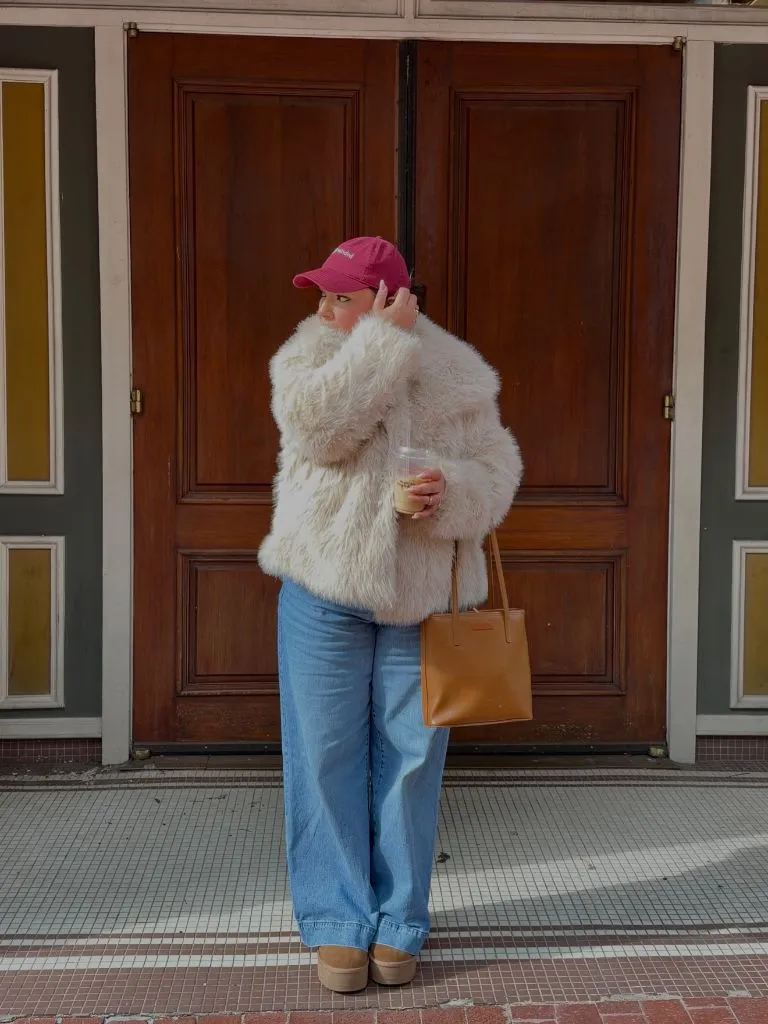
Where the previous outfit used a close crop to emphasize texture, this full-body frame makes the silhouette outline the dominant feature. The jacket creates a wide, soft upper block, and the wide-leg denim extends that width all the way to the ground. The result is a columnar silhouette with no narrowing point, which is rare and visually striking. The pink cap is the single accent that breaks the neutral palette, and because it sits at the highest point of the frame, it functions as a color anchor that the eye finds first.
The strongest proportion here is the equal width from shoulder to ankle. Most outfits create at least one pinch point at the waist, knee, or ankle. This one does not. If you want to recreate the shape, keep both the jacket and pants at the same visual width, and add one small color interruption above the neckline to prevent the silhouette from reading as a single undifferentiated rectangle.
7. White Overcoat Framing All-Black Interior
A long white double-breasted overcoat with wide lapels hangs open, revealing a black turtleneck, a black belt with a silver buckle, and black wide-leg trousers underneath. Black leather-looking gloves and a small structured black handbag with a gold clasp and chain detail are held at the waist. Pointed black shoes with a sharp toe extend below the trouser hem. The coat reaches below the knee, and its bright white surface contrasts sharply against the dark inner column.
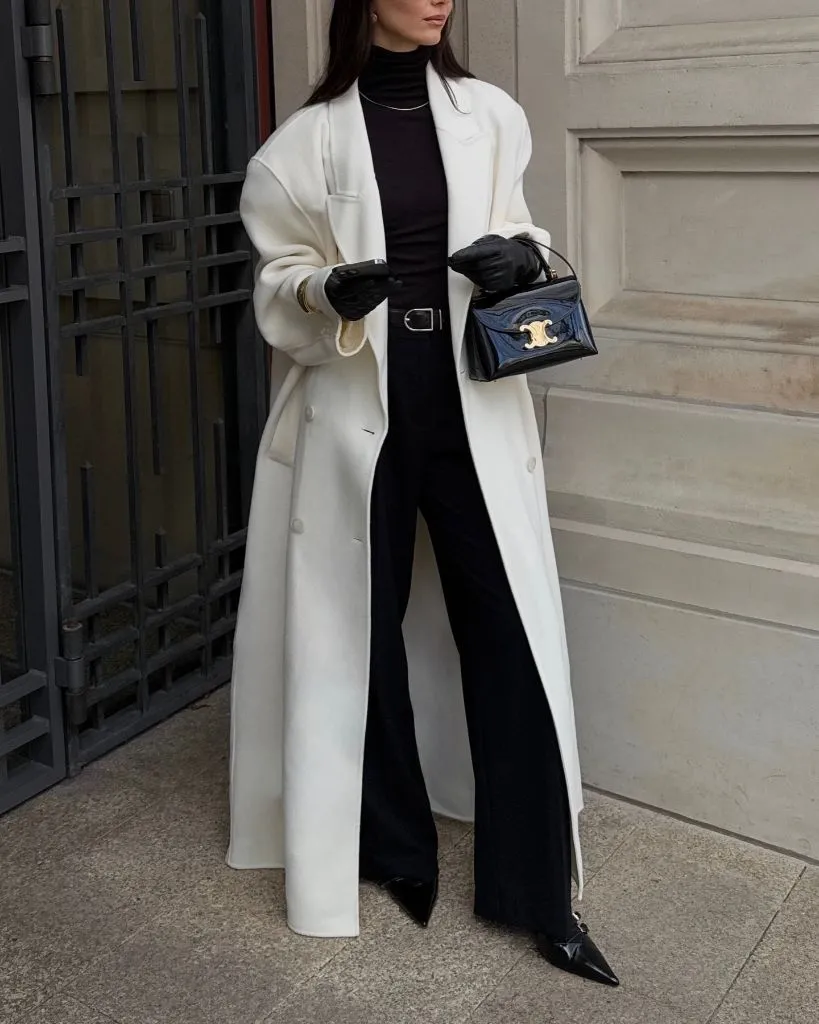
This is a contrast-in-value study pushed to its maximum. The white coat acts as a wide frame, and the black interior acts as a narrow column visible through the opening. The outfit essentially creates a picture-within-a-picture, where the dark center is bordered on both sides by bright fabric. The gold clasp on the bag and the silver belt buckle are the only metallic interruptions, placed at the same horizontal line to create a band of small detail across the midsection.
The most transferable detail is using an open coat as a literal frame around a monochrome interior. The wider the coat lapels and the more it stays unbuttoned, the more the dark center becomes a defined visual channel. Button the coat and the framing effect disappears entirely, which means the styling depends on the coat staying open.
8. Burgundy Leather-Looking Jacket With Layered Travel Accessories
A cropped burgundy leather-looking jacket with exaggerated shoulder structure sits over an olive knit-looking sweater and a printed silk-looking scarf tied at the neck. Dark wide-leg denim-looking pants fall to the floor, where pointed black shoes peek out. A dark knit beanie with red embroidered text sits on the head. A large brown leather-looking top-handle bag rests on a black hard-shell rolling suitcase. The setting appears to be an airport or transit terminal with white walls and large windows.
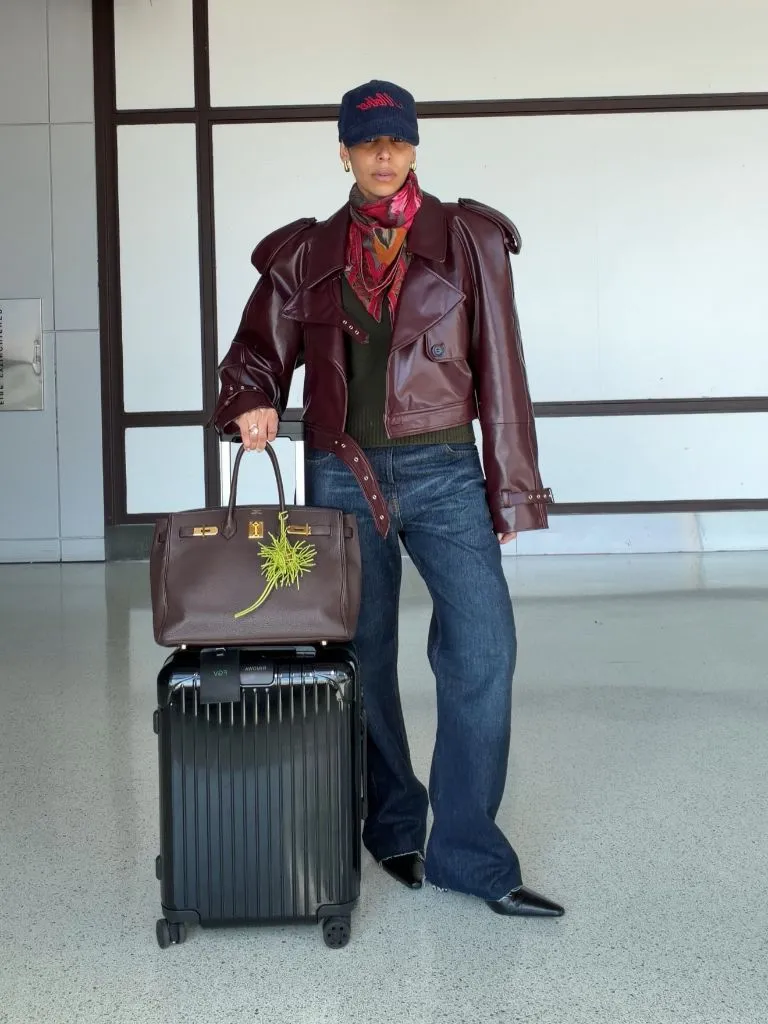
The argument here is about placement and zoning. The outfit stacks multiple visual events in the upper third of the body: the structured shoulders, the printed scarf, the beanie, and the cropped jacket all compete for attention above the waist. Below the waist, the dark denim provides a long, quiet zone with almost no detail. This deliberate zoning means the eye stays busy at the top and rests at the bottom, which is a readable rhythm despite the number of pieces involved. A winter aesthetic outfit built this way avoids clutter by confining detail to one area.
The adaptation is about discipline in the lower half. With this many accessories and layers above the waist, the pants and shoes need to be as simple as possible. Swap the plain dark denim for anything patterned or cropped, and the upper-body detail would no longer have a quiet zone to balance against.
9. Charcoal Cape Layer Over Dark Wide Trousers
A dark charcoal cape-like layered jacket with snap buttons along the shoulder yoke sits over a black ribbed knit-looking top. A white shirt collar peeks out beneath the knit. Wide-leg charcoal trousers with a subtle pinstripe or herringbone texture fall straight to the ground, where flat light-colored shoes provide a tonal break. A gray knit-looking beanie and tortoiseshell-patterned sunglasses add two small points of texture near the face. A dark structured bag is held behind the hip.
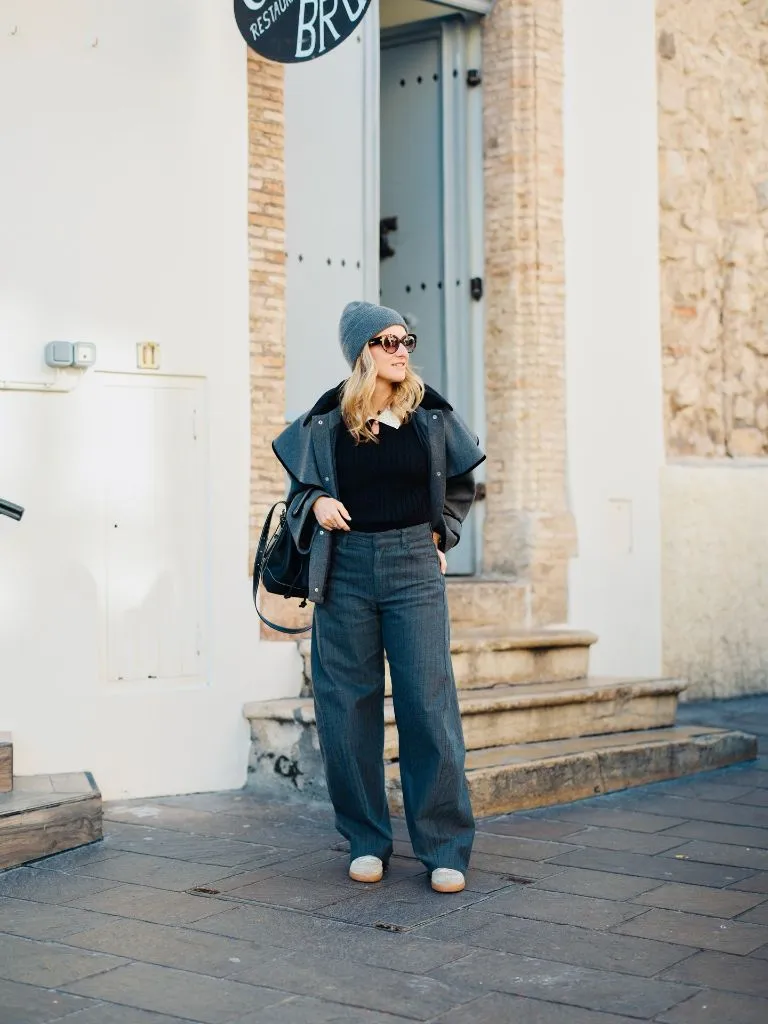
The dominant mechanism is tonal layering within a single color family. Almost every visible piece falls between charcoal and black, yet the outfit avoids flatness because each piece carries a slightly different surface. The cape layer has a smooth, dense finish. The knit top has visible ribbing. The trousers show a faint pattern. The beanie is matte and soft. These surface differences create depth within what is essentially a monochrome column, proving that variety does not require color contrast.
The strongest proportion here is the wide trouser balanced by the structured shoulder of the cape. Both the top and bottom carry width, but the cape’s angular shoulder line gives the upper half a geometric quality that the softer, draping trouser does not share. That shape difference is what separates this from a shapeless dark column.
10. Herringbone Blazer With Gray Turtleneck and Burgundy Bag
A black-and-cream herringbone-patterned blazer is worn open over a gray turtleneck knit-looking sweater. Dark wide-leg jeans sit high at the waist, secured with a dark belt featuring a gold buckle. A burgundy leather-looking crossbody bucket bag hangs at the hip. Tortoiseshell sunglasses and tan suede-looking pointed heels complete the frame. The background shows a European-looking shopping street with greenery-framed storefronts and warm lighting.
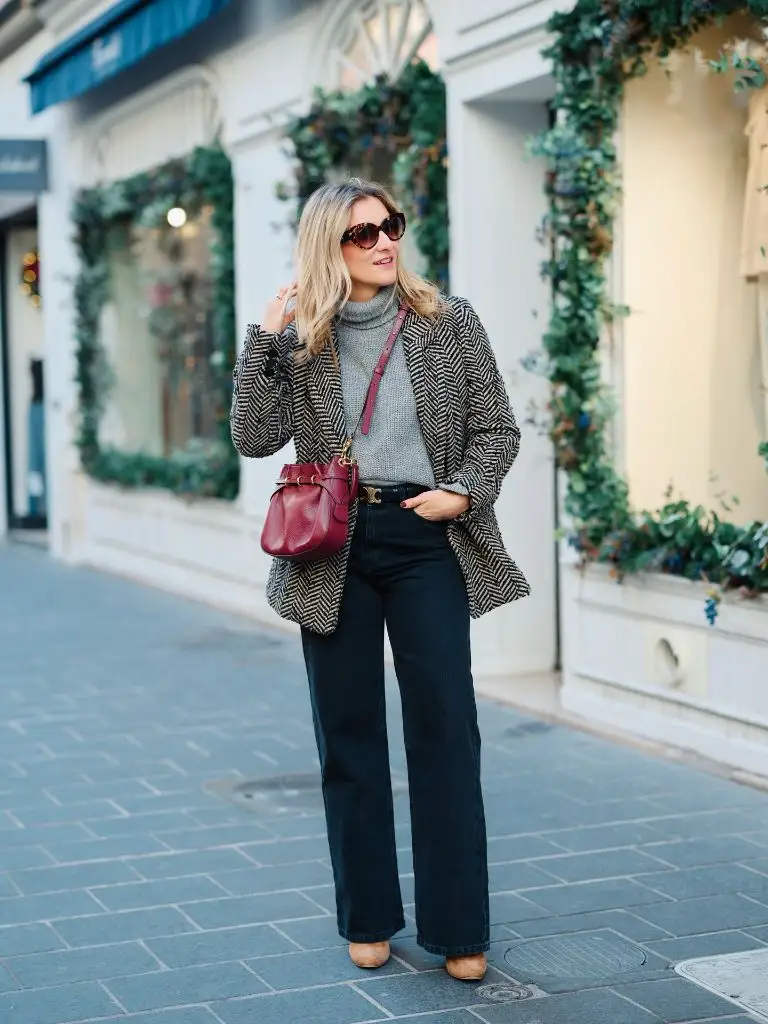
This composition works through scale of pattern. The herringbone on the blazer is the most active visual texture in the frame, and it is contained within a relatively small area compared to the large plain surfaces of the jeans and turtleneck. The burgundy bag introduces the only saturated color, and because it sits at the hip against the dark denim, it stands out without competing with the patterned blazer above it. Two points of visual interest, one textural, one chromatic, placed at different heights, keep the eye moving vertically.
The most useful detail is the restraint in the lower half. The dark jeans and simple heels do almost no visual work, which is why the blazer’s pattern and the bag’s color get to be prominent. If you added patterned shoes or a second bold color below the waist, the composition would lose its two-point clarity and become scattered. Check chicstyleblog.com for more on balancing pattern with plain surfaces.
11. Camel Overcoat Over White Top and Cream Skirt
A long camel-colored overcoat with dark buttons hangs open, showing a white ribbed-looking top and a cream or pale beige skirt that falls above the knee. A dark brown leather-looking belt cinches the waist between the top and skirt. Black tall boots rise to just below the knee. A cognac-toned leather-looking shoulder bag sits on one arm. The ground is gray stone with a striped crosswalk pattern partially visible.
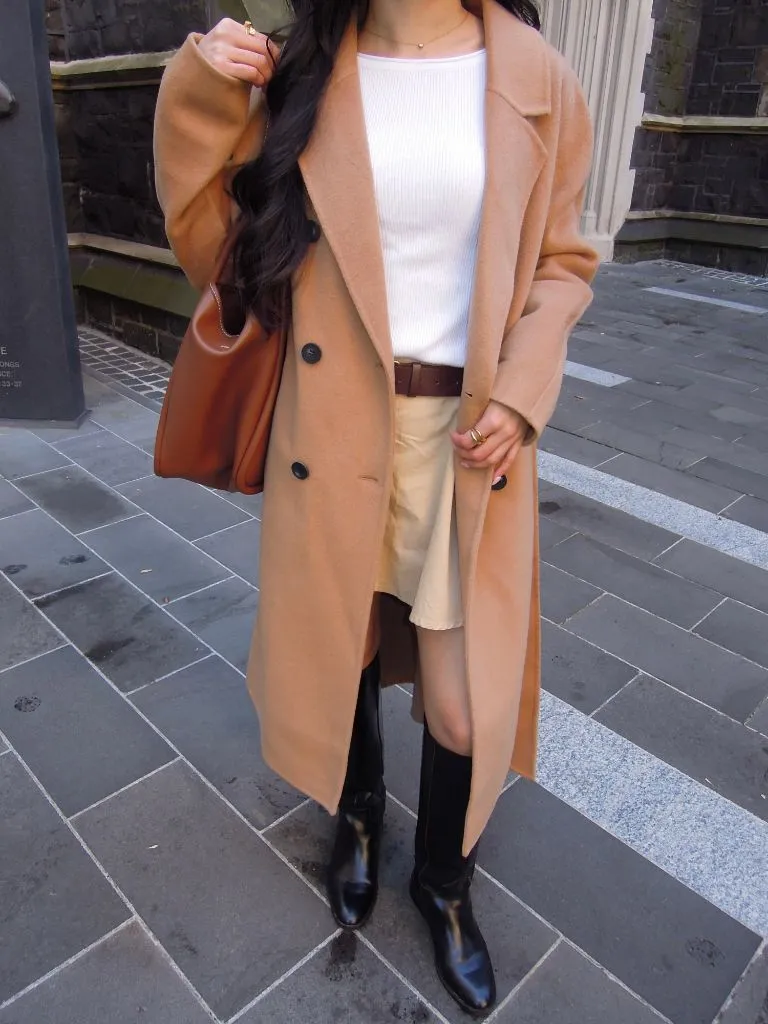
The rhythm here is built from alternating light and dark bands. Starting from the top: camel coat, white top, dark belt, cream skirt, skin, black boots. That sequence of warm-light-dark-light-light-dark creates a visual pattern that repeats the light-dark exchange several times across the body’s length. No single zone dominates because the eye keeps bouncing between the light and dark segments. This rhythmic alternation is more complex than a simple two-tone split.
The adaptation worth noting is the belt’s role as a separator. Without it, the white top and cream skirt would blur into one pale zone, and the rhythm would simplify into just pale-above and dark-below. The belt’s dark color introduces a necessary dividing line that keeps each light segment distinct. Even a narrow belt achieves this as long as it contrasts with what sits above and below it.
12. Black Belted Jacket With Cream Wide Culottes
A black high-collared jacket with a tie belt at the waist creates a defined upper structure. Beneath it, wide cream-colored culottes or a wide midi skirt falls to mid-calf. Black leather-looking boots with a squared toe extend below the cream hemline. Oval dark sunglasses and a brown leather-looking shoulder bag add small accent notes. The setting shows a tiled storefront with a shop window displaying the text “SOAZ 22.”
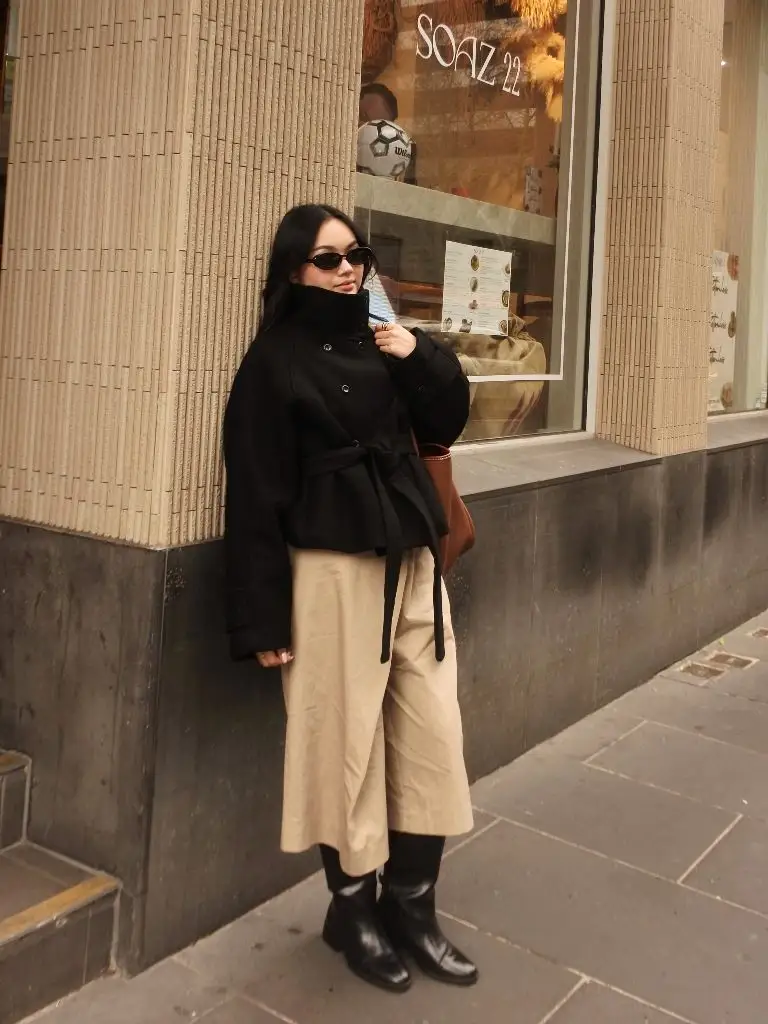
The mechanism is negative space created by the wide, pale lower half. The cream culottes form a large light area that contrasts with the compact, dark upper half. Because the jacket is belted and fitted, it occupies relatively little visual space, while the culottes spread wide and catch light. That imbalance, where the bottom is lighter and wider than the top, inverts the more common top-heavy winter silhouette seen earlier in this set. The boots reintroduce dark at the hem, grounding the light expanse so it does not float.
The strongest proportion is the length of the cream panel relative to the black jacket. The cream section is roughly twice as long as the black section, which is what gives the lower half its visual dominance. Shortening the culottes or lengthening the jacket would equalize the two halves and reduce the outfit’s most distinctive quality, that sense of weight pooling downward into light fabric.
13. Gray Fur-Like Cropped Jacket Against Textured Wall
A cropped gray fur-like jacket with a voluminous, rounded silhouette covers the upper body down to just below the waist. Black gloves, a small black bag held at the hip, and black wide-leg trousers continue below. The jacket’s gray tone is cool and silvery, reading lighter against the rough, earth-toned textured wall behind. Dark cat-eye sunglasses and a slicked-back hairstyle keep the head area clean and minimal. The frame is cropped just above the knee.
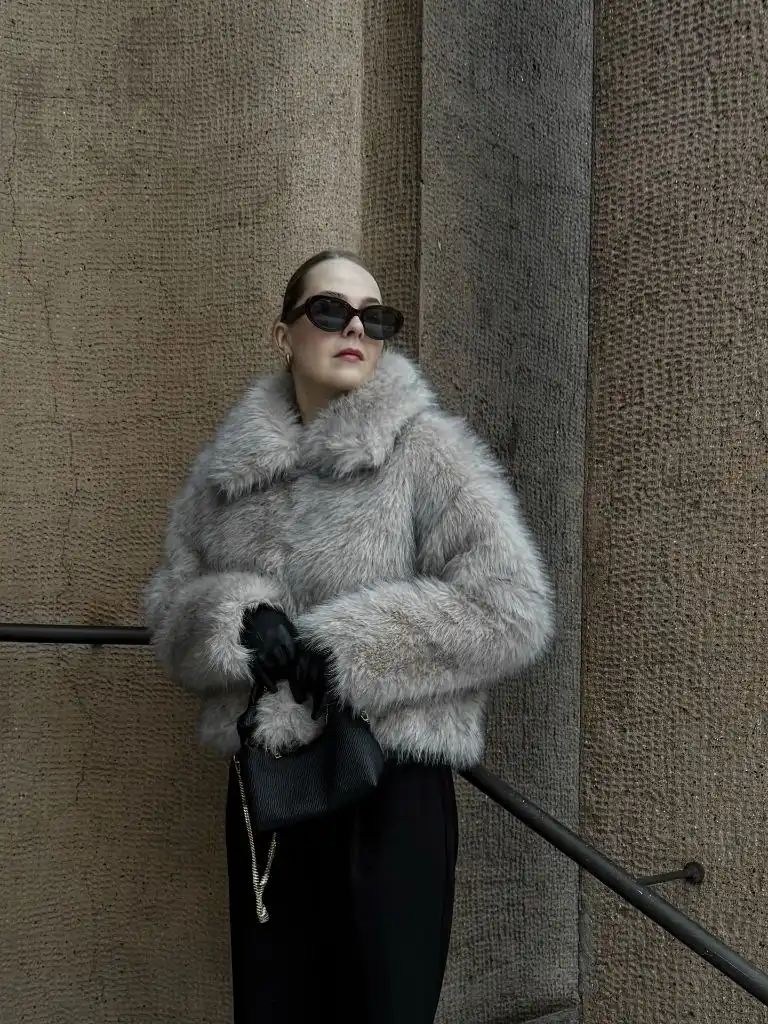
This works as a silhouette outline study. The jacket’s rounded, puffy shape against the flat, hard wall creates a strong figure-ground contrast. The jacket is the only soft, three-dimensional element in the frame, and everything else, the flat trousers, the smooth gloves, the angular sunglasses, defers to it. The gray-on-black palette keeps color out of the conversation entirely, leaving shape and texture as the only two variables. That simplification makes the jacket’s volume the single focal point.
If you want to use a voluminous fur-like jacket without it overwhelming the frame, this is the template: keep everything below it dark, flat, and close to the body. The moment you add wide pants or a competing texture below, the jacket’s rounded shape loses its contrast against the surroundings. Restraint underneath is what makes volume on top read as intentional. Visit chicstyleblog.com for further proportion breakdowns.
14. Leopard Knit-Looking Sweater in Mirror Selfie
This is a mirror selfie cropped at the upper thigh, placing all the focus on the torso. A gray and dark brown leopard-patterned knit-looking oversized sweater fills most of the frame. A mauve-toned headscarf is wrapped around the head and neck. Silver chunky rings, a silver bead bracelet, and a silver chain necklace cluster near the hands and neckline. A phone with a reflective metallic case is held in front of the face. The lower edge of what appears to be gray wide-leg pants is barely visible.
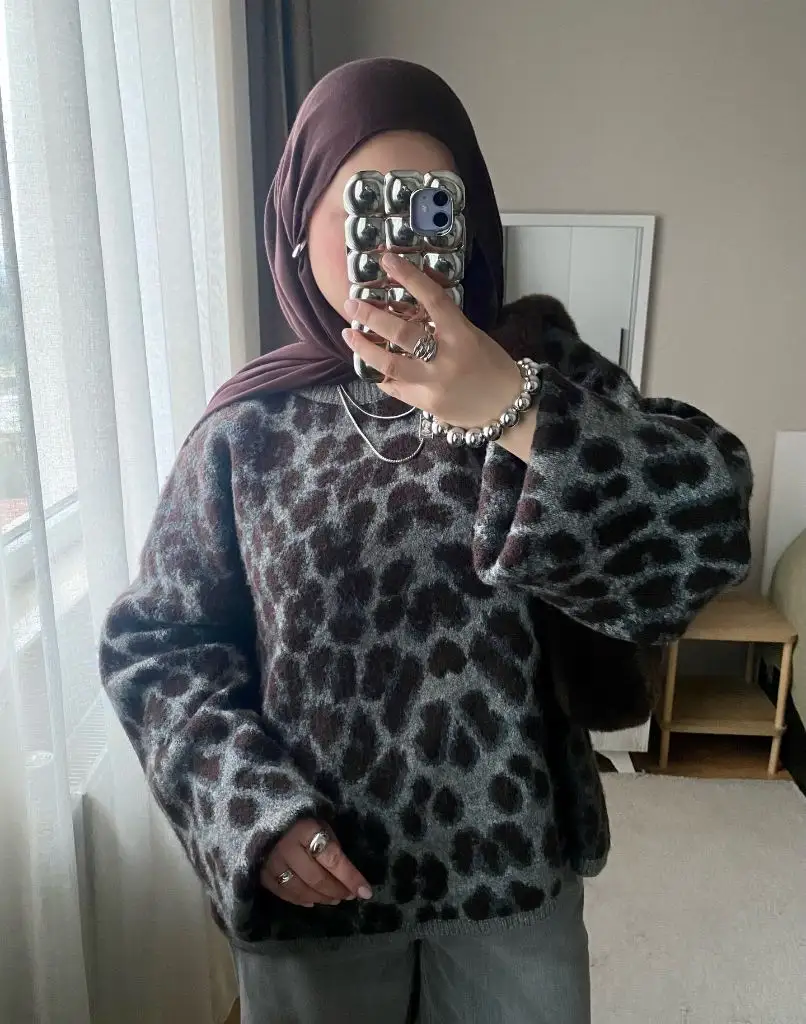
The dominant argument here is one accent versus many, but inverted. The leopard print is the large-scale pattern that fills the frame, and the silver jewelry pieces are the many small accents scattered across it. Because the silver is cool-toned and reflective while the sweater is warm-toned and matte, the jewelry reads as a constellation of bright points against a textured background. The headscarf’s mauve tone bridges between the cool silver and the warm brown of the print, sitting at a midpoint in color temperature.
The takeaway is about accessory density over a busy pattern. The silver pieces work because they are all the same metal tone and similar in visual weight. Mixing gold and silver, or adding a brightly colored bag, would create competition with the already-active print. When the garment carries this much pattern, accessories succeed by being tonally uniform.
15. Gray Trench-Style Coat Over Pale Knit
A long gray trench-style coat with a button-front closure hangs open to reveal a light gray or off-white chunky knit-looking sweater underneath. Black wide-leg trousers fall to the floor. A black leather-looking crossbody bag with a simple rectangular shape hangs at hip level. The outfit is captured in a full-length mirror selfie in what appears to be a bright interior space with wooden furniture and a white ceramic vase holding dried branches. A phone is held at face level.
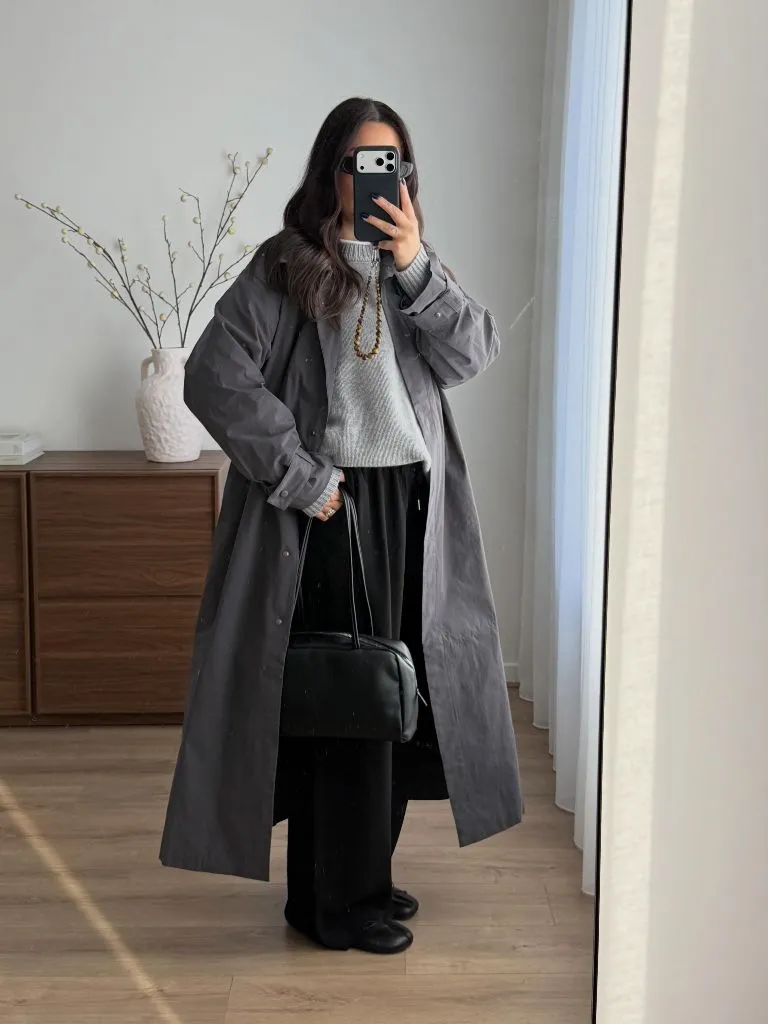
This is a value-gradient study. The coat is medium gray, the sweater beneath it is lighter gray, and the trousers at the bottom are black. The outfit moves from light to dark as the eye travels downward, creating a gradient effect that feels deliberate rather than accidental. The black bag sits against the dark trousers where it nearly disappears, which is a strategic choice: it removes one potential interruption from an otherwise smooth tonal transition. Winter outfits aesthetic often relies on this kind of quiet graduation rather than sharp contrast.
The most useful adaptation involves the sweater’s role. It provides the lightest value in the outfit and sits at chest level, which is where the eye naturally settles in a full-body mirror shot. If you swapped it for a dark sweater, the gradient would break into a dark-light-dark sandwich, losing the smooth downward transition. Keep the lightest piece near the center of the body when working in a single color family.
16. Beige Trench Over Striped Top in Autumn Park
A short beige trench-style coat with double-breasted buttons is worn over a navy-and-white horizontal striped top. Black wide-leg trousers fall straight and long, nearly covering the shoes. A navy baseball cap, oval silver-framed sunglasses, and a brown leather-looking shoulder bag add accessory detail. The shoes appear dark. The setting is an autumn park with yellow fallen leaves carpeting the ground and trees with gold and green foliage in the background.
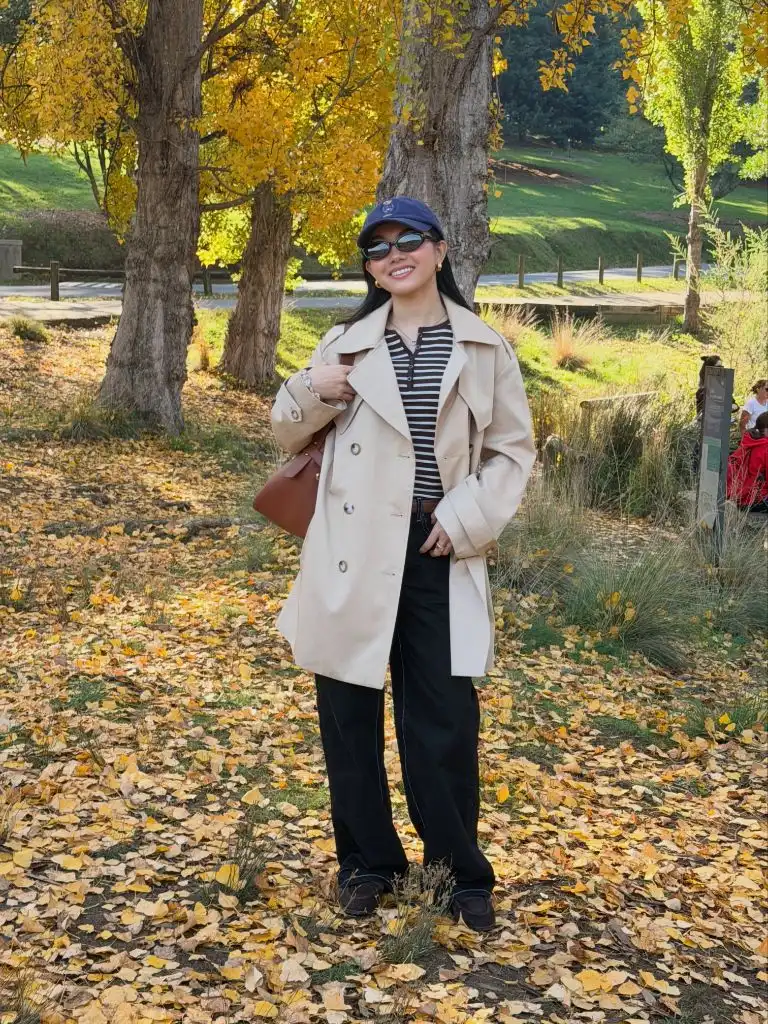
The mechanism here is color echo between the outfit and the visible surroundings. The beige coat picks up the golden-yellow of the fallen leaves, and the brown bag reinforces that warm tone. The navy cap and striped top ground the palette with a cooler note that prevents the warm tones from feeling unbroken. This echo effect is not something the outfit creates alone; it depends on the environment. The same outfit against a gray wall would read as preppy and quiet. Against the autumn backdrop, it reads as integrated. Considering winter aesthetic outfits across seasonal transitions, this illustrates how environment shifts a palette’s impact.
The adaptation is about stripe scale. The horizontal stripes are thin and closely spaced, which makes them read as a subtle texture rather than a bold graphic. Wider stripes would compete with the coat’s plain surface more aggressively. When layering a patterned piece under a solid coat, keep the pattern fine enough that it recedes slightly behind the outerwear.
17. Deep Burgundy Fur-Like Jacket With Snowy Backdrop
A voluminous deep burgundy fur-like jacket with a round, cropped shape sits over a tonal burgundy patterned turtleneck or scarf at the neck. Dark gray or charcoal jeans are visible below. A small cream-colored structured bag is held at the waist. Dark oversized sunglasses cover the upper face. The hair is pulled back. Behind the figure, a black iron fence and snow-covered ground create a stark background. Bare tree branches and a columned structure are visible beyond.
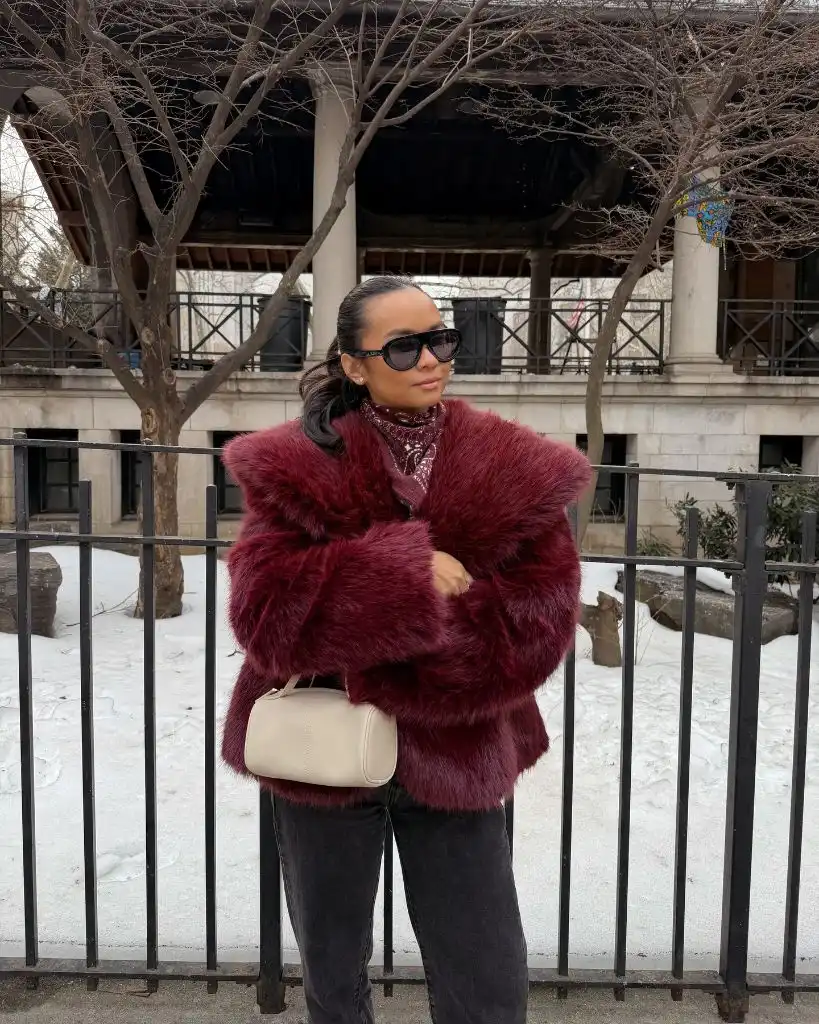
The contrast point here is the cream bag against the deep burgundy jacket. Everything else in the outfit sits in the dark range, from the burgundy to the charcoal jeans to the dark sunglasses. The cream bag interrupts that darkness at the body’s center, creating a single bright focal point that the eye locks onto. The snow in the background echoes that cream tone, which means the bag and the environment share a value while the outfit itself stays saturated and dark. That creates a feeling of the figure standing as a dark shape inside a light frame.
The takeaway is the power of one light object inside a dark composition. The bag does not need to be large or ornate. Its lightness is enough to become the accent. If you replaced it with a black bag, the entire outfit would merge into one dark block with no resting point for the eye. One pale piece at the center is doing all the compositional work.
18. Brown Teddy-Looking Coat With Tropical Greenery
A three-quarter view shows a long dark brown teddy-looking coat with a curly, nubby texture and large dark buttons. The coat is open slightly, revealing a dark layer beneath. One hand holds a small dark object near the chest. The background contains tropical-looking palm fronds and broad-leafed plants against a stone building wall, creating an unexpected pairing of heavy outerwear against lush green foliage. The frame is cropped at approximately mid-thigh.
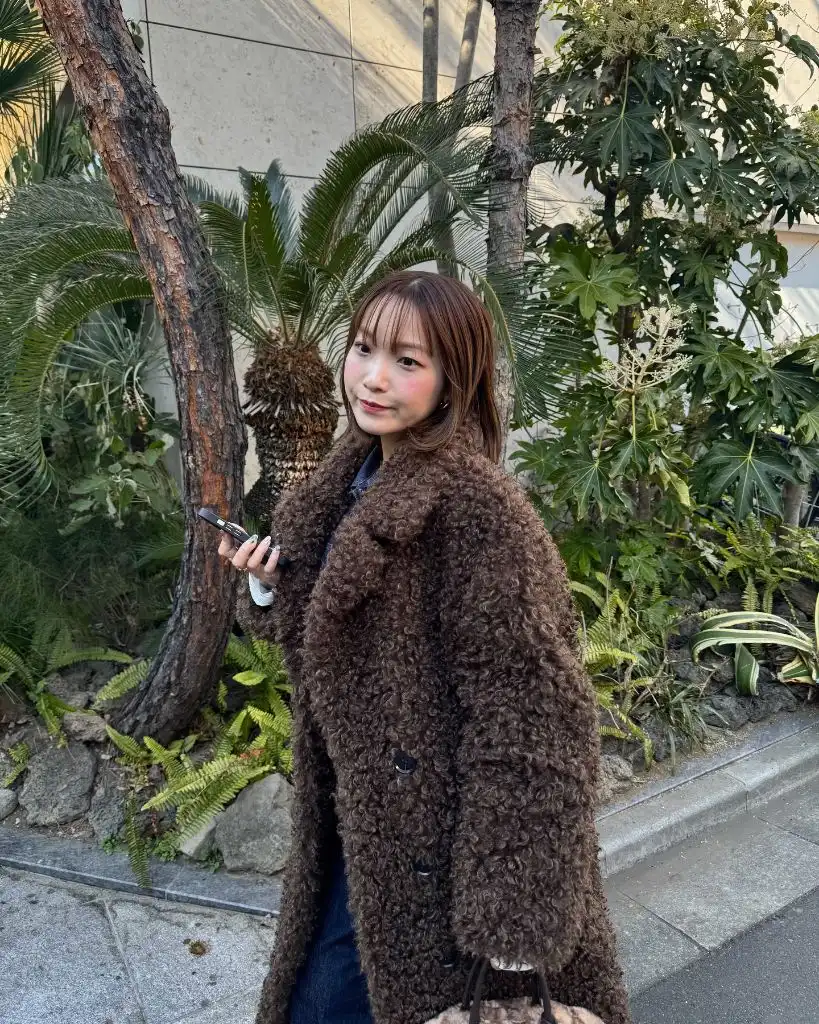
The visual argument is texture against texture. The coat’s curly, dimensional surface occupies the left half of the frame, while the feathery, organic shapes of the palm fronds occupy the right and background. Both surfaces are highly textured but in completely different ways: one is dense and uniform, the other is irregular and organic. The brown-against-green color relationship adds a complementary contrast that strengthens the figure-ground separation. Neither the coat nor the plants are flat, which gives the image an unusual amount of surface activity.
The strongest proportion here is how much of the frame the coat fills. Because the image is cropped close and the coat extends nearly to the frame’s edges, the texture becomes almost abstract. To adapt this for your own wardrobe choices, consider that a heavily textured coat reads very differently in a tight frame versus a full-body shot. Shown at full length, this coat would be one element among many. Cropped close, the texture becomes the subject.
19. Black Blazer With Gray Knit Draped at Shoulders
A black single-button blazer is layered over a black top, with a gray ribbed knit-looking sweater or cardigan draped over the shoulders so that its body falls behind and its collar frames the neck. Dark charcoal cropped trousers with a straight leg taper to the ankle above black pointed-toe pumps. A small dark structured bag is held in one hand. The setting is a styled interior with dried pampas grass in vases, a full-length mirror, and a row of hats mounted on the wall.
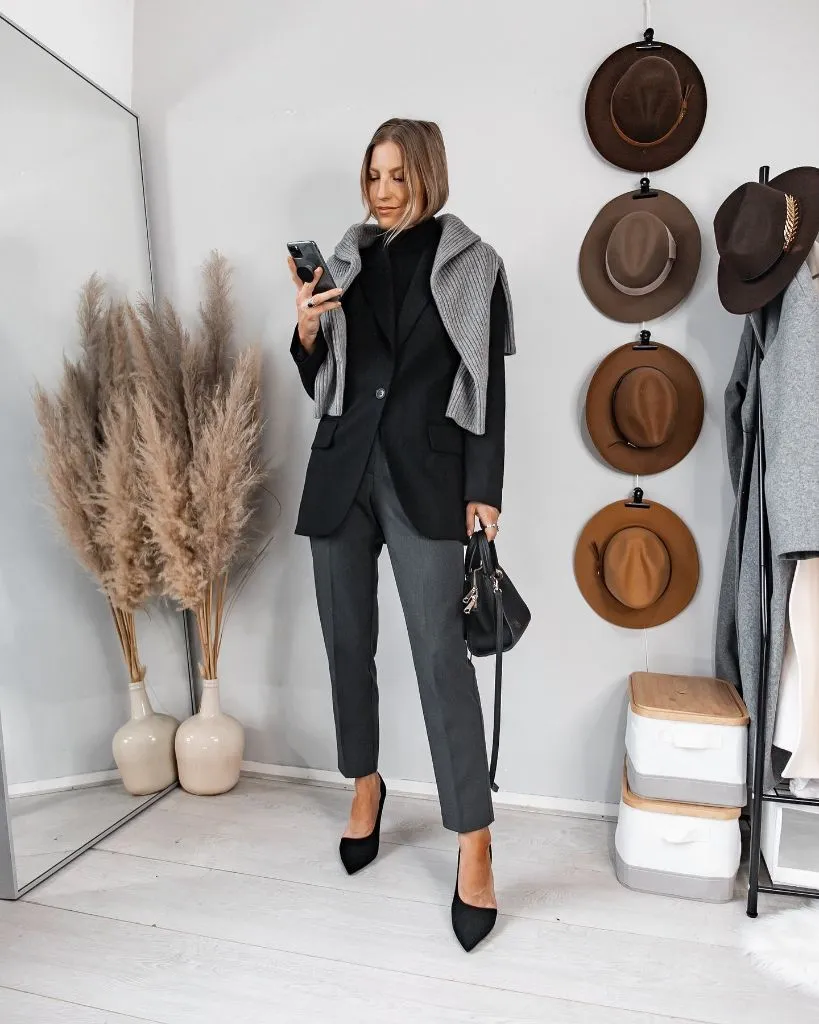
The analytical lens here is placement. The gray knit is not worn conventionally. It is draped at the shoulders, which means it occupies the highest visible zone of the outfit and introduces the only lighter tone right where the eye enters the frame. Below it, everything is dark: black blazer, black top, charcoal trousers, black shoes. The drape transforms a simple knitwear piece into a compositional device that creates a light cap over a dark column. The hat wall in the background reinforces the idea of accessories as framing elements.
The most useful detail is the crop length of the trousers. They end just above the ankle, exposing a small gap before the pointed shoe. That gap is doing the same thing the cream bag did in the burgundy outfit earlier: it introduces a small interruption in an otherwise continuous dark line. Keep that ankle showing when wearing dark-on-dark below the waist, because without it, the trouser and shoe merge into one unbroken mass.
20. Charcoal Belted Coat in Parisian Cafe
A seated three-quarter view shows a dark charcoal structured coat with a notched collar and what appears to be a belt or buckle closure at the waist. Dark gray or charcoal wide-leg jeans extend below. The background is a warm-toned cafe interior with mosaic tile flooring, a cast-iron radiator, wooden furniture, and glass shelving. Dark oversized sunglasses remain on. A white coffee cup on a saucer rests on a small round table. The overall frame reads as dark figure in a warm, light interior.
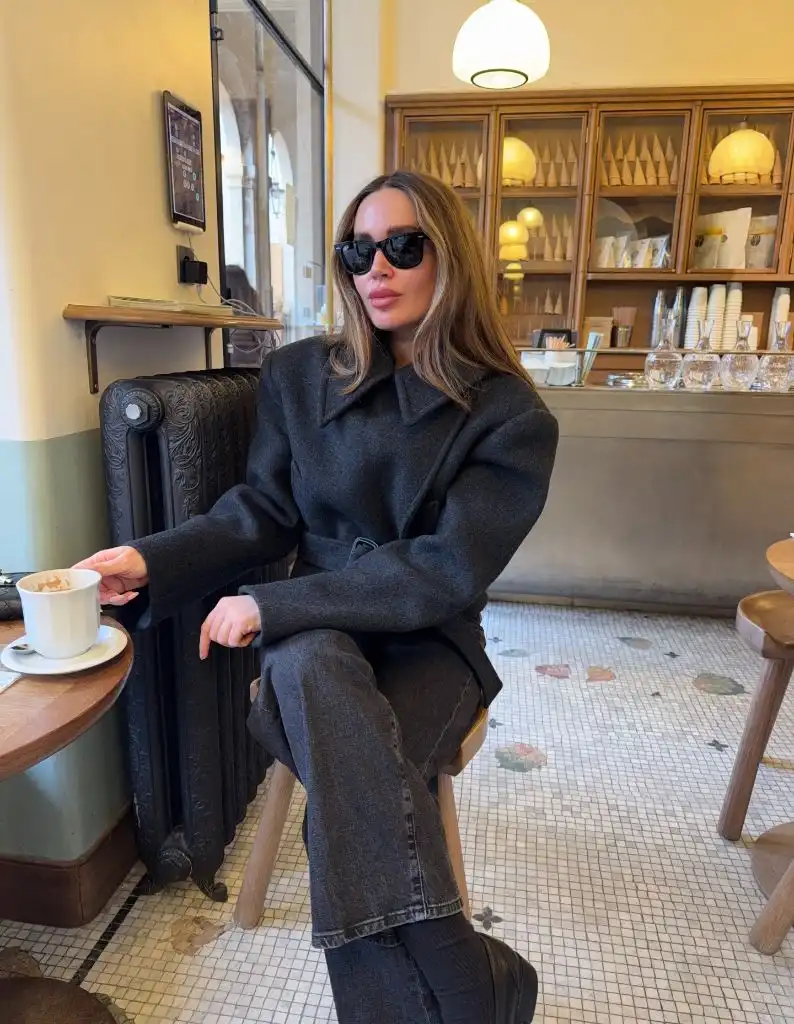
The contrast here is environmental rather than garment-based. The outfit itself is nearly monotone dark charcoal from shoulder to shoe, carrying minimal internal variation. What creates the visual interest is the warm cafe background: the honey-toned wood, the cream tile, the white cup. The dark figure reads as a solid shape against a light, detailed backdrop, which is the opposite of how most of the other outfits in this set work. Here, the background is doing the compositional heavy lifting, and the outfit’s job is simply to be a clean, dark anchor.
The adaptation is straightforward: when you dress in a single dark tone head to foot, the environment you choose to photograph or exist in becomes part of the outfit’s visual identity. The same charcoal coat against a charcoal wall would disappear. Against warm wood and white tile, it becomes a focal point. Winter outfits aesthetic is sometimes less about what you wear and more about what surrounds you.
21. Brown Suede-Looking Fringe Jacket Over White Pants
A mirror selfie shows a brown suede-looking jacket with horizontal fringe detail across the chest, worn open over a black top. White straight-leg pants end just above the ankle. Flat leopard-print-patterned ballet-style shoes provide a patterned accent at the base. The setting is a bedroom with white walls, a white door, and light-colored flooring. The phone is held at face height, partially obscuring the face.
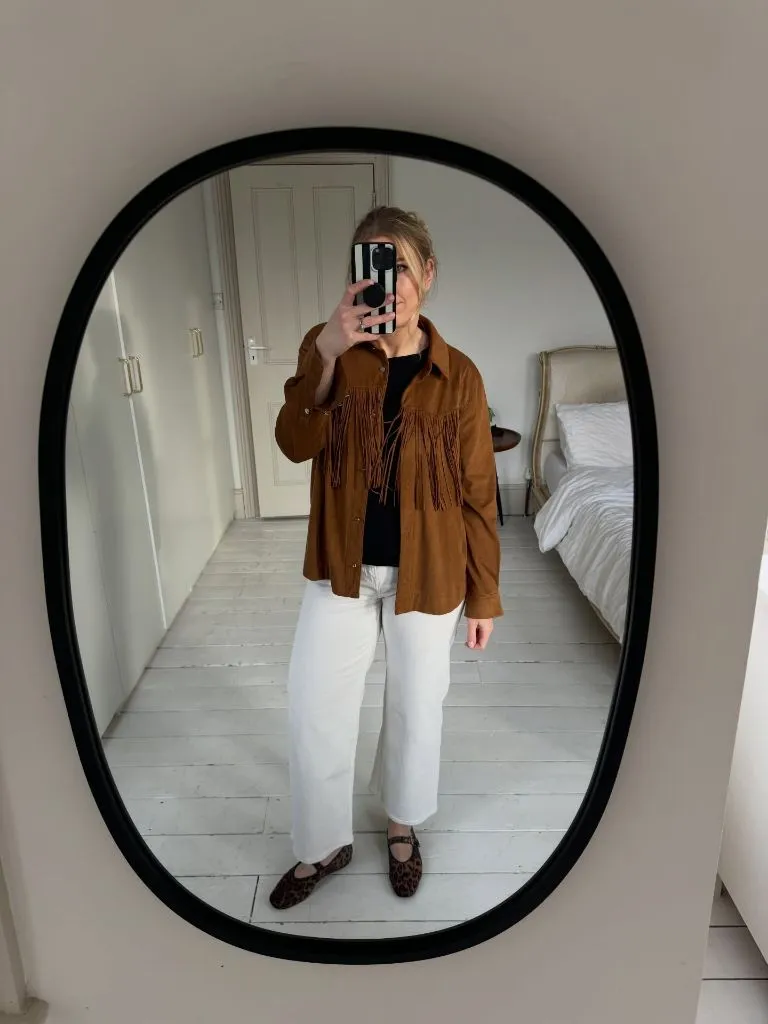
The mechanism is the horizontal line created by the fringe. Every other element in the outfit runs vertically: the straight pants, the open jacket edges, the body’s natural line. The fringe cuts across the chest horizontally, creating a single interrupting band that stops the eye from sliding straight down. That horizontal accent is subtle but it restructures the entire reading of the silhouette, converting a simple jacket-and-pants combination into something with directional tension. The leopard flats echo the brown of the jacket at a much smaller scale, tying top to bottom.
The strongest detail here is the fringe placement at chest level. Lower fringe, say at the jacket’s hem, would draw the eye downward and visually shorten the torso. At chest height, the horizontal line widens the upper body’s apparent span. If you are considering a fringe jacket, pay attention to where the fringe sits, because that horizontal line will redefine proportions more than the fringe’s texture or length.
22. Burgundy Fur-Like Jacket Tonal With Patterned Turtleneck
A deep burgundy fur-like cropped jacket with a voluminous, rounded shape sits over what appears to be a burgundy patterned turtleneck beneath. The visible portion of the turtleneck carries a subtle texture or print in a similar tone. Dark charcoal or faded black jeans are visible below. A cream-colored small structured bag is held at the center. The background shows a snowy scene with a dark iron fence, bare branches, and a columned structure.
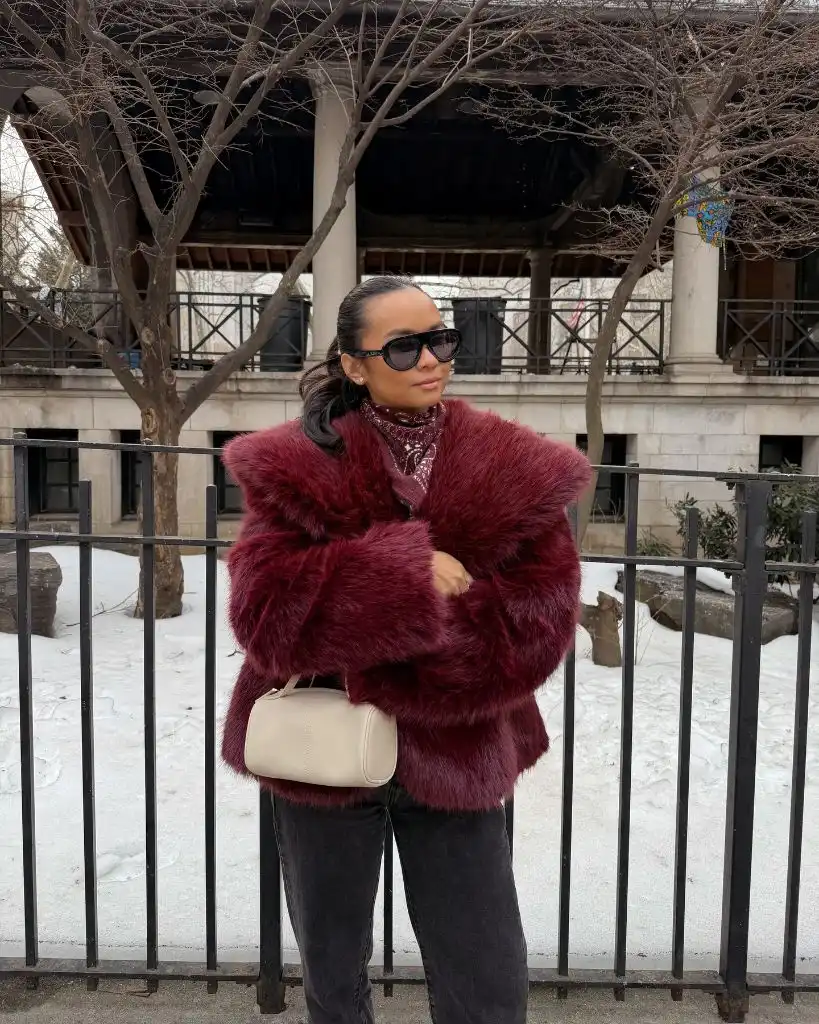
The argument here is tonal layering within one hue. The jacket and the turtleneck are both burgundy, but the jacket’s fur-like surface catches light differently than the flatter turtleneck beneath. This means the same color appears in two different values depending on the surface, creating depth without introducing a second color. The cream bag and the snowy background serve as the only light notes, and they sit outside the burgundy zone, framing it rather than competing with it.
The adaptation is about committing to a single color across your heaviest layers and letting texture do the work of differentiation. If the turtleneck were a contrasting color, say cream or gray, the jacket’s rich tone would be isolated rather than reinforced. By keeping both pieces in the same family, the burgundy reads as a deliberate color statement rather than an incidental coat color.

Hi, I’m Zoey Mitchell, the creator of ChicStyle Blog.
I share simple, wearable outfit ideas, hairstyles, nail trends, and beauty tips that feel natural and easy to recreate.
This blog is where I explore everything that makes a woman feel put together and confident every day. I’m not an expert — just a woman who genuinely loves style, mixing looks, and discovering what works.
If you love effortless fashion with a personal touch, you’ll feel at home here.