
Winter hair color for black women requires a decision most shade guides skip: whether to let the tone sit close to your natural base or push it far enough away that the contrast becomes the point. The answer depends on how much visual distance you want between your roots and your ends, and on whether the color reads as a surface change or a structural one. Proximity to your base creates warmth; departure from it creates edge.
Winter hair color for black women works best when you treat each option as a relationship between two or three tones rather than a single flat shade. Across these examples, notice what changes and what stays fixed: some keep the roots dark and move the ends toward copper or platinum, while others shift the entire head into one saturated hue. Compare where the lightest point falls, how much of the natural texture stays visible, and whether the color or the cut carries the composition.
1. Freeform Locs With Dark Brown Volume
Shoulder-length freeform locs fill the frame from a three-quarter front angle, parted loosely near the center. The color is a consistent dark chocolate brown from root to tip, with slight tonal variation where individual locs catch the light. A blue eyeliner wing and a small gold nose ring sit against the face. The background is a flat blue-gray textured wall, and a cream knit-looking sleeve enters the lower right corner.
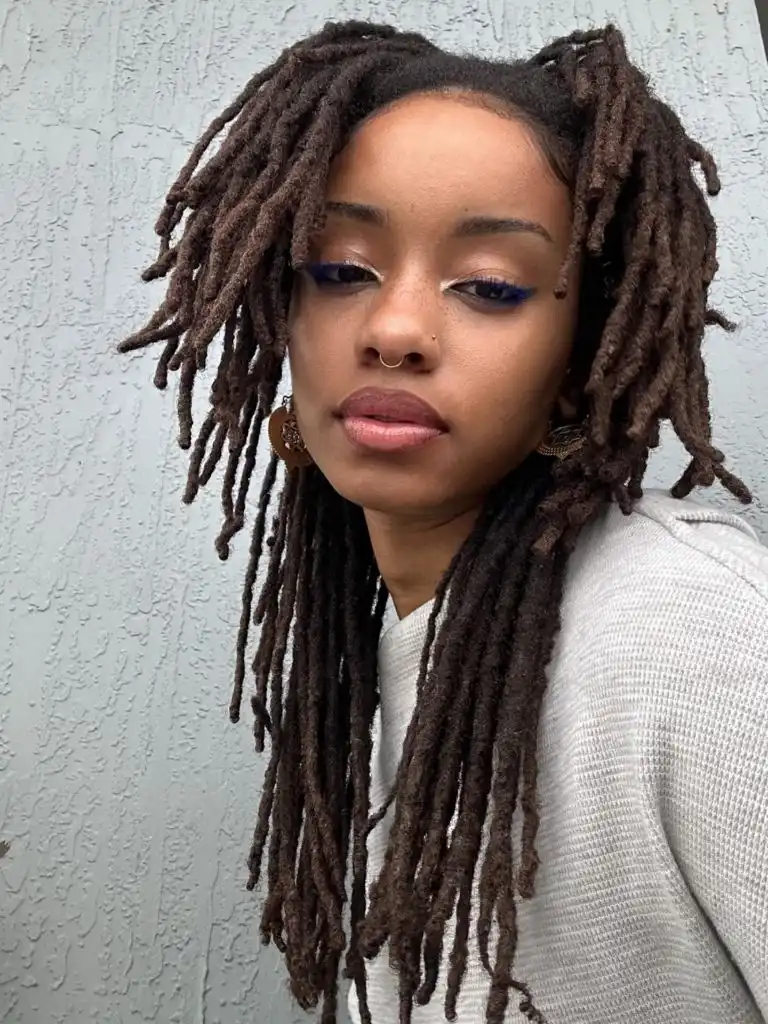
The strength here is textural density against a monochrome backdrop. Every loc carries a slightly different diameter and curl pattern, which means the single brown hue never reads as flat. The blue-gray wall functions almost like a complementary color field, pushing the warm brown forward. Because no highlight or ombre interrupts the length, the eye registers shape and movement first, color second. This is tonal layering working through volume rather than through shade variation.
If you want this kind of uniform richness, the key detail is keeping the tone close to your natural base so regrowth stays invisible. A semi-permanent deposit in the dark brown family refreshes without lifting. To push it further, a single face-framing loc in a warmer chestnut would add a break without disrupting the overall density reading.
2. Curly Bob With Emerald Green Ends
A close-crop selfie taken inside a car shows voluminous curls at roughly chin length, parted off-center. The roots are a deep natural black that transitions into a vivid emerald green through the mid-lengths and ends. One hand rests against the cheek. A dark gray graphic tee with a “Laguna” print is partially visible below the curls.
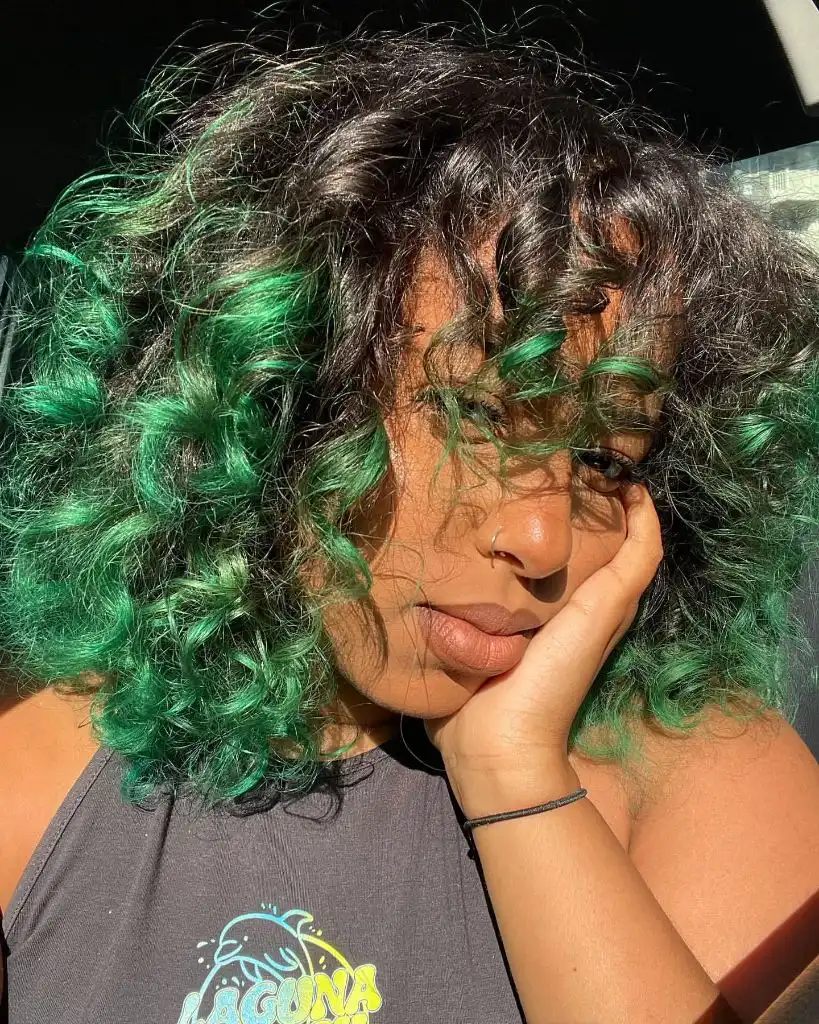
The mechanism driving this composition is contrast in value. The black root zone is the darkest element in the frame, and the green sits in a mid-value range that the eye reads as luminous precisely because of how dark the origin point is. Natural curl pattern disperses the green unevenly, so some spirals read almost teal while others stay closer to forest. This irregular distribution prevents the color from looking like a single solid block and instead makes it feel organic.
To adapt this for a subtler read, reduce the green saturation to a dark teal so the jump from black root to colored end is shorter. For bolder impact, extend the green closer to the roots and add a lighter mint tone at the very tips, creating a three-stage gradient. The curl pattern does the blending work naturally, so precise placement matters less than it would on straight hair.
3. Auburn Waves With Warm Copper Dimension
A side-profile view shows medium-length hair with loose waves, brushing just past the shoulders. The color moves between a dark auburn base and brighter copper strands that catch light across the mid-shaft. Glasses and a black face mask are visible. The setting appears to be a salon, with dark chairs and a stone-textured wall in the background.
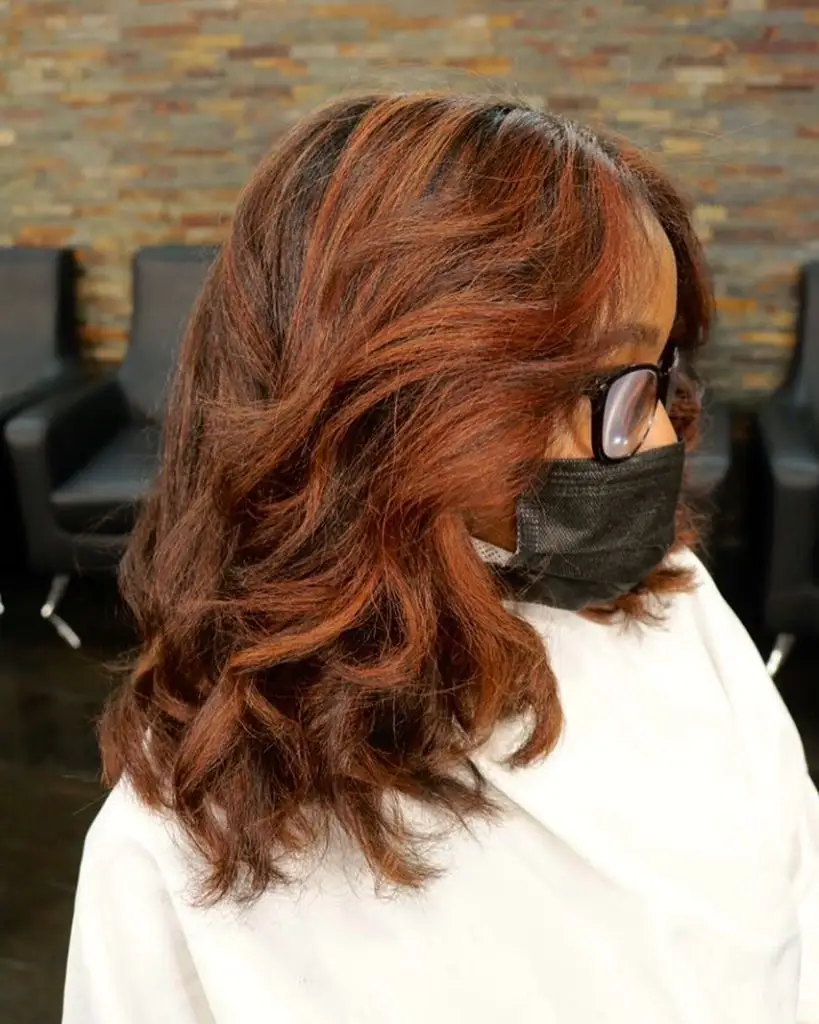
This is a study in color echo. The auburn base and the copper highlights belong to the same warm red-orange family, separated by only a few degrees of lightness. Because the distance between the two tones is narrow, the overall effect reads as dimension rather than as a deliberate two-tone choice. The loose wave pattern catches the copper on the outer curves and hides the darker auburn in the inner valleys, creating a natural-looking rhythm of light and shadow without any obvious stripe or panel.
The most useful detail here is that keeping highlight and base within the same color family eliminates harsh grow-out lines. If you want to warm this up further, a gloss in a cinnamon tone over the whole head would push both the base and the highlights half a shade richer. To cool it down, ask for an ash-copper formula that leans more toward rose brown shades rather than orange.
4. Sleek Straight Black With Center Part
A front-facing close-up shows long, straight black hair falling past the shoulders, parted cleanly down the center. The hair has a smooth, flat-ironed appearance with a subtle sheen. A butterfly pendant necklace, a silver-toned watch, and a crystal ear cuff are visible. A lavender knit-looking top sits under a black puffer-looking jacket.
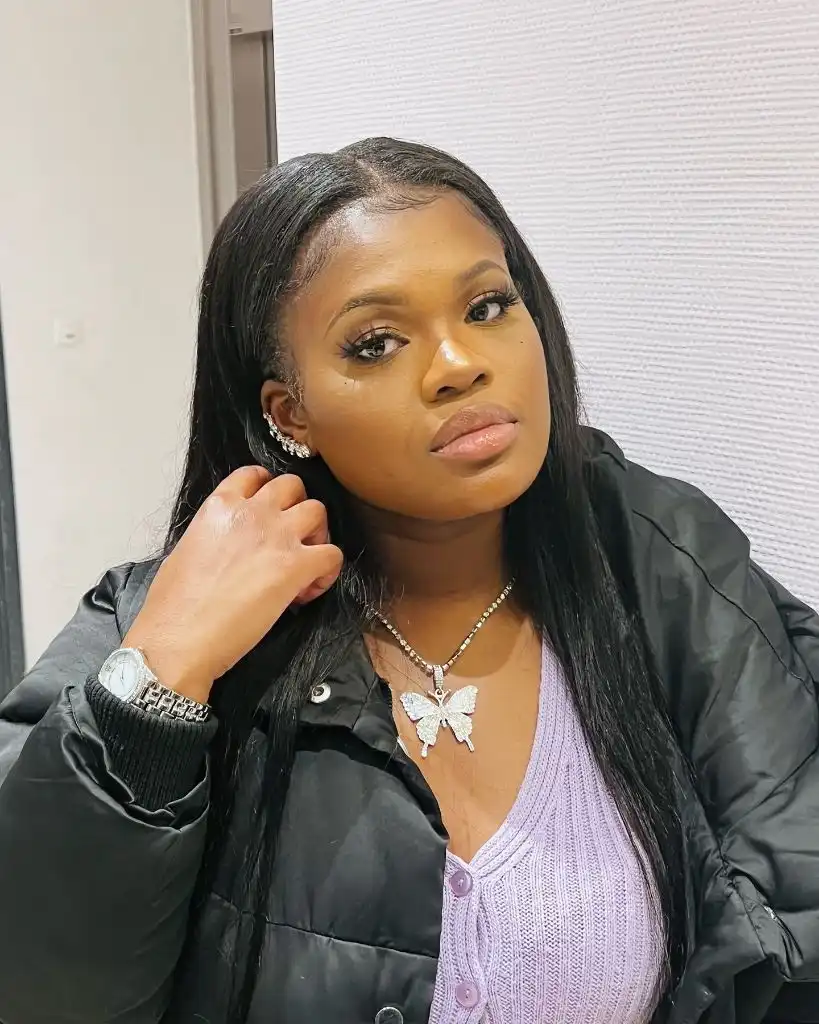
The silhouette outline is doing the work here. With no color variation, no highlights, and no visible texture, the hair becomes a pair of dark vertical panels framing the face. The center part creates perfect bilateral symmetry, and the eye moves down the straight edges the way it follows the seams of a tailored garment. The pendant and ear cuff function as small interruptions in what would otherwise be a completely unbroken dark field.
Because the color is a true black with no warm or cool undertone pushed through it, this is the lowest-maintenance option in a winter hair color for black women lineup. The adaptation that matters most is the finish: a matte flat-iron pass gives an editorial quality, while a glossing serum shifts the same black into a glassy, reflective surface. Both are the same shade, but the perceived depth changes entirely based on how much light the surface bounces.
5. Bouncy Curled Bob With Deep Side Part
A front-facing view shows a chin-to-shoulder-length bob with large, defined barrel curls. The color is a uniform jet black with a high-shine finish. The hair is parted deeply to one side, with the larger section sweeping across the forehead before the curls begin. A deep plum long-sleeve top fills the lower portion of the frame.
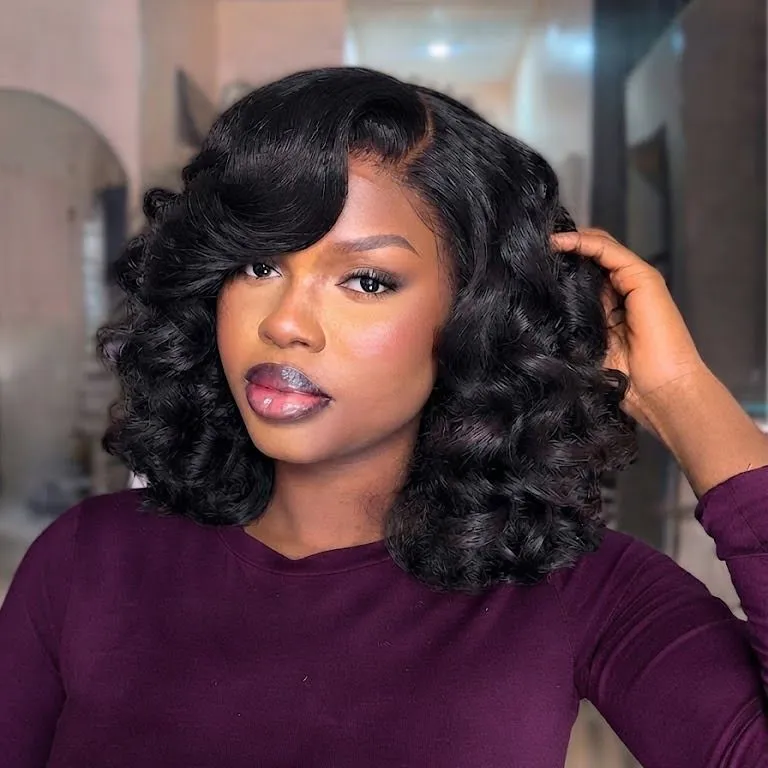
Proportion is the dominant force. The deep side part creates an asymmetry where roughly two-thirds of the hair volume falls on one side, and the curls on that heavier side are larger and more prominent. This imbalance gives the style a directional sweep that a center part would eliminate. The curls themselves are uniform in diameter, so the visual interest comes not from varied curl sizes but from the lopsided distribution of a single, consistent shape repeated across the head.
To adapt this shorter, reduce the curl diameter so the bob stays compact rather than wide. For a winter hair color for black women approach that keeps this silhouette but adds tonal range, a few face-framing pieces lifted to a dark espresso brown would catch light inside the curl barrels without changing the overall black reading at a distance.
6. Short Curly Pixie With Wet-Look Finish
A tight front-facing crop frames a short curly style that sits close to the head, with slightly longer curls at the top and sides. The color is jet black with a wet or gel-set sheen that emphasizes each curl’s definition. Gold hoop earrings and layered gold necklaces are visible. A black crew-neck top fills the bottom edge.
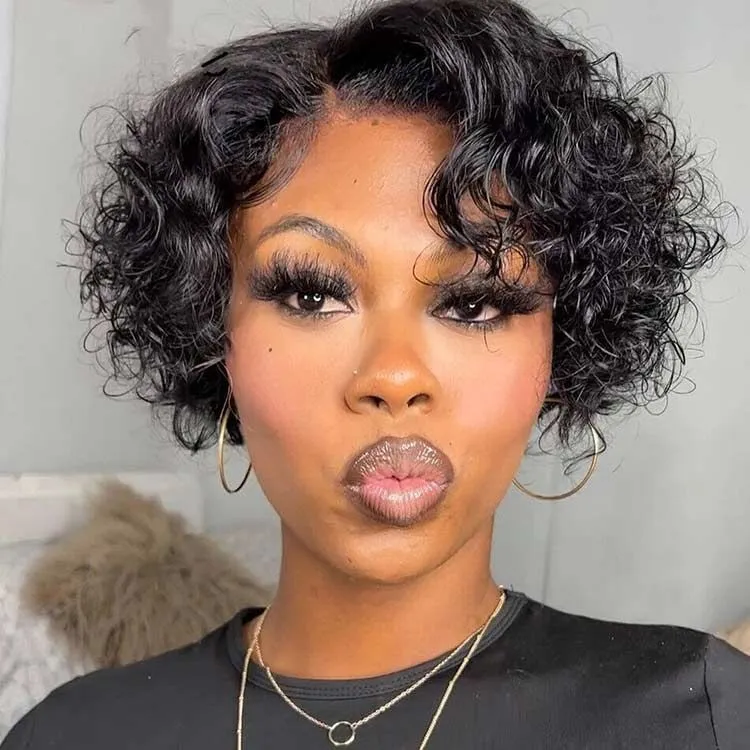
Scale of pattern is the argument. Each curl is small and tightly wound, packed densely across the head, and the wet-look product compresses them further so they read almost as a textured cap. The gold jewelry introduces a contrasting scale: the hoop earrings are large smooth circles against the tiny repeated curl shapes. This difference in scale between hair texture and accessory geometry is what makes the overall composition feel deliberate rather than minimal.
The strongest adaptation lever is the product finish. The same cut and color with a matte cream instead of a glossy gel would read entirely different, shifting from sculpted to soft. If you want to introduce color without losing the close-cropped shape, a few bleached curls at the very front hairline would create a focal point that draws the eye forward, similar to how a short natural hairstyle can anchor attention with one strategic detail.
7. Long Straight Copper-Red With High Shine
A side-profile close-up shows long, straight hair in a warm copper-red tone, falling well past the shoulders. The sheen is extremely high, with individual strands reflecting light in a way that suggests a fresh gloss or smoothing treatment. Only the lower portion of the face is visible in profile. A blue-and-white patterned garment appears at the bottom edge.
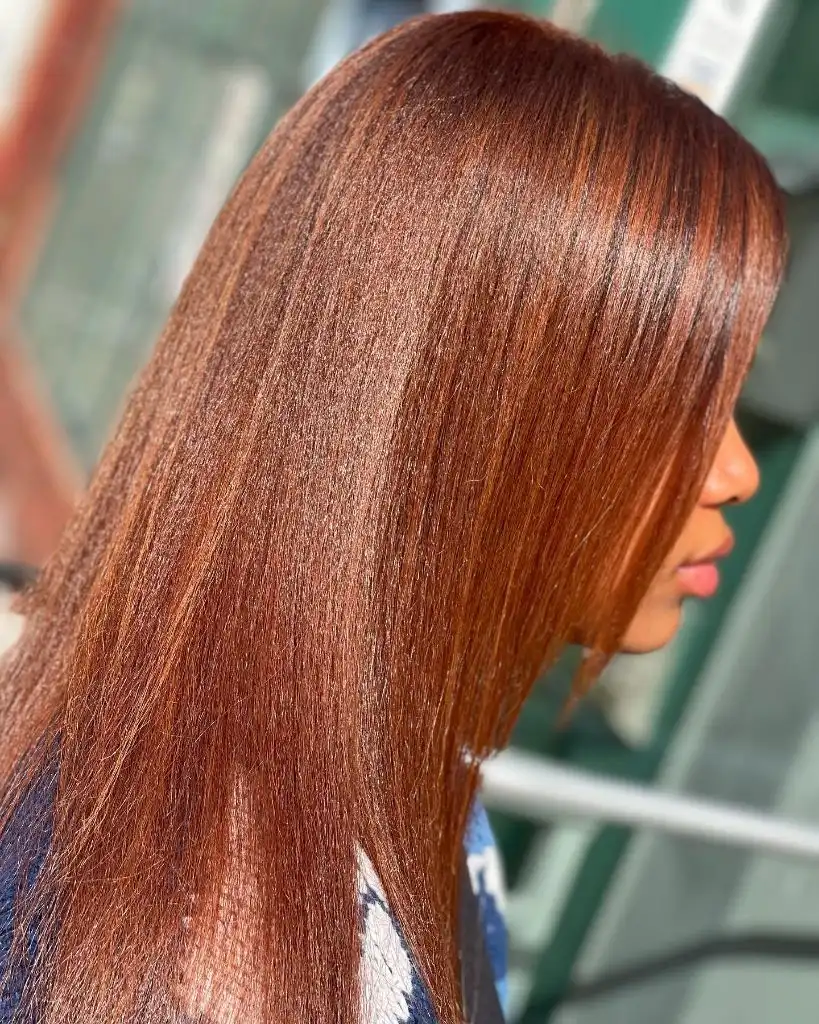
This image is almost entirely about one thing: reflectivity. The copper-red tone is consistent from root to end, but the straight texture and the gloss finish turn the hair into a reflective surface where the color appears to shift from a deep auburn in shadow to a bright penny copper in direct light. The side-profile camera angle maximizes this effect because it shows the full length as a single unbroken plane rather than splitting it into two curtains.
The most transferable detail is the relationship between color saturation and surface smoothness. A copper tone this vivid on natural texture would scatter light and read as a softer, more diffused warmth. On a straightened or smoothed surface, the same formula concentrates light into bright streaks. Neither is better, but knowing which finish you plan to wear determines whether to ask for a slightly deeper or slightly lighter copper at the mixing stage.
8. Short Honey Blonde Bob With Feathered Layers
A three-quarter front angle shows a short bob in a warm honey blonde, with feathered layers that flip slightly at the ends. A floral-patterned fabric mask covers the lower face. A denim-looking jacket collar frames the neck. The background is soft and light, with a small green plant visible on a shelf.
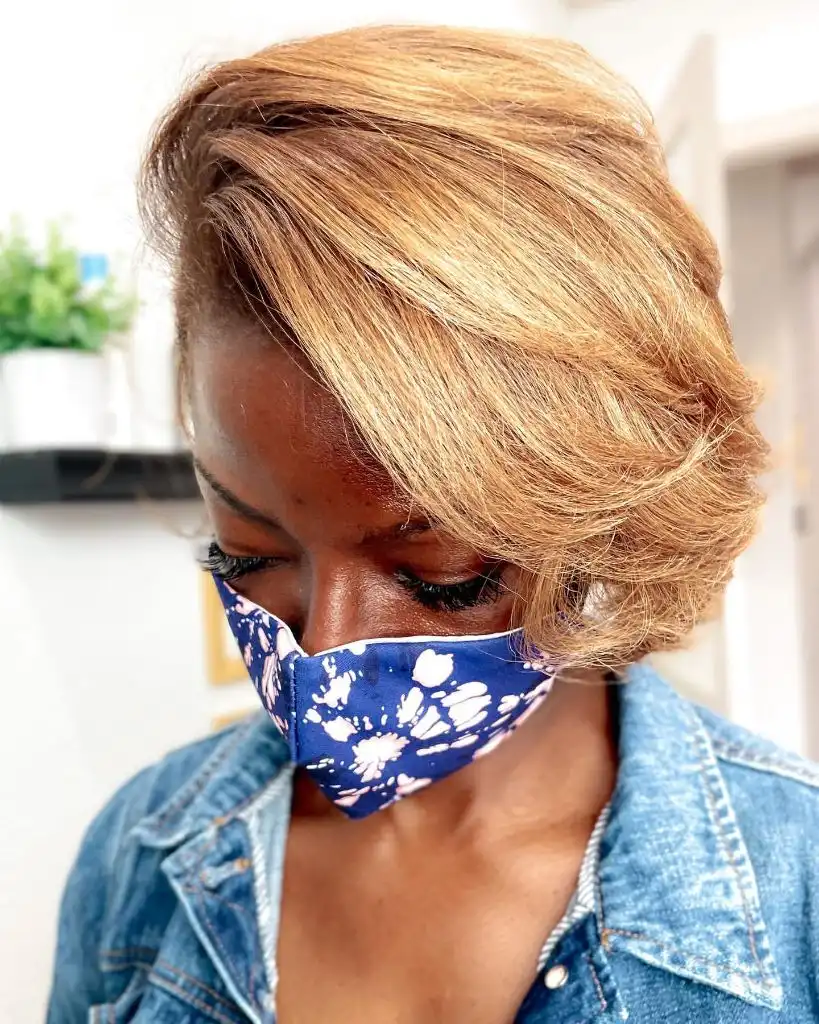
The silhouette is a rounded shape that tapers at the nape and flips outward near the jawline, creating a soft frame around the face. The honey blonde sits in a middle ground between warm gold and light brown, which means it carries enough warmth to read as intentional but not so much lift that the roots demand constant attention. The feathered layers add movement to what could otherwise be a static bob shape, and that movement is what distributes light across multiple planes instead of one.
For anyone considering winter hair color for black women in blonde territory, this shade is a useful reference point because it avoids both the coolness of platinum and the heaviness of dark golden. To push it warmer, a caramel glaze over the ends would deepen the tips while leaving the roots this same honey tone. To go cooler, an ash-blonde toner would pull the gold out and leave a sandy, more neutral result.
9. Sleek Dark Brown Angled Bob
A side-profile view shows a chin-length angled bob in a rich dark brown with subtle warm undertones revealed where light hits the surface. The hair is smoothed flat with a precise blunt cut at the bottom edge. A small pin holds hair behind one ear. The background is a warm gray with a soft amber light source on the right.
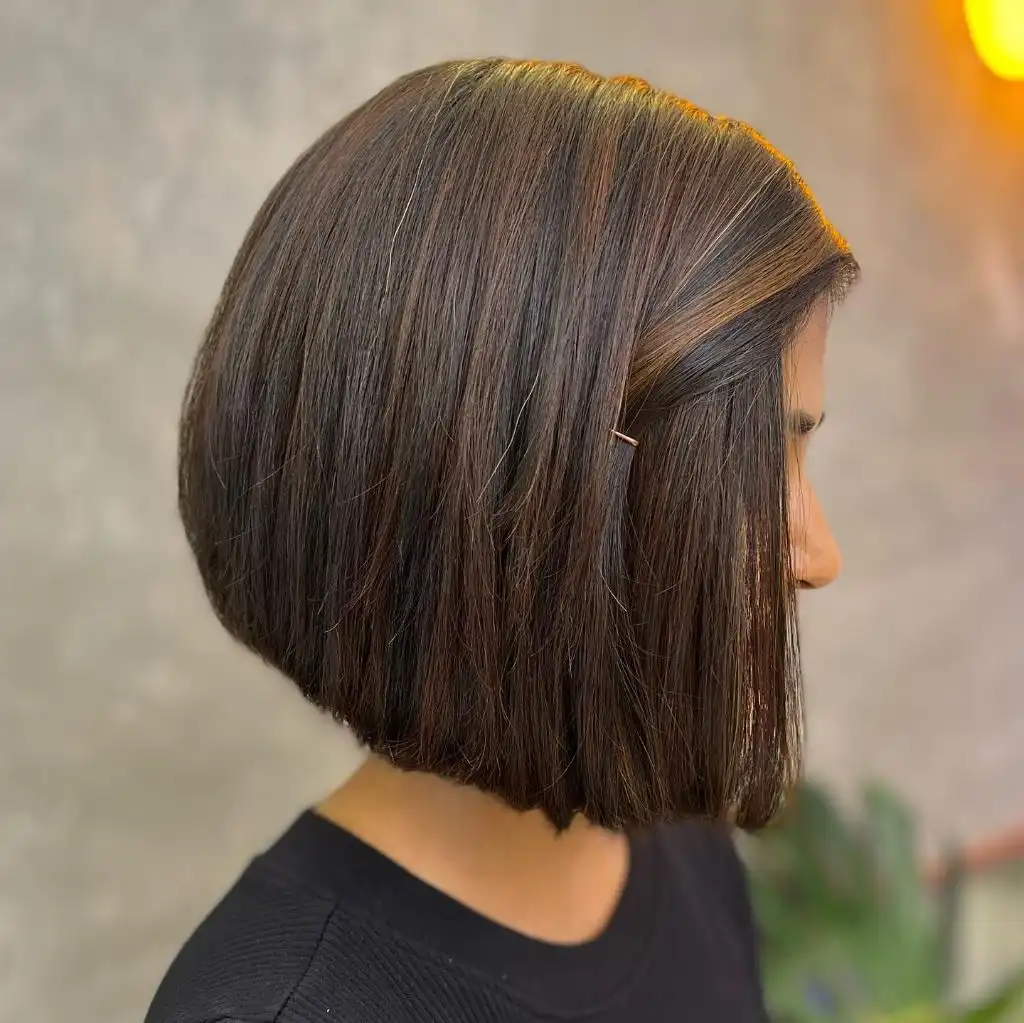
The dominant principle is negative space. Because the bob is short and angled sharply from the back of the head to the jawline, it exposes a large triangle of bare neck and background. That visible space is as important to the composition as the hair itself. The dark brown color stays understated enough that the geometric cut, not the shade, becomes the focal point. A bolder color would compete with the line work; this muted brown lets the architecture speak.
The blunt bottom edge is the detail that makes this cut look precise rather than simply short. If you want this shape but with slightly more visual weight, keeping the same length while adding a layered bob variation would introduce internal movement without softening the outer line. The color requires only a clear gloss to maintain its depth through winter months.
10. Long Black Curls With Cardboard Sign
A front-facing selfie taken inside a vehicle shows long, defined spiral curls in natural black, falling past the collarbone. The curls are tight and uniform in pattern, with baby hairs laid along the hairline. One hand holds a cardboard sign with handwritten text. A black crop top is visible. The interior of the vehicle is dark with windows behind.

Rhythm is the analytical lens here. The spiral curls repeat at a consistent interval from the part line down to the ends, and their uniformity creates a visual cadence that the eye follows like a pattern. The baby hairs along the forehead introduce a different, finer rhythm at a smaller scale, so the overall composition has two layers of repetition operating simultaneously. The natural black color keeps both layers on the same tonal plane, which unifies them.
To adapt this with a winter color shift, face-framing highlights in a dark honey or warm brown would break the tonal uniformity at one strategic point without disrupting the curl rhythm through the rest of the length. Keep the highlight thin enough that it reads as an accent rather than a panel, and start it just past the baby hair zone so the hairline stays clean and dark.
11. Burgundy Waves With Dark Root Shadow
A three-quarter angle shows medium-length hair with soft waves, colored in a deep burgundy that transitions from darker roots to a more vivid berry tone through the mid-lengths and ends. A Grambling graphic tee and gray bottoms are visible. A floral tattoo covers the forearm. The setting has a dark curtain backdrop with a green hedge-like wall on one side.
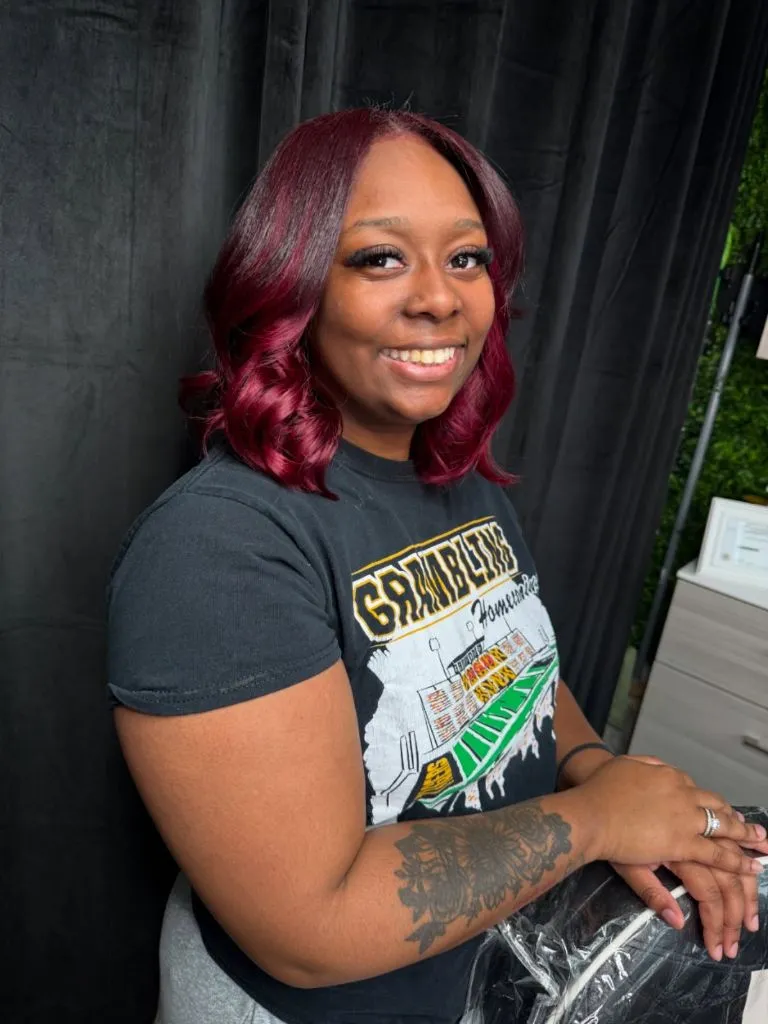
The mechanism is tonal layering between the dark root zone and the brighter burgundy lengths. The roots anchor the color to a believable starting point, and the burgundy intensifies gradually as it moves away from the scalp, which prevents the vivid tone from looking like a flat, single-process application. The waves compress and stretch the color unevenly, so some curves appear almost plum while the outer wave crests catch more light and lean toward cranberry.
This is a strong reference for winter hair color for black women who want visible color without full bleach commitment. The dark root shadow means the grow-out will blend naturally for several weeks. To deepen the effect, a violet-toned conditioner would push the burgundy cooler between salon visits. To brighten it, a clear gloss restores the berry vibrancy that fades first.
12. Long Honey Waves Under Satin Head Wrap
A front-facing view shows long, wavy hair in a warm honey blonde, flowing from beneath a silver satin-looking head wrap tied in a knot at the crown. The waves are loose and brushed out, reaching past the bust line. Full glam makeup with pink-toned eyeshadow and a matte mauve lip is visible. A blue floral satin-looking robe or top drapes across the shoulders.
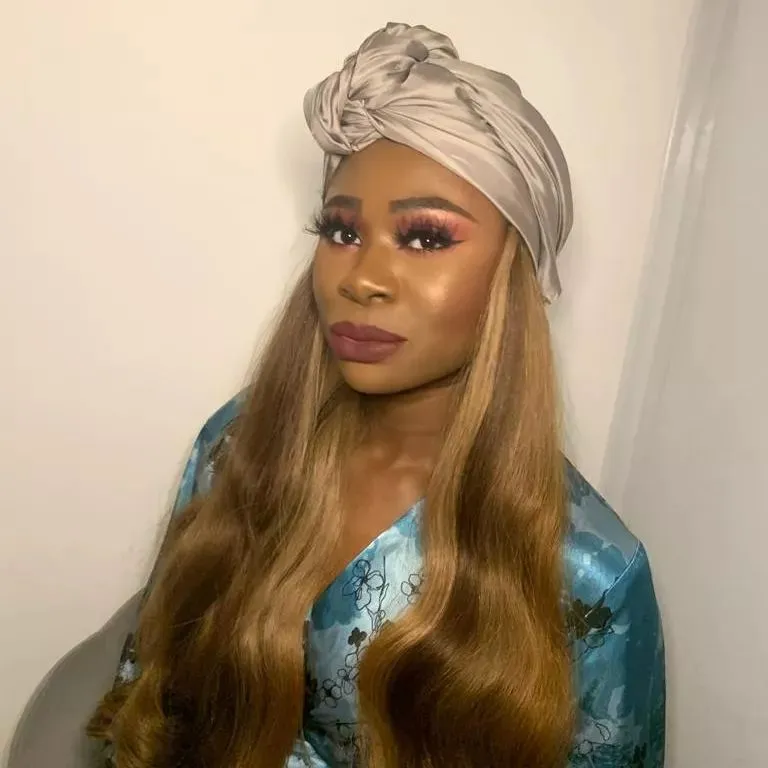
The visual principle is one accent against many. The silver head wrap is the single cool-toned element in a frame otherwise dominated by warm tones: the honey hair, the warm skin-tone makeup, the golden lighting. That one cool accent at the top of the composition prevents the warmth from becoming monotonous and gives the eye a resting point before it travels down through the blonde waves. The wrap also creates a clean horizontal line that contrasts with the organic wave shapes below it.
The most useful adaptation detail is the wrap itself as a color tool. Pairing this same honey blonde with a black wrap would darken the perceived shade at the crown, while a gold wrap would extend the warm tone seamlessly. If the honey blonde feels too warm for your preference, shifting toward a cool-toned blonde with ash undertones would change the overall temperature dramatically while keeping the length and wave pattern intact.
13. Long Platinum Straight With Center Part
A front-facing selfie shows long, straight platinum blonde hair falling past the shoulders, parted near the center. The blonde is a very light, almost white shade with minimal yellow undertone. A small nose stud is visible. A gold satin-looking zip-front top in a mustard shade fills the lower frame. The background is a dark room with faint text visible on the wall.
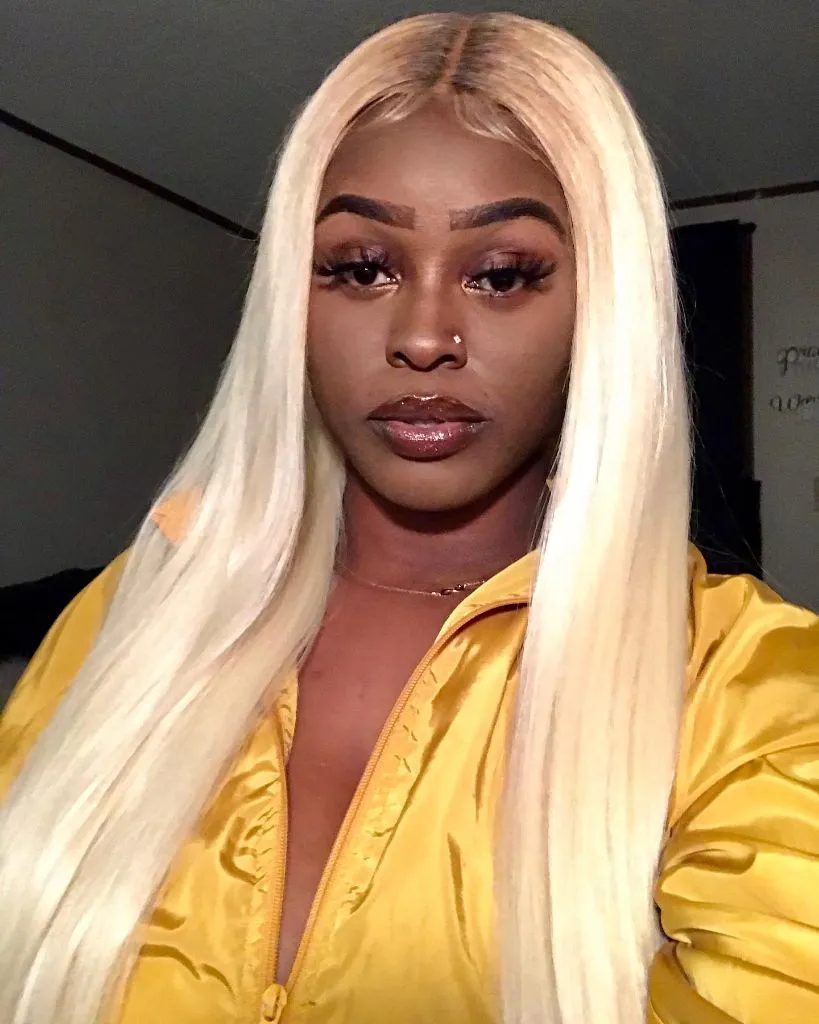
Contrast in value is the engine. The platinum hair is the lightest element in the entire composition, and it sits against a dark background and dark skin tone, which maximizes the visual pop. The mustard top introduces a middle value that bridges the gap between the bright hair and the dark surroundings, preventing the contrast from feeling like only two extremes. The straight texture keeps the platinum reading as a smooth, unbroken surface rather than scattering into multiple highlight and shadow zones.
Platinum this light on dark hair requires significant lifting, which means the maintenance commitment is real. The center part reveals root growth symmetrically, so scheduling matters. To reduce upkeep, a shadow root technique blends two to three inches of your natural dark base into the platinum gradually, buying extra weeks between appointments. The finish also matters: a purple-toned shampoo keeps the platinum cool and prevents brass from creeping in.
14. Wavy Blonde Bob Framing Jaw and Cheekbones
A close-up front-facing shot shows a chin-length wavy bob in a pale butter blonde. The waves are loose and slightly tousled, with the hair parting naturally off-center. The blonde has a warm yellow undertone that catches light across the wave peaks. A black halter-style neckline is visible at the bottom of the frame. The background is a plain off-white.
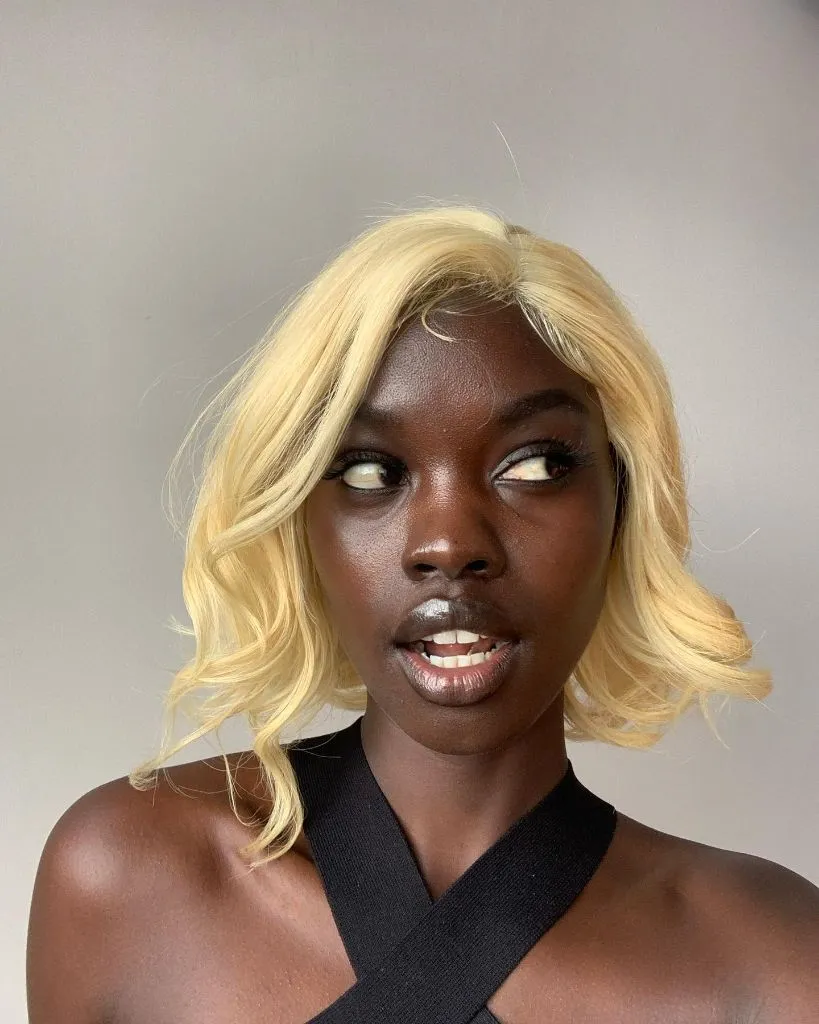
Placement and zoning define this image. The blonde volume is concentrated around the jaw and cheekbone area, with the waves pushing outward at exactly that zone. Above the ear, the hair sits flatter and closer to the head, which means the widest point of the style corresponds to the widest point of the face. This zoning creates a frame-within-a-frame effect where the hair outlines the face geometry rather than simply hanging around it.
To adapt this for a cooler winter reading, shifting the blonde from butter yellow toward a sandy ash would keep the same structural effect while lowering the warmth. For anyone with shorter natural hair considering a wig or extensions in this shape, the key is matching the wave density to the length. Too many waves in too short a span creates bulk rather than movement, so keep the wave pattern loose and open if the length is at or above the chin.
15. Natural Curls In Low Double Ponytails
A back-facing view shows natural type 3c/4a curls gathered into two low ponytails, one on each side of a center part. The hair is natural black with no visible color treatment, and the curl pattern is dense and well-defined in the ponytail sections while smoother and flatter against the scalp. Pink hair ties hold each ponytail. A light pink ribbed knit-looking top is visible. The background is a white room with minimalist floating shelves.
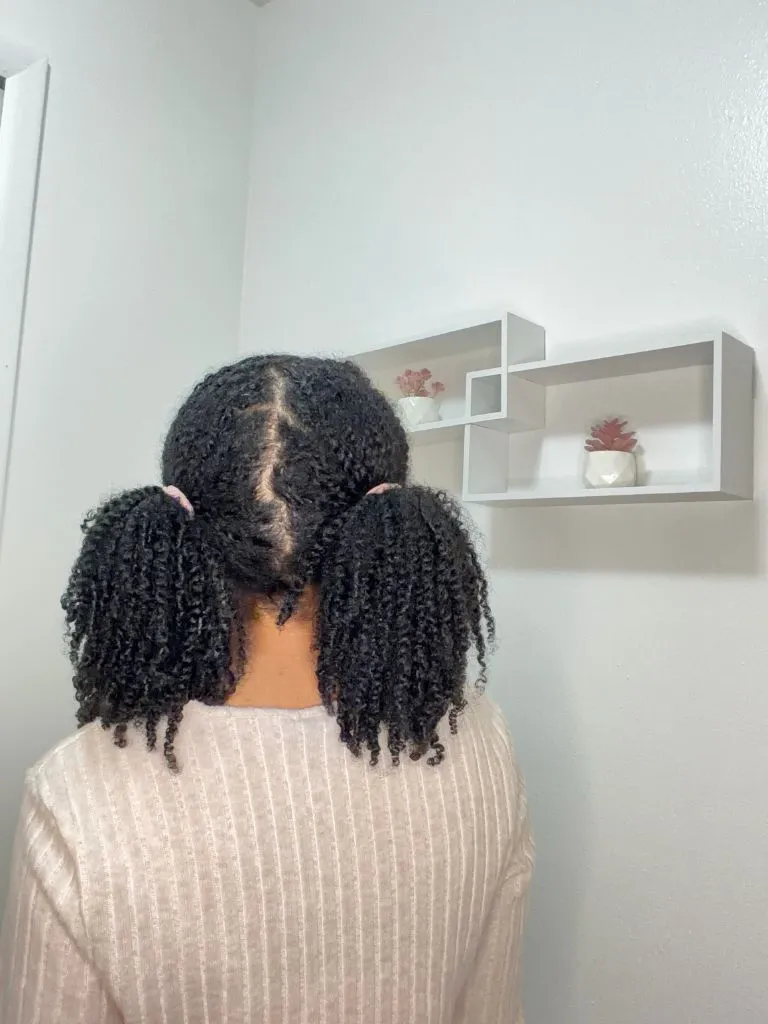
The visual argument is about vertical versus horizontal line. The center part creates one strong vertical line down the middle of the head, and the two ponytails create horizontal volume that spreads outward at the nape. This cross-axis composition is readable even from the back, where the face provides no focal point. The pink hair ties are the only color accents in a frame dominated by black hair and white surroundings, and their small scale makes them function like punctuation marks in an otherwise neutral sentence.
This is a low-manipulation style that protects ends while still showing curl definition. To introduce color here without a permanent commitment, temporary color-depositing conditioners in a deep plum or navy would tint the ponytail ends while leaving the roots untouched. The back view itself is a reminder that winter hair color for black women can be appreciated from every angle, so color placement on the underlayer or at the ends matters as much as what faces the mirror.
16. Ombre Twists Swept To One Side
A front-facing selfie shows medium-length two-strand twists with an ombre effect, moving from dark brown at the roots to a lighter caramel brown at the tips. One hand pulls the twists to one side. The twists vary in thickness, and the lighter ends create a visual gradient that intensifies where the twists cluster together. A cream knit-looking cardigan with brown buttons is visible. The background is a white room with the same floating shelves seen previously.
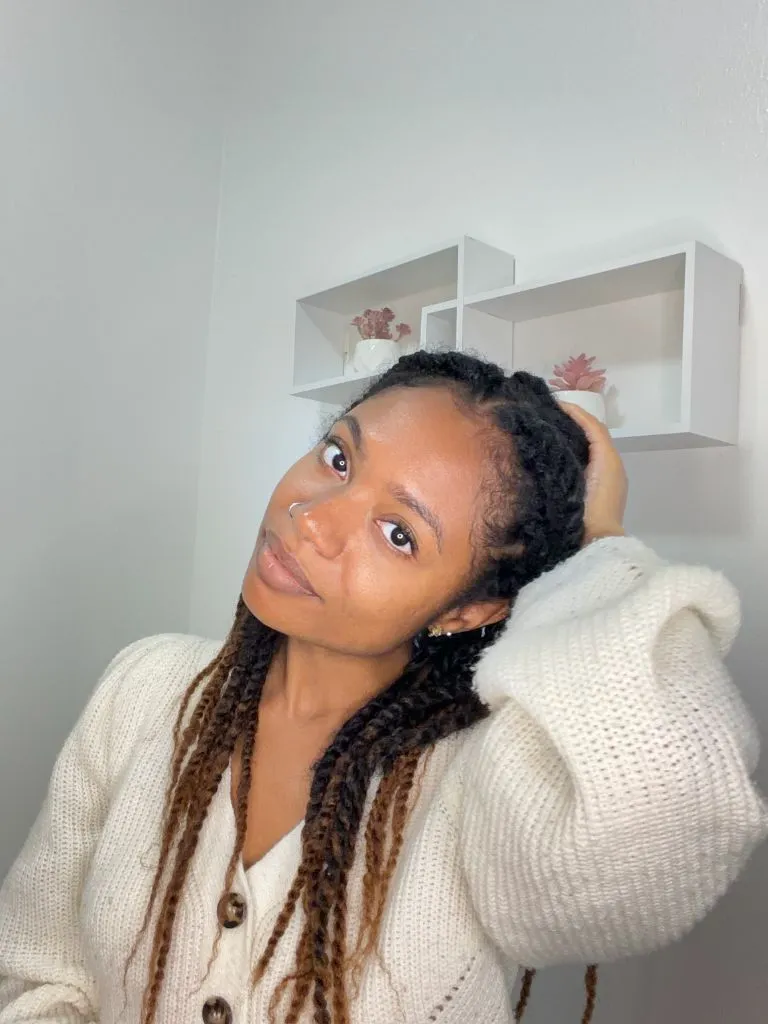
Color repetition with gradual shift is the mechanism. Each individual twist carries the same dark-to-light gradient, and when they cluster together, the caramel ends merge into a concentrated light zone at the bottom while the dark roots merge into a concentrated dark zone at the top. This creates a natural-looking ombre that is actually built from dozens of tiny individual gradients rather than one continuous blend. The twist texture adds a ropey dimension that you would not get from the same ombre on loose hair.
The two-strand twist is one of the most adaptable protective styles for trying color, because the twist compresses the hair and intensifies whatever shade sits on the outer surface. To go bolder, the caramel ends could be swapped for a warm copper or even a muted gold. To keep it tonal, stay within the brown family and simply adjust how high or low the transition point falls. A higher transition means more visible light color; a lower one keeps the look closer to a natural protective style with just a hint at the tips.
17. Shoulder-Length Twist-Out With Defined Spirals
A front-facing shot in a bright bedroom shows shoulder-length hair in a defined twist-out pattern, with each section forming a distinct spiral or coil. The color is natural black throughout, with no highlights or lowlights visible. A light blue sleeveless denim-looking button-up shirt is visible. The background includes a white bed with neutral bedding and dried pampas grass in a vase.
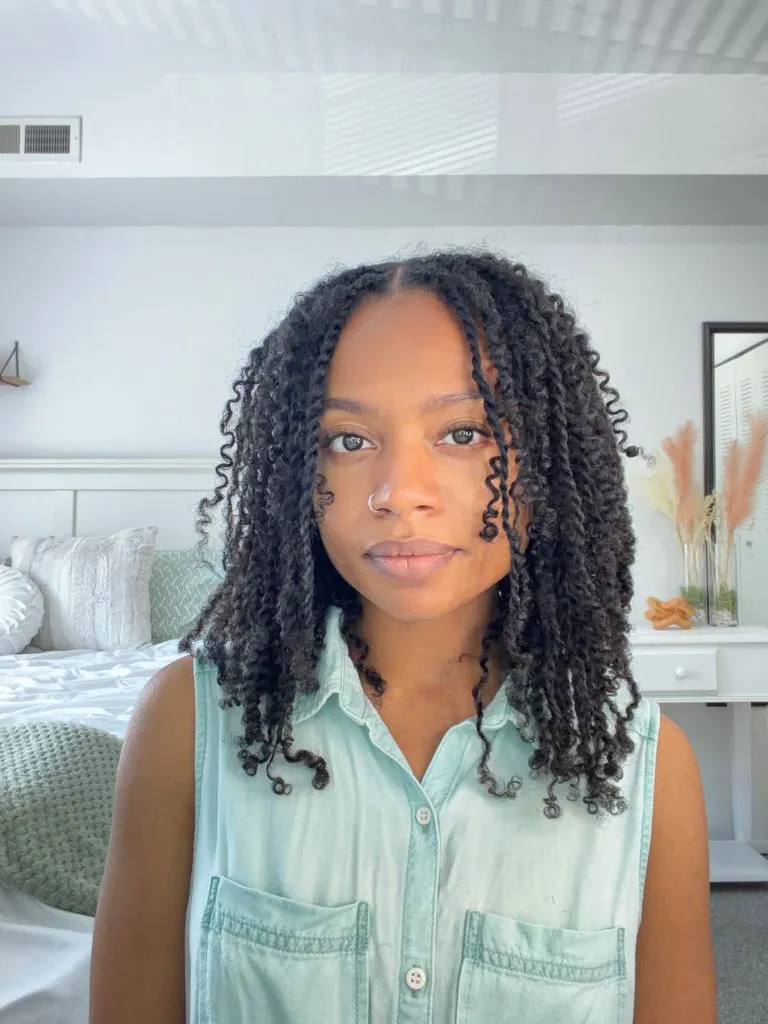
Texture against smoothness is the argument. Each twist-out section has a coiled, dimensional surface that catches light at multiple small points, while the denim-looking top has a flat, plain weave that reflects light uniformly. The contrast between the complex hair surface and the simple garment surface is what makes the hair read as the primary visual event even though both are relatively muted in color. The natural black and the pale blue are quiet enough that texture, not hue, drives the composition.
If you want to add color to a twist-out without altering this silhouette, the most effective placement is on the outermost layer of each twist, where the spiral faces the camera. A semi-permanent rinse in a dark auburn or deep burgundy would tint those outer surfaces and leave the inner twist core darker, creating a shadow effect that only appears when the twist-out is separated. The twist-out’s inherent dimension does the blending work.
18. Chin-Length Curls In Sunlit Car Selfie
A close-up front-facing selfie inside a car shows chin-length tight curls in natural black with subtle brown undertones revealed by strong sunlight hitting from the left. A small nose ring is visible. A light gray sherpa-looking or fleece-looking cardigan and a dark striped top underneath are partially visible. Green trees are blurred outside the car window.
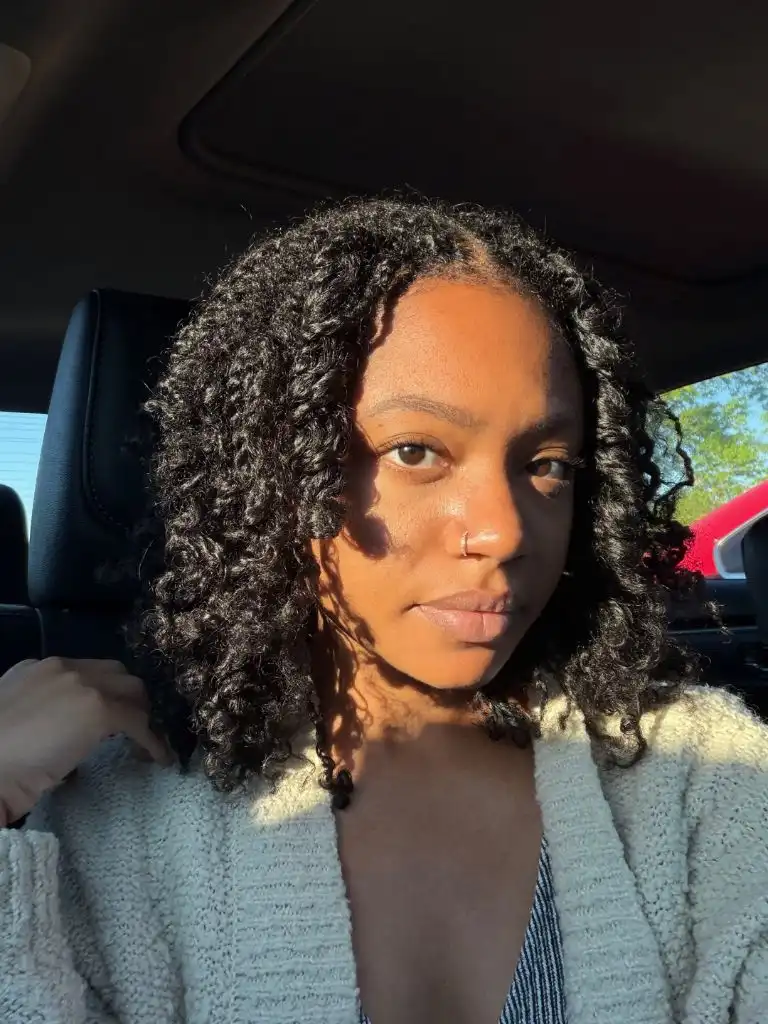
The analytical lens is how lighting reveals hidden tone. In indoor or overcast light, this hair would read as a solid black. Direct sunlight penetrates the curl structure and exposes warm brown pigment underneath, essentially creating a highlight effect that costs nothing and appears only under certain conditions. The curls at the temple, where sunlight is strongest, appear almost a medium brown, while the curls on the shadow side remain true black. This unintentional two-tone is the most natural version of tonal layering available.
This image is useful as a baseline reference. Before committing to a color appointment, seeing your natural hair in direct sunlight shows what undertones already exist. Many formulas build on those existing undertones rather than fighting them. If the sunlit brown here looks appealing, a demi-permanent in a matching warm brown applied only to the face-framing sections would replicate this sun-caught effect consistently, regardless of lighting.
19. Long Deep-Wave Install With Honey-Brown Roots
A close-up three-quarter view shows long, deep-wave textured hair reaching past the collarbone. The color shifts from a warm honey-brown at the roots and hairline to a dark espresso through the lengths. The wave pattern is tight and consistent, with high shine across the surface. A gold chain necklace and a black graphic top are partially visible. The background suggests a salon setting with products on shelves.
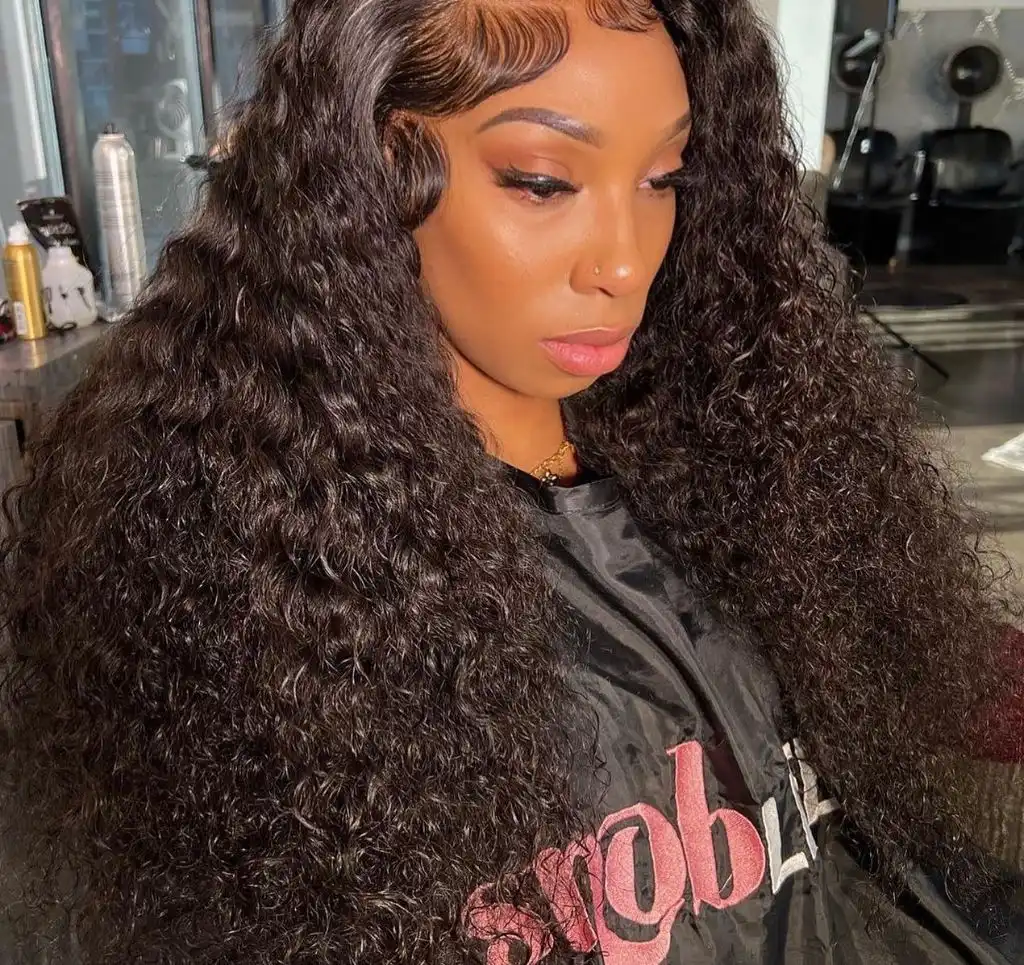
This is a reversal of the typical ombre direction, and that reversal is the entire point. Standard ombre goes dark at the root and light at the end; here, the lighter honey-brown sits at the root while the lengths darken. This inverted placement means the lightest color frames the face and the darkest color adds weight and density to the lower half. The eye reads the face-framing warmth first and then travels into the darker mass below, which creates a grounding effect that standard ombre does not provide.
The practical advantage of lighter roots on a dark install is that natural regrowth, which is typically dark, will eventually create a three-tone gradient rather than a harsh line. To adapt this concept on natural hair without an install, a balayage that concentrates lighter color on the first two inches near the roots and lets the rest stay dark achieves a similar inversion. The deep-wave texture here enhances the effect because each wave crest reflects the honey tone while each trough hides it.
20. Long Box Braids With Ankara-Print Top
A front-facing view shows long box braids extending past the waist, in a uniform natural black. The braids are medium-sized and neatly sectioned, with slightly wavy ends. A vibrant yellow-and-purple Ankara-style print top with ruffled shoulders is the most saturated element in the frame. A thin gold chain necklace sits at the collarbone. The background is a plain white wall.
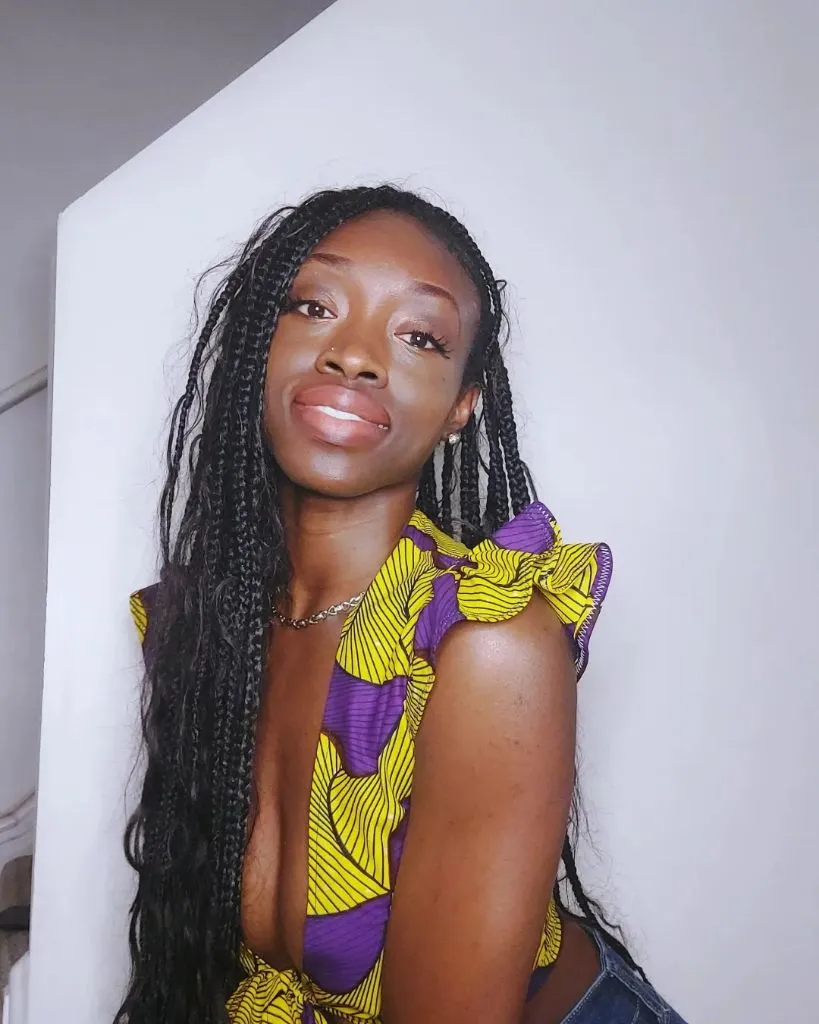
The principle at work is one accent versus many. The hair is entirely neutral, a single flat black with no color variation, which means it absorbs attention rather than competing for it. The Ankara-print top then becomes the sole color event in the frame, and its vibrancy registers more powerfully because nothing above the neckline challenges it. If the braids carried highlights or a second tone, the print and the hair would divide the viewer’s attention. Instead, the black braids serve as a visual rest that amplifies everything below.
This dynamic is worth remembering when choosing winter hair color for black women who wear bold prints or colorful accessories regularly. A neutral hair color, whether black, deep brown, or dark navy, functions as negative space that makes clothing and jewelry read more clearly. To introduce subtle color into braids this long without disrupting that neutral role, weaving in a few strands of very dark navy or deep forest green braiding hair would create a tone-on-tone shift visible only at close range.
21. Voluminous Copper-Red Waves With Curtain Part
A low-angle front-facing shot shows voluminous, large waves in a saturated copper-red tone, parted in a curtain style with swooping pieces framing the forehead. The color is consistent from root to end with a warm, almost orange-red cast. The hair reaches past the shoulders with the ends curling inward. A dark blazer-looking jacket is partially visible. The background shows a white wall and a yellow-orange artwork or surface.
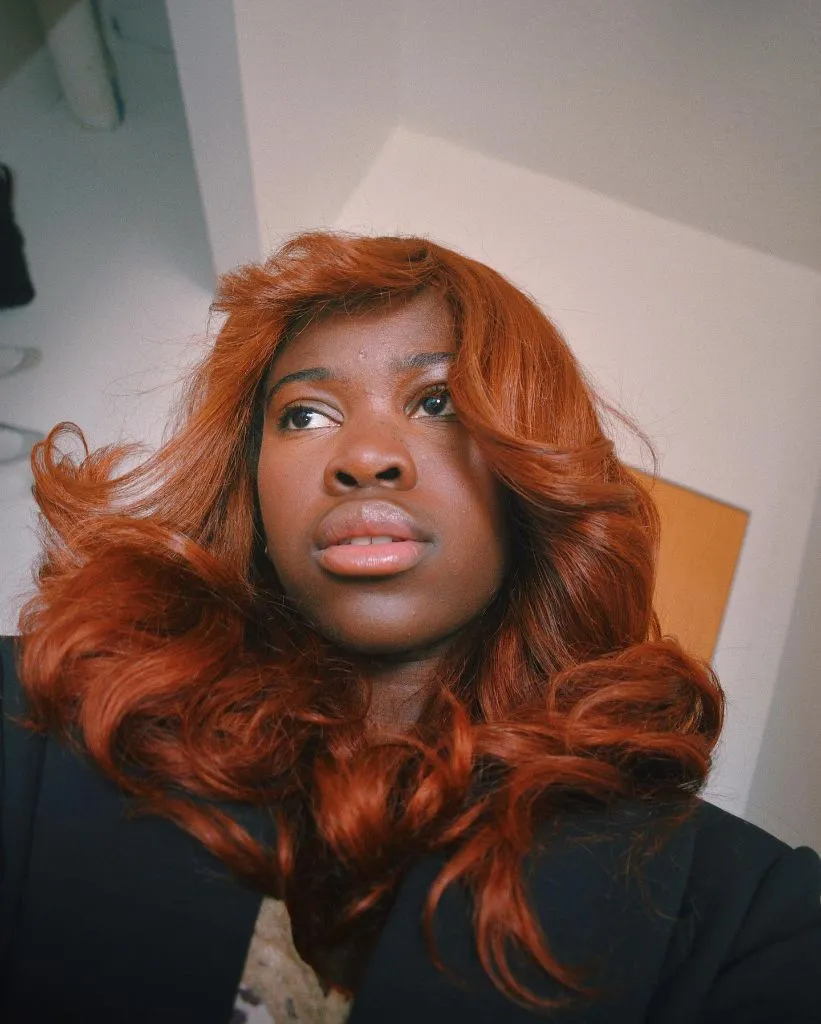
Color echo between the hair and the background is the subtle force in this composition. The copper-red hair and the yellow-orange surface behind it belong to adjacent positions on the warm spectrum, so they reinforce each other rather than contrasting. This creates an enveloping warmth across the entire frame that would not exist if the background were cool gray or blue. The dark blazer-looking jacket provides the only value contrast, grounding the composition so the warm tones do not float unsupported.
The curtain part is the structural detail worth noting. It divides the volume evenly and creates two symmetrical waves that swoop away from the center, which gives the forehead a framing arch. To adapt this shape with less volume, using fewer large rollers or larger flexi-rods would produce a similar wave shape with less overall density. For anyone exploring red hair tones as a winter option, this copper-red sits warmer than burgundy and cooler than ginger, making it a middle-ground entry into the red family.
22. Blonde-and-Black Waves With Chunky Highlights
A close-up front-facing selfie shows medium-length loose waves with a mix of dark black base and chunky blonde highlights concentrated at the face-framing sections and scattered through the lengths. The blonde is a cool-toned ash or platinum shade rather than warm gold. A layered gold necklace set is visible. The background is soft and slightly blurred, suggesting an indoor setting with neutral tones.
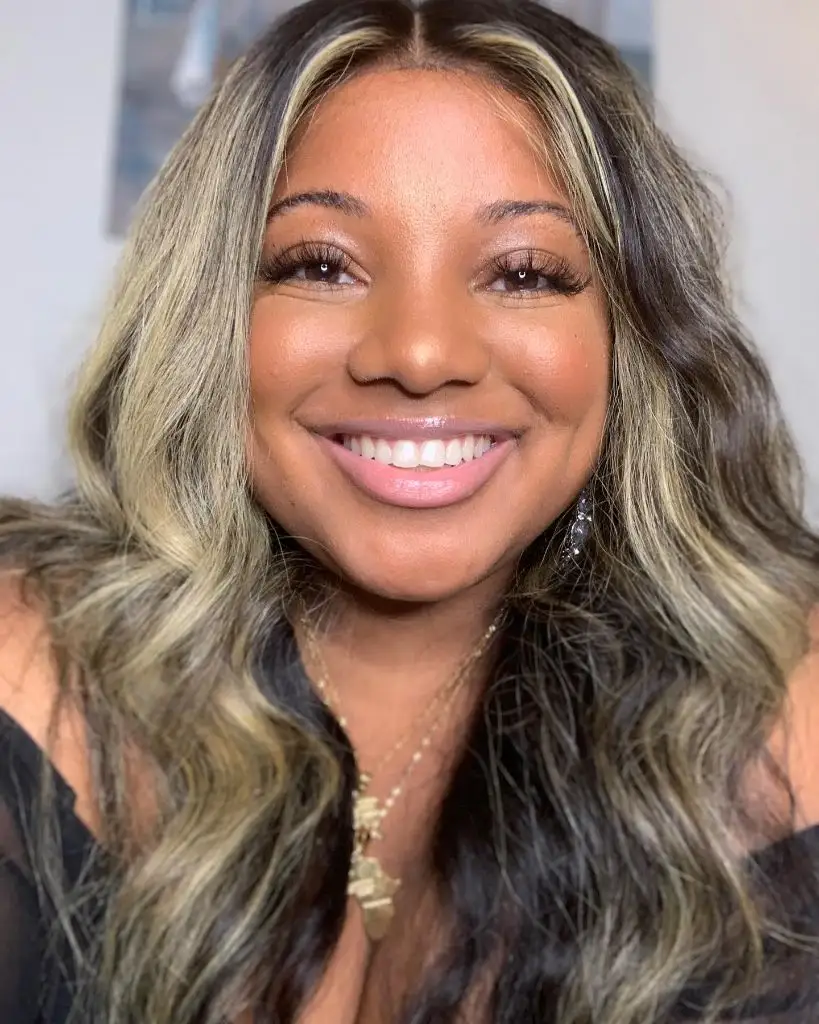
The mechanism is interruption. The chunky blonde pieces break the dark base at irregular intervals, creating a staccato rhythm rather than a smooth gradient. Each blonde section functions as a bright punctuation mark against the continuous dark sentence of the base color. Because the blonde is cool-toned rather than warm, it reads as a deliberate contrast rather than a natural sun-lightening effect. The loose wave pattern means some blonde pieces twist behind dark pieces, creating moments where the two colors overlap and a brief transitional mid-tone appears.
To make this less bold, reduce the width of the blonde sections from chunky to ribbon-thin, which converts the staccato into a softer shimmer. To adjust the tone, swapping the platinum blonde for a warm caramel would reduce the value contrast and make the overall look feel warmer. The face-framing placement is the most impactful position for any highlight, because it catches the most direct light and sits next to the features the viewer looks at first.
23. Platinum Tapered Natural With Tight Coils
A side-profile view shows a very short tapered cut with tight, defined coils in a platinum or silver-blonde tone throughout. The color is uniform from the slightly longer top to the closely faded sides. A small gold hoop earring is visible. Bold berry-toned lipstick and a leopard-print scarf tucked into a dark leather-looking jacket complete the visible elements. The background is a warm sandstone wall.
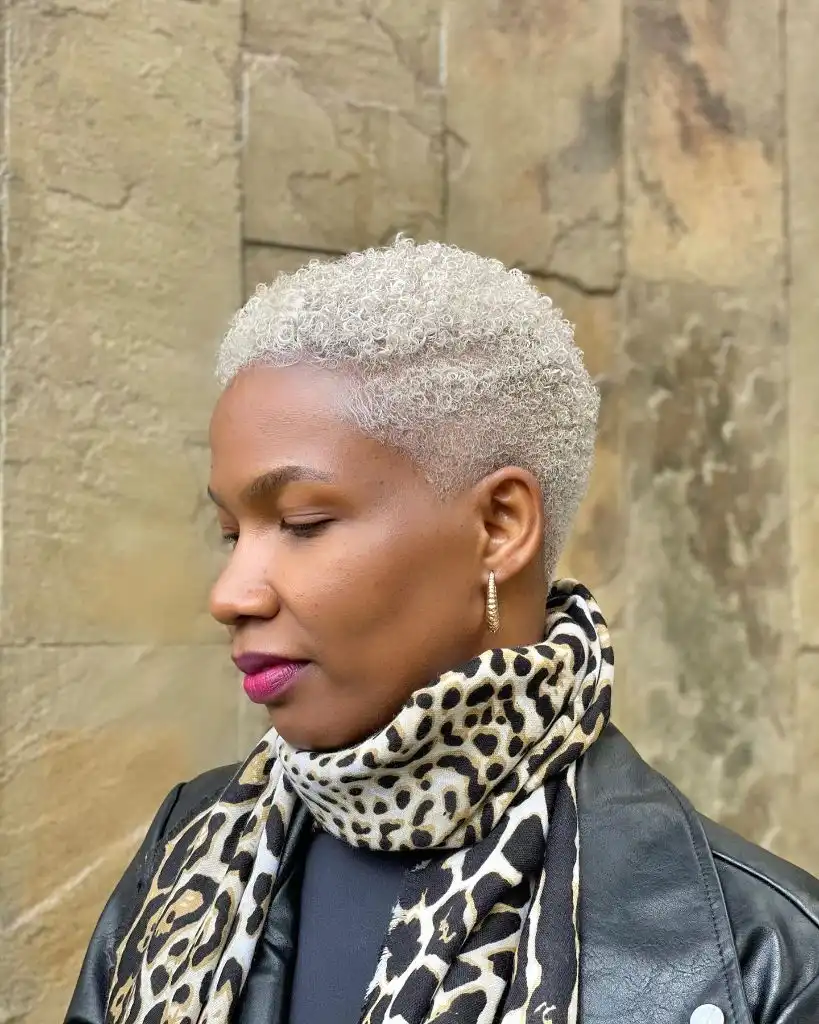
Restraint is the argument. Every element in this frame is edited down to its most essential version: the hair is as short as it can be while still showing curl definition, the color is pushed to one extreme (platinum), and the accessories are limited to a single earring and a single scarf. This economy of means makes each element register clearly. The platinum reads as bolder on a short cut than it would on long hair, because there is no length to dilute the shade. The tight coil pattern at this length creates a textured surface that catches light differently from straight platinum, producing a sparkle effect rather than a mirror effect.
This is the most committed color in the collection because platinum on natural coils requires full lightening. The maintenance cycle is determined by how quickly natural dark growth becomes visible at the hairline and nape. To extend time between appointments, a root smudge in a dark gray or charcoal blends the regrowth into the platinum gradually rather than creating a hard line. The sandstone background here is a coincidental but useful reference for the kind of warm neutral that complements cool platinum tones.

Hi, I’m Zoey Mitchell, the creator of ChicStyle Blog.
I share simple, wearable outfit ideas, hairstyles, nail trends, and beauty tips that feel natural and easy to recreate.
This blog is where I explore everything that makes a woman feel put together and confident every day. I’m not an expert — just a woman who genuinely loves style, mixing looks, and discovering what works.
If you love effortless fashion with a personal touch, you’ll feel at home here.