
Choosing among trendy haircuts 2027 means weighing shape against maintenance, fringe against forehead, and volume against control. Every cut in this collection solves that tension through one architectural idea: the relationship between where weight sits and where movement begins. A layered mid-length and a blunt bob answer different questions, but both succeed when internal proportion stays deliberate and the silhouette reads as one continuous decision from root to end.
Trendy haircuts 2027 are easier to evaluate when you stop looking at the overall impression and start reading the cut in segments. Compare crown volume to perimeter density. Notice whether the fringe dissolves into the side or breaks away from it. Watch how the longest pieces behave at the shoulder line versus above it. These relationships, not trend labels, tell you whether a shape will translate to your own hair.
1. Loose Waves Framing a Side-Swept Part
Dark brunette hair falls past the collarbone in wide, relaxed waves with a deep side part pushing volume toward the right. The ends carry the most visible curl, while the mid-shaft stays relatively open and elongated. A cream-toned sweatshirt and a neutral gray wall keep all attention on the hair’s surface texture. The camera captures a three-quarter angle, showing how the waves stack forward over the shoulder.
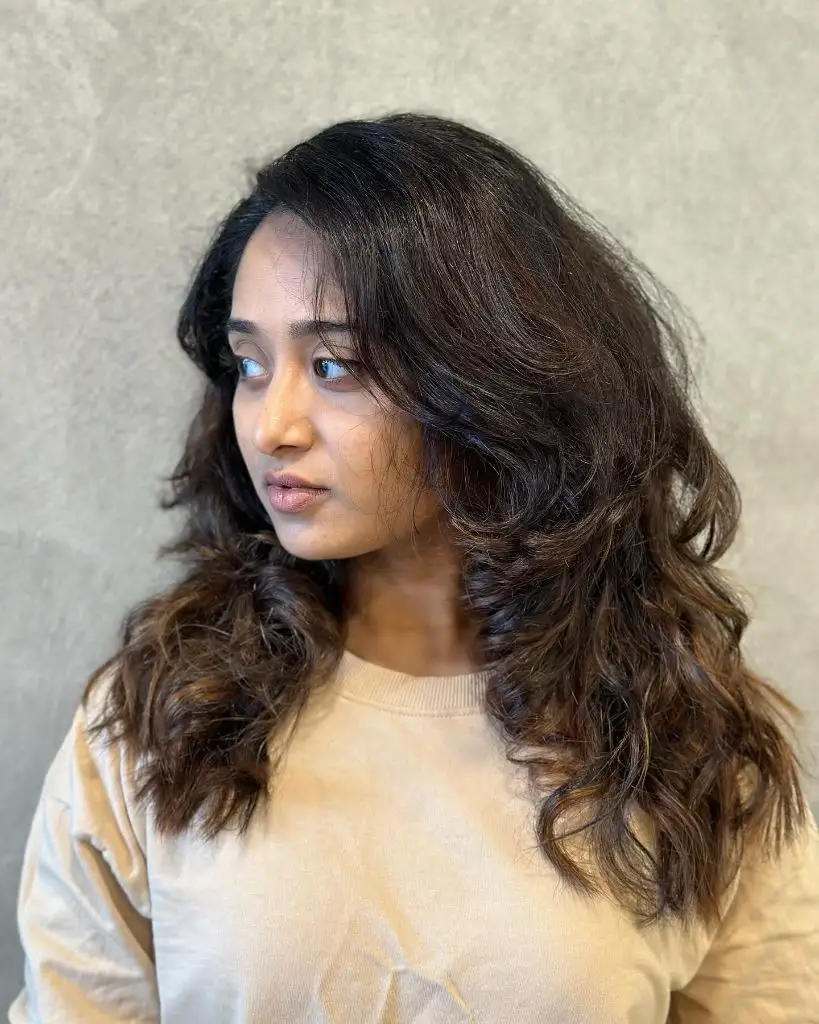
The proportion argument here is about density migration. Weight concentrates from mid-length downward, leaving the root area and crown visually lighter. That graduation prevents the overall shape from reading as a single heavy mass. The side part amplifies this by sending more hair to one side, which creates asymmetry without requiring an asymmetric cut. The wave pattern stays irregular enough to avoid looking set or styled with heat tools.
To adapt this softer, reduce the wave intensity below the ear and let the ends fall straighter, which will thin out the bottom silhouette. To go bolder, push the part even deeper and allow the heavy side to come further forward across the face. The key proportion to preserve is the contrast between a quieter crown and an active perimeter.
2. Bouncy Curtain Layers With Inward Curl
Shoulder-length dark hair is cut into visible layers that curve inward at the ends, creating a rounded silhouette that widens at the jaw and narrows again below. A curtain-style fringe parts at the center and sweeps to both sides, blending into the first layer. The background is a warmly lit interior space, slightly blurred. The subject faces the camera directly, and the hair’s symmetry is the strongest compositional element.
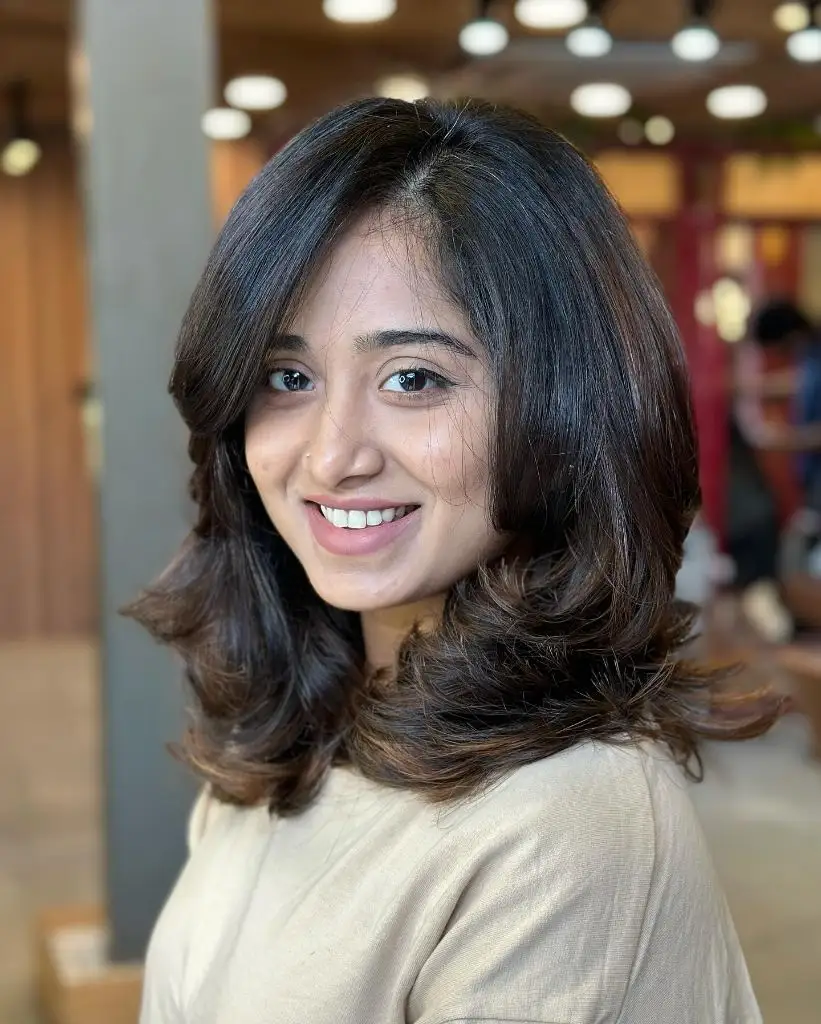
This cut works through repetition of a single curve. Every layer echoes the same inward arc, from the fringe down to the longest pieces. That consistency builds a shape that reads as composed without appearing rigid. The volume peaks at the jawline and creates a soft diamond outline when viewed from the front. Because the layers are relatively close in length, the transitions between them stay invisible, and the whole form moves as one unit.
For a less polished version, skip the inward styling and let the layers separate naturally, which will open the silhouette into something less contained. If you want more visible structure, shorten the fringe slightly so it disconnects from the first layer rather than flowing into it. The strongest detail to carry forward is the consistent curl direction across every layer.
3. Textured Shag With Heavy Curtain Fringe
Dark hair is cut into a heavily layered shag that sits between the collarbone and the shoulder. The fringe is thick and falls to eyebrow level, with visible texture through the bangs that keeps them from looking blocky. Shorter pieces frame the face at cheekbone height, and the longest sections fan outward near the ends. The background shows colorful wall art in pinks and blues. The camera captures a straight-on, slightly downward angle.
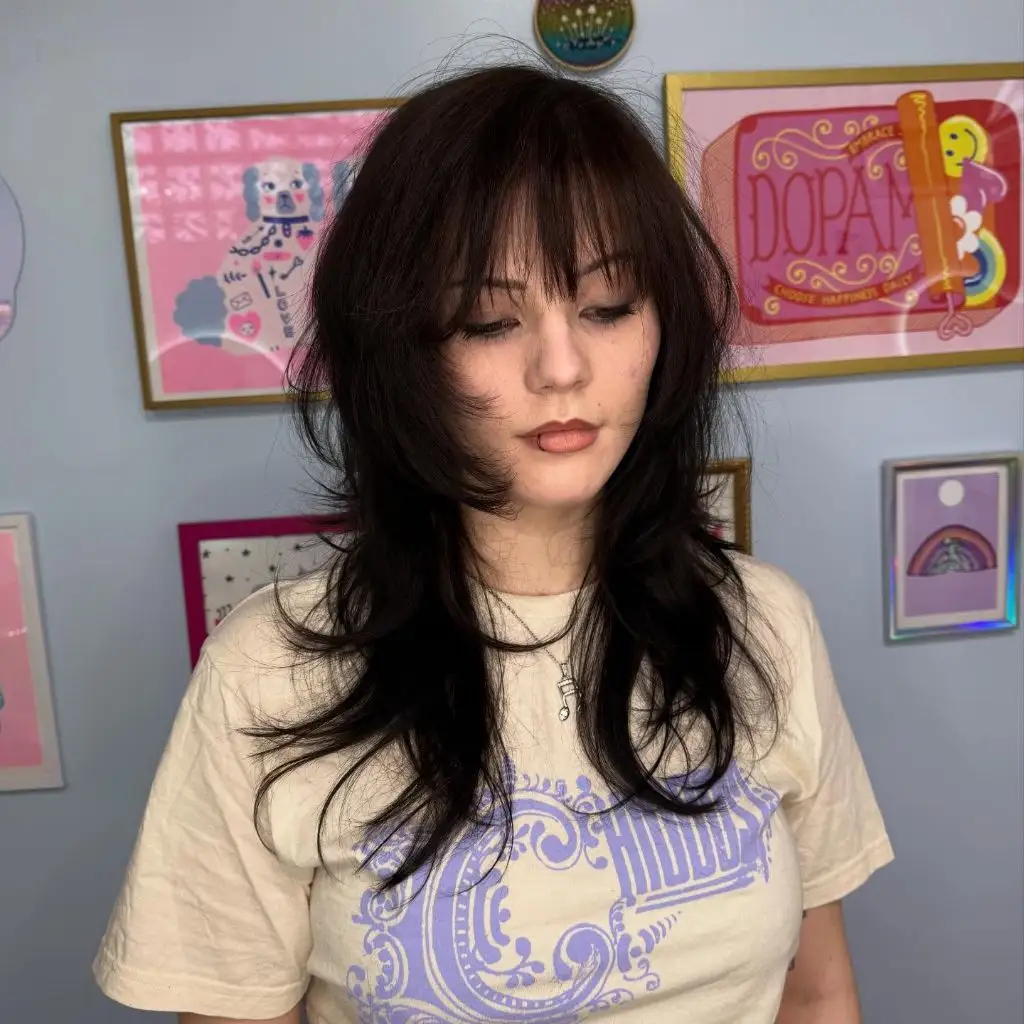
The silhouette outline does most of the work here. Viewed as a shape, the hair forms a wide triangle from the crown downward, interrupted only by the fringe cutting a horizontal line across the forehead. That interruption is what keeps the triangle from reading as uncontrolled. The face-framing pieces at cheekbone height add a second horizontal reference, breaking the vertical fall into readable zones. This is where trendy haircuts 2027 demonstrate how internal structure can coexist with visible disorder.
To soften this, thin out the fringe so more forehead shows through, which reduces the horizontal weight at the top of the shape. To make it bolder, take the shortest face-framing layers even higher, toward the temples. The most transferable element is the idea of using a strong fringe line to anchor an otherwise loose silhouette.
4. Voluminous Curtain Layers With Rolled Ends
Long dark hair is styled into large, defined curls that roll outward and inward in alternating directions, creating significant volume from the ear down. A center part feeds into curtain-framing pieces that curve away from the face. The hair reaches several inches past the shoulder. The subject wears a gray graphic sweatshirt, and the background suggests a storefront with a window. The front-facing angle shows the full width of the silhouette.
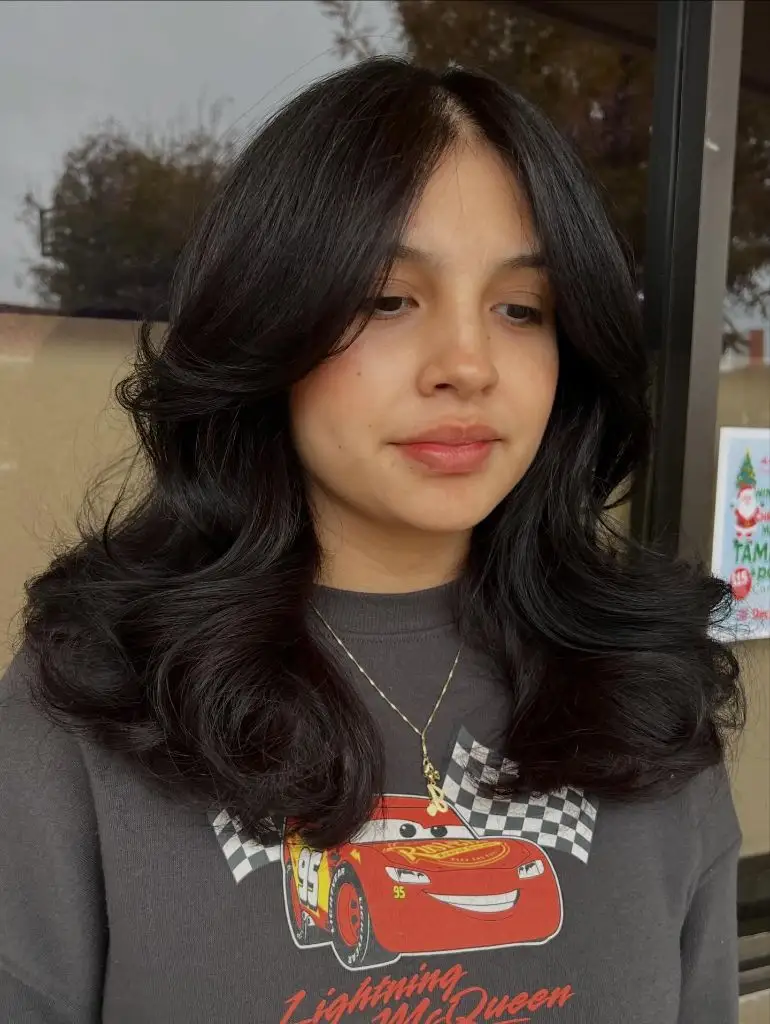
Scale of pattern is the dominant mechanism. The curls are large and uniform in diameter, which gives the volume a structured rather than chaotic quality. Because each curl occupies roughly the same amount of space, the eye reads the shape as intentional even though the overall silhouette is very full. The center part reinforces symmetry, and the curtain pieces keep the face visible despite the surrounding volume. Without that parting, the density would close in and flatten the composition.
Adapt this for shorter hair by keeping the curl scale the same but reducing the number of layers, so fewer pieces overlap. For less volume, style only the bottom third with curl and leave the upper sections smoother. The detail worth noting is that large, consistent curl diameter is what separates this from looking unstyled. You can find more ideas on maintaining volume with layers at chicstyleblog.com.
5. Cascading Curls Seen From the Back
The same dark hair from the previous angle is now shown from behind, revealing how the curls distribute across the back. The longest pieces reach the mid-back, and the layers create visible tiers where shorter curls sit on top of longer ones. The surface catches light at different points, giving the shape a sense of depth. The gray graphic sweatshirt and the same storefront background confirm the continuity.
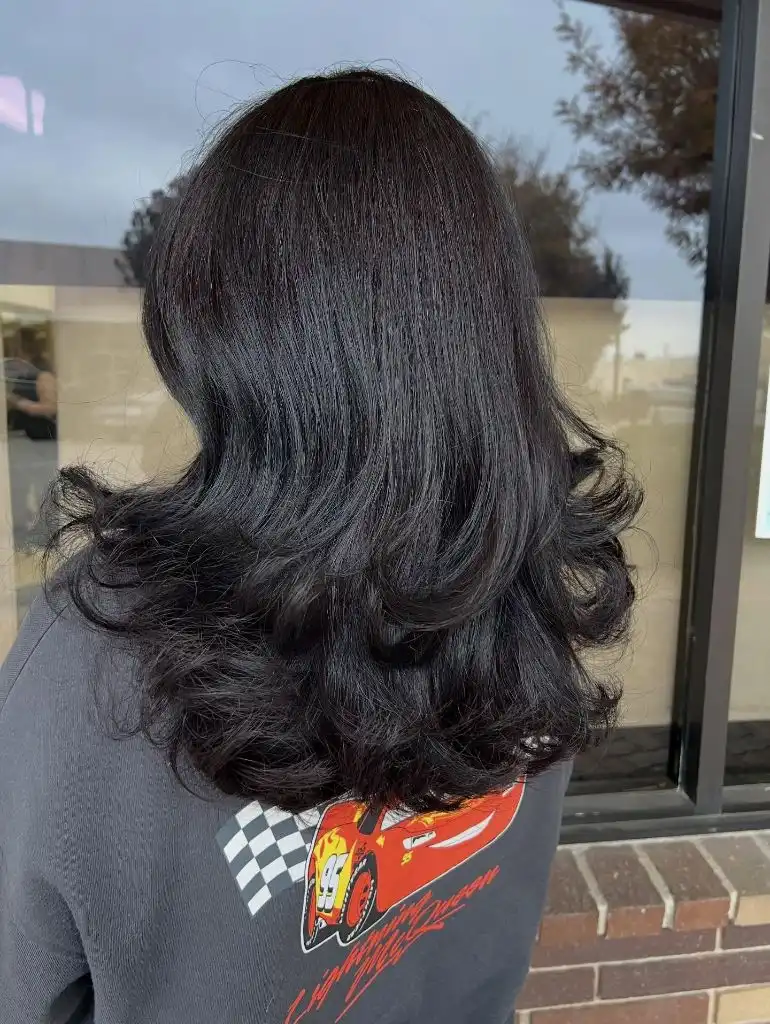
From this angle, tonal layering becomes visible. The top sections catch more light and read slightly warmer, while the underlayers sit in shadow and appear cooler and darker. That value shift creates a three-dimensional quality that the front view only hinted at. The tiered layering also shows how the shorter interior pieces lift the longer exterior ones, producing the volume seen from the front. Without those internal layers, the back would fall flat against the body.
If you want this back silhouette without the full front volume, ask for interior layers that are shorter but keep the perimeter length uniform. The strongest observation here is that back-view shape depends almost entirely on internal layering rather than perimeter length, which is worth communicating to a stylist before any cutting begins.
6. Dark Bob With Side-Swept Highlights
A chin-length bob is styled with volume at the crown and soft outward movement at the ends. The hair is predominantly dark brunette with lighter warm-toned pieces visible near the face and at the tips. Side-swept bangs blend into the longer front sections. The subject wears glasses with metallic frames and a gray top with cut-out sleeve details. The setting appears to be a dimly lit restaurant interior. The framing is a close three-quarter view.

Contrast in value carries this composition. The dark base provides a ground, and the lighter pieces near the face act as accent points that draw the eye inward. Because the highlights are concentrated at the front and the tips rather than distributed evenly, they function as placement decisions rather than allover color. The glasses add a second frame within the frame, and the metallic tone of the frames echoes the warm highlight color, creating a subtle visual rhyme between hair and accessory.
To adapt, increase the highlight concentration near the part line for more visible contrast, or push it exclusively to the ends for a dipped effect. The most useful takeaway is that highlight placement on a short bob has an outsized impact because there is less hair to distribute color across, so every lighter piece reads as a deliberate choice.
7. Soft Shoulder Bob With Center Part
Dark brunette hair is cut to just above the shoulder, with the ends curving gently inward. A center part creates two equal curtains that fall forward slightly. The hair surface is smooth with minimal visible texture. The subject wears a bright blue crewneck top and is photographed in a selfie angle from slightly below, against a light interior background. Makeup tones are warm and visible but secondary to the hair shape.

Negative space defines this cut. The hair stops well above the chest, and the clean perimeter line creates a visible gap between the hair’s edge and the neckline of the top. That open space gives the cut a sense of lightness and prevents the dark color from feeling heavy. The center part reinforces vertical symmetry, and the smooth texture means there are no stray pieces interrupting the outline. Every element supports a reading of restraint and clarity.
For more edge, let the ends sit blunt and straight rather than curving inward, which will make the perimeter line harder and more geometric. For a softer adaptation, add a slight wave through the mid-lengths so the silhouette has some irregularity. The proportion to protect is the length stopping clearly above the shoulder rather than grazing it, because that gap is what makes the shape feel intentional.
8. Curly Shag With Tight Ring Curls
Medium-length hair is cut into a layered shag with tight, defined curls that create significant volume, especially at the crown and sides. The curls are natural in appearance, with a mix of spirals and ringlets. Shorter pieces at the forehead function as a curly fringe. The subject wears a white tee layered under a dark olive vest with pinstripe texture and an amber heart-shaped pendant on a cord necklace. The background shows purple-tinted lighting against a neutral wall. The angle is a side profile.
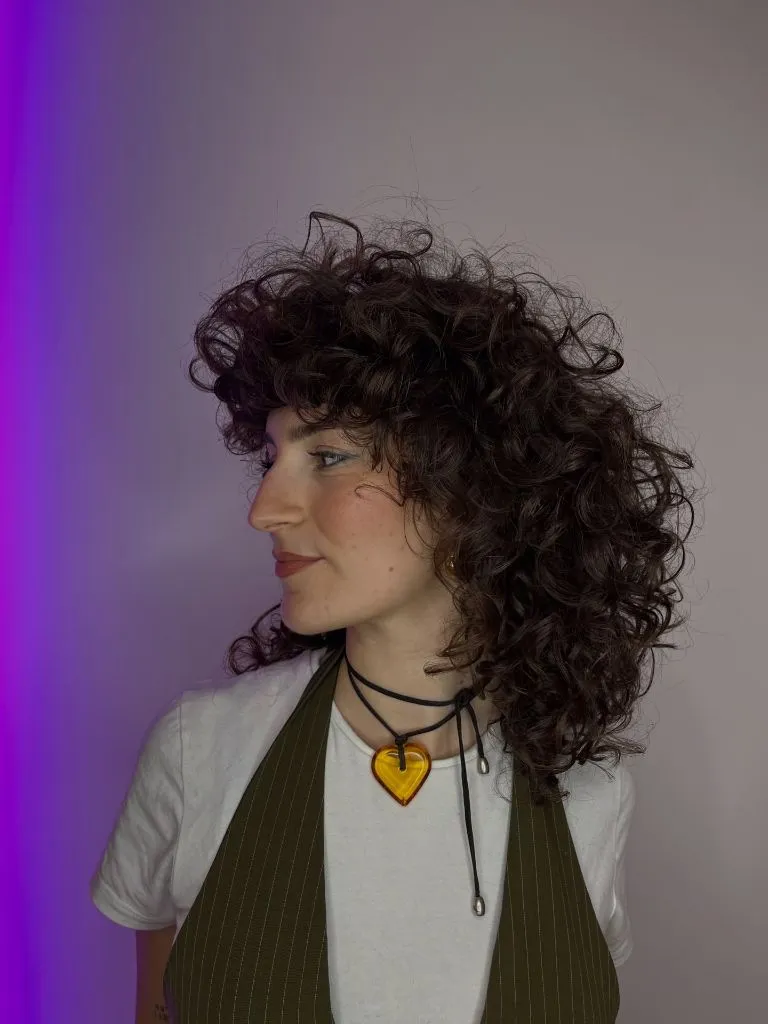
Texture against smoothness is the argument. The hair is entirely textured, every surface covered in curl, while the vest fabric reads as flat and finely striped. That juxtaposition makes the hair’s volume appear even more dramatic. The profile angle reveals how the curls project outward from the head, creating an almost spherical silhouette that contrasts with the narrow vertical line of the torso. The curly fringe is important because it continues the texture right to the hairline instead of introducing a smooth zone.
Adapt this for looser curl patterns by keeping the same layering structure but expecting less outward projection, which will produce a softer triangle instead of a sphere. To manage volume on tighter curls, reduce the number of layers near the crown so less hair lifts away from the head. The detail to remember is that a curly shag depends on layer placement more than layer count, since each cut creates a new point where curl springs outward.
9. Textured Lob With Warm Brown Dimension
A shoulder-length lob is shown from behind, revealing soft movement through the mid-lengths and ends. The color is a warm medium brown with subtle lighter pieces visible where light catches the surface. The cut has minimal visible layering, with most of the length sitting at one level. The subject wears a white high-collared jacket or top. The background is a softly lit interior with blurred elements.
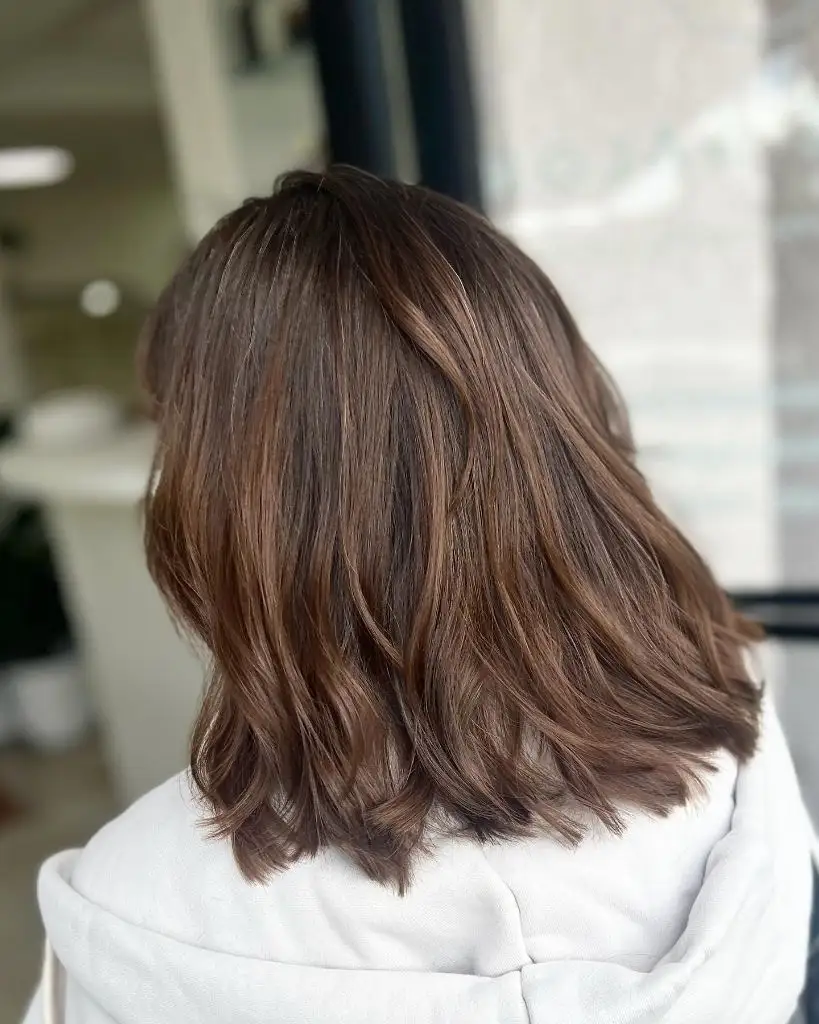
This is a study in tonal layering within a single color family. The base brown and the lighter pieces differ by only one or two shades, so the dimension appears only when light hits the hair at certain angles. That subtlety keeps the overall reading monochromatic while still preventing flatness. The one-length perimeter adds to the simplicity, making the color variation the only source of visual interest. Without those slight tonal shifts, this back view would read as a solid block.
To increase the dimension, ask for a few pieces that are a full shade lighter rather than a half shade, concentrated at the ends where light naturally falls. To simplify further, tone everything to one uniform shade and let the cut’s clean line do all the work. The strongest lesson from this image is that on short-to-medium lengths, even the most restrained color variation changes how light interacts with the shape. For more on subtle color techniques, visit chicstyleblog.com.
10. Flippy Layers With Curtain Bangs at Shoulder Length
Dark black hair is cut with visible layers that flip outward at the ends, creating movement that widens the silhouette below the jaw. A curtain fringe parts at the center and sweeps to each side at cheekbone height. The overall length reaches the shoulder. The subject wears a dark top and is photographed against a light wall with dramatic side lighting that creates a shadow. The angle is a slight three-quarter view with eyes closed.
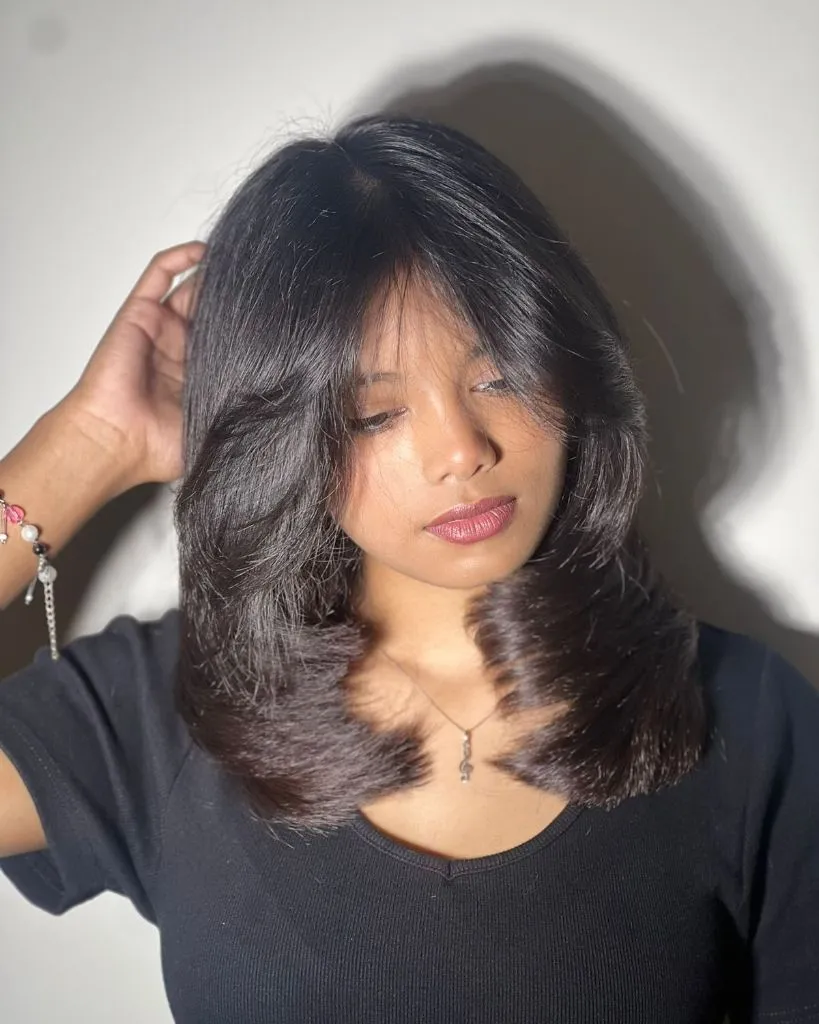
The vertical versus horizontal line tension is what makes this shape dynamic. The hair falls vertically from the crown, but every layer end kicks outward in a horizontal direction. That directional conflict creates energy in the silhouette without requiring extreme volume or length. The curtain bangs add another horizontal element at forehead level, so the eye bounces between two zones of outward movement separated by a vertical fall. The side lighting amplifies this by casting the horizontal flips into relief.
For straighter hair that does not naturally flip, use a round brush on the ends during drying to encourage the outward direction. For a calmer version, flip only the bottom layer outward and keep the face-framing pieces falling straight. The most portable idea here is that outward-directed ends on a medium-length cut create width and energy that inward-curling ends cannot replicate.
11. Clean Angled Bob From the Side
A short bob is shown in profile, with the back cut close to the nape and the front falling to just below the jaw. The angle of the perimeter line is steep and precise. The hair is straight, smooth, and dark brunette with no visible layers or texture. The ear is exposed on the near side. Only the side and back of the head are visible. The background is softly blurred with warm tones.
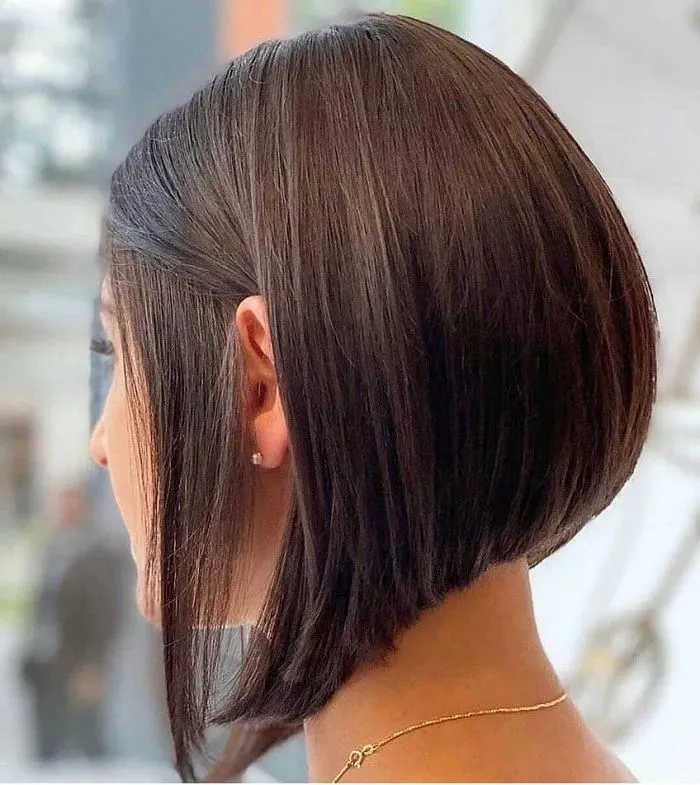
The silhouette outline is the entire argument. With no layers, no color variation, and no texture, the only visual information is the angle of the perimeter line from nape to jaw. That single line communicates the full intention of the cut. The steepness of the angle determines how dramatic the shape reads. A shallow angle would produce a quieter effect, but here the difference between back and front length is significant enough to create a strong diagonal that the eye follows immediately.
To soften, reduce the angle so the back and front lengths are closer together, which produces more of a classic bob silhouette. To push the drama further, keep the back even shorter at the nape while maintaining the front length. The one thing to communicate clearly to a stylist is the exact angle you want, because on a cut this minimal, a half-inch change at the nape alters the entire character of the shape.
12. Short Layered Cut With Feathered Nape
A short cut is shown from behind, with layers that feather outward at the nape and sides. The hair is a medium warm brown, and the layers create visible texture across the back of the head. The top sections are slightly longer and fall over the shorter underlayers. The subject wears a cream ribbed knit top. The background is a plain light wall with a faint rectangular outline. The framing is tight on the back of the head.
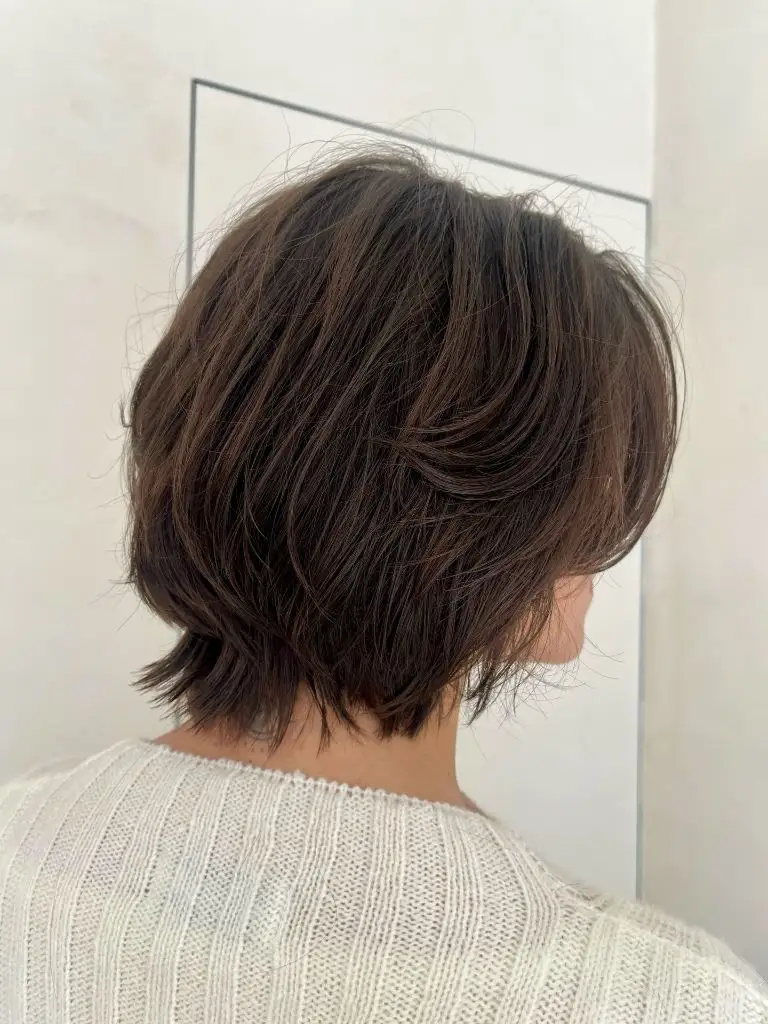
Rhythm through layering drives this shape. Each layer sits at a different length, and the ends point in slightly different directions, creating a staggered pattern across the back. That staggering prevents the short length from looking blunt or helmet-like. The feathering at the nape is particularly important because it provides a gradual transition between hair and skin, avoiding a hard stop line. The warm brown color keeps the overall feeling soft despite the short length and visible structure.
Adapt this for finer hair by reducing the number of layers so each one has enough density to read as a distinct section. For thicker hair, add more interior layers to thin out the bulk while preserving the feathered outline. The essential detail is the nape treatment, because the way a short cut ends at the neck determines whether the back looks finished or grown out. More short cut inspiration is available at chicstyleblog.com.
13. Beachy Blonde Balayage Waves From Behind
Long hair shown from the back features a balayage color that transitions from a dark brunette root into sandy blonde and pale blonde through the mid-lengths and ends. The hair has loose, irregular waves that create a natural-looking texture. The length reaches the mid-back. The subject wears a black top or cape. The setting is a salon interior with dark walls, mirrors, and product shelving visible in the background.
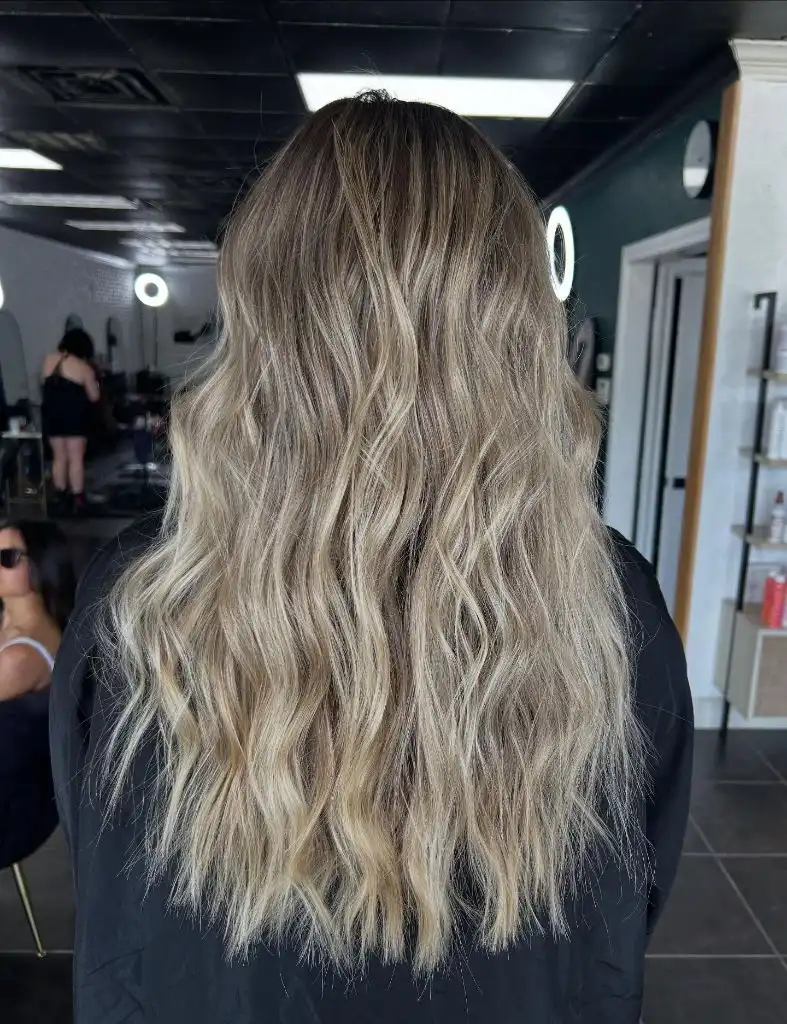
The color graduation creates a built-in value contrast that works independently of styling. Dark at the crown and light at the ends means the eye travels downward naturally, which emphasizes the length. The waves add a secondary texture layer but are not the primary mechanism. Even if this hair were blown straight, the dark-to-light transition would still provide visual interest. The irregular wave pattern simply prevents the color from looking like a flat ombre stripe and instead makes the lighter tones appear to emerge organically.
For a cooler adaptation, shift the blonde tones toward ash rather than sandy gold, which will change the mood without altering the placement. For less maintenance, keep the dark root zone larger so regrowth is invisible for longer. The proportion to study is how far down the hair the color transition begins, because starting it higher creates more blonde surface area while starting it lower keeps more of the natural dark tone dominant.
14. Warm Blonde Waves With Face-Framing Brightness
Long hair is shown from a three-quarter side angle, with loose waves falling past the shoulder. The color is a warm blonde with visible darker roots at the crown and brighter, lighter pieces concentrated near the face. The waves are relaxed and slightly irregular. The subject wears a dark navy or teal top under a black open layer. The setting is the same salon interior with dark walls and warm overhead lighting.
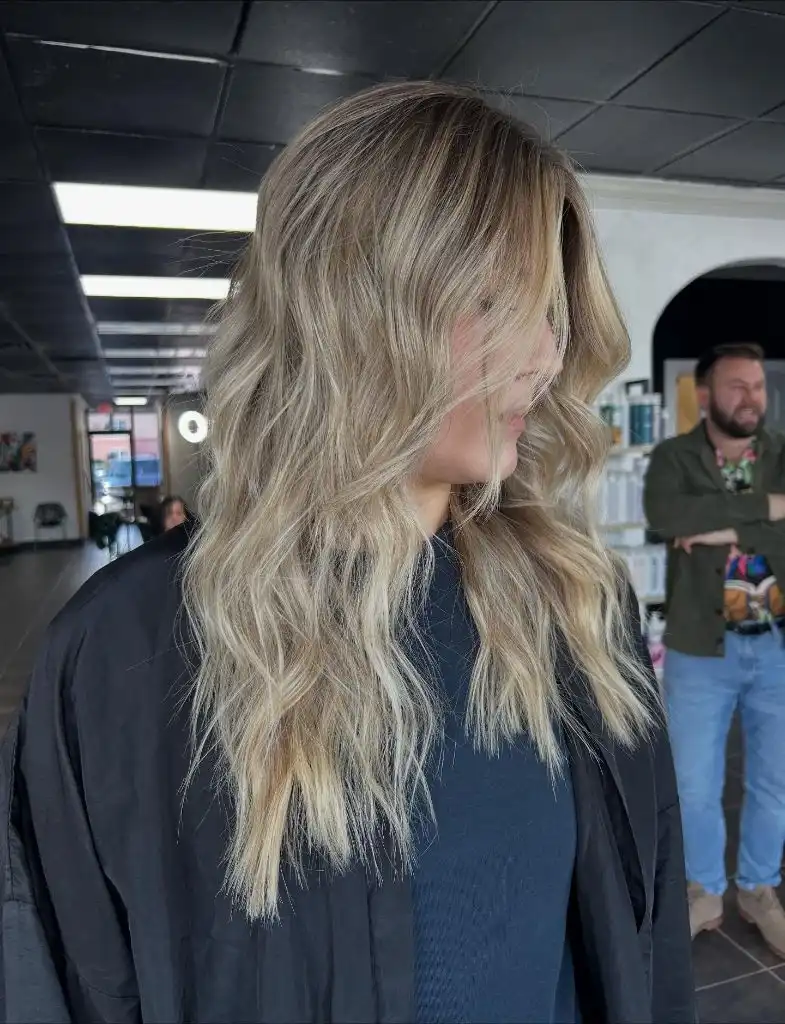
Placement and zoning tell the story. The brightest blonde pieces are positioned where they catch the most light and sit closest to the face, while the back and crown remain darker. This zoning creates the impression of allover blonde from the front while the side and back reveal the darker base. It is an efficient use of color because the most visible zones get the most work. Trendy haircuts 2027 often pair this kind of strategic color placement with relaxed shapes that do not compete for attention.
To adapt toward a more uniform look, extend the brighter pieces further back and through the interior sections. For a more rooted, low-contrast version, darken the face-framing pieces by one shade so they blend more gradually into the base. The strongest detail here is the concentration of brightness specifically at the front, which is a decision about where the viewer’s eye should land first.
15. Precision Blunt Bob From Behind
A short bob is shown from the back, with the perimeter cut into a perfectly straight, blunt line at the nape. The hair is very dark, nearly black, and completely smooth with high shine. No layers are visible. The line is clean and even from side to side. The subject wears a beige or tan top. The background is a softly lit salon interior with warm lights and mirrors.
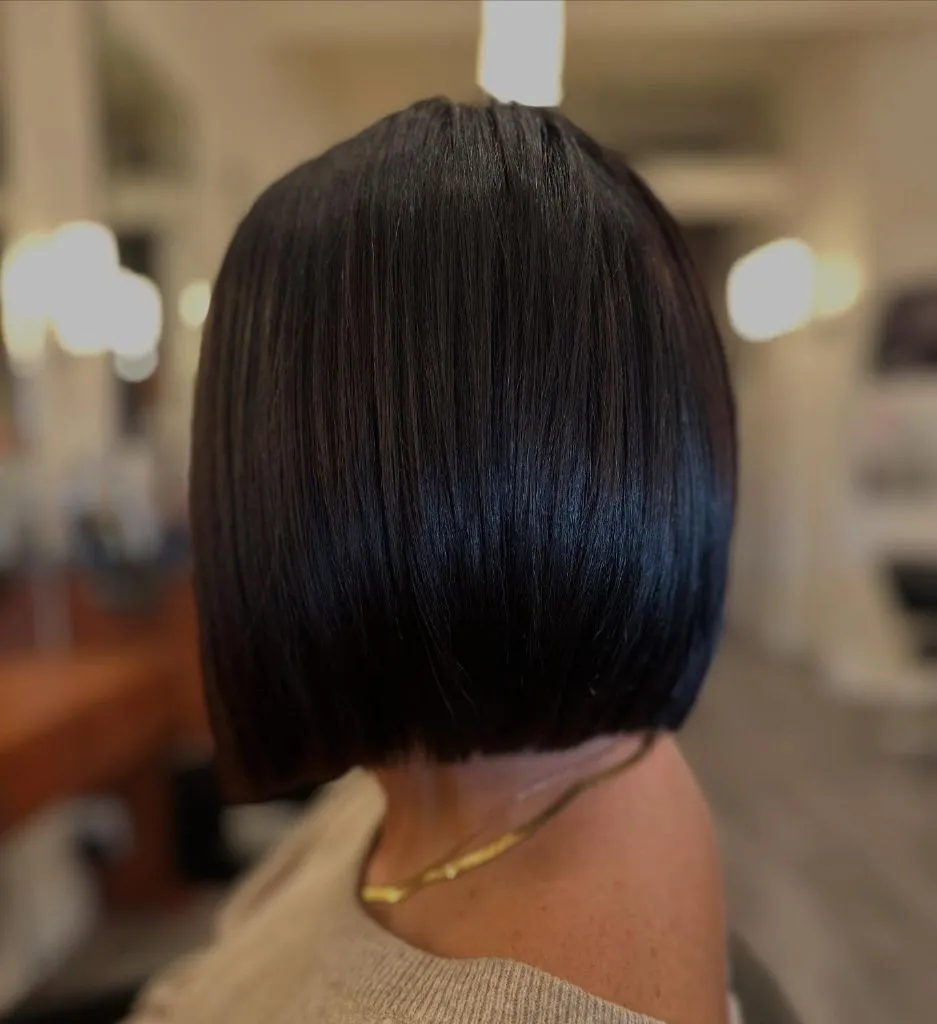
This is negative space reduced to its most extreme expression. The cut removes everything except one clean line, one uniform color, and one smooth texture. There is no layering to analyze, no color variation to trace, no wave pattern to describe. The entire impact comes from precision. The straight bottom edge is so exact that any unevenness would immediately register as a flaw. The dark color and high shine amplify the geometry because light reflects uniformly across the surface, revealing every angle of the shape.
This cut demands regular trims because the blunt line is its only feature, and any growth softens the geometry that makes it work. To adapt it with slightly more texture, ask for a single interior layer near the crown for movement while keeping the perimeter blunt. The lesson is that the fewer elements a cut contains, the higher the execution standard each one must meet.
16. Choppy Textured Pixie With Full Fringe
A short pixie-length cut features choppy, textured layers across the top and a full fringe that covers the forehead to just above the eyebrows. The sides and back are cut close but not shaved, with visible texture remaining. The color is a warm light brown with slight variation. The subject wears a black graphic tee and is photographed in a salon setting with soft pink walls and shelving. The angle is a three-quarter front view.
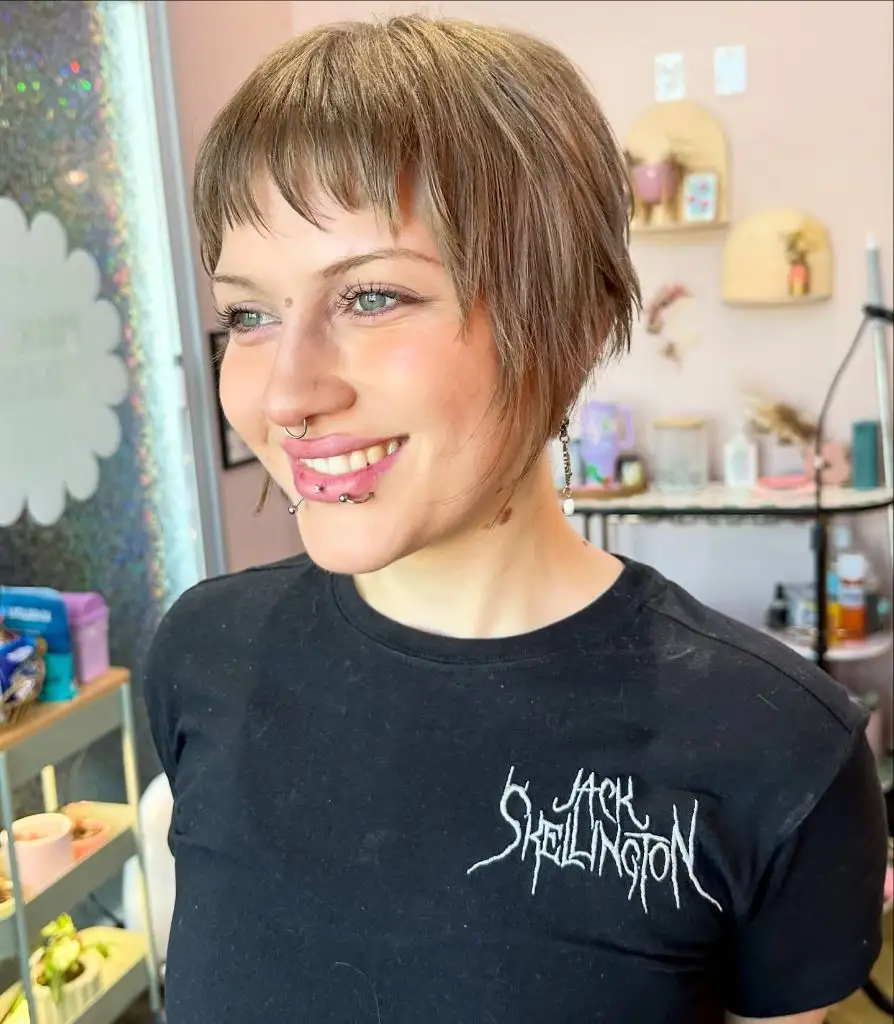
Texture against smoothness operates in reverse here compared to longer cuts. On a pixie, the textured pieces are the dominant element and the smoother sections along the sides provide the ground. The full fringe establishes a strong horizontal line across the forehead, and the choppy top layers break that line with vertical and diagonal movement. That combination of one controlled edge and many uncontrolled ones gives the cut personality without chaos. Trendy haircuts 2027 with this kind of short length rely on texture rather than silhouette for their impact.
To soften, blend the fringe edges so they feather rather than chop, which will make the forehead line less severe. For a more dramatic contrast, keep the sides shorter and smoother while leaving the top layers longer. The most important adaptation detail is fringe density. A full, thick fringe on a pixie anchors the whole shape, while a thinner fringe changes the balance entirely and shifts attention to the top layers.
17. Ash Blonde With Silver Undertones From Behind
Long hair is shown from the back, falling past the shoulder blades in soft, large waves. The color is an ash-toned blonde with cool silver and gray undertones, transitioning from a darker root area to lighter ends. The surface has a silky quality with visible shine. The subject wears a black short-sleeved top. The background is a modern interior with light floors and patterned wall elements.
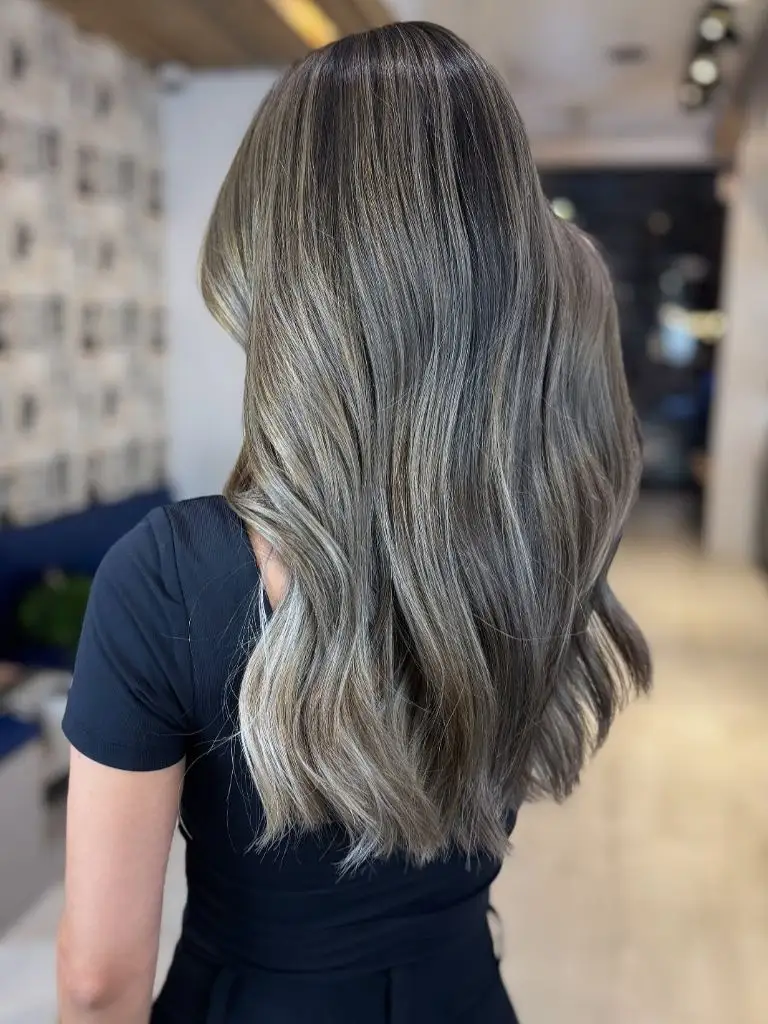
Color temperature is the primary mechanism. Every tone in this hair reads cool, from the ashy roots to the silver-touched mid-lengths to the pale ends. That tonal consistency across the full length creates a cohesive reading even though the value shifts from dark to light. The waves are gentle enough to keep the color visible across large surface areas without breaking it into small fragments. On tightly curled hair, the same color would read differently because each curl would create its own shadow and highlight, fragmenting the tonal flow.
To warm this up slightly without losing the ash quality, introduce a few pieces of pale champagne near the face. To push it cooler, tone everything toward pure silver. The key observation is that cool-toned color on long hair needs a smooth or gently waved surface to read as intended, because excessive texture creates shadows that can make ash tones appear muddy. For more on cool-toned color choices, browse chicstyleblog.com.
18. Choppy Medium Layers With Long Side Fringe
Dark black hair is cut to a medium length with visible choppy layers, particularly through the mid-lengths. A long side fringe sweeps across the forehead and covers one eye from this profile angle. The ends are textured and slightly uneven. The subject wears a white sleeveless top and is photographed against a plain off-white wall. The side profile reveals how the fringe connects to the longer sections.
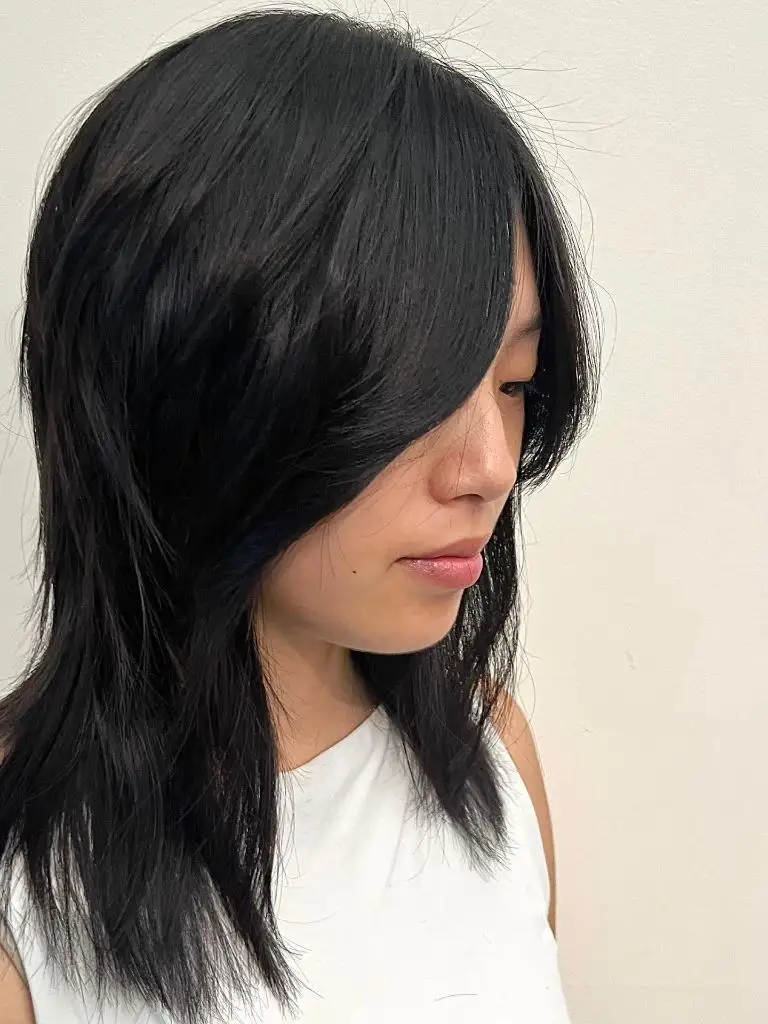
The vertical line dominates. From the crown, the fringe falls forward in one long diagonal, and the remaining hair drops straight down with minimal outward movement. The choppy layers add texture to the surface but do not significantly alter the vertical direction of the silhouette. This means the cut reads as narrow and elongating rather than wide. The single longest fringe piece crossing the face interrupts the vertical just enough to keep the profile view interesting without breaking the overall downward flow.
For a wider silhouette, add layers that are short enough to project outward from the head rather than falling alongside it. For an even more minimal version, smooth the surface texture so the layers blend and the shape becomes a clean column. The most useful detail is the fringe length and angle, because a side fringe that reaches the cheekbone creates a very different diagonal than one that stops at the eyebrow.
19. Textured Blonde Pixie With Dark Root Shadow
A short pixie cut is shown in profile, with longer textured pieces on top and shorter, tapered sides. The color features a dark root shadow transitioning into a pale platinum blonde on the top and crown. The texture is soft and slightly tousled. The subject wears glasses with clear frames and a dark burgundy crewneck sweater. The setting is an urban storefront exterior with green-painted walls and architectural details.
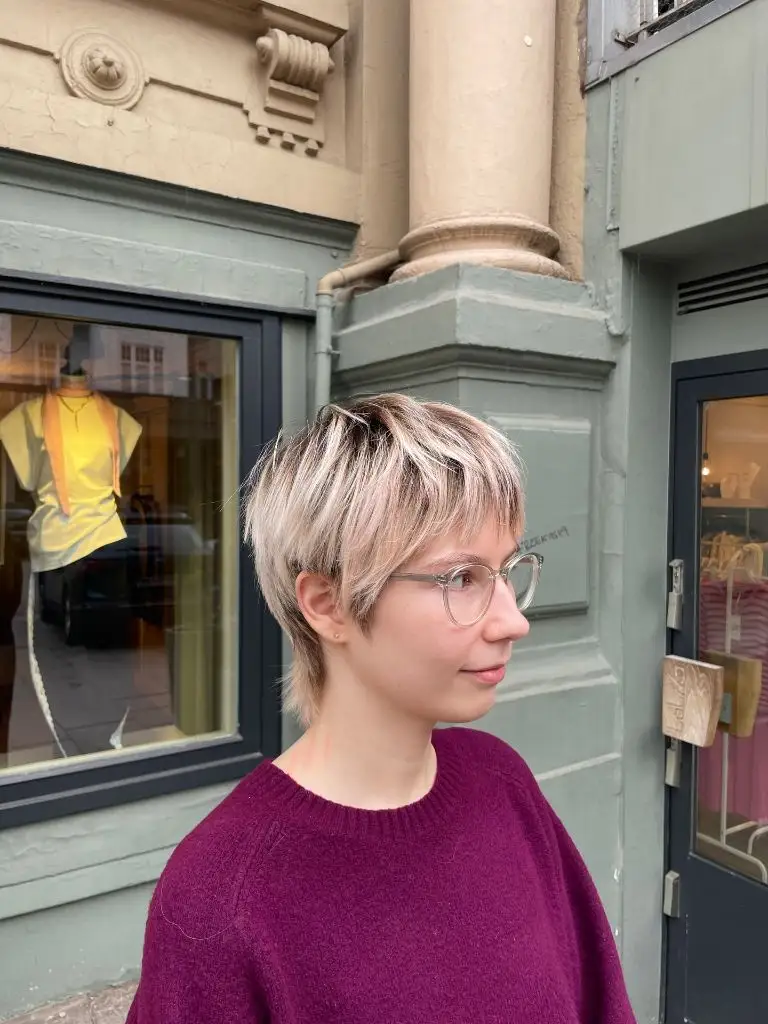
One accent against a ground is the principle at work. The dark root shadow is a small zone within a mostly light-colored cut, but it anchors the entire color scheme by providing a reference point for the eye. Without that dark base, the platinum top would lack depth and context. The root shadow also creates a gradient that gives the very short sides a sense of transition rather than an abrupt change. Trendy haircuts 2027 frequently use root contrast on short cuts because the small total surface area makes even minor color shifts highly visible.
To adapt with less contrast, match the root tone more closely to the blonde so the transition is softer. For more drama, extend the dark root further up and let the blonde begin only at the very top. The detail to preserve when customizing is some amount of visible root, because on a pixie this short, an allover single color can read flat in a way that a slight gradient prevents.
20. Long Black Center-Parted Waves
Very long black hair falls well past the shoulders, nearly reaching the waist. The center part creates two symmetrical curtains of hair. The texture shows loose, natural-looking waves with some visible irregularity and slight frizz at the surface. The subject wears a brown salon cape and is photographed from the front in what appears to be a salon interior with a counter and decorations in the background.

Scale is the argument. When hair reaches this length, the sheer volume of surface area becomes the dominant visual element. Individual styling details matter less because the eye processes the shape as a large mass first. The center part provides the only structural division, splitting that mass into two equal sections. The natural wave texture prevents the length from hanging lifelessly, adding just enough movement to keep the surface readable. Without that texture, the same length in perfectly straight hair would read as a flat panel rather than a dimensional shape.
For a more structured version of this length, add face-framing layers that start at the collarbone to break the front silhouette into sections. To keep the current simplicity but add more polish, smooth the mid-shaft while allowing the ends to keep their natural wave. The strongest takeaway is that at extreme lengths, a center part and natural texture may be all the styling a cut needs. Explore long hair styling options at chicstyleblog.com.
21. Copper Waves With Wispy Bangs
Medium-length hair in a rich copper-red tone is styled in soft waves that begin at the ear and continue through the ends. A wispy, slightly parted fringe sits across the forehead, thin enough to show skin through the strands. The color is warm and saturated with visible variation between brighter and deeper red tones. The subject wears a black printed top and is photographed against a warm-toned wooden background with greenery. The angle is a three-quarter view looking slightly downward.
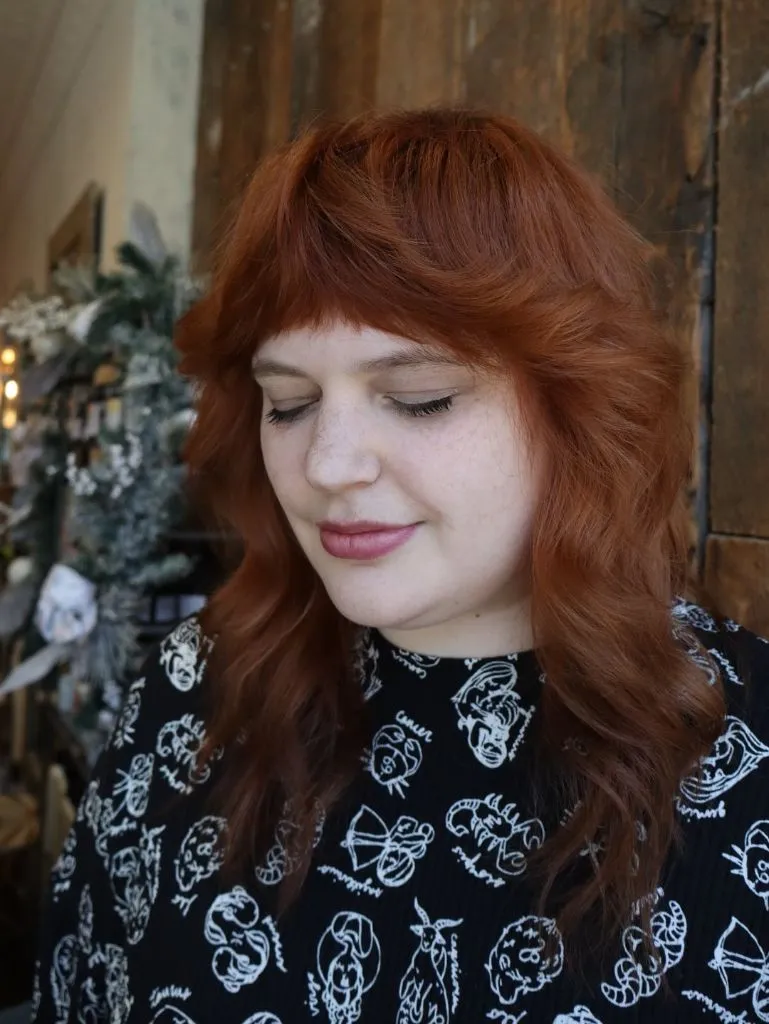
Color saturation is doing the heavy lifting. The copper tone is vivid enough to function as the central design element, making the wave pattern and the fringe secondary to the color itself. The wispy fringe works specifically because it does not add another zone of visual weight. A thick, blunt fringe in this same saturated color would compete with the overall warmth by creating a dense block at the forehead. The thin, airy fringe instead lets the color flow uninterrupted from crown to ends while still providing a sense of structure.
To adapt this color at a lower saturation, shift toward a muted auburn or strawberry tone that reads as warm without demanding attention. For the fringe specifically, keep it thin if the hair color is strong, and thicken it only if the color is muted enough not to overwhelm. The relationship between color intensity and fringe weight is the detail that makes this particular combination succeed.
22. Long Brunette-to-Caramel Ombre Waves
Long hair is shown from behind, falling past the mid-back in polished, defined waves. The color transitions from a dark brunette at the roots through a warm brown mid-section into caramel and golden blonde at the ends. The waves are smooth, consistent, and evenly formed. The subject wears a white top, and the background shows a salon-like setting with curtains and window reflections. The back view reveals the full gradient and wave pattern.
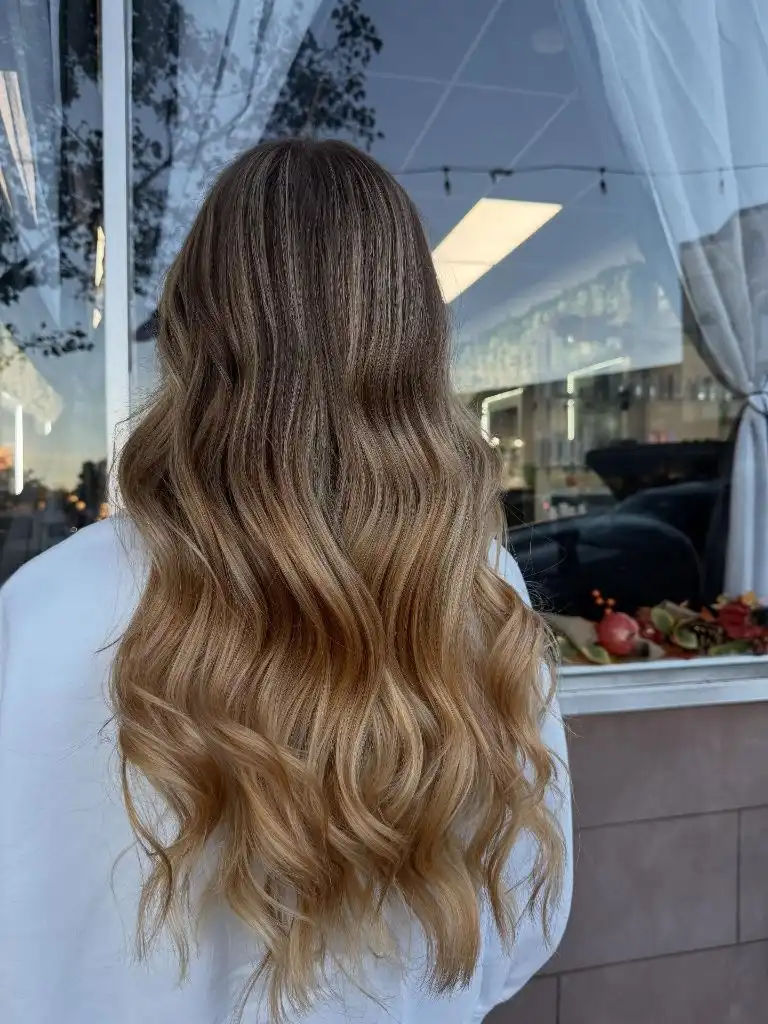
The color echo principle operates across the full length. Rather than a sharp two-tone divide, the gradient moves through at least three distinguishable tones that each relate to the ones adjacent. Dark brown connects to medium brown, medium brown connects to warm caramel, and caramel connects to golden blonde. That chain of relationships makes the transition feel organic even though the total shift from root to end is dramatic. The consistent wave pattern supports this reading by ensuring every tone gets equal visual time across the curves.
To adapt with a shorter gradient, compress the transition zone so the dark-to-light shift happens over a smaller vertical distance, which intensifies the contrast. For a subtler version, eliminate the lightest blonde at the very ends and let the gradient stop at caramel. The principle worth keeping is the idea of a chain, where each tone connects to its neighbor rather than jumping to a distant shade.

Hi, I’m Zoey Mitchell, the creator of ChicStyle Blog.
I share simple, wearable outfit ideas, hairstyles, nail trends, and beauty tips that feel natural and easy to recreate.
This blog is where I explore everything that makes a woman feel put together and confident every day. I’m not an expert — just a woman who genuinely loves style, mixing looks, and discovering what works.
If you love effortless fashion with a personal touch, you’ll feel at home here.