
There is something about the way a hand catches light in the colder months that makes every small decision on the nail surface feel more deliberate. A glitter gradient reads differently against a grey sleeve than it does in summer. A deep burgundy holds more weight when the skin around it carries the pale cool tones of late autumn. November nail ideas tend to settle into that quieter register, and the sets gathered here show just how much range lives inside it.
What makes a November manicure work is rarely about a single color choice. It functions more like a small design language, one where several variables interact across all ten nails at once. The sets in this article are judged by four things: color placement, meaning where each shade sits and how much surface it claims; texture contrast, the interplay between matte, glossy, glitter, and chrome finishes; motif restraint, how pattern and detail are distributed without overwhelming the nail bed; and tonal range, the distance between the lightest and darkest value in the set. These four lenses reveal why some combinations feel balanced and others feel cluttered. Each section below walks through one set, describing exactly what is visible and then unpacking why the choices hold together. The approach treats nail design the way one might treat any other composition, as a series of considered moves rather than a single statement.
1. Silver Glitter With Pink Base and Bow Accents
The set uses an almond shape at a medium-long length. Two nails carry full silver glitter coverage, dense and reflective with a slightly warm undertone. The remaining nails sit on a sheer pink base, with small scattered dot details and delicate bow motifs drawn in fine line work near the cuticle zone. One nail features a glitter French-style curve at the tip rather than a full coat. Two rings, one a dark stone cluster and the other a crystal band, frame the hand.
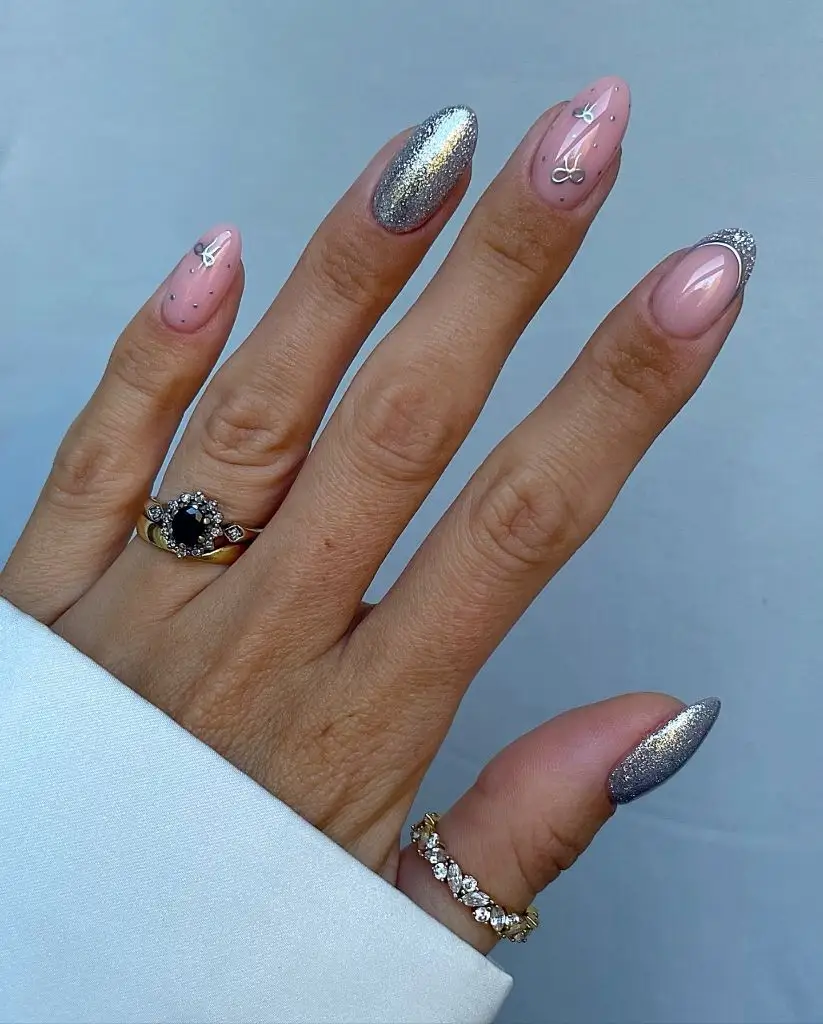
Photo via Instagram
The composition balances high-impact texture against quiet negative space. The full glitter nails act as anchors, pulling visual weight to the thumb and middle finger, while the sheer pink nails between them provide breathing room. The bow motifs are small enough that they read as texture rather than illustration, and the scattered dots create a subtle rhythm across the surface without competing with the glitter. The French curve on one nail introduces a third format, breaking the binary between full coverage and bare pink. It is the kind of layering that feels considered, distributing interest across formats rather than concentrating it in one zone.
The reader takeaway is that alternating between a high-texture accent and a near-bare base gives a set structure without rigidity. The glitter does not need to appear on every nail to carry the theme, and the fine line details work precisely because they sit on the quietest surfaces. That principle of placing detail where there is room for it, rather than where the eye already lands, applies to any set built around a strong accent finish. Approaches to seasonal nail styling often benefit from this kind of spatial thinking.
2. Olive and Black With Dimensional Surface Detail
This set works with a dark, moody palette across almond-shaped nails. One nail is fully covered in a deep olive green with a glossy, almost liquid surface. Another features a chocolate brown base with a raised white circular detail that reads as a dimensional blob or cabochon. A yellow-green nail with a chrome-outlined organic shape sits on the middle finger, and another nail shows a brown and white yin-yang-style split. The pinky carries a black base with fine silver line work and small metallic dots.
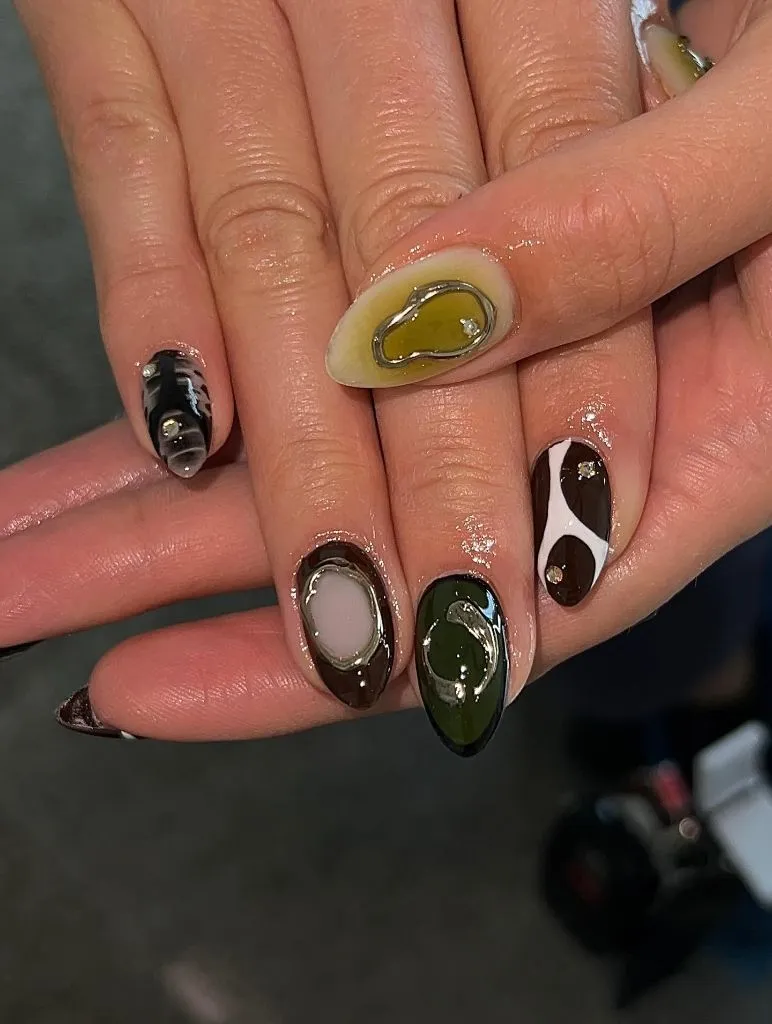
Photo via Instagram
What holds this set together is not a shared color but a shared approach to surface. Every nail carries some form of dimensional or textural interruption, whether it is the raised blob on the brown nail, the chrome outline on the yellow-green one, or the fine metallic lines on the pinky. The palette itself spans a wide tonal range, from near-black to pale yellow-green, yet the glossy finish across all nails acts as a unifying layer. The eye moves from nail to nail not because the colors match but because each surface asks to be examined closely. The olive nail, being the most uniform, functions as a rest point amid all the surface activity.
The useful move here is treating the finish as the connective thread rather than the color. When a set covers this much tonal ground, a consistent gloss level or a recurring dimensional technique can hold the composition together. That logic works well for anyone drawn to varied color palettes but unsure how to keep them from reading as random. Shared surface behavior is often a stronger anchor than shared hue.
3. Red Spider Web French Tips With Character Art
The nails are almond-shaped and medium-long. Several nails feature a clear or nude base with red French tips overlaid with white spider web line work. One nail carries a hand-painted Spider-Man face in red and black with white eye shapes. Another nail shows a small black spider silhouette on a nude base. The index finger and pinky both carry the web-patterned red tips. Two gold rings, one a Chanel-style double-C and the other a red baguette-cut band, sit on the fingers.
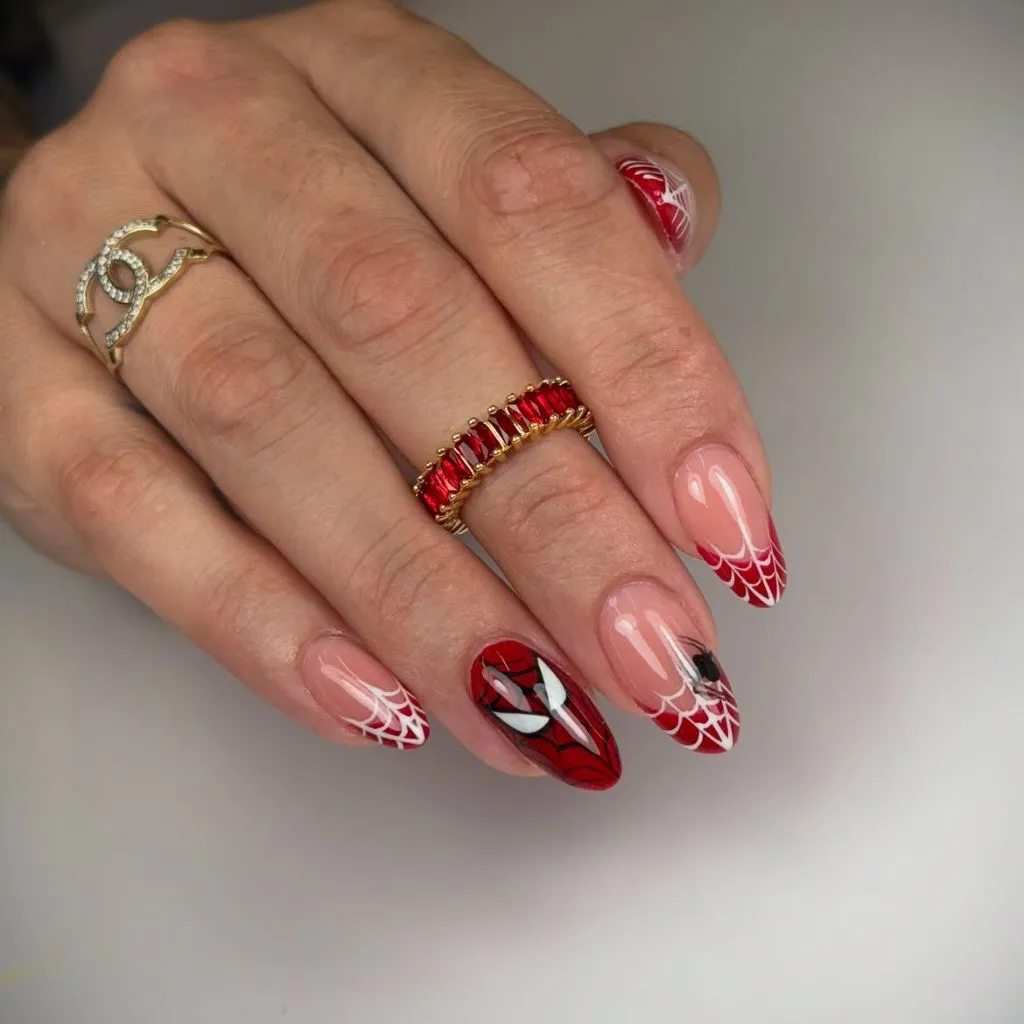
Photo via Instagram
The set manages to incorporate character illustration without losing a sense of design structure. The red French tips with white web overlay appear on enough nails to establish a visual system, and the character face on the middle finger reads as the focal point precisely because it is surrounded by that system. The nude base nails act as negative space, preventing the red from dominating. The spider silhouette on the ring finger is a quiet nod that connects to the theme without repeating the complexity of the face. This distribution, busy center flanked by patterned tips and quiet bases, gives the hand a clear visual hierarchy.
The strongest lesson is that themed nail art holds together best when the theme is expressed at multiple levels of intensity. A full illustration on one nail, a pattern reference on several, and a small icon on another create layers of engagement rather than a flat repetition. Anyone working with character or pop-culture references might consider building that same gradient from detailed to minimal across the set. Exploring creative nail art concepts can help develop that kind of layered approach.
4. Sage Glitter Tips With Starburst and Bow Details
Both hands are visible here, showing a short-to-medium almond shape. Several nails feature sage green glitter French tips with a soft, irregular edge. Others carry a sheer pink base with hand-drawn starburst motifs in metallic tones and small scattered gold and black dots. A few nails display fine bow details drawn in gold line work near the tip area, layered over the green glitter. The overall palette is muted, sitting in a sage-pink-gold range.
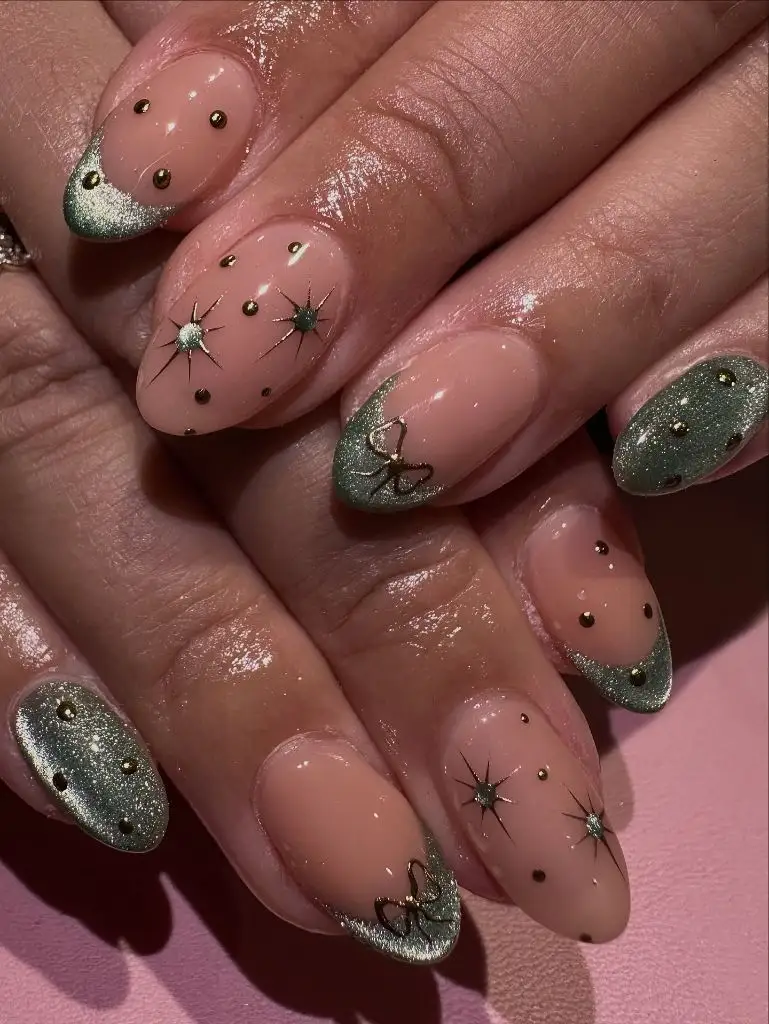
Photo via Instagram
The restraint in color range is what gives this set its cohesion. The sage green and gold sit close enough in warmth that they feel like variations of the same tone rather than competing accents. The starburst motifs, placed on the sheer pink nails, introduce a graphic element without increasing the color count, since they use the same gold already present in the bows and dots. The irregular edge of the glitter tips avoids the crispness of a traditional French, which keeps the overall feeling soft and organic. It reads as a set where every detail was chosen from the same tonal vocabulary.
What stands out most is the way a limited palette can still support multiple motif types. Bows, starbursts, dots, and glitter all appear here without the set feeling cluttered, because they all speak the same color language. That principle, keeping the motif variety high but the color count low, is a reliable way to build complexity without noise. It works especially well in autumn-toned nail palettes where warmth and softness are the primary goals.
5. Teal Plaid With Gradient Brown and Blue French
Two hands are shown, both with short-to-medium oval nails. The set mixes several formats: some nails carry a brown-to-teal gradient that darkens toward the tips, others feature a blue French tip on a pale pink base, and one accent nail on each hand displays a teal and brown plaid pattern with fine white and dark grid lines. Two nails show a chocolate brown base with white dots. A simple gold band sits on one finger. Fallen leaves are visible on the ground behind the hands.
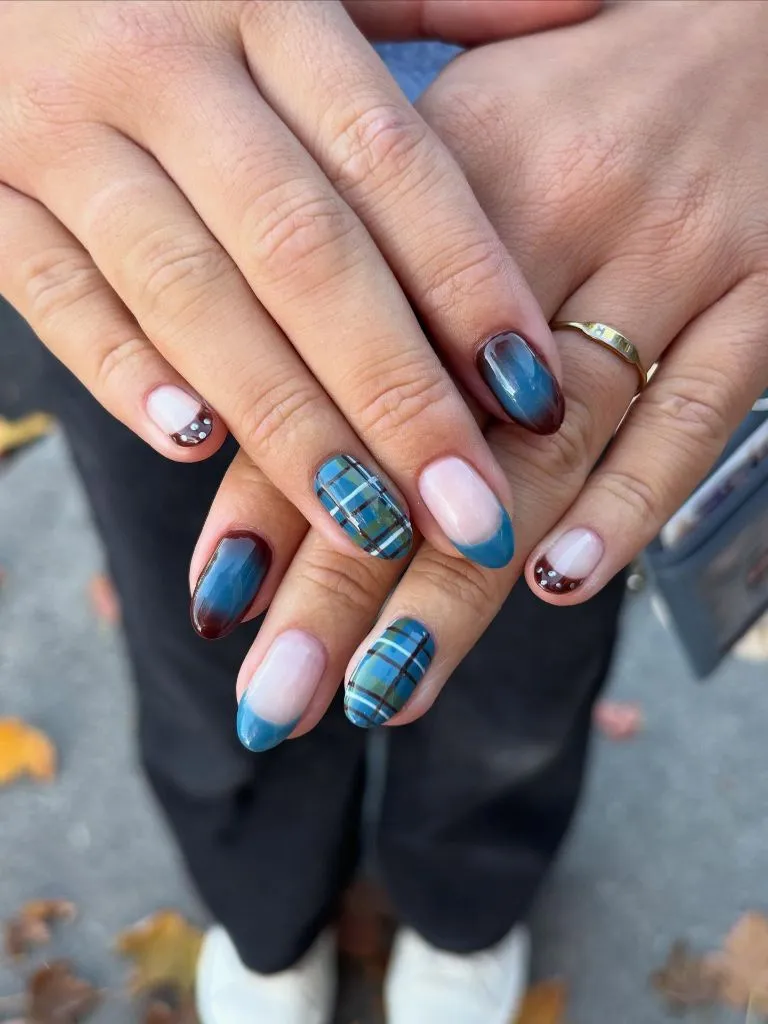
Photo via Instagram
The plaid nail acts as the key that explains the rest of the set. The teal, brown, and white present in the plaid pattern are the exact same colors distributed individually across the other nails, so the patterned nail reads as a decoder for the palette. The brown-to-teal gradient nails pick up both ends of the plaid spectrum, while the blue French tips isolate the coolest tone, and the polka-dot chocolate nails anchor the warmest. This is a composition where every nail is a fragment of the same source pattern, which gives a multi-format set a sense of logic rather than randomness.
The best move here is using a pattern nail as the palette reference point for the entire set. When the plaid contains every color that appears elsewhere, the varied formats feel intentional rather than scattered. Anyone working with multiple nail formats, French tips, gradients, solids, and pattern, might anchor the whole set by choosing one nail that holds all the colors at once. That structural thinking appears often in seasonal plaid and pattern inspiration and translates well to other multi-format sets.
6. Chocolate Brown With White Polka Dots
Two thumbs are held together, both showing short, rounded nails with a glossy chocolate brown base and scattered white polka dots. The dots are small and irregular in placement, not aligned in a grid. The brown is deep and warm, with a red-leaning undertone visible in the light. The finish is high gloss, and the nails are kept natural and short.

Photo via Instagram
The simplicity here is the point. With only two elements in play, a solid base and scattered dots, the entire composition rests on the quality of the brown and the spacing of the dots. The warmth of the chocolate tone gives the surface depth, and the white dots are small enough to function as texture rather than pattern. Their irregular spacing feels hand-placed rather than printed, which adds a slight organic quality. The high-gloss finish amplifies the brown, making it look rich and almost edible, like glazed ceramic. I find that the decision to keep the nails short reinforces the idea that this is about surface quality, not about length or shape drama.
The useful idea is that a two-element nail, one color and one detail, relies entirely on the relationship between those two things. The dot size, the spacing, the base depth, and the gloss all matter more when nothing else competes for attention. That kind of reductive approach can feel more deliberate than a multi-detail set, and it transfers well to any minimalist nail design where one simple gesture does the work.
7. Monarch Butterfly Wings With Plaid and Tortoiseshell
Both hands overlap, displaying long almond nails in a warm autumn palette. The set includes at least four distinct formats: monarch butterfly wing art in orange, black, and white with dotted borders; tiger-stripe or woodgrain patterns in tan and black; burgundy and tan plaid with fine white grid lines; a deep burgundy solid; and what reads as tortoiseshell on one or two nails, with amber and brown blended tones. Silver rings are visible on multiple fingers.
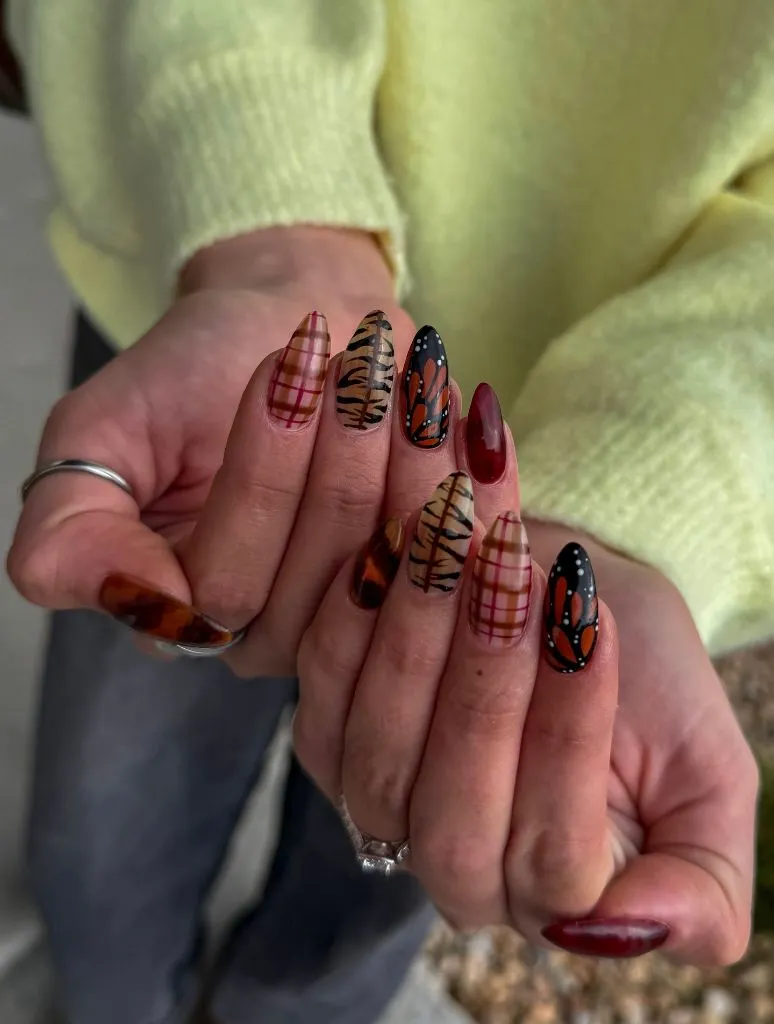
Photo via Instagram
The number of formats here is high, yet the set avoids chaos because the color range is disciplined. Every nail draws from the same warm spectrum: burgundy, orange, amber, tan, and black. The butterfly nails are the most illustrative, with their curved wing lines and dot accents, but the plaid and tiger-stripe nails echo those same tones in more abstract forms. The tortoiseshell nail introduces a blended, organic texture that bridges the flat plaid and the detailed butterfly. It reads as a set built around a single seasonal mood expressed through multiple surface languages, with the butterfly as the narrative anchor and everything else as tonal support.
The beauty of this is in the palette discipline that allows maximal format diversity. Five different patterns and textures coexist because they share the same handful of warm tones. Anyone building a multi-pattern set should consider locking the color count first and then exploring as many surface treatments as that palette can support. The result often feels curated rather than scattered, especially when one motif, like the butterfly here, carries the most visual complexity while the others stay more geometric or abstract.
8. Rose Gold Glitter Tips With Star Motif
The hand shows three visible nails in an almond shape at medium length. One nail carries a rose gold glitter French tip with a soft, curved edge and a small white starburst motif drawn just below the glitter zone on the pink base. Another nail appears to have a clean white French tip. The lowest visible nail features a rose gold glitter tip with what may be a small additional detail near the point. The base color across all nails is a soft, warm pink. A gold crystal band ring sits on the thumb.
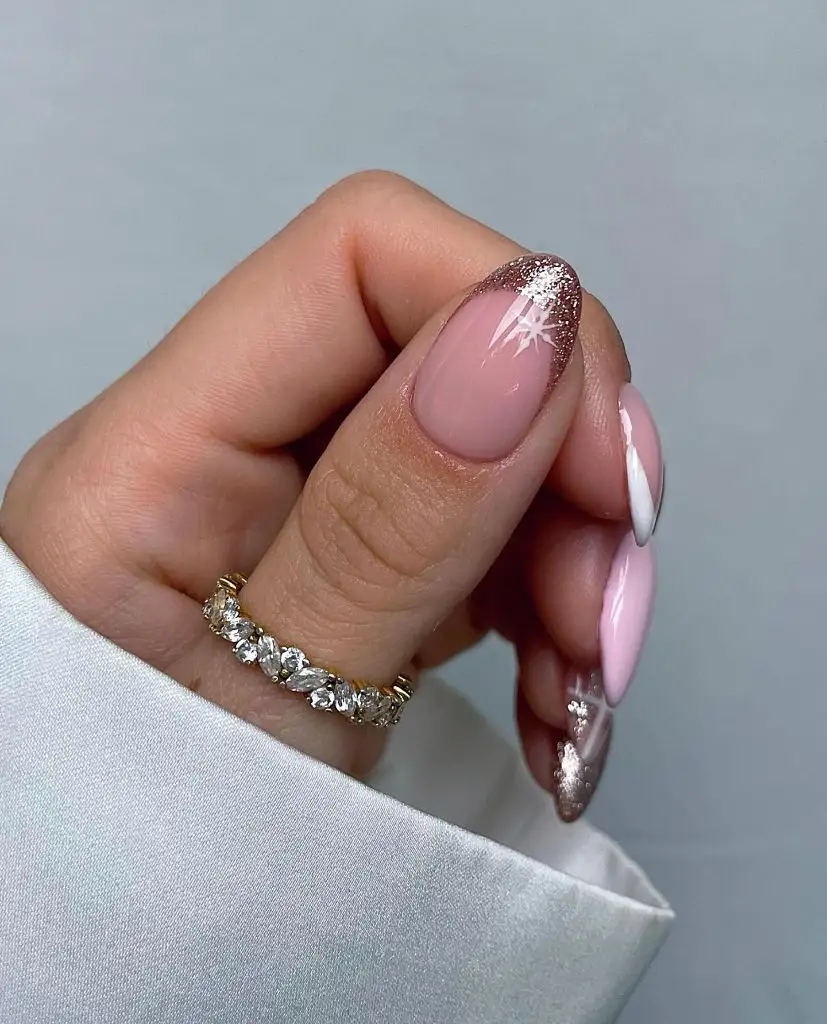
Photo via Instagram
The rose gold glitter here is warm enough to feel distinctly autumnal rather than bridal. The soft curve of the French tip avoids a sharp geometric line, which makes the glitter feel more like a natural gradient than a painted boundary. The starburst detail is positioned precisely where the glitter meets the pink base, which turns a simple French tip into something with a focal point. The white French on the adjacent nail provides a classic contrast, keeping the set from reading as entirely glitter-based. The warm pink base ties everything together with a flesh-toned neutrality.
The reader takeaway is that a single motif placed at the transition point between two finishes creates a focal anchor that a plain French tip cannot. The starburst works because it lives at the edge of the glitter, drawing attention to the boundary rather than the coverage zone. That placement logic, putting detail where two surfaces meet, applies broadly to any French-style set and is a principle worth exploring across different French tip nail variations.
9. White Flower Art With Giraffe Print and French Tips
Both hands are shown with almond-shaped nails at medium-long length. Several nails carry a classic white French tip on a nude base. Others feature a brown giraffe-print pattern covering the full nail. The accent nails display hand-painted white flowers with gold bead centers, placed over the giraffe print or at the French tip junction. The flowers have soft, rounded petals and sit prominently on two or three nails per hand.
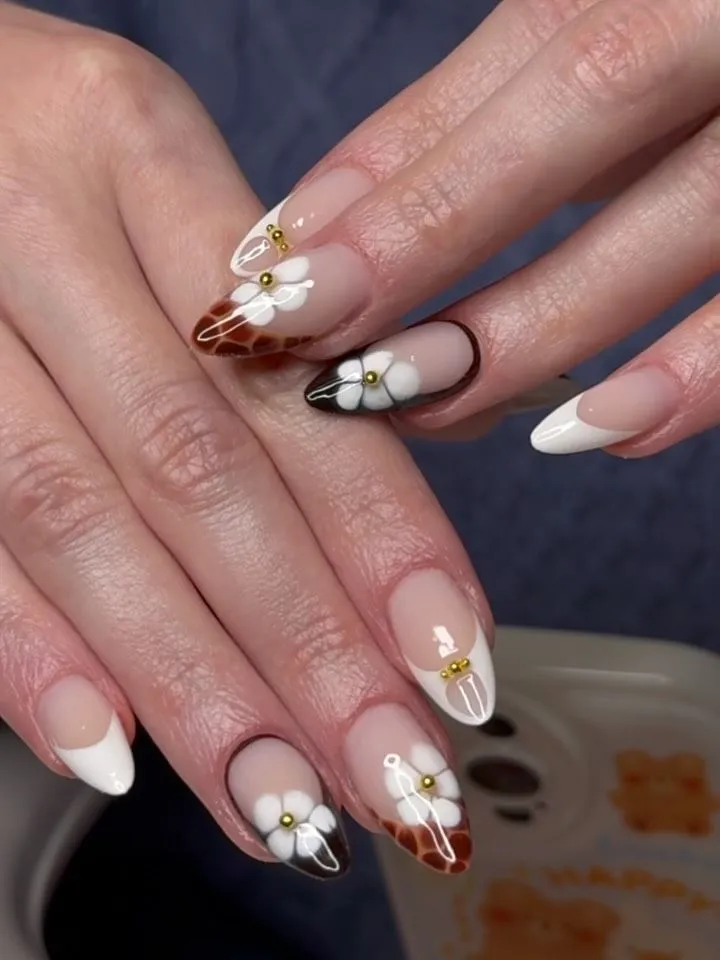
Photo via Instagram
The set operates on a three-tier system: the white French tips are the quietest layer, the giraffe print is the most textured, and the flower art sits on top of both as the decorative peak. The gold bead at the center of each flower is small but functions as a connective element, its warmth echoing the brown tones in the giraffe pattern. The white petals repeat the white of the French tips, creating a visual thread between the busiest nails and the simplest ones. This layering means the eye can read the set at different levels of engagement, from a distance it reads as brown and white, and up close the flower construction becomes the focus.
The useful move here is connecting the accent and the base through shared color rather than shared format. The flower petals borrow the white from the French tips, and the gold bead echoes the brown print, so the illustrative nails feel like they grew from the same palette. When adding floral accent nail art, pulling petal or center colors directly from other nails in the set builds cohesion that feels structural rather than decorative.
10. Caramel Plaid With Solid Brown and Baby Blue
One hand is shown with short oval nails. Two nails carry a caramel and tan plaid pattern with white grid lines on a warm, slightly translucent base. One nail is a solid baby blue, clean and opaque. Another is a rich solid brown, deep and glossy. The combination of plaid, solid warm brown, and a single cool blue creates a distinct color rhythm across four visible nails.
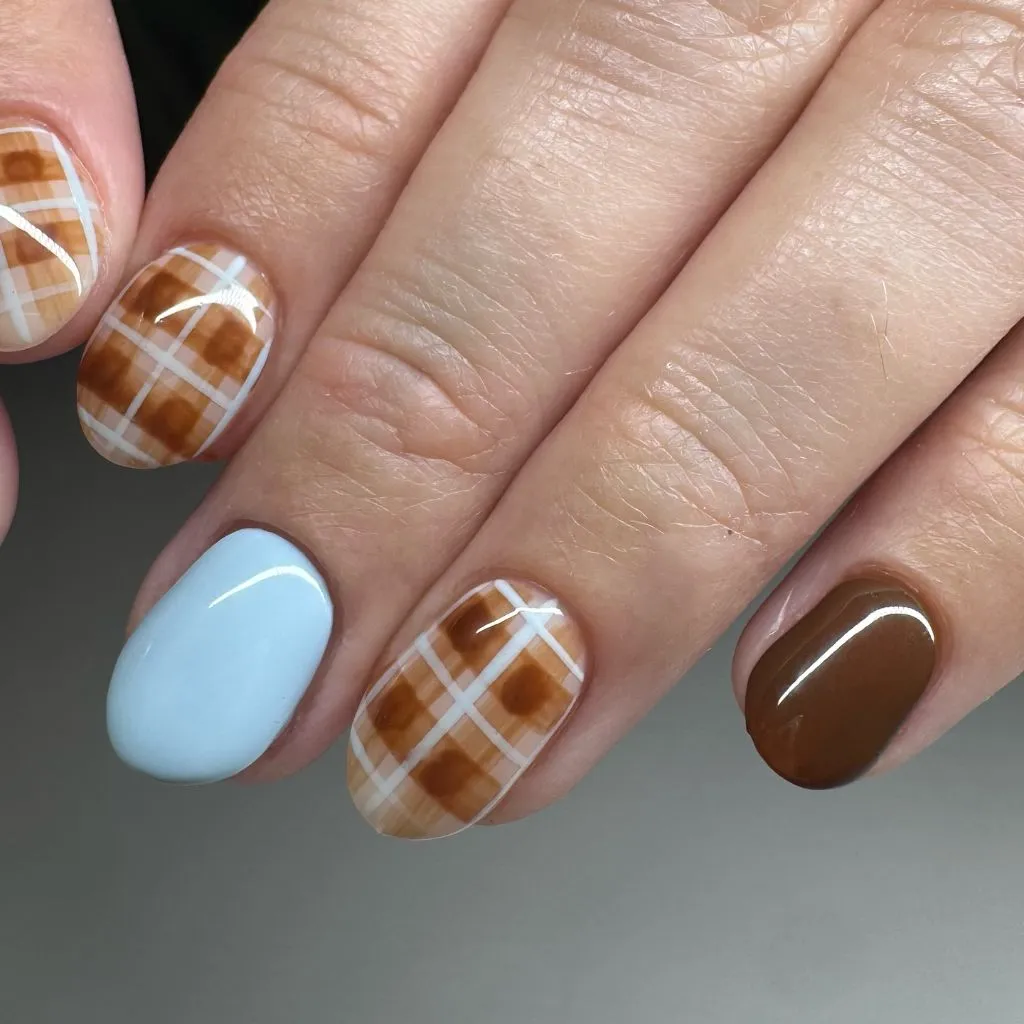
Photo via Instagram
The baby blue nail is the surprise in this set, and it works precisely because it is the only cool tone in an otherwise warm composition. The caramel plaid and the solid brown establish a tonal warmth, and the blue interrupts it with enough contrast to prevent the set from flattening into one temperature zone. The plaid pattern itself contains white grid lines that rhyme with the lightness of the blue, creating a quiet connection between the coolest solid and the lightest linear detail. The glossy finish on the brown nail gives it visual weight that anchors the warm side of the set.
The strongest lesson is the power of a single temperature break in a warm-toned set. One cool nail reframes everything around it, making the warm tones look more intentional by contrast. It is a principle that works at any nail length or format: when a set leans heavily into one temperature, introducing one opposing tone can sharpen the entire composition without disrupting it.
11. Thanksgiving Character Art With Plaid and Gingham
Both hands are displayed at full length, showing almond-shaped nails covered in elaborate character and pattern art. The visible motifs include what appear to be hand-painted turkeys, pumpkins, fall leaves, a gingham check pattern in red and green, solid orange nails with small painted details, a mint green nail, and a white nail with scattered leaf and character motifs. The overall palette spans orange, mint green, red, brown, white, and yellow.
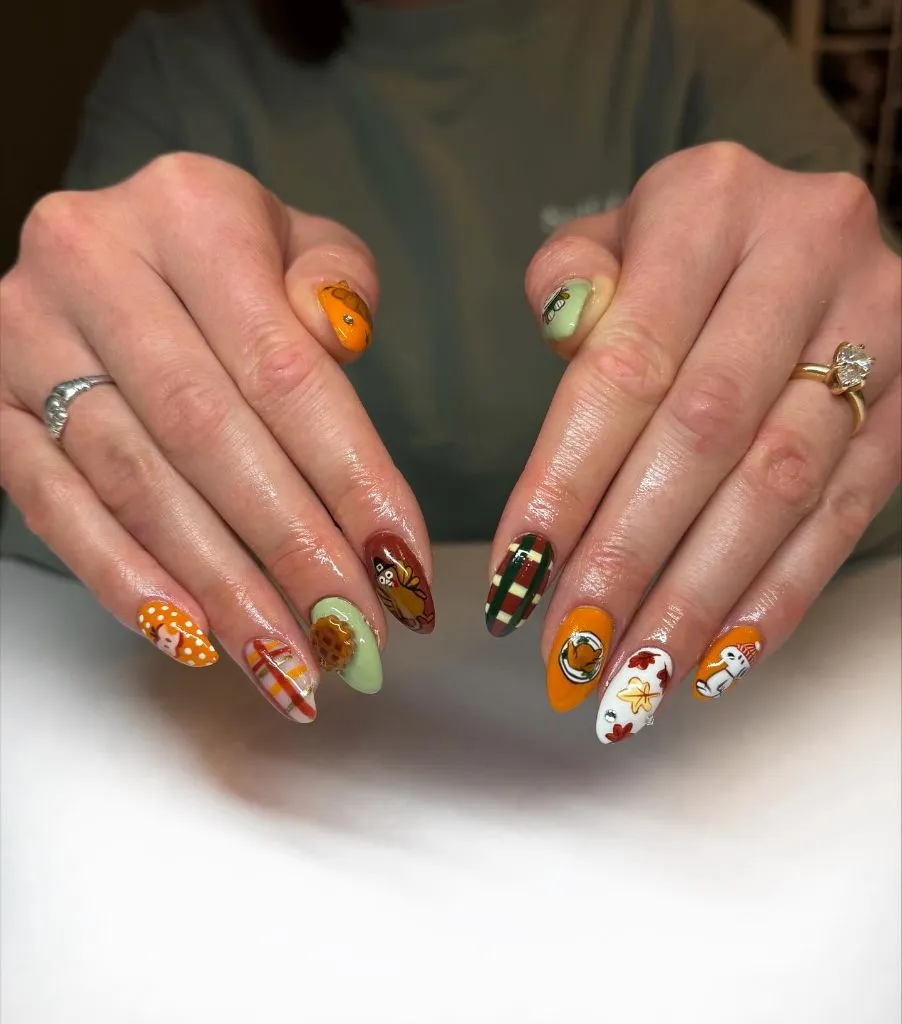
Photo via Instagram
This is a maximalist set where every nail carries its own distinct illustration or pattern. What prevents it from reading as chaotic is that the color palette, though broad, stays within a warm seasonal range anchored by orange, brown, and green. The mint green nails function as the coolest resting points, while the orange solids carry the most visual weight. The character nails, with their turkeys and pumpkins, are illustrative enough to read as narrative rather than abstract, which gives the set a storytelling quality. The gingham nail provides geometric contrast against all the organic, curved illustration work.
What stands out most is that narrative-driven sets can hold together when the color discipline remains firm beneath the illustrative variety. The characters and patterns here are diverse, but they all draw from the same autumnal color pool. For anyone drawn to holiday-themed nail designs, the principle is to let the motifs be as varied as the occasion demands while keeping the palette tightly controlled underneath.
12. Burgundy and White With Plaid, Bows, and Polka Dots
Both hands are shown with almond-shaped nails at medium length. The set alternates between deep burgundy solids and white nails carrying different detail treatments. Some white nails feature hand-drawn bows in burgundy line work. Others show a burgundy and cream plaid pattern with fine grid lines. At least one nail carries burgundy polka dots on a white base. A deep burgundy nail on one pinky also shows white polka dots, reversing the relationship.
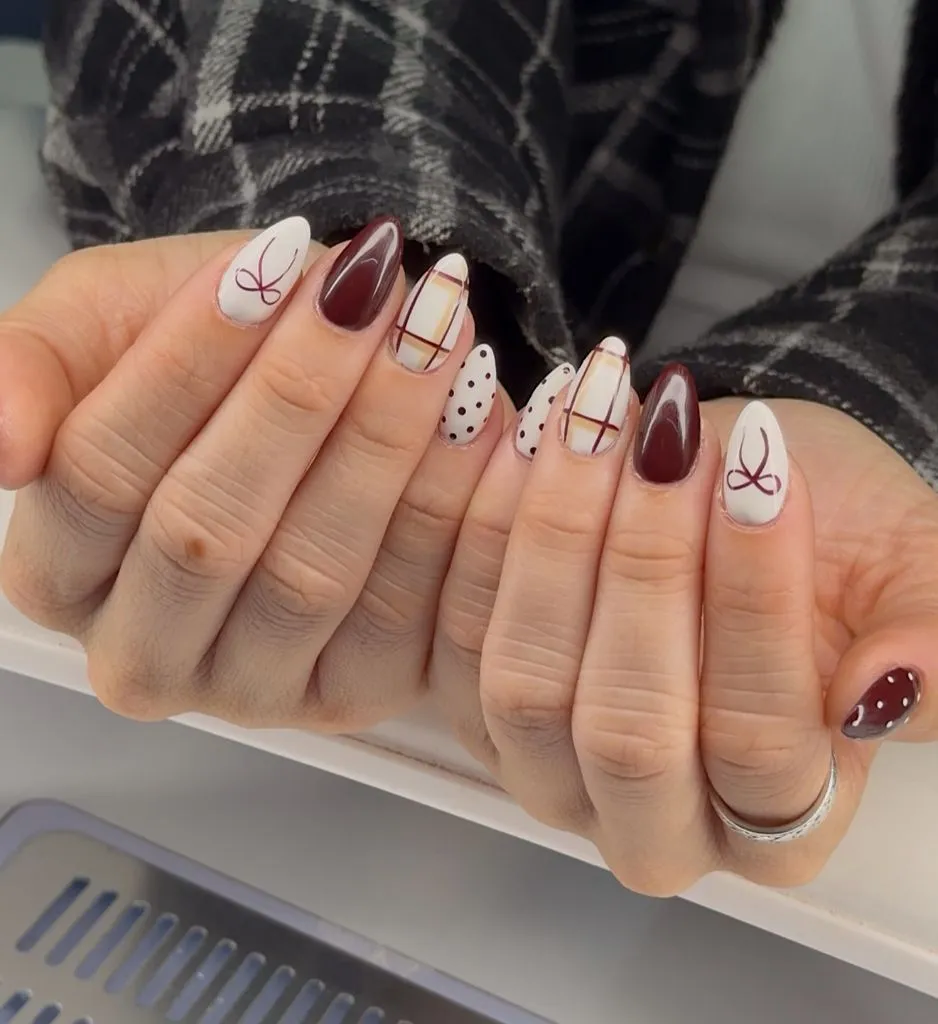
Photo via Instagram
The two-color restriction is what allows so many pattern formats to coexist without competition. Bows, plaid, polka dots, and solids all appear across the set, but because every element is either burgundy or white, the eye reads pattern variety rather than color noise. The reversal of the polka dot relationship on the pinky, white dots on burgundy instead of burgundy dots on white, adds a subtle inversion that enriches the set without introducing a new color. The bow details, drawn in thin line work, keep the decorative nails feeling lighter than the dense plaid.
The best move here is restricting the palette to two colors and then expanding format variety as far as those colors will carry it. Bows, dots, plaid, and solids all feel unified because they share the same burgundy-white vocabulary. That approach, maximizing pattern diversity within a minimal color count, is a dependable structure for anyone exploring patterned nail combinations where cohesion matters as much as creativity.
13. Chocolate Checkerboard With Polka Dots and Bows
Both hands are visible, showing medium-length almond nails. The set uses chocolate brown and white as its only two colors. Some nails carry a full chocolate solid with white polka dots. Others are white with brown polka dots. The accent nails feature a chocolate and white checkerboard pattern in a grid layout. Two nails per hand display brown bow details drawn in thin line work on a white base. A gold ring with a crystal detail sits on one hand.

Photo via Instagram
This set shares the two-color logic of the previous one but shifts the temperature to a warmer, softer register. The chocolate brown reads as rounder and less formal than the deep burgundy, which makes the overall feel more approachable. The checkerboard nails introduce a geometric density that the polka dots echo in a softer, more organic way, creating a conversation between structured and scattered pattern. The bow line work, appearing on the white nails, adds a cursive quality that contrasts with the hard grid of the checkerboard. The overall rhythm alternates between geometric and organic across the hand.
The reader takeaway is that two-color sets can explore entirely different moods simply by shifting the base hue. Brown and white create a warmer, more casual feeling than the same structural choices in burgundy and white. This makes the same format toolkit, checkerboard plus polka dots plus line art, available across very different seasonal moods depending on the core color. It is a principle worth remembering when choosing tones for fall and winter nail palettes.
14. Dusty Blue Solids With Soft Plaid Accents
Both hands rest together, showing short oval nails. Three or four nails per hand carry a solid dusty blue, matte or satin in finish, with a slightly muted, grey-leaning tone. The remaining nails on each hand feature a soft plaid pattern in cream, pale blue, and thin rust-orange grid lines on a light base. The person wears a light blue top, and the overall color relationship between the nails and the clothing reads as coordinated.
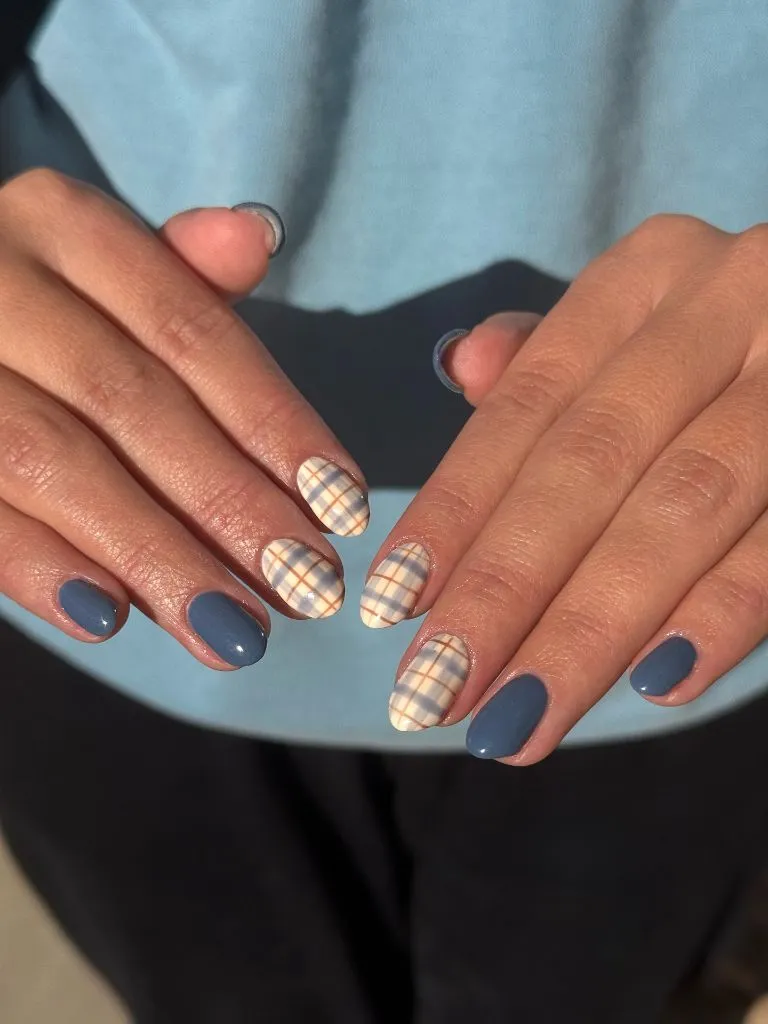
Photo via Instagram
The muted quality of the dusty blue keeps this set feeling quiet even though the plaid introduces multiple tones. The cream base of the plaid pattern shares enough warmth with the skin to read as nearly nude, which means the rust-orange grid lines become the sharpest element in the composition. That creates a subtle hierarchy: the blue solids carry the most visible color area, the cream plaid recedes into the base, and the thin orange lines provide the only real warmth. The short nail length reinforces the understated quality, keeping everything compact and close to the hand.
The useful idea is that the sharpest line in a plaid pattern can become the color accent for the entire set, even if it covers very little surface area. Here, the thin rust-orange grid lines do more to define the set’s warmth than any solid accent nail could. That logic, letting a pattern’s thinnest element carry the accent role, works especially well when the dominant color is cool and muted and needs only a trace of warmth to feel complete.
15. Rich Chocolate Brown With Pink Stripe Accent
One hand is displayed with medium-length almond nails. Four nails carry a deep, rich chocolate brown in a high-gloss finish. The ring finger features a striped accent nail with alternating vertical bands of brown and pink, creating a clean, graphic contrast against the surrounding solids. A simple bezel-set blue stone ring sits on one finger. The brown is dark and warm, with a reddish undertone that reads as almost espresso-toned.
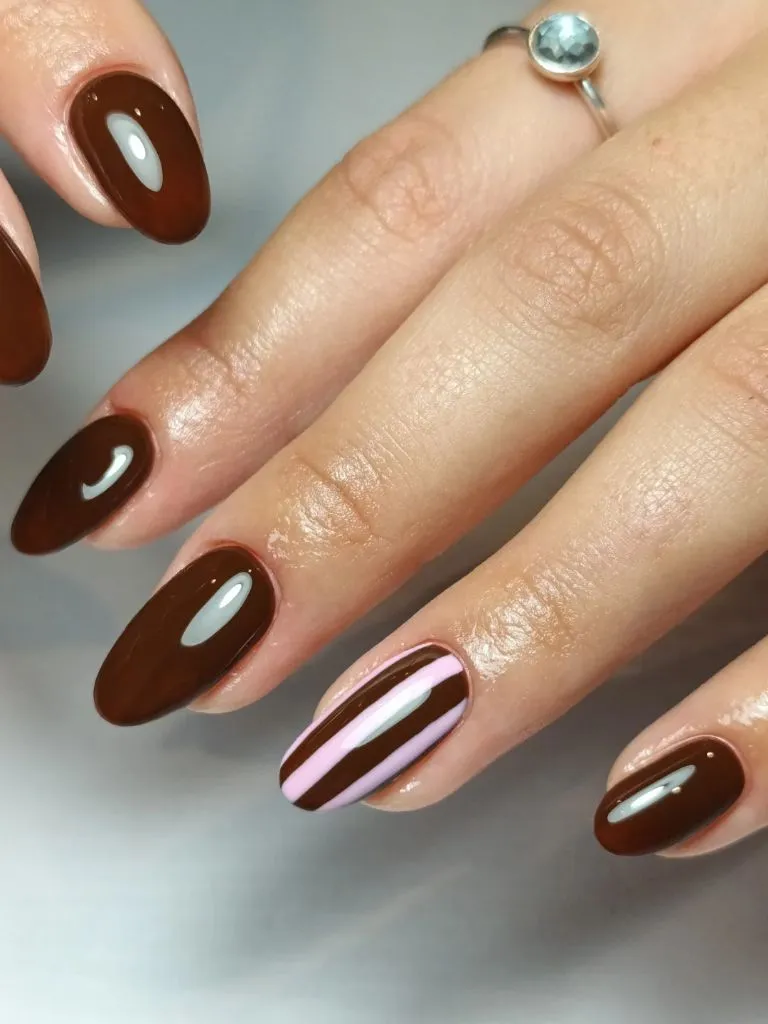
Photo via Instagram
The single accent nail carries the entire compositional tension of this set. Four identical brown nails establish a strong, uniform tone, and the striped nail breaks it with a geometric interruption that introduces pink for the first and only time. The vertical orientation of the stripes elongates the nail visually, and the alternation between brown and pink creates a rhythm that is simple but effective. The high-gloss finish across all nails ensures the brown surfaces have enough depth and light return to hold interest on their own, so the accent nail reads as an addition rather than a rescue.
The strongest lesson is that a single accent nail works best when the surrounding nails are confident enough to stand alone. The chocolate brown here is rich and glossy enough that four nails of it do not feel monotonous, which means the striped nail functions as a surprise rather than a relief. That balance, where the base is strong and the accent is optional, creates the most satisfying version of the single-accent format.
16. Full Silver Glitter With Pink Base and Bow Detail
Two nails are visible in close framing. The thumb carries a full coat of dense silver glitter, highly reflective and textured. The index finger shows a sheer pink base with a silver glitter French-style accent at the tip and what appears to be a small bow or decorative detail on the surface, along with scattered tiny dots. A gold crystal band ring sits on the thumb. The overall look reads as a continuation or alternate angle of the silver and pink set seen earlier, but the closer framing emphasizes the glitter density.
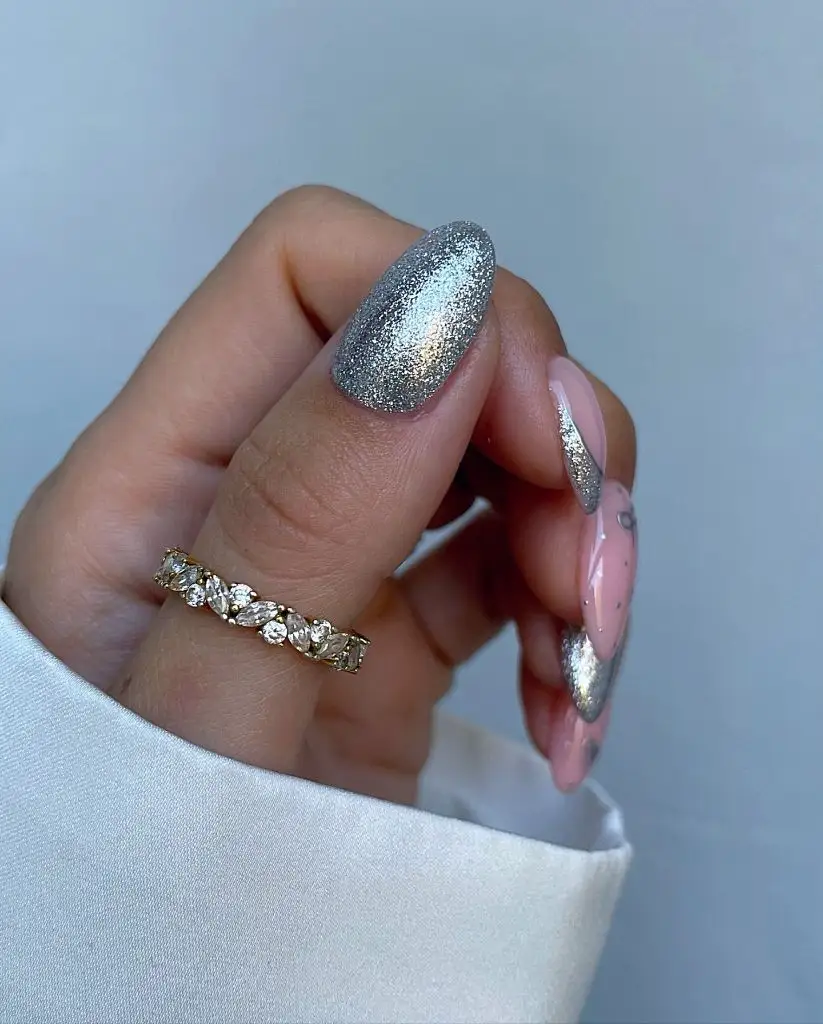
Photo via Instagram
The close framing reveals the texture of the silver glitter in a way the wider shot does not. The particles are fine and densely packed, creating a surface that catches light from multiple angles simultaneously. Against it, the pink nail with its partial glitter accent looks restrained, almost minimal, even though it carries its own glitter element. The contrast between full coverage and partial coverage is the central design move here, and it functions differently at close range where the texture itself, rather than the color distribution, becomes the focal point.
The beauty of this is in understanding that the same set reads differently at different distances. Full glitter coverage carries one kind of impact from across a room and a different, more textural quality up close. Designing with both viewing distances in mind, considering how glitter and reflective finishes behave in different contexts, adds another layer of intention to any set built around reflective surfaces.
17. Pink Base With Rose Gold Plaid and White French
One hand is shown with medium-length almond nails. The set includes a soft pink solid, a classic white French tip on a pink base, a rose gold glitter full-coverage nail, and what appears to be a pink nail with white and rose gold plaid-style intersecting lines. The palette stays within pink, white, and rose gold throughout. A gold ring with a dark stone cluster and a crystal band ring are visible on the fingers.
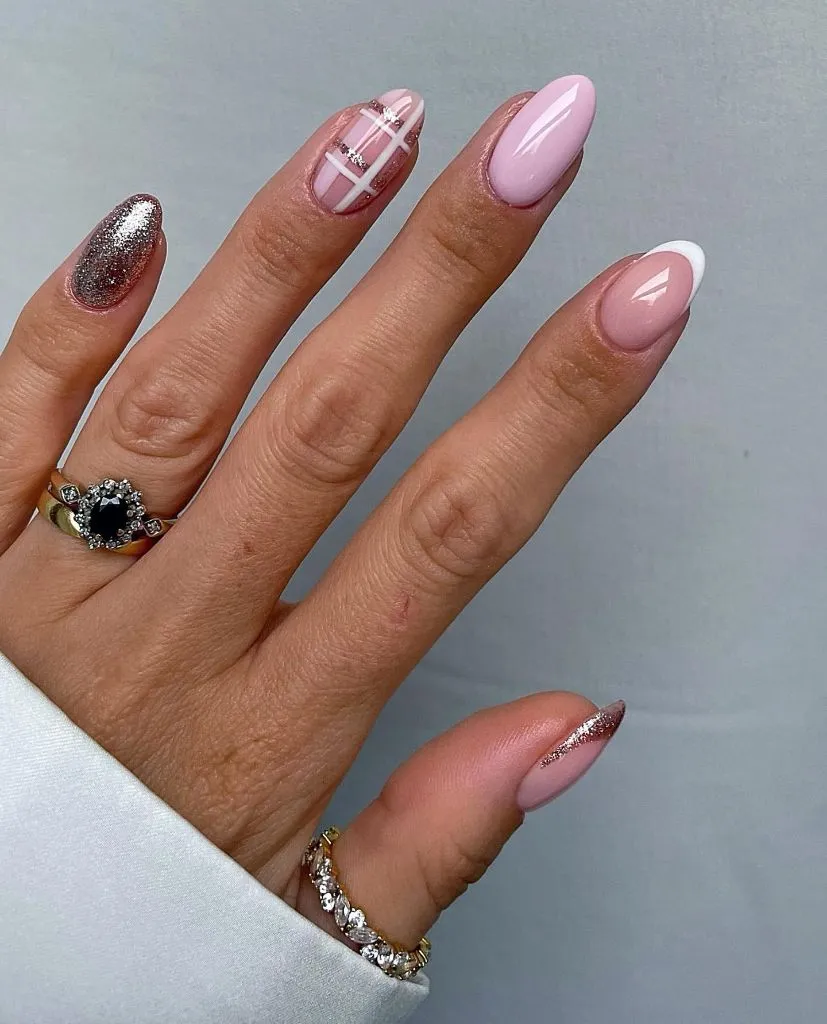
Photo via Instagram
The set organizes three finishes, solid pink, white French, and rose gold glitter, into a rotation that feels balanced across the hand. The plaid-detailed nail acts as a bridge between the solid and the glitter, combining the pink base with intersecting lines that carry the rose gold tone. The white French tip introduces the only truly clean, graphic element, and its crispness sharpens the softness around it. The rose gold glitter nail, being the most reflective, draws the eye first, but the French tip holds it with its contrast. This push-pull between softness and crispness gives the hand its visual rhythm.
The useful move here is using a classic French tip as a sharpening element in an otherwise soft, warm set. The white tip’s clean line reads as structure, which prevents a pink and rose gold palette from feeling too uniformly soft. That interplay between a warm reflective finish and a crisp graphic one is a useful framework for building sets that feel both warm and precise.
18. Amber Solid With Marble Accent and Glitter Edge
One hand is shown with medium-length almond nails. Two nails carry a solid amber or dark mustard tone, glossy and opaque. The index finger shows a sheer nude base with a bronze or gold glitter gradient at the tip. The middle nail features what reads as a marbled or swirled pattern in amber, tan, and gold tones, with visible metallic shimmer throughout the swirl. Small tattoos are visible on two fingers. The overall palette is warm and narrow, concentrated in the amber-to-gold range.
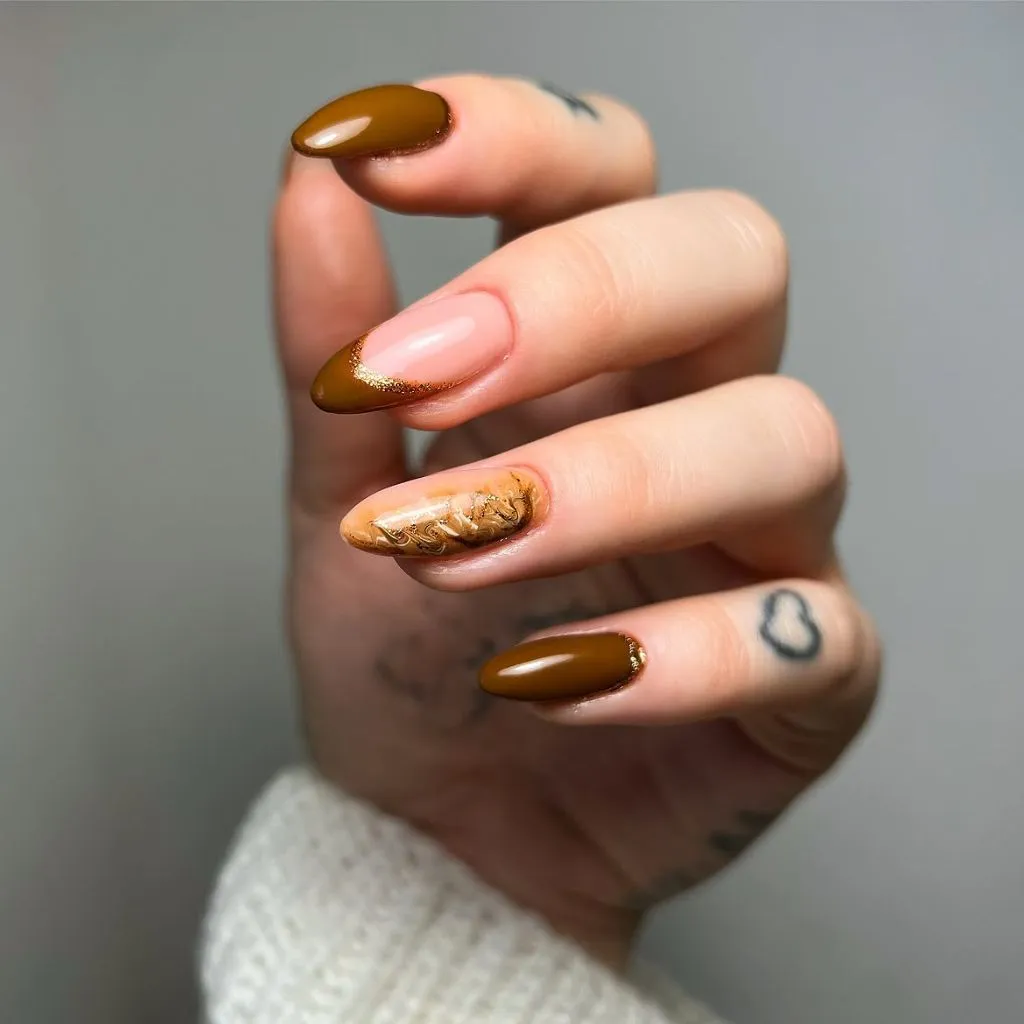
Photo via Instagram
The marble nail is the richest surface in the set, carrying movement and shimmer within its swirled pattern, while the solid amber nails on either side of it provide the flat, stable tones that make the marble stand out. The glitter gradient on the index finger introduces a transitional format, neither solid nor patterned, that eases the eye from the plain amber into the complex marble. The narrow palette, barely leaving the amber-gold zone, means the textural differences between solid, gradient, and marble do all the compositional work. It feels like a study in surface variation within a single color family.
What stands out most is the way a very narrow color range can still support three distinct surface formats without any of them feeling redundant. Solid, gradient, and marble each offer a different kind of visual experience while staying in the same tonal world. This approach is especially effective in November nail ideas where warmth and depth matter more than color range.
19. Nude Base With Red Floral and Gold Cuticle Detail
One hand is shown with medium-length oval nails. Most nails carry a clean nude or pale pink base with a natural, glossy finish. Two nails, the index and ring fingers, feature hand-painted red and pink flowers with green leaf details near the tip area. Two other nails show a thin line of gold glitter at the cuticle edge. The overall design is minimal, with the floral art and gold details occupying small portions of the nail surface.
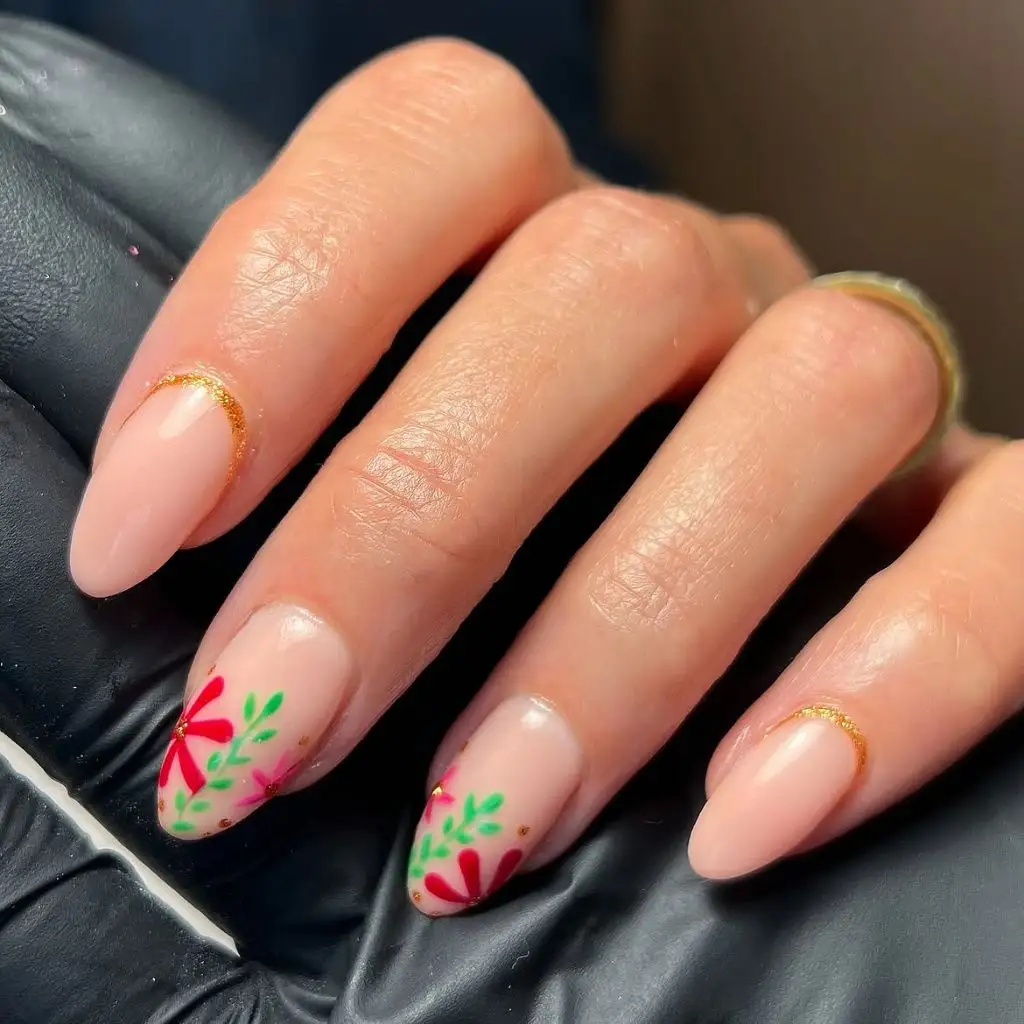
Photo via Instagram
The ratio of bare surface to decorated surface is what makes this set feel so considered. The nude base dominates, and the floral art appears on only two nails, positioned as corner details rather than full-surface illustrations. The gold cuticle lines on the other nails provide just enough shimmer to signal that the bare surfaces are intentional, not unfinished. The flowers themselves use red and green, which introduces the widest color contrast in the set, but their small scale prevents them from overwhelming the composition. The overall effect is one of deliberate quietness, where the hand looks polished and the detail rewards a closer look.
The reader takeaway is that placing vivid color only at the edges of a predominantly nude set creates a framing effect rather than a feature. The flowers do not compete with the bare space; they define its boundaries. That principle, using strong color in small, peripheral doses, works well for anyone who wants detail without volume. Seasonal floral manicure ideas often land best when the bare nail does most of the talking.
20. Sheer Nude With Tiny Star Accents
One hand is shown with short-to-medium almond nails in a sheer nude or pale pink base. Each nail carries one or two tiny starburst or star motifs in metallic gold, silver, or black, scattered at varied positions across the nail surfaces. The stars are very small, almost stamp-like in scale, and no two nails appear to have the same placement. A silver ring with a small stone sits on one finger. The overall look is extremely minimal.
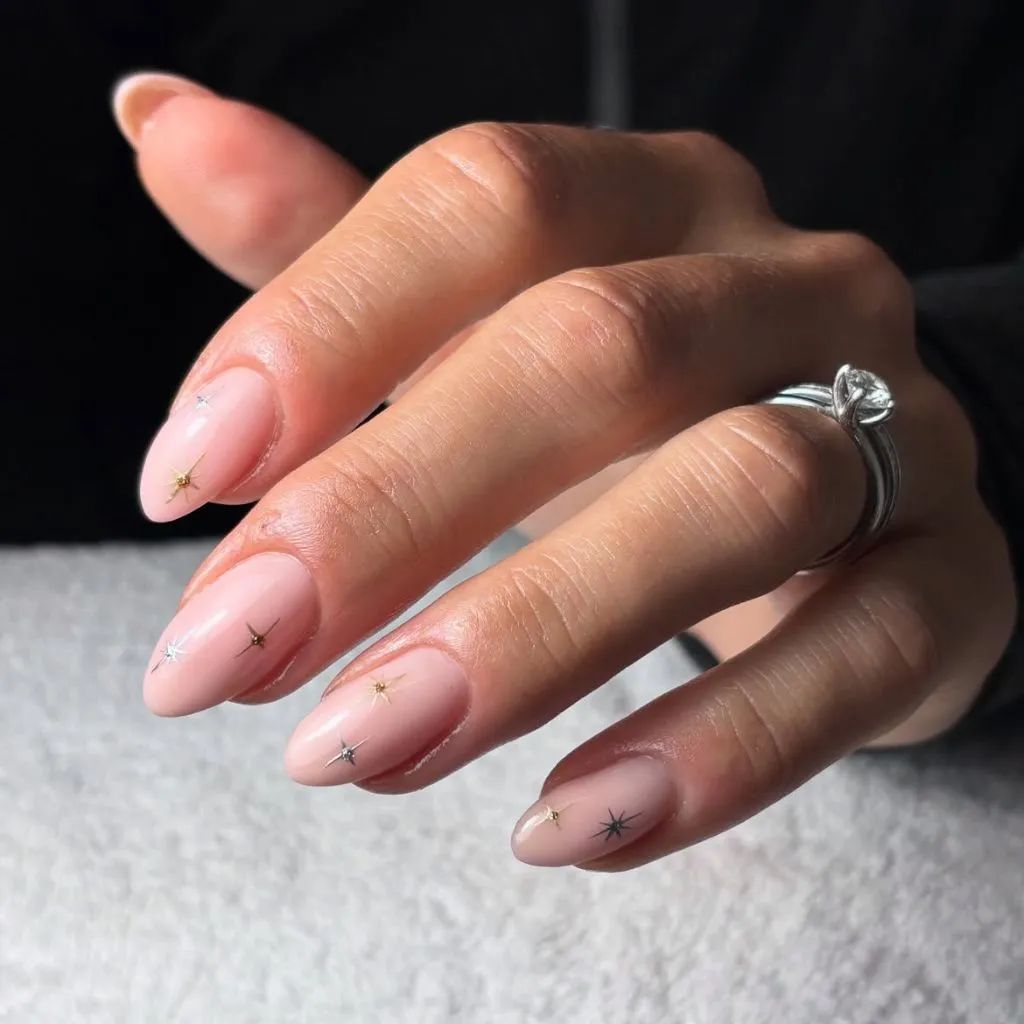
Photo via Instagram
This is the most minimal set in the collection, and its success depends entirely on the precision of placement. Each star is small enough to be missed at a glance, which means the design reveals itself gradually. The mix of gold, silver, and black stars introduces a metallic range without any single star demanding attention. The varied placement, some near tips, some near cuticles, some centered, gives each nail its own quiet moment. The sheer base allows the natural nail color to show through, grounding the metallic details in something warm and organic rather than floating them on an opaque surface.
The useful idea is that extreme minimalism in nail design shifts all the compositional weight to placement. When a single tiny element is the only detail on a nail, where it sits defines the entire visual experience of that surface. This kind of near-invisible detail work creates a private quality, a design that is more for the wearer than the viewer. It represents a quieter end of the spectrum worth exploring in subtle everyday nail inspiration.
21. Berry Solids With Watercolor Flower Accent
One hand is shown resting on a cream knit surface. Three nails carry a deep berry or wine-red solid in a glossy, jelly-like finish. One nail appears as a sheer nude, and another features a soft watercolor-style flower in pink and berry tones with a small gold metallic detail at its center. The ring finger may carry a thin berry line at the tip, reading as a micro French detail. The berry color is rich and slightly translucent, with visible depth in the finish.
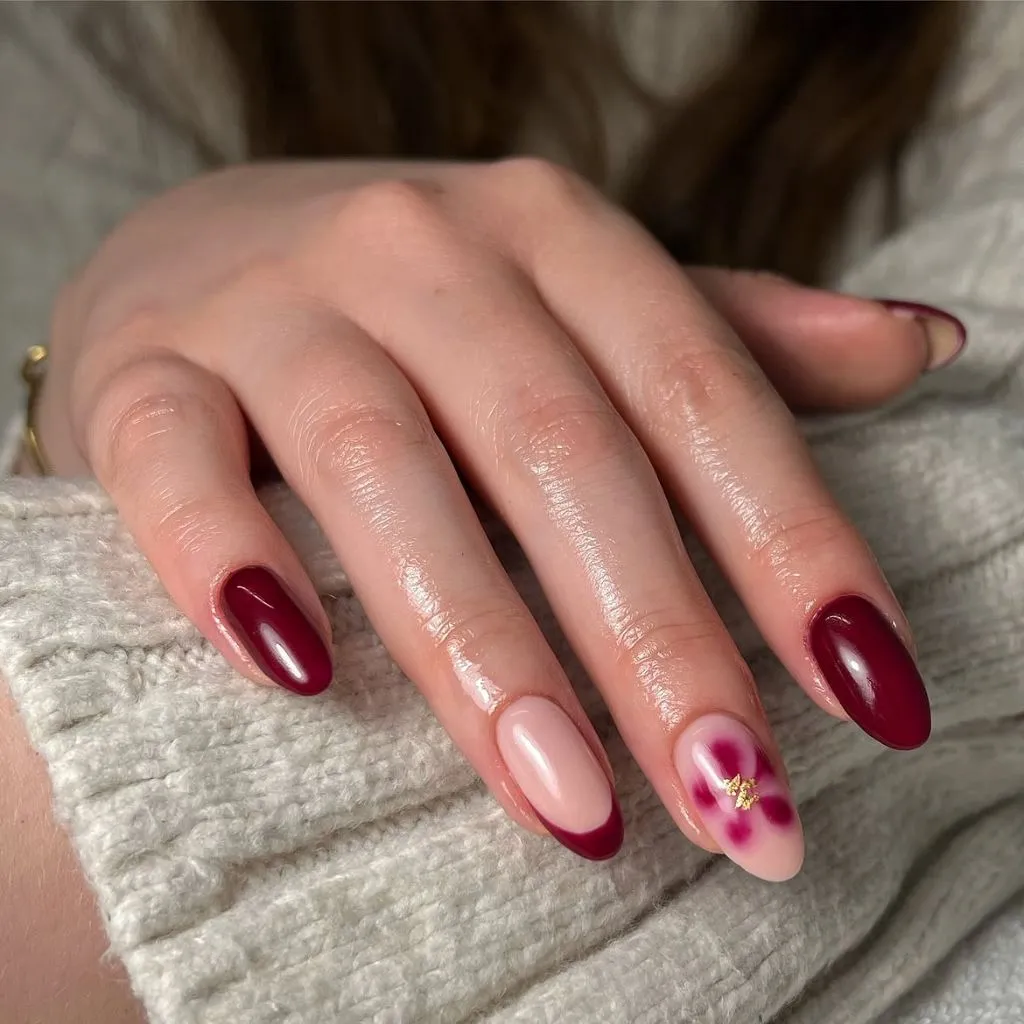
Photo via Instagram
The jelly-like quality of the berry solid is the first thing the eye registers. It has a translucent depth that makes the color look lit from within, which elevates what could be a simple solid into something with visual complexity. The watercolor flower on the accent nail picks up the berry tone and softens it into a diffused, blurred shape that contrasts with the crisp edges of the solid nails. The gold center dot anchors the flower and connects it to the warm tones in the skin. The nude nail provides a breath of space, preventing the set from feeling entirely saturated.
The best move here is recognizing that a translucent or jelly finish can do for a solid nail what texture does for a patterned one: it adds depth without adding detail. The same berry color in a flat opaque finish would read very differently. For anyone building a November set around dark tones, the finish quality is as much a design decision as the color choice itself.
22. Deep Burgundy Glitter With Warm Shimmer
One hand is shown with medium-length almond nails, all carrying the same finish: a deep burgundy base densely packed with fine copper or bronze glitter particles. The glitter is evenly distributed across every nail, creating a uniform shimmer that shifts between burgundy and warm copper depending on how the light hits. No accent nail, no pattern variation, no second color appears in the set. The finish is consistent and rich.
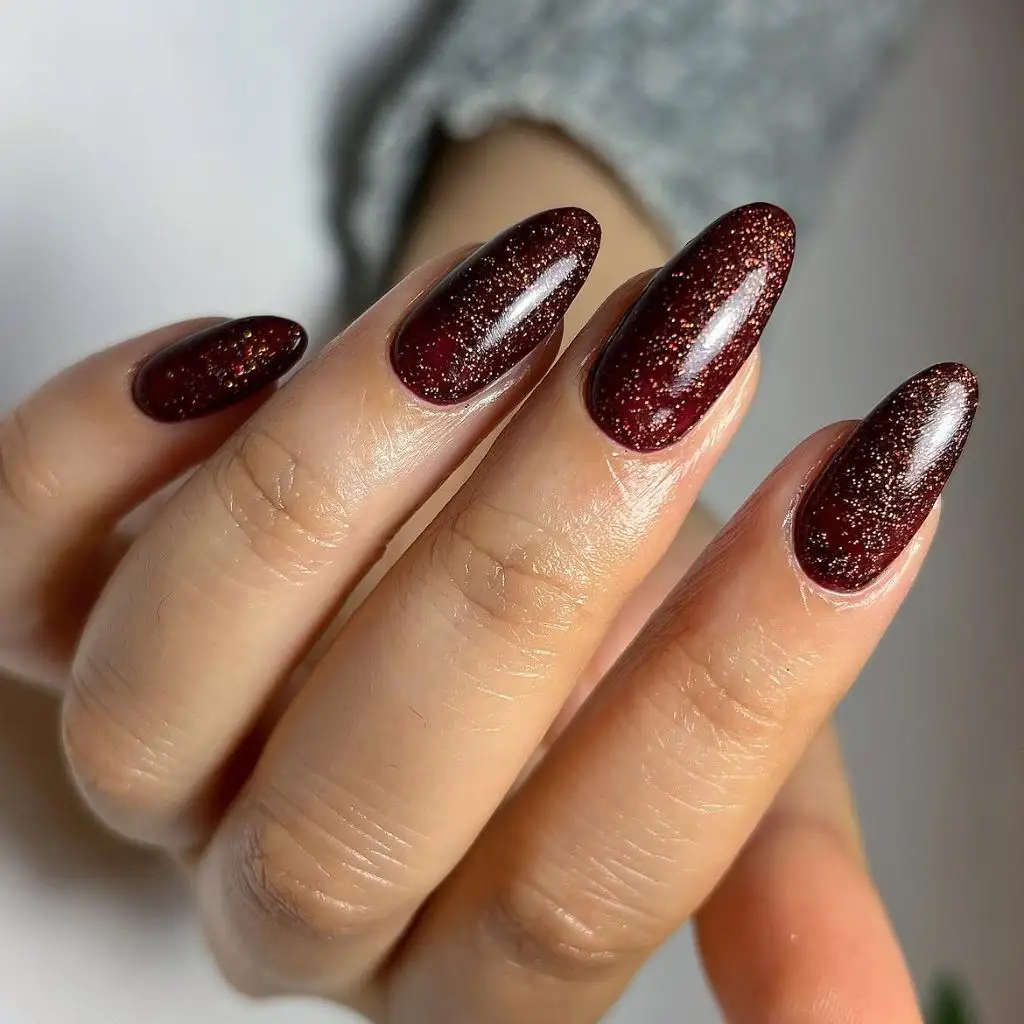
Photo via Instagram
The decision to apply the same finish across every nail removes all compositional complexity and places the entire set’s impact on a single surface quality. The fine copper glitter particles are dense enough that the burgundy base reads as a shadow beneath them rather than a separate layer, creating a finish that looks almost mineral. The color shifts from deep wine in shadow to warm bronze in direct light, which means the set looks different in every lighting condition. This is a design choice that relies on movement and environment rather than on pattern or placement.
The strongest lesson is that uniformity can be its own form of design statement. A single complex finish applied consistently creates a cohesive visual impact that no multi-format set can replicate. The depth comes from the glitter’s interaction with light rather than from compositional variety. When working with a rich shimmer or glitter base, sometimes the most deliberate choice is to let one surface quality fill the entire hand.
23. Cherry Red Abstract Shapes With Star Detail
One hand is displayed with medium-length almond nails. The set uses deep cherry red and nude as its two primary tones. One nail is fully covered in cherry red with a small metallic starburst detail. Another shows an abstract wavy red shape on a nude base, splitting the nail surface between warm and bare. A third nail features a red French-style curve at the tip with a starburst accent. The red is rich and opaque, and the nude base is warm and glossy.
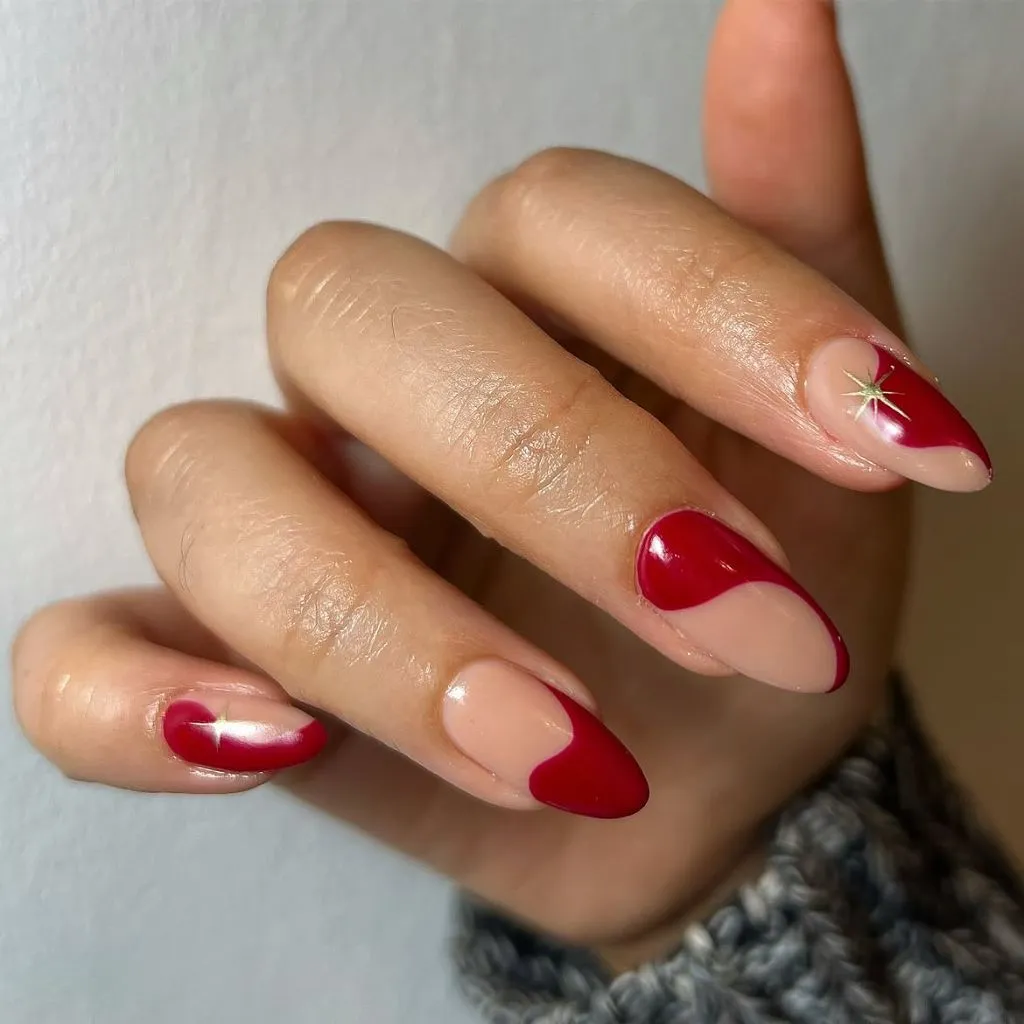
Photo via Instagram
The abstract red shapes avoid the symmetry of a traditional French or half-moon, which gives each nail a slightly different silhouette even though they share the same two colors. The wavy division between red and nude on the middle nail creates visual movement, and the starburst details, placed at different positions on different nails, add a metallic punctuation that prevents the set from reading as purely graphic. The nude sections are large enough to balance the intensity of the cherry red, and the overall effect is one of bold color used with compositional awareness rather than flat coverage.
The reader takeaway is that abstract shapes create more visual interest than straight lines when dividing a nail between two colors. The wavy, organic boundaries here give each nail its own identity within a shared palette, which a uniform French line would not achieve. That approach, letting the division itself become the design element, works across many color pairings and deserves consideration in any two-tone nail design layout.

Hi, I’m Zoey Mitchell, the creator of ChicStyle Blog.
I share simple, wearable outfit ideas, hairstyles, nail trends, and beauty tips that feel natural and easy to recreate.
This blog is where I explore everything that makes a woman feel put together and confident every day. I’m not an expert — just a woman who genuinely loves style, mixing looks, and discovering what works.
If you love effortless fashion with a personal touch, you’ll feel at home here.