
Winter Haircuts tend to force a decision between keeping length that has taken years to grow and cutting something that finally has shape. The way out of that tension is proportion rather than sacrifice. Where the shortest piece lands, how much weight sits at the ends, and whether the outline curves or stays flat will change a shape far more than removing inches. Placement decides the result, not length alone.
Read the shapes below as relationships instead of options on a menu. Compare where each layer begins against the jaw or collarbone, how root color sits against the ends, and whether texture runs through the whole length or only the last few inches. Winter Haircuts read differently depending on those three variables, so the useful comparison is not long against short but weight against negative space, and smooth against interrupted.
1. Long Chestnut Length With Center Part
A hand lifts one section away from a long, center-parted chestnut length, letting the ends fan wide across the shoulders and chest. The color runs light gold at the top of the crown and deepens toward a warmer brown further down. The camera sits close and slightly high, cropping just below the chest, with a plain pale wall behind and a dark burgundy sleeve entering the left edge.
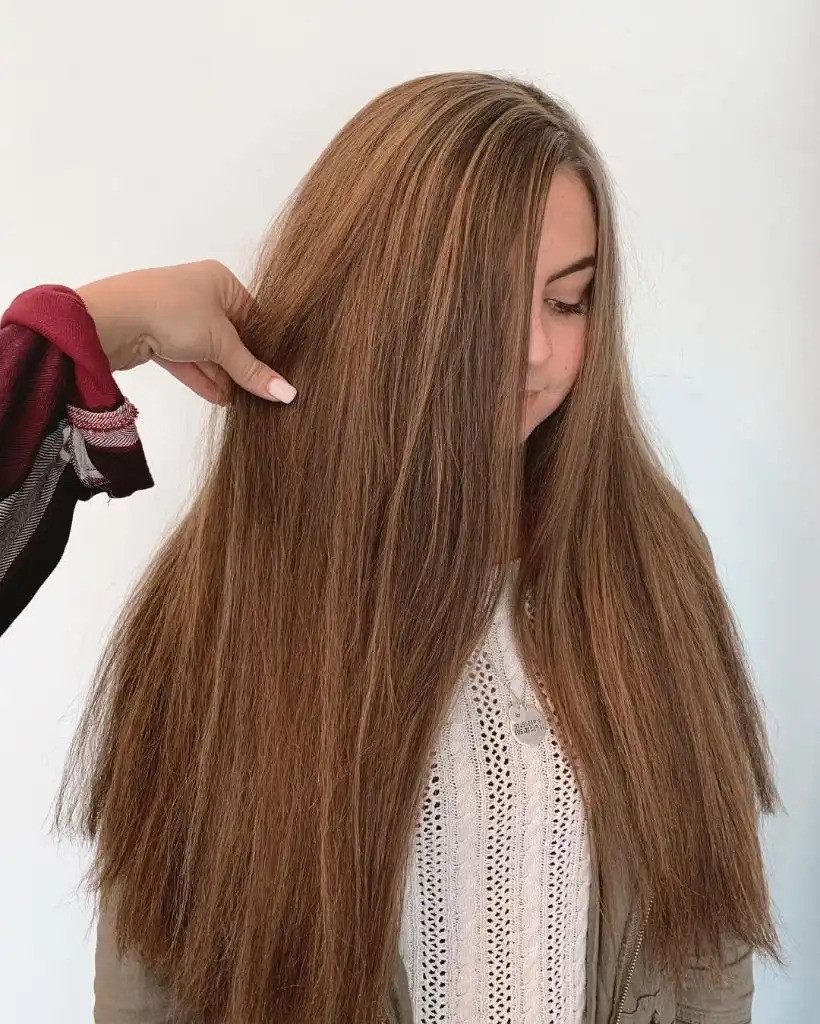
The proportion works because almost all the weight sits at the perimeter, creating a wide triangle that widens gradually from the parting down. Nothing interrupts the line between temple and ends, so the eye travels the full distance in one movement. That single unbroken descent is what makes the length register as length rather than simply as volume sitting on the shoulders.
The strongest adaptation here is a light internal thinning at the mid-lengths rather than face-framing pieces, which keeps the wide outline while removing some density behind it. If a narrower silhouette is preferred, taking the last inch straight across tightens the base and pulls the triangle closer to a column without losing overall length.
2. Full Fringe Framing Dark Brown Layers
A soft full fringe falls to eye level and splits slightly at the center, framing the face while long dark brown layers curve outward from cheekbone to below the chest. The ends flip in different directions, some forward and some back. Light pink zip-front sleeves ground the lower half of the frame, and a bright salon interior with plants and shelves stays blurred behind.
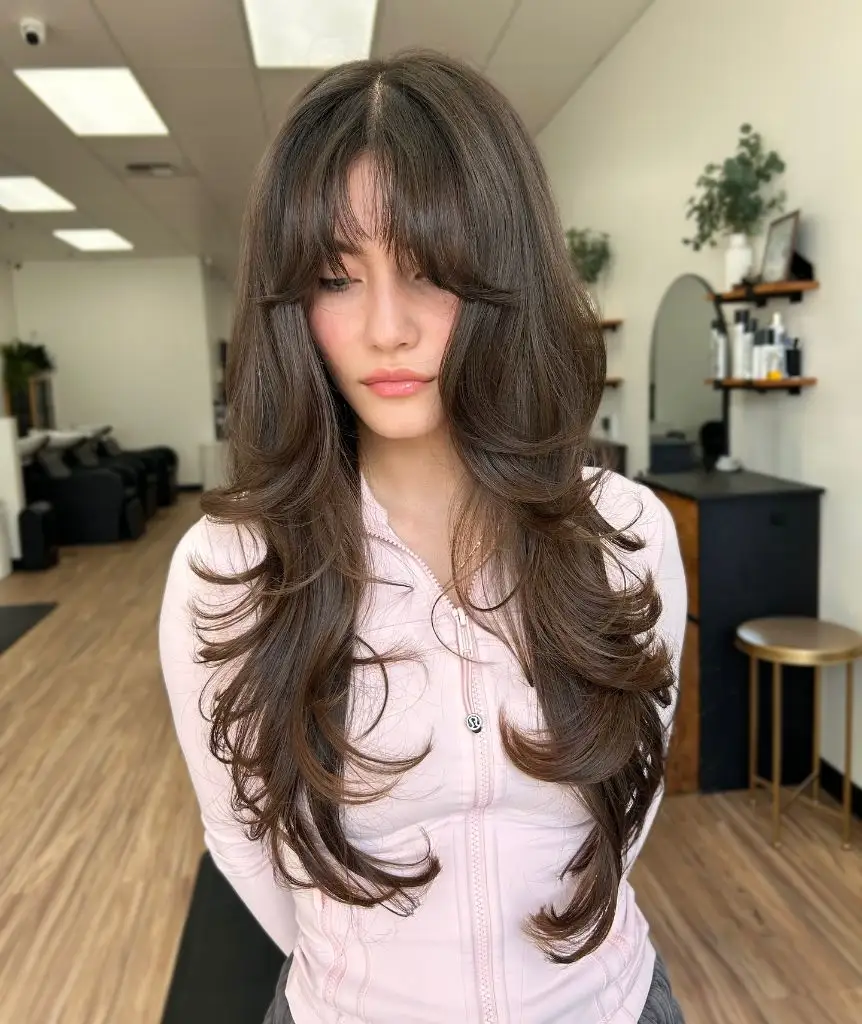
Zoning explains the effect. The fringe occupies a narrow horizontal band across the eyes, the layers occupy the diagonal zone from cheek to shoulder, and the length below stays comparatively quiet. Each zone does one job, so the shape never competes with itself. The fringe also shortens the visual distance from hairline to eyes, which makes the long section beneath read as deliberately long.
To make this softer, keep the fringe slightly longer and allow it to part naturally rather than cutting it dense and level. For a bolder version, tighten the fringe closer to the brow and push the first layer higher, though that raises the amount of daily shaping the shape will need.
3. Chestnut Curls Against Curtain Bangs
Long curtain bangs sweep across the face from a center parting and blend into deep chestnut lengths that lighten to warm caramel through the mid-lengths and ends. Big curved curls stack in horizontal rows down both sides and end near the waist. A brown cropped top and a thin gold cross pendant sit at the center, with a blurred salon corridor and ceiling lights behind.
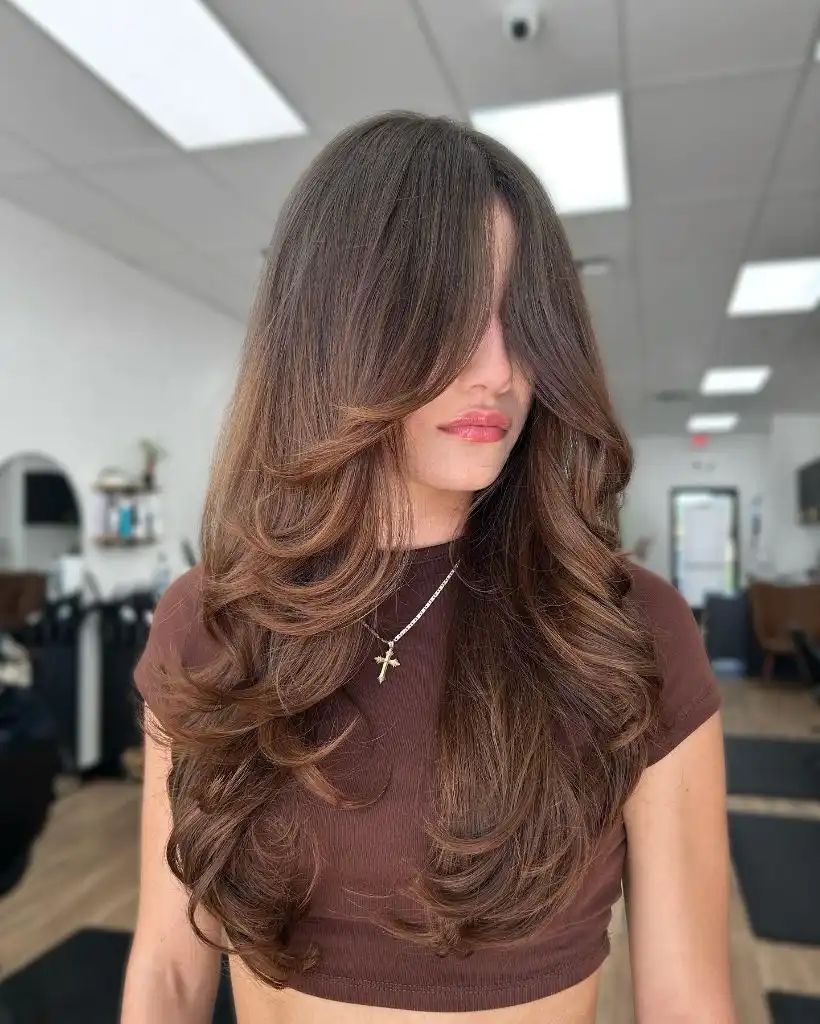
The outline is the argument. Rather than one continuous edge, the silhouette is built from repeated curved bumps that step outward as they descend, so the shape reads sculpted instead of heavy. Curtain bangs then break the top of that outline with a diagonal, which prevents the rounded lower half from looking like a single dome. Long shapes with defined layers respond well to this treatment among winter haircuts for long hair.
The most useful detail is that the curl direction alternates, with some sections turned away from the face and others toward it. Copying that alternation on a smaller barrel gives the same stacked effect at mid-length. Keep the bang ends slightly longer than the cheekbone so the diagonal stays gentle.
4. Pale Blonde Waves Above Dark Roots
A close front-facing selfie shows pale blonde waves parted slightly off center, with visibly darker roots holding the top two inches. The waves begin around the jaw and grow looser toward the ends, which fall past the chest in soft spirals. A dark top and a thin chain necklace fill the lower frame, and a car interior with a window and grey seat sits behind.
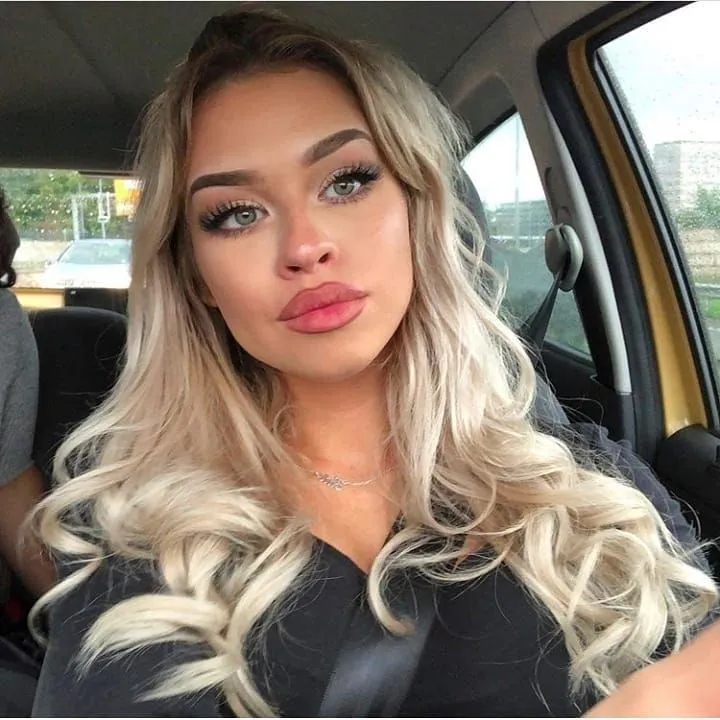
The value gap between root and end is doing the structural work. A dark band at the top compresses the crown visually, which makes the lighter length below appear to expand. Because the transition is short rather than gradual, the contrast point sits high and reads as intentional shadow rather than regrowth. The pale ends then take all the light in the lower half.
If a softer version is wanted, ask for the root shade to be dropped only half a level and dragged another inch downward, which blurs the line. Keeping the wave pattern starting at the jaw rather than the ear preserves the compressed top, since waves that begin higher would cancel the effect entirely.
5. Auburn Red In One Long Column
Deep auburn red length falls in a near-straight column from a low side parting, catching cool light along the surface. A few long pieces sweep across the forehead and past the cheek, while the ends brush the ribcage with a slight inward bend. A white textured puff-sleeve top and dark denim close the lower frame, and a glass storefront blurs into vertical reflections behind.
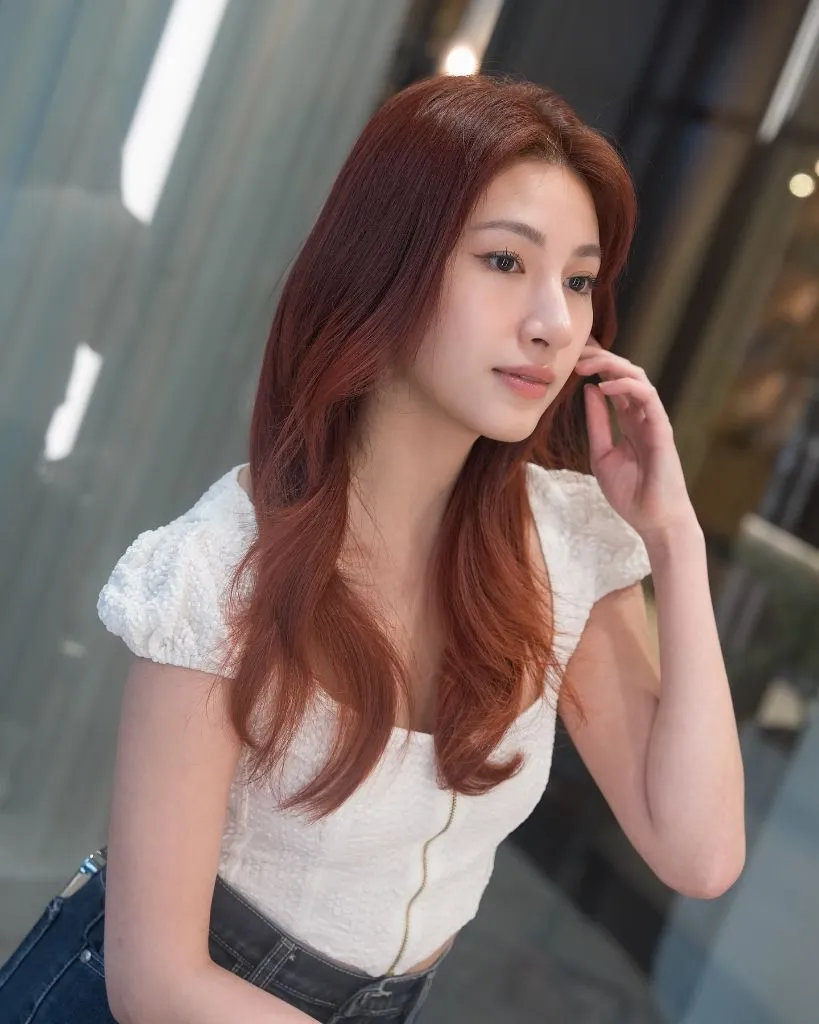
This shape is a vertical line study. Minimal internal layering means the color moves in continuous streaks from root to end, and the low parting adds one long diagonal across the top to keep the column from reading flat. Red at this depth also absorbs more light than warm brown, so the surface shine appears as narrow vertical strips rather than broad panels.
The takeaway is restraint in cutting. A blunt or barely tapered base is what allows this much saturation to look smooth, since heavy layering would break the color into visible steps. For a slightly livelier version, request a long invisible layer inside the back only, leaving the outer perimeter untouched.
6. Caramel Brown Volume Swept To One Side
The shape starts at the crown, where lifted caramel brown roots build height before the length sweeps to one side and falls past the chest. Layers bend outward at the cheekbone, jaw, and again lower down, creating three soft curved tiers. The color reads mid brown at the root and warms toward honey through the ends. A black blazer and a dark interior frame the composition.
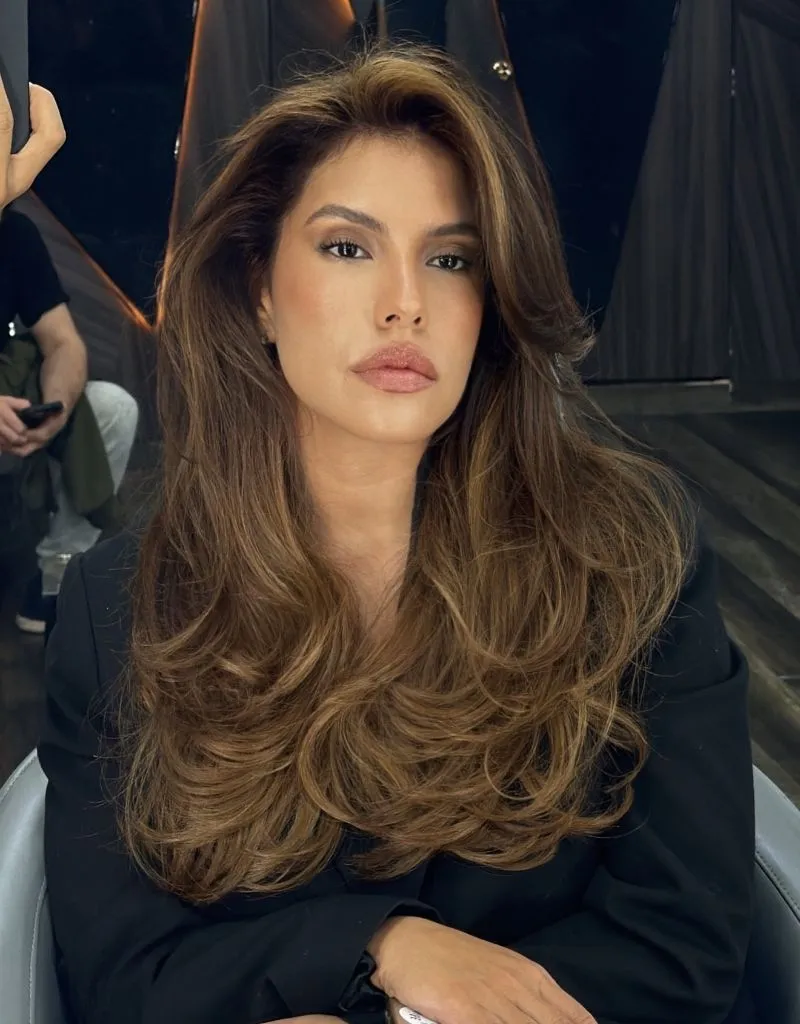
Smoothness against movement is the mechanism. The top four inches are polished flat, which makes the bending layers below feel like a deliberate release rather than general fluff. Because the sweep travels in one direction, the whole silhouette leans, and that lean reads as shape instead of size. The curved ends stop the lean from collapsing into a straight diagonal.
To adapt it for less density, concentrate the bend at only two points instead of three and keep the crown lift lower. Shapes like this sit comfortably alongside other long hairstyle ideas that rely on directional styling rather than heavy internal cutting to create their outline.
7. Smooth Dark Brown Above Curled Ends
From directly behind, dark brown hair lies completely smooth from the crown to just past the shoulder blades, then breaks into tight ribbon curls for the final four inches. The upper section reflects a broad band of light across the back of the head. Ends fall to a soft uneven line, and a cream knit-like sweater edges the bottom right corner against a blurred warm interior.
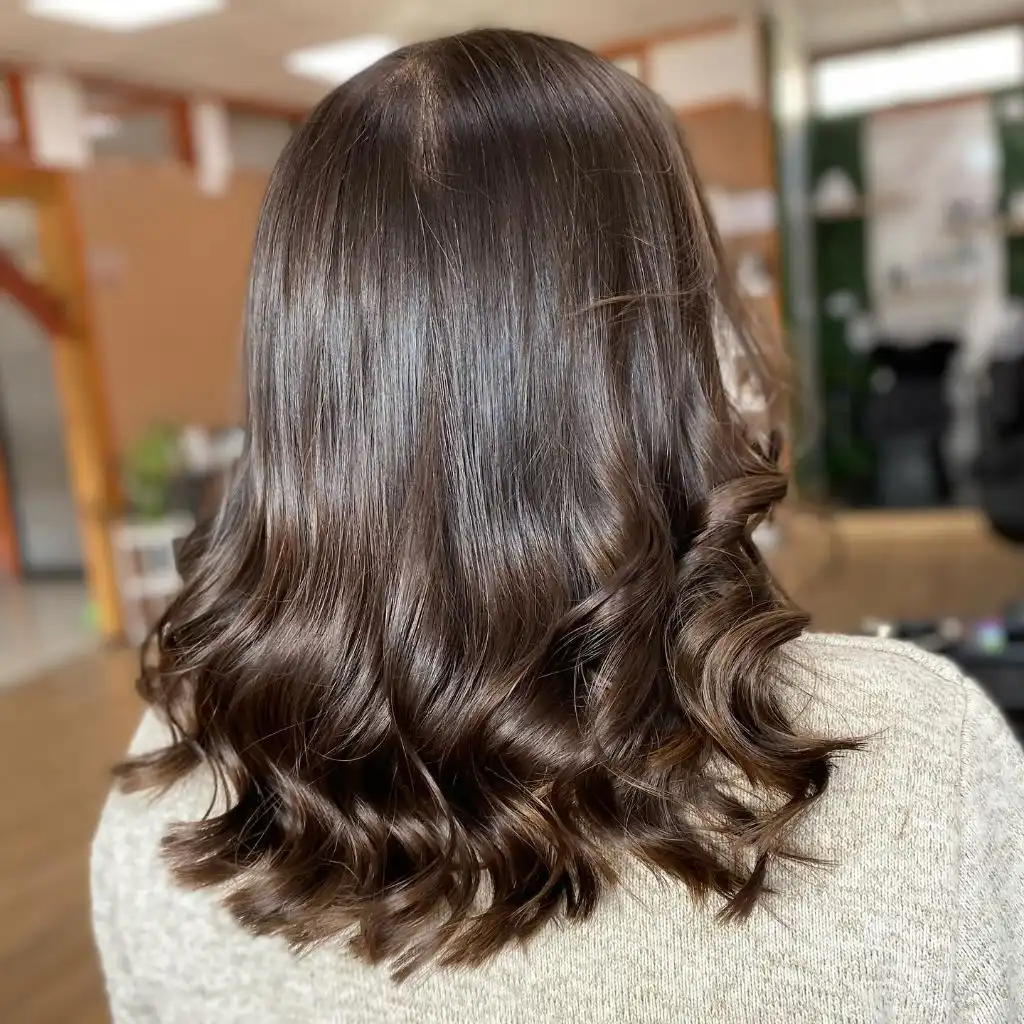
Tonal layering carries this one. A single depth of brown runs throughout, so the only visible information is how light behaves on two different surfaces. The flat upper section produces one wide highlight, while the curled ends fracture that same light into dozens of small points. Among winter haircuts for medium length, this contrast delivers detail without any color work at all.
The practical detail is where the curl begins. Starting it below the shoulder blades keeps the top narrow and lets width appear only at the very base. For a softer finish, brush the curls out once with fingers so the ribbons loosen into a continuous wave and the transition line becomes less abrupt.
8. Honey Highlights Echoing Through Deep Brown Waves
Long waves in deep brown carry repeated honey and caramel strands that surface at the cheek, mid-length, and again near the ends. The parting sits slightly off center with a soft sweep across the forehead. Waves stay wide and open, ending below the chest. A navy halter neckline and a delicate moon pendant sit centrally, with a warmly lit interior and a large plant behind.
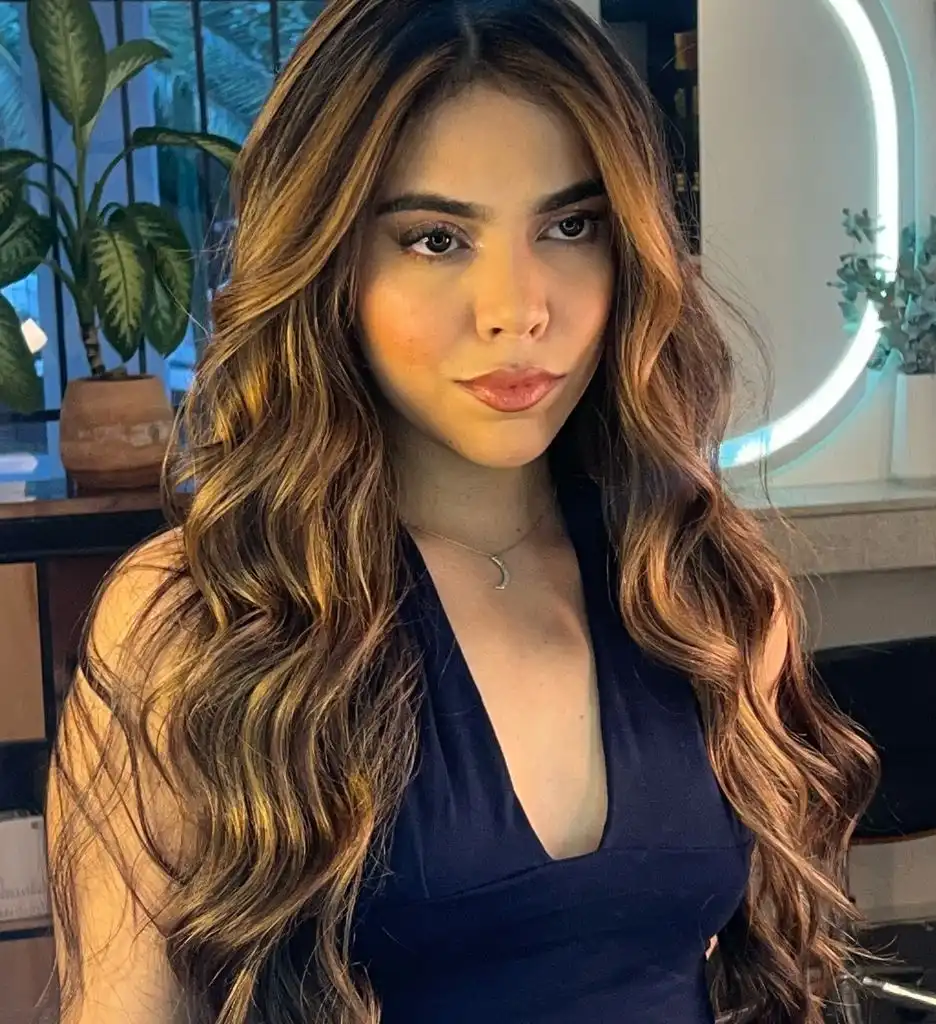
Color repetition builds the rhythm here. The same warm tone reappears at three different heights, and because each appearance is separated by darker brown, the eye connects them into a diagonal path down the length. That echo makes the waves look deeper than they are, since every bend has both a lit side and a shadowed one. Nothing is placed only at the ends.
The most transferable idea is that highlights placed at three heights read as dimension, while highlights placed only near the face read as brightness. Ask for finer strands nearest the parting and slightly wider ones lower down, which keeps the top from looking striped in flat light.
9. Copper Ribbons Inside Dark Brown Waves
Seen from behind, a dark espresso root sits across the top of the head before copper and warm auburn ribbons begin to appear through the mid-lengths. Below that, uniform S-shaped waves stack in even horizontal rows to well past the shoulder blades. The ends finish in a wide, softly rounded line, and a black sweatshirt with white lettering fills the lower half of the frame.
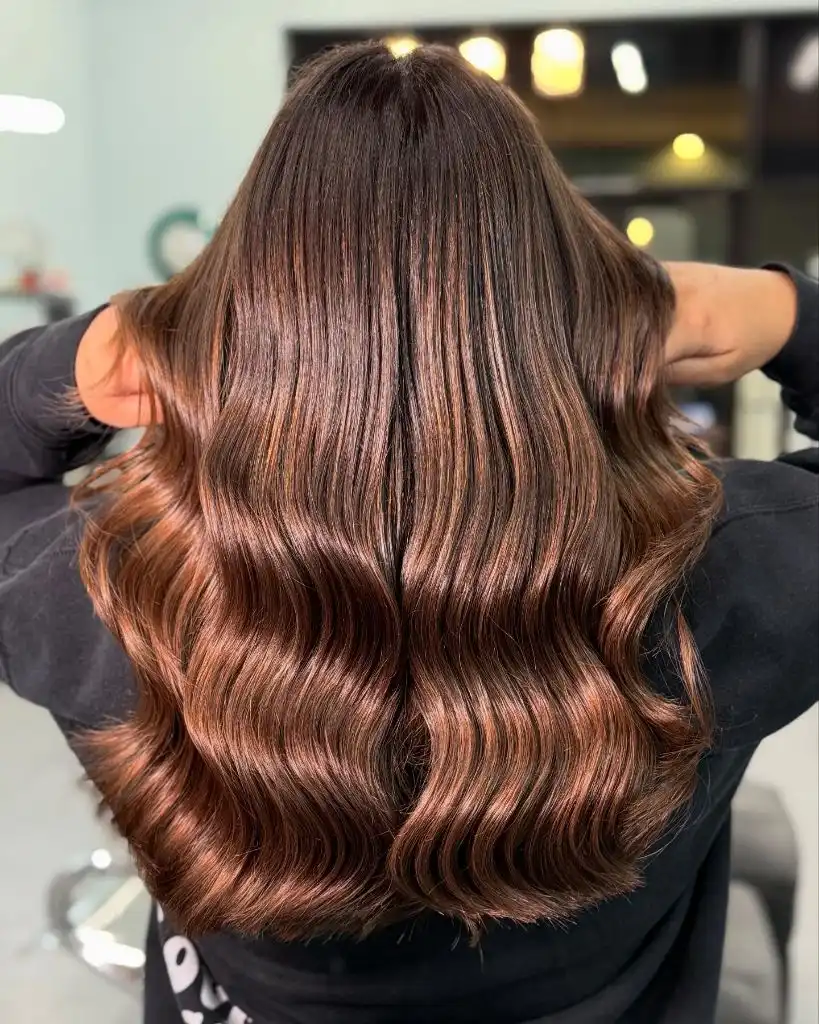
Scale of pattern is what makes this legible. Every wave is roughly the same width and sits at the same height as its neighbor, so the surface behaves like a repeated motif rather than random movement. The copper strands run along the crest of each wave, which means the pattern and the color placement reinforce each other instead of fighting for attention.
For a quieter version, reduce the copper to half the number of pieces and keep them below the shoulder line, letting the dark root occupy more of the length. If the even wave pattern feels too uniform, alternate the barrel direction on every third section, which softens the grid without losing the rhythm. Related balayage hair color ideas follow the same logic of aligning color with movement.
10. Copper Front Pieces On Espresso Waves
A front-facing shot shows dark brown length parted slightly off center, with two brighter copper sections falling directly beside the face. The rest of the hair stays a cool deep brown and moves into loose open waves that begin near the collarbone. Ends reach the chest with a slight outward curl. A black hooded sweatshirt printed with circular white text closes the frame.
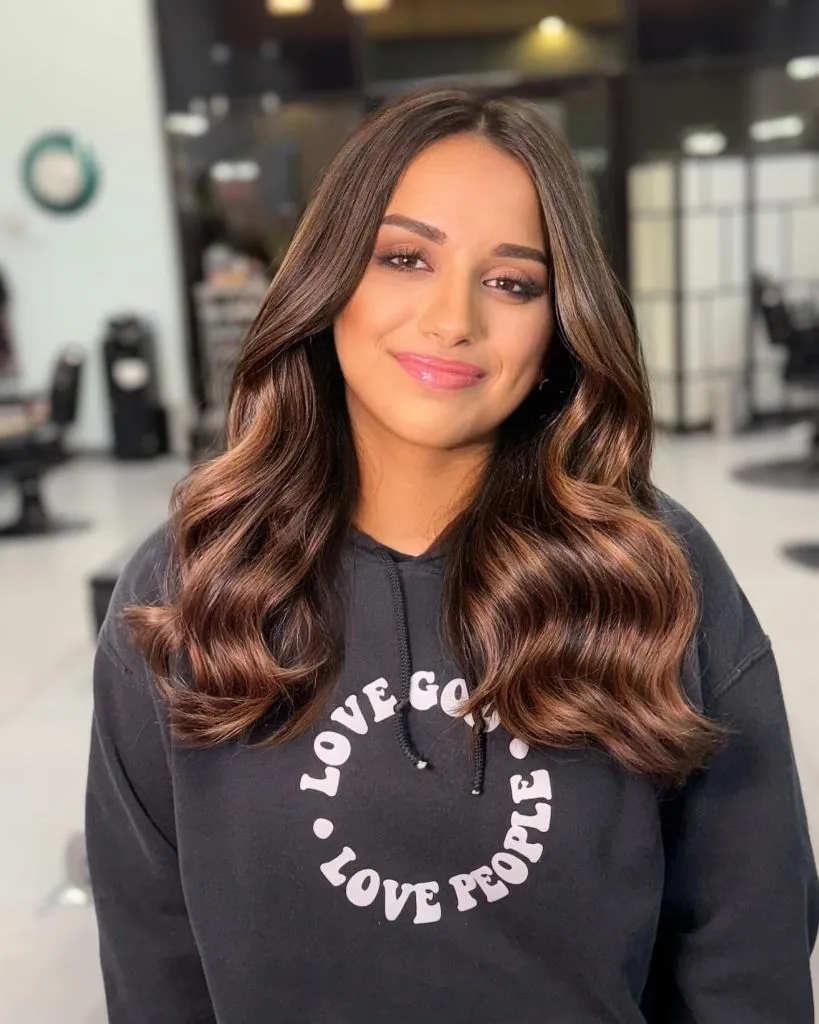
One accent against many is the operating principle. Because the copper appears in a limited pair of sections and the surrounding brown stays uniform, those two pieces function as a contrast point rather than a general lightening. The restraint also keeps the wave texture readable, since the eye is not asked to track color changes throughout the entire length at once.
The adaptation worth borrowing is width control. Two sections about an inch wide each, starting below the cheekbone rather than at the root, give brightness near the face without visible regrowth at the parting. Doubling that width would shift the shape toward a full money piece, which changes the balance considerably.
11. Blunt Chestnut Length Seen From The Back
Straight chestnut length falls from a high loose section at the crown down to a clean, almost level line just below the shoulder blades. The color deepens at the root and warms into a light copper brown toward the ends, with fine vertical striations visible throughout. A cream sweater and a dark salon chair back frame the lower edges against a plain grey wall.
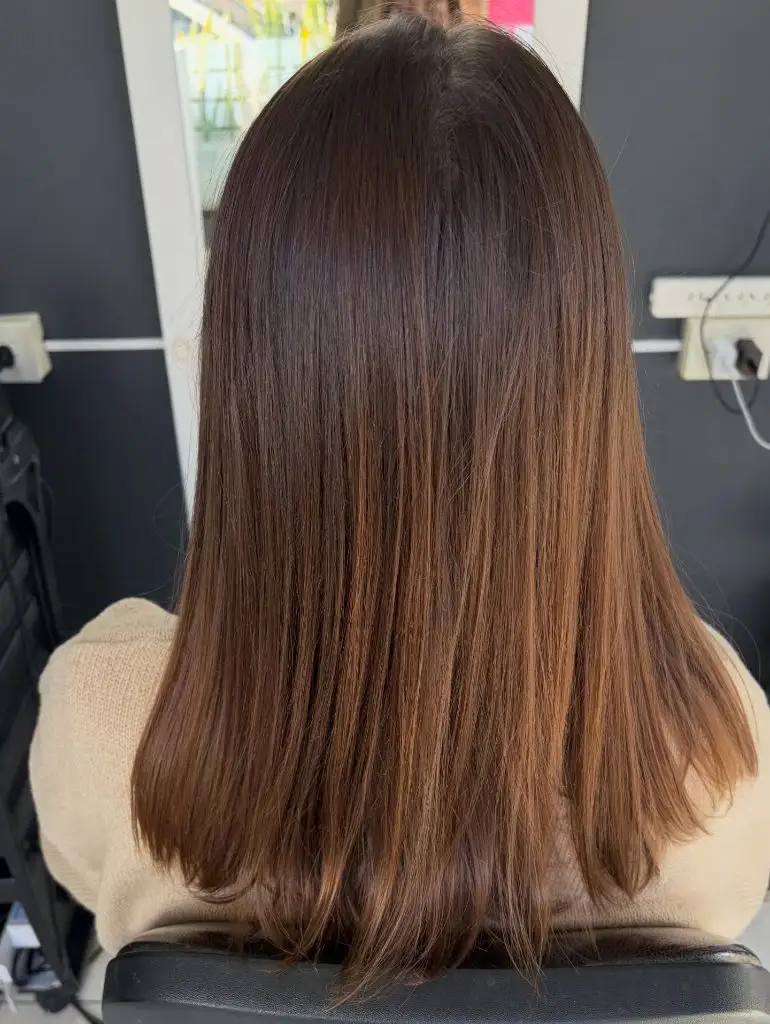
Restraint is the whole point. With no layering to break the surface and no wave to catch light unevenly, the shape depends entirely on the strength of that bottom line. The empty space around the outline stays undisturbed, which is why the perimeter looks deliberate rather than untouched. Winter Haircuts built this way rely on regular ends maintenance rather than styling.
The single most useful detail is a very slight taper at the outer corners, which stops a blunt line from looking boxy at the shoulders. Anyone with finer density can keep the same line but request the last half inch point cut, adding just enough irregularity to avoid a hard edge while preserving apparent thickness.
12. Caramel Balayage Starting Below The Roots
A three-quarter rear view shows brown roots holding the top third before caramel and light copper tones begin to spread through the mid-lengths. Loose waves open up below the shoulder, ending in soft spirals with the brightest pieces at the very tips. A black salon cape covers the shoulders, and a blurred bright interior with shelving fills the background on the left.
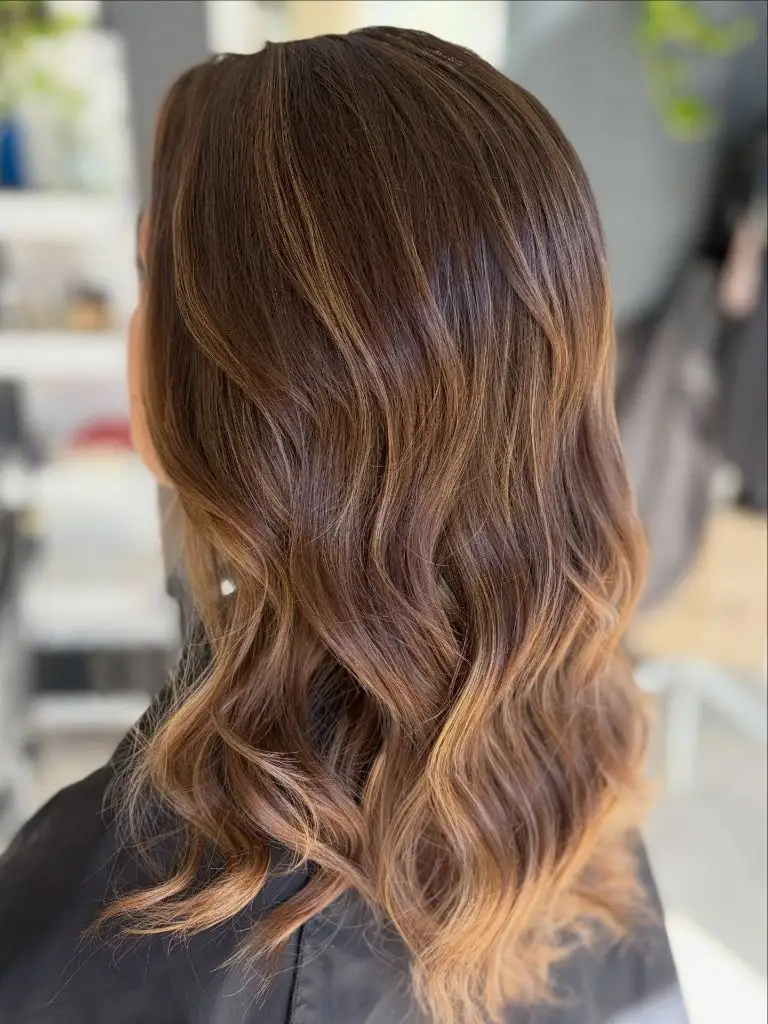
Placement decides how natural this reads. The lightest pieces sit only where the wave turns outward, and the darkest remain in the interior sections, which is how light and shadow already behave on curved hair. Because the color change starts below the root rather than at it, the growth line will move down with the hair instead of forming a visible border.
Keeping the top third untouched is the detail to carry over, since it preserves depth at the crown and stops the whole head from lifting to one flat brightness. For a bolder read, brighten only the final two inches further while leaving the mid-length as it is. More medium length haircut ideas work on this same depth-at-the-root approach.
13. Ash Blonde Ombre Over Brown Roots
From behind, mid brown roots occupy the upper third of the length before shifting through a mushroom tone and finishing in cool ash blonde. Loose open waves begin around the shoulder blades and continue to a wide, slightly uneven hem. A mustard yellow long-sleeve top and lettering on a white wall sit behind, with a large green plant at the right edge.
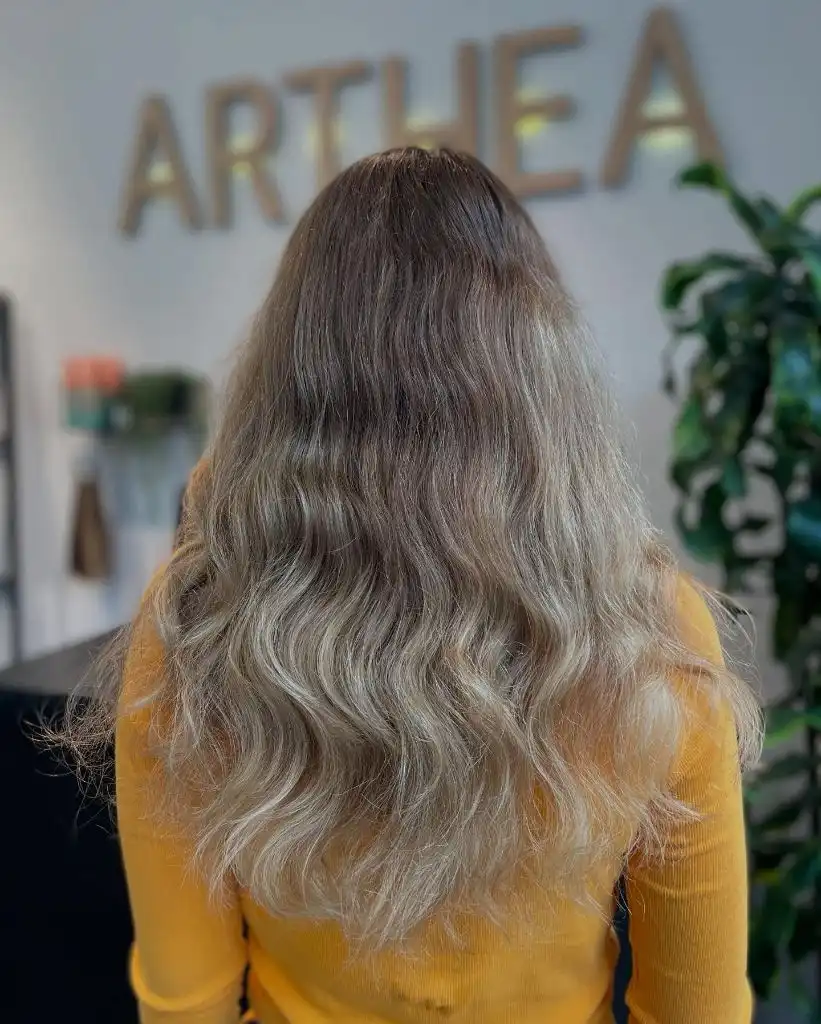
The value shift is gradual rather than stepped, which is what keeps a two-tone result from splitting into halves. Three distinct depths appear in sequence, so the eye reads a slope instead of a line. Cool ash at the base also lowers the warmth against the mustard behind it, making the ends look lighter than their actual level.
Anyone adapting this should note that the darkest section needs to stay above the shoulder blades. Push it lower and the blonde loses room to develop, leaving a compressed transition. For a warmer result, request a beige rather than ash toner on the ends while keeping the same root depth and the same gradual blending zone.
14. Dark Roots Melting Into Golden Caramel
The side view shows very dark roots across the top of the head shifting into golden caramel by the cheekbone and continuing lighter to the ends. Long waves fall past the chest with a wide bend near the jaw and looser spirals lower down. A dark brown sleeveless dress with a belt detail edges the frame, and a plain white wall keeps the outline clean.
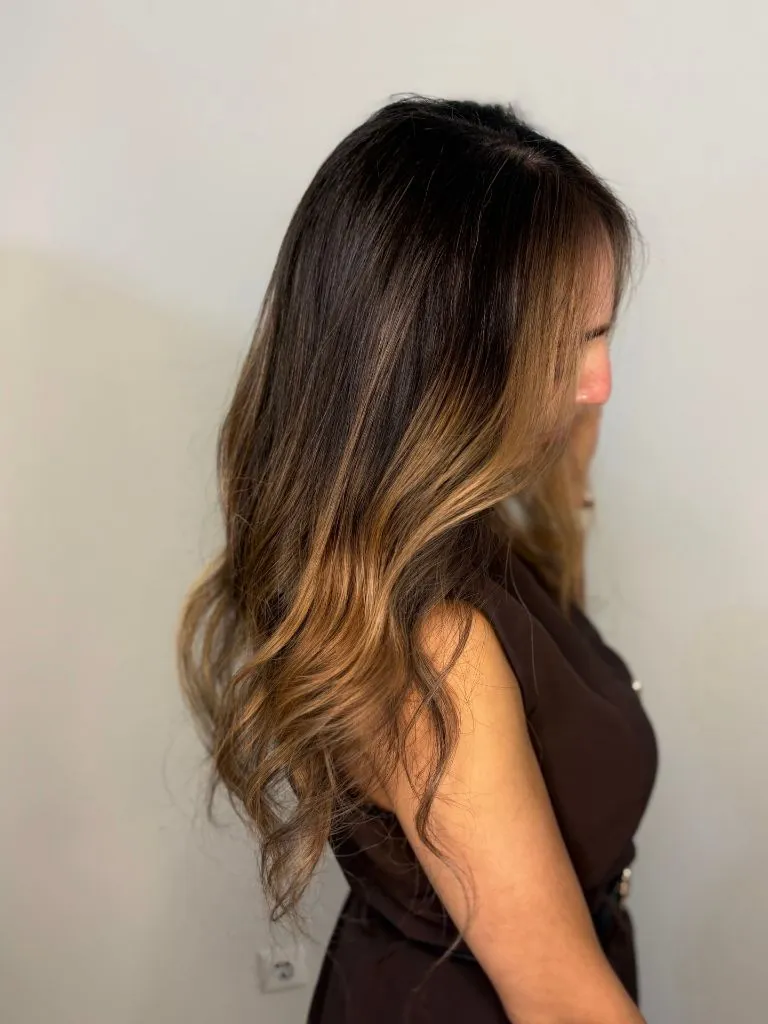
The vertical line matters more than the color here. Fine strands of gold run downward through the darker base, so the length appears drawn in long thin strokes rather than blocks. Against the flat white behind it, the outer edge stays visible as a single continuous curve, which is what stops such a dark root from reading as heavy at the top.
The most useful detail is that the lightest tone appears only on the outermost layer. Keeping the interior dark holds the depth that makes the gold look brighter. If sharper contrast is wanted near the face, add two brighter pieces at the parting only. Similar contrast principles appear across these curtain bangs styles when framing pieces sit against darker interiors.
15. Icy White Blonde Cut Straight Across
A hand holds one side of an icy white blonde lob out from the back of the head, revealing a clean level hemline just below the shoulder. The surface is glassy and almost entirely free of wave, with faint silver and pearl striations running vertically. A white collared top sits below, and the background blurs into pale neutral tones and small ceiling lights.
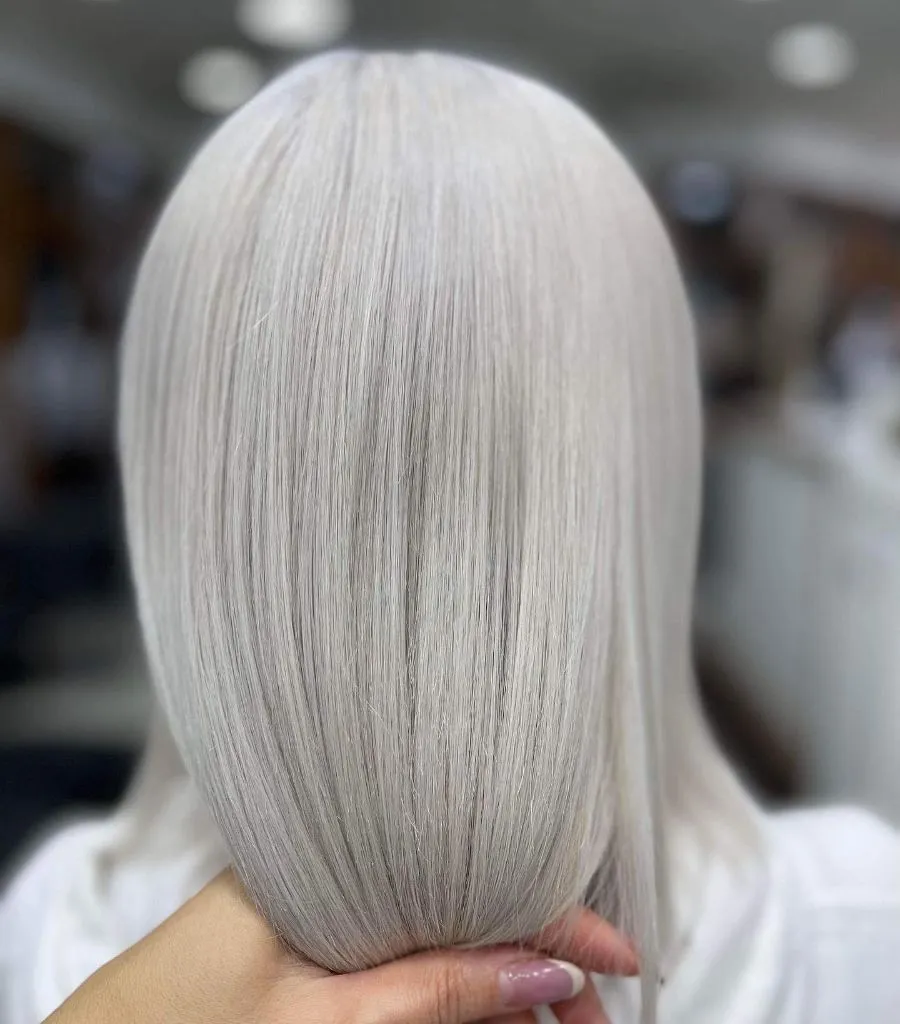
Negative space governs this shape. The outline is a simple rounded rectangle with no interior interruption, so every irregularity would be visible, and none is. At this level of lightness, tone replaces texture entirely, and the small pearl and silver variations become the only detail on an otherwise uniform field. Winter Haircuts in this register depend on precision over movement.
The takeaway is that a shape this smooth needs a level cut and a consistently cool toner to hold. To soften it without losing the line, ask for a subtle inward bend on the last inch only, which rounds the corners toward the neck. Warmer beige toning would reduce the icy read while keeping the same structure.
16. Soft Layers Stacked Around Warm Brown
Photographed from behind between two mirrors, warm brown mid-length hair falls in soft stacked layers, with the shortest pieces bending outward near the shoulder and longer sections continuing below. Fine lighter strands catch light across the crown and upper back. Ends flick in several directions along an uneven hem, and a camel sweatshirt fills the lower frame beside pale salon fittings.
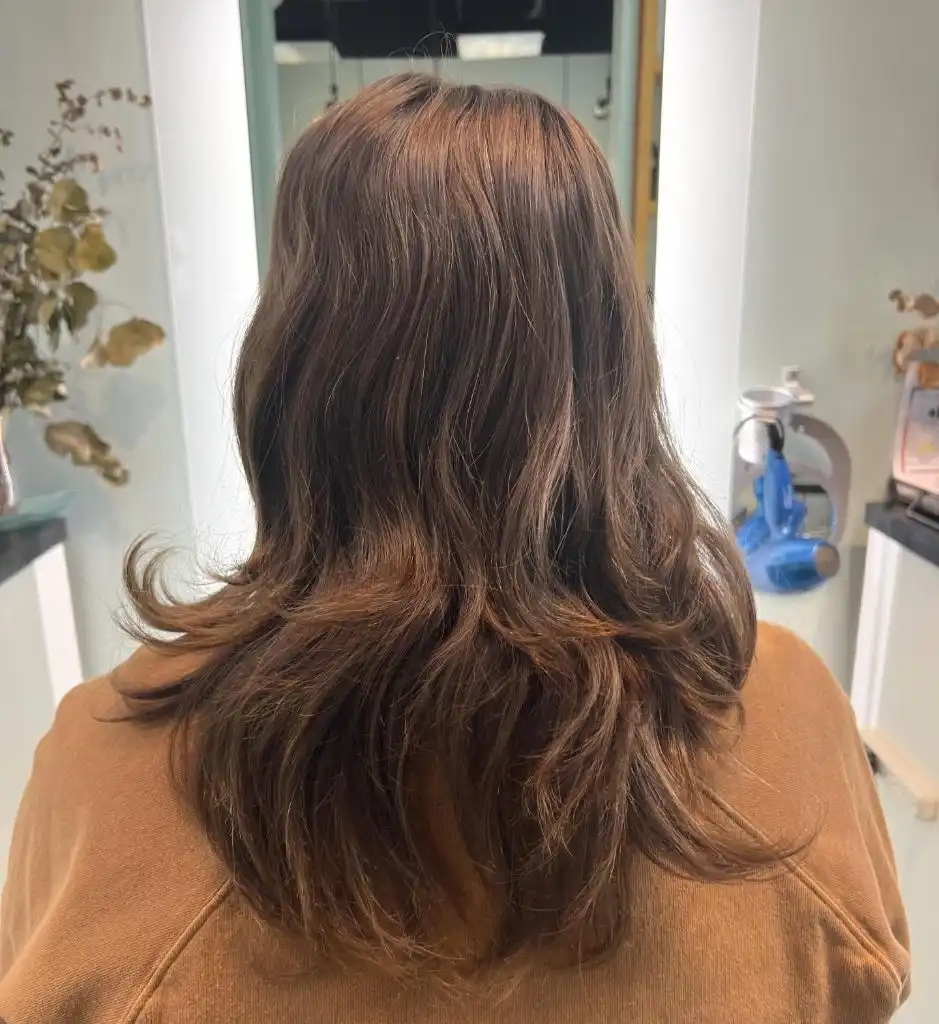
Proportion is set by where the shortest layer lands. Because it stops near the shoulder line, width appears at the widest part of the back rather than at the head, giving the shape a broad lower half and a compact top. The longer sections beneath then extend that width downward, which keeps the outline from looking cut off at one level.
For less width, raise the shortest layer an inch and reduce how far the ends flick outward when drying. For more, keep the layer as it is and encourage the bend with a round brush. Anyone considering going shorter can compare these short haircut ideas before removing the longer underneath sections.
17. Bronde Lob With Undone Wave Texture
A rear view shows a bronde lob ending just past the shoulders, with irregular waves running through the lower two thirds. The root sits mid brown and lifts toward a soft wheat tone at the ends, with individual lighter strands visible near the surface. The hem breaks unevenly, and a mottled cream and pale blue distressed wall provides a textured backdrop above a black ribbed top.
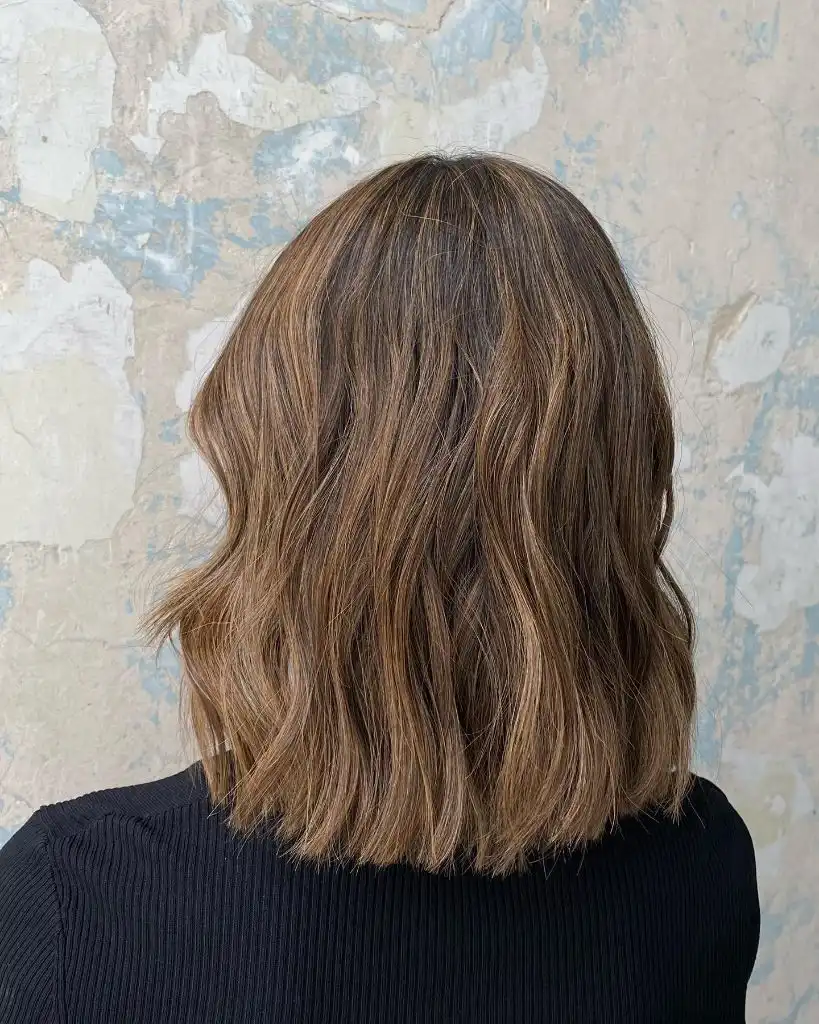
Texture against smoothness works in the opposite direction here. The roots stay flat while everything from the ear down turns irregular, so the movement builds gradually rather than arriving all at once. The waves also run at slightly different angles, which breaks the horizontal hem into small steps and makes a shoulder-length shape look less blocky than a level cut would.
The adaptation is straightforward. Work the wave in with a flat iron in random directions instead of a curling barrel, leaving the last inch straight so the hem keeps some definition. For a cleaner finish, smooth only the outer layer and leave the interior textured, which holds volume without the surface looking rough.
18. Golden Blonde Falling In Straight Panels
Straight golden blonde length hangs from a shadowed root area in two broad panels down the back, reaching just below the shoulder blades. Darker brown roots occupy the top few inches, then blend into a light wheat gold that pales further toward the tips. The hemline is soft and slightly tapered, and a dark grey salon cape and blurred wooden interior sit behind.
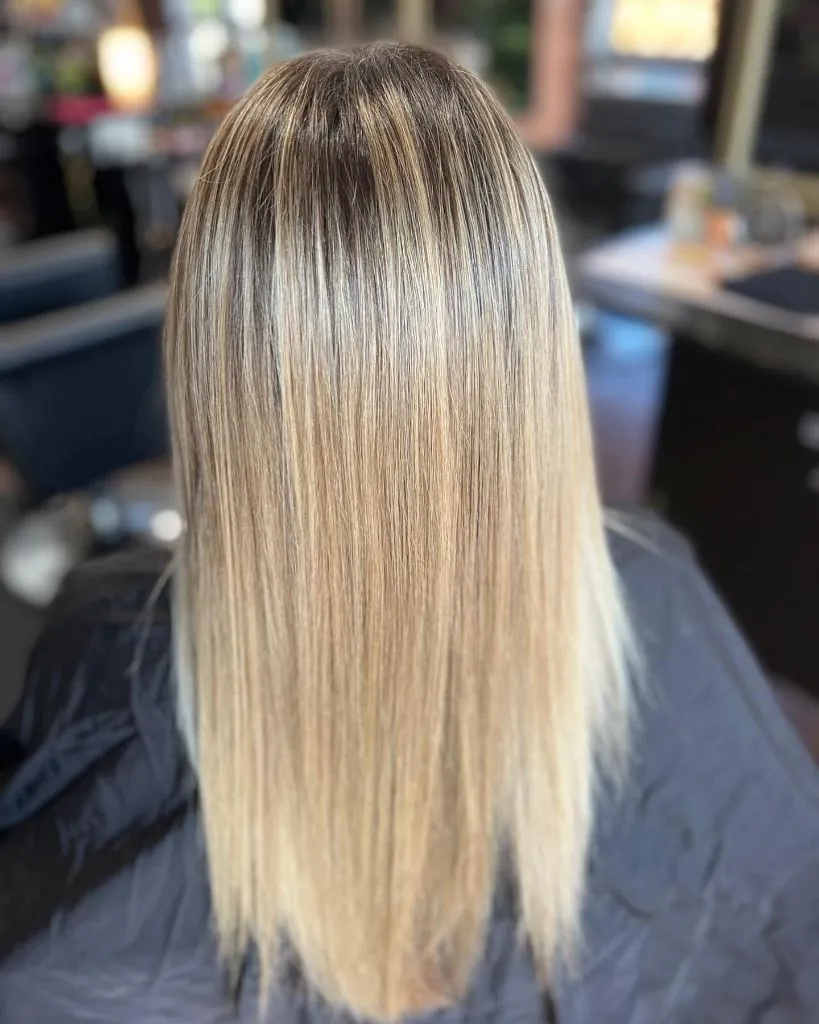
Tonal layering explains the depth. Three tones stack from top to bottom, and because the hair is straight, each one occupies a clear horizontal band instead of scattering through waves. The shadowed root grounds the shape, the mid gold carries most of the surface light, and the palest tips widen the visual base without any cutting involved.
The detail worth copying is the softness of the root shadow. Blurred rather than banded, it lets straight hair carry a strong lightness difference without a visible line. Adding a very slight inward taper at the sides keeps a one-length blonde shape from reading wide across the shoulders when there is no layering to reduce weight.
19. Espresso Brown Curled Only At The Ends
From directly behind, espresso brown hair runs smooth and glossy from the crown to mid back, then turns into defined ringlet curls for the last several inches. A broad highlight band travels across the smooth section, while the curls scatter light into small separated points. The hem sits uneven with individual spirals visible, framed by a cream sweater and a blurred warm-toned interior.
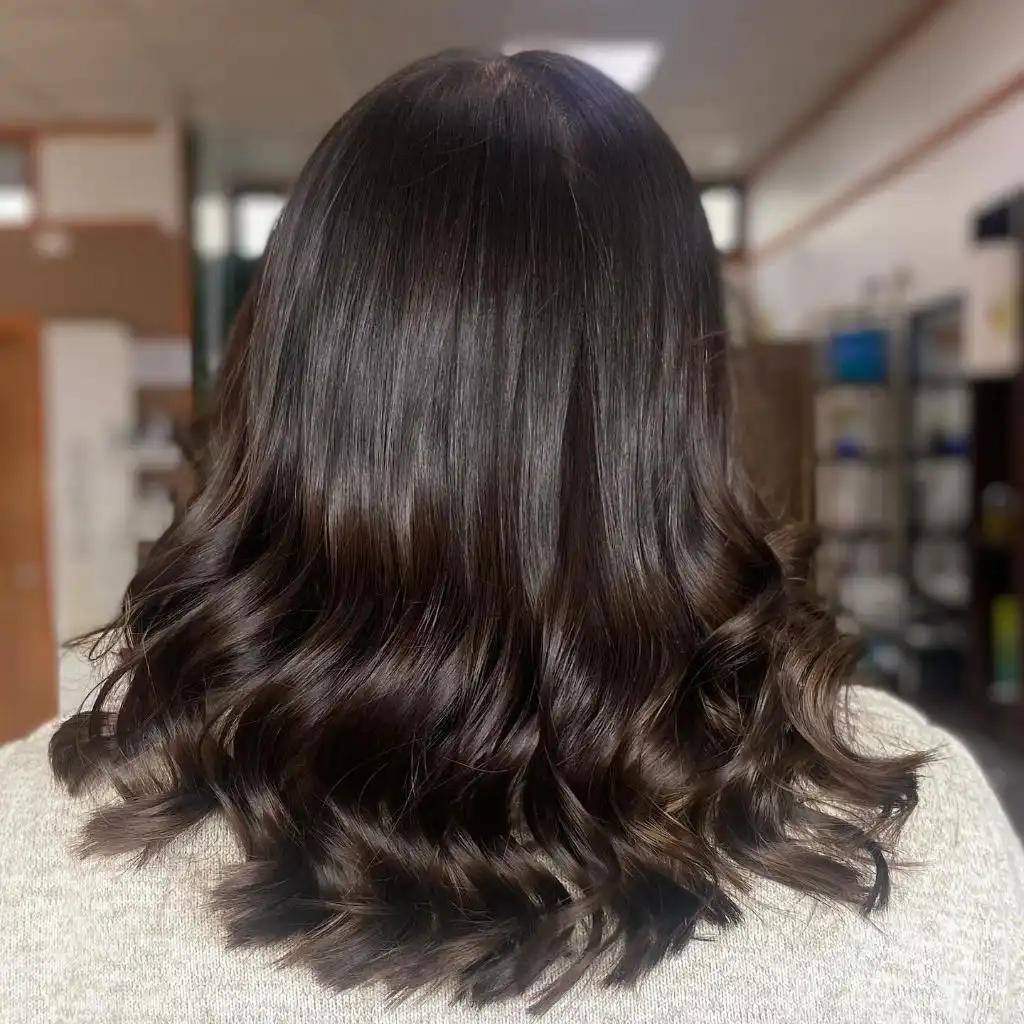
The silhouette does the talking. A narrow smooth column widens abruptly into a curled base, producing a clear outline shift at one specific height. Because the color stays a single deep brown throughout, that shift is the only structural event in the shape, which is why it reads so cleanly. Winter Haircuts with dark uniform color often need exactly this kind of edge definition.
The most useful control is where the curl starts. Beginning it at mid back keeps the top narrow and the base compact, while starting higher would build volume across the whole length. For a softer version, use a larger barrel and separate each ringlet once with the fingers so the base widens into a wave rather than a distinct block.

Hi, I’m Zoey Mitchell, the creator of ChicStyle Blog.
I share simple, wearable outfit ideas, hairstyles, nail trends, and beauty tips that feel natural and easy to recreate.
This blog is where I explore everything that makes a woman feel put together and confident every day. I’m not an expert — just a woman who genuinely loves style, mixing looks, and discovering what works.
If you love effortless fashion with a personal touch, you’ll feel at home here.