
Trendy winter hair color ideas usually stall at one question: how dark can a base go before the whole head reads flat. The answer sits in placement rather than pigment. A deep base holds shape when lighter pieces land where the hair bends, because light gathers on curve and skips the interior. Contrast placed low keeps weight visible at the ends, and contrast placed high keeps the face framed.
Read the pairings below as relationships instead of formulas. Compare how far each lighter tone travels from the root, how wide each ribbon of color runs, and how much untouched base is left between them. The trendy winter hair color ideas that hold up longest tend to keep one dominant value and let a second tone interrupt it briefly. Watch the ends too, since that is where every gradient resolves.
1. Soft Black Waves Against Camel Knit
The frame is a three-quarter side view, and the hair leads everything in it. A single-length dark base falls past the shoulder, curling into wide S-waves from mid-shaft down. Surface shine breaks the black into charcoal ribbons where the waves turn. A camel-toned knit-like cardigan with a fine grid texture sits over a plain black top, and the background stays a soft blur.
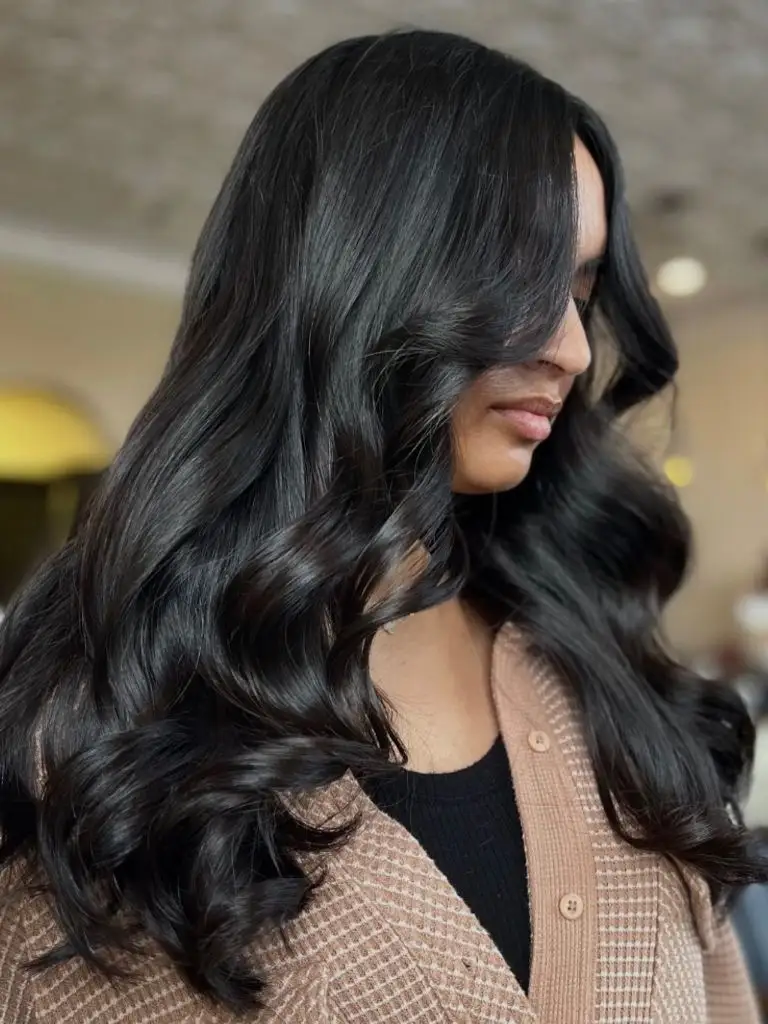
All the variation here comes from tonal layering inside one shade rather than added color. Black reflects in narrow bands, so the wave pattern supplies the dimension that a lighter tone would normally provide. The camel knit-like layer raises the value of everything around the hair, which pushes the dark column forward instead of letting it sink. Nothing competes for the eye, so shape becomes the whole story.
To keep that read on shorter lengths, hold the wave larger than the section it sits in, since tight curl on black hides the shine bands that create depth. A gloss-level refresh maintains the reflective surface without lifting the base. If more visible movement is wanted, one shade of soft espresso through the ends is enough.
2. Espresso Roots Over Bronze Caramel Mids
This one is built around a dark canopy that opens into lighter mid-lengths. The top section reads near-black and smooth, while bronze and caramel ribbons appear from the cheekbone level down. Waves are loose and slightly undone, with piecey ends that separate into fine points. A black ribbed top keeps the lower frame plain, and a warm cluster of lights hovers in the blurred background.
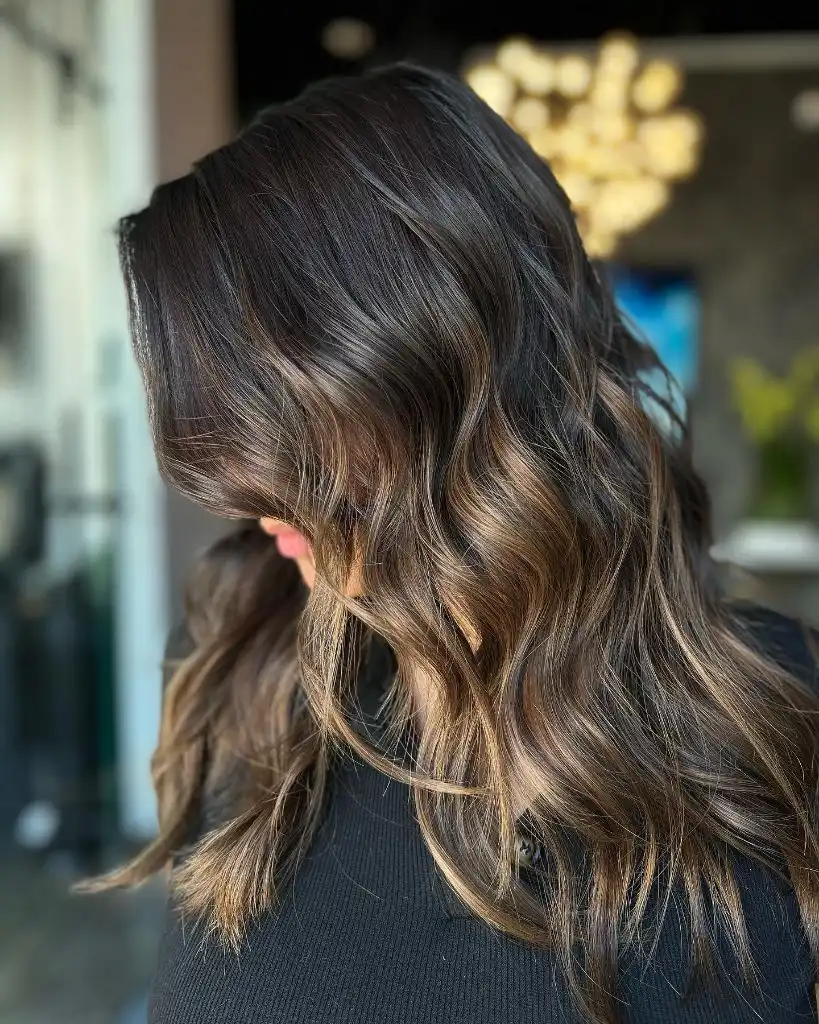
The mechanism is a value gap held inside a narrow zone. Dark stays dark for the first third, then the lift jumps two or three levels at once, which reads as light striking the hair instead of a gradual fade. Because the black top repeats the root value, the eye connects the two dark areas and treats the bronze band as the only bright event in the frame.
Ask for the lift to start below the cheek if an easy grow-out matters, since the root stays untouched. Softer versions pull the same bronze through the outer layers only, leaving the interior dark so the contrast appears in movement rather than at rest.
3. Caramel Ribbons Framing Chestnut Brown Waves
Long waves dominate the composition, styled in even barrel curves that repeat from the crown to the ends. The base is a mid chestnut brown, threaded with caramel and toffee pieces that run the full length rather than stopping at the mid-shaft. A black top and a dark door frame sit behind, with a frosted branch entering the top corner.
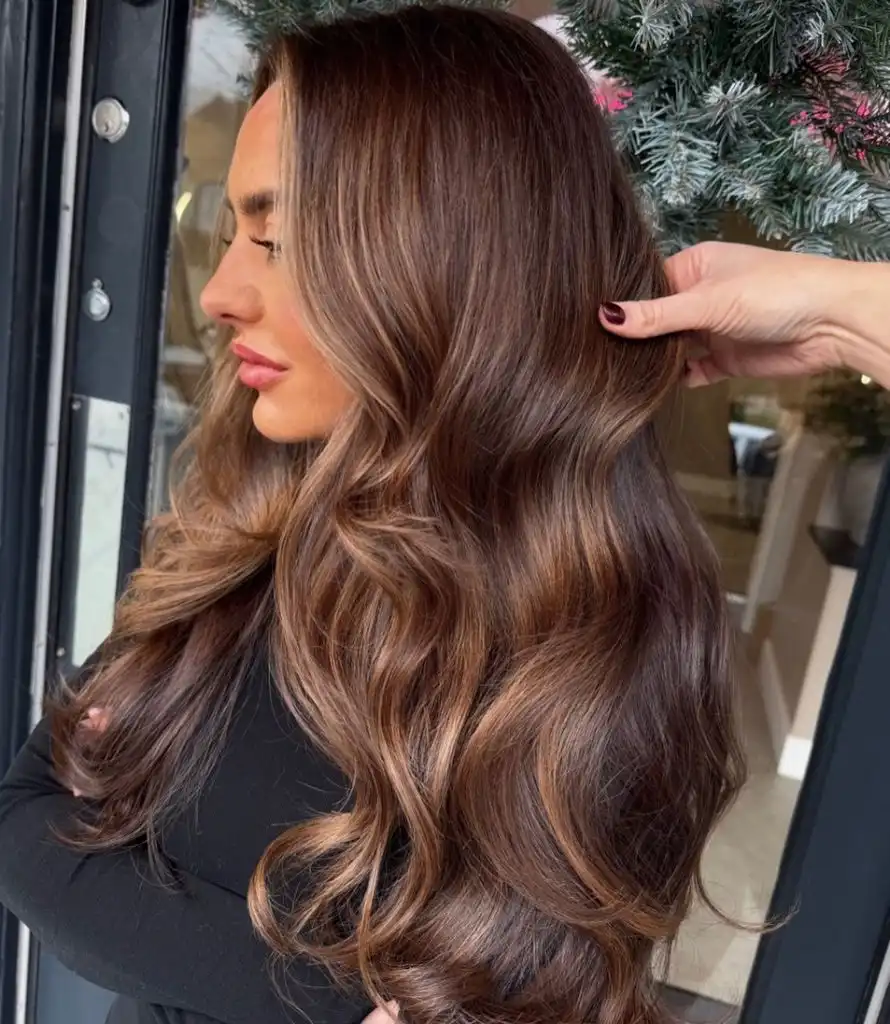
Repetition is doing the work. The same caramel value recurs at close intervals, so no single strip stands out and the whole length reads uniformly lit. This is where trendy winter hair color ideas for brunettes stay believable, because the lighter tone never exceeds the base by more than a couple of levels. Even wave size reinforces the rhythm, since each curve catches an identical amount of light.
The useful detail is spacing. Fine, frequent pieces keep the effect soft, while fewer thick ones would read striped at this length. For a cooler finish, the same placement works with a neutral beige instead of caramel, holding the pattern and dropping the warmth.
4. Shoulder-Length Brown Warming Into Auburn Ends
A shorter cut takes the lead, ending just below the shoulder with the curl concentrated in the last few inches. The root is a deep neutral brown that warms gradually into auburn and light chestnut through the ends. Bright reflections sit on the wave crests near the collar. A heather gray sweatshirt fills the lower frame, and the background dissolves into pale shapes.
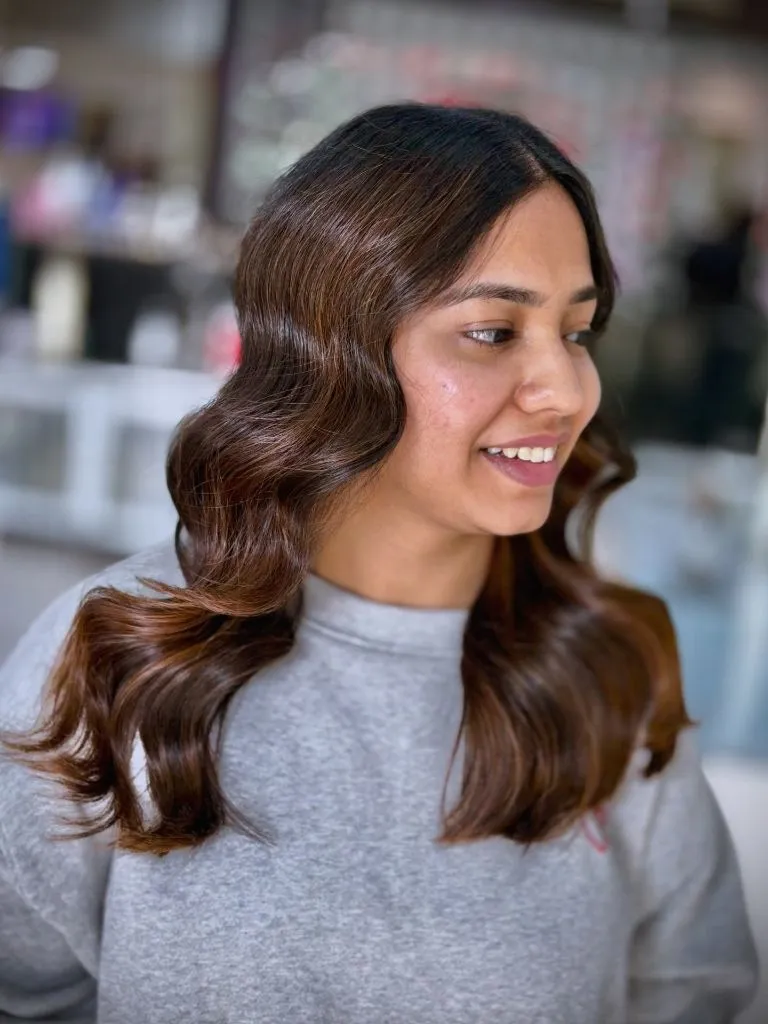
Proportion carries this. Because the length stops near the shoulder, the warm section occupies roughly the bottom third, which keeps weight from collecting at the top of the head. Curl placed only at the ends sits low, so the outline reads as a soft triangle rather than a full bell. The gray layer below holds a mid value and keeps the warm tones from looking heavy.
To push it bolder, extend the auburn upward to eye level and the whole silhouette warms. To keep it quieter, hold the warmth below the jaw and let the root stay cool, which is also the easiest version to grow out on a shoulder-length cut.
5. Beige Blonde Layers Above Gray Knit
Layers set the structure in this front-facing frame. Mid-length blonde is cut in stacked sections that flip outward at the jaw, the cheek, and again near the ends. The color runs beige to sandy, with a slightly deeper root shadow behind the part. A gray knit-like sweater with a wide neckline sits low in the frame, and small warm lights blur behind.
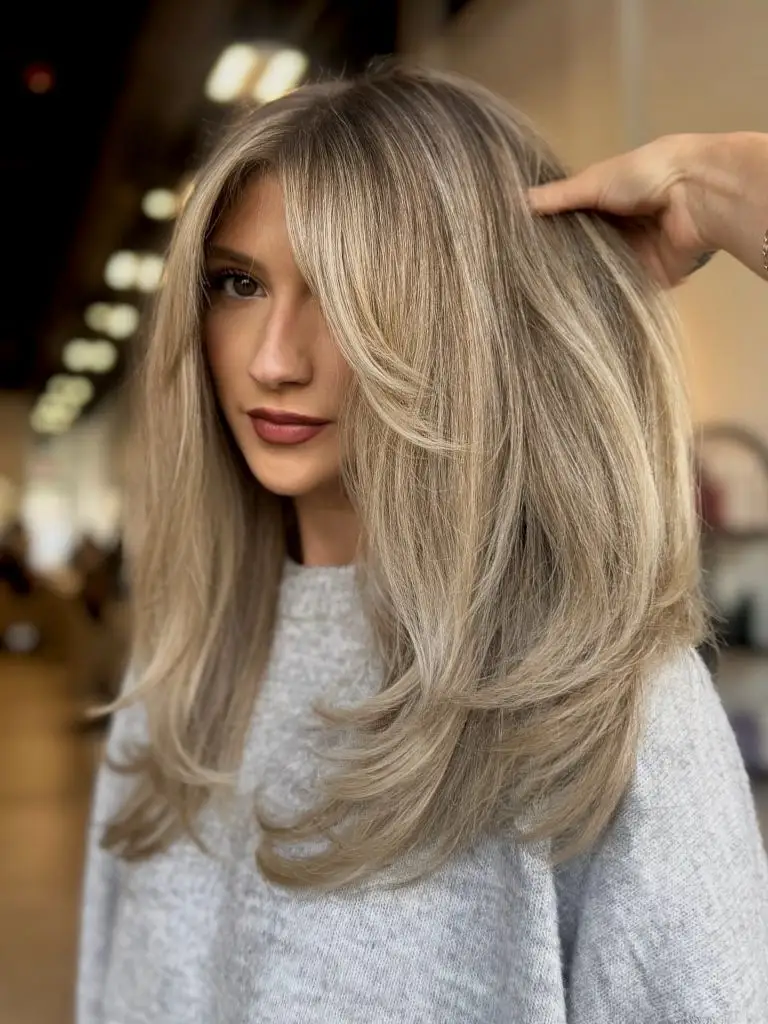
The outline is the argument. Each layer ends at a different height, so the perimeter reads as a series of soft steps rather than one solid edge. That broken edge lets the blonde look airy without extra lift, because light passes between the sections. The root shadow anchors the top and prevents the layered outline from floating away from the head shape.
The detail worth copying is the root shadow, roughly two levels deeper than the ends, which keeps the layered edge legible. On finer hair, fewer and longer layers protect the perimeter while still giving the outward bend at the jaw.
6. Brightened Front Pieces Zoning A Darker Base
The styling reads as a smooth blowout with the volume pushed back off the forehead. Color is zoned rather than uniform: the pieces closest to the part are the brightest blonde, while the mid-lengths sit several levels deeper in mushroom and olive-leaning tones. Ends turn under near the collarbone. A plain black tee and a gold-toned chain with two pearl-like beads finish the frame.
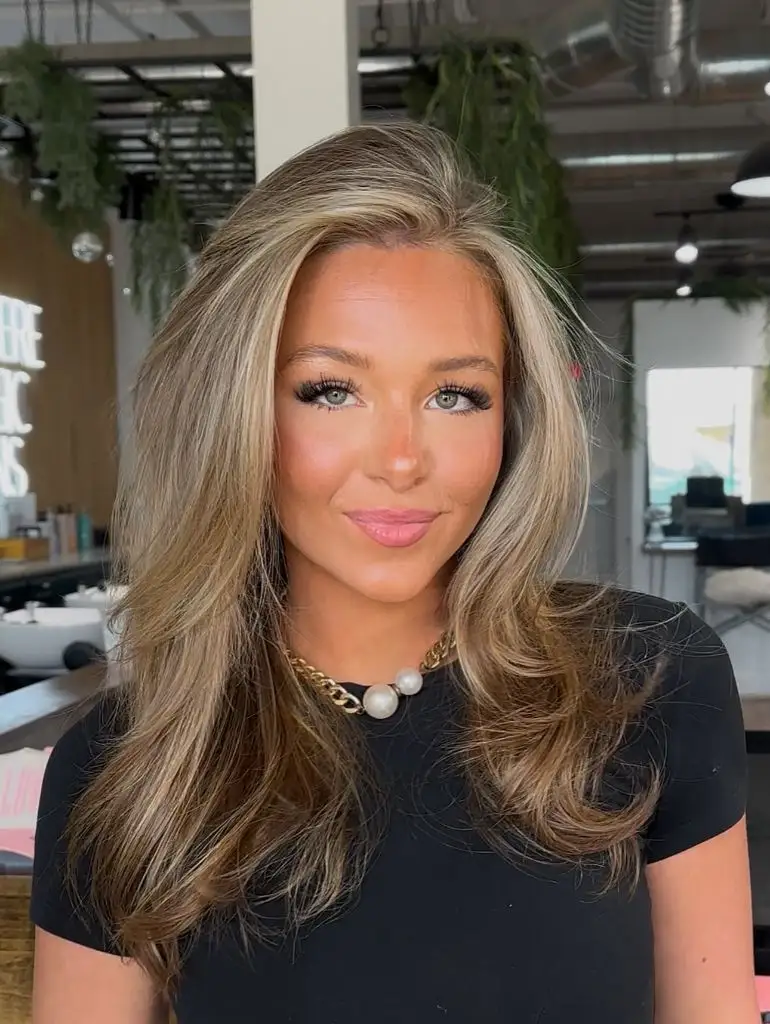
Placement decides everything here. The lightest tone is concentrated in a narrow band along the part and around the front sections, so brightness sits exactly where the hair folds back. Everything behind stays dim, which is why the front reads luminous instead of the whole head reading light. Among trendy winter hair color ideas for blondes, this zoning approach keeps upkeep confined to one small area.
Keep the bright band no wider than a couple of inches from the part, otherwise the depth behind it loses its job. For a softer result, ask for the same placement one level deeper, which blurs the join between the front and the base.
7. Saturated Plum Burgundy Seen From Behind
A single saturated tone covers the full length in this back view. Deep plum burgundy runs root to end, shifting only where the waves catch light and read closer to red wine. The waves are wide and soft, breaking into a looser pattern below the shoulder blades. A black cape covers the shoulders, and a dark mirrored panel sits behind.
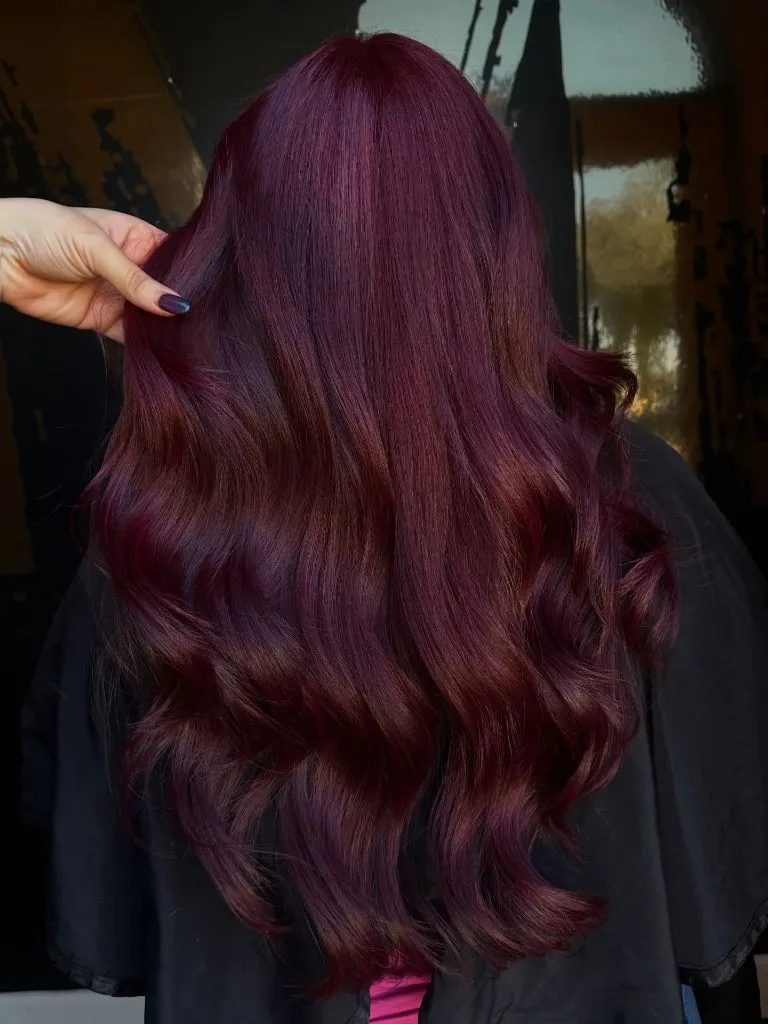
One tone, no accents, and the depth comes purely from saturation. Because there is no second color competing, every bright area is a reflection rather than a separate shade, which keeps the plum reading as one continuous surface. The black cape sets a lower value floor, so the burgundy sits above it and holds its color instead of merging into the darkness behind.
The most useful part is the violet lean, which stops the red from turning orange as it fades. For a lighter reading, the same family works a level or two up in a mulberry tone. Cool-toned washes preserve the plum longer than a warm red base would.
8. Ginger Copper Waves Over Polka Dots
A hand lifts the mid-lengths, so the wave pattern reads clearly from the side. The color is a bright ginger copper, even from root to end, with paler gold sitting on the outer curves and a deeper rust settling in the folds. Waves are uniform in size and stacked in a regular S. A black top with white dots and a pale pink wall sit behind.
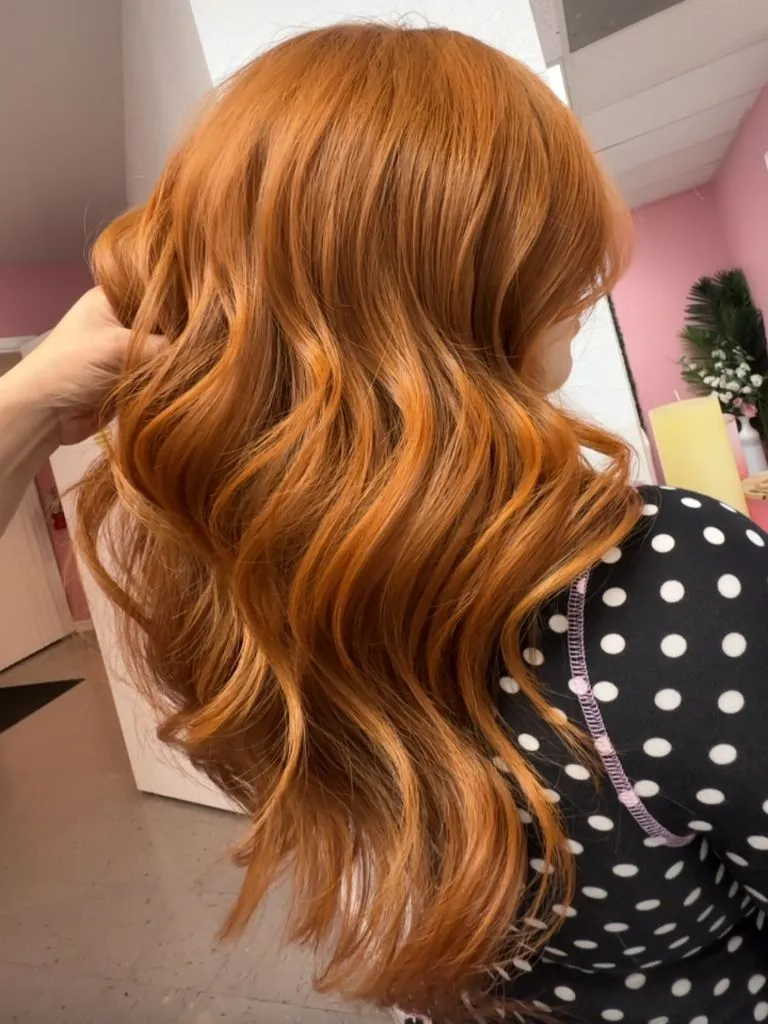
Scale is the point of comparison. The dots behind are small and evenly spaced, while the waves are broad and few, so the two patterns never compete. That difference in scale lets the copper stay the largest shape in the frame. Within one shade, the pale gold crests and rust valleys behave like a large gradient, which reads as volume rather than as separate highlights.
If the copper feels too bright, a single filter through the ends softens it without disturbing the root. Curling in larger sections keeps the wave scale wide, which is what makes these copper hair color shades look dimensional instead of flat.
9. Long Auburn Length Falling In Vertical Waves
Seen from directly behind, the length runs well past mid-back with a dark root area at the crown. Below that, the color opens into chestnut with auburn and cinnamon threads that grow warmer toward the ends. The wave pattern is fine and consistent, closer to a crimped S than a barrel curl. A white long-sleeve top and a wooden counter fill the lower frame.
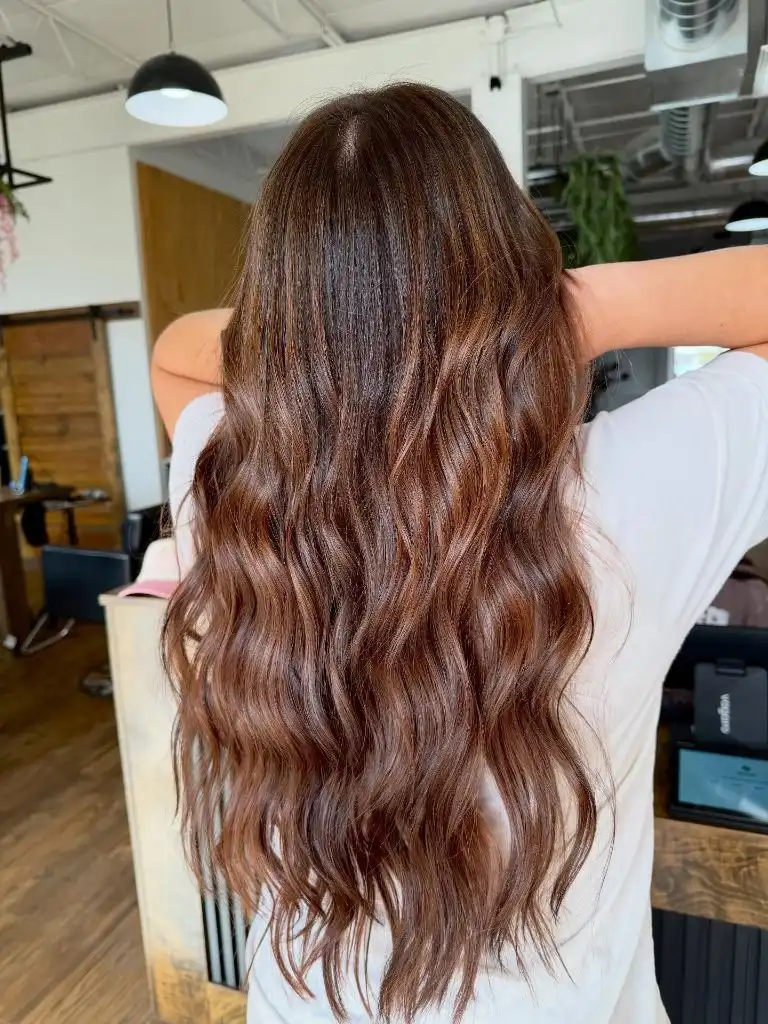
The line is almost entirely vertical, and the color follows it. Warm threads run downward in narrow columns instead of pooling in horizontal bands, so nothing cuts the length in half. That keeps the eye traveling from crown to end in one movement, which is what makes trendy winter hair color ideas for long hair look intentional at this scale. The tight wave adds width only at the perimeter.
The takeaway is direction. Vertical placement suits lengths past the shoulder blades, while horizontal placement shortens them visually. For a warmer finish, the cinnamon can be concentrated in the final six inches, which also keeps regrowth easy to blend.
10. Copper Layers Framing A Sweeping Fringe
Layers and a long sweeping fringe shape the front of this side view. The color is a warm copper red with lighter marmalade pieces sitting on the top layers and along the fringe. Ends are curled into defined rounded barrels that separate near the shoulder. A black tee with white lettering sits below, and the wall behind stays plain with a small mirror.
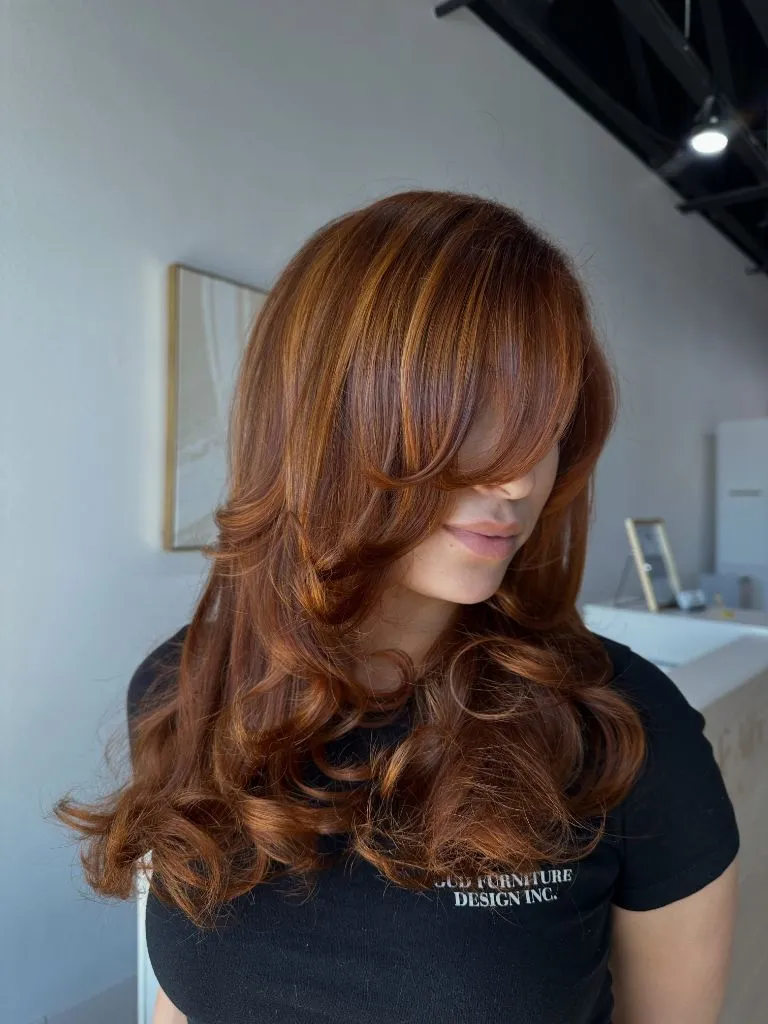
Smooth roots against curled ends set up the contrast. The top section lies flat and reflects in a single sheet, while the lower barrels break the same copper into dozens of small highlights. Because the lighter marmalade pieces sit only on the surface layers, curl reveals them and flat areas hide them. Movement therefore changes how bright the color appears.
Keep the lighter pieces shallow if a subtle result matters, since surface placement shows only when the hair bends. On shorter layers, curling just the ends and leaving the fringe smooth preserves the same split between flat shine and broken shine.
11. Dark Ash Brown With Silver Gray Highlights
This back view shows a long, blunt-edged length with a soft outward bend near the ends. The base is a dark ash brown, cut through with cool silver gray ribbons that begin below the crown. Some ribbons run wide, others narrow, and the darkest sections stay untouched between them. A black fitted top and a lit vanity mirror occupy the background.
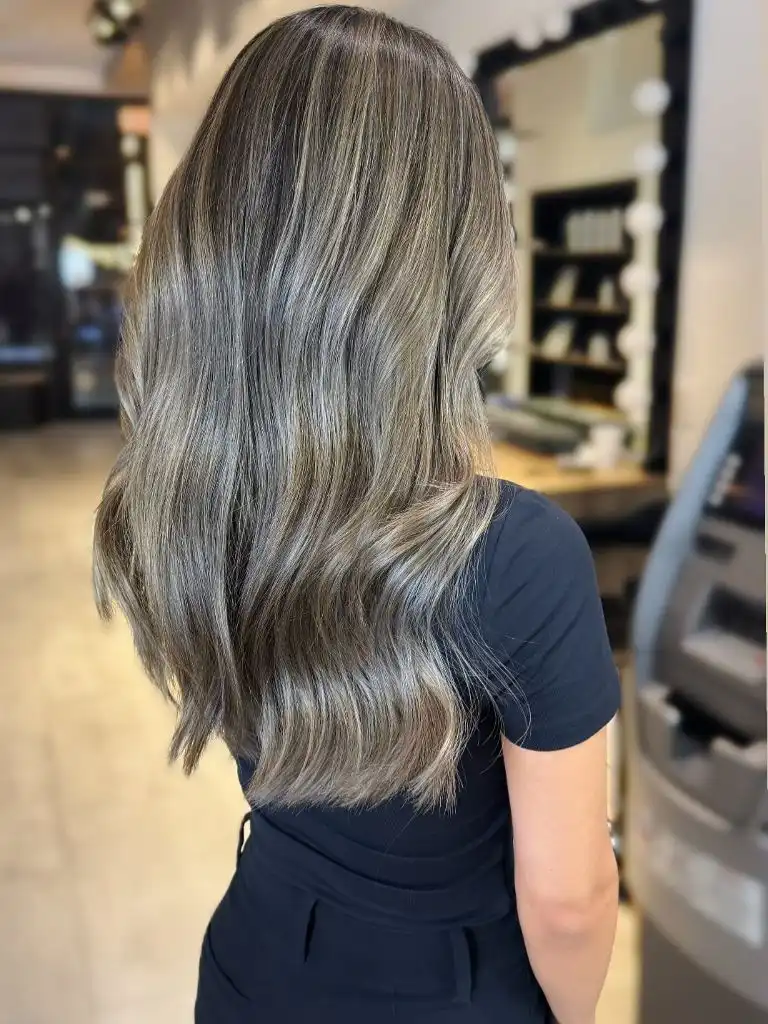
Untouched hair functions as negative space. Each silver ribbon reads clearly because a wide band of dark ash sits on either side of it, giving the light tone an edge to work against. Remove that dark spacing and the whole head would drift toward a flat gray. The blunt perimeter also gives the ribbons a definite stopping point, which sharpens the pattern.
The adaptation is straightforward: fewer, wider silver sections read bolder, while thinner ones set further apart read closer to natural silvering. Cool toners every few washes keep brass out, which matters more here than anywhere else. The same spacing logic applies to other versions of ash brown hair with highlights, including shorter mid-lengths.
12. Black Roots Breaking Into Honey Balayage
The composition centers on a long, softly waved length parted slightly off-center. The root area is a solid black that holds for several inches before honey and caramel take over from the cheekbones down. Face-framing pieces are the lightest in the frame. A black top keeps the base of the image dark, with warm pendant lights and greenery blurred behind.
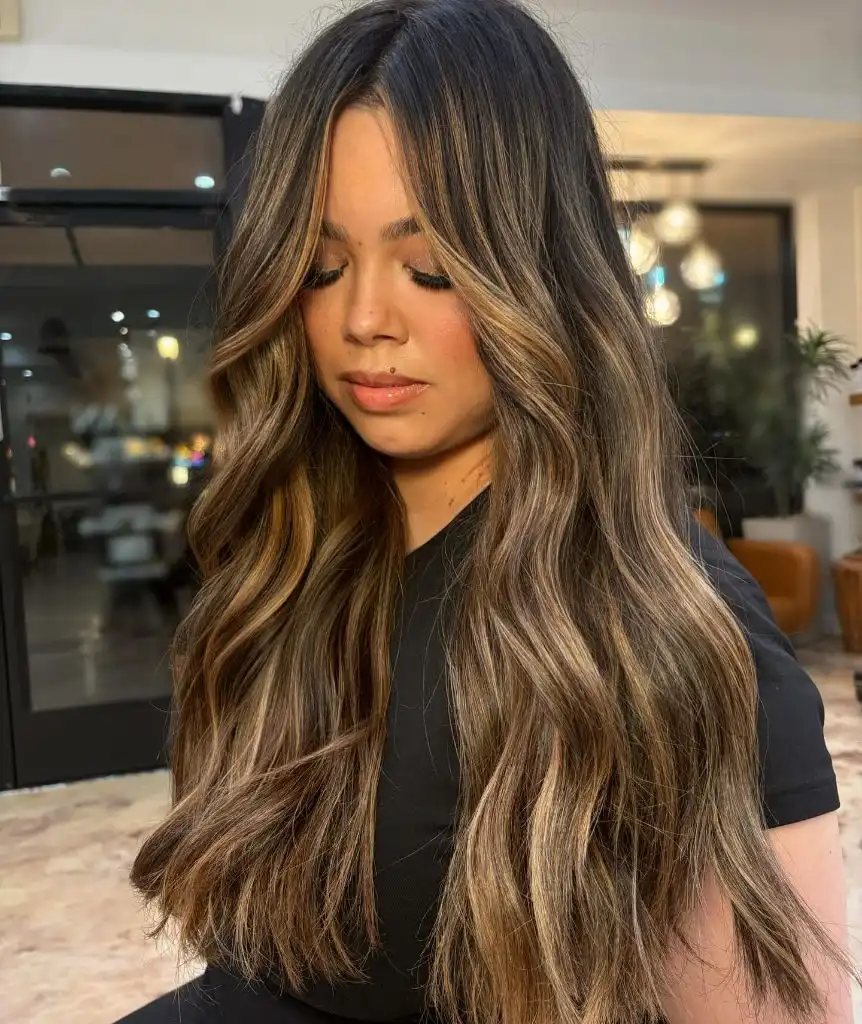
Value does the separating, and the join is deliberately short. Black meets honey across a narrow blend zone, so the transition reads as an edge rather than a long fade. Among trendy winter hair color ideas with high contrast, that short blend is what separates deliberate placement from a grown-out gradient. The face-framing pieces gain their brightness from the dark root sitting directly above them.
Shorten the blend zone for more drama, lengthen it for less. If the contrast feels strong, a single warm gloss over the root softens the meeting point without touching the lighter ends.
13. Shadowed Roots Fading Into Creamy Blonde
A face-framing layered blowout drives this frame, with sections bending outward at the cheek and again at the collarbone. The root sits in a soft mushroom tone and lifts steadily through sand, wheat, and near-white pieces at the perimeter. The ends stay smooth and rounded. A white waffle-knit-looking shirt sits open over a dark neckline, and the wall behind is plain.
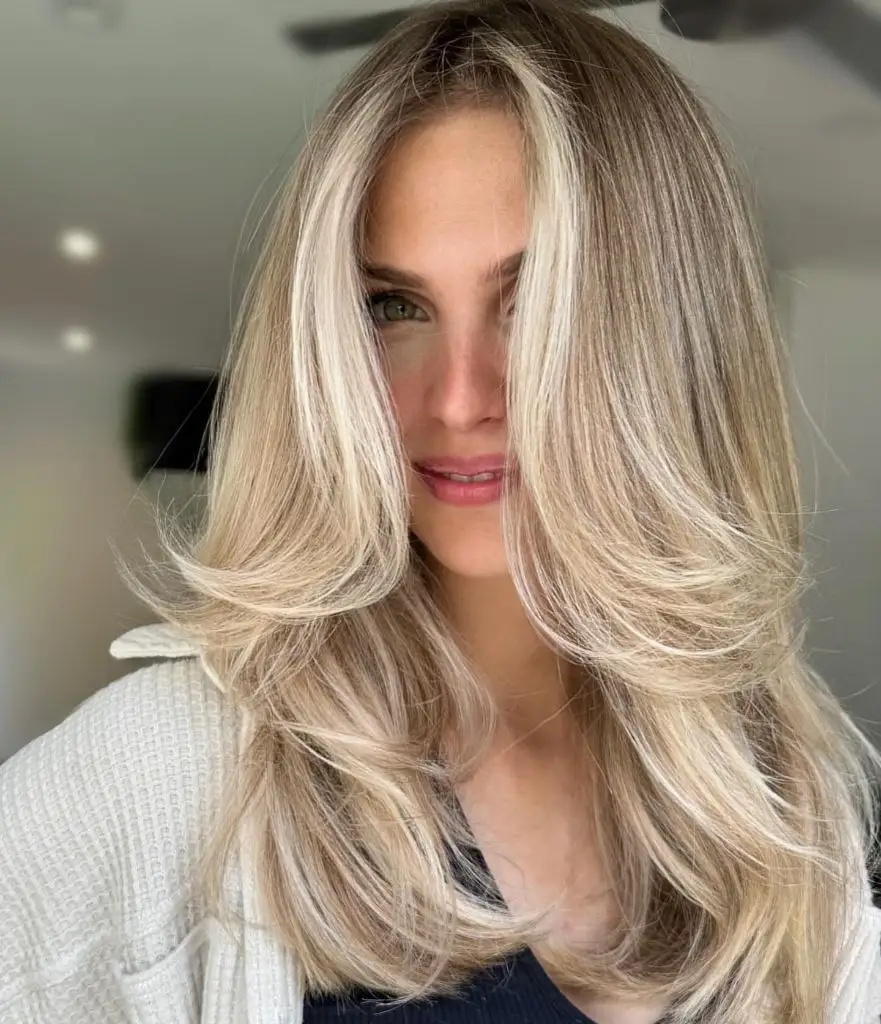
Three or four blonde values stack in sequence, and the order is what sells it. Each step is close enough to the one before that no line appears, yet the total distance from root to end is wide. Because the palest pieces sit at the outer edge, light gathers on the perimeter and the interior recedes. That arrangement reads as depth rather than as highlights.
The detail to carry over is the order of values, darkest at the base and lightest at the outline. For lower upkeep, hold the mushroom root deeper and let the brightest tone appear only in the final third of the length.
14. Golden Ribbons Repeating Through Dark Brown
Arms raised behind the head open up a full back view of the length. A dark brown root holds the top quarter, then golden caramel ribbons begin and continue to the ends in a regular sequence. The lower half is set in large glossy waves that stack side by side. A gray sweatshirt and a pale railing sit behind the length.
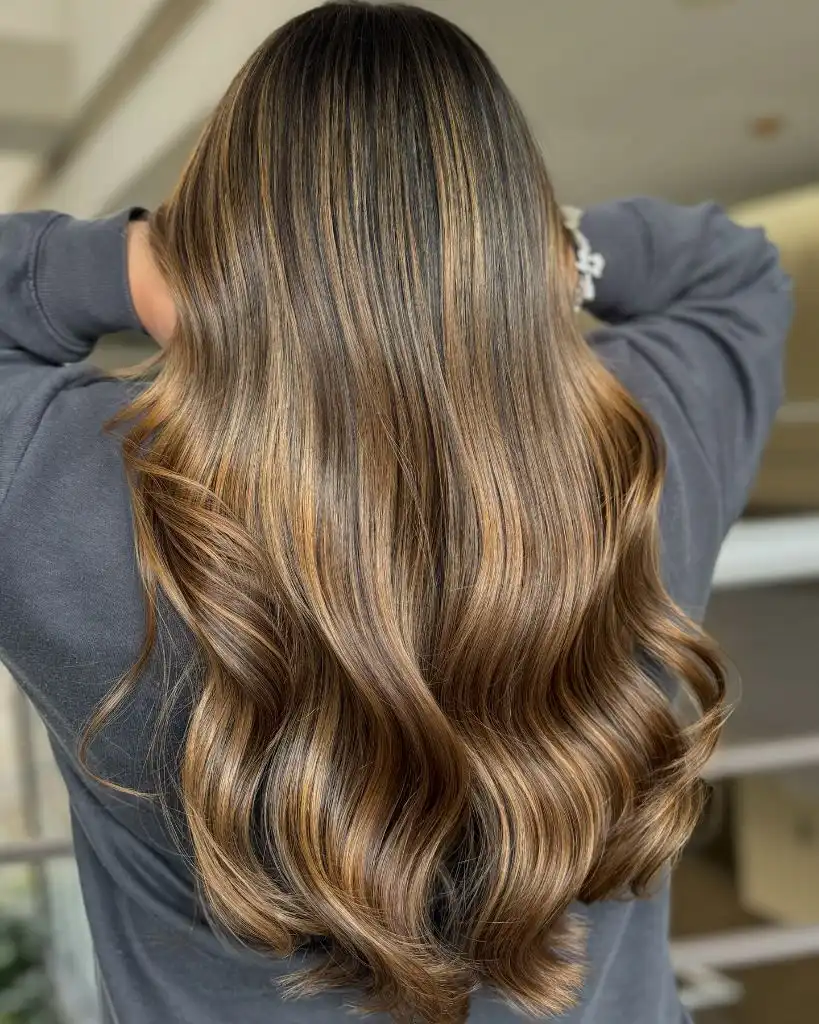
Rhythm holds this together. The ribbons repeat at similar widths and similar intervals, so the pattern reads as texture rather than as individual streaks. Where the waves turn, several ribbons align and form a bright crest, which gives the length its glass-like surface. The dark upper section supplies the starting value that makes every repeat visible.
The strongest element is even ribbon width, since mismatched widths would read as stripes at this length. A cooler take swaps the golden caramel for a neutral toffee. This kind of caramel balayage on brown hair also sits well on mid-length cuts with the same interval spacing.
15. Near-Black Top Sections Shading Chestnut Copper
The frame catches the length from behind with one arm raised. The upper half stays almost black and unbroken, while chestnut and copper appear low, mostly along the outer sections and the ends. Waves are irregular in size, with some pieces spiraling and others falling straight. A black graphic tee and denim-looking jeans sit below, and a glass door reflects pale light.
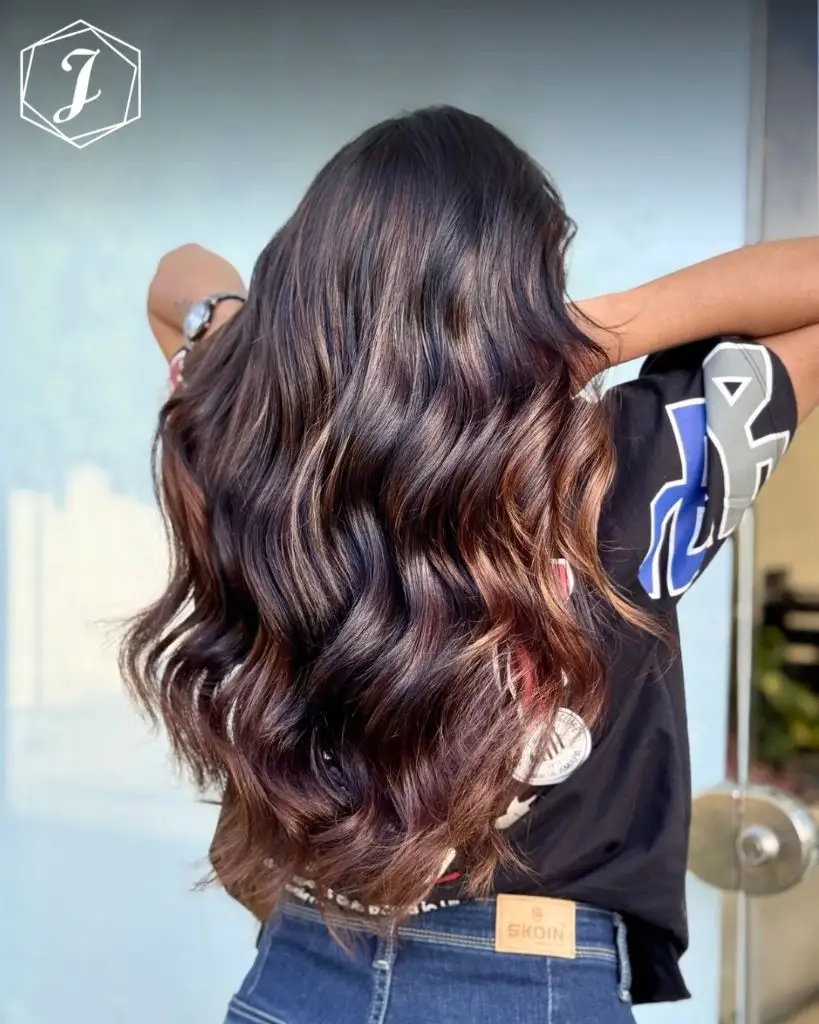
The split is roughly two-thirds dark to one-third warm, and that ratio is why it stays subtle. Keeping the majority in one deep value gives the copper somewhere to arrive rather than something to compete with. Many trendy winter hair color ideas for dark hair fail by lifting too much of the interior, which flattens the base and removes the arrival point entirely.
Hold the warm zone below the shoulder blades to preserve that ratio on long hair. On shorter lengths, shift the same proportion by keeping the top two sections untouched and warming only the perimeter.
16. Copper-Brown Highlights Tucked Behind One Side
From the side, the top section is swept back and tucked behind the ear, with loose pieces falling forward across the face. The base is a deep neutral brown, lifted with fine copper-brown threads that show mainly in the lower half. Ends taper into loose, uneven waves. A black tee, a metal watch, and green fronds sit around the edges of the frame.
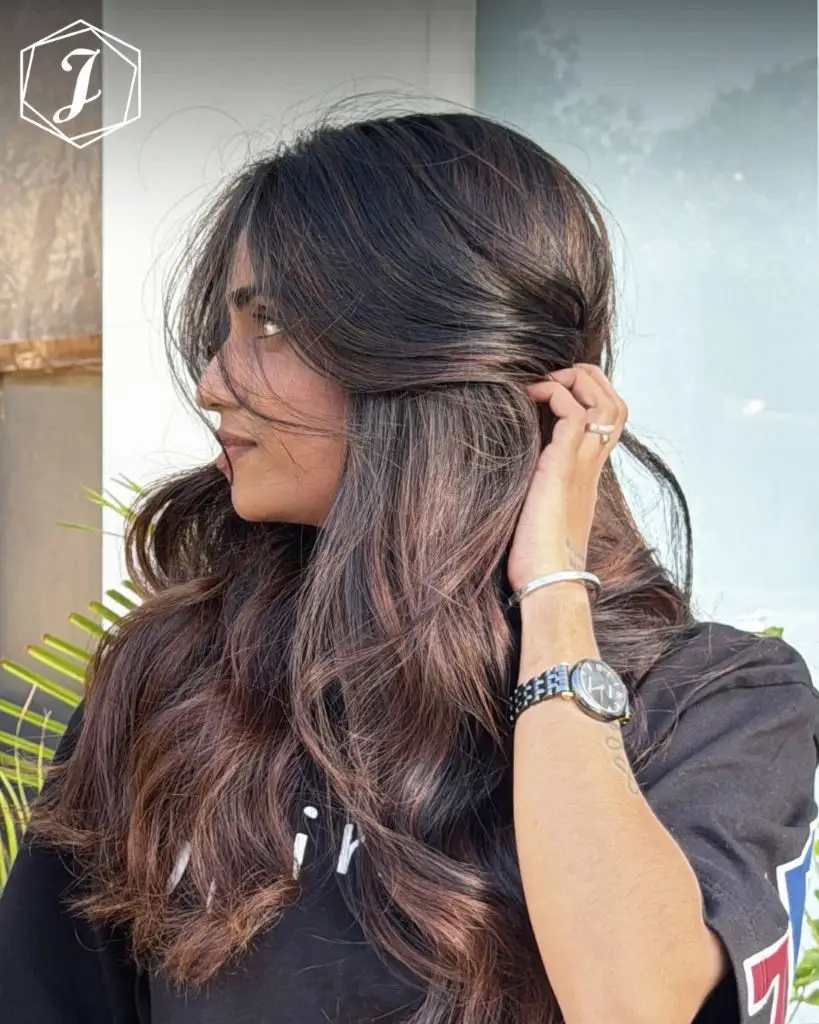
Placement follows the styling. Because the front is pulled back, the visible color sits along the sides and underneath, where the fine copper threads catch light as the hair moves. Keeping the threads narrow means the base still reads as the dominant value at rest. The result changes with the position of the hair, which is a quieter way to build dimension than a solid band of lift.
Fine, scattered threads suit anyone who wants the base to stay dark most of the time. To make it more visible, concentrate the same threads in the two sections nearest the part so they show even when the hair is tucked back.
17. Bright Copper Length Falling Straight Down
Everything is smooth in this front-facing frame. A bright copper length is parted down the center and pressed flat, running past the chest with almost no wave. The color is even from root to tip, with soft vertical shine lines rather than distinct highlights. A black zip-front top and a slatted wood wall with a lit sign complete the composition.
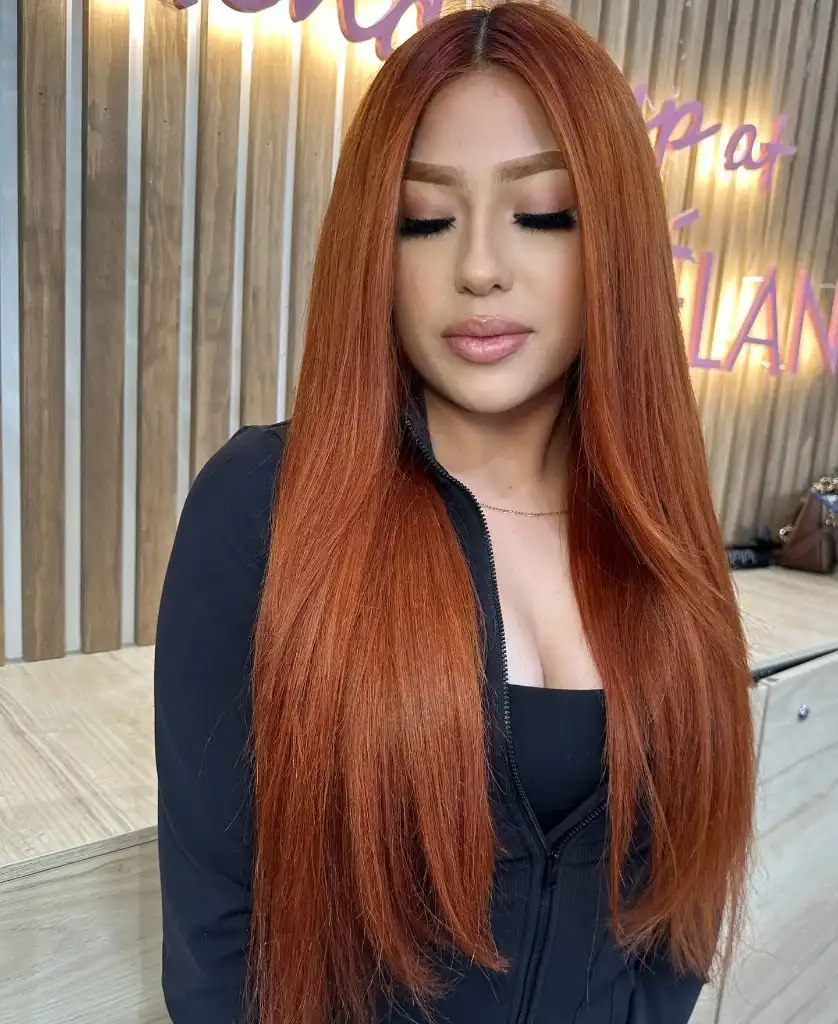
Smoothness is the entire effect. A flat surface reflects light in long continuous strips, so a single-tone copper looks dimensional without any second shade added. Any wave would break those strips into fragments and reduce the intensity. Center parting also splits the reflection into two matching panels, which reads as symmetry and keeps the saturated color from feeling overwhelming.
The lesson is that flat styling and one saturated tone support each other. A soft bend at the ends is enough if the length needs shape. Similar single-tone approaches work across other long straight hairstyles where a gradient would be lost.
18. Deep Root Melting Into Beige Blonde Waves
A center part opens onto a long, loosely waved length that reaches past the waist. The root is a deep neutral brown that dissolves into beige and buttery blonde by the mid-shaft. Wide, soft ribbons of light sit along the outer waves, and the ends stay slightly airy. A black long-sleeve top and a pale corridor with a hanging light sit behind.
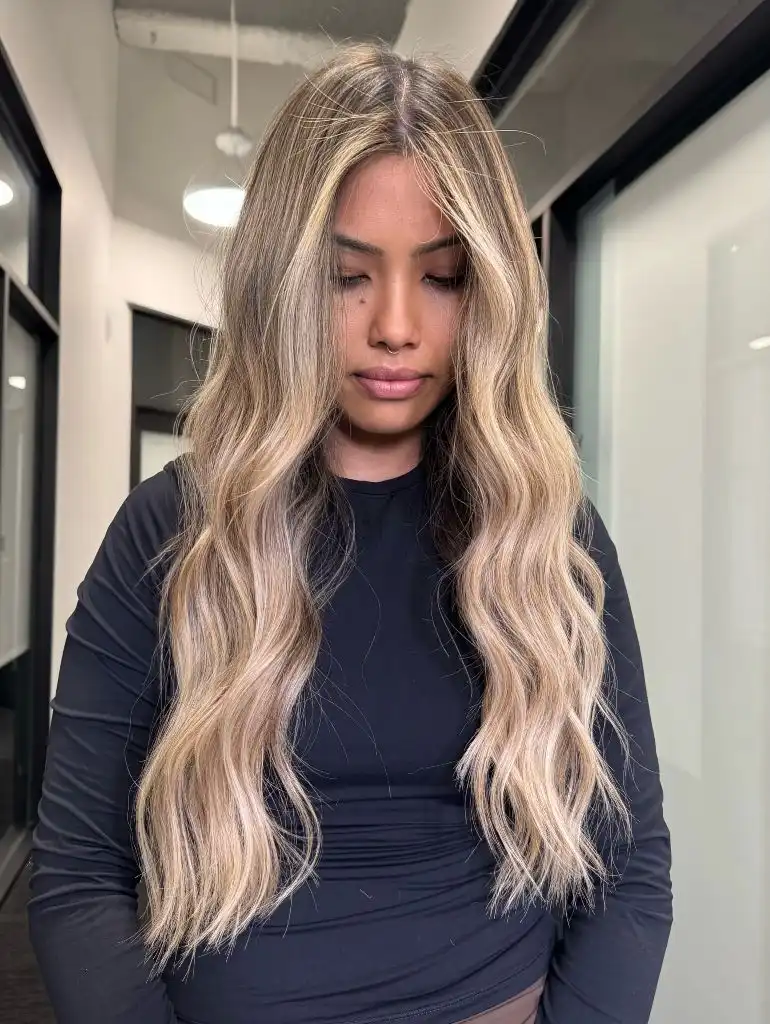
Ribbon width sets the mood. These sections are broad and soft-edged, so the blonde reads as one large area of light rather than a set of fine lines. Broad scale also survives grow-out well, because a wide ribbon shifts downward without changing shape. Trendy winter hair color ideas for lived-in blonde usually rely on this, pairing a deep root with wide, low-contrast lift.
Keep the widest sections at the front and narrow them toward the back so the perimeter does not thicken visually. If the beige turns warm, a single cool rinse restores it without touching the root depth.
19. Cool Silver Streaks Interrupting Warm Blonde
A mirror catches the length from the side with the waves lifted away from the shoulder. Cool silver and pale ash sections cut through a warmer sandy blonde base, with a few deeper mushroom pieces near the root. The waves are large and slightly separated, so the tones alternate visibly. Glass, plants, and a lit interior fill the reflected background.
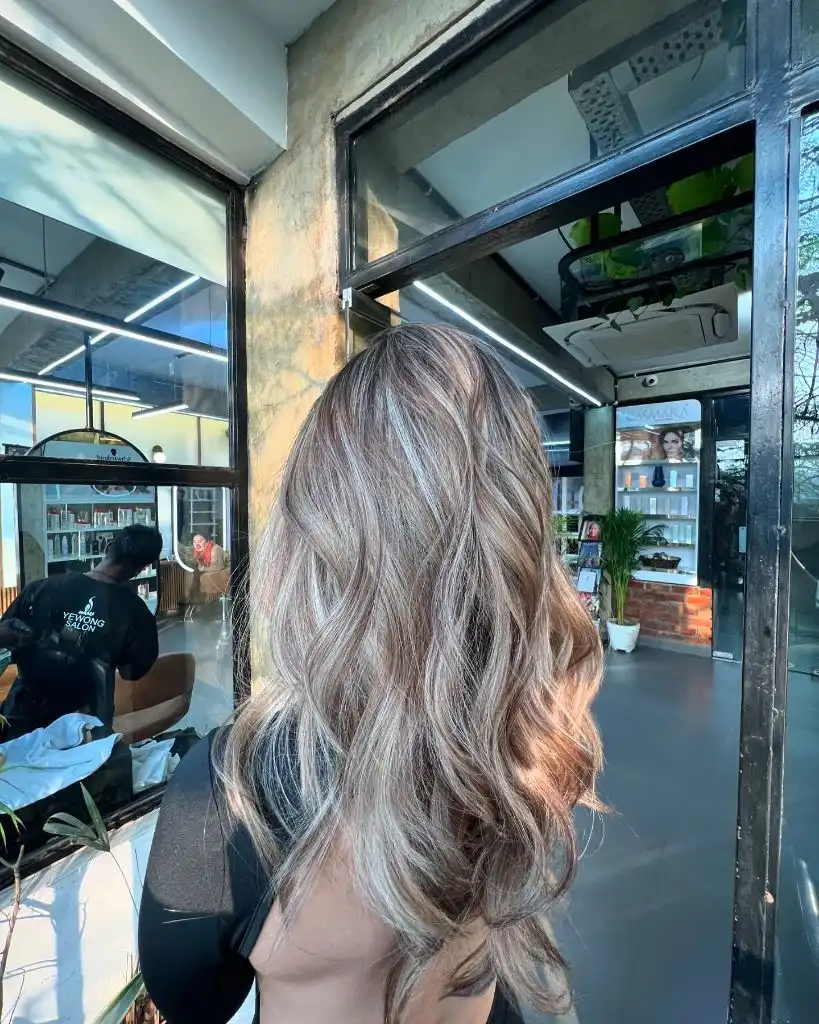
Temperature, not brightness, creates the contrast point. The silver pieces sit close to the sandy base in value, yet far apart in tone, so they interrupt without producing a hard line. Because cool sections alternate with warm ones, neither temperature dominates and the pattern stays balanced. The mid-toned mushroom pieces near the root ground the whole arrangement.
Alternating warm and cool works best when both stay within about two levels of each other. For a cleaner finish, pull the silver into the front sections only and let the rest stay sandy, which reduces the toning schedule considerably.
20. Golden Beige Blonde Waves From Behind
From behind, the length forms a wide column that narrows slightly at the ends. The color is a golden beige blonde that deepens toward the interior and lightens along the outer waves. The wave pattern starts around the shoulder blades and repeats in even barrels. A black tee sits below, and shelves of products blur into the background.
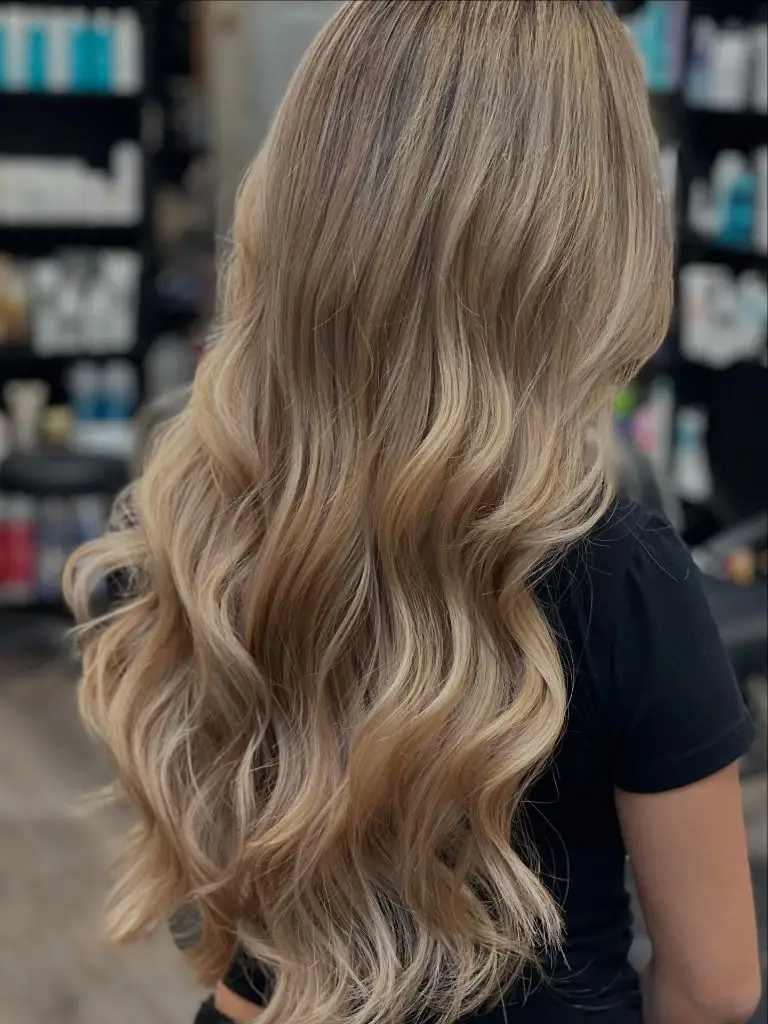
The outline holds the shape. Wide waves push the perimeter outward at regular intervals, so the column reads as a series of soft scallops instead of a straight edge. Lighter tone concentrated on those outer curves traces the outline in a brighter value, which sharpens the silhouette. Depth kept in the interior stops the whole column from flattening into one pale block.
The most transferable detail is lighter outer curves against a slightly deeper interior. Shorter lengths can borrow this by keeping the brightest pieces on the outermost sections only. The same interior-to-edge logic shows up in most versions of golden blonde balayage.
21. Strawberry Copper Base Under Many Blonde Ribbons
The back view shows a long, heavily waved length with a soft natural part at the crown. A strawberry copper base carries a large number of blonde ribbons, some near-white and others closer to honey. Waves fall in loose, irregular spirals that separate at the ends. A muted purple top appears at the shoulder, and the wall behind is plain cream.
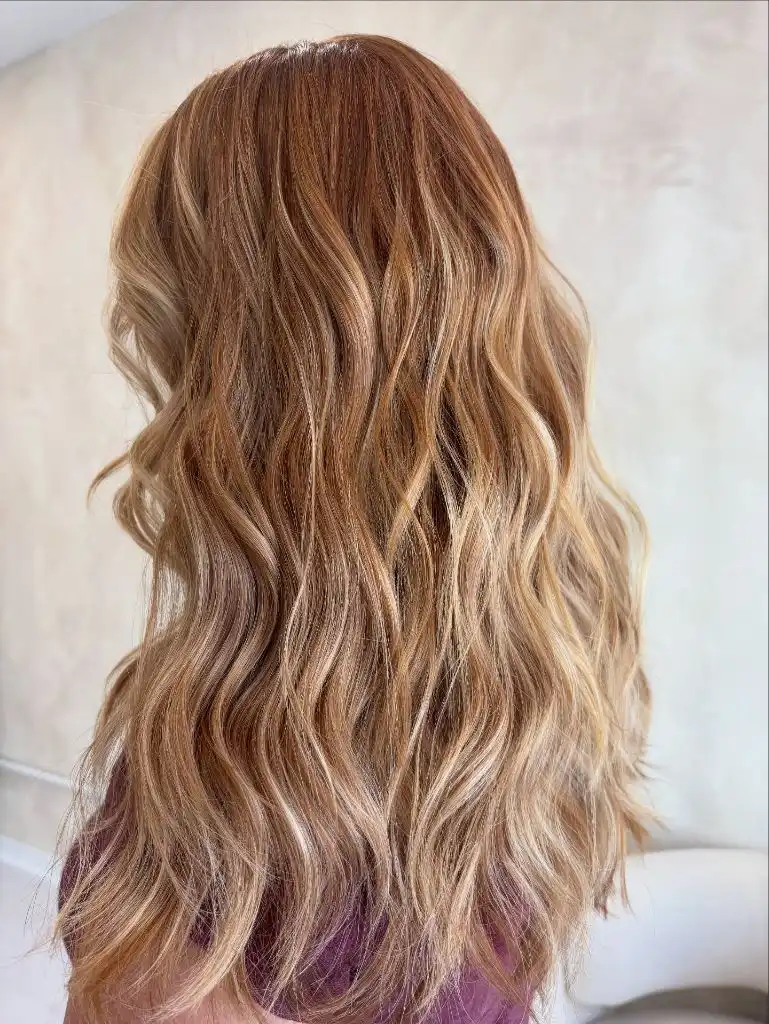
Many accents replace a single one, and the count changes the effect. With ribbons this frequent, no individual piece reads as a highlight, so the eye averages them into one lighter overall tone lifted by the copper underneath. The irregular wave pattern helps by scattering the ribbons in different directions, which prevents any striped alignment from forming.
Frequency is the control. Halve the number of ribbons and the copper base takes over, giving a redder result with visible highlights. Keep the count high and the finish reads sandy with warmth underneath, which is the easier version to maintain between appointments.

Hi, I’m Zoey Mitchell, the creator of ChicStyle Blog.
I share simple, wearable outfit ideas, hairstyles, nail trends, and beauty tips that feel natural and easy to recreate.
This blog is where I explore everything that makes a woman feel put together and confident every day. I’m not an expert — just a woman who genuinely loves style, mixing looks, and discovering what works.
If you love effortless fashion with a personal touch, you’ll feel at home here.