
There is a particular kind of outfit that catches the eye not because it shouts but because every piece in it seems to know its place. A trench falls open at just the right width. A knit skirt grazes the knee at a length that feels considered rather than accidental. A single bow, a woven flat, a dark scarf with a frayed edge — these are the small visual events that turn clothing into something worth studying. Cute outfits in their strongest form tend to work this way, through accumulation of quiet choices rather than a single loud gesture.
What makes an outfit read as genuinely appealing is rarely one garment. It is the relationship between garments — the way color moves from one zone to the next, the way a silhouette widens at the hem to offset a fitted shoulder, the way texture shifts from smooth to tactile within a single layer. Throughout this article, the outfits are measured against a small set of recurring variables: proportion, which governs how much visual weight sits where; contrast, which determines whether the eye moves or settles; placement, which decides where detail lands and where it stays absent; and color control, which shapes the overall mood before any single piece is identified. These are the tools that separate an outfit that photographs well from one that simply exists. Each section that follows isolates one look and reads it through these lenses, pulling out the specific decisions that make it function and translating them into principles that travel beyond the original image.
1. Taupe Trench With Woven Flats and a Green Juice
A long, oversized trench coat in a cool taupe drapes loosely over a white tee and black knee-length shorts. The person sits on a wooden pallet outside a storefront, holding a green smoothie in a clear cup. Black woven Mary Jane flats and a black woven bag sit nearby. Small black sunglasses finish the look with a narrow, retro-leaning frame.
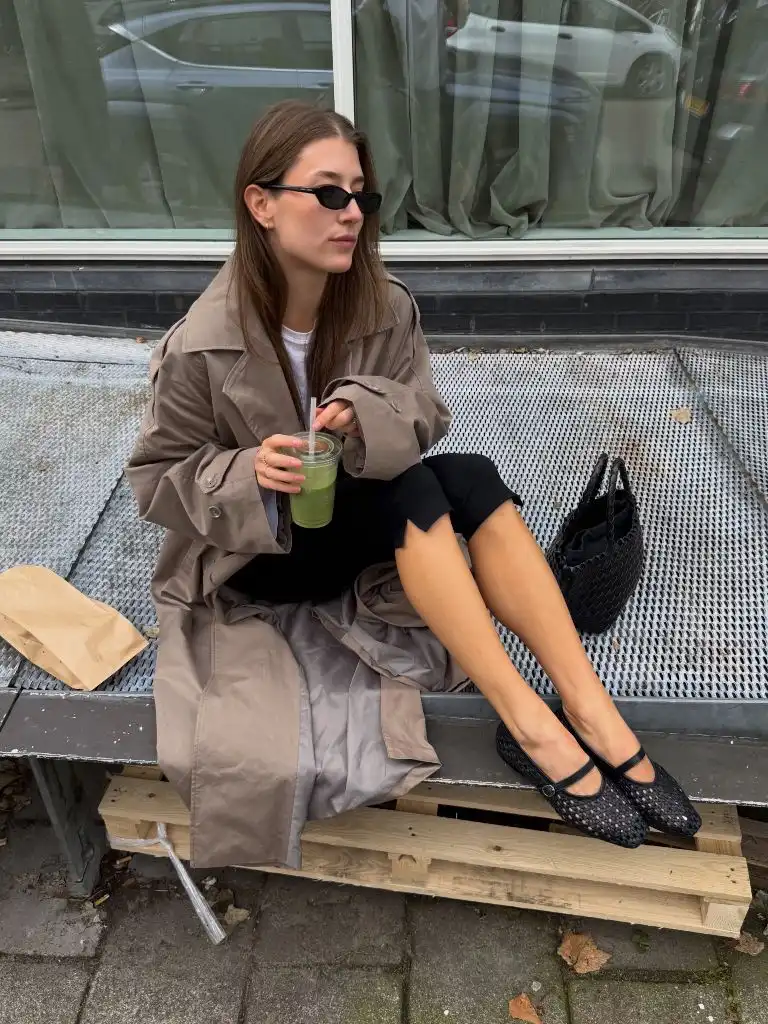
Photo via Instagram
The trench does most of the visual work here, occupying the widest silhouette zone while everything underneath stays slim and dark. Black shorts and black flats create a continuous lower line that lets the coat’s volume breathe without competition. The white tee functions as a brightness anchor at the center, drawing the eye inward before the coat pulls it outward again. The woven texture on both the shoes and the bag creates a quiet material echo that ties the accessories together without matching them literally. Color stays limited to three values — taupe, white, black — which gives the green of the drink an almost accidental accent role.
The reader takeaway is that an oversized outer layer gains clarity when everything beneath it runs in a single dark tone. The contrast between the coat’s width and the slim base keeps the proportions intentional rather than shapeless, and repeating a texture across two accessories builds cohesion that everyday styling ideas can draw from without requiring any single statement piece.
2. Oversized Bow Tee With a Mint Skirt
A white oversized T-shirt carries a large appliqued bow in deep plum and pink tones, centered on the chest with a small heart at its middle. The person wears double braids tied with white ribbons and holds one hand near the hair. A mint-green mini skirt is partially visible beneath the shirt’s hem. A red-and-white gingham knit bag hangs from one hand.
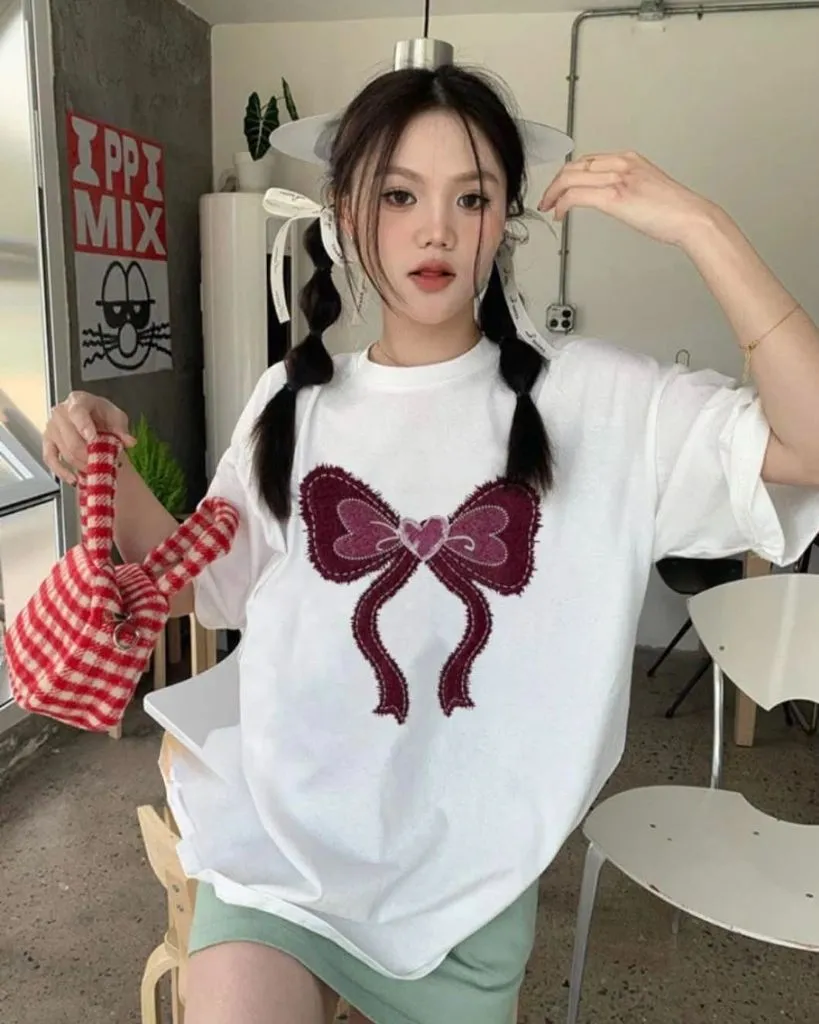
Photo via Instagram
The graphic bow commands attention through both scale and color saturation, sitting against the plain white fabric like a focal stamp. Everything else in the outfit stays deliberately secondary — the mint skirt is soft enough to recede, and the gingham bag picks up the red family from the bow without competing for dominance. The braids and ribbons add a vertical rhythm on either side of the face that frames the graphic center. What keeps this from feeling costume-like is the restraint in the lower half, where a single quiet color does all the work.
The useful move here is placing one oversized graphic element on the torso and then letting everything around it operate at a lower visual volume. The bag references the graphic’s color family without repeating it exactly, which creates a sense of coordination that feels intuitive rather than forced. Scale contrast between the large bow and the small heart detail adds a second layer of visual play.
3. Blush Knit Set With a Cap at Sunset
A soft blush-pink crewneck sweater pairs with wide-leg drawstring trousers in a sandy beige tone. The person stands barefoot on flat rock formations near the water, one hand adjusting a dark navy or charcoal baseball cap. The sky behind shows a gradient of pale blue, soft pink, and warm peach. The knit texture on the sweater reads as fine-gauge and smooth.
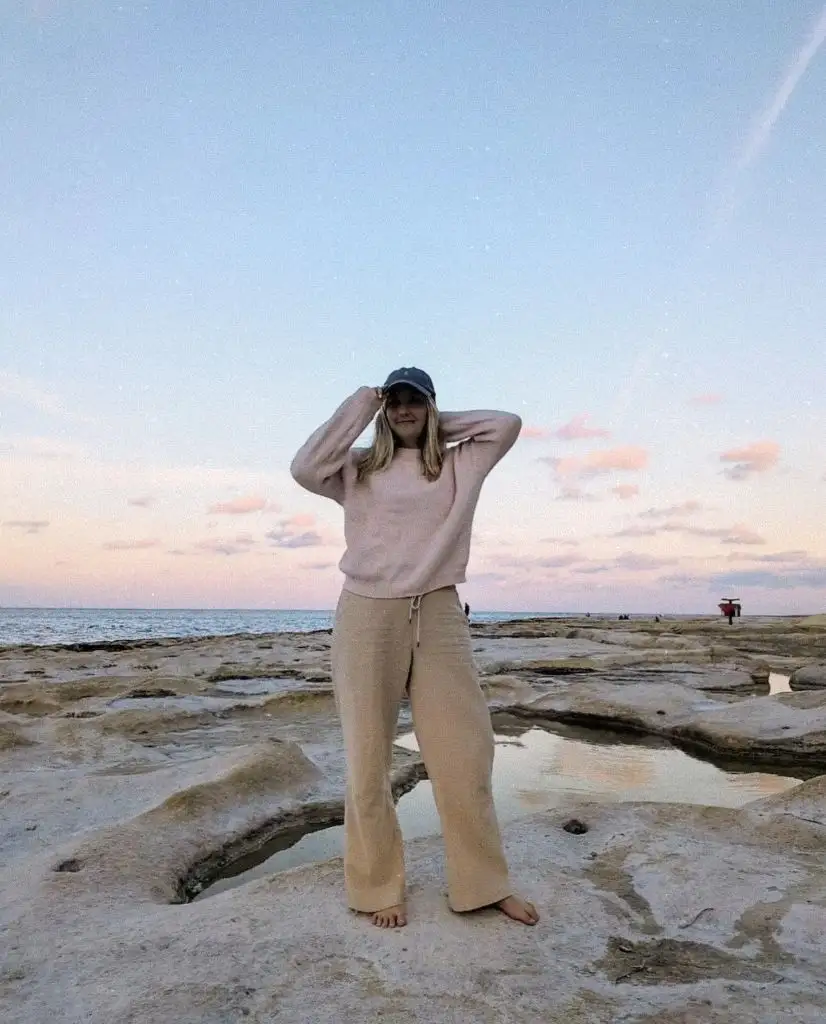
Photo via Instagram
The tonal closeness between the sweater and the trousers creates a near-monochrome column that elongates the silhouette, with only a slight shift from pink to sand marking the transition. The cap introduces the only true contrast — a dark value sitting at the highest point of the frame, which anchors the composition and gives the eye a place to start. Wide-leg proportions at the bottom balance the relaxed fit of the sweater so that neither zone dominates. Bare feet keep the look grounded and uninterrupted at the hem, letting the trouser length read fully.
The strongest lesson is that tonal dressing in soft, warm values gains structure when a single dark accessory sits at the top of the frame. The cap does not need to match anything below it — its job is purely architectural, providing a visual ceiling that keeps the pale palette from floating. That kind of tonal outfit approach can anchor any light-colored combination.
4. Sherpa Jacket Over Cable Knit and Pleated Trousers
A cream-colored sherpa jacket with a large collar and a single dark button sits open over a deep brown cable-knit sweater. The sweater’s turtleneck is visible above the jacket’s neckline, and a lighter scarf or cowl in a taupe tone wraps loosely beneath it. Wide-leg pleated trousers in a chocolate brown fall from the waist with a full, flowing drape. The setting is a minimal interior with a pale sofa and small wooden stools.
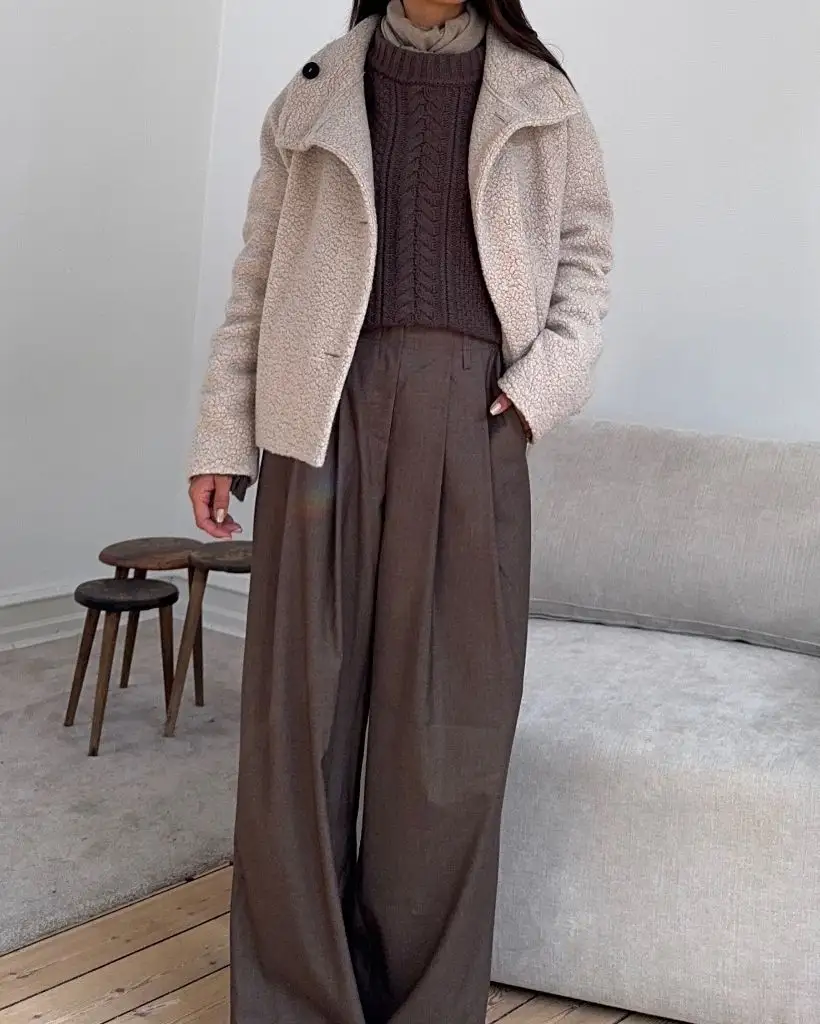
Photo via Instagram
Three distinct textures — sherpa, cable knit, and smooth suiting fabric — stack vertically without any two sitting adjacent. The sherpa’s nubby surface gives way to the structured cable pattern at the torso, which then drops into the clean drape of the pleated trousers below. Color runs in a tight brown-to-cream range, but the value shifts are deliberate: lightest at the shoulders, darkest at the mid-torso, and medium-dark at the legs. The pleats add controlled movement to the lower half, creating a rhythm that echoes the cable pattern above without matching it literally.
What stands out most is the way texture substitutes for color variety. When a palette is this narrow, each material change reads as its own visual event, and layering them in a clear sequence — from softest at the top to smoothest at the bottom — creates the impression of depth. This principle works in any cold weather styling situation where interest needs to come from the fabric rather than the hue.
5. Open Abaya With Wide Denim and Platform Sneakers
A long black abaya hangs open over a light sage-green top and wide-leg dark-wash jeans with a lived-in, slightly distressed finish. A burgundy or oxblood leather shoulder bag sits on the right shoulder. A sage-toned hijab frames the head and drapes over the chest. Black-and-white platform sneakers with a chunky sole provide the base. The background shows trees and a paved sidewalk with a painted curb.
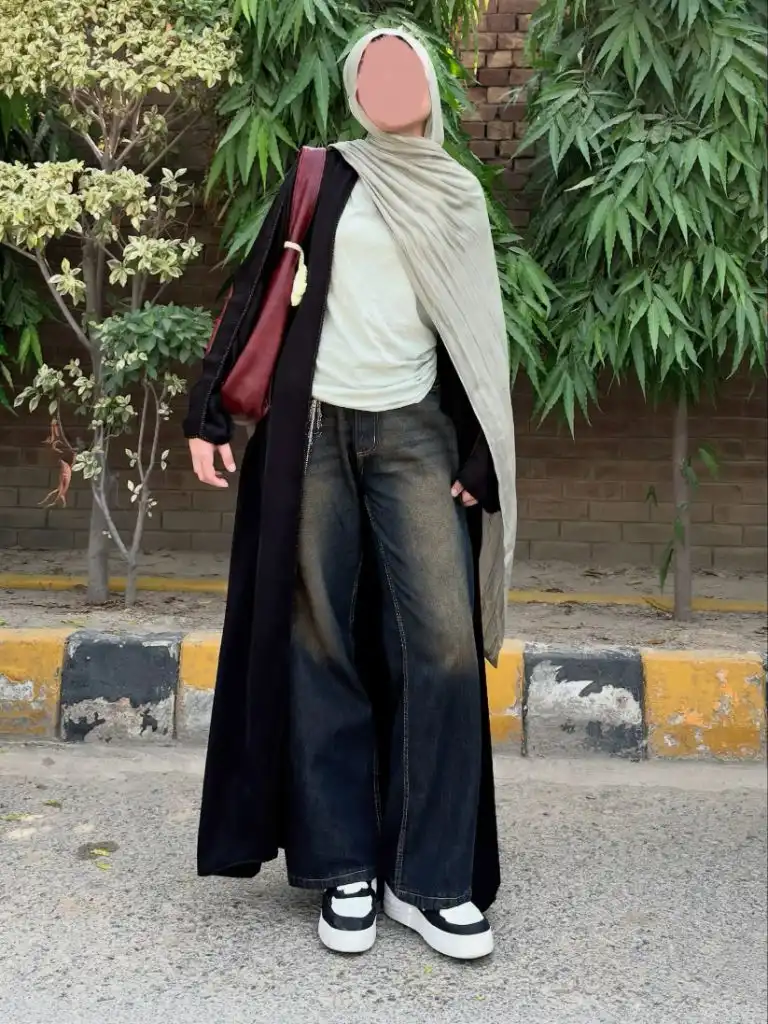
Photo via Instagram
The abaya functions as a vertical frame, its dark length creating two narrow columns of contrast on either side of the lighter core. The sage top and hijab form a tonal bridge at the upper body, connecting across the dark abaya in a way that reads as intentional color placement. The wide jeans add volume at the leg, balanced by the platform sneakers that provide enough visual weight at the base to support the overall width. The burgundy bag is the only warm color present, sitting at the shoulder like a controlled interruption in an otherwise cool-toned scheme.
The useful idea is that a long, open outer layer can serve as a framing device rather than a covering one, creating parallel lines that define the outfit’s edges while letting the interior layers do the color work. The single warm accent — the bag — gains impact precisely because it sits alone in its temperature range, a principle that applies anywhere a layered look with structure needs a focal point.
6. Standing Trench Coat With Knee-Length Shorts
The same taupe trench coat from an earlier image now appears in a standing position, revealing its full below-the-knee length. The white tee is more clearly visible, tucked or falling naturally at the waist. Black shorts end just above the knee. The black woven Mary Jane flats and woven bag are visible again, this time with the bag held near the hip. The storefront window behind shows text that reads “STORE.”
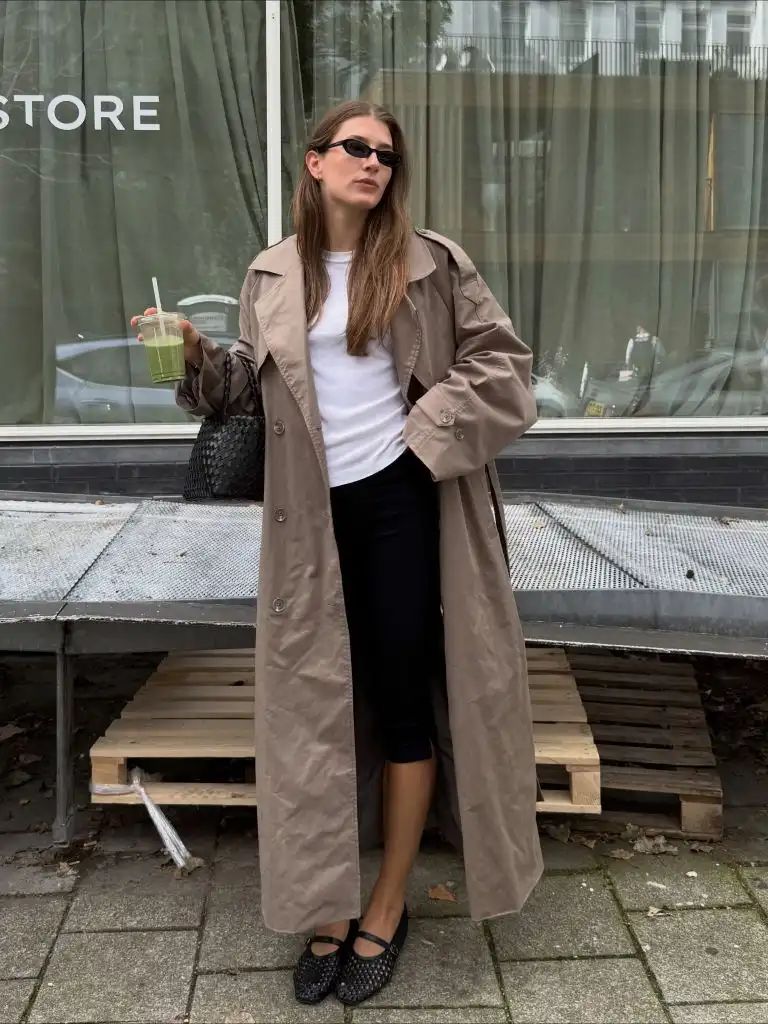
Photo via Instagram
Seeing the same outfit standing changes the proportional read entirely. The trench now falls past the shorts, creating a layered hemline where the coat’s edge and the shorts’ edge form two horizontal breaks in quick succession. This double-hem effect adds visual interest to the lower third without requiring any additional garment. The white tee, now more visible as a vertical stripe through the center, becomes the brightest zone in the frame, pulling the eye up and inward. The flats remain visually quiet, closing the composition without competing with the coat’s drama.
The best move here is understanding that the same outfit produces a different visual story depending on posture and position. A coat that pools while sitting becomes a clean column while standing, which means the proportional balance of any outfit is dynamic rather than fixed. Designing for multiple positions — seated, walking, standing — is part of what makes certain combinations consistently effective.
7. Plum Polo Under a Dark Coat With Knee-High Knit Socks
A dark charcoal or black wool coat, single-breasted and slightly oversized, sits open over a fitted plum-colored polo top with a visible collar and placket. A white skirt or short dress peeks below the coat’s hem. Gray ribbed knee-high socks with small bow details at the calf extend into what appears to be socklike footwear with no visible sole. Iridescent blue-tinted sunglasses and a small structured black bag complete the accessories.
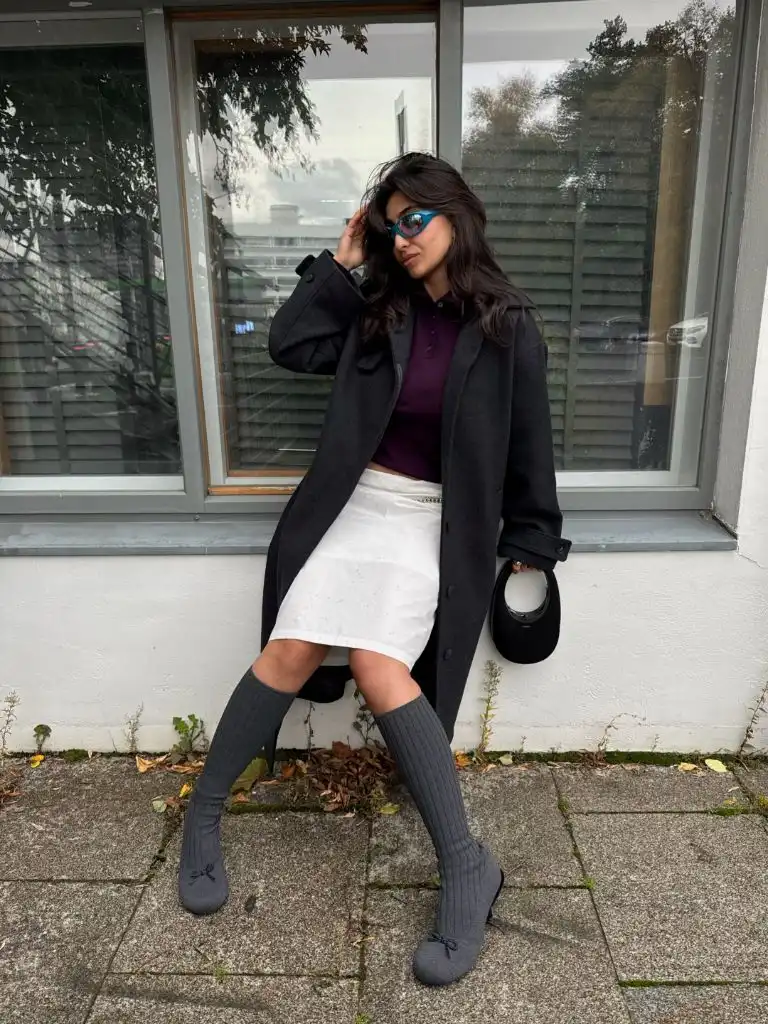
Photo via Instagram
The plum polo introduces a saturated mid-tone between the dark coat and the white skirt, creating a three-step value gradient from top to bottom that then reverses at the legs with the gray socks. This zigzag in value keeps the eye moving vertically rather than settling in one zone. The bow details on the socks are small enough to register as texture rather than decoration, adding a gentle detail that rewards a closer look. The blue-tinted sunglasses inject an unexpected color note at the very top, functioning almost as a punctuation mark.
The reader takeaway is that working in deliberate value shifts — dark to saturated to light to medium — creates visual movement that a simple two-tone combination cannot achieve. The small details, like the sock bows and the tinted lenses, earn their place because the larger structure is already clear. Tiny ornamental touches function best when the color architecture of the outfit can support them without confusion.
8. Blue Plaid Flannel With a Cream Sweater Draped Behind
A blue-and-cream plaid flannel shirt is buttoned up, its sleeves pushed to the forearms. A cream knit sweater is draped over the shoulders from behind, its body hanging down the back while the neckline sits loosely at the collar. Off-white straight-leg jeans end at the ankle, and neutral-toned loafers or mules are partially visible at the bottom. The background is a plain beige wall, and a text overlay reads “CASUAL CHIC.”
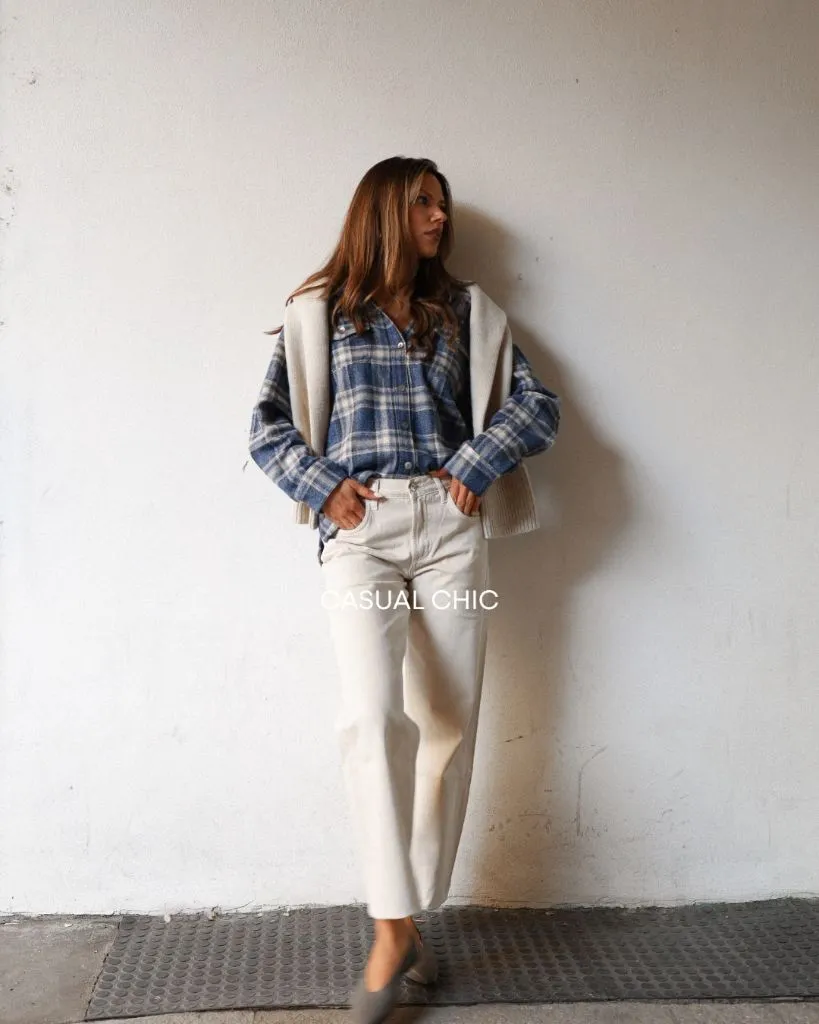
Photo via Instagram
The draped sweater transforms what could be a simple shirt-and-jeans outfit into a layered composition with visible depth. Its cream tone picks up the lighter threads in the plaid, creating a diagonal color conversation between the shirt’s pattern and the sweater’s solid body. The off-white jeans keep the lower half in the same tonal family as the sweater, building a pale base that lets the blue plaid own the color story. There is nothing competing with the flannel — every other piece defers to it in both color and texture. The loafers stay neutral, closing the frame without adding a new voice.
The strongest lesson is that draping a piece rather than wearing it conventionally adds a layer of visual interest without adding visual weight. The sweater here is not functioning as warmth or coverage — it is functioning as a compositional tool, broadening the shoulder line and creating a backdrop for the plaid. That same casual layering technique applies to any combination where a single pattern needs room to be the clear subject.
9. Black Off-Shoulder Top With a Polka Dot Midi Skirt
A black off-the-shoulder top with long sleeves fits closely through the torso, its neckline sitting just below the collarbone. A black-and-white polka dot midi skirt in a sheer or semi-sheer chiffon falls to below the calf with a gentle flare at the hem. A black shoulder bag with hardware detail sits at the left side. The person is taking a mirror selfie in what appears to be a cafe, with a wavy-framed mirror and a menu board visible in the background.
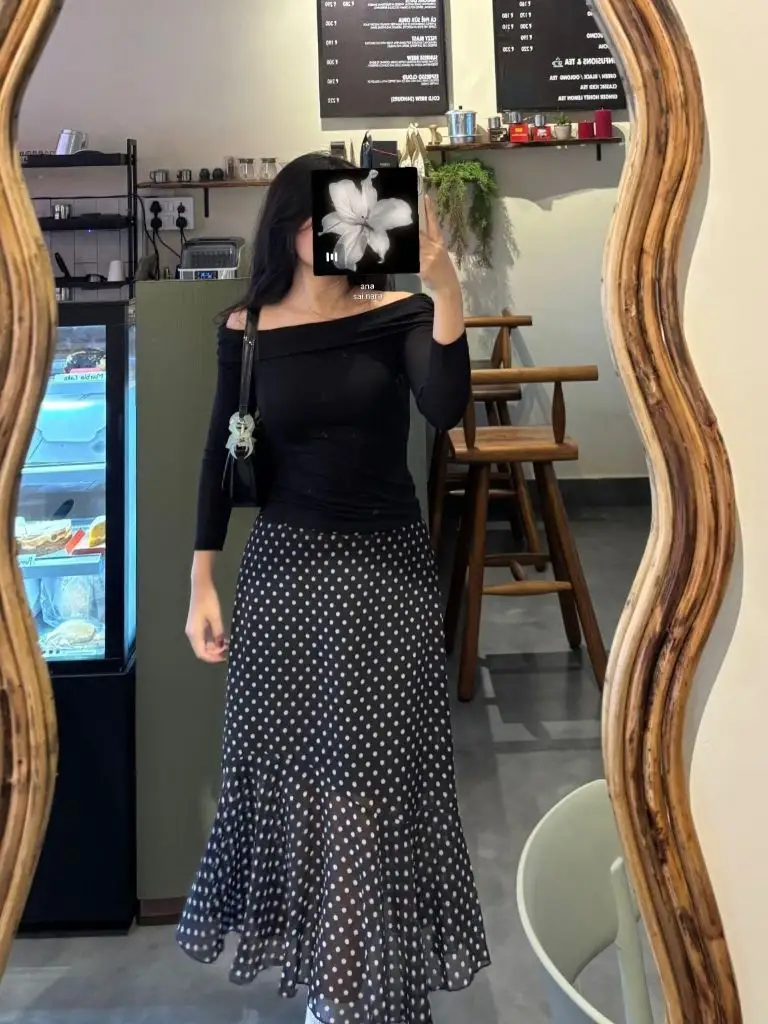
Photo via Instagram
The outfit operates on a single color axis — black — with the polka dots providing the only pattern break. This restraint gives the dots outsized impact; against the solid black top, they read as rhythmic and deliberate rather than busy. The off-shoulder neckline introduces a horizontal line at the top that contrasts with the vertical fall of the skirt, creating a cross-directional tension that adds structure to an otherwise fluid silhouette. The sheer quality of the skirt fabric adds a subtle depth, suggesting movement even in a still image. I like how the bag stays in the same tonal range, refusing to introduce a competing element.
The useful move here is committing to a single base color and then letting pattern do all the work of visual variety. The polka dots do not need a second pattern or a contrasting solid to justify their presence — the solid black top is enough of a canvas. This kind of pattern-focused dressing works best when the non-patterned pieces are quiet enough to disappear.
10. Textured Blush Jacket With Fur Scarf and Earmuffs
A blush or cream-toned textured jacket with a fuzzy, curly surface sits over pale pink trousers with a wide, straight leg. A dark brown fur stole or scarf wraps around the neck and drapes down one side. Oversized earmuffs in cream and brown sit on the head. Pink gloves peek from the sleeves. The person stands on stone steps in front of an ornate white door with decorative ironwork in the glass panel. Pale sneakers with a low profile complete the base.
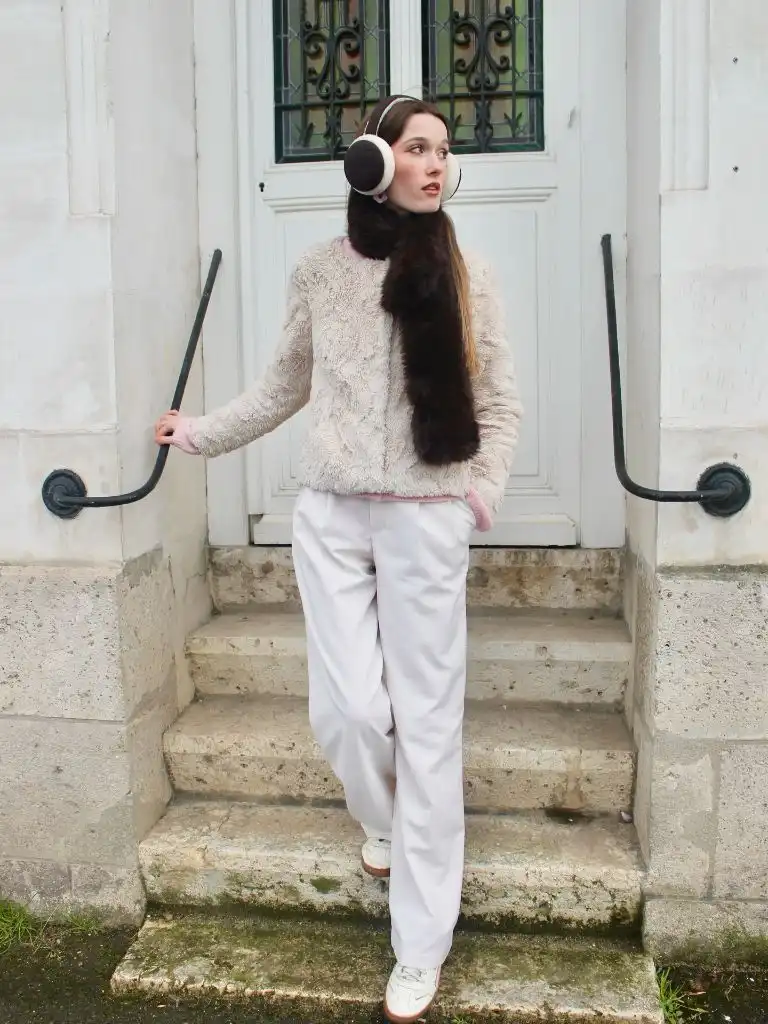
Photo via Instagram
The texture gradient here is the organizing principle. The jacket’s curly surface is the most visually active, the fur scarf adds a second organic texture at a different scale, and the smooth trouser fabric provides a calm zone below. The dark brown of the scarf is the deepest value in the outfit, sitting at the neck like a visual anchor that prevents the overall pale palette from reading as flat. The earmuffs echo the scarf’s color split — cream and brown — creating a small dialogue between the head and the neckline. Pink gloves, barely visible, repeat the trouser tone at the extremities.
What stands out most is the deliberate use of texture weight to create hierarchy within a near-monochrome palette. The jacket draws the most attention because its surface is the most complex, followed by the scarf, then the smooth trousers. This hierarchy would collapse if the trousers were also textured, which confirms that quiet zones are as important as active ones in any thoughtfully assembled outfit.
11. Herringbone Blazer With a Fringed Scarf and White Shirt
A brown herringbone blazer with the sleeves pushed up sits over a white button-down shirt with the collar visible. A charcoal scarf with a fringed edge wraps loosely around the neck and falls forward. Black slim trousers or jeans are partially visible below. A suede shoulder bag in a warm brown tone hangs from one shoulder. Gold jewelry — a watch, rings, and a bracelet — catches light at the wrist. The setting is a minimal interior with a neutral palette.
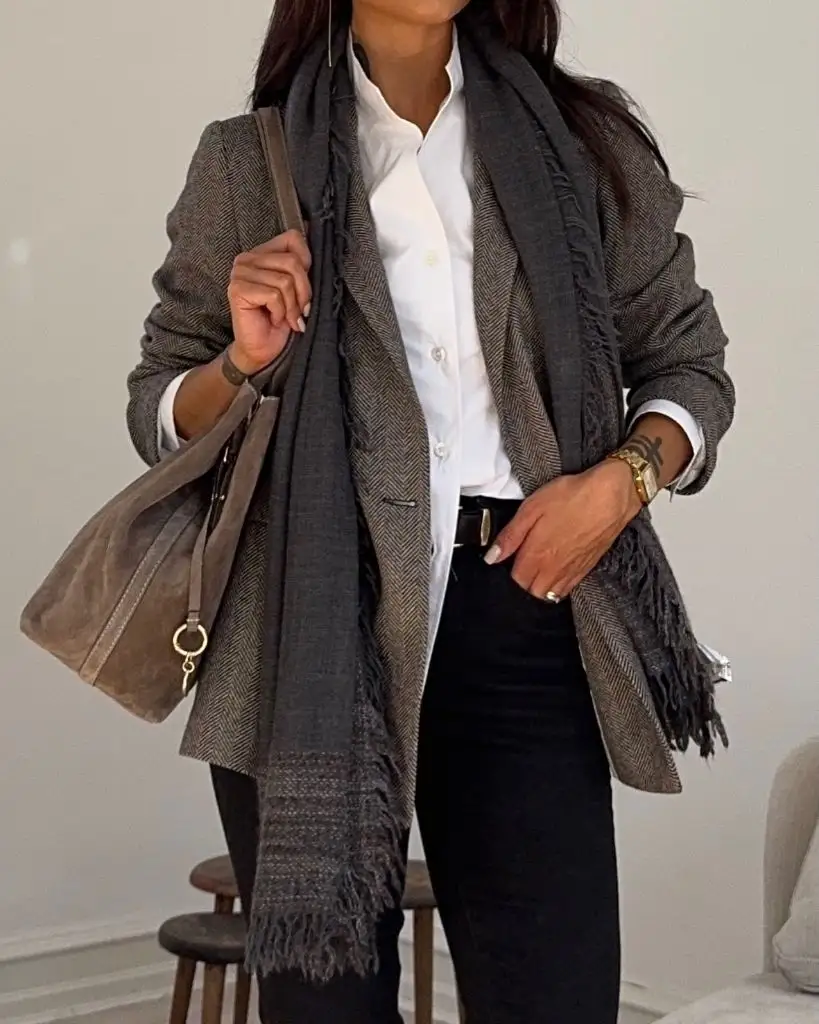
Photo via Instagram
The herringbone pattern gives the blazer a visual density that reads as formal without being stiff, and the scarf’s fringe softens the entire upper body by introducing an unfinished edge into an otherwise structured zone. The white shirt underneath provides the brightness that keeps the dark tones from feeling heavy, and the pushed-up sleeves expose the gold jewelry, which adds a warm metallic note that connects to the brown of the bag. The layering order — shirt, blazer, scarf — creates three distinct depth planes within a narrow vertical space.
The beauty of this is the way the scarf’s fringe introduces controlled imperfection into a tailored framework. Without it, the blazer and shirt would read as strictly professional; with it, the look shifts toward something more relaxed and editorial. This is a useful reminder that one piece with an irregular edge or unfinished detail can reset the tone of an entire smart layered combination.
12. Red Mandarin Collar Jacket With White Wide-Leg Trousers
A vivid red jacket with a mandarin collar and black frog-button closures fits closely through the torso, creating a structured, peplum-like silhouette at the waist. White wide-leg trousers with a raw or frayed hem sit below. A black quilted Chanel-style bag with a gold chain hangs from one hand. Black pointed-toe mules or heels are partially visible. The background is a light, curtained interior with a woven mat underfoot.
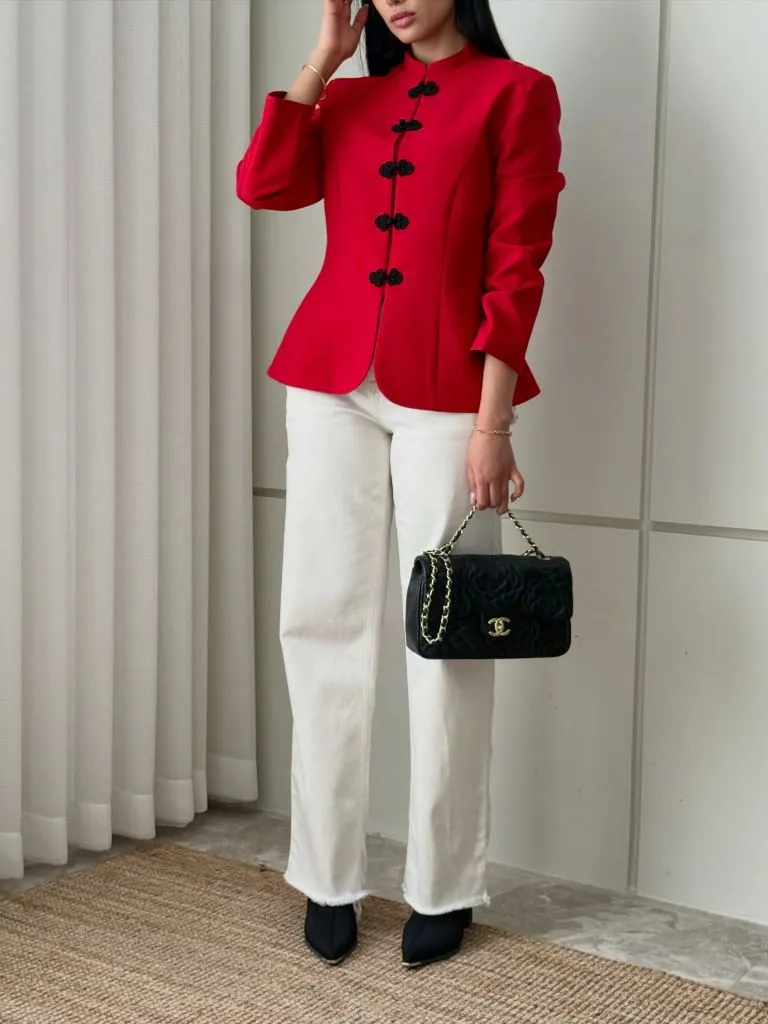
Photo via Instagram
The red jacket is the undeniable center of this outfit, and everything else exists to support its dominance. The white trousers provide maximum contrast below, ensuring the jacket’s silhouette — particularly the nipped waist and the slight flare at the hip — reads clearly. The black frog buttons add structural detail to the jacket’s surface, creating a vertical line of dark accents that draws the eye upward along the center front. The black bag and black footwear form a secondary color story that frames the red without pulling focus from it. The raw hem on the trousers introduces a single casual note at the very bottom.
The reader takeaway is that a garment with strong color and strong silhouette needs its surrounding pieces to be as neutral as possible. The white-and-black supporting cast here does not compete — it clarifies. When one piece carries this much visual authority, the rest of the outfit’s job is to stay out of the way while still maintaining enough structure to keep the overall composition balanced.
13. Cobalt Vest Over a Smocked Top With Plaid Wide Trousers
A cobalt blue sleeveless vest sits over a light blue smocked or textured short-sleeve top with a lettuce-edge hem. Gray-and-blue plaid wide-leg trousers flow from the waist to the ground, their volume creating a dramatic lower silhouette. A pale yellow crossbody bag cuts diagonally across the torso. Round tortoiseshell glasses, layered gold necklaces, and bracelets add detail at the face and wrists. The person stands at the corner of a brick building near a door with gold script.
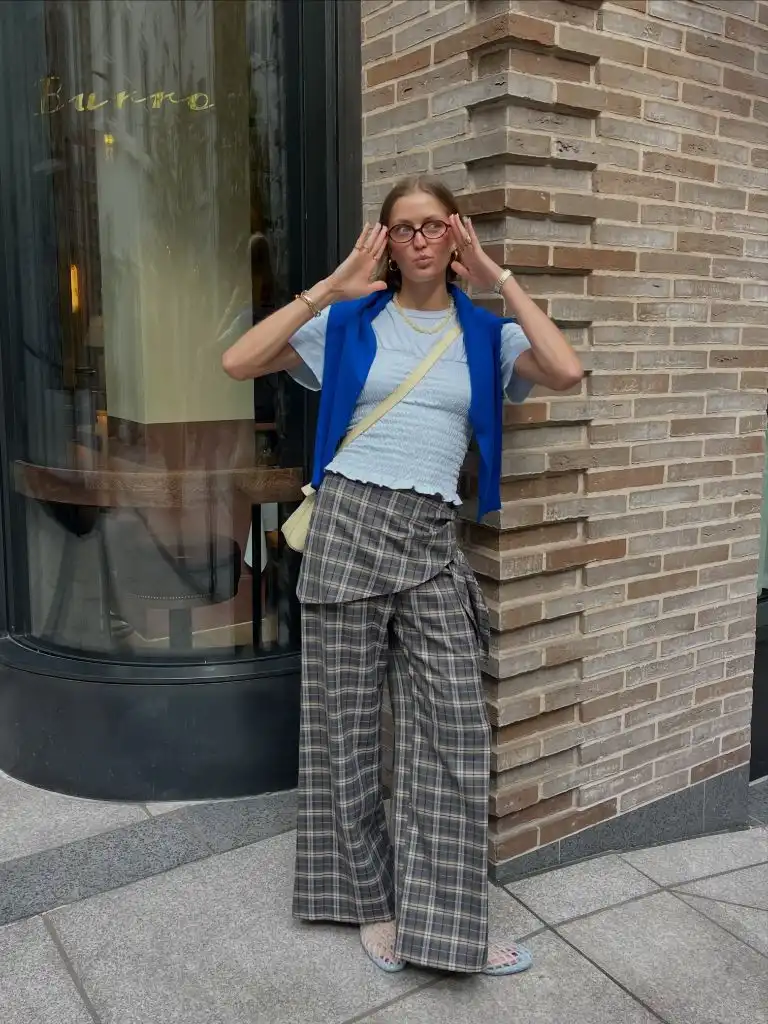
Photo via Instagram
Multiple patterns and colors are at work here, but they hold together because the plaid contains threads of both the cobalt and the gray that appear elsewhere. The vest’s solid blue operates as a bridge between the lighter smocked top and the plaid’s blue tones, creating a graduated color path from top to bottom. The yellow bag is the only warm element, and its diagonal placement cuts across the vertical color zones, adding directional energy. The lettuce edge on the top introduces a small textural detail at the waist that signals playfulness without overwhelming the composition. Volume sits predominantly in the lower half, grounded by the wide trouser hem.
The useful idea is that mixing patterns and colors stays coherent when one element — here, the vest — shares a color with both the pieces above and below it. That bridging role prevents the plaid and the smocked top from reading as two unrelated choices. Any color-forward outfit can use a solid piece in a shared tone to link its more complex elements.
14. White V-Neck Long Sleeve With Black Wide Trousers
A white V-neck long-sleeve tee in a soft, slightly rumpled cotton sits loosely over the torso. Black wide-leg trousers with a smooth drape create the lower half. A black round leather shoulder bag with a clean, structured shape is held at the left shoulder. Black shoes — possibly loafers — are just visible at the trouser hem. The background is a gray stone wall on a paved sidewalk.
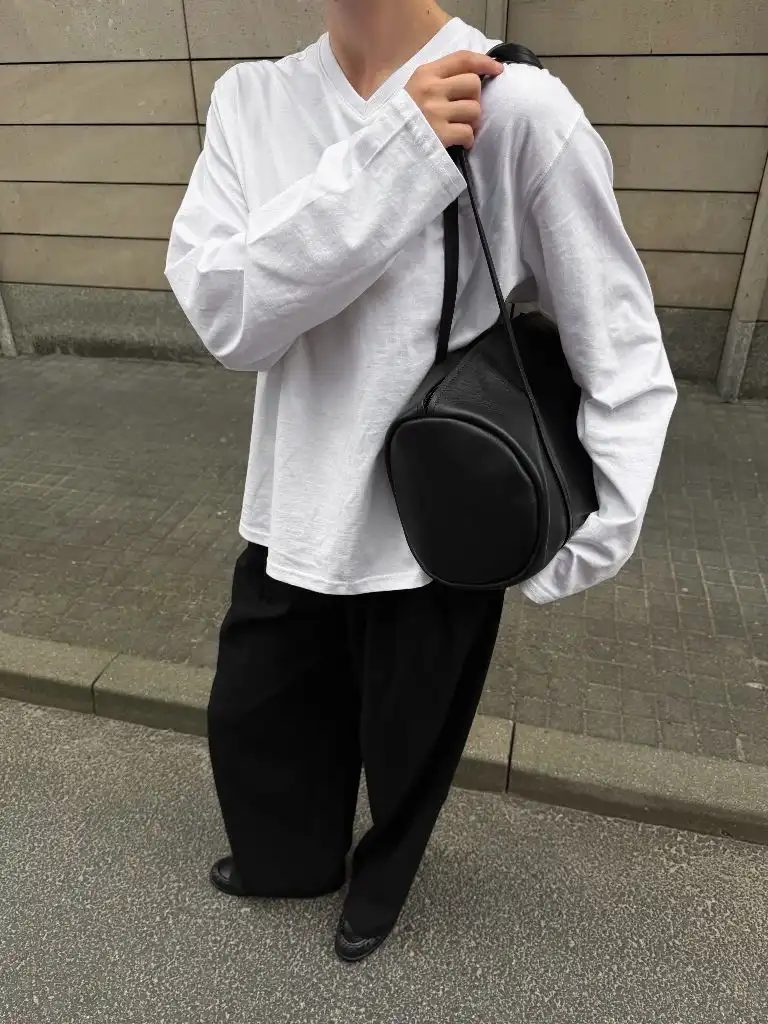
Photo via Instagram
The outfit’s strength is its refusal to add. Two colors, two garments, one bag — and the visual interest comes entirely from proportion and shape. The white top is relaxed and slightly oversized, while the trousers are wide but clean, creating a silhouette that carries volume at both levels without a defined waist. The round bag introduces the only curved shape into a composition otherwise built on vertical and horizontal lines, and that single shape contrast gives it disproportionate visual weight. The gray background almost matches the black, which compresses the frame and pushes the white forward.
The strongest lesson is that minimalism earns its impact through the quality of its proportions rather than the absence of effort. The wide-on-wide silhouette works because both garments carry similar volume, creating a unified column rather than competing shapes. When working with only two tones, the silhouette becomes the primary styling tool, and every proportion choice matters more.
15. Leather Jacket With Navy Scarf and Striped Trousers
A dark leather jacket — likely black or very deep navy — sits unzipped over what appears to be a navy sweater or knit top with a rounded neckline. The sweater’s fabric bunches slightly at the collar inside the jacket. Striped trousers in navy and a lighter tone, possibly pink or blush, fall in a straight or slightly wide leg below. The setting is a residential street with a distinctive flint-and-brick building behind.
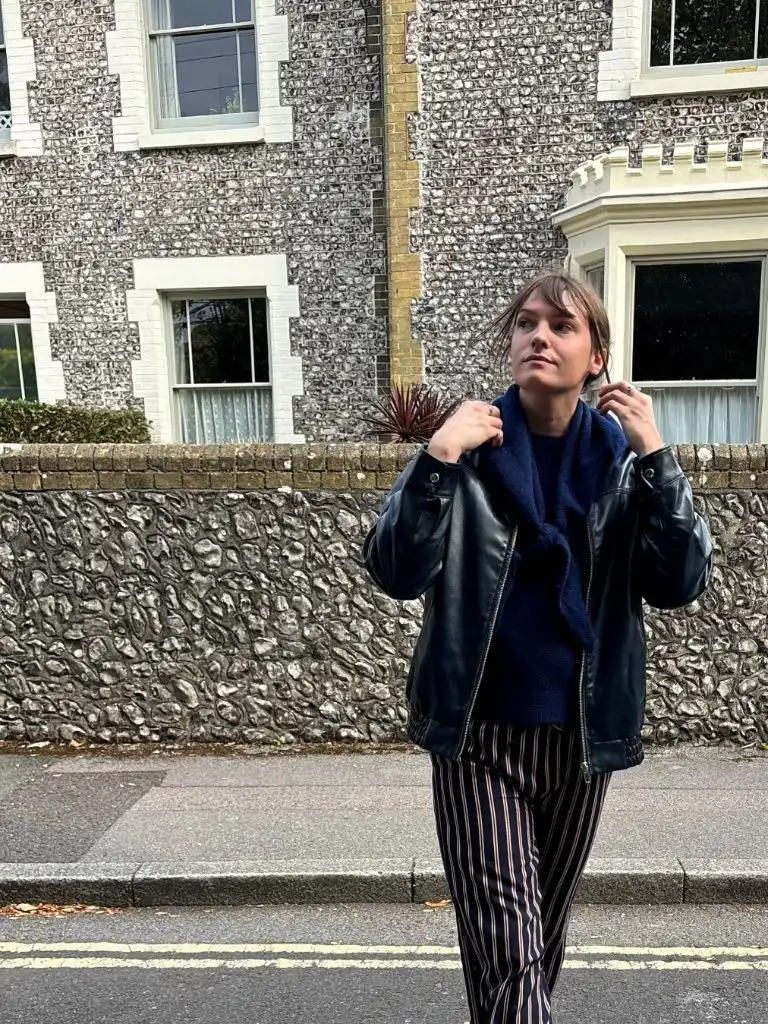
Photo via Instagram
The leather jacket provides a hard, smooth surface at the top that contrasts with the softer knit beneath and the lightweight stripe below. This three-texture stack — rigid, soft, flowing — creates a descending hardness gradient that the eye follows naturally from shoulder to hem. The stripes in the trousers are the only pattern, and they introduce a secondary color into an otherwise nearly monochrome navy scheme. The lighter stripe tone is quiet enough that the trousers still read as dark from a distance, revealing their pattern only up close. The jacket’s collar framing the gathered sweater creates a visual nesting effect at the neckline.
The best move here is introducing pattern through a piece that is already tonally close to the rest of the outfit, so the pattern registers as texture rather than as a separate color event. The stripes add visual complexity without disrupting the overall dark mood, and this approach applies to any situation where a subtle pattern accent is desired without changing the outfit’s tonal direction.
16. Dark Leather Jacket From Behind on a Residential Street
The same leather jacket appears from a different angle, showing its back and the slightly oversized drop through the shoulders. The elasticated hem of the jacket is visible, gathering slightly at the waist. The striped trousers are seen more fully, confirming a wide-leg cut with vertical stripes. The flint building’s facade fills the background, and the person looks back over one shoulder.
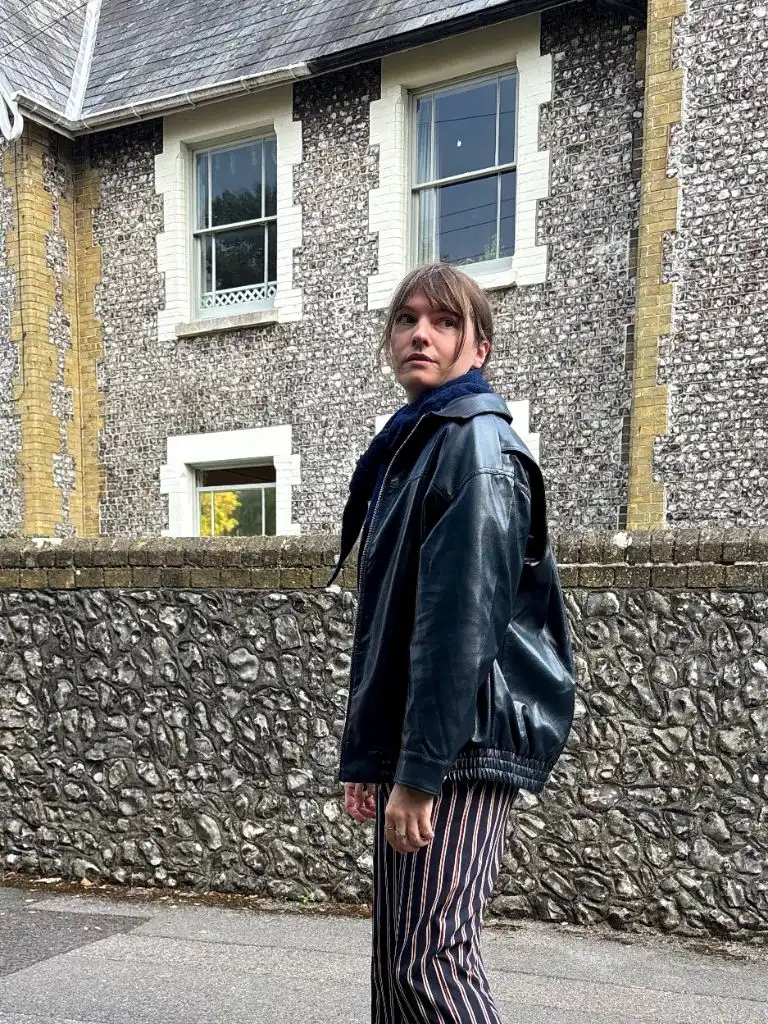
Photo via Instagram
From this angle, the jacket’s proportions become clearer — the drop shoulder and the gathered elastic waistband create a blouson effect that shortens the torso visually, which in turn makes the wide-leg trousers appear even longer. The vertical stripes reinforce this lengthening effect, drawing the eye down from the jacket’s hem to the ground in an unbroken line. The dark tones of both jacket and trousers create a nearly continuous column, broken only by the stripe pattern’s lighter intervals. The flint wall’s rough, mottled texture provides an unexpectedly complementary backdrop for the outfit’s mix of smooth leather and soft striped fabric.
The reader takeaway is that understanding how a silhouette reads from behind is as important as how it reads from the front. The blouson jacket shortening the torso works with the striped trouser’s vertical lines to produce a lengthening effect that would not be apparent without this angle. Building outfits that hold up from multiple viewpoints is a mark of considered dressing.
17. White V-Neck With Black Trousers and a Round Bag in Full View
A white V-neck long-sleeve tee — visually similar or identical to the one in an earlier section — pairs again with black wide-leg trousers and the same round black shoulder bag. This view shows the full standing silhouette, with the bag held forward and slightly away from the body. Sunglasses with a dark, squared frame sit on the face. Hair is pulled back into a low bun. Black leather shoes with a squared or slightly pointed toe are visible at the bottom.
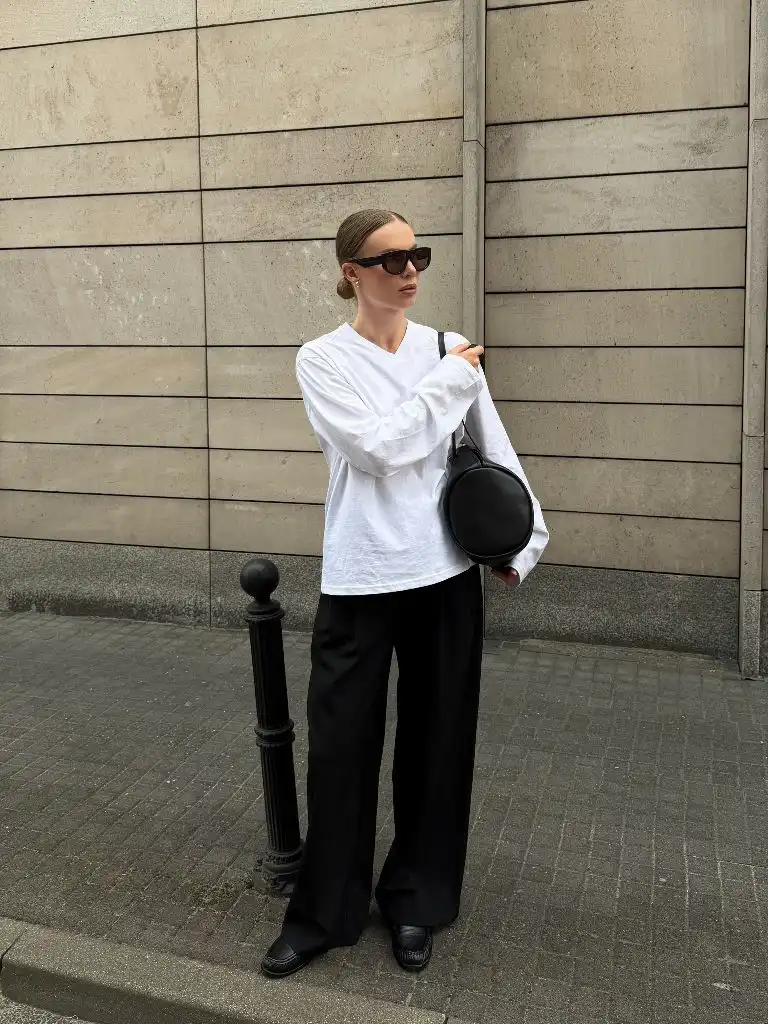
Photo via Instagram
The full-length view reveals how the wide trousers create a continuous black plane from waist to floor, with only the shoe shape breaking the line at the very end. The round bag, held slightly forward, introduces negative space between the body and the accessory, giving it a sculptural presence. The sunglasses and the low bun work together to keep the head clean and geometrically simple, which matches the overall minimalism of the outfit. I appreciate how the squared shoe toe echoes the angular frame of the sunglasses — a correspondence that is subtle enough to feel accidental but functions as a deliberate design rhyme.
What stands out most is the way small shape echoes — squared glasses, squared shoe toe, round bag — create an underlying geometry that organizes the look without being obvious. These correspondences are felt more than seen, which is exactly the register at which the most effective styling details tend to operate. The principle applies broadly: when the overall outfit is simple, shape repetition in accessories becomes the primary source of visual interest.
18. Red Tee With Brown Trousers and a Suede Tote
A bright red short-sleeve crewneck tee tucks into or sits at the waist of dark brown wide-leg trousers. A warm-toned suede tote bag in a caramel or cognac shade hangs from the right shoulder. Sunglasses with round dark frames sit on the face. The person walks past a shopfront with a dark red painted facade and a display window showing clothing. Open-toe dark shoes or sandals are partially visible.
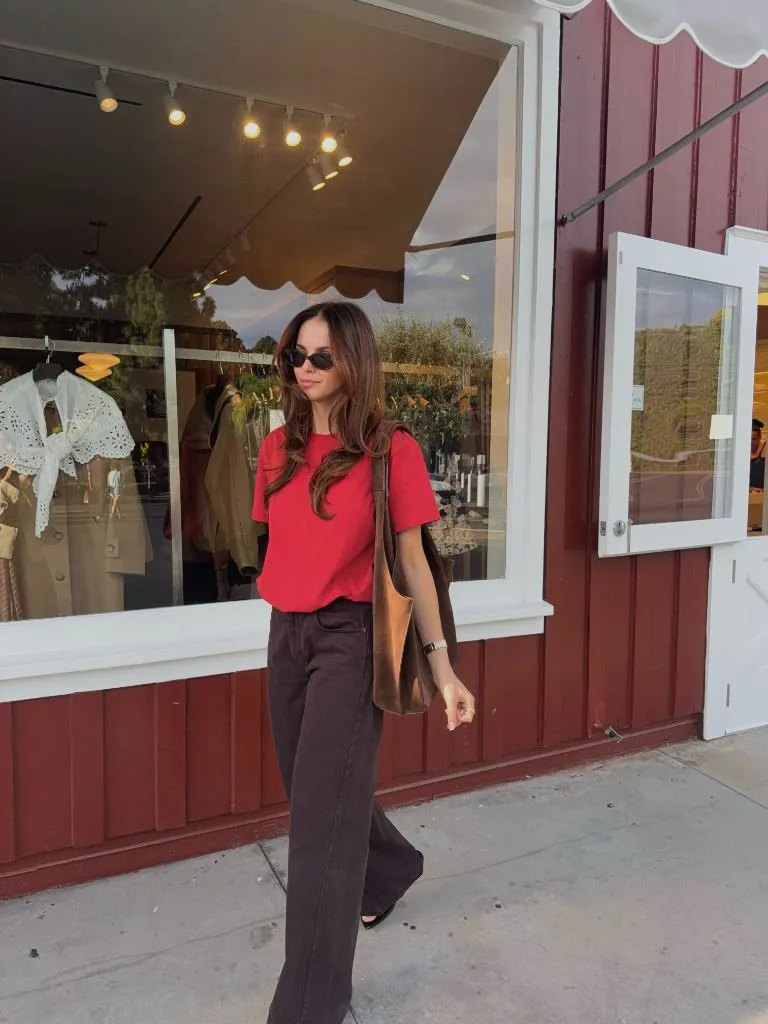
Photo via Instagram
The red tee is the obvious center, but what makes it work is the warm supporting context. The brown trousers and the cognac tote both sit in the same warm color family, so the red reads as the most saturated member of an already warm palette rather than as an isolated pop. The shopfront’s dark red facade behind creates an environmental color echo that could not have been planned but deepens the effect. The trousers’ dark brown grounds the look at the base, while the tote occupies the mid-warm range between the red and the brown. No cool tones appear anywhere, which gives the entire frame a cohesive warmth.
The useful move here is building a warm tonal world around a bright piece rather than contrasting it against cool or neutral tones. When the reds, browns, and caramels all belong to the same temperature family, the bright piece feels like a natural peak rather than a disruption. This is a reliable framework for anyone working with a bold color top as a focal point.
19. Cream Knit Set With a Pink Bow in the Forest
A cream or ivory knit sweater with slightly puffed sleeves pairs with a matching knit mini skirt in the same tone and texture. A pink satin bow ties back long wavy hair at the crown. The person sits on a fallen log, reading a book, with a pink quilted bag and a takeaway coffee cup beside them. Knee-high socks with a lace or ruffle trim and tan lace-up boots are visible below the skirt. The setting is a deciduous forest with dappled light filtering through green and yellowing leaves.
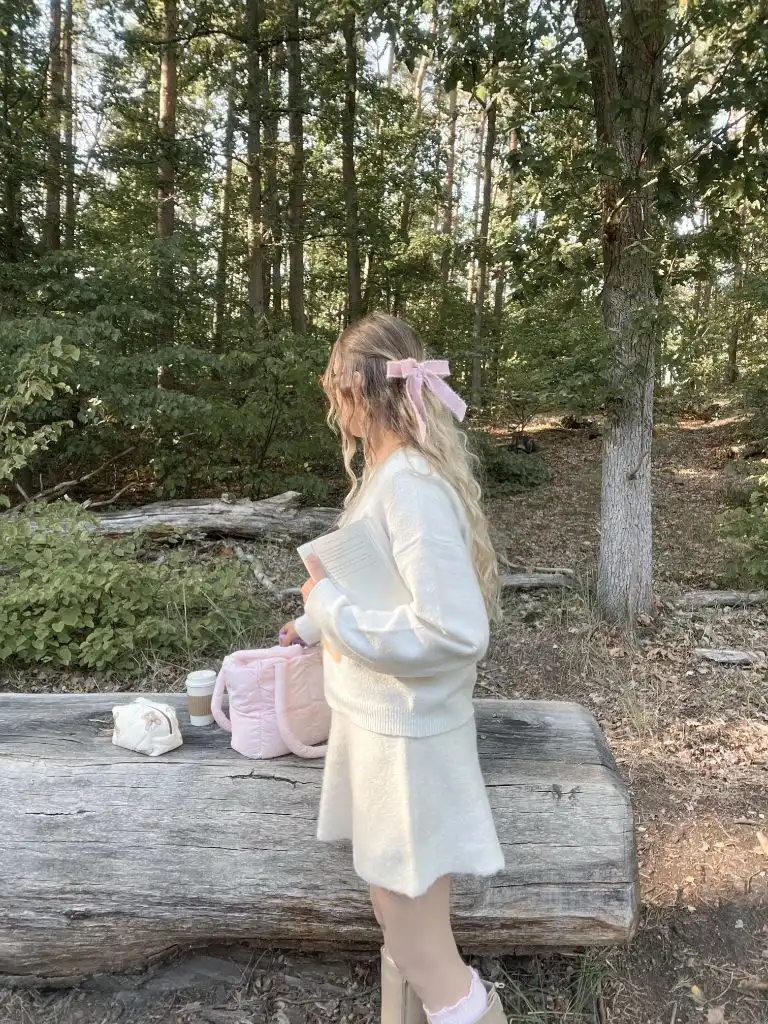
Photo via Instagram
The matching knit set establishes a soft, uniform surface that the pink accessories interrupt gently — the bow at the top, the bag at the side. These pink accents are placed at different heights, which distributes their presence through the frame rather than clustering it. The lace-up boots add a structured, slightly rugged note at the base that prevents the overall softness from reading as one-dimensional, and the socks’ lace trim transitions between the knit’s coziness and the boot’s utility. The forest setting amplifies the warmth of the cream palette, with the natural greens and browns providing a complementary backdrop.
The beauty of this is the three-layer tonal system: cream as the dominant, pink as the recurring accent, and tan as the grounding base. Each occupies a clear role, and none crosses into the others’ territory. The boots’ presence is particularly important — without a structured element at the base, the knit set and pink accessories could read as too uniform in texture. Combining soft and structured elements in a deliberate proportion is a reliable principle for any coordinated set.
20. Blue Plaid Flannel From Behind With Cream Knit Drape
The same blue plaid flannel and cream draped sweater from an earlier section appear from a side-and-back angle. The sweater’s drape over the shoulders is more visible here, showing how it sits across the upper back with the front panels falling forward. The cream jeans are partially visible at the hip. Hair falls loosely over one shoulder, covering part of the flannel.
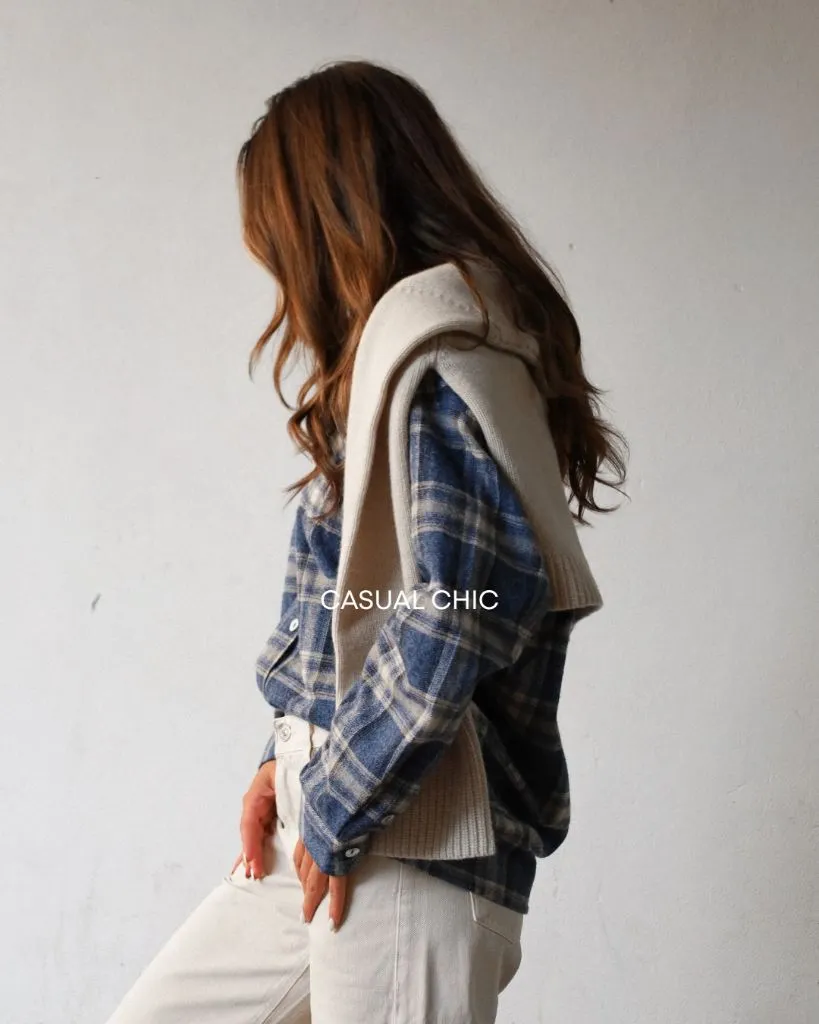
Photo via Instagram
From this angle, the sweater’s drape reveals its role more clearly — it sits like a second collar or a shawl, widening the shoulder silhouette and creating a cream border around the upper frame of the plaid. The hair falling over one side adds an asymmetry that balances the sweater’s symmetrical placement. The cream knit’s ribbed hem is visible at the mid-back, adding a horizontal line that defines where the draped layer ends and the shirt continues solo. This perspective confirms that the outfit’s layering is not incidental but architectural, with each layer assigned a specific zone.
The reader takeaway is that viewing an outfit from behind tests whether its layering logic holds up beyond the front-facing view. The sweater’s drape here creates a clear shape — a U-shaped cream frame around the plaid — that reads as deliberately designed from any angle. Building outfits that function as compositions in the round, rather than only from the front, is a hallmark of truly considered styling.
21. Cream Knit Set With Lace-Up Boots and a Pink Bicycle
The cream knit sweater and mini skirt from an earlier section reappear, this time seen from behind as the person stands beside a pink bicycle in the forest. The pink satin bow is tied at the back of the head, its tails visible against the wavy hair. The pink quilted bag sits on the bicycle’s rear rack. Tan lace-up knee-high boots are fully visible, showing their full shaft and lacing detail. Fallen leaves and bare branches create a muted, autumnal floor.
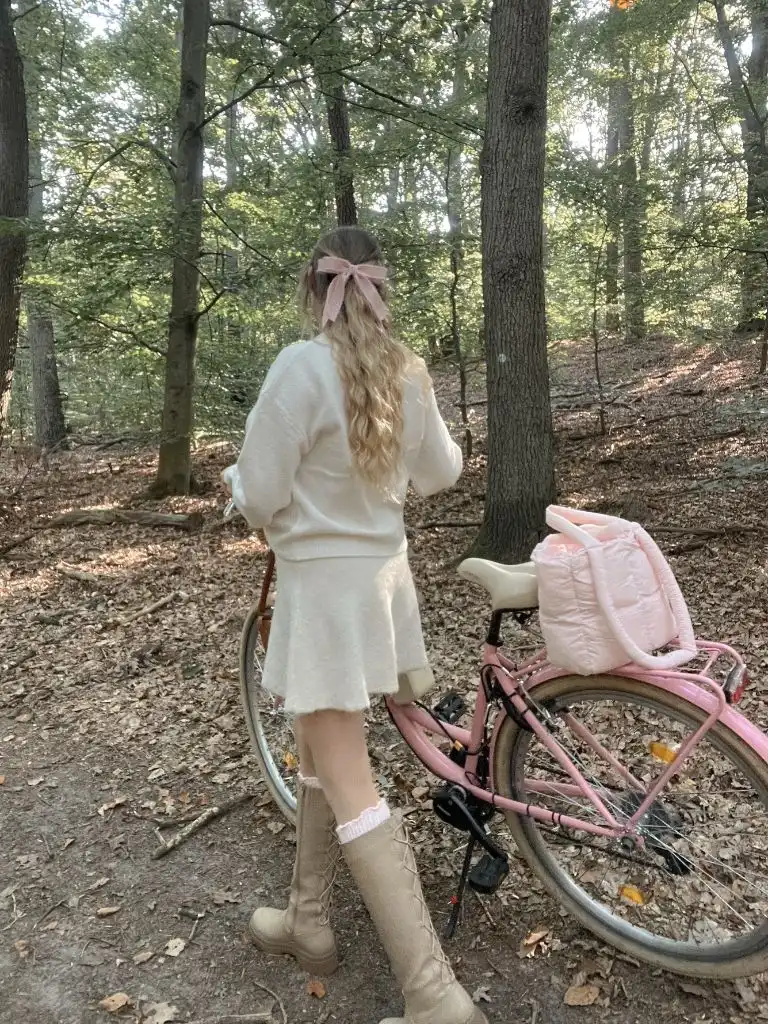
Photo via Instagram
From behind, the pink bow becomes the visual anchor of the upper body, its placement at the center-back of the head creating a focal point that the cream sweater radiates outward from. The pink bicycle and the pink bag reinforce the accent color through environmental repetition — the same hue appears at three different heights and distances within the frame. The boots’ lacing detail is fully visible now, their vertical lines adding a structured, linear texture to the lower body that contrasts with the knit’s soft, fuzzy surface above. The autumnal setting — browns, greens, and ochres — wraps the cream-and-pink palette in a warm, complementary environment.
The useful idea is that carrying an accent color beyond the outfit itself and into the environment or accessories creates a visual world rather than just a look. The pink moves from hair to bag to bicycle, building a narrative that a single pink accent could not achieve alone. This idea of extending a color story beyond the garments and into the surrounding elements makes any outfit feel more intentional and complete.

Hi, I’m Zoey Mitchell, the creator of ChicStyle Blog.
I share simple, wearable outfit ideas, hairstyles, nail trends, and beauty tips that feel natural and easy to recreate.
This blog is where I explore everything that makes a woman feel put together and confident every day. I’m not an expert — just a woman who genuinely loves style, mixing looks, and discovering what works.
If you love effortless fashion with a personal touch, you’ll feel at home here.