
There is a particular stillness in the way a fresh cut falls against a shoulder in low winter light, the weight of it settling into place with a kind of quiet certainty. The ends turn under or flick outward, and the whole silhouette changes. Winter haircuts for plus size women work best when they are considered as architecture rather than decoration, each layer and angle doing something deliberate for the frame around the face and the line of the neck.
What makes a winter cut feel right on a fuller figure has less to do with following a single rule and more to do with understanding a few variables that repeat across every successful example. Proportion is the first and most constant one, the relationship between the volume at the crown and the width at the shoulders, between the length that falls past the collarbone and the density that builds around the jawline. Contrast matters too, whether that shows up as a sharp blunt hem against soft waves or dark roots meeting lighter mid-lengths. Placement of layers, the zone where movement begins and where it stops, decides whether a cut reads as shapely or shapeless. And texture, from a sleek blowout to a tousled wave, controls how much visual weight a style carries. These four variables, proportion, contrast, placement, and texture, run through every section that follows.
1. Layered Brunette With Curtain Bangs
The hair is a rich, cool-toned brunette falling just past the shoulders, with long curtain bangs that part softly at the center and sweep toward the cheekbones. The layers begin around the chin and build volume through the mid-lengths, while the ends curl gently inward. The setting appears to be a salon, and the person wears a simple grey crewneck tee that keeps all attention on the cut itself.
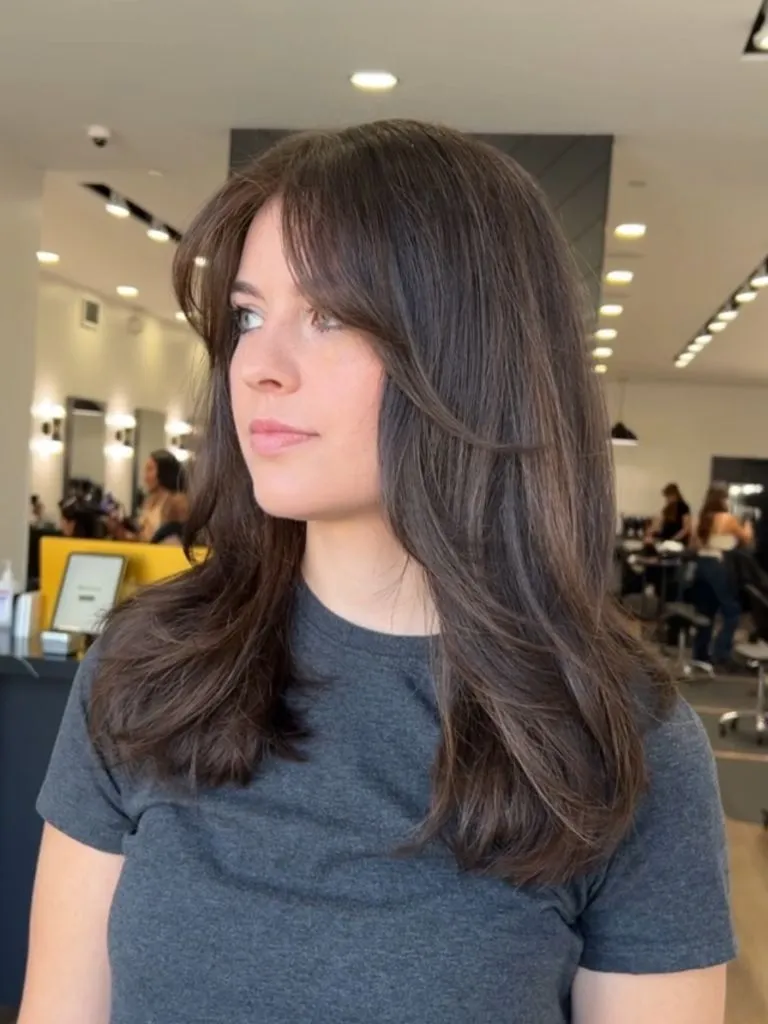
Photo via Instagram
The curtain bangs create a narrow frame at the top of the face, and then the layers widen gradually as they move past the jaw, building a soft diamond shape around the head. That inward curl at the ends is doing real structural work, pulling the silhouette back toward the body rather than letting it drift outward. The cool brunette tone reads as one unbroken surface, which keeps the eye moving vertically rather than catching on color shifts. The grey tee disappears, and the hair becomes the entire composition.
The reader takeaway is that curtain bangs on a layered winter cut can narrow the frame at the forehead while layers add controlled width at the jaw, building proportion without relying on extreme length. The inward curl at the ends is a small move that tightens the whole silhouette, and it works on almost any medium-length cut where the goal is shape rather than volume for its own sake.
2. Warm Caramel Blowout With Bouncing Curls
Seen from behind, the hair is long and full, cascading past the mid-back in large, bouncy curls that catch the light. The color moves from a warm brunette root through caramel and honey tones, with the lightest pieces concentrated at the ends. A black salon cape covers the shoulders, and a round hand mirror is visible at the lower left, suggesting the moment just after a blowout is finished.
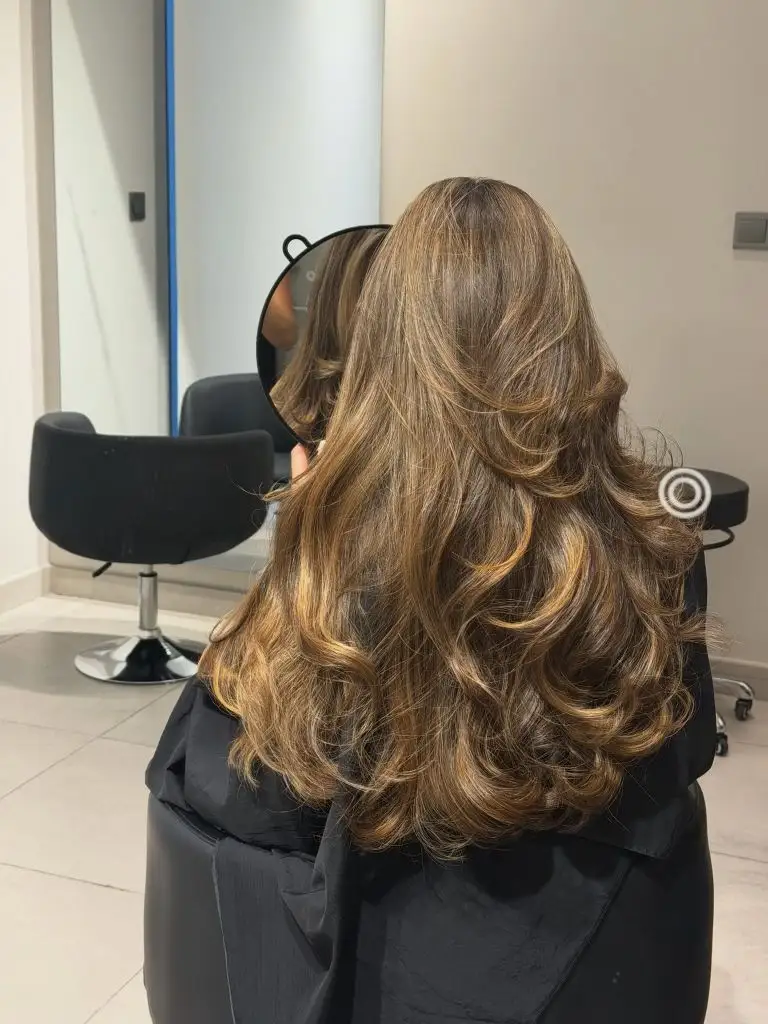
Photo via Instagram
The curls are uniform in size and direction, rolling outward and then under in a deliberate rhythm that distributes volume evenly from mid-length to ends. That graduated color, darker at the crown and lighter as it descends, creates a sense of depth that makes the hair look thicker without appearing heavy. The movement reads as structured rather than windblown, and the light catches each curl individually, which gives the whole mass a three-dimensional quality. There is a sense of occasion in this kind of winter blowout styling that a simple straight finish cannot quite reach.
The useful move here is that large, uniform curls on long hair can distribute volume across the entire back rather than letting weight pool at the bottom. The graduated color supports this by drawing the eye downward through lighter and lighter tones, so the silhouette feels tall and shaped rather than wide. It is the kind of finish that works as a principle for any length where fullness needs direction.
3. Soft Brunette Layers With Side-Swept Fringe
The hair is a medium-warm brunette, shoulder length with layers that begin just below the ear and build outward toward the ends. A side-swept fringe falls across the forehead and partially covers one eye. The person is photographed in profile against a mirror that reads “COZMA.” in dark lettering, and they wear a beige knit top. A few product bottles sit on the counter behind.
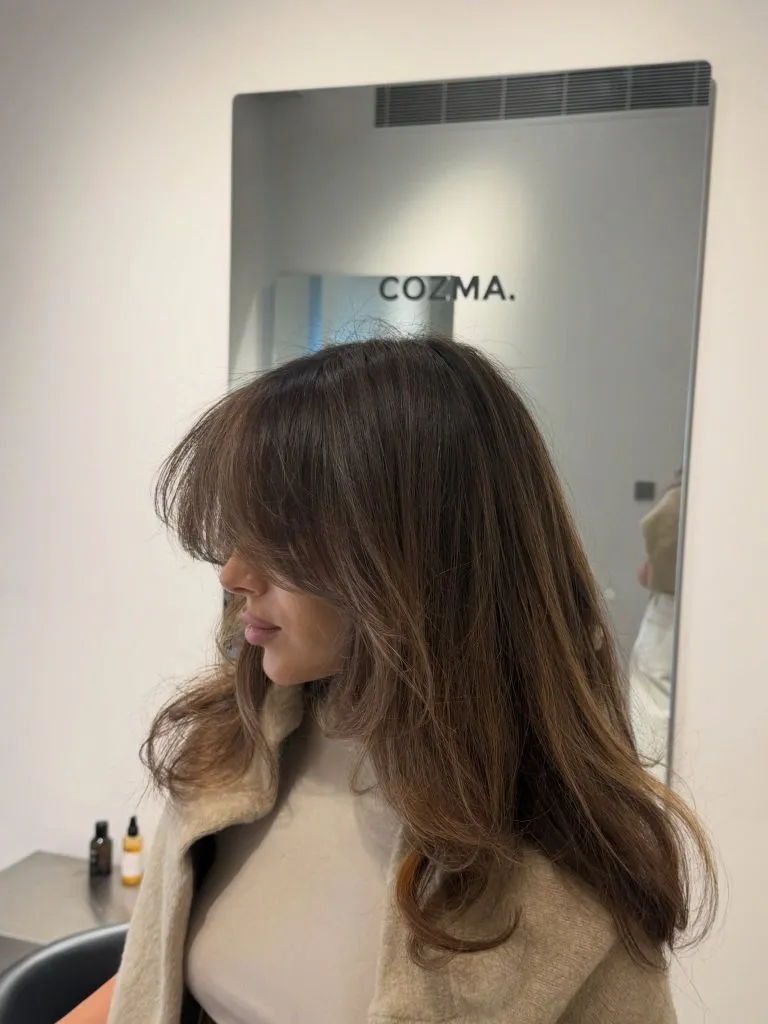
Photo via Instagram
The fringe adds a diagonal line across the forehead that breaks the roundness of the face shape, giving the profile a slightly angular quality it would not have with a center part. The layers flip outward at the ends rather than curling inward, which pushes the widest point of the hair out to the shoulders and creates a base that balances the narrower crown. The warm brunette reads as natural and low-maintenance, with no visible highlights or color breaks, so the cut itself is doing all the shaping work. That restraint in color keeps the structure honest.
The strongest lesson is that a side-swept fringe can introduce an asymmetric line to a round face shape, creating visual angles where the natural bone structure is softer. When combined with layers that flip at the shoulder, the whole silhouette reads as deliberately shaped. It is a principle that applies broadly: diagonal lines across the face narrow, and outward movement at the base anchors.
4. Ombre Bob With Center Part
The hair is a sleek, jaw-length bob with a precise center part. The roots are a deep, cool black that transitions sharply into a warm sandy blonde by the mid-lengths, ending in light golden tips. The cut is blunt at the bottom with no visible layering, and the surface is smooth and straight. The person looks downward, eyes closed, wearing pink lipstick and a silver-toned blouse with large abstract swirl patterns.
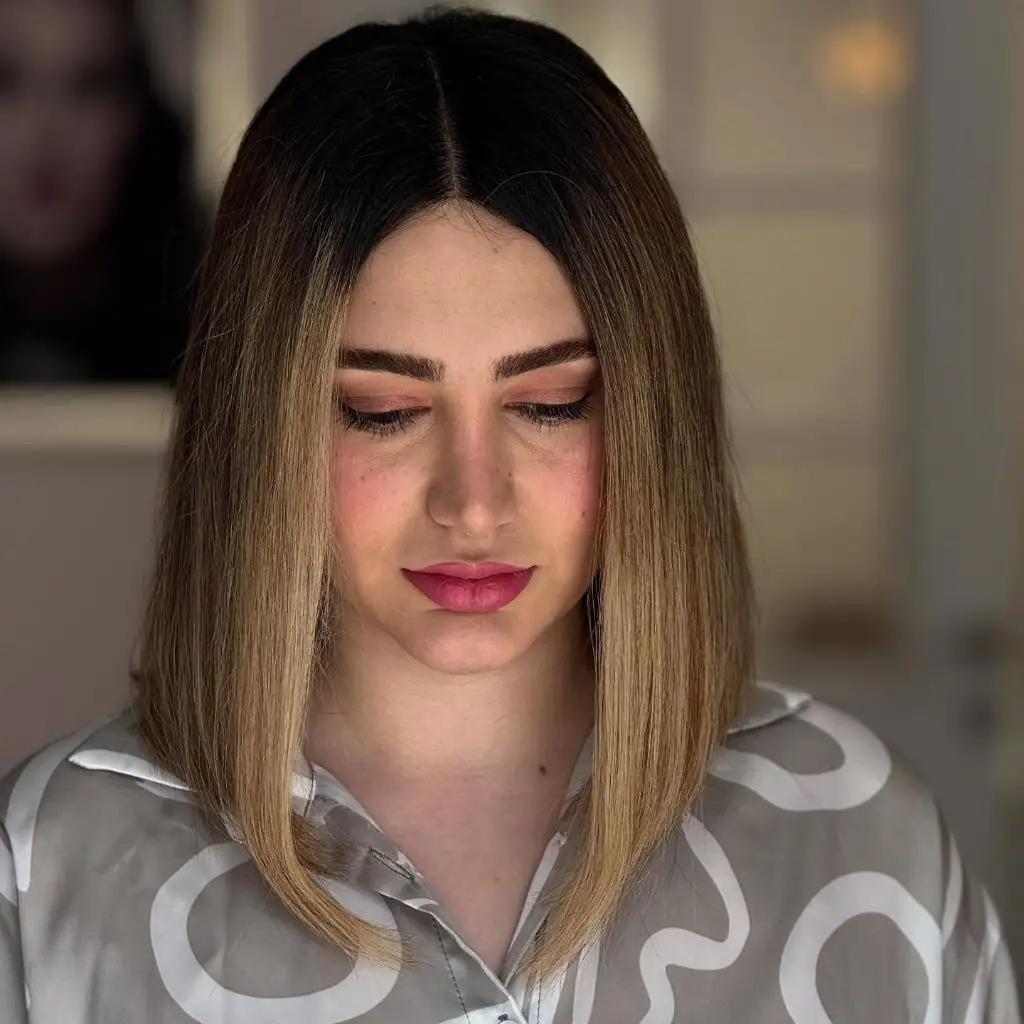
Photo via Instagram
The sharp color contrast between the dark roots and the blonde lengths does something specific to proportion: the dark zone at the crown visually narrows the top of the head, while the lighter, wider section at the jaw opens the lower face. That center part reinforces the symmetry, and the blunt hem draws a clean horizontal line that anchors the entire shape. There is no texture or wave softening the edges, which gives the bob a graphic, almost architectural quality. The patterned blouse adds visual noise below, but the hair reads as a clean, separate zone above it.
What stands out most is that a blunt bob with a strong color transition can create its own proportion system, dark above and light below, that shapes the face without needing layers or curls. The principle is transferable: when a cut is this simple in silhouette, color placement becomes the primary tool for directing where the eye reads width and where it reads narrowness.
5. Textured Dark Crop With Soft Wave
The hair is a short, ear-length crop in a deep, cool black-brown, with soft waves that push forward around the face and a longer piece that falls across the forehead like a loose, undone bang. The texture is slightly tousled, with individual pieces separating at the ends. The person holds one hand near their temple, wearing a black button-front shirt, and is photographed against a grey stone wall.
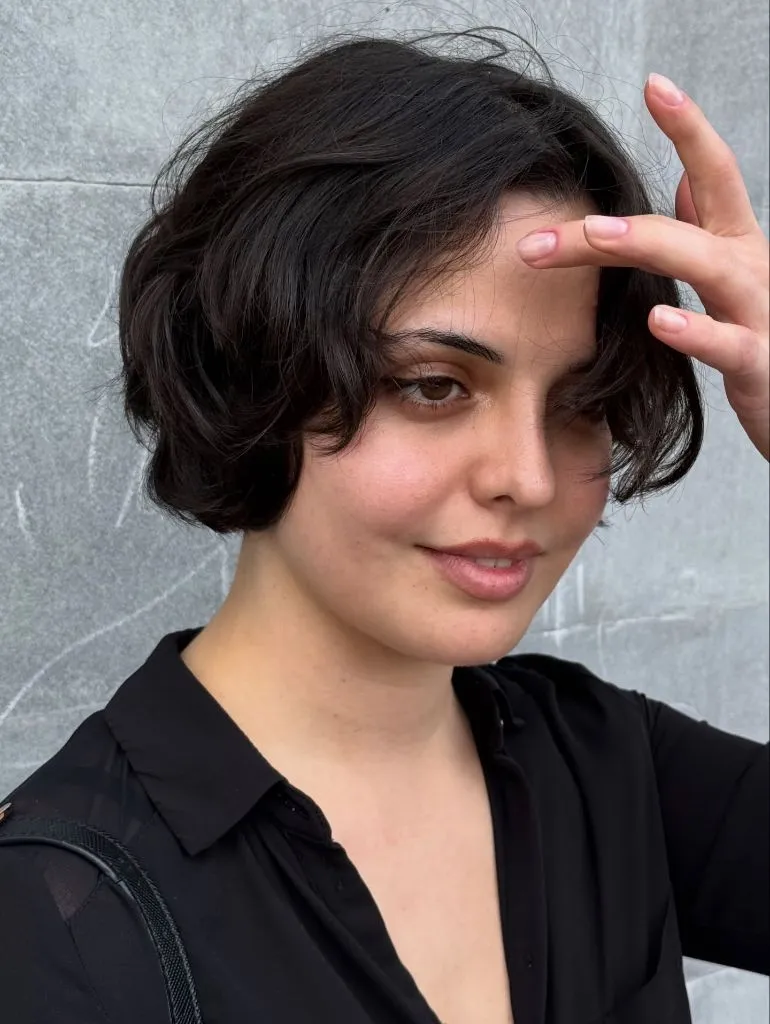
Photo via Instagram
The short length lifts all the visual weight off the shoulders and neck, which changes the proportional relationship between the head and the body entirely. The waves add just enough volume at the sides to keep the shape round rather than flat, and that loose piece across the forehead softens what could otherwise read as a very structured silhouette. The deep, uniform color keeps the eye on shape and movement rather than color, and the tousled finish reads as deliberate imperfection. Shorter cuts like this one can shift the frame in ways that flattering haircut choices for curvier figures often explore.
The best move here is recognizing that a short crop does not need to sacrifice softness. The waves and the forward-falling fringe piece keep the cut approachable, while the short length does the structural work of lifting the frame. For anyone considering a winter crop on a fuller figure, the lesson is that texture at the right density can replace the security of length without losing shape.
6. Medium Layered Cut With Full Bangs
The hair is a dark, cool black at medium length, falling just past the shoulders with layers that begin around the chin. Full, blunt bangs sit straight across the forehead, and the ends of the layers flip outward in a pronounced, wing-like movement. The person wears a light-colored button-front shirt, and the image is watermarked “MARIYA HAIRCUT.” The face is obscured, placing all focus on the cut.
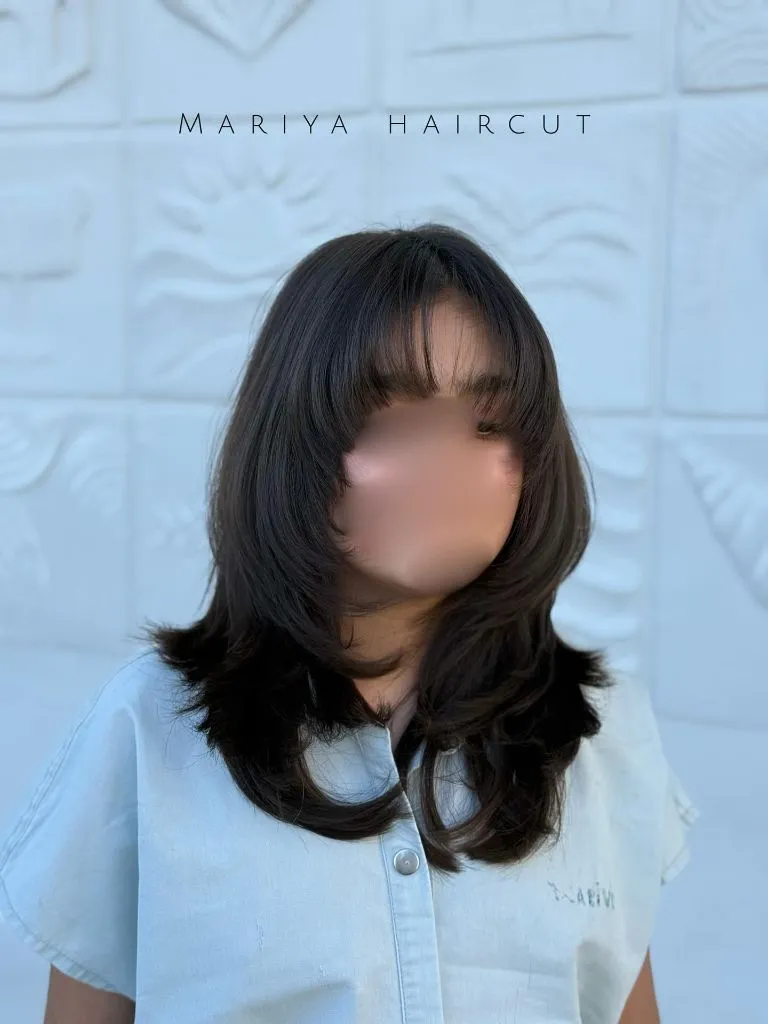
Photo via Instagram
The full bangs create a strong horizontal line across the forehead that visually shortens the face, and then the layers pick up that horizontal energy at the ends with their outward flip. The result is a silhouette with two distinct width zones, one at the brow and one at the shoulders, with a narrower passage through the cheeks and jaw between them. That narrowing effect in the middle is where the cut does its most flattering work. The dark, uniform color keeps the surface simple, so the shape and movement carry all the visual information.
The useful idea is that full bangs paired with flipped ends create a kind of bracketing effect around the face, with the widest points at the top and bottom framing a narrower center. It is a proportion strategy that can work across different lengths and textures, wherever the goal is to create visual narrowing through the mid-face rather than relying on color or highlights alone.
7. Long Layered Brunette With Face-Framing Movement
Photographed from a three-quarter angle in a salon chair, the hair is a rich, warm brunette with subtle lighter pieces that catch the light along the top layers. It falls well past the shoulders with long, sweeping layers that begin around the collarbone and curve gently away from the face. The person wears a dark salon cape with embroidered lettering that reads “CHERRY.” The surface is smooth and glossy, with a slight bend at the very ends.
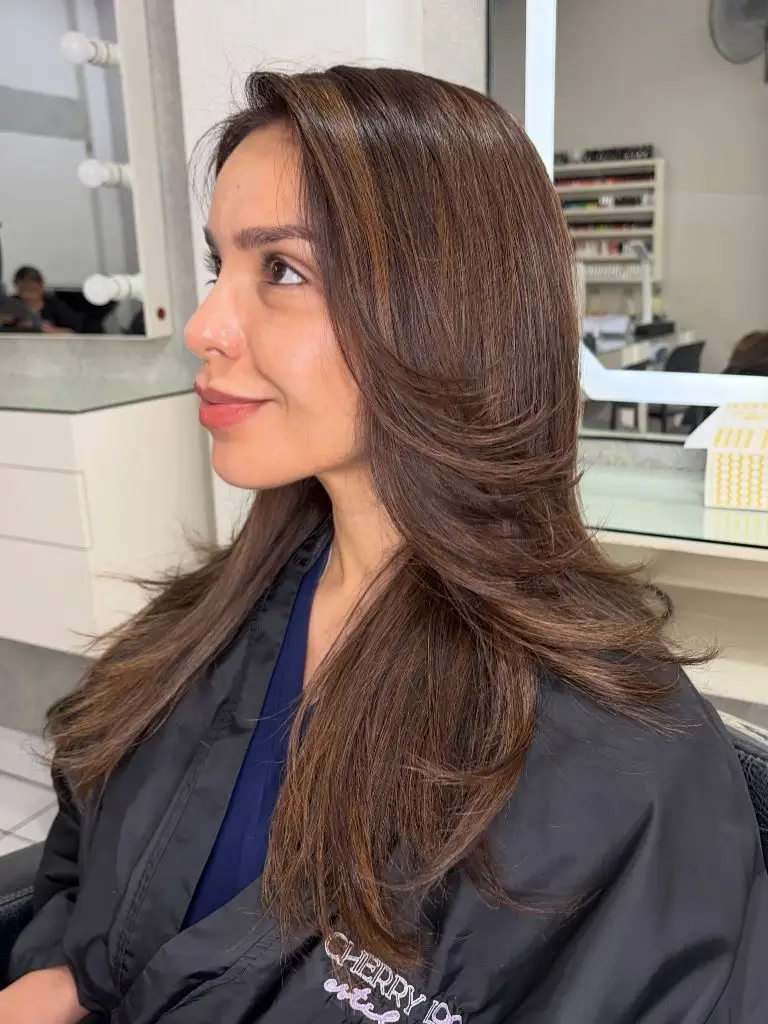
Photo via Instagram
The face-framing layers do something specific here: they curve away from the jawline rather than falling straight down, which opens the area around the chin and neck and creates breathing room in the silhouette. The warm brunette with those subtle lighter threads along the top gives the surface a sense of dimension without any bold contrast. The glossy finish reads as healthy and considered, and the length itself acts as a vertical line that draws the eye downward past the shoulders. This kind of layered approach is something that thoughtful winter hair inspiration returns to season after season.
The beauty of this is that the direction of the layers matters as much as their placement. Layers that sweep away from the face create openness around the jaw, while layers that fall straight down can close that same space. It is a small directional choice that has a large effect on how the face reads within the frame of the hair, and it applies to any length where face-framing pieces are in play.
8. Dark Layered Cut From Behind With Soft Ends
Seen from the back, the hair is a deep, natural-looking dark brown that falls to the mid-back. The layers are long and gradual, with the shortest pieces ending around the shoulder blades and the longest reaching several inches below. The ends show a gentle outward curve, and the overall texture is smooth with a slight natural wave. The person wears a light grey tee, and the background shows shelves lined with products in a salon setting.
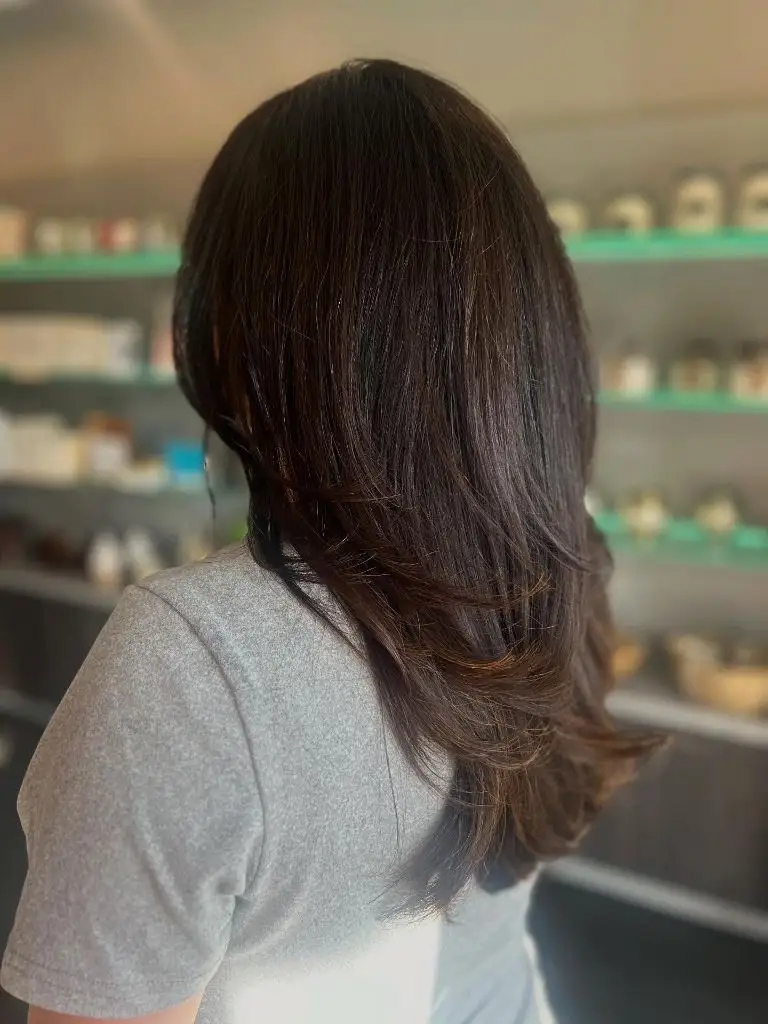
Photo via Instagram
The long, gradual layering removes bulk from the interior of the hair without creating visible steps or choppy texture, which keeps the silhouette sleek through the upper back and allows movement only at the very ends. That gentle curve at the bottom prevents the cut from reading as flat or heavy, and the deep, uniform brown makes the entire mass feel like one cohesive shape rather than a collection of separate pieces. The proportional effect from behind is a long, tapered triangle that narrows as it descends, which is a naturally slimming line.
I like how the simplicity of this cut lets the shape do the talking. The takeaway is that long layers do not need to be dramatic to be effective. A gradual internal layering that removes weight without creating visible texture can build a tapered, narrowing silhouette from behind, and that single structural decision is often more flattering than any amount of color work or styling.
9. Warm Chestnut Layers With Flipped Volume
The hair is a warm chestnut brown with copper undertones, falling to the mid-back with layers that begin around the shoulders. The ends flip outward in large, deliberate curves, and the top section lies smooth and close to the head before the volume builds lower down. The person is photographed from behind, and a gold salon logo with decorative scrollwork is partially visible on the glass behind them. The person wears a dark ribbed top.
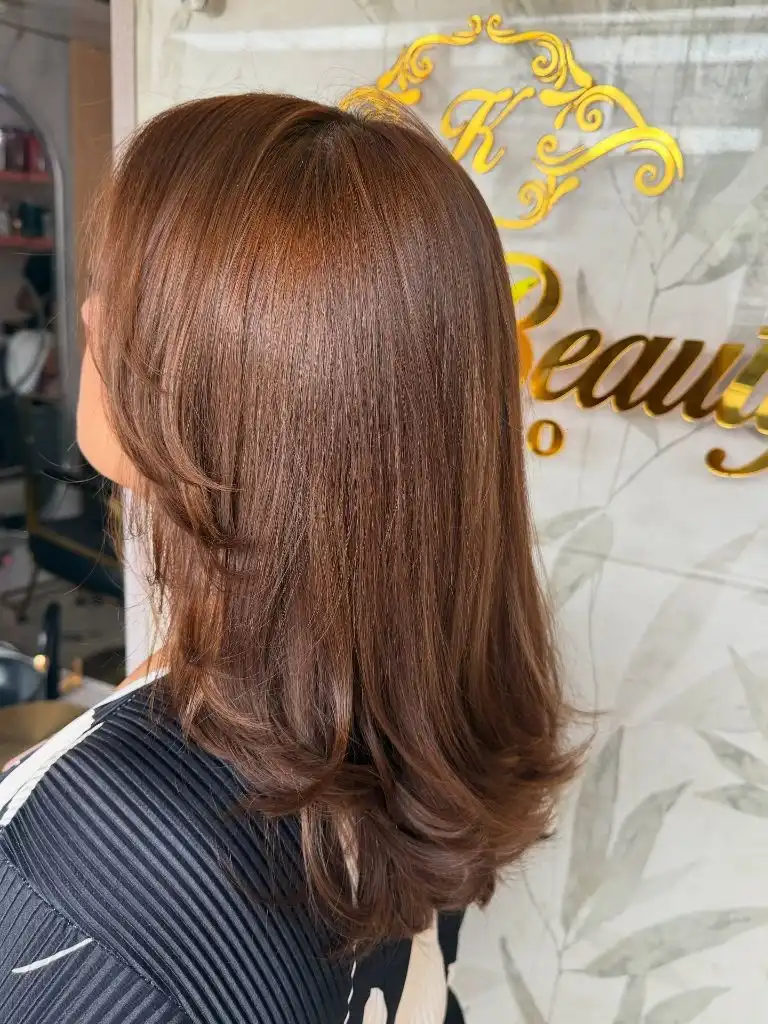
Photo via Instagram
The volume distribution here is very specific: the crown and upper layers are flat and smooth, while all the movement and width live in the lower third. That creates a silhouette that is narrow at the top and full at the bottom, like an inverted triangle, which can balance broader shoulders by drawing the eye downward to where the hair is widest. The warm chestnut tone with its copper threads catches light along the curves of each flip, adding dimension without any bold highlight. For those exploring how proportions shift with layering, this is a clear example.
The reader takeaway is that controlling where volume lives in a haircut is as important as how much volume there is. Keeping the crown smooth and building fullness only at the ends creates a deliberate shape that reads as styled rather than simply thick. It is a transferable idea for any medium-to-long cut where the goal is a shaped silhouette with movement concentrated in one zone.
10. Sleek Highlighted Bob With Rounded Shape
The back of a short bob is shown in close detail, the hair sitting just at the nape in a smooth, rounded shape. The color is a medium brown base threaded through with fine copper and golden highlights that run vertically from root to tip. The surface is extremely smooth and glossy, with no visible wave or texture. The person wears a beige knit turtleneck, and part of a salon sign with an ampersand is visible in the background.
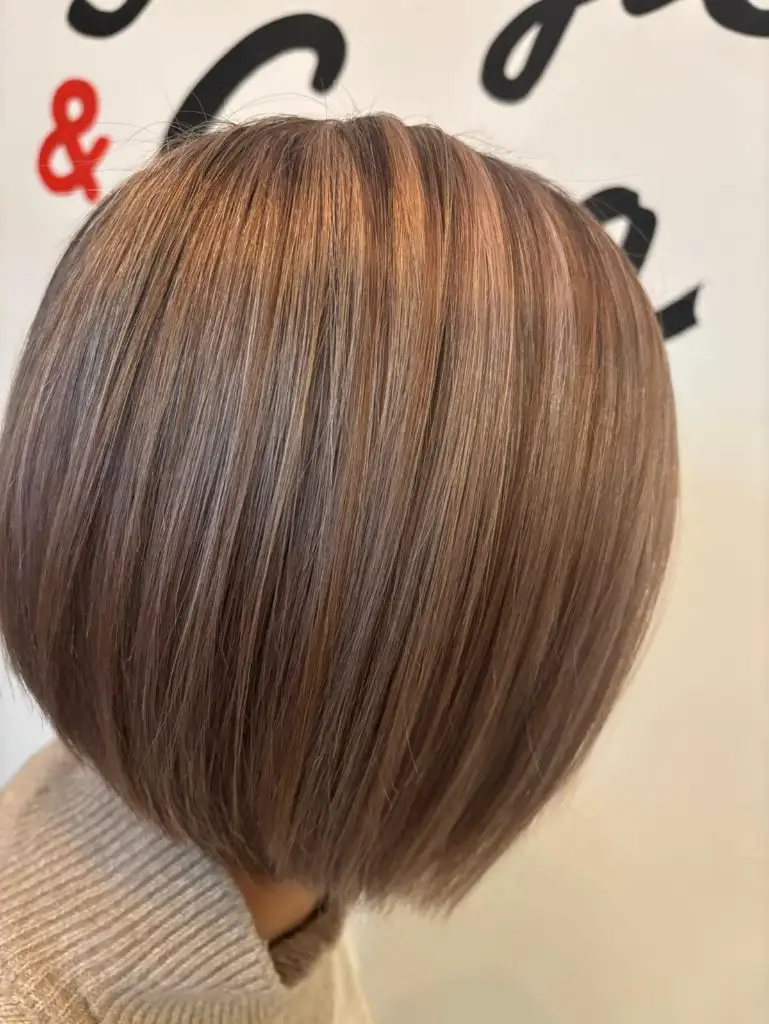
Photo via Instagram
The rounded shape of this bob creates a single, unbroken curve from the crown to the nape, which reads as compact and deliberate. The fine highlights add vertical lines within that curve, and vertical lines in a rounded shape create an optical narrowing effect. The glossy finish amplifies this by reflecting light in long, straight streaks that pull the eye downward. There is no layering, no texture, and no movement at the ends, so the shape itself carries the entire design. That kind of restraint in a short cut can feel especially polished for colder months.
The strongest lesson is that a short bob with a smooth, rounded silhouette can create a very clean frame around the face and neck. The vertical highlights within that round shape add a subtle narrowing quality that a single-tone color would not provide. It is a principle worth noting: when the cut is simple and compact, the direction of the color within it becomes the primary tool for adjusting proportion.
11. Long Dark Hair With Soft Layered Ends
The hair is a deep, near-black shade with a glossy, healthy-looking surface, falling well past the mid-back. The top two-thirds are straight and smooth, and the lower third shows soft, loose curls that flick outward and inward in an alternating pattern. A hand reaches in from the left to hold a section, and salon shelves stocked with products, including what appears to be Oribe packaging, are visible in the background. The person wears a dark washed tee.
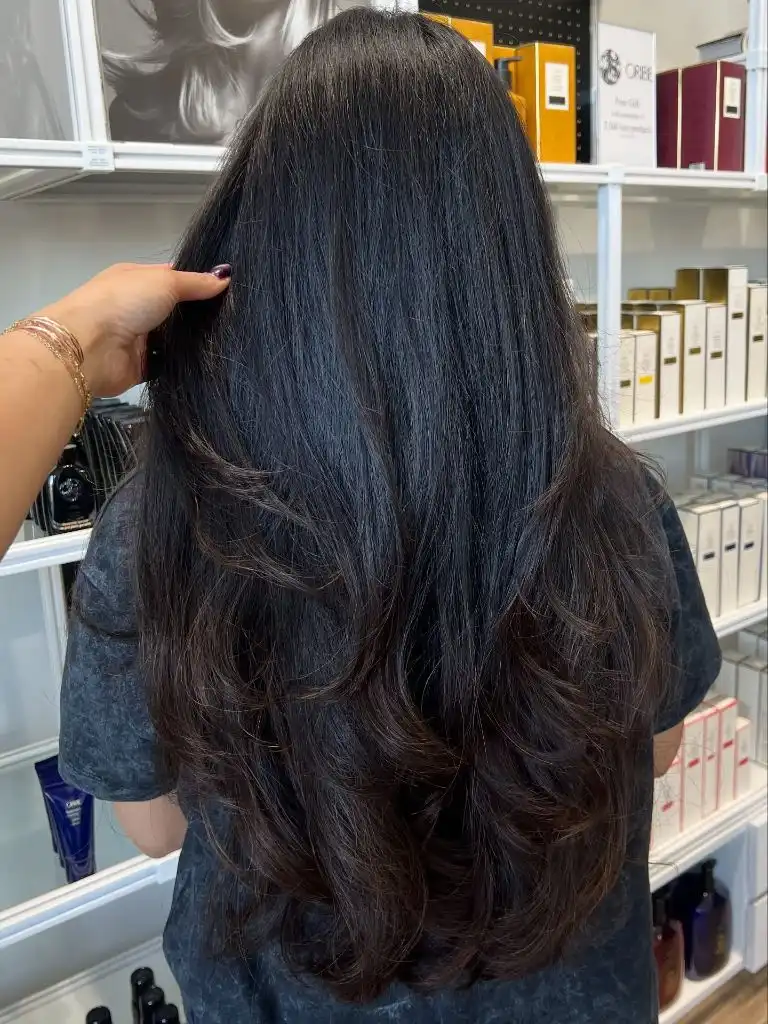
Photo via Instagram
The contrast between the straight upper section and the curled lower section creates two distinct visual zones in one cut: a sleek, narrow passage through the shoulders and then an opening burst of movement at the bottom. The near-black color unifies both zones, so the transition feels like one style rather than two. The curls at the ends add width and visual weight exactly where the silhouette needs a base, anchoring the long vertical line so it does not read as flat or lifeless. The glossy surface keeps the whole composition feeling rich and intentional.
What stands out most is that movement at the ends of very long hair functions as a visual anchor, giving the silhouette a defined bottom edge rather than a gradual taper into nothing. The principle is straightforward: when the upper portion stays smooth, the curled ends have more impact because the contrast gives them a clear starting point. It works on any dark, long cut where the goal is shape with minimal intervention.
12. Medium Dark Layers With Bouncy Curled Ends
Seen from behind, the hair is a dark chocolate brown falling to the mid-back, with layers that build volume from the shoulders downward. The ends are styled into large, bouncy curls that roll inward, creating a rounded, full shape at the bottom. The person holds both hands up near their head, and they wear a mauve long-sleeved top with small rhinestone details. A salon mirror with blue LED edging is visible behind them.
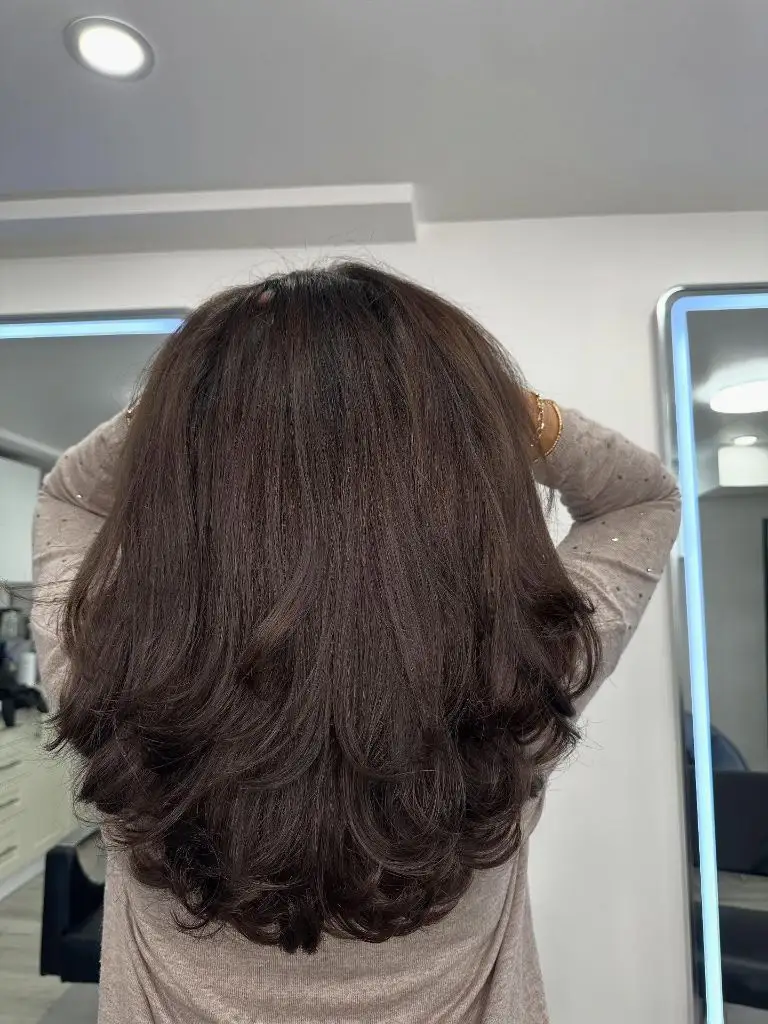
Photo via Instagram
The inward curl at the ends pulls the widest part of the hair back toward the center, creating a silhouette that expands and then contracts rather than simply flaring outward. That containment effect is the difference between volume that reads as shaped and volume that reads as uncontrolled. The dark chocolate color keeps the surface uniform, so the curls read as texture and movement rather than individual color segments. The rhinestone details on the top add a subtle sparkle that echoes the bounce in the hair without competing with it. Styling choices like these echo what works well in curvy figure hair strategies.
The useful move here is the inward direction of the curls. Curls that roll inward contain the silhouette, while curls that roll outward expand it, and that single directional choice changes the proportion of the entire back view. It is a styling principle that applies to any layered cut with enough length to curl: the direction matters as much as the size of the curl.
13. Blonde Bob With Soft Layered Movement
The back of a chin-to-jaw-length bob is shown, the hair a warm, sandy blonde with lighter pieces woven through the surface. The cut has soft internal layering that creates a slight A-line shape, shorter at the nape and longer toward the front. The ends show a gentle bend rather than a sharp curl. The person wears a white blouse with small black polka dots, and a gold chain clasp is just visible at the nape.
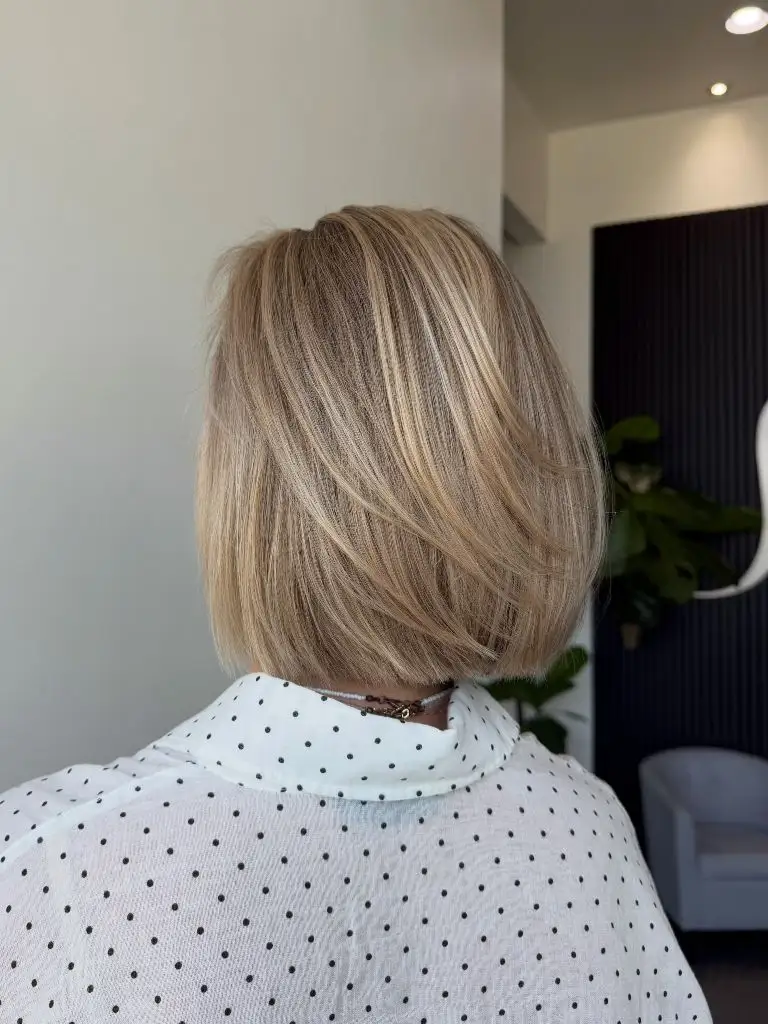
Photo via Instagram
The A-line shape does something quietly effective for proportion: the shorter back lifts the visual weight off the neck and shoulders, while the longer front pieces frame the jawline with a bit more coverage. The warm blonde with its lighter threads gives the surface a woven quality that adds dimension without any bold contrast. The gentle bend at the ends prevents the bob from looking rigid, and the polka dot blouse below introduces a small-scale pattern that makes the smooth, larger-scale shape of the hair stand out by contrast. Exploring shorter cuts for winter often leads to exactly this kind of quiet, structured bob.
The best move here is the A-line graduation, that subtle difference in length between the back and the front. It lifts the nape, frames the jaw, and creates directional flow from back to front, all without any dramatic layering or styling. The principle is that a small architectural decision in the cut itself can do more for proportion than any amount of product or heat styling after the fact.
14. Warm Auburn Short Layered Cut
The hair is a warm, rich auburn with reddish-copper tones, cut short to about chin length with heavy layering that builds volume at the crown and through the sides. The layers are flipped and textured, creating a tousled, windswept quality. The person is seen from a three-quarter back angle, wearing a plain white crewneck tee, in what appears to be a bright salon space.

Photo via Instagram
The heavy layering at this short length creates maximum volume at the crown and the sides, which builds a full, rounded shape around the head. The auburn color with its copper warmth catches light on every textured piece, giving the cut a dimensional, lived-in quality that a darker or cooler shade would not emphasize as strongly. The volume sits high, above the ears and at the crown, which lifts the visual center of gravity and creates a vertical emphasis that can be particularly flattering on fuller frames. This kind of warm-toned short cut works precisely because it puts the emphasis at the top of the frame.
The reader takeaway is that heavy layering on a short cut can build a high-volume shape that lifts the visual center of gravity upward, away from the shoulders and toward the crown. Warm auburn tones enhance this by catching light across every textured surface. The transferable principle is that volume placed high reads differently from volume placed low, and on a fuller figure, that upward shift can change the entire proportional story.
15. Dark Plum-Toned Straight Hair With Subtle Shimmer
Seen from behind, the hair is very long and straight, falling well past the mid-back with a blunt or near-blunt hem. The color is a deep, dark shade that reads as a blackened plum or dark aubergine, with a faint violet shimmer visible where the light hits the surface. The person wears a black tee, and a tattooed sleeve is visible on the left arm. The background shows a storefront with dark-framed glass doors and what appears to be a sidewalk.
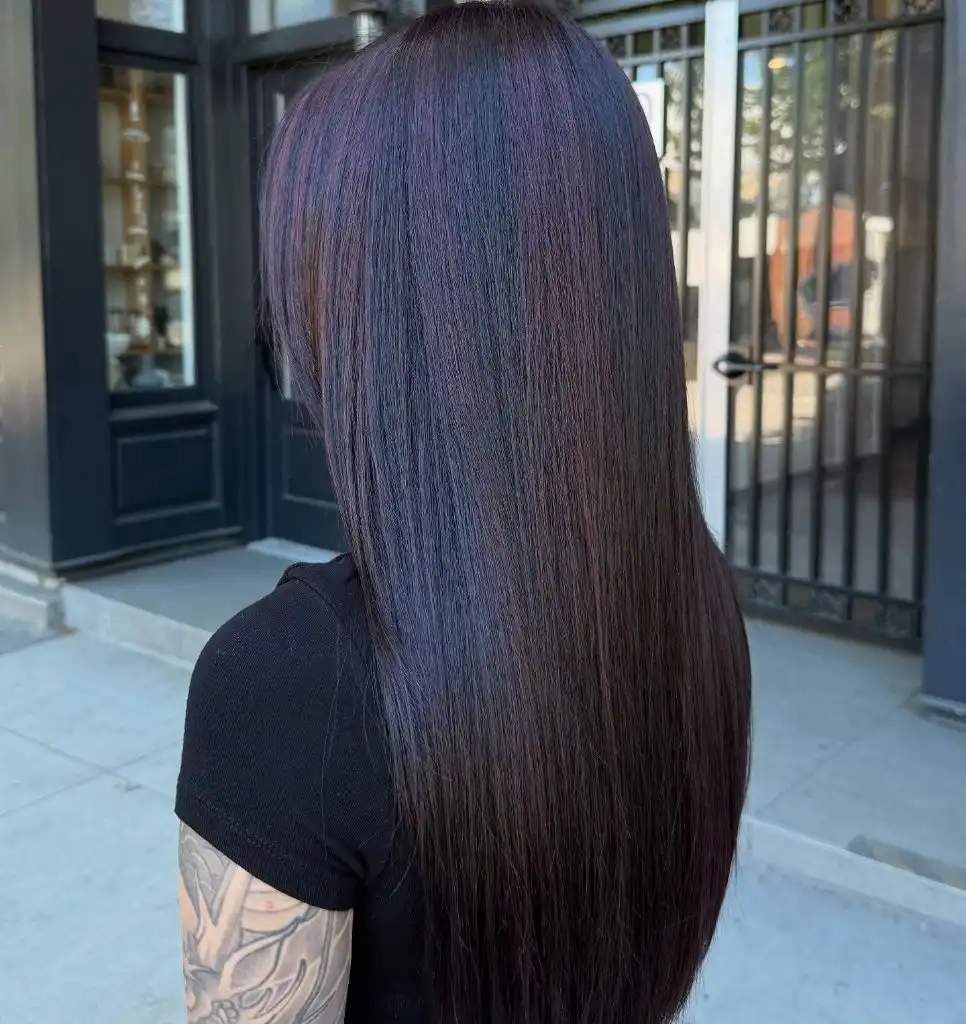
Photo via Instagram
The extreme straightness and length create a single, unbroken vertical line from the crown to the lower back, which is one of the most slimming silhouettes a haircut can produce. The dark plum tone absorbs most of the light, which compresses the visual width of the hair, while the faint violet shimmer adds just enough surface interest to keep it from reading as flat or matte. There is no layering, no curl, no texture, just a clean vertical drop. The blunt hem gives the bottom a definitive edge, which is useful because without it, very long straight hair can simply trail off without resolution.
The useful idea is that a perfectly straight, single-length cut creates maximum vertical emphasis with minimum visual width. The dark, cool plum tone supports this by absorbing light rather than reflecting it outward. For anyone drawn to length as a proportion strategy, the lesson is that straightness and a blunt hem give the long line its power, and a dark, cool tone compresses it further.
16. Sleek Dark Straight Hair With Blunt Hem
The hair is a dark, cool brown-black, very straight and smooth, falling to the mid-back with a blunt, perfectly horizontal hem. There is no visible layering, and the surface has a natural, low-sheen finish rather than a high gloss. The person is seen from behind wearing a dark top with white polka dots, and the background shows a salon interior with a gold-framed arched mirror and various styling products on shelves.
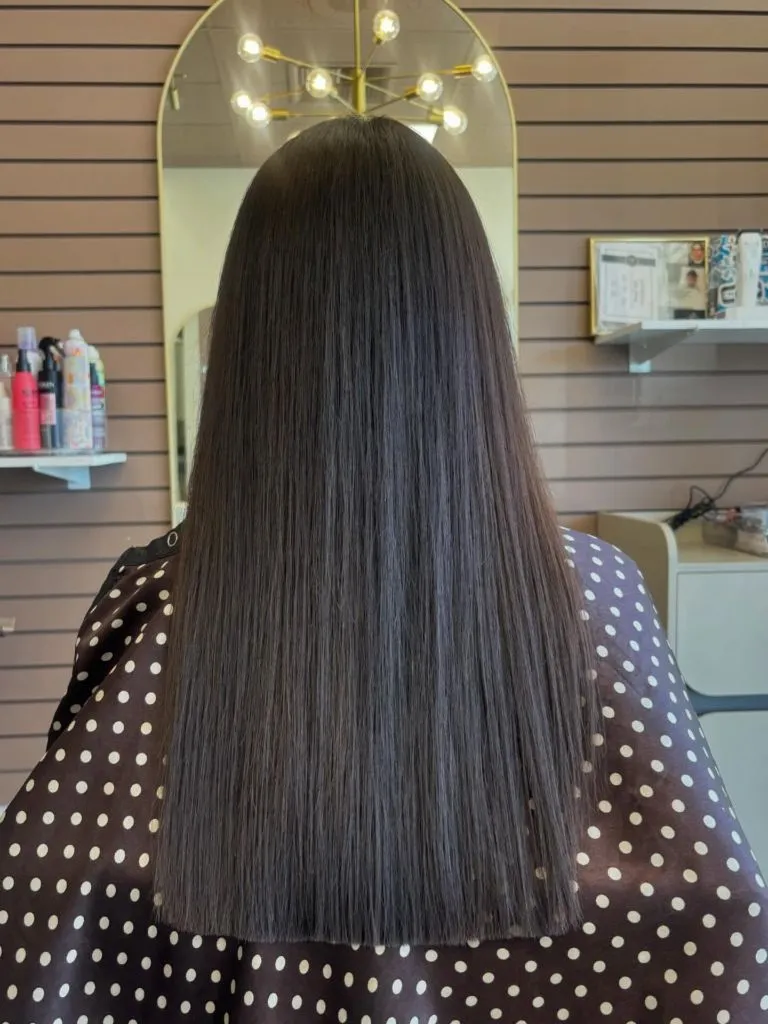
Photo via Instagram
The blunt hem creates a clean, deliberate bottom edge that gives the silhouette a definitive stopping point, and that single horizontal line at the base is what separates a shapely cut from hair that simply grows. The straight texture and dark color keep the entire back reading as one continuous surface, narrow and vertical, with no interruptions. The polka dot top below introduces a pattern that makes the smooth, unbroken surface of the hair more noticeable by contrast. Approaches to straight cuts and plus size proportions often emphasize exactly this kind of clean, uninterrupted line.
The strongest lesson is that a blunt hem on straight, dark hair is not a lack of styling but a deliberate choice that creates resolution and shape. Without it, the hair simply thins out at the bottom and the silhouette loses its structure. The principle is simple and transferable: a clean bottom edge gives any long, straight cut a designed quality that says the shape was chosen, not accidental.
17. Copper Ombre Waves With Rich Warmth
The back of the head shows long hair styled in large, loose waves. The color transitions from a warm chestnut brown at the roots into a bright, rich copper-gold at the mid-lengths and ends, with the lightest pieces at the very tips. The waves are defined and uniform, and the overall volume is full and rounded. The person wears a dark charcoal sweater, and the background features a lattice wall with artificial green leaves.
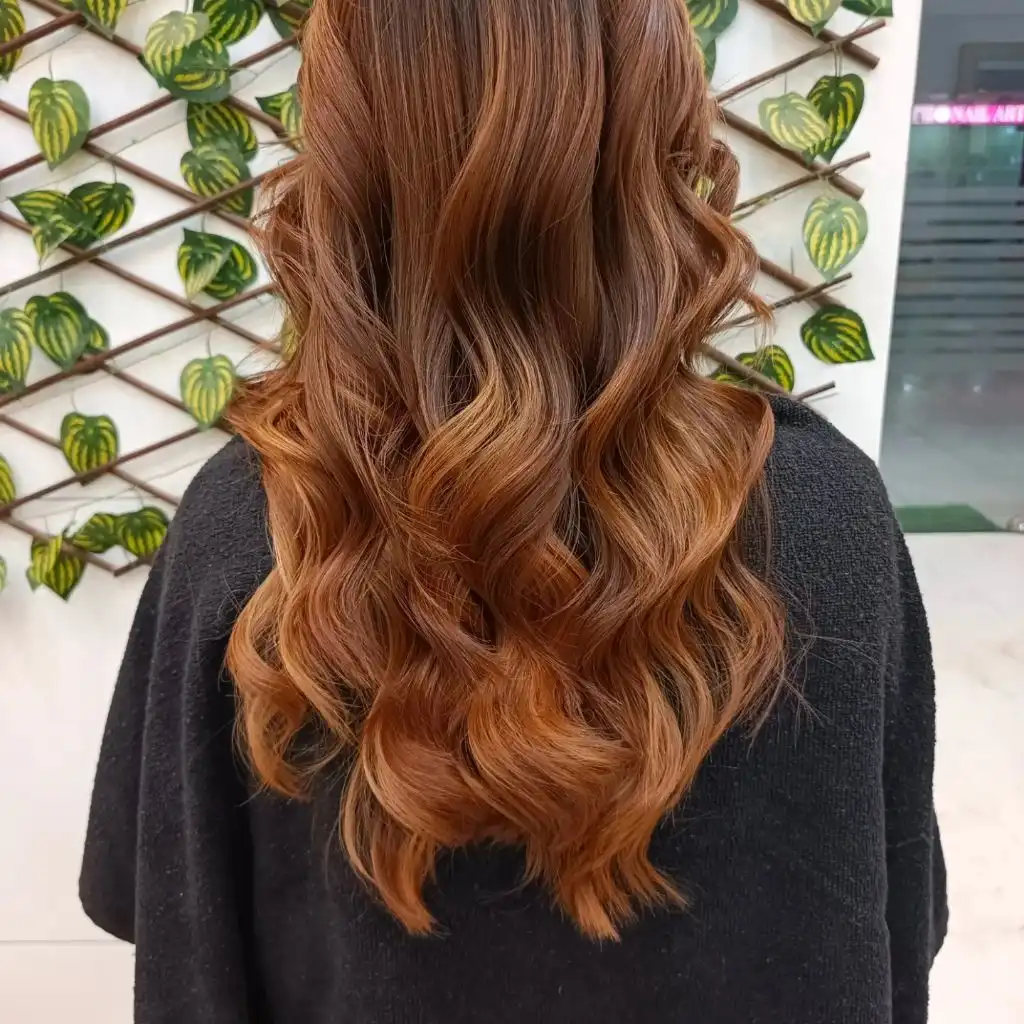
Photo via Instagram
The ombre transition here is warm to warmer, moving from chestnut into copper-gold, which creates a glow effect that intensifies as the eye travels downward. The waves distribute that color across a series of curves, and each curve catches the light differently, so the overall impression is of depth and dimension rather than a flat gradient. The full, rounded volume is contained by the wave pattern, which gives it shape rather than letting it spread. That charcoal sweater below provides a cool, dark base that makes the warm copper pop even more.
The beauty of this is that a warm-to-warm ombre builds intensity rather than contrast. It reads as one cohesive color story that deepens as it moves, which can feel more natural and more flattering than a sharp light-to-dark transition. The principle is that color direction, whether it warms or cools as it descends, is a design decision that affects how the eye reads the proportion and movement of the whole cut.
18. Copper-Red Blunt Cut at Shoulder Length
The hair is a bright, warm copper-red, cut bluntly at shoulder length with no visible layering. The surface is straight and smooth with a natural texture, not blown out to a glassy finish but sitting naturally. The person is seen from behind wearing a grey graphic tee, and the background shows a bright salon interior with floor-to-ceiling windows.
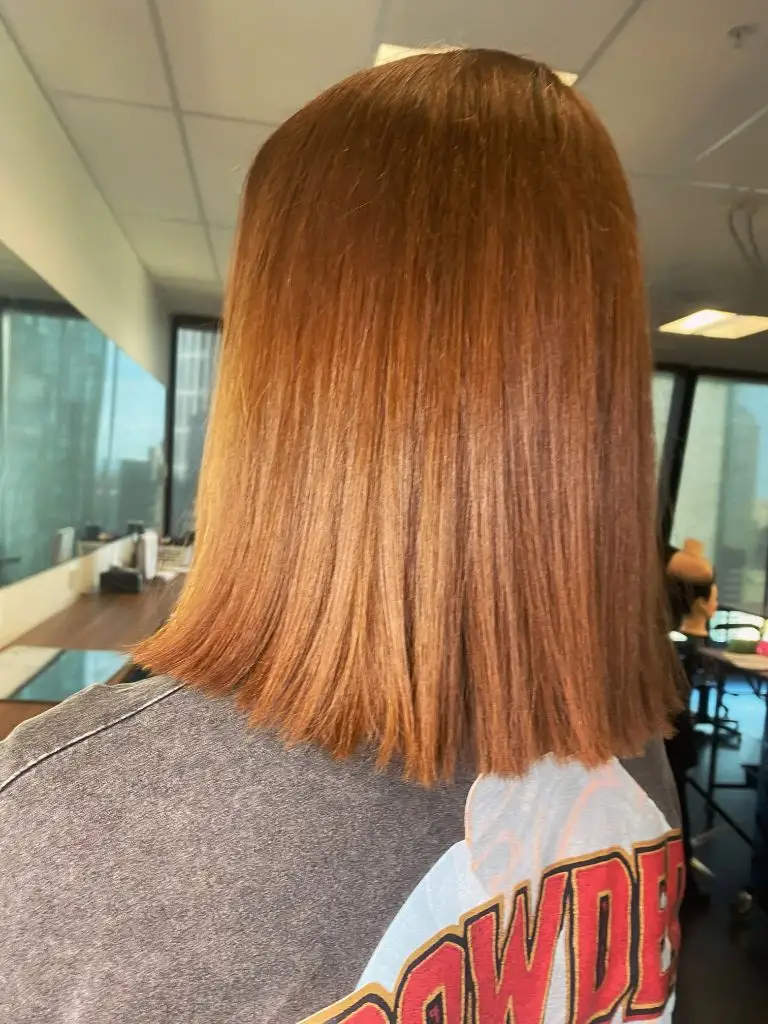
Photo via Instagram
The blunt hem at shoulder length creates a width point exactly where the shoulders sit, which means the hair and the body share the same horizontal line. That can either widen or balance the shoulders depending on the density and color: here, the warm copper-red draws the eye to the hair itself rather than the shoulder line beneath it, which effectively shifts attention upward. The natural, un-styled texture keeps the look grounded, reading as everyday rather than event. Choices like this reflect how bold color on simpler cuts can reshape the visual frame.
What stands out most is that a single-length cut at shoulder level puts the color in a position to do the proportional work. The copper-red becomes the focal point at the shoulder zone, and because the eye goes to color before it reads shape, the hair effectively reframes the width at that level. The transferable principle is that bold, warm color on a simple cut can redirect attention and reshape proportion without any structural complexity.
19. Buttery Blonde Layers With Soft Face Framing
The hair is a warm, buttery blonde with slightly darker roots and lighter pieces through the mid-lengths and ends. It falls past the shoulders with long, soft layers and a gentle wave at the ends. The face-framing pieces are lighter and fall forward, partially covering the cheek. The person wears a brown jacket or overshirt, and the background shows a salon interior with recessed lighting.
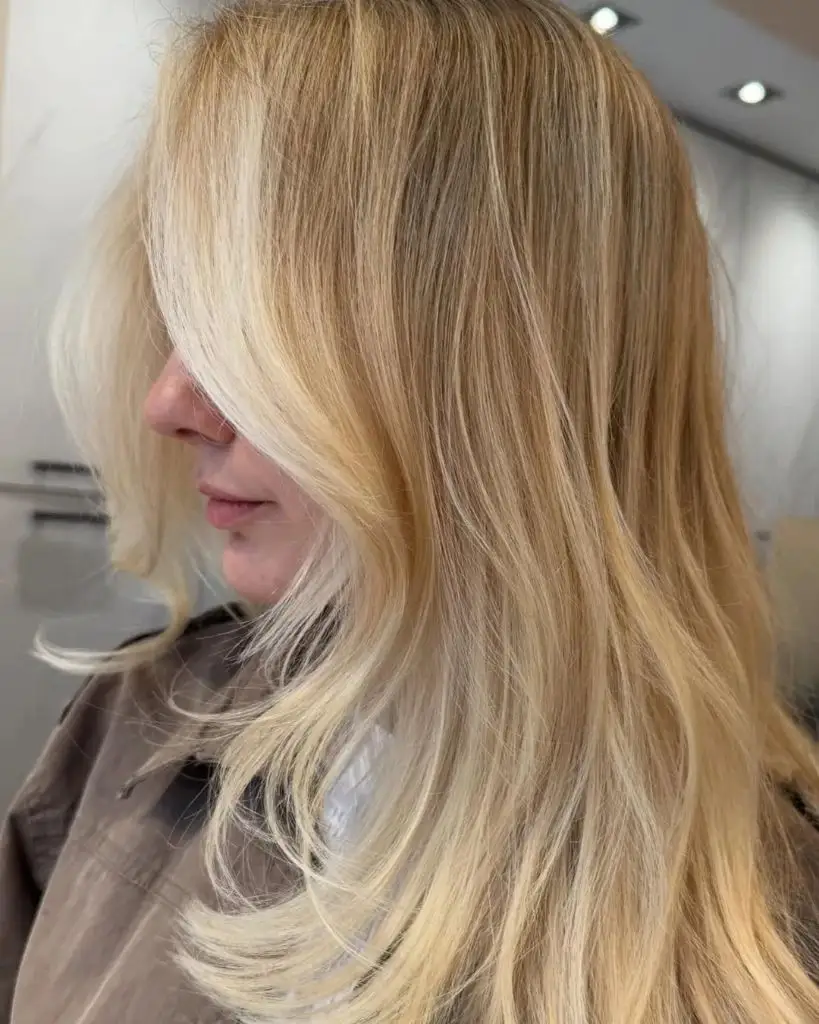
Photo via Instagram
The lighter face-framing pieces act as a visual highlight around the cheek and jaw, drawing the eye toward the center of the face rather than the outer edges of the hair. The darker roots create a shadow at the crown that reads as natural depth, and the transition into the buttery blonde through the lengths builds a warm glow that softens the overall shape. The layers are not heavily textured but instead fall in long, smooth sections that create movement without choppy interruptions. That kind of considered, low-contrast approach to lighter hair on curvier frames keeps the warmth centered around the face.
The useful move here is the placement of the lightest pieces specifically around the face. By concentrating the brightness in the face-framing zone and keeping the rest of the hair in a slightly deeper range, the color draws attention inward rather than letting it spread across the full width. It is a placement principle that works with any color family, light pieces near the face pull focus, and darker tones at the periphery create quiet.

Hi, I’m Zoey Mitchell, the creator of ChicStyle Blog.
I share simple, wearable outfit ideas, hairstyles, nail trends, and beauty tips that feel natural and easy to recreate.
This blog is where I explore everything that makes a woman feel put together and confident every day. I’m not an expert — just a woman who genuinely loves style, mixing looks, and discovering what works.
If you love effortless fashion with a personal touch, you’ll feel at home here.