
There is something quietly compelling about the way a heavy knit falls open against a dark base layer, the way a scarf catches the light differently from the coat beneath it, the way winter dressing becomes a series of small decisions stacked on top of one another. A winter outfit for plus size women, at its most considered, is not about coverage or concealment but about rhythm — the rhythm of fabric against fabric, of warm tones folding into cool ones, of structure meeting softness at exactly the right seam.
This article moves through twenty individual looks, each built from a different combination of weight, color, and proportion. Rather than offering a single rule, the images here present winter styling as a design language with several working variables. The first is layering structure — how many visible layers appear and how they interact in length and volume. The second is color strategy, whether a look commits to a single tonal family or introduces deliberate contrast through one accent piece. The third is proportion management, meaning where volume sits on the body and what stays fitted to counterbalance it. The fourth is texture play, the way a chunky knit reads differently from a quilted puffer or a smooth wool coat. Each section examines one image through these lenses, drawing out what makes the specific combination function visually and what principle a reader might carry forward into their own closet.
1. Light Knit Cardigan With a Dark Fitted Base
The image shows an open-front chunky knit cardigan in a pale silvery grey, worn over a fitted black V-neck top and black trousers. The cardigan falls to mid-thigh with a relaxed, slightly oversized silhouette, and the hands rest casually in its patch pockets. A small circular pendant necklace sits against the neckline. The setting is a bedroom with a sage green wall behind.

Photo via Instagram
The look works because the cardigan’s volume is entirely outward — it opens at the front rather than closing around the torso, which creates a vertical channel of dark fabric running from neckline to hem. That dark center line anchors the eye and provides a slimming corridor while the lighter knit frames it on both sides. The texture of the chunky stitch adds visual interest without introducing a competing color or pattern. The pendant necklace is small enough to mark the neckline without interrupting the clean V-shape.
The reader takeaway is that an open cardigan over a monochrome base creates structure through framing rather than tailoring. The dark center channel does the visual work while the outer layer provides warmth and texture. Keeping accessories minimal lets the interplay between the two tones carry the entire composition, and that kind of layered winter styling can feel remarkably polished with very simple pieces.
2. Olive Cardigan Paired With Distressed Denim
A button-front cardigan in a warm olive or dark khaki tone is worn slightly cropped, with the hem sitting just at the waistband of light-wash distressed jeans. A black crossbody belt bag cuts diagonally across the torso. The jeans feature a torn knee and a relaxed straight leg, cuffed once at the ankle. White low-top sneakers complete the look, and the hair is pulled up in a loose bun.
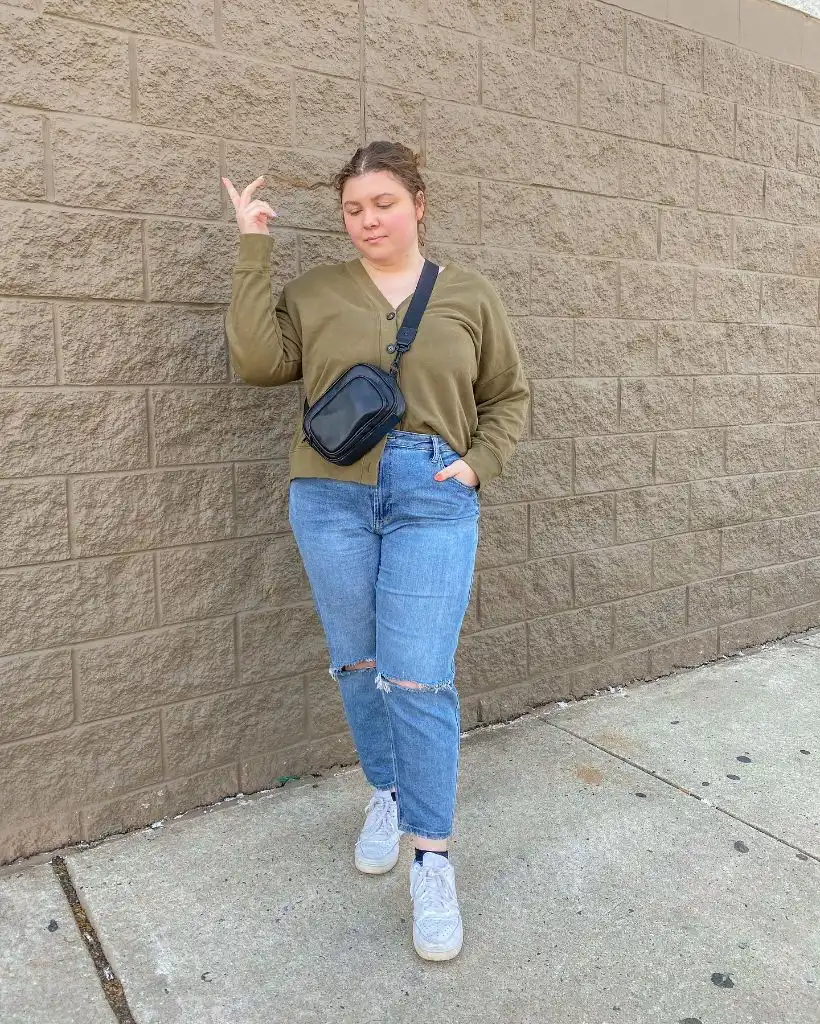
Photo via Instagram
The diagonal line of the crossbody strap introduces asymmetry that keeps the look from reading as too uniform. The olive cardigan has enough warmth to contrast meaningfully against the cool wash of the denim, and the cropped length means the waistline stays visible, which establishes a clear break between the upper and lower halves. The white sneakers pick up the lightest tones in the jeans and pull brightness to the bottom of the frame.
The useful move here is using a crossbody bag as a structural element rather than just an accessory. The strap creates a line that the eye follows, dividing the torso into zones and adding visual rhythm to an otherwise simple two-piece combination. A bag worn this way can function almost like a belt in terms of how it organizes a silhouette.
3. Dark Quilted Jacket Over Wide-Leg Denim
A black quilted jacket with snap closures is worn open over a dark top, paired with wide-leg light-wash jeans. A brown leather tote bag hangs from one hand, and a phone is held in the other. The scene is a city street at night, with illuminated European-style architecture and a crosswalk visible behind.
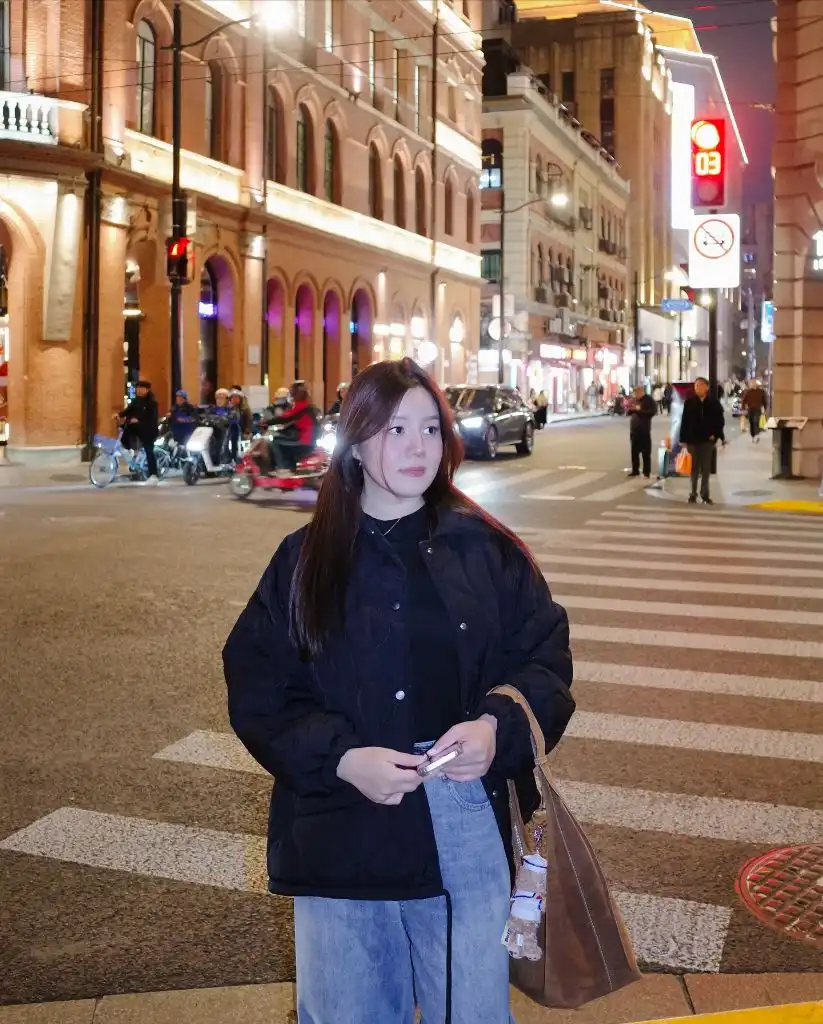
Photo via Instagram
The quilted texture of the jacket reads as substantial without appearing heavy, and the boxy silhouette on top is counterbalanced by the wide flare of the denim below. That mirror effect — volume up top, volume at the hem — creates a balanced column rather than concentrating weight in any one zone. The brown tote introduces a third tonal note that reads warmer than either the black or the denim, which prevents the palette from feeling too cold under artificial light.
The strongest lesson is that matching the scale of the outerwear to the scale of the pants can produce a harmonious proportion even when both pieces carry significant volume. When the top and bottom echo each other in width, the result feels intentional rather than oversized, and a warm-toned bag can soften an otherwise cool-leaning palette.
4. Striped Knit With a Long Cream Trench
A black-and-cream striped knit sweater is worn under a long cream trench coat that drapes open to the knee. Black flared trousers extend below, and pointed black boots are just visible at the hem. Oversized sunglasses sit on the face, and a bold red lip provides a sharp accent. A small structured black bag is worn crossbody, and the coat is draped casually off one shoulder.
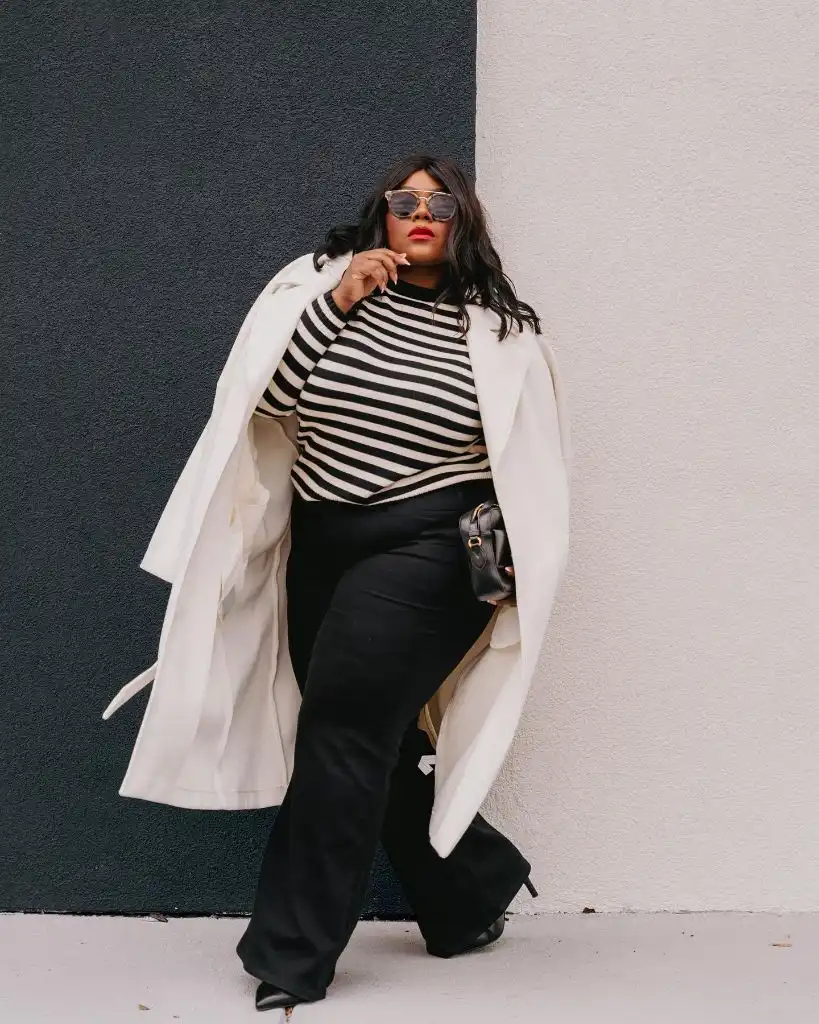
Photo via Instagram
The interplay between the horizontal stripes and the vertical fall of the trench coat is what gives this look its tension. The stripes create width and movement across the torso, while the long coat provides a strong downward line that counters that lateral pull. The red lip functions as a color interrupt — it has nothing to do with the rest of the palette, and that isolation is exactly what makes it effective. The flared trousers mirror the coat’s drama at the lower half.
What stands out most is the discipline of keeping the color palette to just two tones — black and cream — and then using a single point of red to break the pattern. That kind of controlled color contrast can make a winter outfit feel editorial without requiring elaborate coordination, and the lesson transfers to any neutral palette where one unexpected color note sharpens the whole composition.
5. Tonal Brown Half-Zip Set With Platform Boots
A matching set in a warm brown tone consists of a half-zip pullover with a collared neckline and wide-leg drawstring trousers. The fabric appears to be a medium-weight fleece or ponte. The text overlay reads “Size up to 8xl.” Platform boots in a tan or oatmeal shade sit below the trouser hem, and a gold chain necklace is visible at the open collar. A coffee cup is held in one hand.
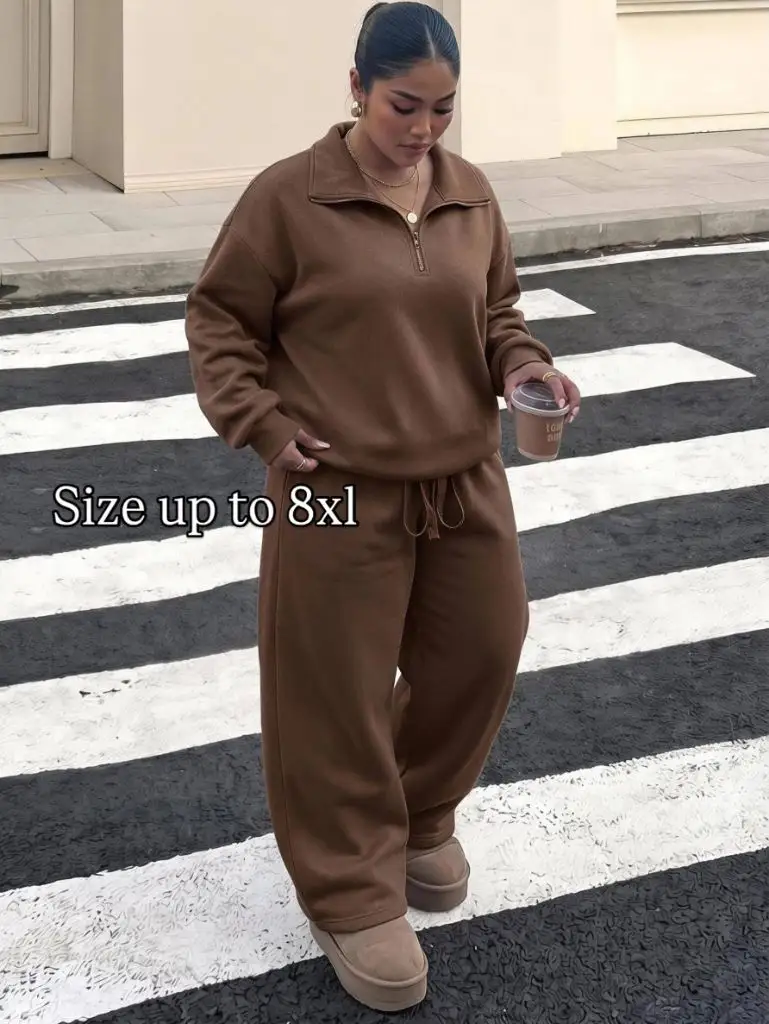
Photo via Instagram
The strength of a tonal set lies in the unbroken color column it produces. There is no seam where the eye is forced to stop and recalibrate, which gives the silhouette a sense of elongation even when both pieces carry a relaxed fit. The platform boots add height without introducing a contrasting color, since their shade sits close enough to the brown to read as part of the same family. The gold necklace catches light at the collar and draws attention to the face.
The best move here is committing fully to a single color family and allowing the silhouette to do the work. When every piece shares a tonal range, the visual result is a continuous line from shoulder to ankle, and the only accents needed are small metallic details that add warmth without breaking the column.
6. Burgundy Sweater Tucked Into Dark Wide-Leg Jeans
A ribbed burgundy or deep plum sweater is worn tucked into dark indigo wide-leg jeans, with a thin brown leather belt marking the waist. Round sunglasses sit on the face, and a small brown crossbody bag with a thin strap hangs at the hip. Nude or light tan pointed mules are visible below the hem. The background shows large glass panels reflecting trees and sky.
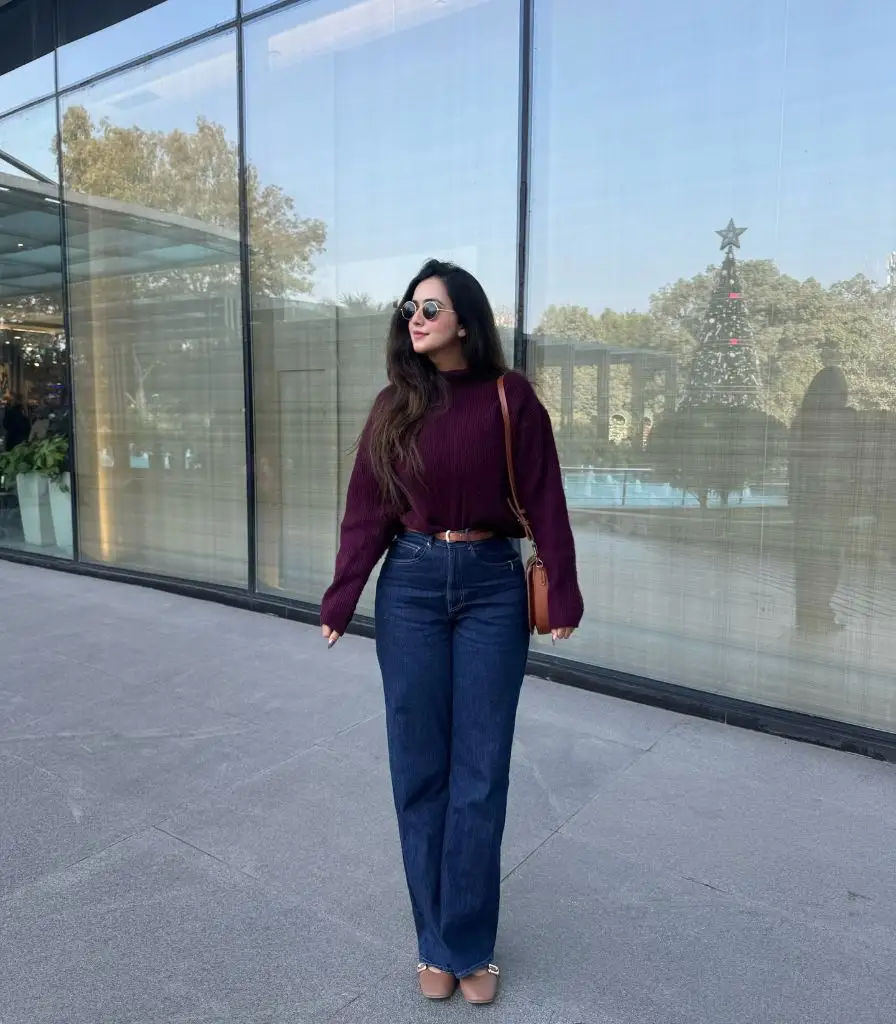
Photo via Instagram
The tucked sweater establishes a clear waistline, and the belt reinforces it with a thin line of brown that echoes the bag strap and the mule color. That trio of brown details creates a quiet rhythm across the look — wrist level, hip level, ground level — without any single piece demanding attention. The wide leg of the jeans adds volume at the bottom, but the dark wash keeps it grounded, and the burgundy provides a rich seasonal tone that feels warmer than black without reading as bright.
The useful idea is that repeating a secondary color in three small places — a belt, a bag, and a shoe — can unify a two-tone outfit without requiring a matching set. Those small coordinated details create coherence through repetition, and the effect is stronger when the accent color appears at different heights on the body.
7. Black Coat Over Tweed Skirt in a Snowy Setting
A double-breasted black wool coat falls to mid-calf, worn open to reveal a black turtleneck and a tweed or houndstooth mini skirt with a wide decorative buckle belt at the waist. Black tights and tall black leather boots extend below, and sunglasses are held in one hand. A gold choker necklace is visible at the neckline. The backdrop is a frozen lake with snow-covered evergreen trees and low clouds.
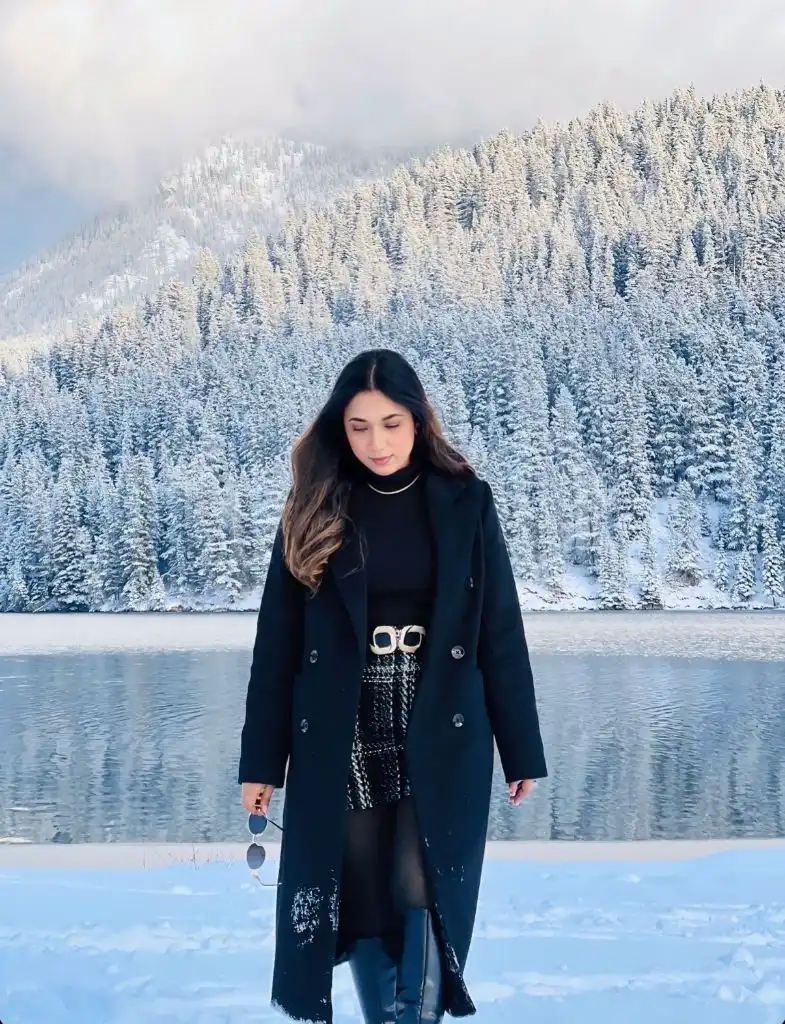
Photo via Instagram
The almost entirely black palette could risk reading as flat, but the tweed skirt introduces texture and a subtle pattern that breaks the monotony right at the center of the frame. The oversized buckle belt sits at exactly the point where the turtleneck meets the skirt, drawing the eye to the narrowest part of the silhouette. The coat’s length and the boot’s height leave only a small band of tighted leg visible between skirt hem and boot top, which creates a deliberate ratio of coverage to exposure.
The reader takeaway is that an all-dark outfit gains depth through texture variation rather than color. I like how the tweed provides enough visual friction to keep the look from going uniform, and that principle — introducing one textured piece into a monochrome winter palette — can make even the simplest combination feel intentionally styled.
8. Long Grey Cable-Knit Cardigan Over Fitted Basics
A floor-length open-front cardigan in medium grey features a heavy cable-knit pattern with alternating textures. It is worn over a white square-neck fitted top and light-wash skinny jeans. The cardigan has deep patch pockets and wide cuffs. The setting is a plain white interior backdrop.
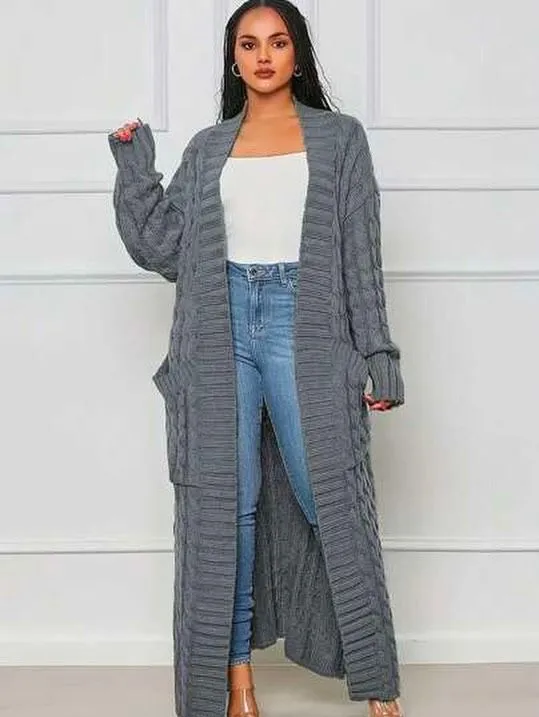
Photo via Instagram
The extreme length of the cardigan — nearly reaching the floor — creates a dramatic vertical sweep that dominates the silhouette. By keeping the inner layers fitted and light-toned, the look avoids the bulk that such a heavy outer layer might suggest. The cable-knit pattern adds significant texture, and the alternation between cable panels and ribbed sections creates visual zones within the single garment. The patch pockets add weight at hip level, which grounds the look.
The strongest lesson is that a single statement layer can carry an entire outfit when everything underneath stays deliberately quiet. The proportional contrast between the oversized cardigan and the fitted base pieces is what makes the length read as intentional rather than overwhelming, and that ratio works with any long outer layer paired against slim foundations.
9. Dark Sweatshirt Dress With a Plaid Scarf
A dark navy or black oversized sweatshirt — possibly reading as a sweatshirt dress — is worn with black tights and chunky black lace-up boots. A large plaid scarf in cream, black, and red drapes across the chest, and sunglasses are pushed up onto the head. The text on the sweatshirt appears to reference a city name. The background is a brick wall corner with a small white street lamp.
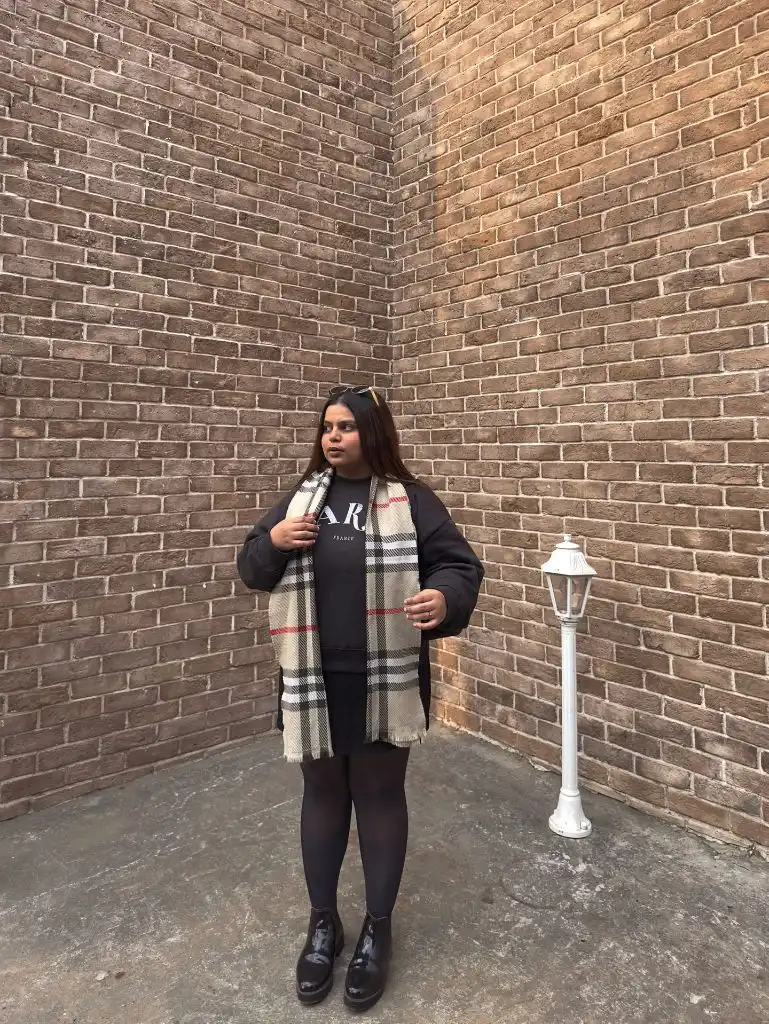
Photo via Instagram
The plaid scarf is doing most of the compositional work here, introducing three colors and a geometric pattern into an otherwise monochromatic base. Its width and drape create a vertical panel of interest across the center of the chest, and the red line within the plaid acts as the only warm note in the entire frame. The chunky boots provide visual weight at the bottom, anchoring the relaxed proportions of the oversized top half.
What stands out most is the way a single patterned accessory can transform a monochrome base into something visually complex. The scarf functions almost like an outer layer in terms of how much space it occupies and how much pattern it introduces, and that approach — keeping the garments simple and letting one accessory carry the visual interest — can work in nearly any cold-weather context.
10. Purple Sweater With Printed Zebra Trousers
A chunky ribbed sweater in a warm lilac or purple tone is worn slightly cropped, paired with high-waisted trousers in a purple and coral zebra print. Black chunky-soled boots ground the look. The background features a pink painted wall with a mural of hand-drawn hearts and a pink wooden planter bench. The hair is a vivid teal or turquoise shade.
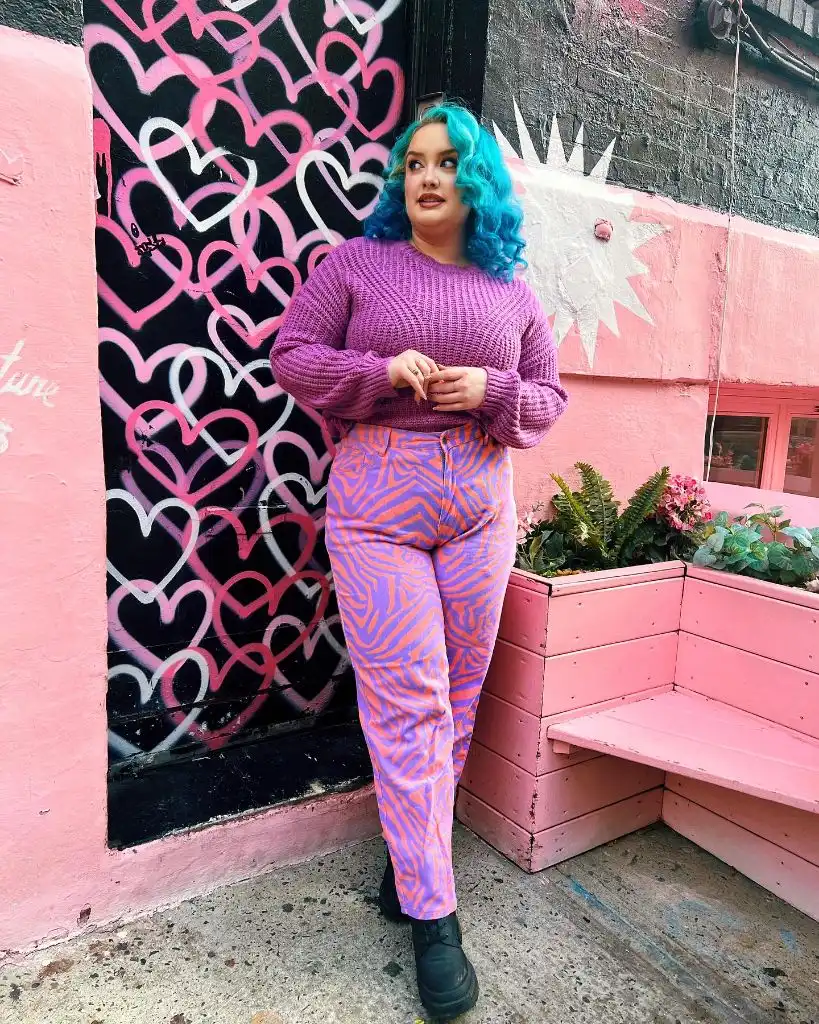
Photo via Instagram
The color commitment here is striking — the sweater’s purple is picked up in the dominant tone of the zebra print, so the two pieces read as related rather than competing. The coral within the print provides a warm counterpoint that prevents the purple from going too cool, and the black boots serve as a visual full stop at the base. The teal hair adds yet another color layer, but it sits far enough from the purple family to function as an independent accent rather than a clash.
The beauty of this is the confidence of working within a bold color family rather than defaulting to neutrals. When the top and bottom share a color thread, even a loud print can feel cohesive and deliberate, and the lesson is that bold does not mean chaotic as long as there is a connective tone running through every piece.
11. White Sherpa Coat Over a Green Sweater in Snow
A long white sherpa or faux-fur coat is worn open over a green crewneck sweater, with white or very light trousers below. A white knit beanie with a pom-pom tops the head, and white chunky sneakers or hiking-style boots sit at the base. A belt in green or a matching tone is just visible at the waist. The setting is a snow-covered wooden footbridge with a small chapel behind.
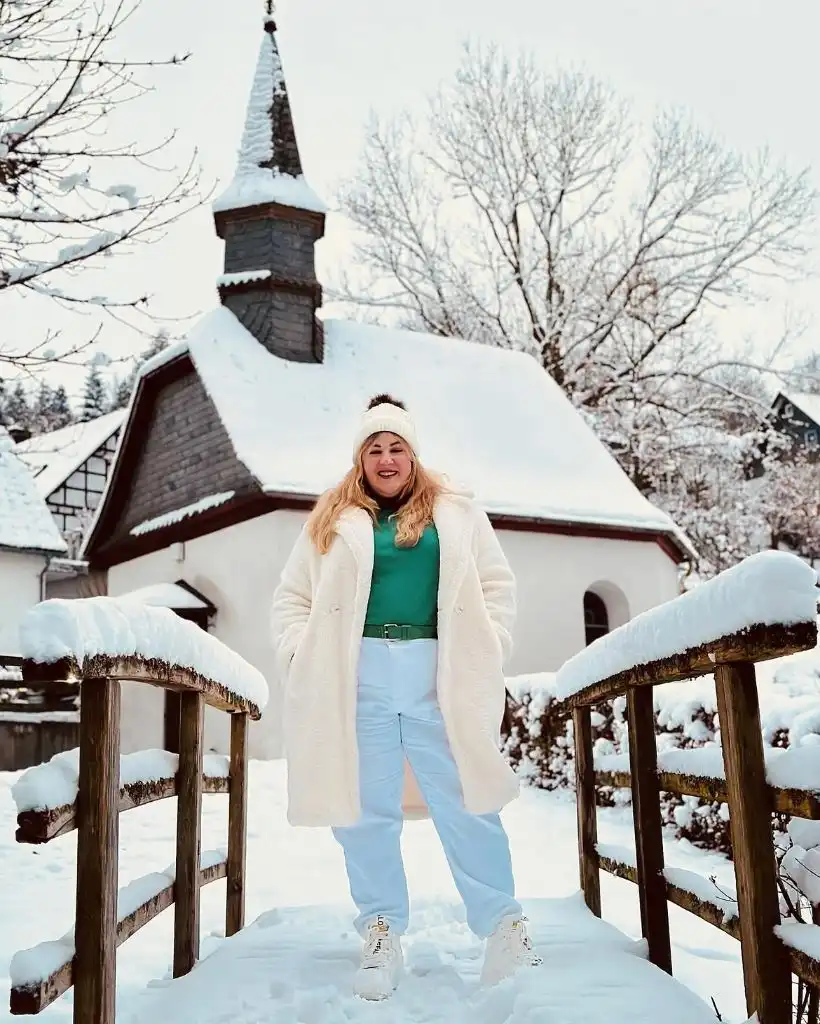
Photo via Instagram
The green sweater is the single color interrupt in an otherwise all-white composition, and its placement at the center of the chest means the eye travels directly to it. The sherpa coat’s texture reads as soft and substantial without appearing heavy, and its open drape frames the green like a window. The white trousers and white boots extend the pale column downward, and the beanie continues it upward, so the green truly sits as an island of color in a sea of white.
The useful move here is using a single garment in a contrasting color as the focal point within a head-to-toe neutral scheme. That one green sweater transforms what could be a monochrome look into something with a clear center of gravity, and the principle works with any bright piece placed strategically inside a neutral layered outfit.
12. Blue Patterned Puffer With a Quilted Crossbody
A hooded puffer jacket in a blue-and-white pattern — possibly tie-dye, cloud print, or watercolor — is worn zipped over a dark base layer. A knit beanie in grey with a small Swiss-cross emblem sits on the head, and oversized dark sunglasses cover the eyes. A black scarf or dark knit layer is visible at the chest. A small light pink quilted crossbody bag with a chain strap hangs at the front. The background shows a marina with sailboats and yachts in misty light.

Photo via Instagram
The puffer jacket’s pattern introduces movement and visual complexity across the entire upper body, and the cool blue tones harmonize with the misty marina behind. The pink crossbody bag is a deliberate color surprise — it sits against the blue and reads as both complementary and unexpected. The beanie and sunglasses darken the top of the frame, grounding what might otherwise feel too airy with the light-toned jacket. The layering of the scarf beneath the jacket adds depth at the neckline.
The reader takeaway is that a patterned outerwear piece works best when accessories either echo its tonal family or introduce a single strategic contrast. The pink bag against the blue jacket demonstrates how one small color departure can bring warmth and personality to a cold-toned winter look without disrupting the overall composition.
13. Zebra Print Top With a Cream Cardigan and Dark Jeans
A black-and-white zebra print bustier or corset-style top is layered over a cream ribbed long-sleeve shirt, creating a visible contrast between the fitted print piece and the softer knit beneath. Dark wash wide-leg jeans or trousers are worn below, and white low-top sneakers — appearing to be Nike Air Force 1s — ground the look. A crossbody bag with a matching print is visible at the side. The photo is taken from a low angle against a green painted wall.
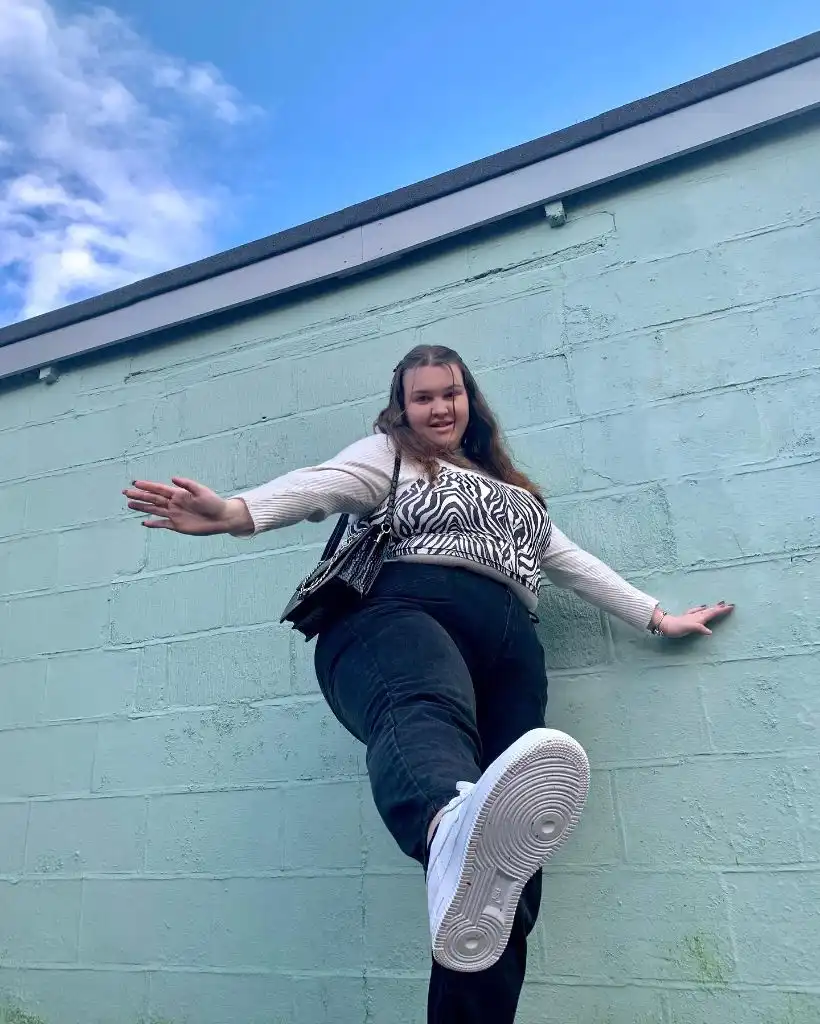
Photo via Instagram
The layering of the structured print top over a soft sleeve creates an interesting tension between formality and ease. The zebra print is bold, but because the cream sleeves extend beyond it and the dark jeans sit below, it occupies a contained zone at the center of the torso rather than dominating the entire frame. The white sneakers keep the overall mood casual and prevent the print from reading as dressy. The low camera angle emphasizes the length of the leg line.
The best move here is using a statement piece — in this case a patterned top — as a middle layer rather than the outermost one, so it reads as an accent within the outfit rather than defining it entirely. That layered approach to bold prints allows them to appear in winter looks without overwhelming the overall silhouette.
14. Cream Teddy Jacket Over Black Basics With a Houndstooth Bag
A short cream teddy or sherpa jacket with snap buttons is worn over a black cropped top and dark grey or charcoal wide-leg jeans. A small structured handbag in a black-and-white houndstooth pattern is carried by hand. Auburn or copper-toned wavy hair falls over the shoulders, and dark sunglasses are pushed up onto the head. The setting is a stone-faced urban building exterior.
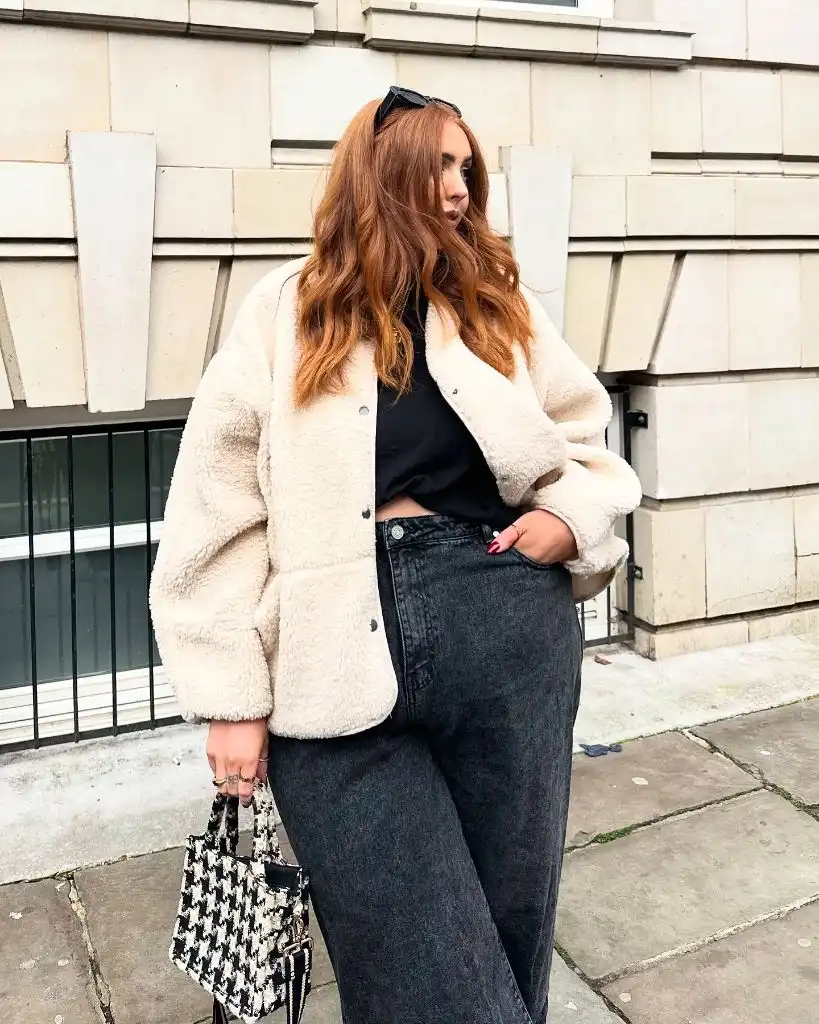
Photo via Instagram
The teddy jacket’s short length — hitting at the natural waist — is what keeps the volume from overwhelming the frame. By pairing it with a cropped top and high-waisted jeans, the waistline remains visible and the proportions stay balanced. The houndstooth bag introduces pattern at a small scale, which adds visual interest without competing with the jacket’s texture. The cream and black palette feels classic, and the warm hair color adds a tonal bridge between the two extremes.
The strongest lesson is that a textured jacket works most effectively when it stays short enough to reveal the waistline beneath. That simple proportional choice — heavy texture above, clean line at the waist, wide leg below — creates three distinct zones that balance volume thoughtfully and prevent any single layer from dominating the silhouette.
15. Lavender Wool Coat With a Pink Oversized Scarf
A long oversized coat in a pale lavender or lilac wool is worn with what appears to be dark trousers or leggings below. A large pink scarf with fringe is wrapped generously around the neck, its ends hanging past the waist. The setting is a snowy residential street with bare trees and houses in soft focus behind. One hand rests on the head, and the overall silhouette is relaxed and enveloping.
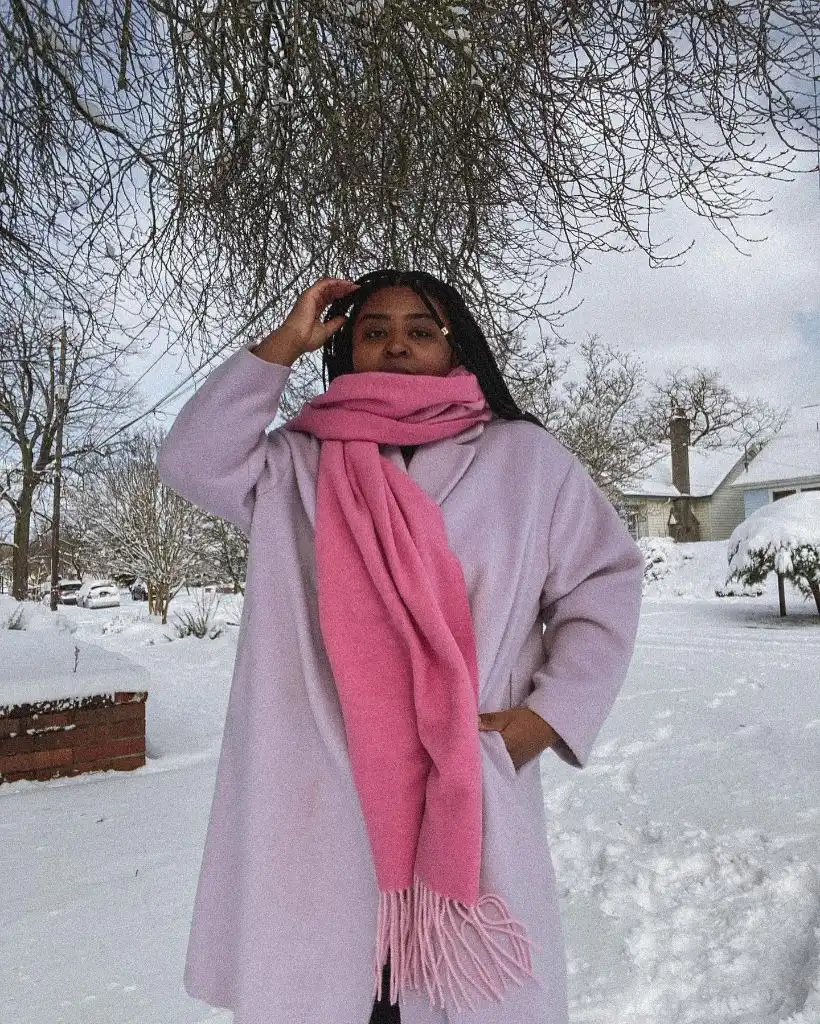
Photo via Instagram
The lavender and pink combination works because the two colors sit close enough on the spectrum to feel harmonious while remaining distinct enough to create visual separation. The scarf’s volume at the neck balances the coat’s volume through the body, so neither zone feels heavier than the other. The fringe adds a subtle texture detail that breaks up the smooth wool of the coat. Against the white snow, the pastels read as warm and deliberate rather than washed out.
What stands out most is the willingness to pair two soft colors together rather than grounding one with a neutral. That tonal-neighbor approach — lavender beside pink, both in the same value range — creates a gentle, cohesive warmth that a harsh contrast would not achieve, and it works particularly well in snowy or overcast light where softer colors hold their own.
16. Zebra-Print Coat With Neon Yellow and Pink Accents
A zebra-print coat in black and white is worn open over a bright neon yellow blazer or jacket, which in turn layers over a dark base. Black leggings or slim trousers are below, with chunky black lace-up boots featuring metallic or studded details. A small bright fuchsia or hot pink handbag is held in one hand. A beaded phone strap in green adds another color point. The setting is a living room with a decorated Christmas tree.
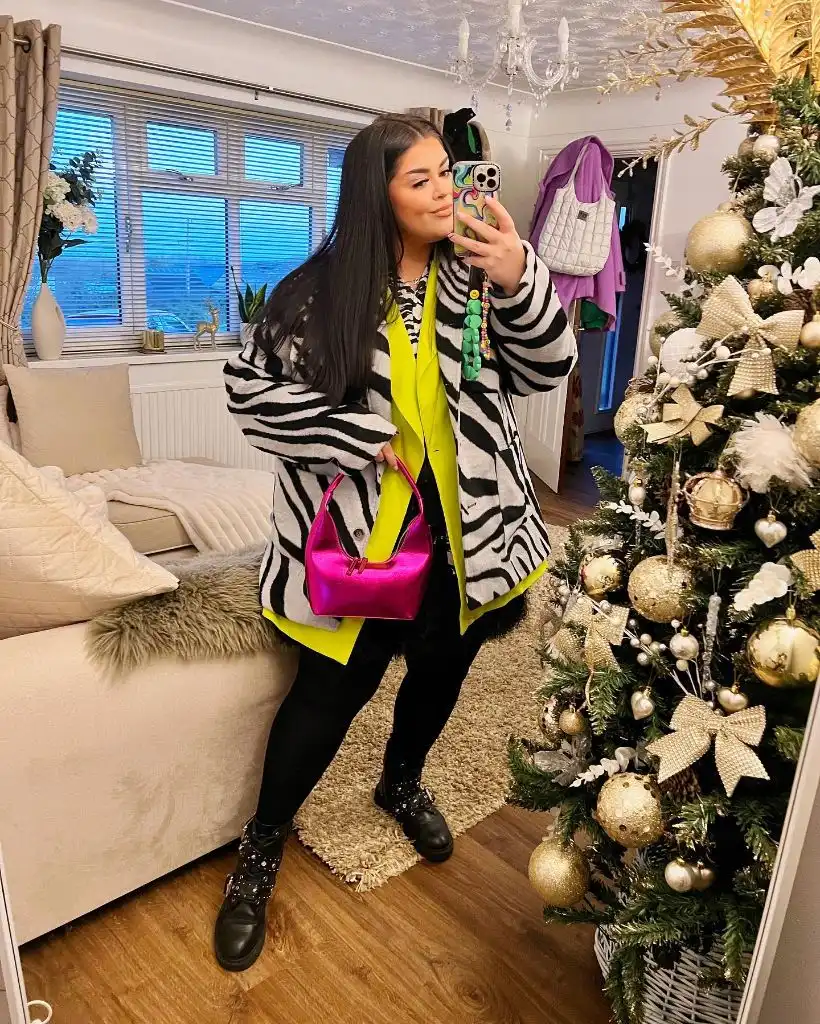
Photo via Instagram
The layering here operates on a principle of deliberate escalation — the dark base is quiet, the neon yellow raises the volume, and the zebra print amplifies it further. The pink bag introduces yet another color note, but because it is small in scale, it reads as punctuation rather than noise. The black boots provide a visual anchor that keeps all of those competing signals from floating, and the studded details echo the maximalist energy without adding another color.
The useful idea is that multiple bold elements can coexist when they are organized by scale and position. The loudest piece — the coat — sits outermost where it has the most surface area, while the brightest color — the yellow — occupies a narrower band beneath it, and the smallest accent — the pink bag — is held in hand. That graduated layering of intensity is what keeps a multi-pattern, multi-color look from reading as accidental.
17. Green Houndstooth Coat With a Lilac Beret
A green and white houndstooth or dogtooth-patterned coat or shirt-jacket is visible at close range in this selfie-style image. A lilac or light purple felt beret sits on the head, and a purple crossbody bag strap is visible over one shoulder. The collar of a green shirt or blouse peeks above the coat’s neckline. The makeup features natural tones with a soft pink lip, and gold hoop earrings are just visible.
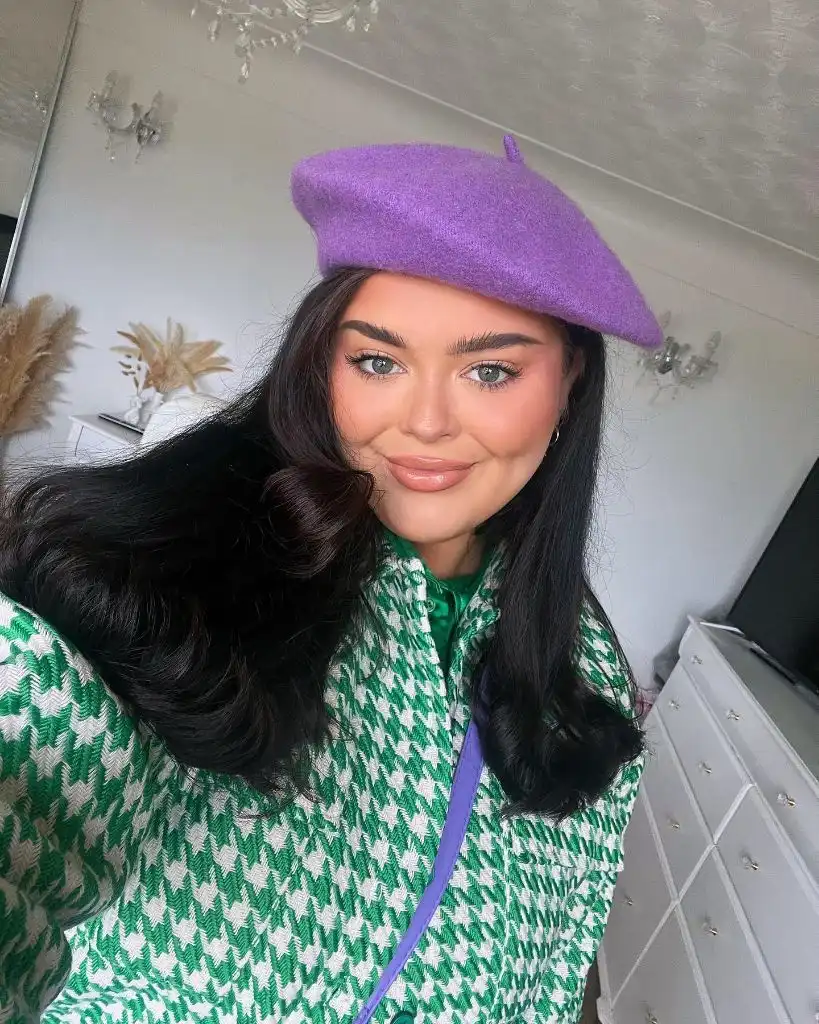
Photo via Instagram
The green-and-purple color pairing is complementary on the color wheel, which gives it an inherent visual energy, but the softness of the lilac and the small scale of the houndstooth pattern keep it from reading as aggressive. The beret adds a structured shape at the top of the frame, and its felt texture contrasts with the woven pattern of the coat below. The gold earrings add a metallic warmth that bridges the cool purple and the warm green.
The reader takeaway is that complementary colors work best when one is muted and one carries the pattern. By keeping the purple soft and solid while the green appears in a textured print, the combination stays balanced rather than competing, and that approach to color pairing in winter accessories can apply to any two complementary tones adjusted for softness.
18. Black Leather Bomber Over a Beige Crop Knit
A black leather or faux-leather bomber jacket is worn open over a beige or nude cropped knit sweater. Wide-leg black trousers or a flowing skirt extend below. The curly hair is loose and falls past the shoulders. The setting is a snowy garden with evergreen trees and a black wrought-iron lamp post. The outfit exposes a small band of skin at the midriff between the crop top and the waistband.
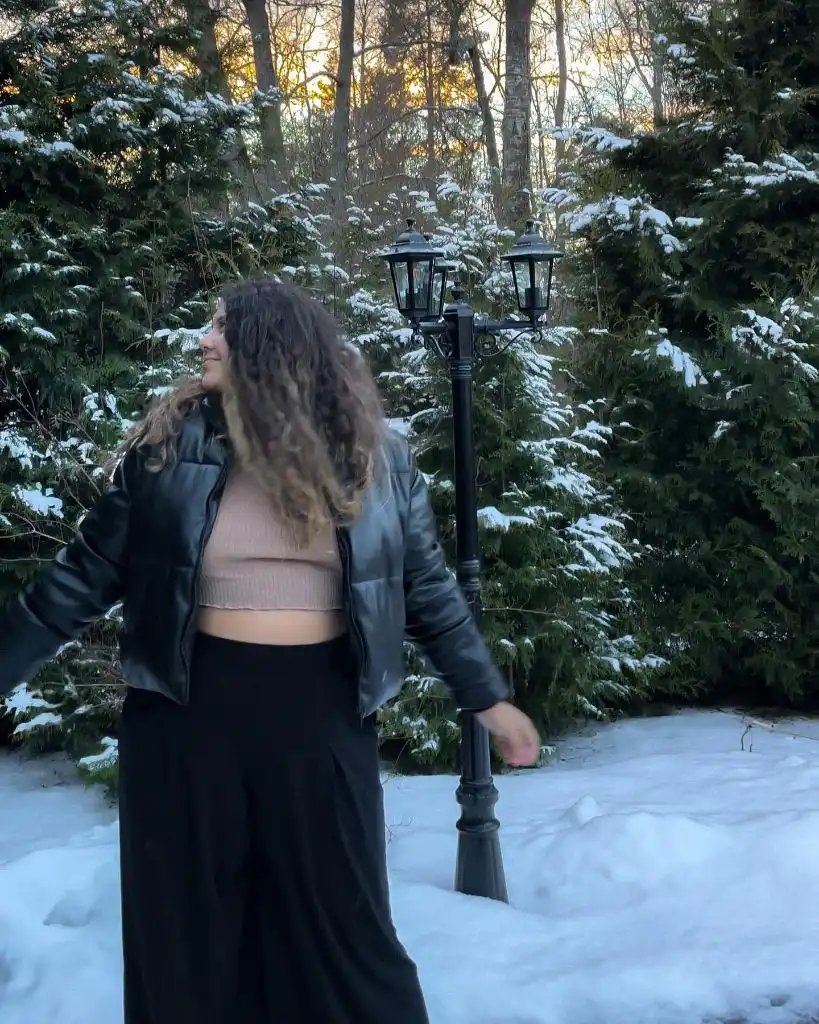
Photo via Instagram
The contrast between the smooth leather of the bomber and the soft knit texture of the crop sweater creates a tactile tension that gives the look its edge. The beige crop sweater is the lightest element, and its placement at the center of the torso draws the eye to that zone while the black jacket and black trousers frame it on either side. The wide leg of the trousers balances the bomber’s structured shoulders, and the curly hair adds a softness that prevents the leather from reading as too severe.
The beauty of this is the way a single light-toned piece can serve as the focal point within an otherwise dark composition. The beige sweater functions like a window of warmth between two panels of black, and that technique — placing the lightest color at the body’s center — can anchor any dark-layered winter outfit with a clear point of visual interest.
19. All-White Corset and Skater Skirt Ensemble
A white corset-style top with lacing detail is worn over a white long-sleeve base layer, paired with a white skater skirt that flares at mid-thigh. White opaque tights with decorative heart cutouts run down the legs, and chunky white lace-up boots with thick soles complete the look. A delicate chain belt with heart-shaped links sits at the waist. The setting is a European stone building facade in warm sunlight.
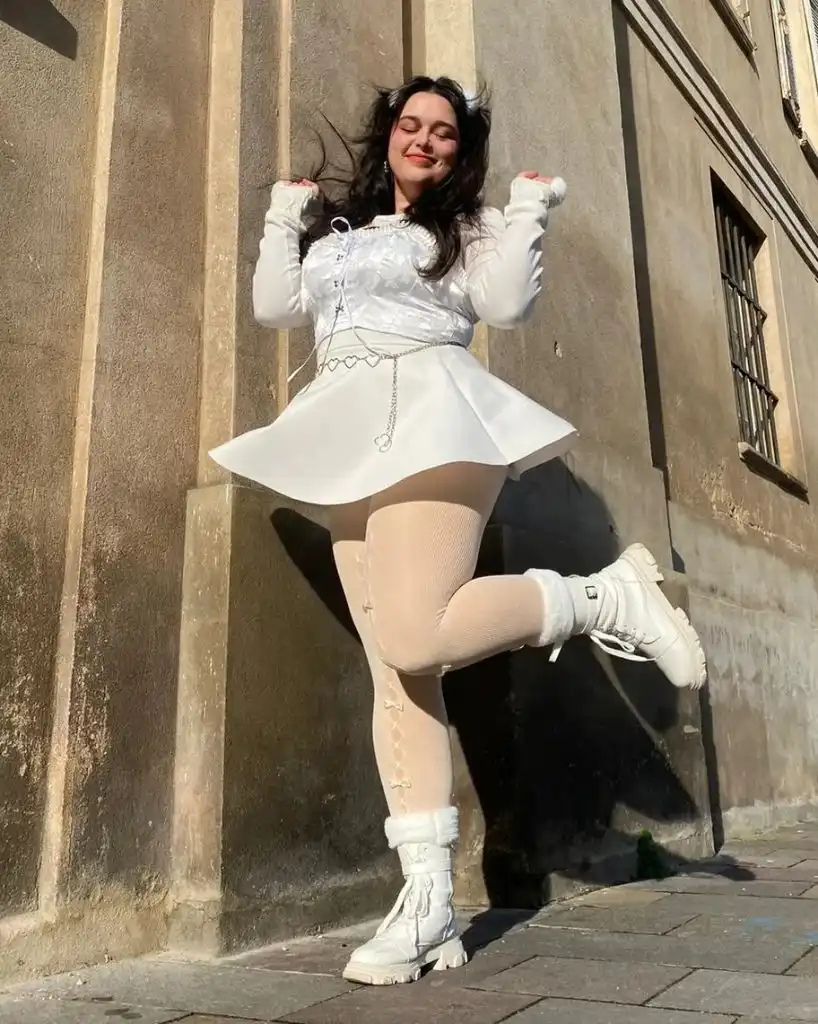
Photo via Instagram
The all-white palette is held together by the variety of textures and details within it — the smooth corset, the ribbed or knit base layer, the flowing skirt, the patterned tights, and the rugged boots each contribute a different surface quality that prevents the monochrome from going flat. The heart motifs appear in both the tights and the chain belt, creating a thematic thread that ties the accessories together. The boots’ chunky sole adds visual weight at the base, grounding the lighter, more delicate pieces above.
The useful move here is recognizing that monochrome does not mean monotonous when texture and detail vary across each layer. The hearts, the lacing, the cutouts, and the chain all function as pattern elements within a single color, and that approach to building visual interest through texture alone demonstrates that winter whites can carry just as much complexity as a multi-color look.
20. Striped Breton Knit With Black Jeans and a Crossbody Bag
A fitted black-and-cream Breton-stripe knit sweater is worn tucked or sitting at the waist of black high-waisted jeans. A black leather crossbody bag hangs at the hip. The hair is dark with soft waves, and a bold red lip provides the only color accent. The background is a split-tone wall — dark charcoal on one side, white on the other — which mirrors the black-and-white palette of the outfit itself.
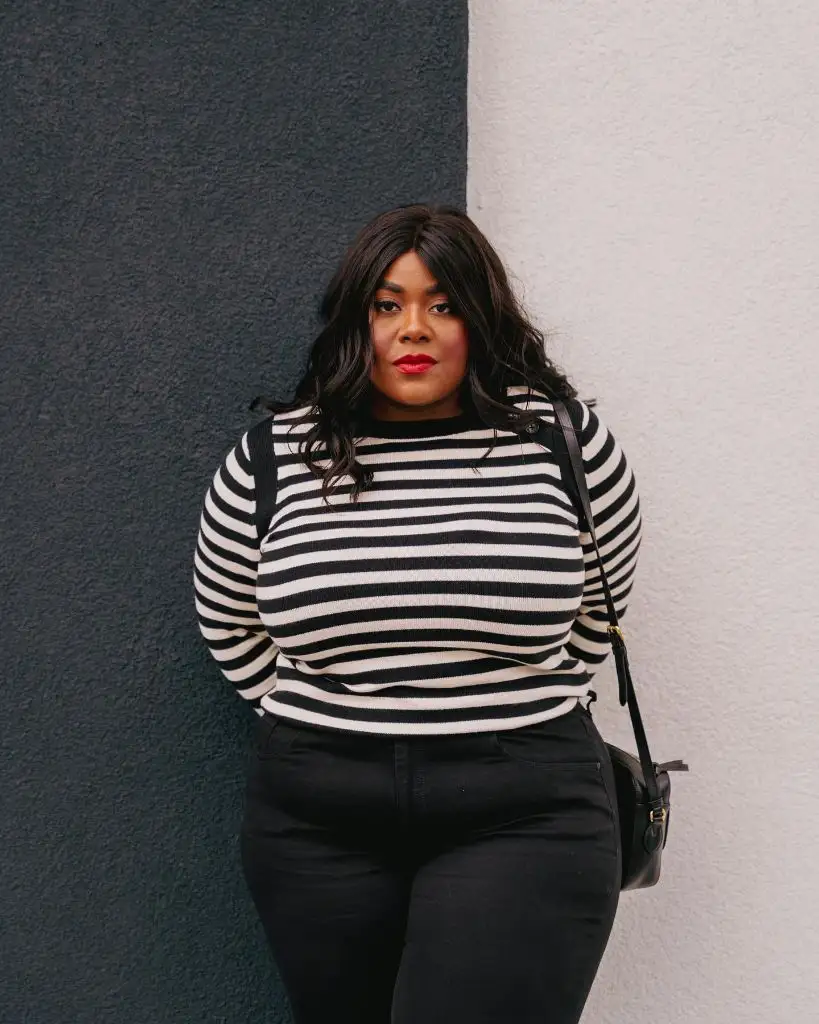
Photo via Instagram
The background wall almost functions as an extension of the outfit, with its dark-to-light split echoing the stripe pattern and the black-to-cream color range. The fitted sweater defines the torso without adding bulk, and the horizontal stripes create a rhythm across the chest that the eye follows laterally before being pulled downward by the solid black of the jeans. The red lip is the only departure from the monochrome scheme, and its placement at the face ensures it catches attention first.
The strongest lesson is that a background or environment can reinforce an outfit’s visual logic when the tones align. But the transferable principle here is simpler — a classic striped knit and dark jeans need almost nothing else to feel complete, and the restraint of adding only a bold lip as the single point of color contrast is often more striking than any accessory could be.

Hi, I’m Zoey Mitchell, the creator of ChicStyle Blog.
I share simple, wearable outfit ideas, hairstyles, nail trends, and beauty tips that feel natural and easy to recreate.
This blog is where I explore everything that makes a woman feel put together and confident every day. I’m not an expert — just a woman who genuinely loves style, mixing looks, and discovering what works.
If you love effortless fashion with a personal touch, you’ll feel at home here.