
There is something about a hand curled around a wool cuff in cold light, where the nails carry a color so deep it nearly disappears into shadow, or so pale it could be frost settling on skin. Winter short nails hold their own quiet authority in that space between warmth and chill, where every finish and every tiny painted detail has to work harder because the canvas is small and the season demands richness.
This article moves through twenty-five distinct manicures, each photographed on real hands, each offering a different answer to the same seasonal question: how do you build visual interest on a short nail without clutter or noise? The variables worth watching across these images are color density, which determines whether a nail reads as deep and saturated or airy and frosted; surface texture, from mirror-gloss to matte to scattered glitter; motif placement, meaning where a snowflake or bow or line art sits relative to the cuticle, the free edge, and the negative space; and shape-to-length proportion, the way an almond tip or a square edge changes the personality of an identical shade. These four threads run through every section that follows, and they are the tools that separate a considered winter manicure from one that simply chose a dark color and stopped thinking.
1. Deep Cherry With Silver Glitter Border
Four nails in a rich cherry-red cream finish sit at a short-to-medium almond length, each one framed by a fine border of silver holographic glitter that traces the entire perimeter of the nail plate. The glitter sits tight against the cuticle line and sidewalls, forming a consistent halo rather than a scattered field. A delicate eternity band on one finger echoes the silver without competing for attention.
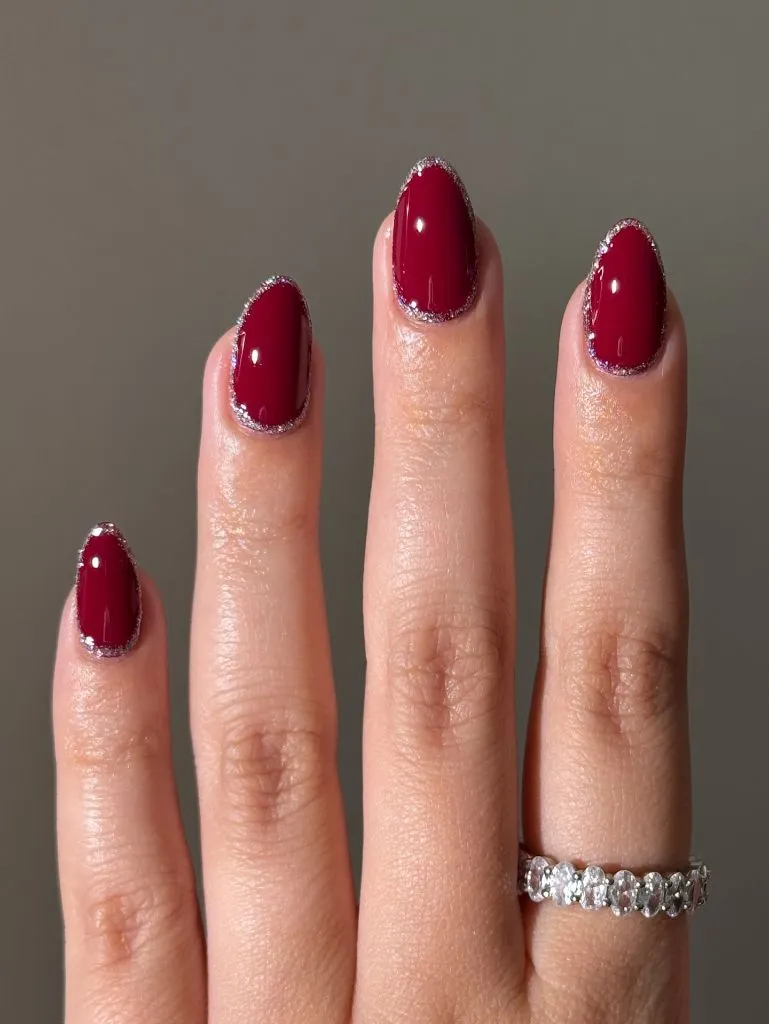
Photo via Instagram
The structural idea here is framing as restraint. The glitter does not cover the nail or fade into it; it outlines it, the way a thin gilt frame holds a painting without entering the image. Because the red is so deeply saturated and the glitter so fine, the eye registers the border as architecture rather than decoration. The silver and the ring metal repeat each other at different scales, which keeps the hand feeling unified. That kind of tonal echo between jewelry and nail detail is one of the quieter ways a winter nail palette can feel intentional rather than assembled.
The reader takeaway is that a glitter border works best when it stays narrow and consistent all the way around the nail. The moment the border thickens unevenly, it reads as spillover rather than design. Keeping the interior finish as a pure cream, with no shimmer, gives the frame something solid to outline.
2. Oxblood Cream With Gold Flake Scatter
Five nails in a deep oxblood shade sit at a natural, slightly rounded length, the finish a high-gloss cream with a handful of tiny gold foil flakes suspended beneath the top coat. The flakes are sparse and irregular, catching light at unpredictable angles rather than forming any pattern. A textured olive-green knit fabric appears behind the hand, adding a warm neutral backdrop.
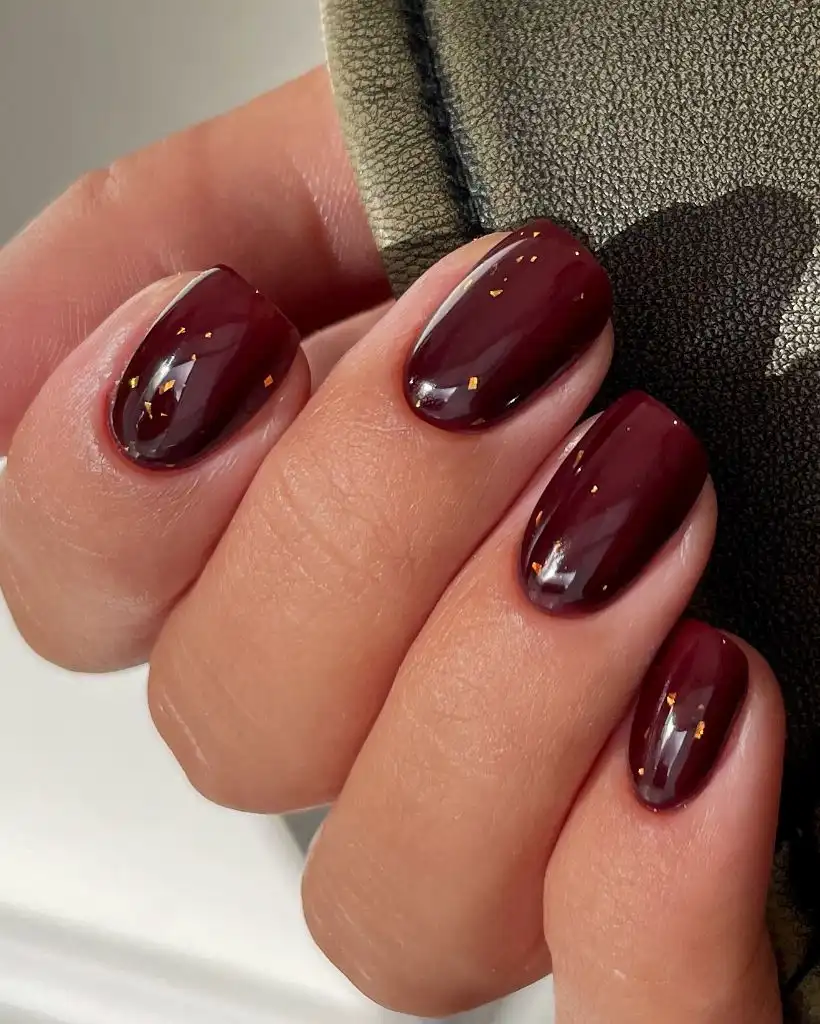
Photo via Instagram
What holds this manicure together is the tension between the controlled, almost-black red and the randomness of the gold flakes. The base color is so dark it could pass for a single solid tone in low light, but the flakes interrupt that uniformity just enough to give the surface depth without pattern. The gold reads warm against the cool red undertone, and because the flakes are so small, they function more like light catching on a textured fabric than like deliberate nail art. The olive knit behind the hand keeps the warmth going without pulling focus.
The useful move here is trusting a dark base to do most of the work and adding only a whisper of metallic disruption. Gold foil flakes lose their charm when they crowd a nail; it is their scarcity on this deep field that makes each one noticeable. The principle transfers to any dark winter shade where a handful of flakes can replace an entire accent nail.
3. Navy Gloss With Holographic Glitter Frame
A set of almond-shaped nails in a rich navy gloss carries a full perimeter border of holographic glitter, denser and more multicolored than a simple silver. The glitter ring sits flush against every edge of the nail, from cuticle to sidewall to free edge, creating a consistent luminous outline around each deep blue surface. A white cable-knit sleeve frames the hand from below.
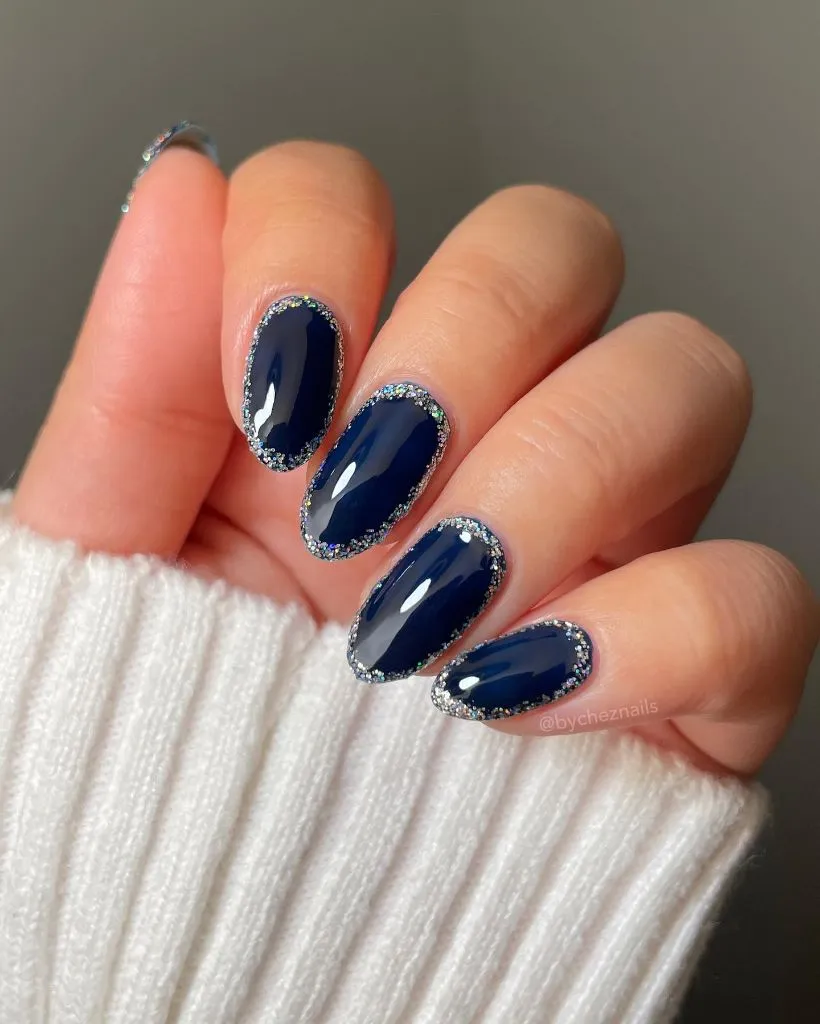
Photo via Instagram
The navy here is dark enough to anchor the hand on its own, but the holographic border lifts every nail into a different register. Because the glitter contains green, purple, and silver tones alongside the expected white flash, the border reads as iridescent rather than monochrome. That complexity keeps the eye moving along the nail edge instead of settling on one point. The white knit beneath adds a clean contrast zone that makes the navy appear even deeper, and the almond shape elongates each nail just enough to give the border room to breathe along the sidewalls.
The strongest lesson is that a glitter border on a dark base gains dimension when the glitter itself is multicolored rather than a single metallic. The holographic mix means the frame shifts tone with every angle of the hand, which is exactly the kind of movement that rewards a short nail style where surface area is limited and every detail needs to pull weight.
4. Teal Glitter With Snowflake Accent Nails
The hand shows a mix of solid teal glitter nails and two accent nails on the middle and ring fingers. Those accent nails carry a sheer or nude base with a dark teal curved line near the tip and a hand-painted white snowflake motif centered in the open space. The remaining nails are coated in a dense teal glitter with a slight navy lean. A white knit cuff and a teal-and-clear two-stone ring sit on the ring finger.
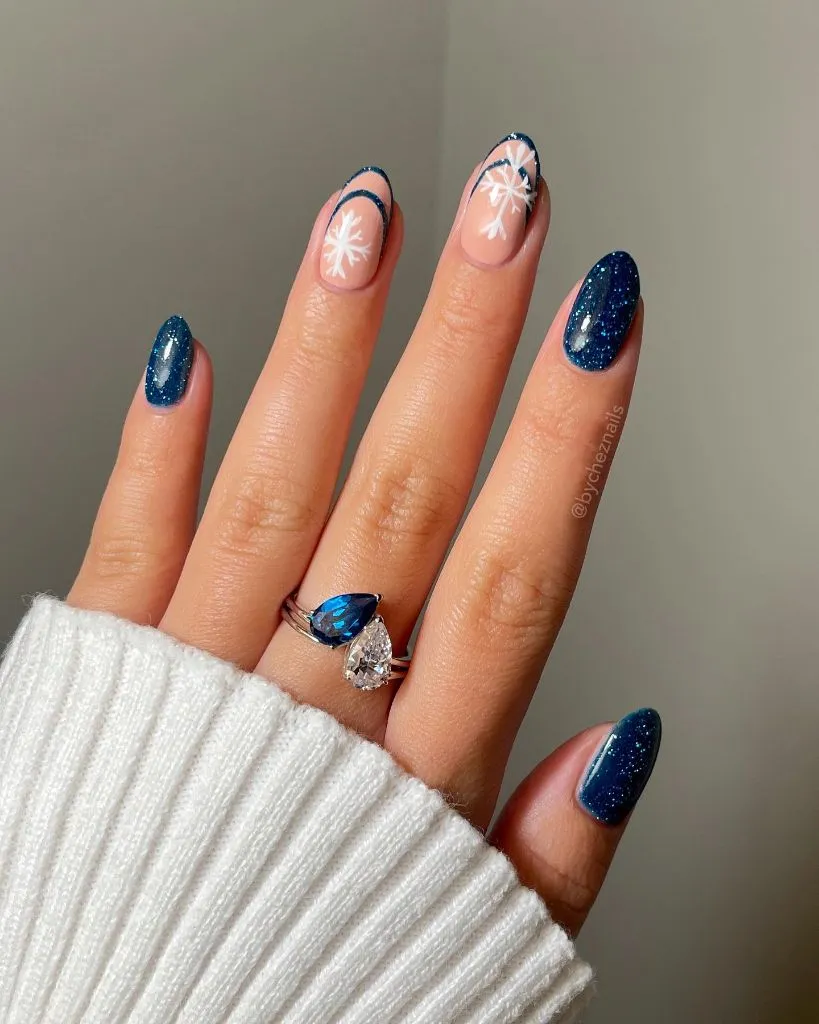
Photo via Instagram
The design splits the hand into two visual zones: the saturated glitter nails act as a color anchor, while the accent nails open up breathing room with their sheer base. The snowflake motif is small enough that it does not crowd the nail, and the dark teal line above it acts as a ceiling, giving the art a defined territory rather than letting it float. The ring’s teal stone repeats the nail color at a different scale, which ties the whole hand together in a way that feels deliberate rather than matched.
What stands out most is the decision to reserve the motif for only two nails and let the glitter carry the remaining three. That ratio keeps the hand from reading as busy, and it gives each zone a clear role. The principle is transferable: when mixing art and texture, keeping the detailed nails in the minority lets the pattern register as a feature rather than a default.
5. Deep Plum Gloss on Natural Shape
Both hands are visible, overlapping gently, all ten nails painted in a deep plum that leans slightly toward grape rather than burgundy. The finish is a pure high-gloss cream with no shimmer, flake, or matte variation. The nails are short with a soft oval shape, and the cuticle lines are clean. The background is a soft neutral fabric, warm-toned and slightly blurred.
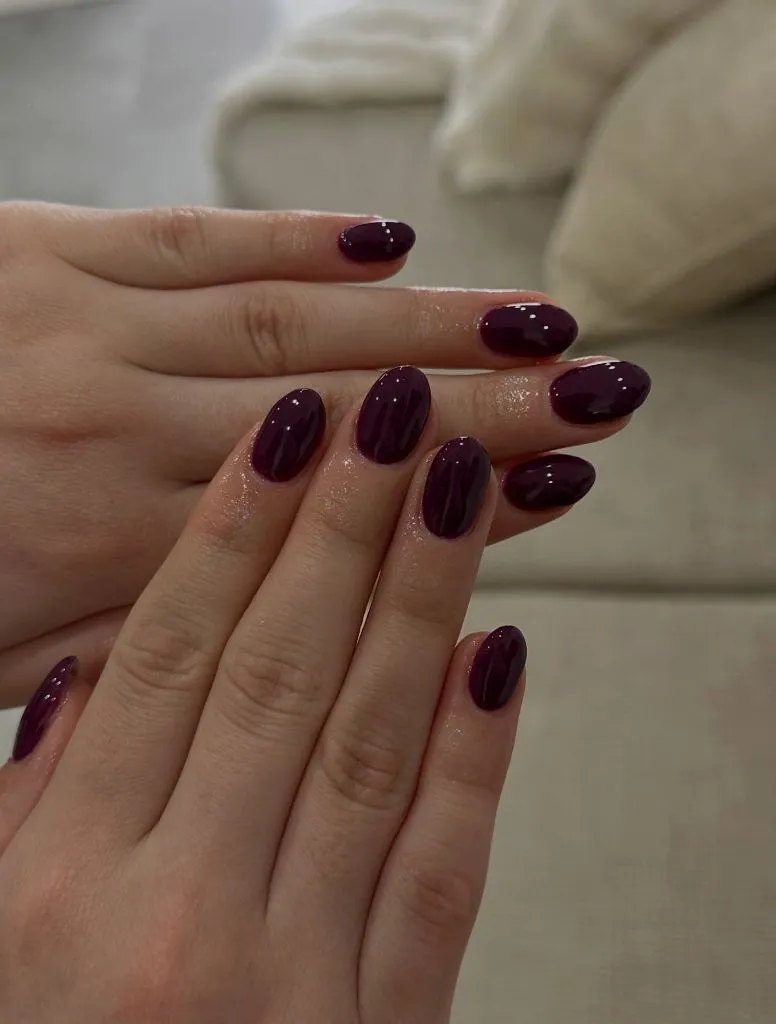
Photo via Instagram
There is a confidence in a ten-nail single-shade manicure that no accent nail can replicate. The plum here is dark enough to command attention but warm enough to avoid reading as black in indoor light. Because every nail matches exactly, the eye moves across the hand as a continuous sweep of color rather than stopping at any single point. The soft oval shape keeps the silhouette gentle, and the high gloss gives each nail a single bright highlight that acts as a miniature light source. Anyone exploring dark nail tones for colder months will recognize how much a clean, unbroken surface can communicate on its own.
The best move here is the refusal to add anything. No glitter, no accent, no matte top coat on one finger. The plum does all the talking, and the consistency across both hands turns the color into a statement of calm certainty. When a shade is this rich, simplicity is the most deliberate design choice available.
6. Icy French Tips With Snowflake Stamps
Four nails at an almond length carry a sheer pink base with glittery white-silver French tips that fade softly rather than ending at a hard smile line. Small white snowflake stamps sit near the tip zone on several nails, and a few tiny rhinestone-like accents are scattered sparingly. A gold ring is visible on one finger, and a cream knit sleeve frames the hand.
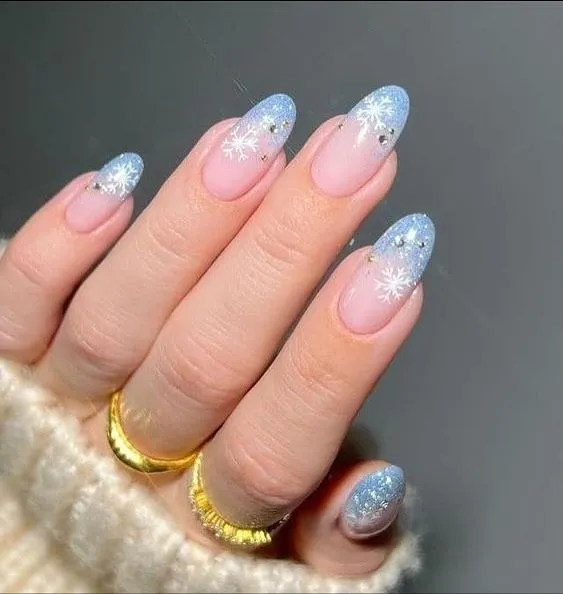
Photo via Instagram
The softness of this manicure comes from the gradient between the sheer pink and the glitter tip. There is no hard line where the color changes; the silver-white fades in gradually, which makes the tip feel like frost forming rather than paint applied. The snowflake stamps are placed high on the nail, near the free edge, which keeps the lower two-thirds of the nail open and quiet. That open space is what prevents the design from tipping into clutter, and the gold ring adds a single warm note against all the cool silver tones.
The useful idea is that a faded French tip absorbs motifs more gracefully than a hard-lined one. Because the glitter zone has no sharp boundary, the snowflakes blend into it rather than sitting on top of a distinct stripe. That integration is what makes the art feel like part of the finish rather than an addition layered after the fact.
7. Red Glitter With Gift Bow Accent
Five nails at an almond length, four coated in a dense red glitter and one accent nail on the middle finger carrying a sheer nude base with a hand-painted red bow motif. The bow sits centrally, its ribbon lines extending toward the cuticle, making the nail look like a wrapped gift. Two rings on the hand carry red stones and red heart details, repeating the color theme. A dark ribbed knit cuff sits at the base of the hand.
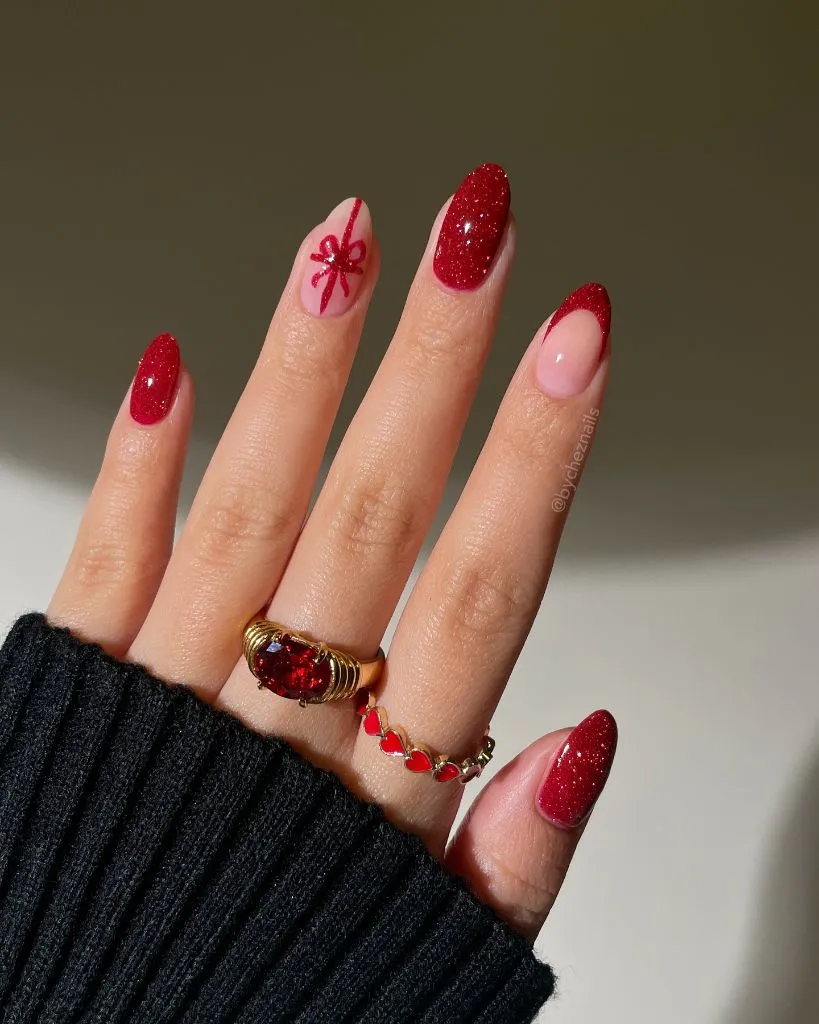
Photo via Instagram
The gift-wrap concept works here because the execution stays graphic rather than literal. The bow is drawn in clean lines with no shading or dimension, so it reads as a design element rather than an illustration. Against the surrounding red glitter nails, the sheer accent creates a pause, a single clear window that lets the art breathe. The red-stone rings are a smart echo, pulling the nail color into the jewelry without adding any new hues. The dark cuff behind everything anchors the composition and keeps the red from floating.
I like how the manicure keeps its sweetest detail to a single nail. The reader takeaway is that a novelty motif like a bow or a gift-wrap line gains credibility when it occupies only one position on the hand. Spreading it across multiple nails would turn the concept into a theme; isolating it turns it into a focal accent with seasonal charm.
8. Emerald Gloss With Gold Cuticle Accents
Five nails in a deep emerald green with a pure cream finish and high gloss, shaped to a short almond. A fine line of gold glitter sits at the cuticle area of several nails, visible as a thin crescent rather than a full border. Two gold rings, one a wide band and one a smaller baguette setting, sit on the fingers. The hand emerges from a matching emerald ribbed knit cuff.
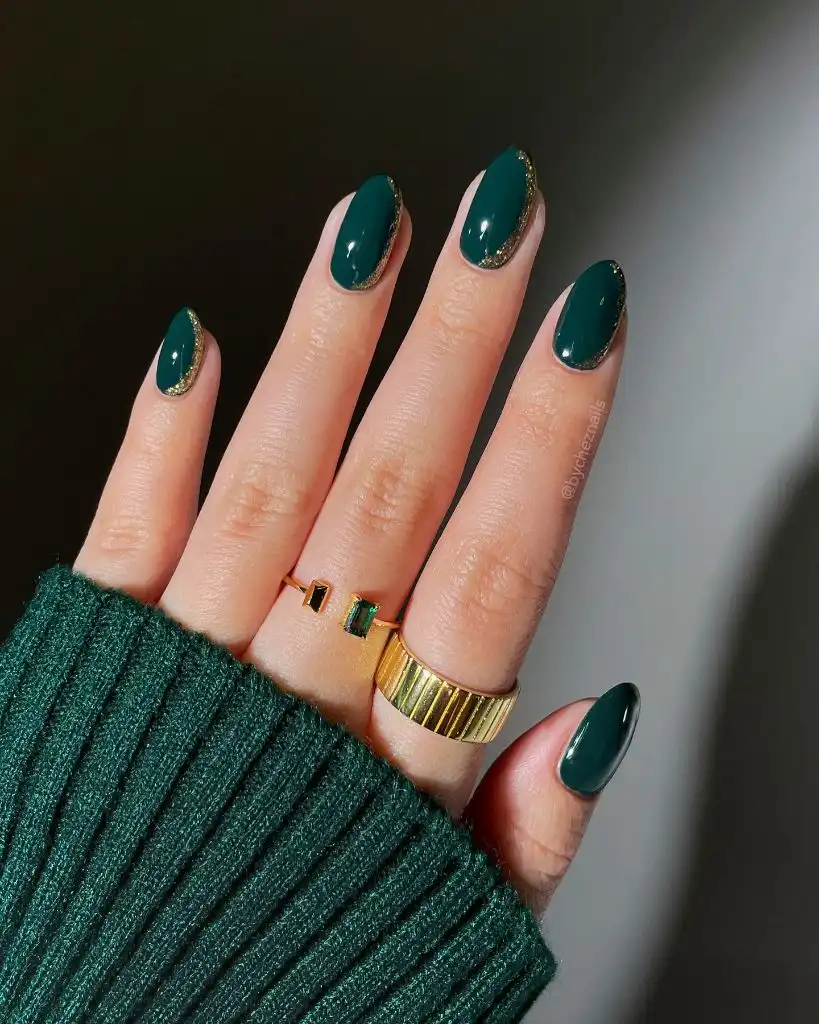
Photo via Instagram
The emerald here is so deeply saturated that it nearly reads as black in shadow, which gives the gold cuticle accent its purpose: it marks the boundary where color begins and skin ends, functioning almost like a piece of fine jewelry laid along the nail base. Unlike a full perimeter border, the cuticle-only placement keeps the free edge and sidewalls clean, directing the eye to the root of the nail rather than its tip. The matching emerald sleeve creates a color-drench effect where the hand, the fabric, and the nails merge into one tonal zone, broken only by the gold.
The beauty of this is how the gold appears at three different scales: the fine cuticle line, the wide band ring, and the small baguette stone. That repetition at varying sizes creates a rhythm across the hand without any one gold element dominating. The transferable principle is that a cuticle accent in a warm metallic can replace a full border when the goal is subtlety over structure.
9. Black and White Snowflake Pattern Mix
Both hands display a mix of nail designs: solid black nails with a fine glitter texture and a white highlight streak, white or sheer nails with hand-painted black snowflake motifs, a black French-tip accent nail, and a black nail with white knit-pattern line art. The overall palette is strictly black and white with no color. The nails sit at a short almond length.
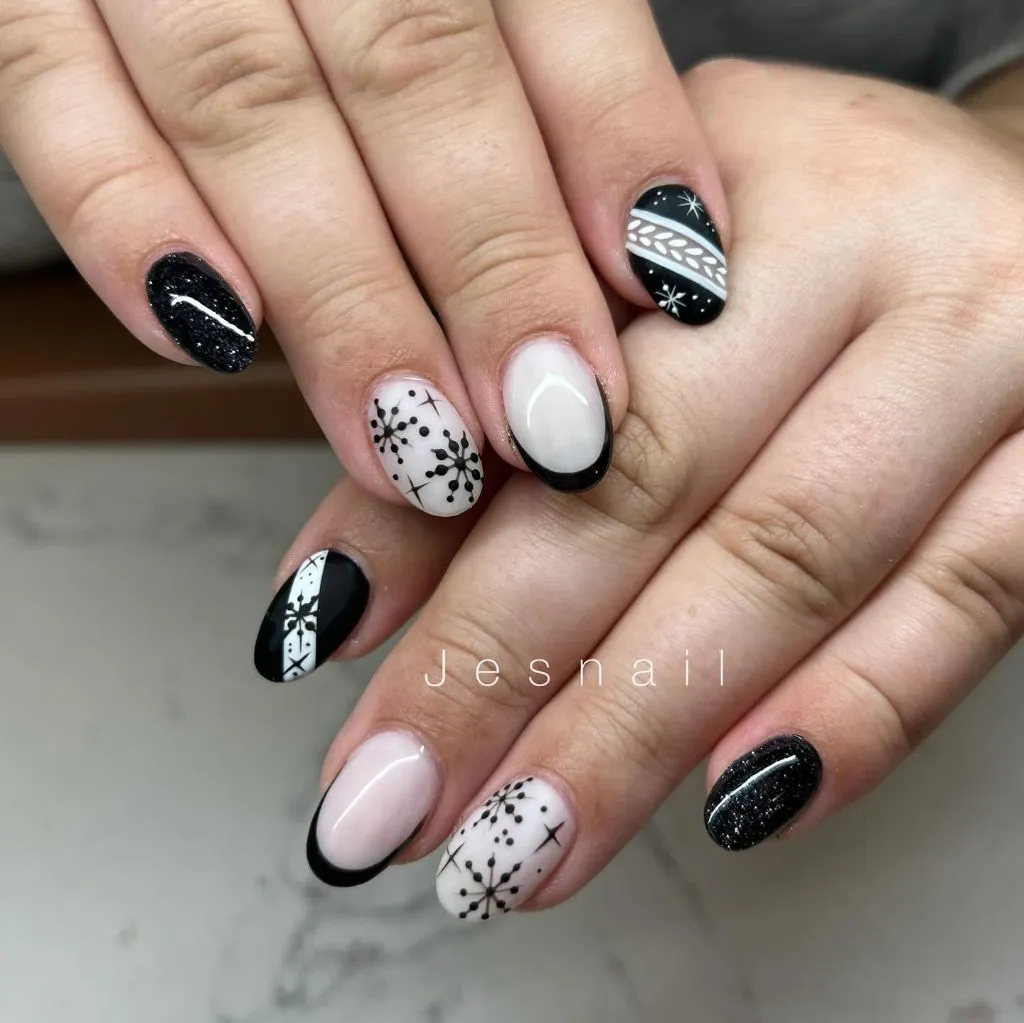
Photo via Instagram
The high-contrast black-and-white palette turns each nail into a miniature graphic study. Because the hand mixes several different design approaches, including solid glitter, line art, stamped snowflakes, and a French tip, within that single two-tone restriction, the variety feels cohesive rather than chaotic. The knit-pattern nail is a particularly effective detail: its wavy lines and dots suggest the texture of a winter sweater without requiring any literal illustration. Every nail reads differently up close, but from a few feet away, the hand registers as one unified black-and-white composition.
The useful move here is restricting the palette to just two values while varying the technique from nail to nail. That constraint is what holds the hand together; without it, five different art styles on one hand would risk looking like a sampler rather than a set. The lesson is that color restriction can compensate for pattern complexity, which matters especially on shorter nails with winter-themed art.
10. Classic Black Gloss on Short Natural Nails
Four nails in a pure black high-gloss finish, shaped to a short, slightly squared-off oval. There is no shimmer, no matte zone, no accent, and no art of any kind. The nails are close to natural length, with the free edge barely extending past the fingertip. The hand is bare of rings, and the background is a soft neutral gray.
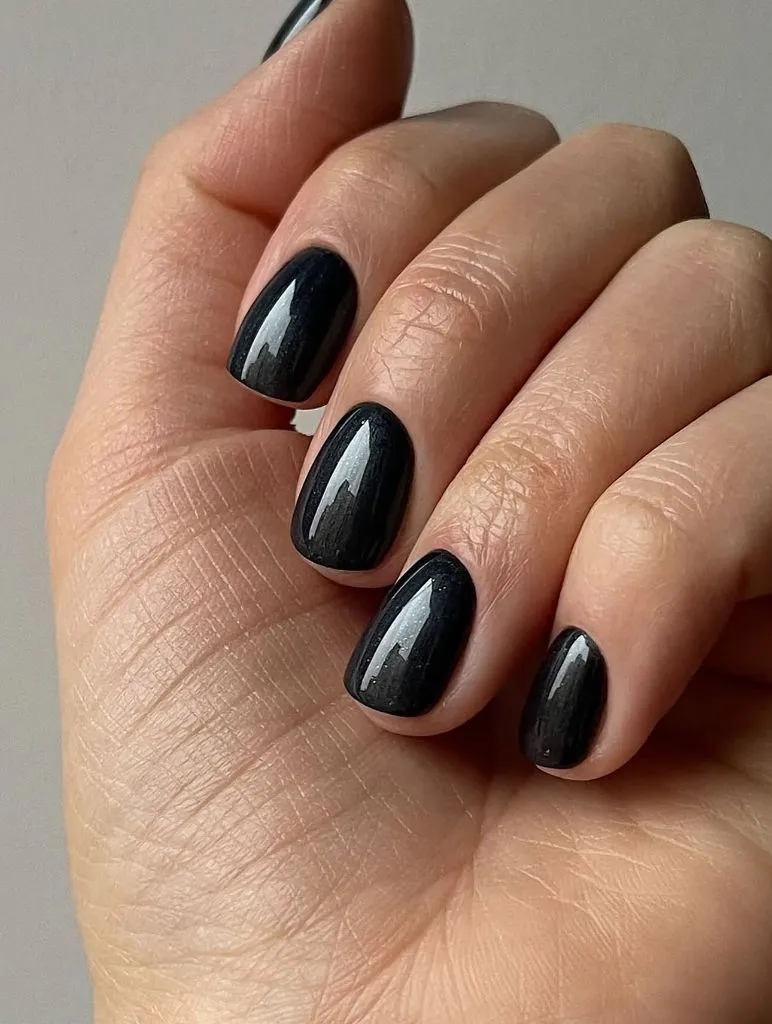
Photo via Instagram
The black gloss here does something that no amount of nail art can replicate: it turns the hand into a silhouette. Because the nails are so short and the black is so opaque, each fingertip reads as a clean dark cap with a single sharp light reflection running across its surface. The slightly squared shape adds a touch of geometry that a round tip would soften away, and the absence of rings or any other detail means there is absolutely nothing competing with the color. The gray background keeps the contrast honest without pushing it into drama.
The strongest lesson is that black gloss on a truly short nail is one of the most complete statements in winter manicure design. There is no rule that says short nails need art to compensate for their size; sometimes the density of a single dark shade at that length creates more visual authority than any motif could. The principle is to trust the shade and the shape to carry the entire hand.
11. Chocolate Brown Gloss on Short Square Nails
Four nails in a warm chocolate-brown cream finish with a high-gloss surface, shaped to a short, slightly rounded square. The shade sits in the space between burgundy and true brown, leaning warmer in the highlight and darker at the edges. A small halo-set ring is visible on one finger. The hand emerges from a cozy taupe-mauve knit fabric.
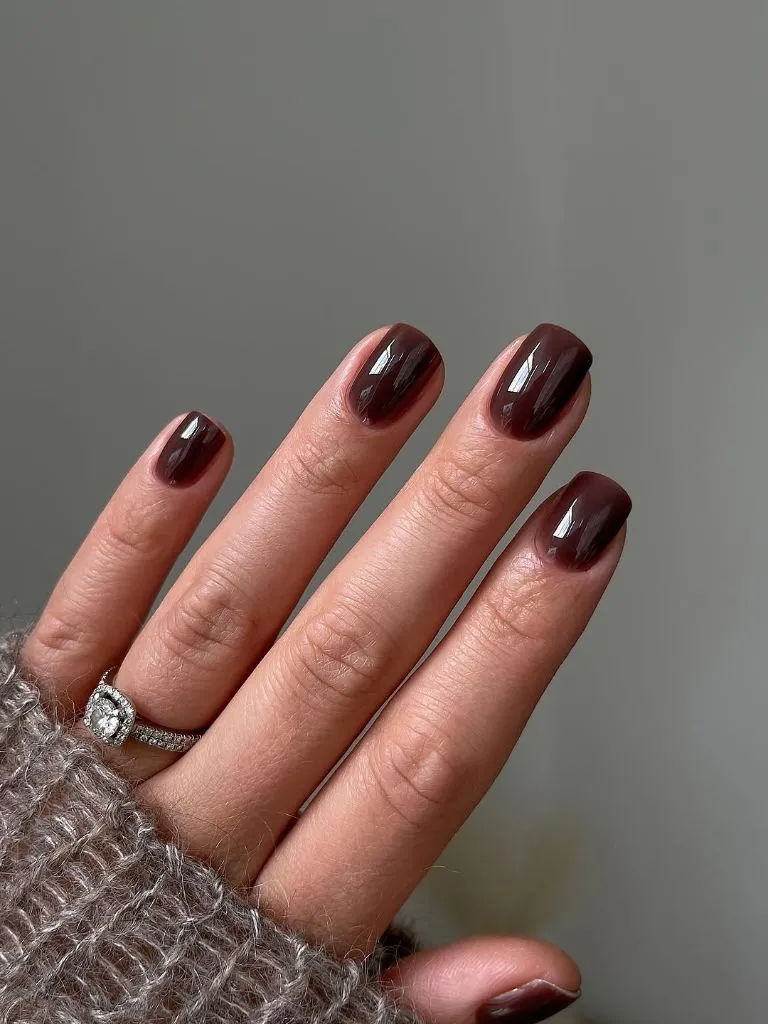
Photo via Instagram
The brown here occupies a specific zone that most winter manicures skip: it is too warm to read as dark and too dark to read as neutral. That in-between quality gives the nails a richness that does not depend on depth alone. The high gloss amplifies the warmth, and the taupe knit behind the hand extends the tonal range without introducing contrast. The halo ring adds a single bright point, which the eye finds quickly because the rest of the composition stays so tonal and muted. For anyone drawn to warm-toned seasonal manicures, this shade sits in the sweet spot between understated and saturated.
What stands out most is how the nail color and the knit fabric exist in the same tonal family without matching exactly. That near-match is more interesting than either a deliberate contrast or a perfect color echo, because it creates a subtle visual conversation between the hand and its setting. The transferable idea is that pairing a warm brown nail with a warm neutral fabric creates a richness that cool-toned darks cannot replicate.
12. Dark Red With Negative Space Accents
Both hands show a mix of full-coverage deep red nails and nails with a negative-space design where portions of the natural nail are left bare, framed by the dark red. Several nails carry only a red tip or a curved red section at the free edge, leaving the lower half exposed. The nails are short with a soft square shape. The hand rests against a gray knit fabric.
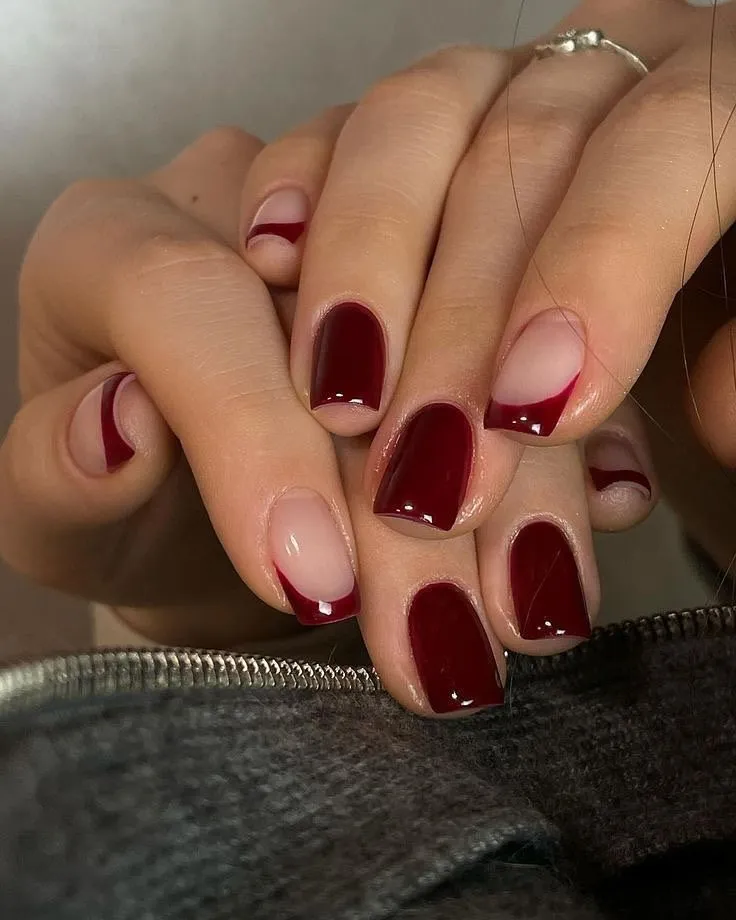
Photo via Instagram
Negative space on a dark color creates a graphic quality that full coverage cannot achieve. The exposed skin acts as a second color, turning the red into a shape rather than a fill. Because the red sections are placed asymmetrically, with some nails carrying a full coat and others showing only a tip or a corner, the hand reads as deliberately composed rather than half-finished. The soft square shape keeps the geometry sharp enough to support the clean lines between red and bare nail. The gray fabric behind the hand stays entirely neutral, which lets the red-and-skin contrast do all the visual work.
The best move here is mixing full-coverage nails with negative-space nails on the same hand. The full red nails anchor the overall color, and the partial nails provide the design interest, so neither approach has to carry the entire hand alone. That balance is what keeps the look from reading as either too simple or too busy, and it works on any short length where space is at a premium.
13. Berry Red Gloss on Short Square Nails
Five nails in a saturated berry red with a high-gloss cream finish, shaped to a short square with softly rounded corners. The shade is a true mid-red, not as dark as oxblood and not as bright as cherry, with a slight depth that comes from the multiple coats visible in the way light pools at the center of each nail. A gold ring is visible on the thumb. The hand rests against a cream linen or cotton fabric.
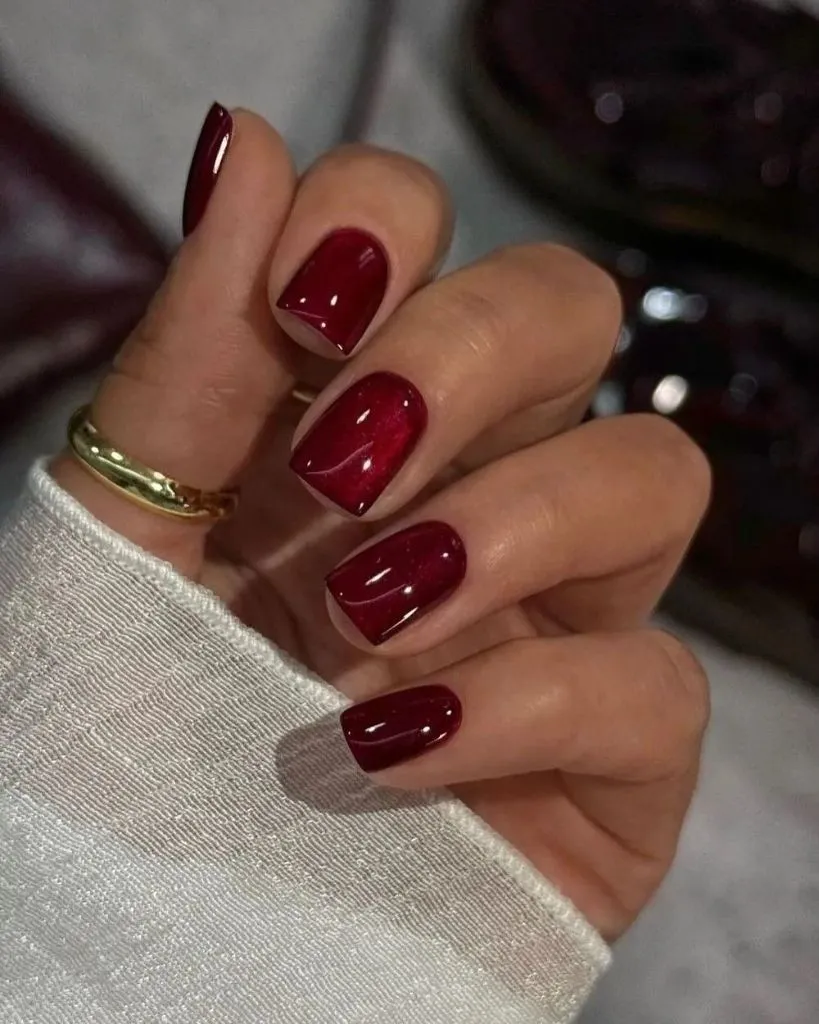
Photo via Instagram
This is the kind of red that sits exactly in the center of the winter red spectrum, warm enough to avoid severity but dark enough to carry weight. The short square shape gives each nail a satisfying width-to-length ratio, and the cream fabric behind the hand provides just enough contrast to let the red register fully without pushing it into high drama. The gold ring on the thumb introduces one warm metallic note that complements the red’s warmth without creating a theme, and the absence of any other jewelry keeps the hand clean.
The reader takeaway is that a mid-range berry red on a short square nail is one of the most versatile winter choices available, precisely because it sits between extremes. It does not demand a mood the way black does, and it does not carry the holiday associations of a true bright red. The strength is in that middle position, where the color works across settings without needing to be explained.
14. Milky Nude With Silver Thread Lines
Both hands show short nails in a milky, sheer nude or off-white base with fine silver metallic thread-like lines crossing each nail at random angles. The lines are thin enough to look like actual threads or wire rather than painted strokes. The nails are short with a natural oval shape, and the overall effect is quiet and textural rather than graphic. A cozy beige or taupe jacket fabric is visible in the background.
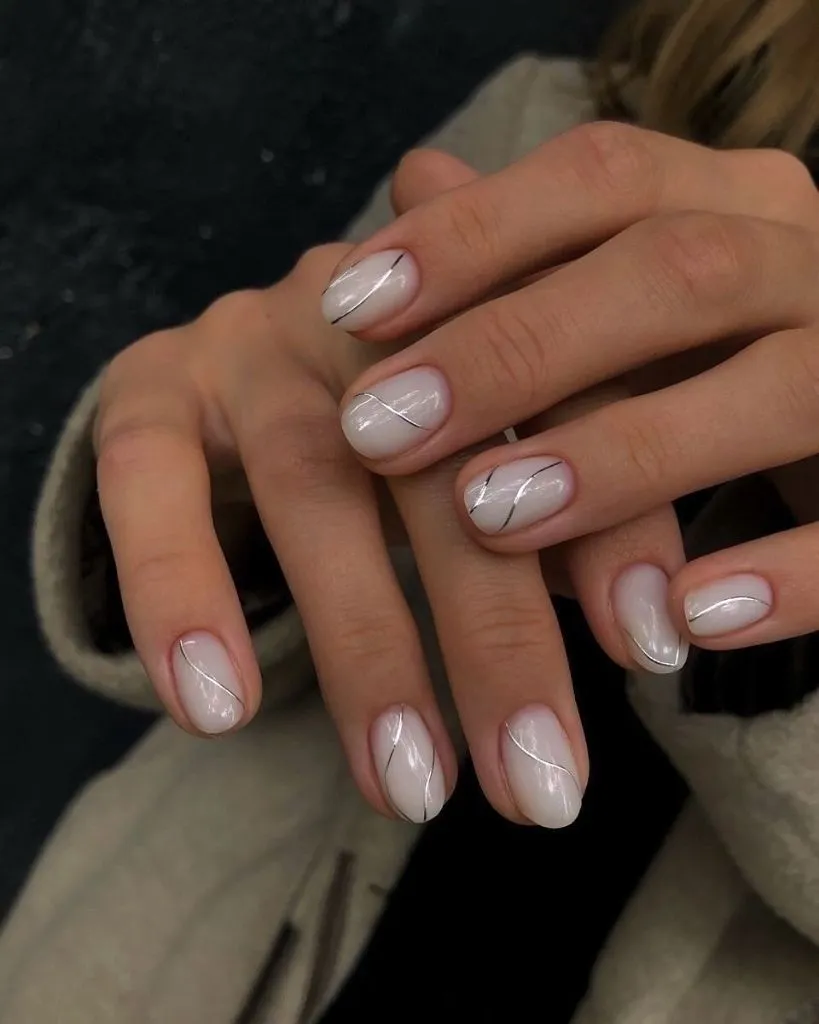
Photo via Instagram
The silver lines here do something unusual: they add interest without adding color. Because they are so fine and because the base is so close to the natural skin tone, the entire manicure reads as barely-there until the light catches a line and it flashes. That intermittent visibility is the design’s greatest strength, turning each nail into a surface that changes depending on the angle. The natural oval shape supports the effortless quality, and the beige coat behind the hand keeps the palette completely neutral. Those interested in understated nail textures will find this approach rewards close-up attention.
The useful idea is that metallic thread lines on a near-nude base create a winter manicure that functions in two registers simultaneously: quiet from a distance and detailed up close. The principle is that the thinnest possible metallic accent on the palest possible base produces a kind of visual whisper that heavier designs cannot achieve.
15. Burgundy French Tips on Short Square Nails
Five nails at a short square length carry a sheer natural base with deep burgundy French tips. The tips are thin and precise, following a straight line across the free edge rather than a curved smile line. The overall effect is a clean, modern French manicure translated into winter tones. The hand grips a white fluffy fabric, possibly a blanket or towel.
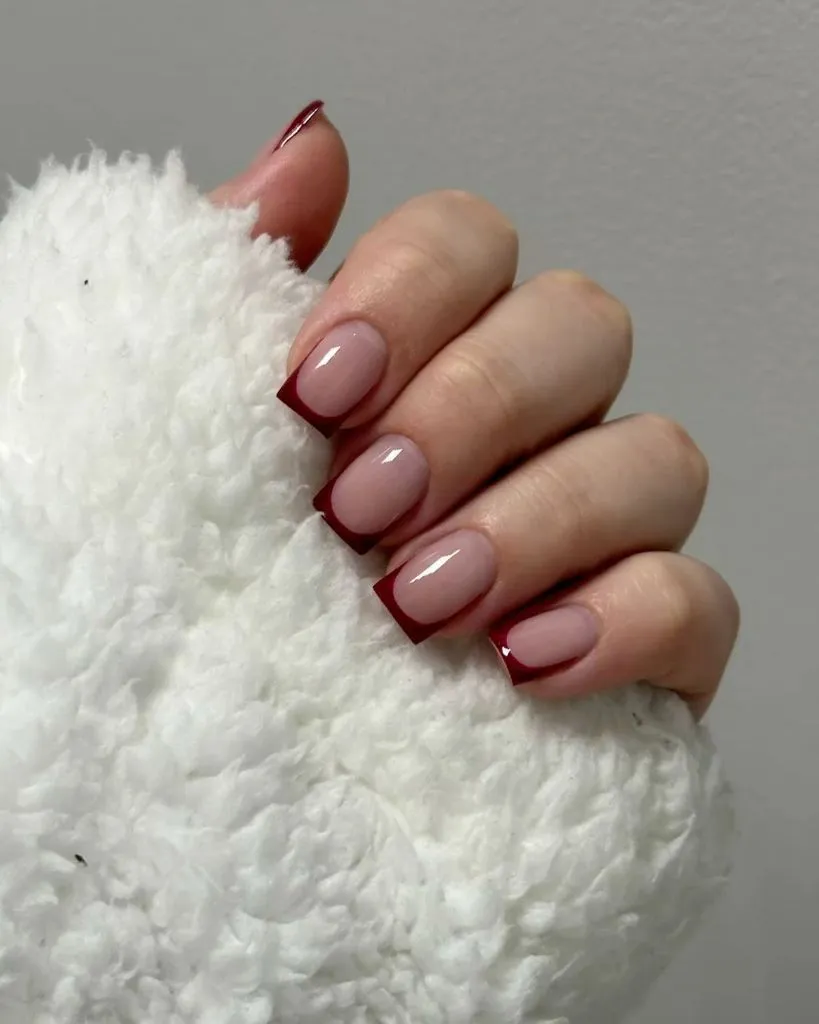
Photo via Instagram
The burgundy French tip reads as a direct translation of the classic white French into a winter vocabulary. Because the tip line is thin and because the square shape provides a straight edge for it to follow, the execution looks architectural. The sheer base underneath does not compete; it simply provides a clean runway that leads the eye to the dark tip. The white fabric behind the hand isolates the burgundy and amplifies its depth, making even that thin stripe of color feel substantial. This is one of the cleaner expressions of seasonal color in a French tip format.
The strongest lesson is that a colored French tip on a short nail works best when the tip line stays thin and follows the shape’s natural geometry. On a square nail, that means a straight horizontal line; forcing a curve would fight the shape. The transferable principle is to let the nail shape dictate the tip’s architecture rather than imposing a standard smile line onto every silhouette.
16. Sheer Lavender With Blue Glitter Stars
Both hands display short nails in a sheer lavender or milky white base with scattered blue glitter and tiny star or snowflake accents. Some nails carry a subtle white French edge. The overall palette is icy and pale, with blue particles distributed unevenly across the surfaces. Silver rings are visible on several fingers. The background is dark, which makes the pale nails pop.
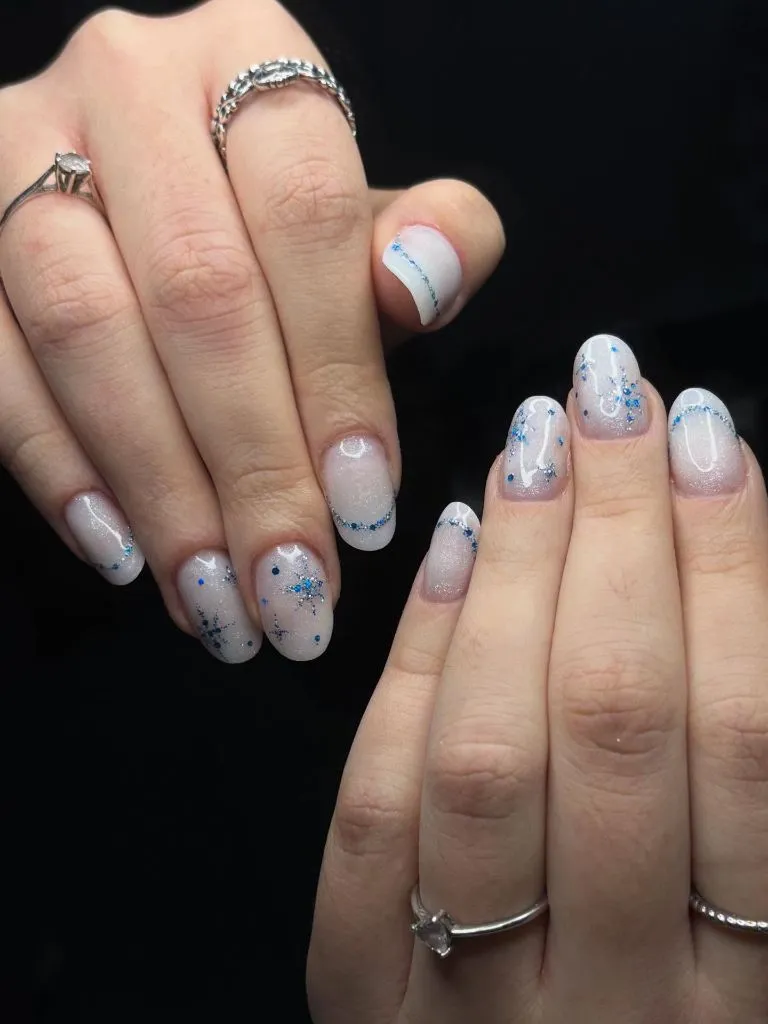
Photo via Instagram
The dark background here does critical work: it turns each pale nail into a small glowing surface, almost like a frosted window lit from behind. The blue glitter particles are sparse enough that they read as individual points of color rather than a wash, and the star accents are placed irregularly, which keeps the hand from looking like a repeating pattern. The sheer base lets the natural nail show through slightly, adding a warmth that pure white would lack. The silver rings continue the cool metallic thread without introducing any warmth.
The beauty of this is how the restraint in glitter density creates the impression of a light snowfall rather than a blizzard. Each blue particle is visible on its own, which gives the eye specific points to land on rather than a general shimmer. The principle is that scattered cool-toned glitter on a pale base works best when the particles are few enough to count, not dense enough to merge.
17. Blue Ombre Glitter With Snowflake Art
Both hands show nails with a pink-to-blue glitter ombre, the blue concentrating at the free edge and fading to pink near the cuticle. Two accent nails carry hand-painted white snowflake designs over a denser blue glitter field. The nails are at a short-to-medium almond length. The background includes what appears to be a salon setting with neutral tones.
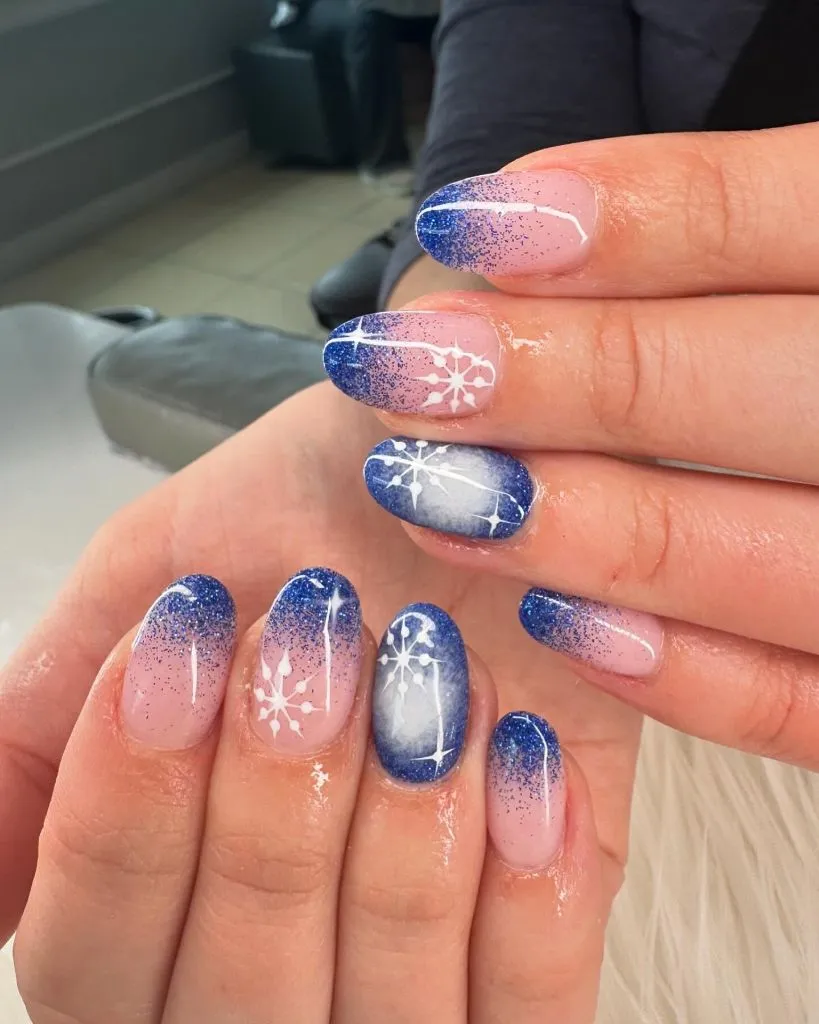
Photo via Instagram
The ombre here does something smart with the eye’s path: it pulls focus toward the fingertips, where the blue is densest and where the snowflake art sits. Because the gradient starts from a near-nude pink at the base, the transition feels like color accumulating rather than color applied, which gives the design a sense of movement from root to tip. The snowflake accent nails intensify the blue into a solid field, making them read as focal points against the softer gradient neighbors. That contrast in density between the accent nails and the ombre nails is what keeps the hand visually organized.
The useful move here is using an ombre gradient to lead the eye toward the accent nail. Rather than placing art on a flat solid color, the gradient creates a natural visual pathway that arrives at the snowflake as a destination. This technique works for any winter nail design with mixed elements, where directing the viewer’s attention becomes part of the composition itself.
18. Blue Glitter Gradient With Silver Snowflake Detail
A hand emerging from a white fabric sleeve shows nails with a blue-to-white glitter gradient, denser at the tips and fading toward the cuticle. One nail carries a hand-painted white snowflake, and another features a small silver textured element, possibly a foil or 3D accent. The nails are at a medium length with a soft coffin or tapered square shape. A watermark from the nail artist is visible.
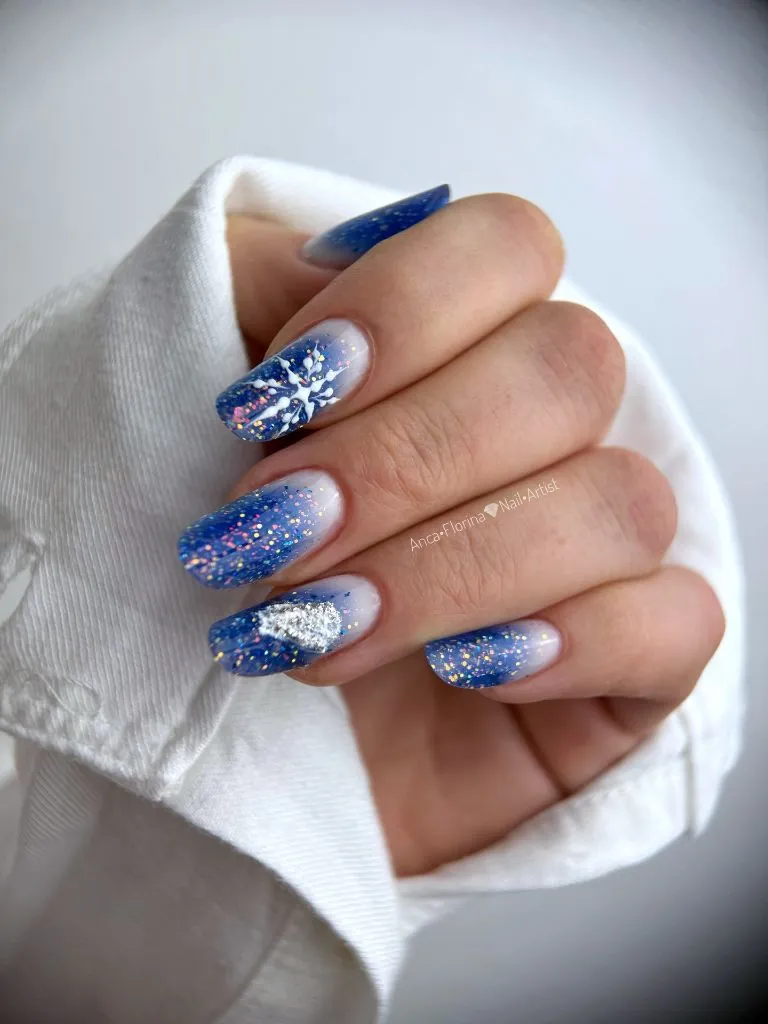
Photo via Instagram
The gradient here runs cooler and denser than the previous ombre, with the blue reaching nearly opaque at the tips before dissolving into a frosty white near the cuticle. The snowflake is placed on a nail where the blue is at its deepest, which gives the white motif maximum contrast and legibility. The silver textured element on another nail introduces a third-dimensional quality, catching light differently than the flat glitter around it. That mix of flat shimmer and raised texture prevents the hand from reading as a single-technique design.
What stands out most is the layering of different finishes within one cohesive palette. Flat glitter, painted art, and a three-dimensional accent all coexist because they share the same blue-white-silver color story. The principle is that winter short nails in a cool palette can support multiple techniques as long as the color range stays narrow and each technique occupies its own nail.
19. Red French Tips With Cherry Art and Bows
Both hands show nails with glossy red French tips on a sheer nude base, combined with hand-painted cherry motifs, small 3D white bows, and tiny rhinestone accents. The cherries are rendered as small red spheres with fine painted stems. The nails are at a short-to-medium almond length. The hands rest on a white satin fabric.
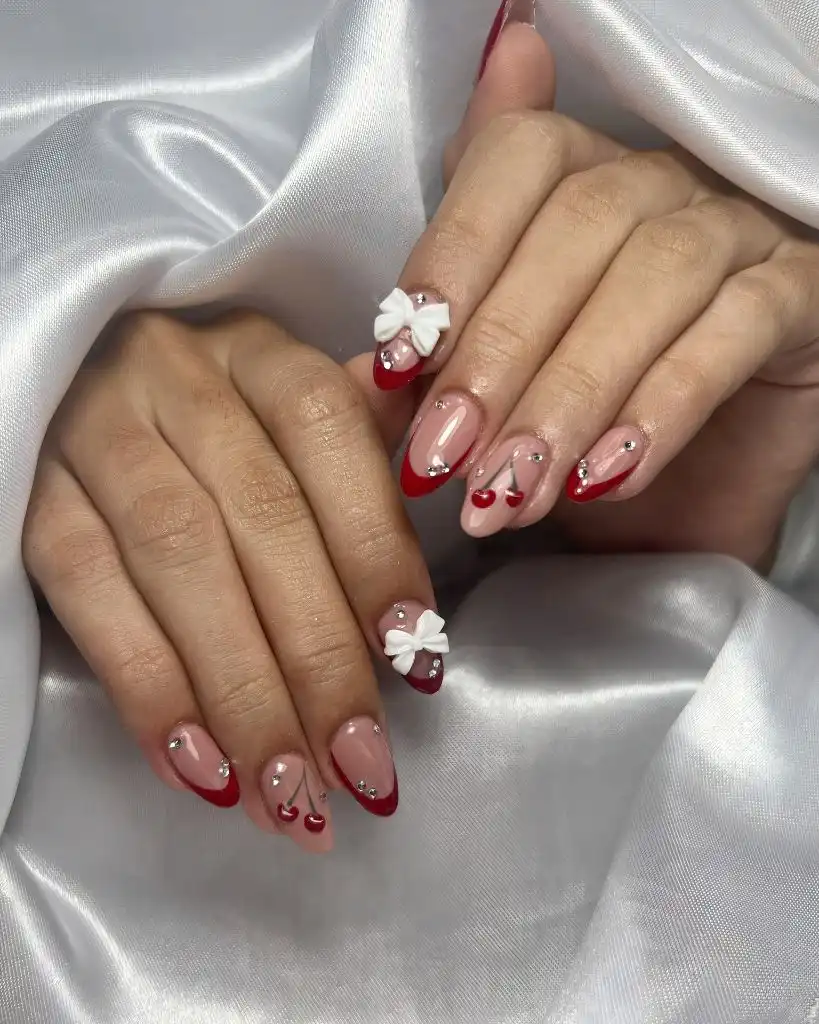
Photo via Instagram
There are multiple art elements happening across these nails, yet the hand does not feel overloaded, because each element shares the same red-and-white palette and because no single nail carries more than one or two details. The 3D bows are placed on nails that have no other art, giving them a clean stage. The cherries appear on nails with minimal tip coverage, so the art occupies the open field rather than competing with the French line. That careful distribution is what prevents the playfulness from tipping into chaos. The satin background reinforces the polished, considered quality of the composition.
The reader takeaway is that multiple novelty elements, bows, fruit, rhinestones, and French tips, can coexist on one hand when each element is isolated on its own nail and when the color palette stays tight. The distribution matters as much as the design itself, and the open sheer base between elements provides the breathing room that makes each detail legible.
20. Icy Gray and White Snowflake Embellished Set
Both hands show an elaborate winter-themed set mixing gray, white, and pale blue nails with a variety of snowflake techniques: stamped white snowflakes, 3D textured snowflakes, rhinestone clusters, tiny pearl accents, and a marbled or watercolor-effect nail. The nails are at a short-to-medium almond length. No rings or jewelry are visible, and the background is a plain light surface.
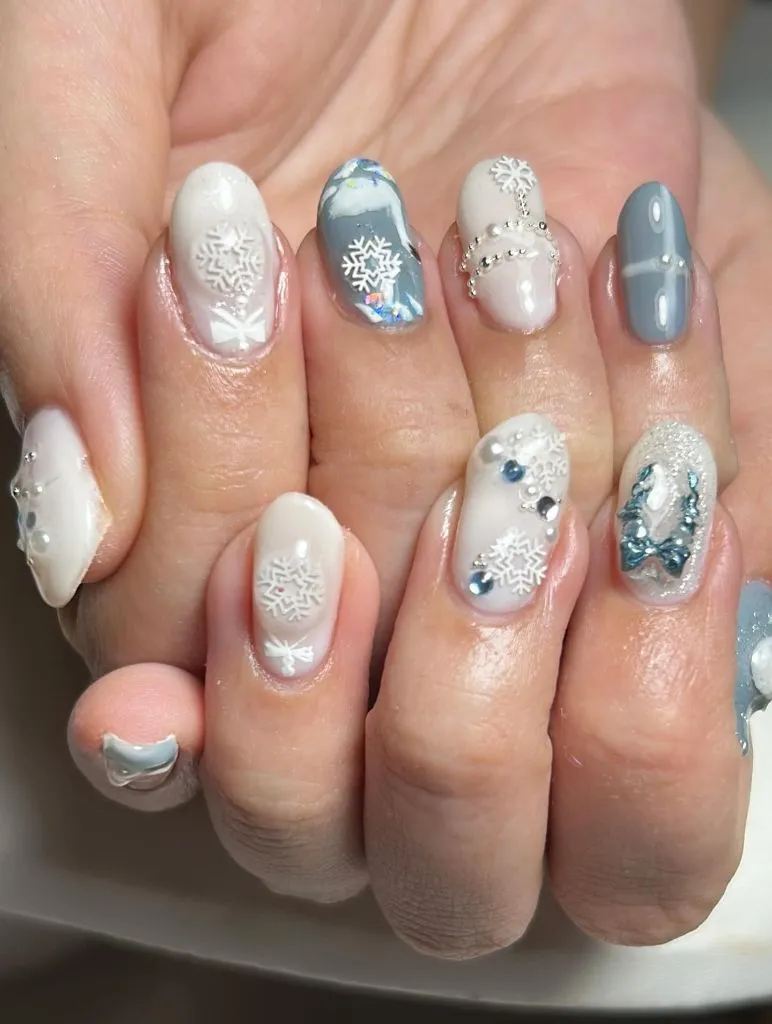
Photo via Instagram
This set is the most maximalist in the entire collection, yet it holds together because every element shares the same icy desaturated palette. The gray, white, and pale blue nails create a tonal base that absorbs the snowflakes, pearls, and rhinestones without any single accent reading as an outlier. The variety of snowflake techniques, from flat stamped to raised 3D, gives each nail its own character while maintaining the winter theme as a continuous thread. The marbled nail introduces organic movement into what could otherwise be a very geometric, crystalline set.
The best move here is the palette discipline. With this many techniques and textures on one hand, the only thing preventing visual overload is the strict limitation to gray, white, and the palest possible blue. The transferable principle is that the more complex the art and embellishment, the narrower the color story for seasonal nail sets needs to be, or the hand loses its coherence.
21. Nude Base With Silver Swirls and Snowflake Charm
Five nails on a sheer nude base at a medium almond length, featuring silver glitter French tips on some nails, white and silver swirl lines on another, and a hand-painted white snowflake with a small 3D butterfly or bow charm on the accent nail. The charm catches light with a slight iridescence. The hand rests against a plain white surface.
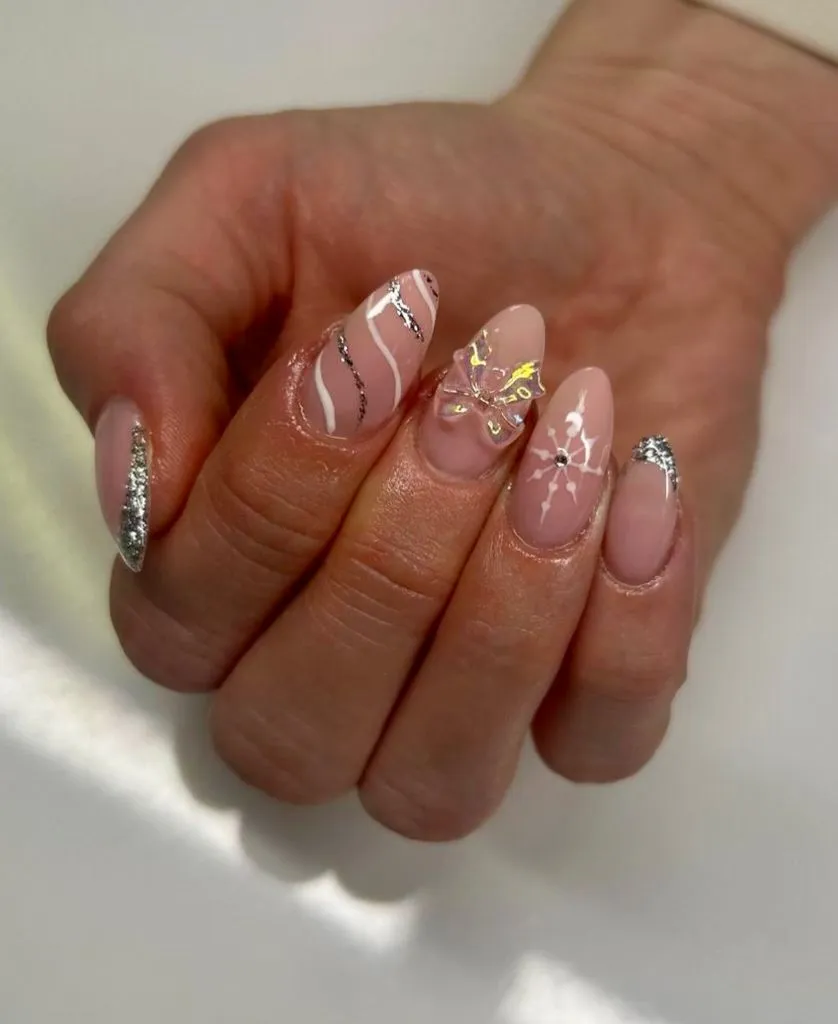
Photo via Instagram
The nude base gives this set an airiness that the previous maximalist designs did not attempt. Each nail carries only one element, whether a silver tip, a swirl, or the snowflake charm, so the sheer field dominates and the accents float on it rather than covering it. The 3D charm is the most eye-catching detail, but its placement on just one nail and its small scale keep it from overwhelming the quieter nails around it. The white and silver swirls add movement without density, tracing paths across the nail like frost on glass.
The useful idea is that a 3D charm or embellishment needs the most space around it. By placing it on a nail with a sheer base and keeping the neighboring nails relatively simple, the design ensures the charm reads as a deliberate focal point rather than one detail among many. On a short or medium nail, that spatial generosity is what separates an accent from clutter.
22. Pink Shimmer With Red Bow Line Art
Five nails at a short almond length carry a pink shimmer base with a warm, almost rose-gold glitter that catches light across the entire surface. Red bow motifs are painted on several nails in a thin line-art style, with ribbons extending across the nail. The bows vary slightly from nail to nail. The hand emerges from a cream knit cuff.
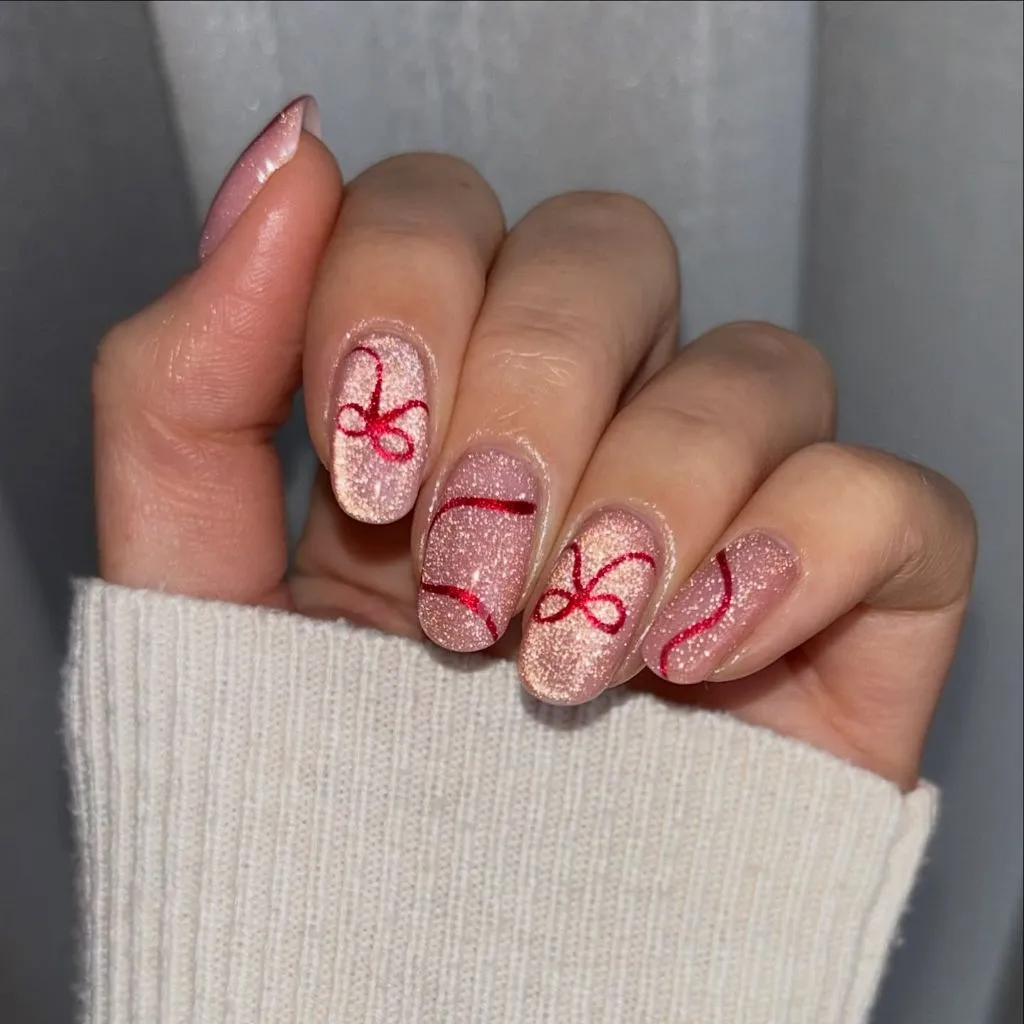
Photo via Instagram
The pink shimmer base here does double duty: it provides the warmth and sparkle that a cream base cannot, while still staying light enough to let the red bow art read clearly. The bows are drawn in a single thin line weight, which keeps them graphic rather than illustrative, and the slight variation from nail to nail, a full bow here, a trailing ribbon there, prevents the repetition from feeling mechanical. The cream knit cuff matches the warmth of the pink base, creating a tonal bridge between the hand and its surrounding fabric.
The strongest lesson is that line art on a shimmering base needs to be drawn in a color dark enough to cut through the sparkle. The red here is just saturated enough to remain legible against the pink glow, and the thin line weight prevents the bows from feeling heavy. The principle is that art over shimmer works when the contrast between line and base is sharp, even if both tones belong to the same color family.
23. Pastel Blue Winter Mix With Snowflake and Sweater Texture
Both hands display a pastel baby-blue manicure mixing several techniques: matte blue nails, a cable-knit sweater texture nail with raised ridges, nails with hand-painted white snowflake motifs, and accent nails featuring a penguin character painted in black, white, and yellow on a pale dotted background. The nails are at a short-to-medium almond length.
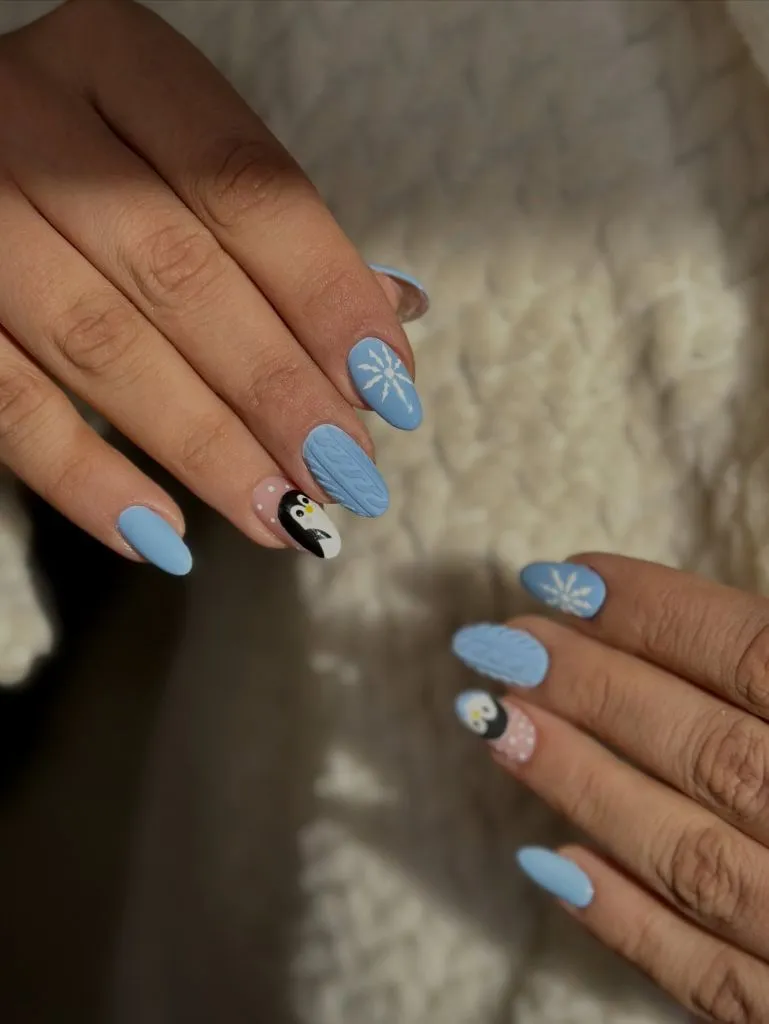
Photo via Instagram
The pastel blue anchors the hand in a single color while the techniques shift dramatically from nail to nail. The sweater-texture nail is the most tactile element, with its raised cable-knit ridges creating actual shadow and dimension. The penguin accent is the most illustrative, introducing a character into what is otherwise an abstract set. These two extremes, pure texture and representational art, coexist because the blue holds them in the same visual family. The snowflake nails serve as a middle ground, figurative enough to be recognizable but abstract enough to bridge the gap between the sweater and the penguin.
The reader takeaway is that a whimsical character accent, like the penguin, works on an adult hand when the rest of the set establishes a strong enough design identity around it. The sweater texture and the snowflakes earn the seriousness, and the penguin then reads as a playful interruption rather than a thematic departure. That balance between structured design and one moment of charm is what keeps novelty from undermining the composition.
24. Pastel Blue and White With Snowflake and Peppermint Art
Five nails at a medium almond length in pastel blue and white, featuring a snowflake stamped on one nail, a peppermint-swirl design on another, a holographic or iridescent finish on the middle nail, and pastel blue tips on the remaining nails. The color palette is strictly icy pastels with no warm tones. The hand emerges from a gray ribbed knit cuff against a blue textured fabric background.
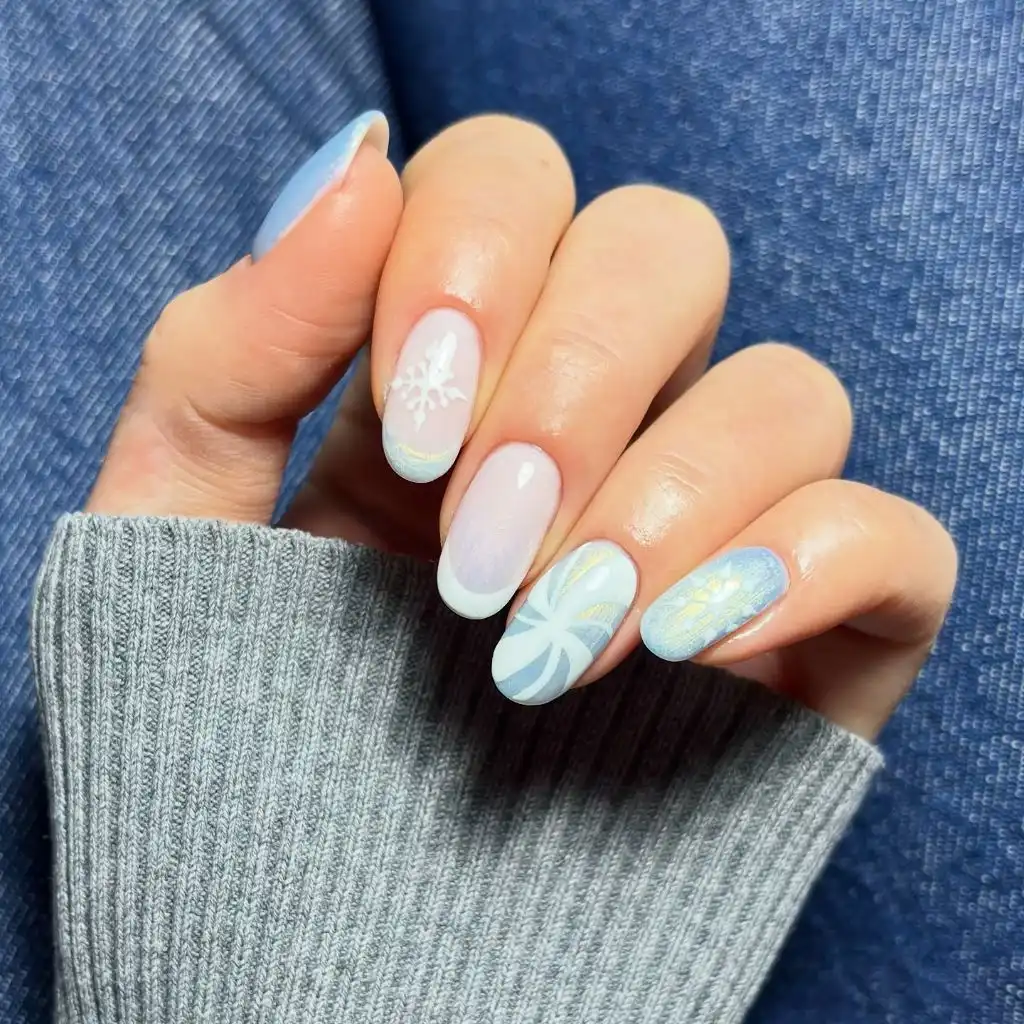
Photo via Instagram
Each nail here carries a different winter reference, snowflake, peppermint, frost, color block, yet the hand reads as one unified set because the palette never leaves the icy pastel zone. The peppermint swirl is a particularly charming detail: its spiral pattern introduces circular movement into a set otherwise dominated by straight edges and crystalline shapes. The iridescent middle nail adds a shift of color that appears and disappears with movement, giving the hand a dynamic quality that static designs lack. Anyone interested in a pastel approach to cold-weather nails will find this set demonstrates how softness and specificity can coexist.
What stands out most is the variety of motifs working within a two-color restriction. Five different design ideas on five nails would normally fragment the hand, but because every element stays within the blue-white range, the brain groups them as one composition. The principle is that motif variety and palette unity are inverse controls: the more different your designs, the fewer colors you can afford.
25. Matte Pink With White Snowflake Stamps and Silver Glitter Tips
Five nails at a short almond length in a matte baby pink, each carrying a white snowflake stamp and a gradient of silver glitter concentrated at the tips and cuticle area. The snowflakes are positioned centrally on each nail and vary slightly in size. The matte finish contrasts with the sparkle of the glitter, creating two textures on one surface. The hand emerges from a white knit cuff.
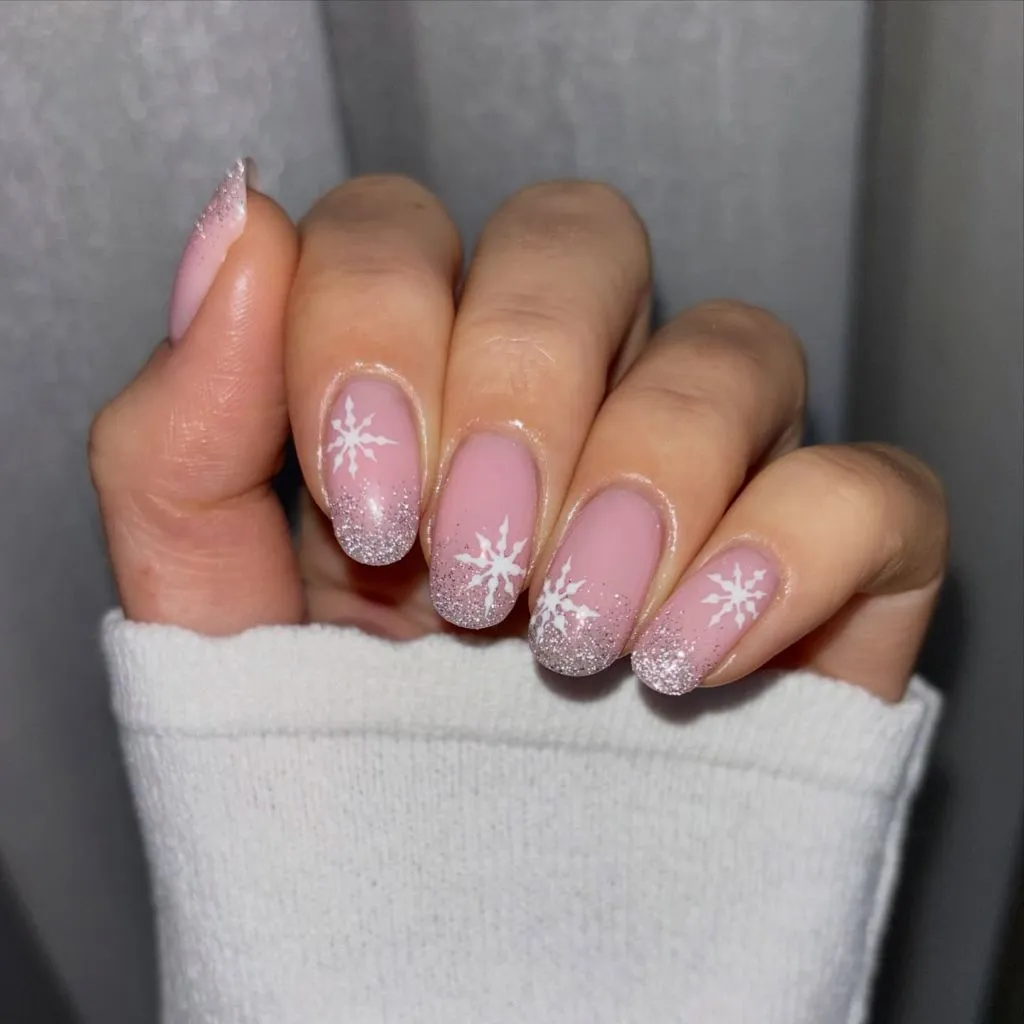
Photo via Instagram
The matte-glitter contrast is the engine of this design. The pink base absorbs light while the silver tips reflect it, so the eye oscillates between the two zones. The snowflakes sit in the matte territory, which makes their white pigment read as chalky and soft rather than bright, a quality that a glossy base would not produce. The silver glitter at both the tip and the cuticle creates a frame effect, bracketing the matte snowflake zone between two luminous borders. The white knit cuff continues the soft, diffused quality of the matte finish, extending the mood beyond the nails themselves. This combination of matte and glitter finishes illustrates how texture contrast can carry a design that uses almost no color contrast at all.
The useful move here is placing the motif in the matte zone and the glitter in the border zone, giving each texture a distinct role. The matte holds the art; the glitter holds the frame. That division of labor keeps the surface organized and prevents the snowflakes from competing with the sparkle for the viewer’s attention.

Hi, I’m Zoey Mitchell, the creator of ChicStyle Blog.
I share simple, wearable outfit ideas, hairstyles, nail trends, and beauty tips that feel natural and easy to recreate.
This blog is where I explore everything that makes a woman feel put together and confident every day. I’m not an expert — just a woman who genuinely loves style, mixing looks, and discovering what works.
If you love effortless fashion with a personal touch, you’ll feel at home here.