
There is a particular stillness in the moment before scissors meet hair, when the cape is fastened and the mirror holds an unfinished shape. Haircuts for Black women carry that weight of intention, each silhouette a conversation between natural texture, deliberate structure, and the geometry of the face beneath it. The images gathered here begin in that in-between space and move outward through color, volume, and line.
What makes a haircut read as considered rather than accidental has less to do with trend cycles and more to do with a handful of visual variables. Proportion is the first, the relationship between length at the crown and length at the nape, or between fullness on one side and compression on the other. Texture is the second, whether the hair is left in its natural coil pattern, blown out for density, heat-styled for sleekness, or chemically shifted into a different curl family entirely. Placement comes third, meaning where volume lives, where color falls, where a part sits, and how those choices frame the forehead, the jaw, the ear. Color functions as a fourth variable, not decoration but architecture, pulling the eye to one zone or pushing a shape forward. Each section that follows judges its image through these four lenses, describing what the cut does and why the proportions hold.
1. Blown-Out Natural With Center-Parted Volume
The hair sits at roughly chin length in its blown-out state, parted down the center and expanded into a wide, rounded silhouette that extends well past the shoulders at each side. The texture reads as type 4 natural hair that has been stretched with heat or tension but not flat-ironed, keeping a soft, cloud-like density throughout. A salon cape covers the body, and the setting behind suggests a salon chair with muted green walls and overhead lighting.
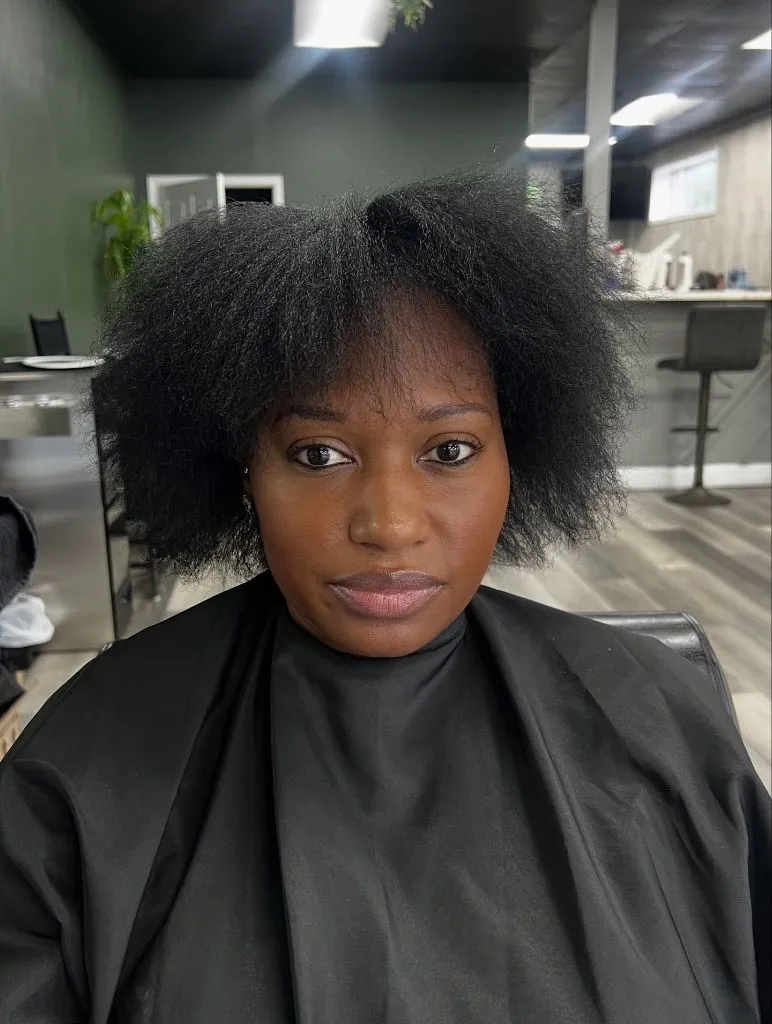
Photo via Instagram
The center part creates bilateral symmetry, which is deceptively hard to hold when hair carries this much volume. What keeps the shape from reading as unfinished is the evenness of the expansion on both sides and the way the density tapers slightly near the ends rather than cutting off in a blunt horizontal line. The rounded outer edge frames the face in a soft oval, and the forehead remains visible enough to anchor the proportions. That balance between structure and organic movement is the quiet engine of the whole silhouette, and it shows how a natural hair styling approach can define shape without rigidity.
The reader takeaway is that a center part in voluminous natural hair only holds its balance when the density on each side is genuinely matched. Uneven sections pull the eye sideways and break the frame. The principle worth borrowing is symmetry as scaffolding: when the hair itself is wild and textured, a precise geometric part gives the eye a resting point and lets the volume feel intentional rather than accidental.
2. Sleek Rounded Bob With Full Bangs
The cut is a short, rounded bob that sits close to the head, with a full fringe that sweeps across the forehead and tapers smoothly into the sides. The hair appears to be heat-straightened to a high-gloss finish, lying flat against the skull at the crown and then curving outward slightly at the jawline before tucking back in at the nape. The profile view shows the ear partially hidden. A black-and-white striped top sits below the neckline.
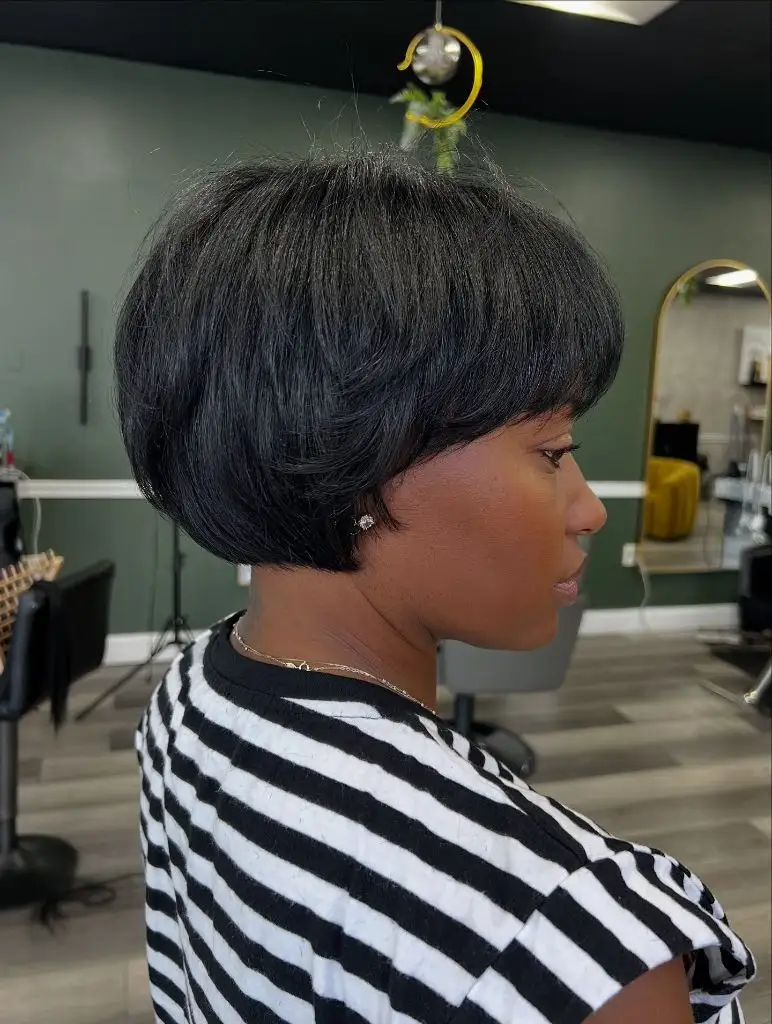
Photo via Instagram
What makes this bob work as a shape rather than just a length is the continuous curve. The fringe flows into the side without a visible break, and the side flows into the back without stepping down, so the entire silhouette reads as one uninterrupted arc. The high shine amplifies that continuity because light travels across the surface in a single sweep. The ear stays hidden, which compresses the frame vertically and keeps the focus on the jawline where the hair’s outward curve creates its widest point. That curve then tucks back in, giving the cut a closed shape rather than a trailing one.
The useful move here is the seamless transition from fringe to side to nape. When each zone of a bob blends into the next without obvious layering steps, the cut reads as sculptural. The transferable principle is that smoothness in a short cut comes less from flatness and more from the continuous direction of each strand, so every piece points toward the same vanishing point at the back.
3. Copper-Toned Tapered Natural With Defined Coils
The hair is cut very short on the sides and slightly longer at the crown, with tight, well-defined coils throughout in a warm copper-orange shade. The color appears even from root to tip, suggesting a full application rather than highlights. A stylist’s hand is visible near the ear, adjusting the nape area. The person wears a white salon cape, and the background is a softly blurred salon interior with warm tones.
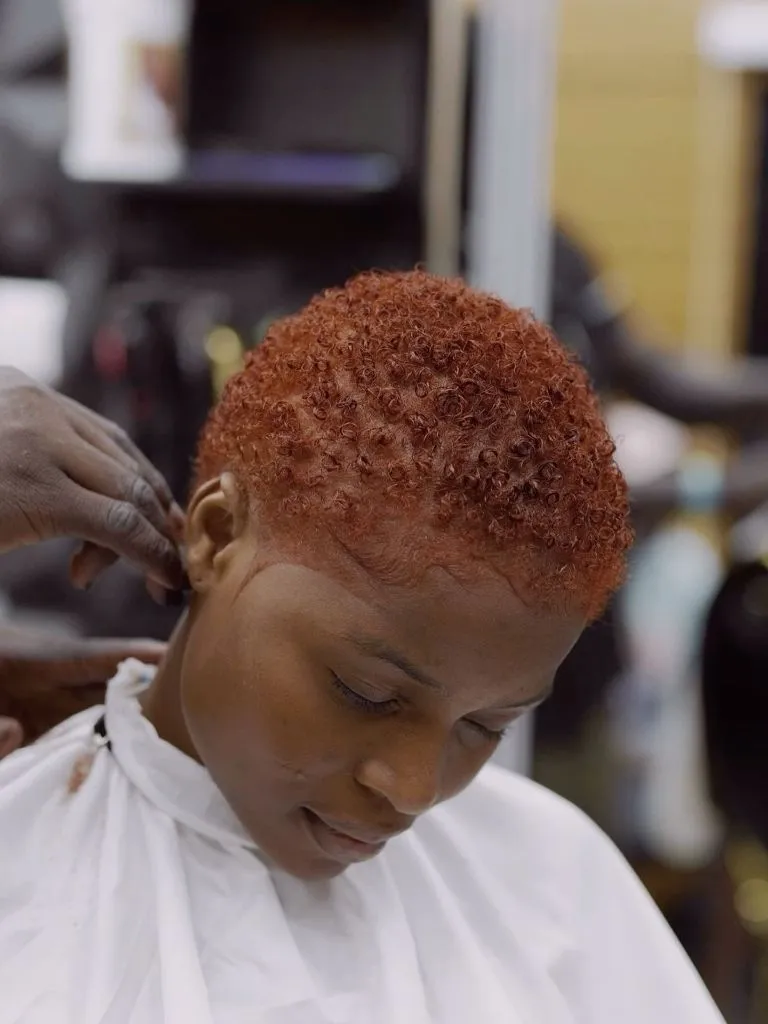
Photo via Instagram
The color does the heavy lifting in this cut. A tapered natural at this length can sometimes flatten into the scalp visually, but the copper tone separates the hair from the skin and gives the coils individual definition they might not carry in a darker shade. The warm orange sits in a similar tonal family to the skin’s undertone, which keeps the contrast medium rather than stark, and that mid-range contrast is what makes the color feel integrated rather than imposed. The taper itself is clean, with the shortest sections at the sideburns and nape creating a fade effect that draws attention upward toward the fuller crown. A resource exploring short hairstyle ideas can show how varied these compact silhouettes become once color enters the frame.
The strongest lesson is that color on very short natural hair functions as a shape tool, not just a cosmetic choice. When the coil pattern is this tight and the cut is this close, the color is what creates visual separation between the hair and the head. The principle to carry forward is that warm tones on warm skin produce a soft boundary, while cool tones on the same skin would push the boundary harder.
4. Textured Pixie With Feathered Layers and Tapered Nape
The cut is a short pixie with layered, feathered pieces across the crown and sides, tapering down to a close-cut nape. The hair reads as relaxed or heat-styled, with a slight bend in the strands that gives them movement without curl. The color is a deep natural black with faint sheen. The person is photographed from the back at a three-quarter angle, showing a silver chain-link necklace and a dark top. Behind them, a wall carries large cursive lettering in silver or white.
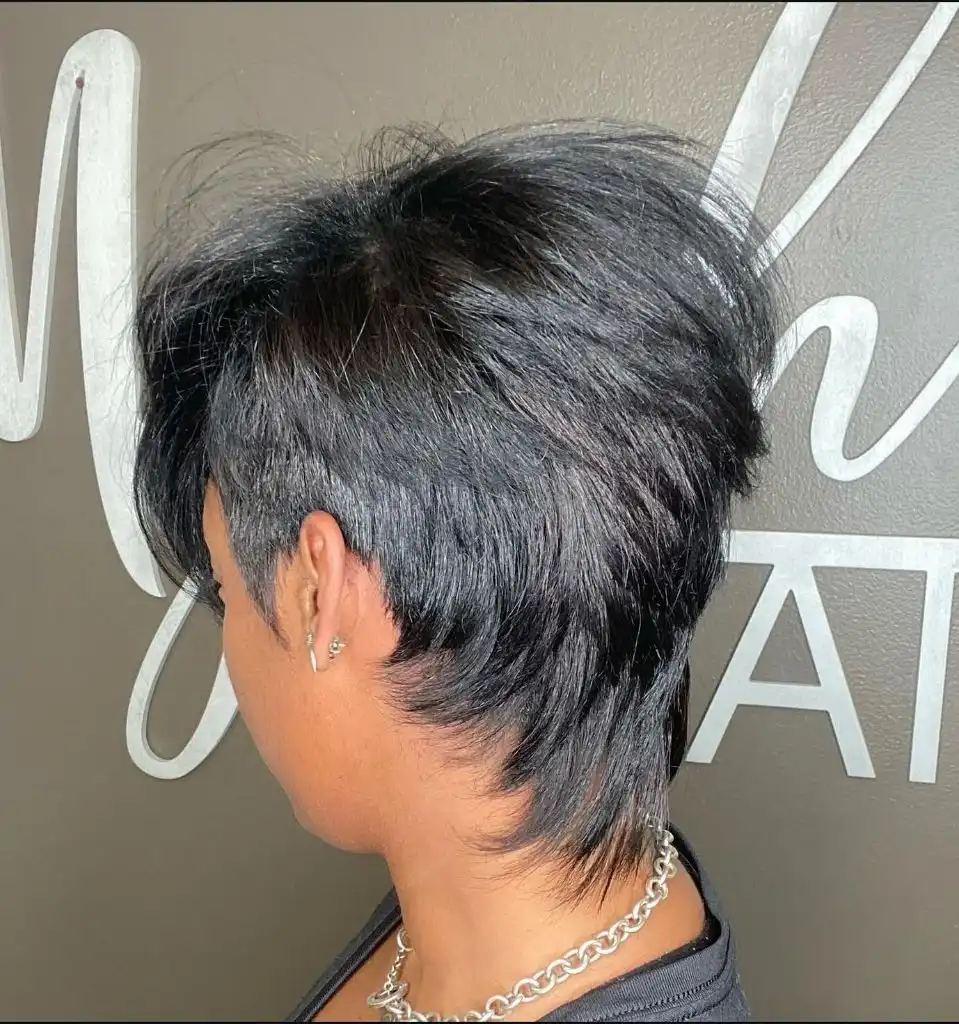
Photo via Instagram
The feathered layers create directional movement that a single-length pixie would not have. Each piece points downward and slightly outward, which gives the crown a lifted appearance even though the actual length is only a few inches. The taper at the nape sharpens the transition from hair to skin, and the exposed neck becomes part of the composition. The chain necklace sits in that cleared zone and reads as a deliberate pairing, an accessory that only works because the cut created room for it. The overall shape narrows as it descends, making the silhouette read as a soft inverted triangle from the back.
The useful idea is that a tapered nape does more than clean up the back of a cut. It opens a visual zone where jewelry, necklines, and skin tone become active participants in the look. The transferable principle is that short cuts benefit from thinking about the cleared space as carefully as the hair itself, because every inch of exposed skin shapes the frame.
5. Platinum Blonde Chin-Length Bob With Side Part
The hair is a straight, chin-length bob in a light platinum blonde with slightly warmer roots visible along the part and the hairline. The part sits to one side, and the hair falls in a single smooth plane on each side, tucked behind one ear to expose a hoop earring. The person is photographed in profile against a deep navy or dark blue background, wearing a dark top with a gathered neckline.
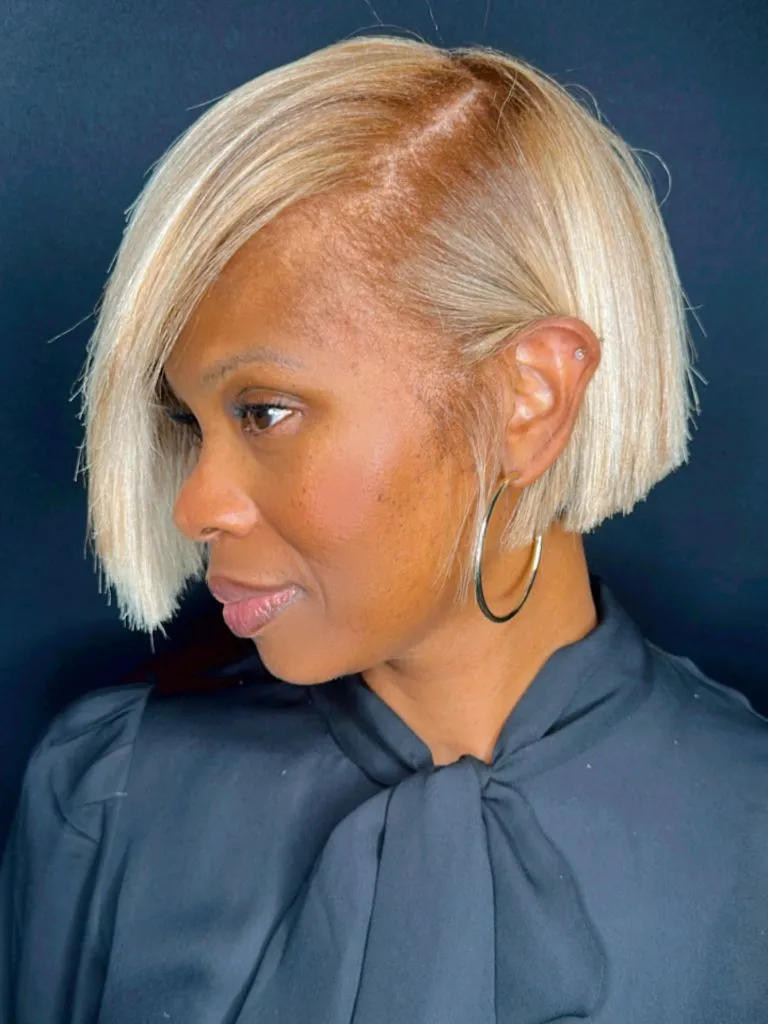
Photo via Instagram
The high contrast between the platinum hair and the deep skin tone is the first thing the eye registers, and it works because the cut’s shape is simple enough to absorb that contrast without becoming chaotic. A more complex layered cut in this color might overwhelm the frame, but the clean single-length line keeps the blonde contained within a predictable silhouette. The warmer roots along the hairline are doing quiet but important work, softening the transition between skin and hair so the platinum does not begin too abruptly. The ear tuck on one side introduces asymmetry, giving the eye a place to land where skin, metal, and hair all converge. For readers considering bold color on short cuts, this kind of restrained shape is often what lets a dramatic color feel wearable.
What stands out most is the relationship between color intensity and cut simplicity. The louder the color, the quieter the cut needs to be for the overall look to hold together. The principle worth keeping is that extreme color works best inside geometric, predictable lines, because the color itself already provides more than enough visual information.
6. Cropped Natural Curls With Tapered Sides
The hair is a short natural cut with defined, springy curls sitting close to the head, longest at the top and slightly shorter on the sides in a soft taper. The color is natural black, and the curls appear well-moisturized with a healthy sheen. The person is photographed at a three-quarter angle, showing gold hoop earrings, a subtle highlight on the cheekbone, and a beige or tan top at the neckline.
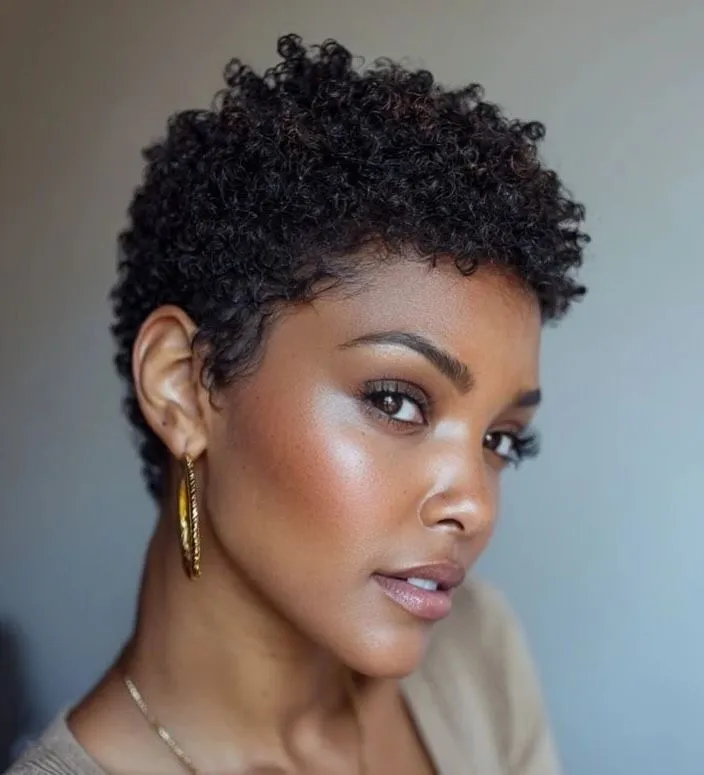
Photo via Instagram
I like how this cut lets the curl pattern do all the talking. The taper on the sides is gentle rather than sharp, which keeps the transition gradual and avoids the hard geometric line that a fade would introduce. The curls at the crown have enough length to show their full spiral, and that extra quarter inch of length is what gives the cut its dimension. The gold hoops echo the warm tones in the skin and the slight golden undertone visible in the hair’s sheen under the light. Everything stays within a narrow tonal range, which is why the overall impression is cohesive rather than assembled from separate decisions.
The best move here is the minimal taper rather than a hard fade. On tightly curled hair at this length, a soft taper preserves the curl pattern all the way down to the edge, while a hard fade would create a band of exposed skin that interrupts the texture. The transferable principle is that short natural cuts gain depth from gradual transitions, letting the curl pattern itself define the silhouette rather than relying on shaved contrast.
7. Curly Mohawk-Inspired Pixie With Tapered Sides
The cut features voluminous, glossy curls piled high at the crown, with the sides cut short and close to the head in a taper or fade. The curls at the top are loose, open spirals with a wet or heavily gelled finish that catches light, sitting several inches above the head. A red accent is faintly visible near the top, possibly a small hair clip. The person wears a gray heathered top and a chain necklace, and the setting reads as a home salon or small studio.
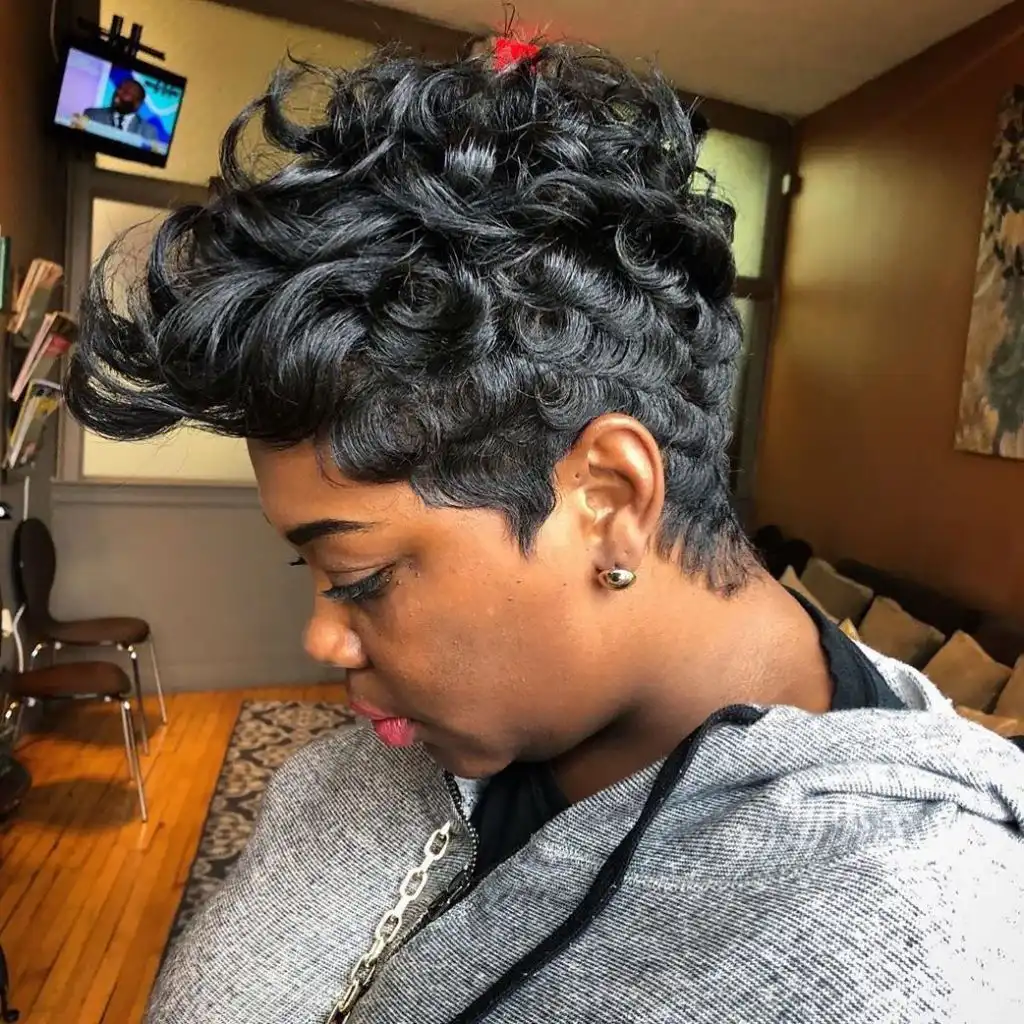
Photo via Instagram
The vertical drama here comes from the height-to-width ratio. The curls at the crown extend the silhouette upward by several inches, while the compressed sides pull the profile inward, and that contrast produces a shape that feels sculptural. The glossy finish on the curls amplifies the volume by reflecting overhead light, making the top section appear even larger than its actual mass. The tapered sides, meanwhile, stay matte and flat, which reinforces the division between the two zones. The chain necklace at the base of the neck grounds the composition by adding a horizontal element that counterbalances all the vertical energy above. This kind of height-driven approach to short hair silhouettes shows how a single cut can occupy two completely different textures and volumes at once.
The reader takeaway is that a mohawk-inspired shape works through extreme contrast between the top and sides. The principle to carry forward is that the higher the crown volume, the closer the sides need to be, because the drama depends on the gap between the two zones.
8. Warm Honey Layered Bob With Soft Movement
The cut is a layered bob in a warm honey-blonde shade, sitting at about chin level with soft, outward-flipping movement at the ends. The layers are stacked, with shorter pieces at the crown creating rounded volume that graduates down to longer pieces at the jawline. The person wears sunglasses pushed up and a white tank top, and the setting appears to be a brightly lit salon with greenery visible through the window behind.
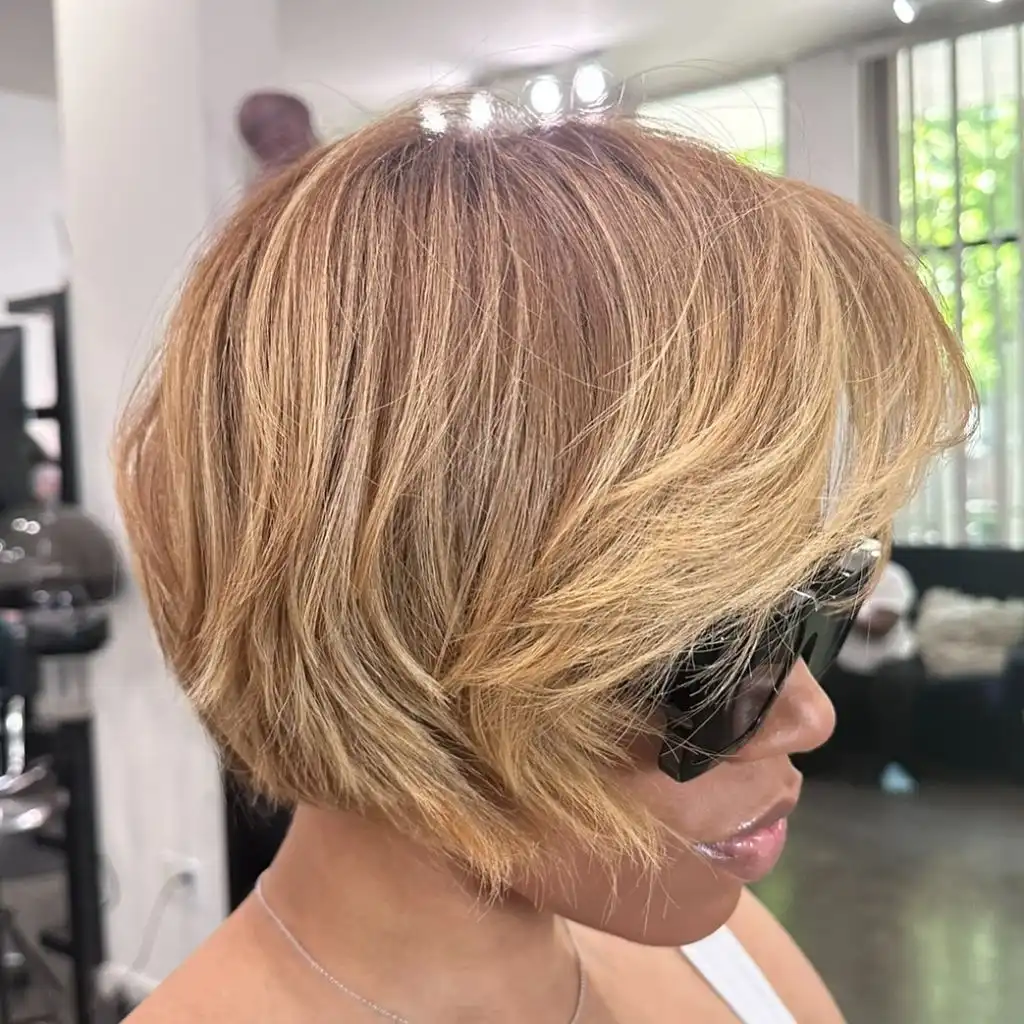
Photo via Instagram
The layering here is what gives the bob its round, inflated shape at the back rather than the flat fall of a single-length cut. Each layer flips slightly outward, and because they are stacked at different lengths, the overall effect is a series of gentle curves that build volume without weight. The honey color has enough dimension within it, with slightly darker roots and lighter tips, to read as natural sun-lightened rather than flat processed blonde. That tonal variation follows the direction of the layers, darker near the scalp where the hair is thicker and lighter at the ends where the pieces are thinner and more transparent.
The useful move here is the layered stacking that creates volume at the crown and movement at the ends simultaneously. A bob without internal layers would collapse under its own weight at this length. The transferable principle is that rounded bob shapes depend on invisible architecture, the interior layering that pushes the outer surface outward and gives it a life that a blunt line alone cannot produce.
9. Deep Plum Bob With Feathered Ends
The hair is a chin-length bob in a deep plum or burgundy shade, with the ends softened into feathered layers that curve gently inward and outward. A side part sends the hair sweeping across the forehead, and the overall shape is a rounded oval when viewed in profile. The person wears a cream or off-white top, and the background is a warm-toned salon interior with shelving and product bottles faintly visible.
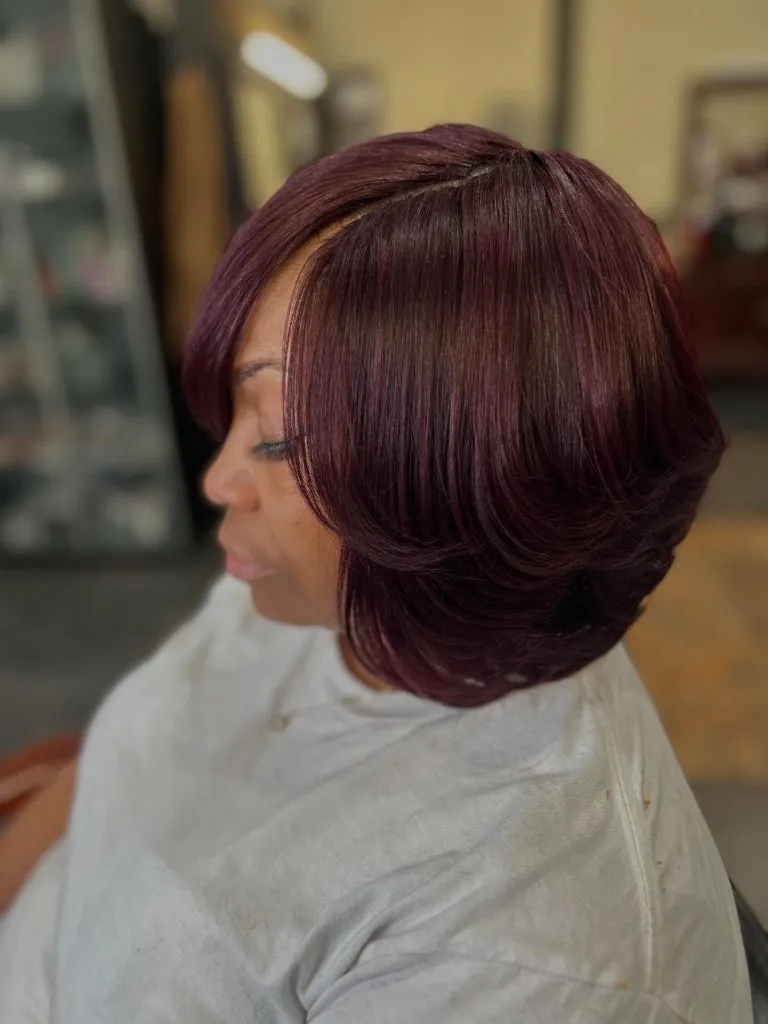
Photo via Instagram
The plum shade reads as both bold and restrained because it sits in the red-violet spectrum, a color family that carries warmth without the brightness of a true red or the shock of a violet. Against the warm undertones of the skin, it creates a soft mid-contrast boundary that feels deliberate but not loud. The feathered ends introduce the only visible texture in the cut, with individual pieces curving in slightly different directions and breaking up what would otherwise be a solid, helmet-like perimeter. That subtle irregularity at the edge is the breathing room the shape needs to avoid looking rigid. For anyone drawn to rich tonal color on bobs, this shade demonstrates how a single deep hue can carry the full visual weight of a cut.
The strongest lesson is that deep, saturated color on a structured cut needs feathered ends to stay approachable. Without those soft edges, a dark bob in a bold shade can read as heavy or closed. The principle is that the harder the color statement, the softer the perimeter should be, letting texture at the edges relieve the density of the shade.
10. Classic Black Layered Bob With Rolled Ends
The hair is a medium-length layered bob in natural black, with the ends curled under in large, deliberate rolls that create visible horizontal bands of movement. Bangs sweep across the forehead, and the layers are stacked from chin length at the front to shoulder length at the back. The person wears a light blue-gray top, and the setting is a warmly lit interior room with a hallway visible in the background.
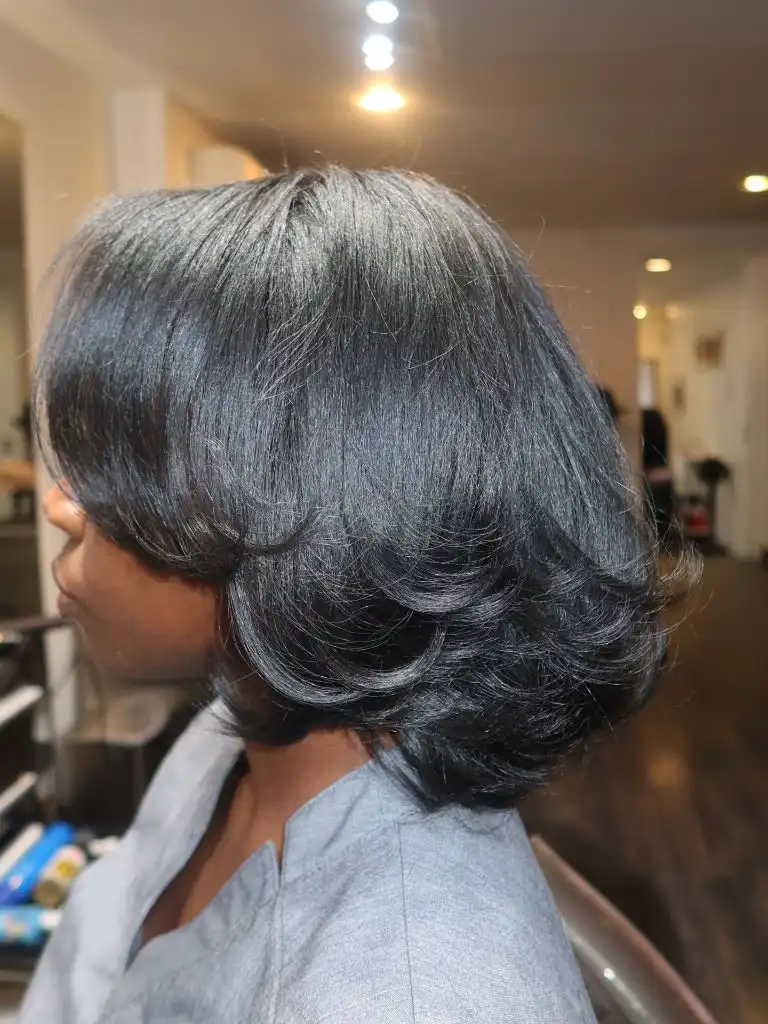
Photo via Instagram
The rolled ends are the structural signature of this cut. Each layer terminates in a smooth, inward-curving roll, and because the layers sit at different lengths, the rolls stack vertically, producing a cascading effect down the back and sides. The high shine of the hair amplifies this stacking by catching light along each curve, making the individual rolls legible even from a distance. The bangs provide a horizontal line across the top that frames the forehead and anchors the composition, preventing all that cascading movement from pulling the eye too far downward. The overall silhouette is a rounded trapezoid, widest at the bottom of the rolls and tapering at the crown.
The beauty of this is the layered roll technique, which turns a basic bob into a sculptural statement. The principle here is that when every layer ends in the same deliberate curl direction, the cut reads as choreographed rather than simply styled. The lesson to carry forward is that uniformity in end treatment across different layer lengths creates rhythm, and rhythm is what separates a set from a shape.
11. Pin Curls With Defined Waves and Tapered Nape
The hair is very short overall, with defined, glossy pin curls covering the crown and sides. The curls are open, looping spirals rather than tight ringlets, sitting close to the head and arranged in a deliberately patterned formation. The nape is tapered close. The person is photographed in profile with eyes closed, face tilted upward, wearing a light gray or blue top and a delicate chain necklace. The outdoor background is softly blurred with blue sky.
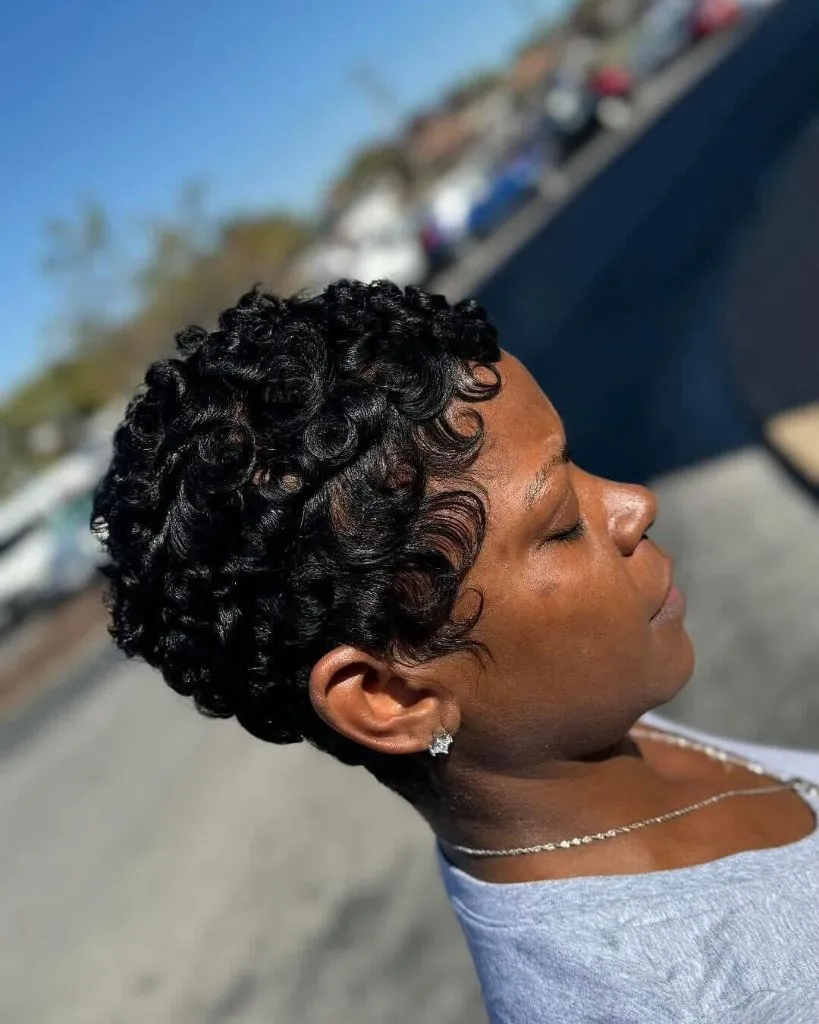
Photo via Instagram
The pin curls create a surface texture that reads almost like fabric, with each curl forming a deliberate loop that catches light individually. The arrangement feels patterned rather than random, which gives the cut a graphic quality even at this close length. The outdoor light plays an important role here, hitting the glossy product at an angle that defines each curl’s edge and shadow, something that flat indoor lighting would flatten. The tapered nape again functions as a clean boundary that sharpens the lower edge, and the chain necklace occupies that cleared space. The tilted profile pose extends the neck line and gives the silhouette a vertical sweep from necklace to crown. Readers exploring ideas for defined short curl styles will notice how the curl size relative to the head size determines whether the overall impression reads as graphic or soft.
What stands out most is the interplay between the structured curl pattern and the clean taper. The principle is that pin curls at this scale function as surface design, and they need a clean perimeter to read as intentional rather than leftover.
12. Platinum Buzz Cut With Soft Texture
The cut is a very close buzz or clipper cut in a platinum white-blonde shade. The hair is barely longer than the scalp, with just enough length to show a faint texture rather than a completely smooth surface. The person wears a white long-sleeve Peanuts graphic shirt and is photographed outdoors at a three-quarter angle, with architectural elements and greenery behind them. A small earring catches light on one side.
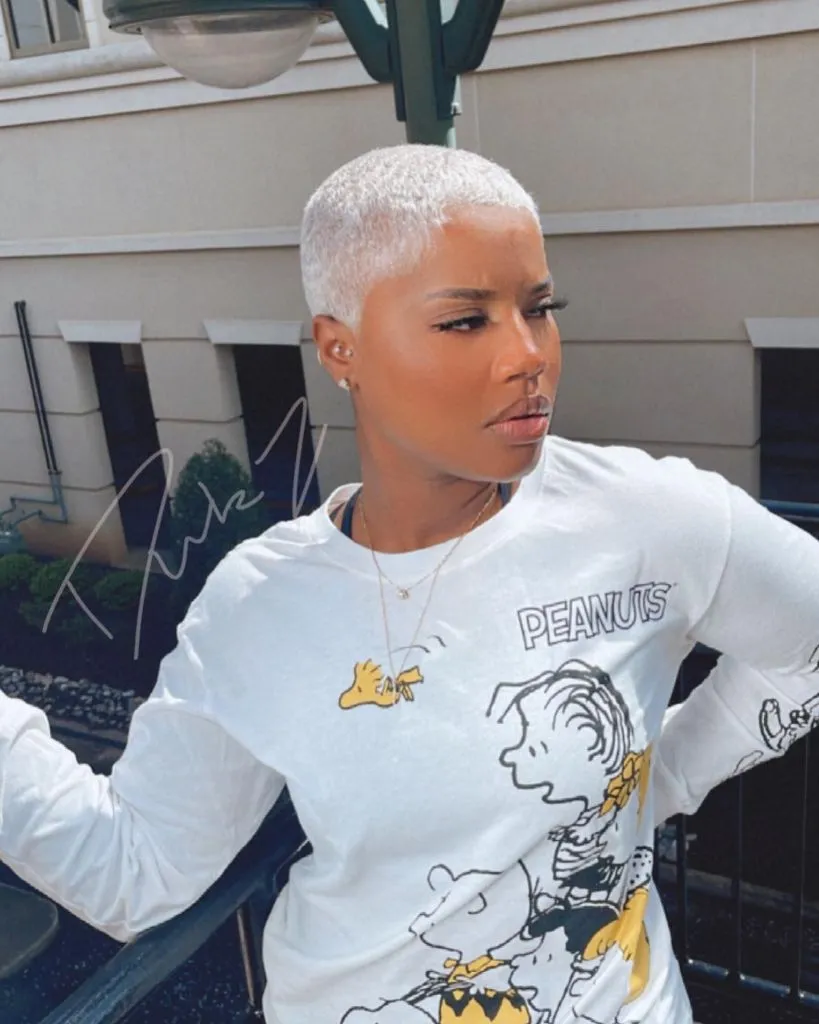
Photo via Instagram
At this length, the cut itself is almost a non-event. The shape is the shape of the head, and there is no layering, no movement, no taper to discuss in conventional cutting terms. What does the work is the color. The platinum blonde on deeply melanated skin produces one of the highest-contrast pairings possible, and that contrast turns the bare skull into a deliberate style statement rather than an absence of hair. The faint texture visible in the remaining length, a soft grain across the surface, prevents the look from reading as completely shaved and signals that this is a chosen length rather than a starting point. The small earring provides the only ornamental detail, and its scale feels right because the cut itself has already committed to maximum minimalism.
The useful idea is that a buzz cut becomes a style when the color is strong enough to carry the entire visual load. The transferable principle is that at the shortest possible length, color replaces shape as the primary design variable, and the bolder the color, the more the cut reads as a confident choice.
13. Half-Up Ponytail With Loose Wavy Extensions
The hair is styled in a high half-up ponytail with the front section slicked flat and the ponytail cascading down in loose, crimped waves. The length extends well past the shoulders. The front section shows a clean parting and baby hairs laid into delicate swirl patterns along the hairline. The person wears a white graphic tee with colorful printing, gold jewelry at the neck, and the setting is a vivid pink-walled room with “Dolled” branding visible on the wall.
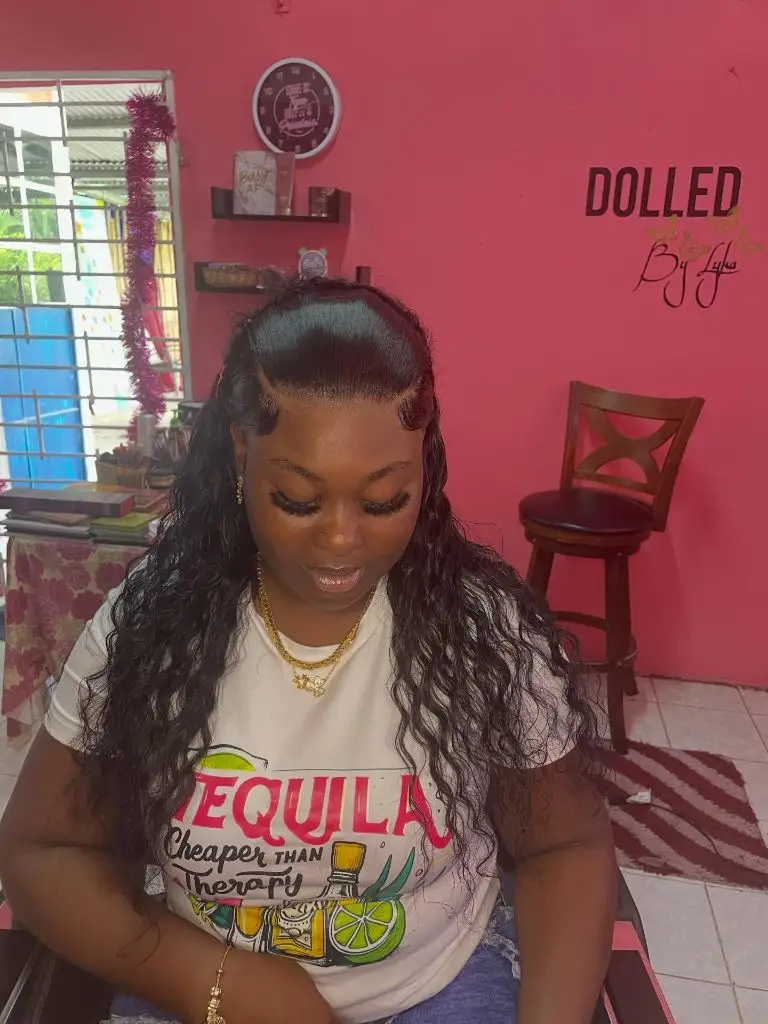
Photo via Instagram
The tension between the slicked front and the loose, voluminous back is the structural engine of this style. The flat zone from forehead to crown compresses the silhouette and reads as controlled, while the ponytail introduces movement and length that spills freely down and over the shoulders. The baby hair details at the hairline add a decorative layer that softens the hard edge of the slicked section and introduces curves where the rest of the front is aggressively smooth. The wave pattern in the extensions is uniform enough to read as deliberate but not so uniform that it looks synthetic, landing in a zone that suggests extensions styled with care and intention. The pink wall behind adds a color dimension that heightens the overall visual energy.
The best move here is the contrast between the slicked front and the released back. The principle is that half-up styles gain their power from the sharpness of the division between the controlled zone and the free zone. The cleaner the front, the more dramatic the volume behind it reads.
14. Shoulder-Length Marley Twists With Volume
The hair is styled in thick, textured Marley twists that fall past the shoulders, with a center part and full volume on both sides. The twists have a matte, natural-looking texture with slightly fuzzy edges that give them an organic appearance. The color is a deep natural black. The person is photographed facing the camera with a warm smile, wearing a dark top and a delicate gold chain necklace, against a gray textured wall.
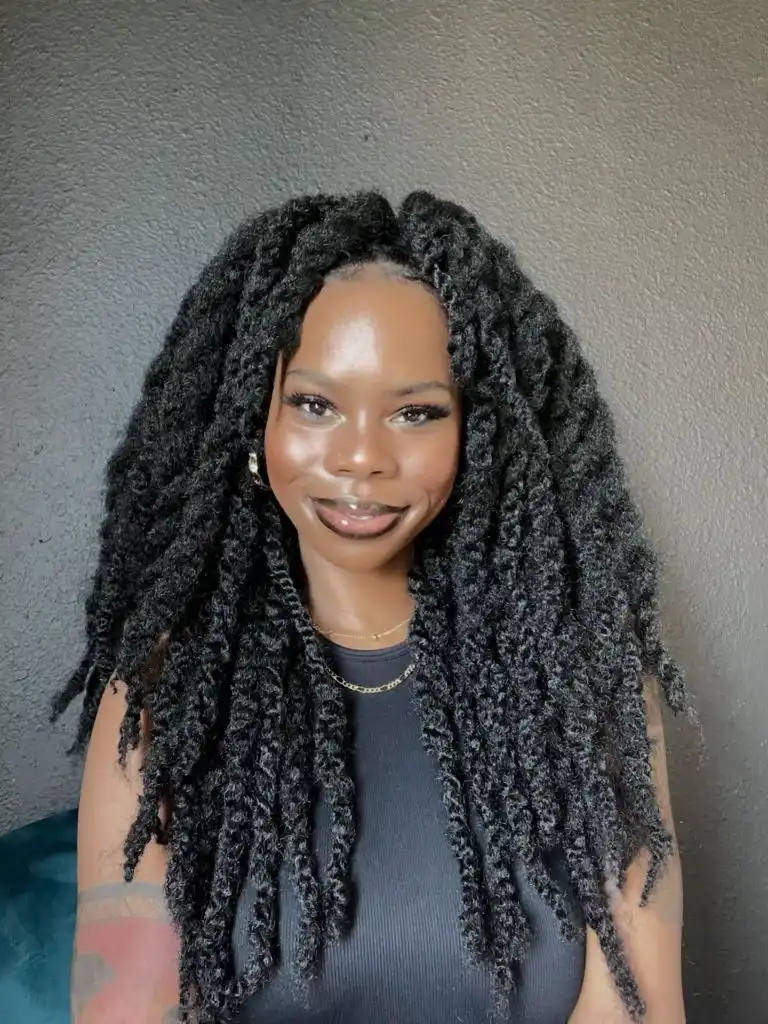
Photo via Instagram
The volume here is distributed evenly on both sides of the center part, creating a wide, triangular silhouette that frames the face in a V shape from the crown down to the outer edges of the twists. The matte texture of the Marley hair absorbs light rather than reflecting it, which gives the overall shape a density and weight that glossy twists would not carry. The slightly fuzzy edges of each twist blur the boundary between individual pieces, so the mass reads as a single textured shape rather than a collection of separate strands. The dark color against the gray wall creates a tonal contrast that pushes the hair forward in the frame, and the gold necklace introduces a single warm metallic accent at the center of the composition. This approach to protective twist styling shows how volume and texture can define a shape even without a traditional cut.
The reader takeaway is that Marley twists create their silhouette through accumulated mass rather than cut lines. The principle is that matte, textured protective styles need even distribution from the part to hold a balanced frame, because any unevenness in density reads more prominently when light is being absorbed rather than reflected.
15. Deep Wave Curly Extensions at Mid-Back Length
The hair falls in tight, defined deep wave curls from the crown to the mid-back, shown from behind. The curl pattern is uniform and consistent, with each wave spiraling in the same direction and size from root to end. The color is a deep natural black with faint light catching the outer edges of each curl. The person wears a red top, and the background shows a storage area with stacked boxes.
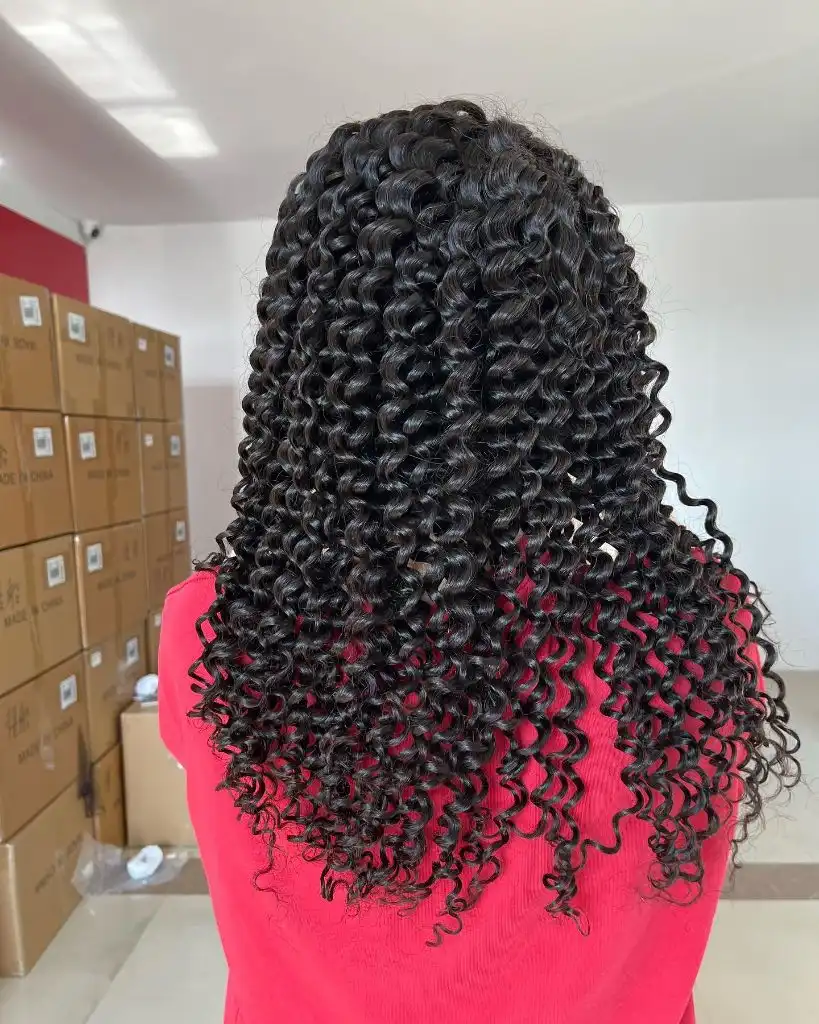
Photo via Instagram
The uniformity of the curl pattern is what gives this length its visual impact. Each wave repeats the same S-curve at the same interval, creating a rhythmic texture that the eye can follow from top to bottom without interruption. The deep black color absorbs most of the ambient light, but the ridges of each curl catch just enough to outline the pattern, producing a subtle three-dimensional effect across the entire surface. From the back, the silhouette narrows from shoulder width to a tapered point at the bottom, which gives the mass a sense of direction and prevents it from reading as shapeless. The red top creates a bold color anchor at the base that keeps the eye from drifting past the hair entirely.
The strongest lesson is that long curly extensions maintain their visual coherence through pattern consistency. The transferable principle is that when every curl repeats the same shape at the same scale, length itself becomes a design element rather than just a measurement, because the eye reads the repeating pattern as intentional structure.
16. Blonde 613 Lace Front With Half-Up Ponytail
The hair is a long, wavy blonde in the 613 platinum range, styled in a half-up ponytail with the remaining hair falling past the shoulders. The lace front is visible along the hairline, and baby hairs are laid in soft curves across the forehead. The person wears a pink top with a green graphic design, a gold chain necklace, and the setting is a salon or studio with blurred warm-toned lighting.
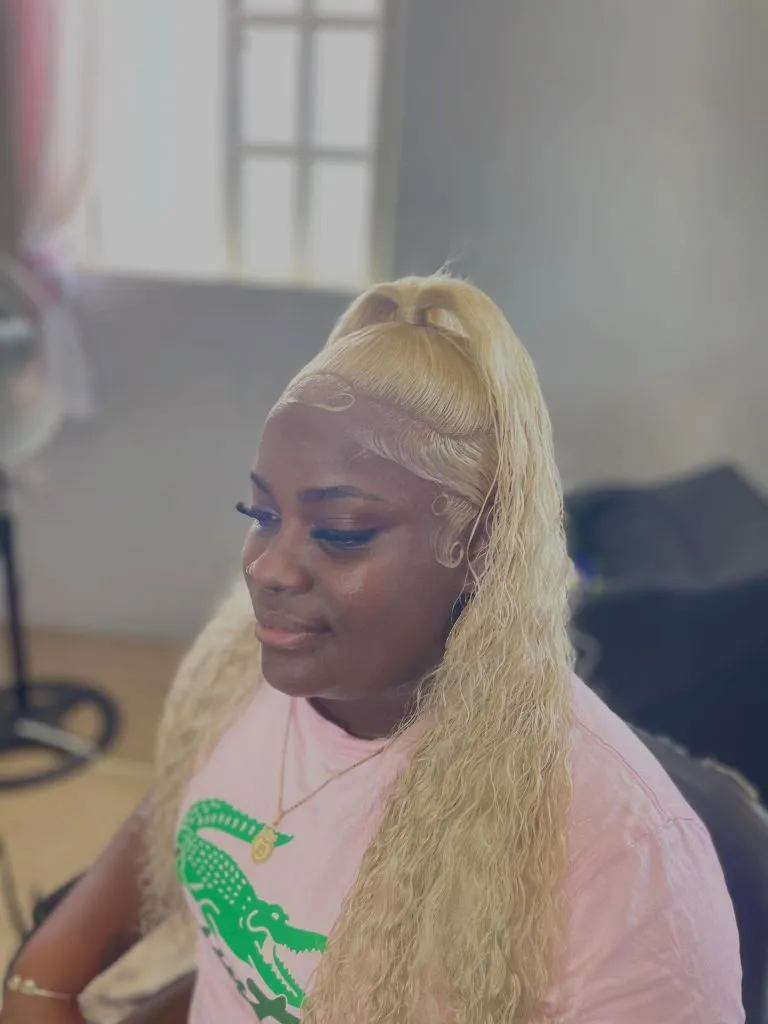
Photo via Instagram
The platinum blonde at this length on deep skin creates a dramatic, high-contrast frame that demands the cut and styling be controlled to avoid visual chaos. The half-up ponytail contains the upper portion and lifts the crown, while the loose lower sections provide length and movement. The wavy texture in the loose hair is open and relaxed, with enough irregularity to avoid looking synthetic while maintaining enough pattern to read as styled. The baby hair work along the hairline softens what could be a harsh wig line and introduces small decorative curves that echo the larger waves below. The gold chain necklace sits against the skin in the zone between the chin and the chest where the blonde hair parts to reveal it. This pairing of bold blonde with structured styling demonstrates how color intensity and styling control need to scale together.
The useful move here is the baby hair detail along the lace front, which transitions the edge from artificial to organic. The principle is that the more dramatic the color contrast between hair and skin, the more attention the hairline zone needs, because that is where the eye evaluates whether the look is integrated or simply placed on top.
17. Mini Twists at Shoulder Length With Natural Texture
The hair is styled in small, uniform mini twists that fall to the shoulder blades, shown from behind. The twists are thin, with curled or coiled ends that suggest they were twisted on damp or moisturized hair. A center part is visible at the crown, and the overall color is deep brown to black. The person wears a light mint or aqua sleeveless top, and the setting is a clean, white-walled room with a small white shelf and a pink plant accent.
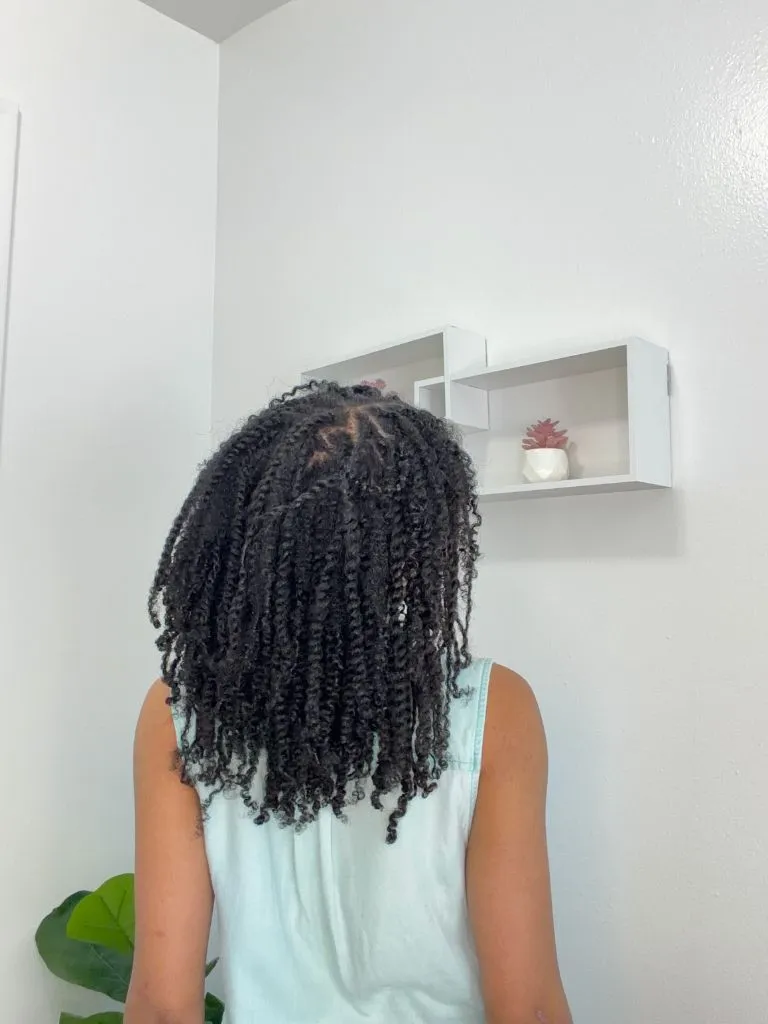
Photo via Instagram
The mini twists read as a texture field from the back, a dense surface of narrow spirals that together form a single mass with gentle movement. The curled ends give each twist a slight bounce that prevents the style from hanging limp, and the overall shape widens slightly from the crown to the shoulder blades before narrowing again at the ends. The center part is the only structural line in the composition, and it functions as a spine that divides the texture field into two equal halves. The clean, white setting emphasizes the dark hair and makes the texture the clear focal point. This kind of natural protective styling works as both a transitional look and a standalone statement, depending on how the texture is maintained over time.
The beauty of this is the way hundreds of individual twists merge into a single textured shape that reads as one silhouette from a distance. The principle is that mini twists create their visual impact through repetition at a small scale, and that repetition needs even sizing to look cohesive.
18. Ombre Marley Twists With Brown Tips
The hair is styled in medium-sized twists that transition from a dark root to a warm brown at the tips, falling past the collarbone. The front sections frame the face and are pulled back slightly with one hand, revealing a center part and the natural hairline. The person wears a cream knit cardigan with brown buttons and is photographed against a white wall with the same small shelving unit visible as in the previous image.
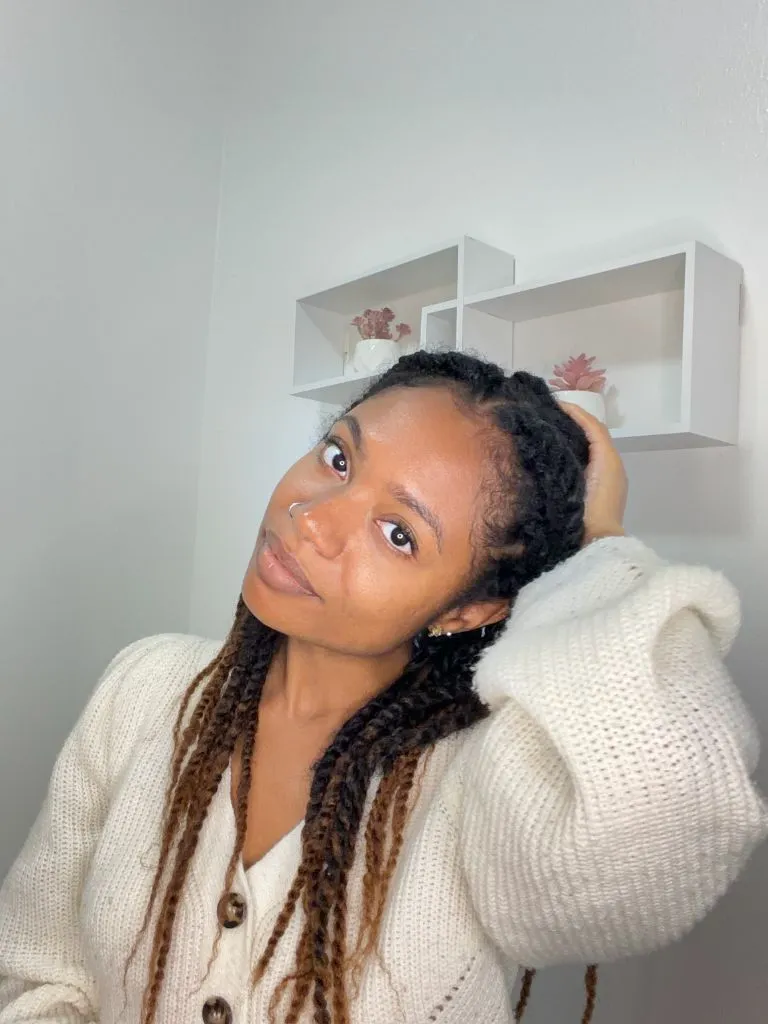
Photo via Instagram
The ombre transition from dark root to brown tip creates a gradient that gives the twists directional movement even when they are hanging still. The eye follows the color change downward, which elongates the perceived length of the style. The warm brown at the tips picks up light more readily than the dark roots, so the lower third of the hair becomes the brightest zone and the upper two-thirds recede into a quieter background. This top-dark, bottom-light distribution is the opposite of what natural root growth produces, which is what makes it read as a deliberate design choice. The cream cardigan provides a neutral backdrop that does not compete with the color transition, letting the ombre effect on textured hair remain the clear focal point.
What stands out most is the way the color gradient mimics directional lighting even in flat ambient conditions. The principle is that ombre on twists works best when the transition point sits at the widest part of the silhouette, because that is where the eye naturally pauses and the color shift becomes most legible.
19. Shoulder-Length Twist-Out With Defined Coils
The hair is a shoulder-length twist-out with well-defined, separated coils that carry both volume and pattern. The color is natural dark brown to black, with light catching the outer edges of each coil and defining its spiral shape. The person is photographed facing the camera with a center part, wearing a light denim sleeveless button-up top. The setting is a bright, white-toned bedroom with a bed, nightstand, and dried floral arrangement visible behind.
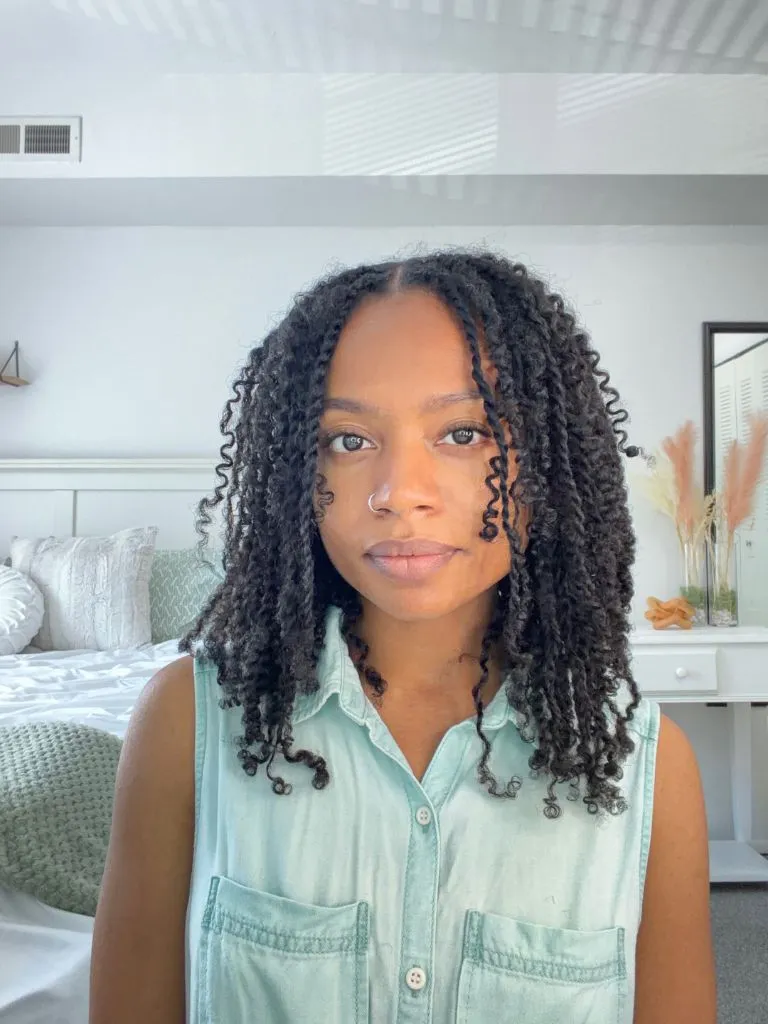
Photo via Instagram
The twist-out produces a shape that is wider than the shoulders and roughly triangular, with the narrowest point at the center part and the widest at the ends. Each coil retains its individual definition, which means the silhouette has internal texture rather than reading as a solid mass. The light denim top introduces a casual, slightly washed-out tone that pushes the visual weight upward toward the hair, making the coils the dominant element in the frame. The center part functions the same way it does in the blown-out natural from earlier in this set, as a geometric anchor that holds the organic texture in balance. The bright, diffused light of the room fills in the shadows between coils and keeps the overall impression open and airy rather than dense. This type of defined natural texture requires careful sectioning during the twisting phase to produce even separation during the unraveling.
The reader takeaway is that a twist-out silhouette depends as much on the unraveling technique as the twist itself. The principle is that uniform coil separation across the entire head creates a shape that reads as structured, while uneven separation produces a more organic, less predictable frame, and either can work depending on the intended effect.

Hi, I’m Zoey Mitchell, the creator of ChicStyle Blog.
I share simple, wearable outfit ideas, hairstyles, nail trends, and beauty tips that feel natural and easy to recreate.
This blog is where I explore everything that makes a woman feel put together and confident every day. I’m not an expert — just a woman who genuinely loves style, mixing looks, and discovering what works.
If you love effortless fashion with a personal touch, you’ll feel at home here.