
Winter hair colors tend to force a choice between going darker for depth and staying light enough to keep the hair from looking flat. The resolution is rarely the shade itself; it sits in placement. A root left deeper than the mid-lengths, brightness kept to the outer edges, and a narrow band of contrast near the face will read as dimension even when the overall value stays low and quiet.
Rather than a set of formulas, treat the following as an exercise in reading relationships. Compare how far each root shadow travels before it releases, how wide the light sections are, and whether the brightest tone sits at the front, the ends, or scattered through the interior. Once you can see those three variables, winter hair colors stop being a color decision and become a question of proportion and rhythm.
1. Chestnut Brown Over Warm Copper Ends
The frame catches a three-quarter angle, with mid-length layers falling from a soft side part and bending outward at the collarbone. The root reads as a deep chestnut, while the interior mid-lengths carry a lighter reddish brown that keeps opening up toward the ends. A black cape covers the shoulders, and the blurred salon shelving behind sits far enough back to stay a flat backdrop.
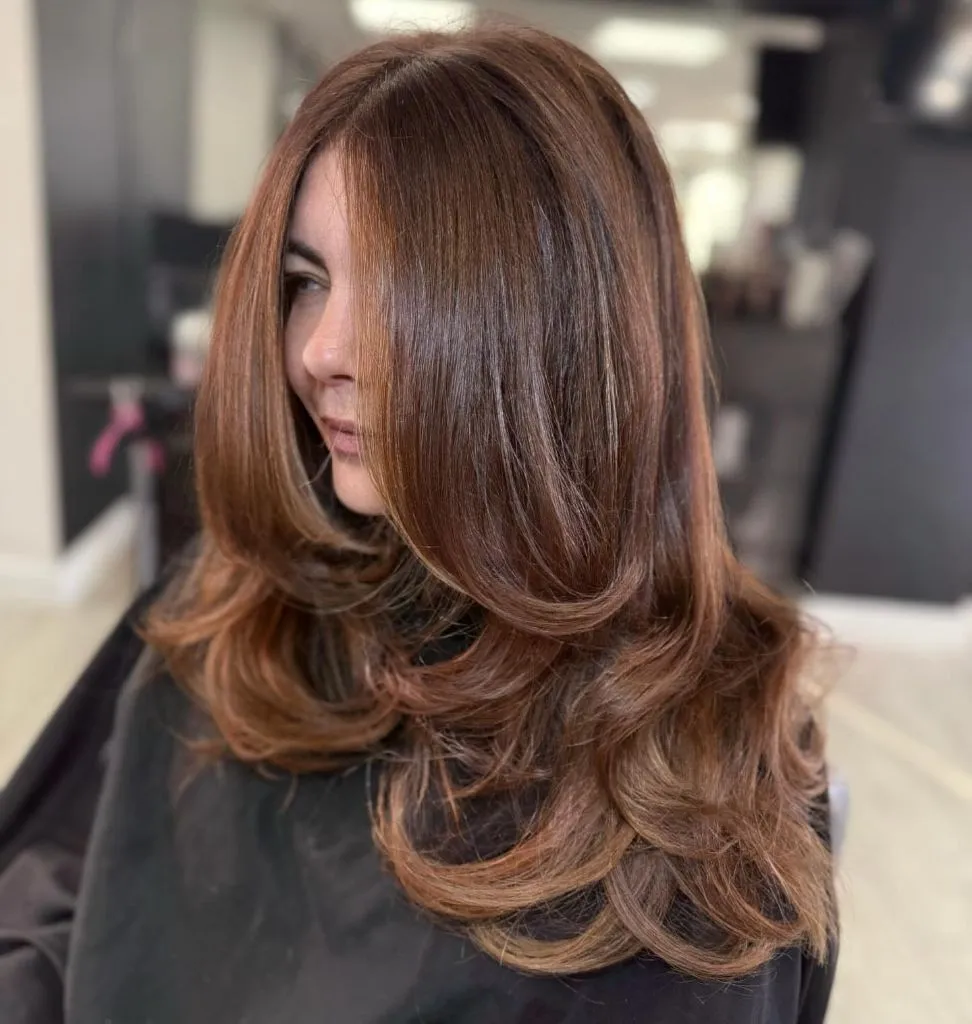
The mechanism here is tonal layering rather than contrast. Three closely related browns stack from dark at the scalp to a warm amber at the tips, and because each step is small, the eye reads gradient instead of stripe. The outward bend at the ends places the lightest tone exactly where the shape turns, so the color change and the haircut change land on the same line and reinforce each other.
To adapt this softer, stop the lightest tone one inch lower and skip the interior brightness entirely, letting only the ends shift. For a bolder read, push the copper further up into the mid-lengths on the side that falls forward. Keeping the root a full level deeper than everything else is what prevents the warmth from taking over the whole head.
2. Buttery Blonde Framing A Center Part
Shot straight on and close-cropped, this one is built around a center part with two long front pieces swept back off the face. The base reads as a soft mid blonde with cooler beige threads, while the front sections carry the brightest, creamiest tone. Length falls past the chest in loose S-waves over a black high-neck top, and the darkened ceiling behind stays out of focus.
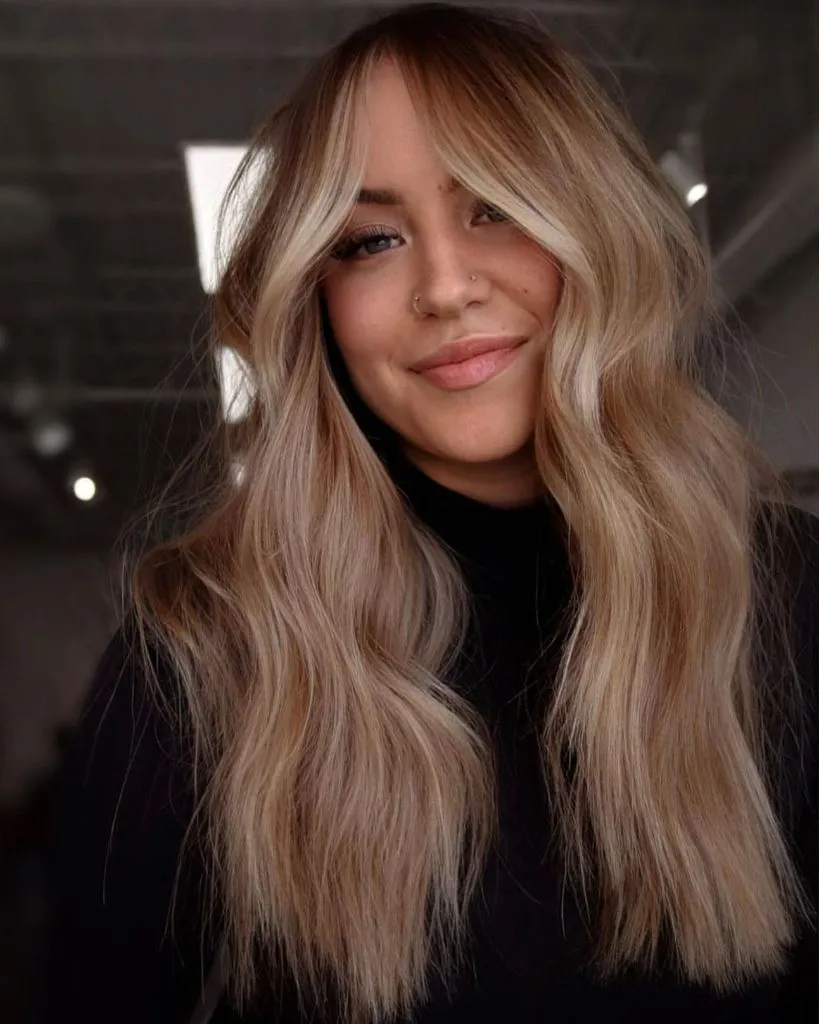
Placement does all the work. The lightest blonde is zoned into a narrow corridor along the part and the first two inches of the front sections, so brightness clusters where the face already draws attention. Everything behind that corridor drops half a level, which keeps the interior from competing. The black neckline underneath acts as a hard stop, making the pale ends look brighter by sitting directly against the darkest value in frame.
The most useful detail is the width of that bright front section: roughly one comb’s worth on each side, no more. Widen it and the whole crown starts to look bleached rather than framed. On shorter lengths, keep the same corridor but shorten it so the brightness ends at the jaw instead of running to the mid-lengths.
3. Cool Bronde Waves Seen From Behind
The back view shows a dark brown root that holds solid through the upper third of the head before breaking into ribbons of cool light brown and sandy blonde. Uniform tight waves run the full length, ending just below the shoulder blades. A black satin-looking shirt sits at the bottom of the frame, and the pale concrete wall behind reads as a neutral flat surface.
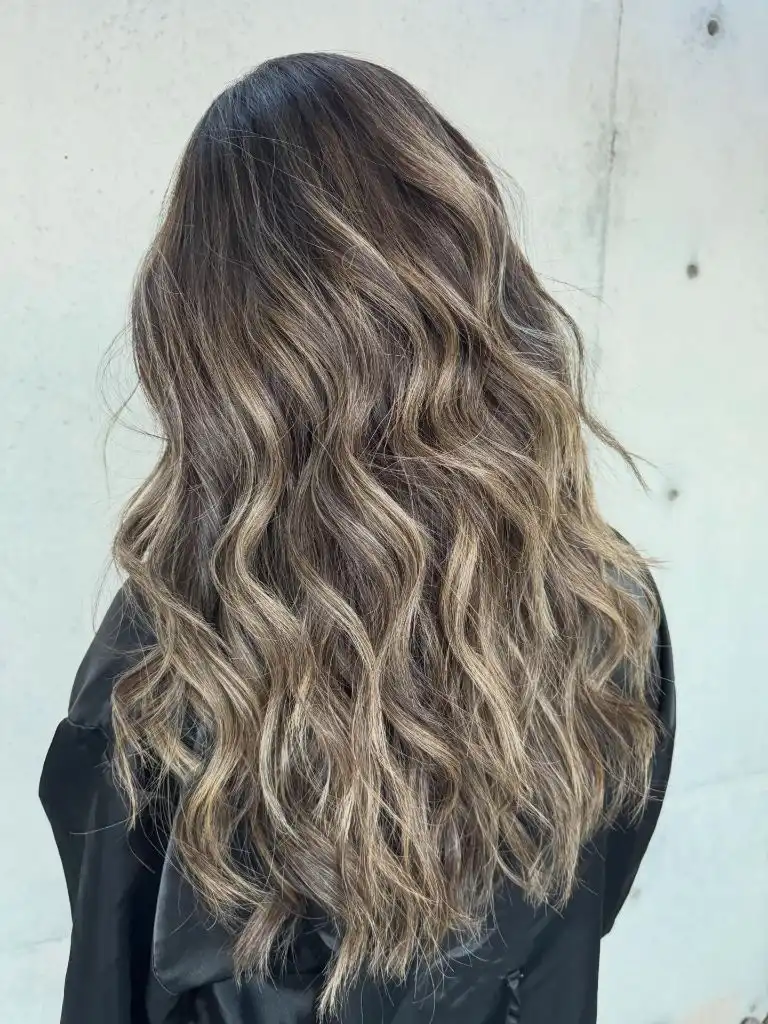
This is a study in contrast of value, and the wave pattern is what makes it readable. Every bend turns a light ribbon toward the camera and hides part of a dark one, so the two values alternate at a regular interval instead of pooling. That rhythm is why winter hair colors for brunettes often rely on wave rather than straightening: the same placement, worn poker straight, would show as separated vertical bands.
The single most useful element is the untouched dark section at the top, which is deep enough to read as a natural base. Keep it at least a hand’s width from the parting before any lightness begins. If you want a quieter version, reduce the number of light ribbons by half and leave the widest ones toward the outer perimeter.
4. Sandy Blonde Above A Shadowed Root
From the side, a collarbone-length cut falls in soft bends with the ends flicking outward. The root area is a muted darker blonde that diffuses gradually into sandy and pale blonde through the mid-lengths and tips. One long front piece crosses the face, and a cream short-sleeve top sits below. The background is a plain off-white wall with no competing detail.
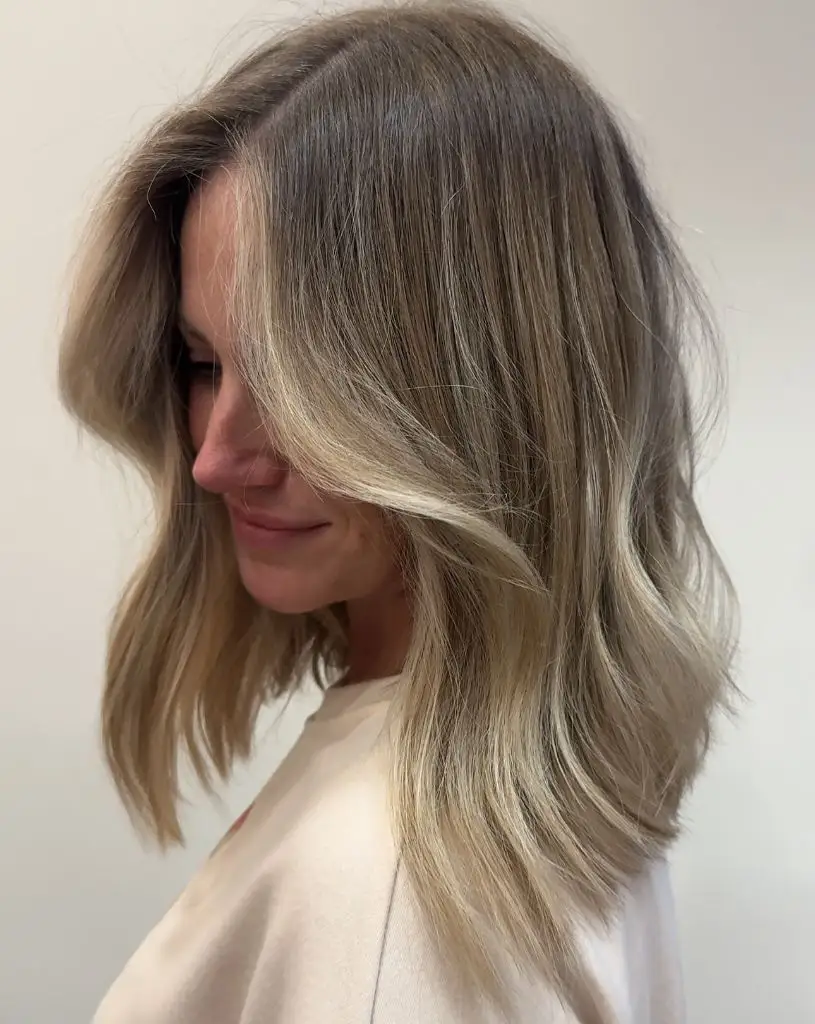
What carries this is negative space in the color placement. Rather than filling the crown with light, the top of the head is deliberately left unlit, giving the brighter mid-lengths somewhere to travel from. There is no visible line where one tone stops, because the transition zone is long and low in contrast. The result depends on restraint: fewer light sections, spaced further apart, each one blurred at its upper edge.
Adapting this for shorter hair works well because the shadowed root needs only two or three inches to establish itself. On a chin-length bob, start the release just under the ear. If regrowth is a concern, this is the version that stretches longest, since the deepest tone is already sitting at the scalp by design.
5. Espresso Brown Against Soft Mocha Ribbons
A side profile shows near-black espresso brown through the crown, loosening into wide barrel waves that stop below the shoulder. Thin mocha and light brown ribbons surface only where the waves turn outward, mostly across the mid-lengths and the exterior. A light gray knit-like sweater grounds the lower frame, and the pale wall and ceiling lights behind stay soft and unfocused.
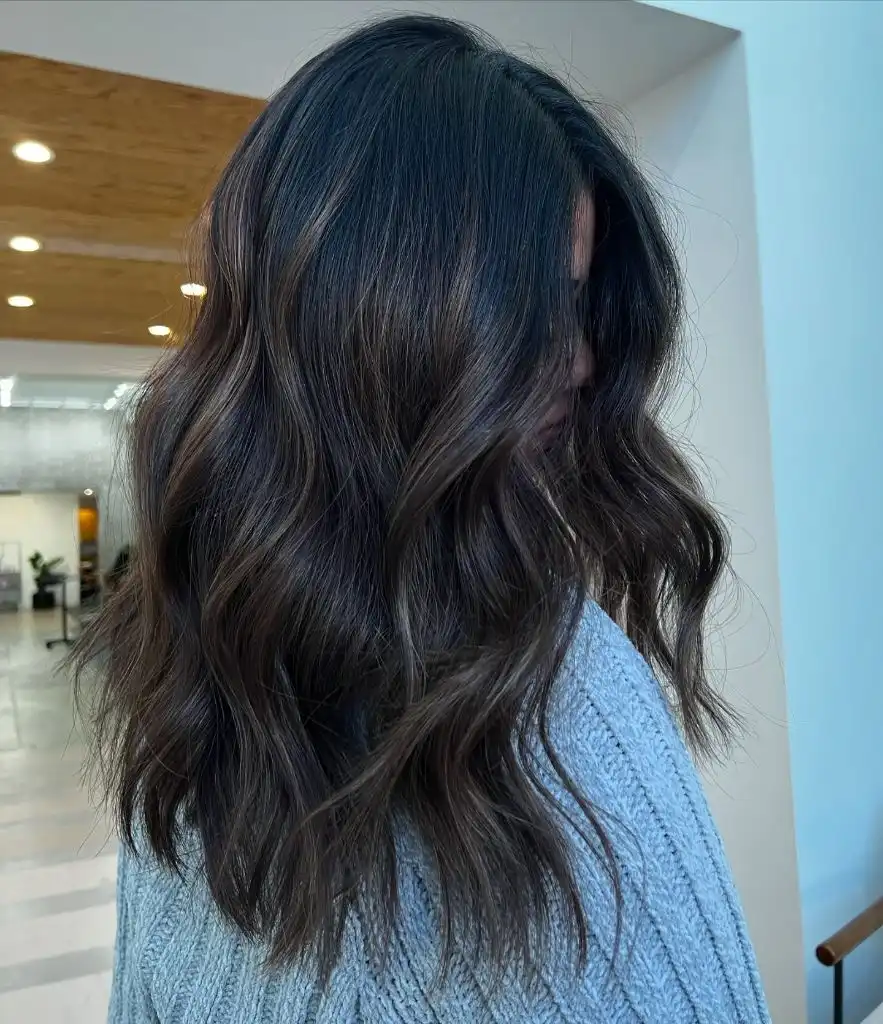
The interest comes from texture working against a smooth, dark ground. Because the base is nearly uniform, every lit curve of the wave becomes a highlight by geometry rather than by bleach, and the few painted ribbons simply amplify what the shape already does. Contrast between base and ribbon is kept to about two levels, which is why the effect reads as shine rather than as separate pieces of color.
The practical takeaway is that dark hair needs wave definition more than it needs lightness. Curl in alternating directions and the same two-level lift will look like twice as much. For a softer version, place the ribbons only on the sections that fall behind the shoulder, leaving the front perimeter entirely untouched.
6. Dark Base Broken By Icy Blonde
Facing forward with the head tilted down, a hand lifts the hair near the part to reveal a very dark, almost black root. Below it, broad cool blonde sections weave through wide waves that run past the chest. The lightest pieces sit heaviest around the face and the outer lengths. A bright pink ribbed tank sits at the base of the frame against blurred shelving.
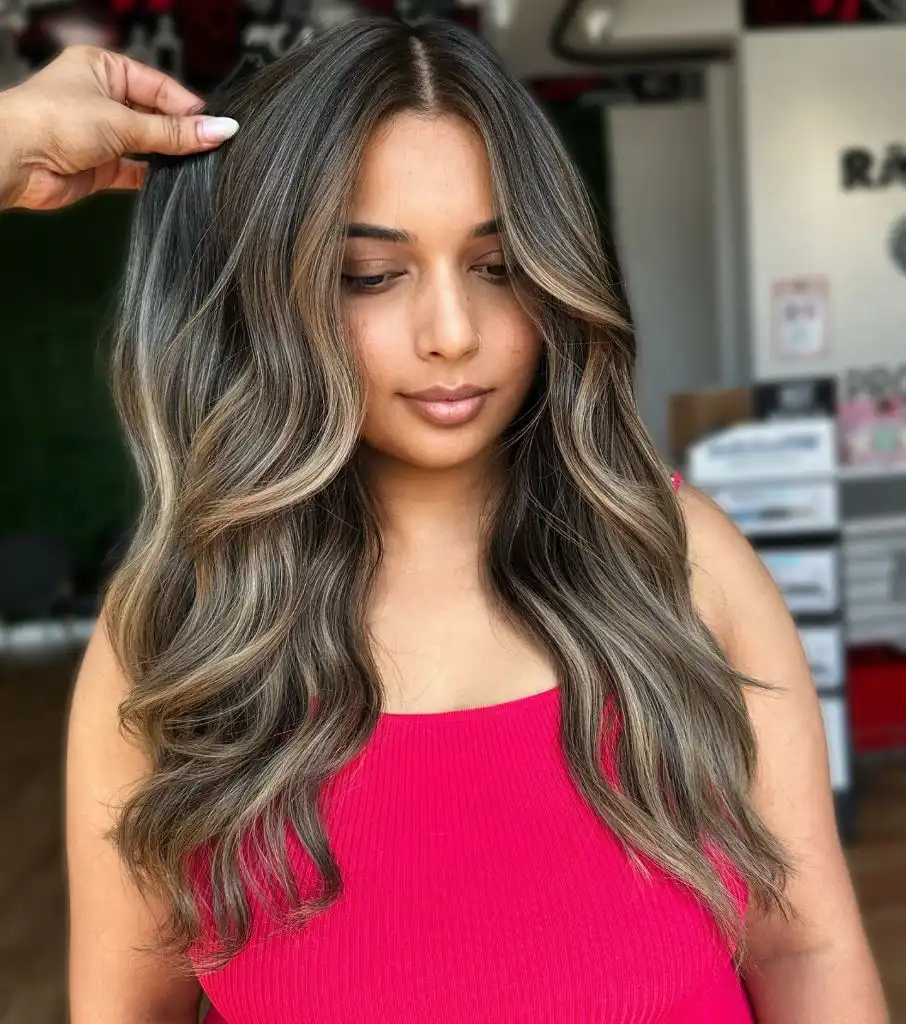
Scale is the deciding factor. These light sections are wide, closer to thick panels than to fine slices, and that width is what lets them survive against such a dark base without turning gray or muddy. Fine weaving at this level of contrast would blur into a flat middle tone. Cool winter hair colors like this one rely on keeping the blonde blue-based, since any gold against a black root reads as brass instantly.
The strongest control point is the amount of dark left at the top. Roughly the first two inches stay untouched, which keeps the contrast intentional instead of accidental. For a lower-maintenance version, reduce the number of panels but keep their width, and let the front two frame the face while the rest sit behind the ear.
7. Mushroom Brown Fading To Pale Tips
The back of the head is centered in frame, showing a deep neutral brown at the top that cools as it descends into a smoky mushroom tone. Defined ribbon waves carry through the mid-lengths, and the final two inches lift sharply into a pale sandy blonde. A gray satin-looking cape covers the shoulders, with a dim open room and a plant visible behind.
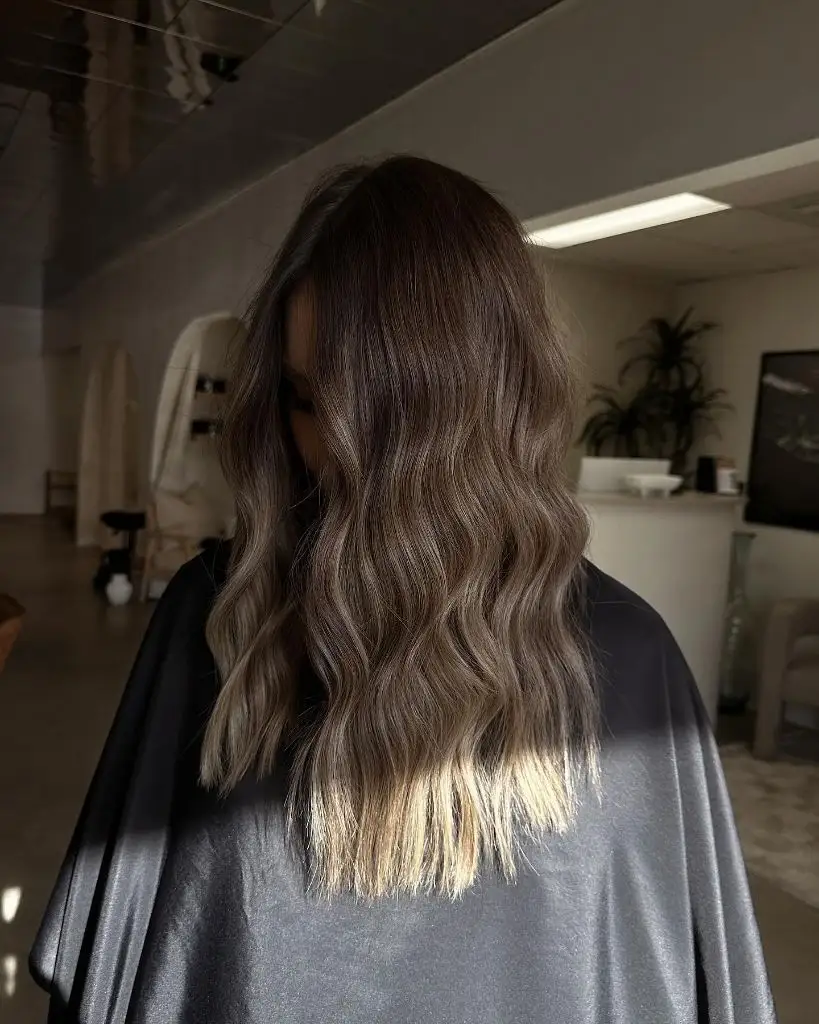
The read here is vertical rather than horizontal. Color changes along the length instead of across the width, so the whole head behaves like one continuous column that gets lighter as it drops. That vertical logic makes long hair look longer, since the eye follows the shift downward without interruption. The abrupt brightness at the very tips works as a terminal accent, marking where the column ends.
The detail worth borrowing is that hard bright edge at the ends, kept to about two inches. Any deeper and the gradient loses its top-to-bottom direction. To soften it, blur that final band with a mid tone so the tips glow rather than separate, and keep the mushroom cast cool throughout for the transition to stay seamless.
8. Deep Brunette Root Over Wheat Blonde
A three-quarter turn shows a solid dark brown root and crown, with light wheat and cream blonde beginning around eye level and dominating everything below. The brightest sections sit at the front, sweeping back from a center part into large uniform waves that fall to the waist. A white ribbed sleeveless knit-like top sits underneath, with a softly lit room behind.
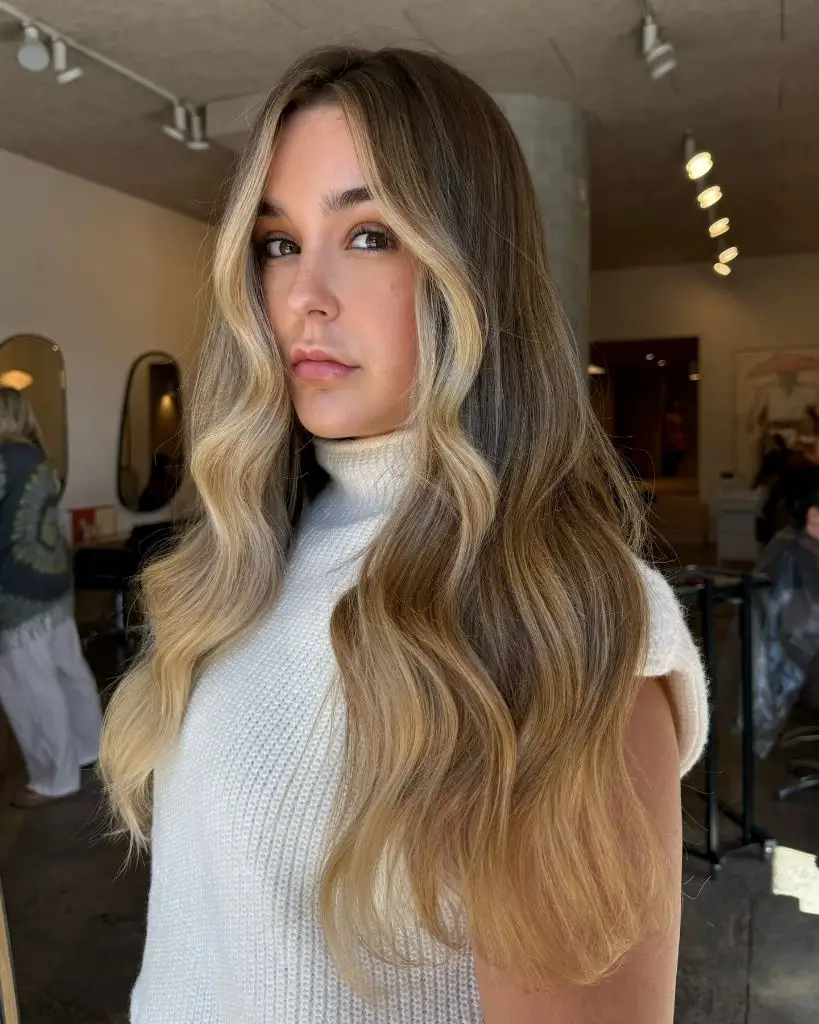
Proportion is the argument. Roughly one third of the visible length stays dark and two thirds sit light, which keeps the balance from reading as either a grown-out root or an all-over blonde. That ratio also loads the visual weight low, so very long hair keeps a sense of density at the ends rather than thinning out. The center part splits the dark section symmetrically, which stops the transition line from looking crooked.
If you want this on mid-length hair, hold the same one-to-two ratio rather than the same measurement, or the dark section will swallow the shape. This is the cleanest reference point for anyone comparing brunette balayage options with a stretched root, since the placement is what carries it, not the level of lift.
9. Fire Copper Streaks On Dark Chocolate
Photographed from behind and slightly to the side, a dark chocolate base runs through the crown while bright orange-red copper streaks fall in narrow vertical bands from the top down. The lengths bend into loose curls that finish past the shoulder blades. A navy top and a cream fur-like collar sit at the lower edge, and the wall behind stays a plain pale surface.
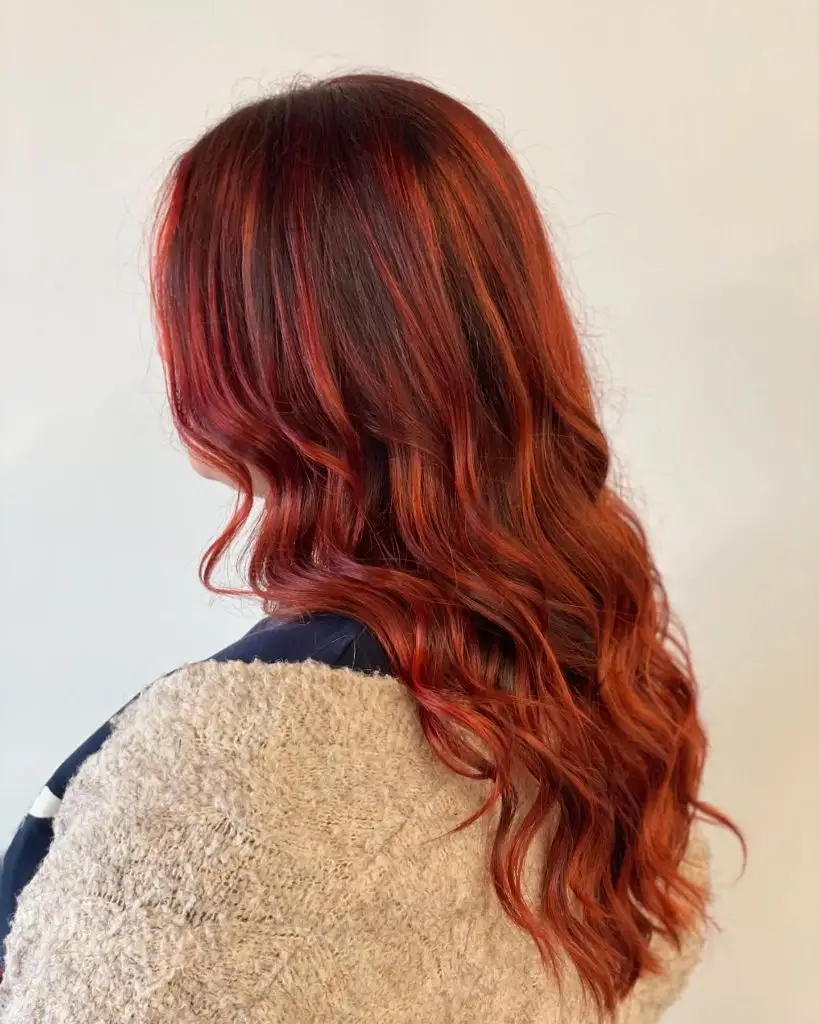
Repetition is what makes this hold together. The same copper appears near the part, again through the mid-lengths, and again at the ends, so a highly saturated color is distributed across three zones instead of concentrated in one. Because the streaks are narrow and the dark base remains the majority, the red reads as an echo running through brown rather than as a second color fighting it.
The useful measure is coverage: the copper occupies well under half the surface. Reduce it further and you get a subtle glint through dark hair; increase it past halfway and the base becomes the accent instead. For a more muted version, drop the copper toward a brick or auburn tone so the jump in saturation is smaller while the placement stays identical.
10. Ash Blonde Panels Through Black Roots
The back view shows a shoulder-length cut with a very dark, nearly black root zone and numerous ash blonde and cool beige panels running through it. Waves are soft and uneven, with the lengths finishing in a slightly angled line. The panels vary in width and start at different heights. A pale lavender-gray top sits below, and tiled and stone wall surfaces fill the background.
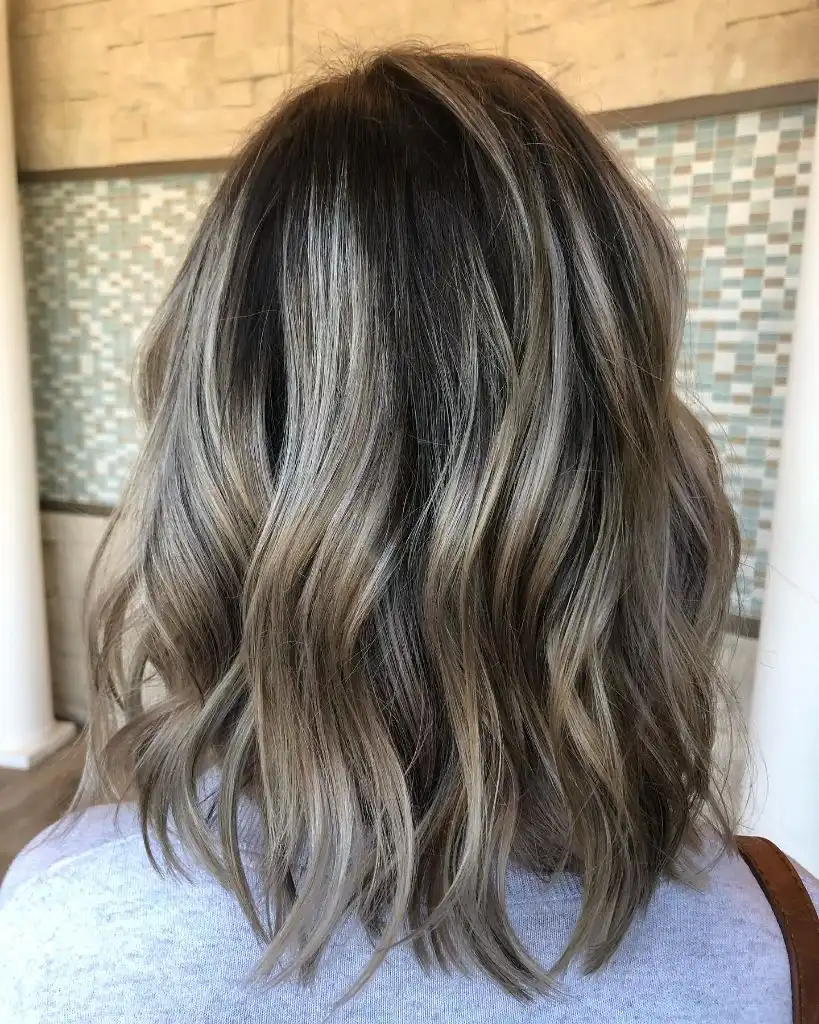
This one argues for many accents rather than one. Dozens of light sections at staggered starting points create a dense salt-and-pepper effect where no single stripe is legible on its own. The variation in width is essential; identical slices would produce a mechanical grid. Since the blonde stays firmly ash, the mix settles into a cool silver-brown overall value when viewed from a distance.
The takeaway is that high-contrast weaving needs irregularity to look organic. Ask for varied section widths and staggered start points rather than a uniform pattern. On finer hair, use fewer panels so the dark base still reads as the dominant tone, otherwise the two values average out into a single flat gray from across a room.
11. Champagne Curls With Muted Beige Shadows
A side-back angle captures shoulder-length hair set in soft, rounded curls. The overall tone is a light champagne blonde, with cooler beige and pale gray-brown appearing in the recesses between curls rather than as distinct streaks. The lightest tone concentrates at the surface and the ends. A black top sits at the shoulder, and a dark wall with a trailing green plant frames the upper corner.
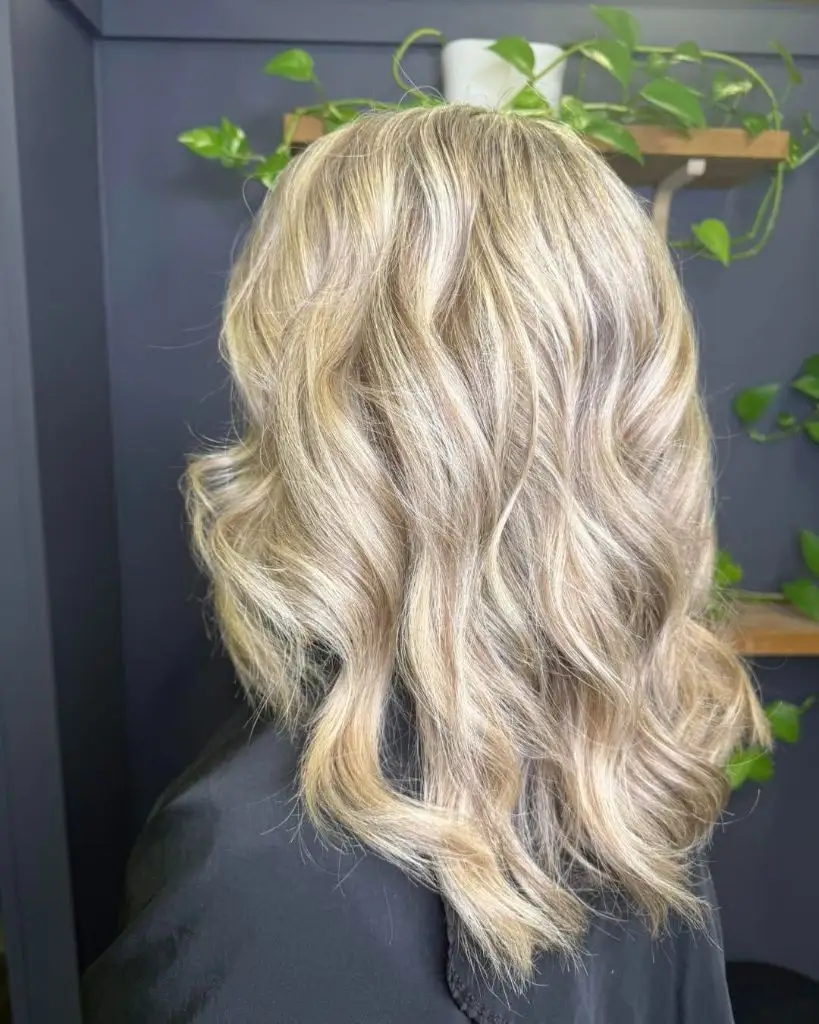
Tonal layering within a narrow band gives this its depth. Every tone here sits within about two levels, so dimension comes from where the light and shadow fall across the curl pattern rather than from contrast between colors. The darker beige tucked underneath acts as a ground, preventing the pale surface from looking like a single sheet. Curl direction changes constantly, which keeps that shadow scattered and irregular.
The most transferable detail is the shadow placement beneath the surface layers instead of on top of them. Kept low, it adds weight without dulling the brightness you see first. Anyone comparing blonde highlight ideas for a low-contrast result should look at how little separation is actually needed once curl is involved.
12. Chocolate Length Warming Into Caramel
Seen from behind, the hair is pulled into a loose half-up section secured with a cream leopard-print scrunchie, leaving the rest to fall past the mid-back. The top and crown read as a deep chocolate brown, gradually warming through the lengths into caramel and light toffee at the ends. Texture is loose and slightly undone. An olive textured-looking sleeve appears at the right edge.
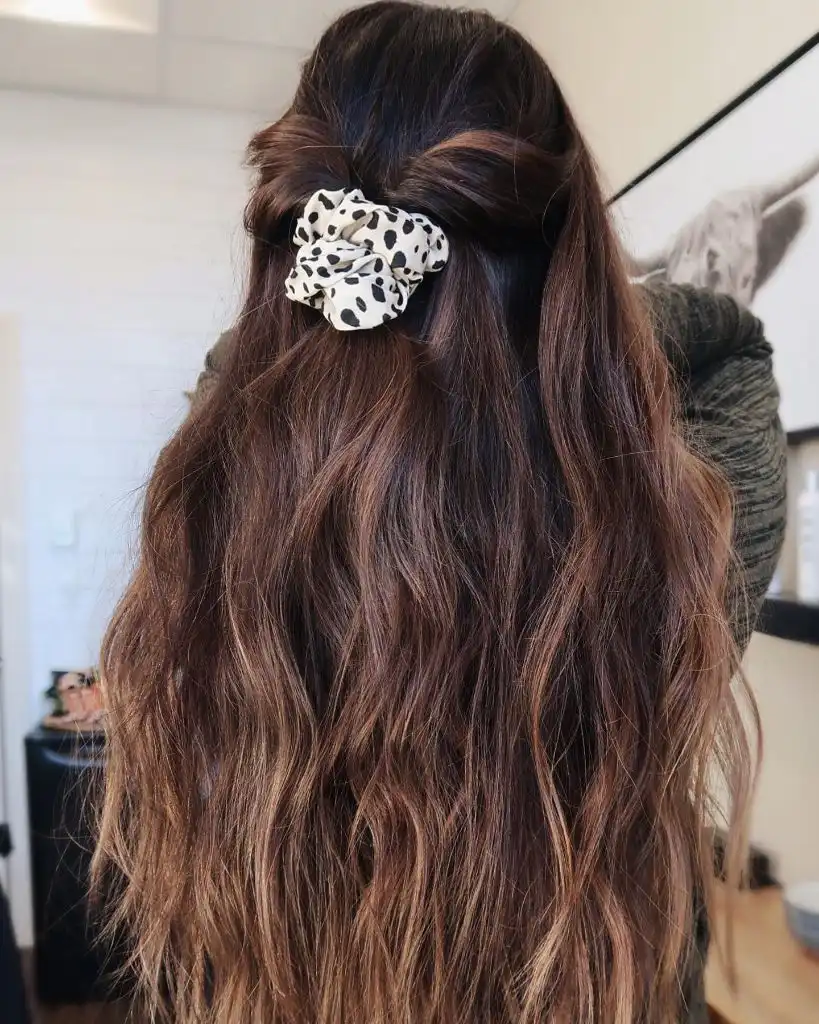
Silhouette drives this. The half-up section narrows the width at the crown and releases into a wide, heavy fall below, so the outline goes from compact to full. Color follows that outline exactly, staying darkest where the shape is tightest and lightest where it spreads. Among winter hair colors for long hair, this alignment of value with volume is what stops great length from looking like an undifferentiated mass.
The single most useful adjustment is keeping the warm caramel confined to the outer surface and the last several inches. Painted through the interior, it would lighten the whole silhouette and lose the dark-to-light direction. For shorter lengths, compress the same gradient so the darkest tone occupies only the top two inches.
13. Sunlit Bronde With Sandy Face Pieces
A close side crop shows lived-in waves running from a soft part down past the shoulder. The base is a warm mid brown, threaded with sandy blonde and honey ribbons that concentrate around the front sections and the surface of the waves. Ends look piecey and slightly separated. A black strap sits at the shoulder, and dark blurred greenery with a pink light fills the background.
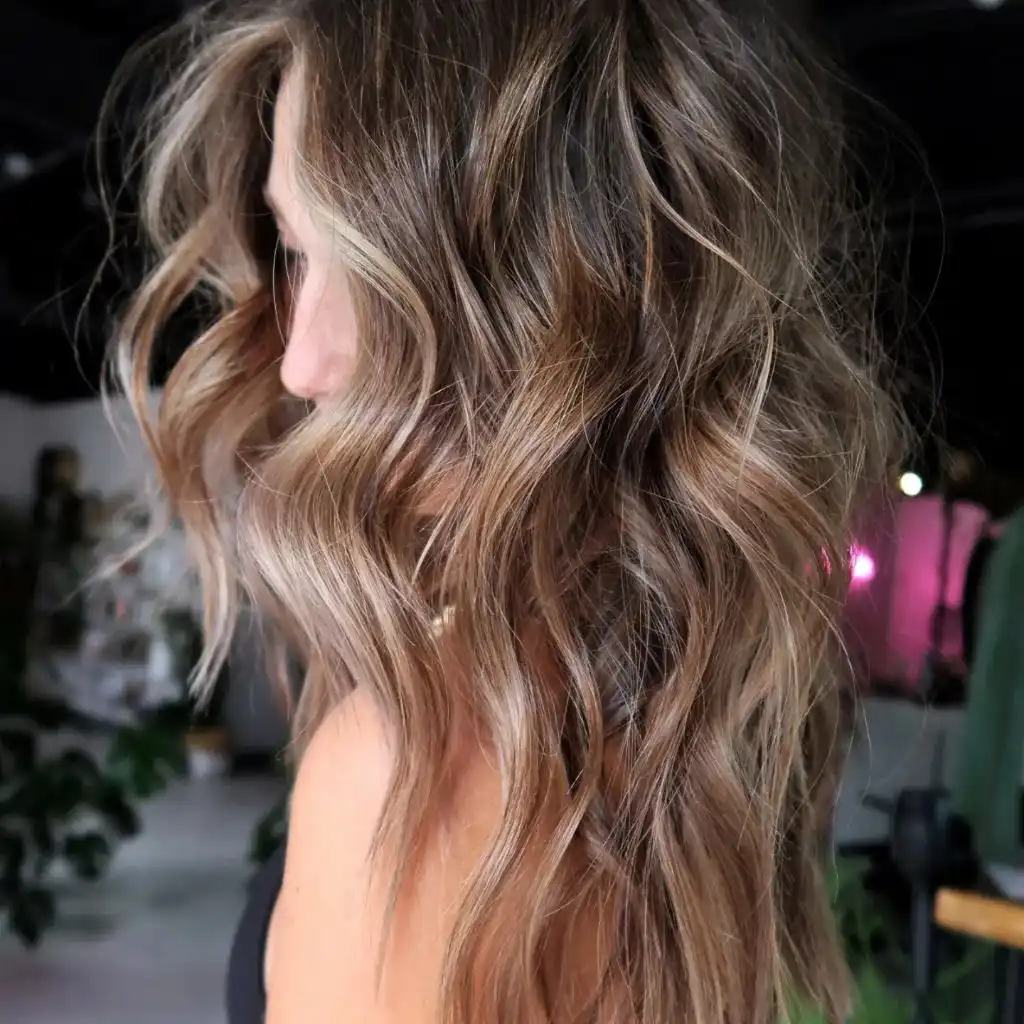
Texture against smoothness is the whole point. The waves are deliberately irregular, with some sections bent tightly and others left almost straight, so the light ribbons appear and disappear at unpredictable intervals. That inconsistency is what makes hand-painted color look unplaced. A smoother finish would expose the ribbon edges and turn the same placement into visible stripes.
The detail to copy is the piecey separation at the ends, which lets the lightest tone show on individual strands rather than in solid blocks. Rough-dry rather than blow out smooth, then break the ends apart. For a softer read, keep the honey tones confined to the lower half so the crown stays a single warm brown.
14. Golden Honey Brown In One Tone
Angled to the side with the head tilted down, long straight hair falls from a middle part well past the chest, with the ends cut into subtle face-framing layers. The color reads as a continuous golden honey brown, slightly lighter through the ends where the light hits, but essentially one tone from root to tip. A navy sweatshirt sits below, against a plain pale wall.
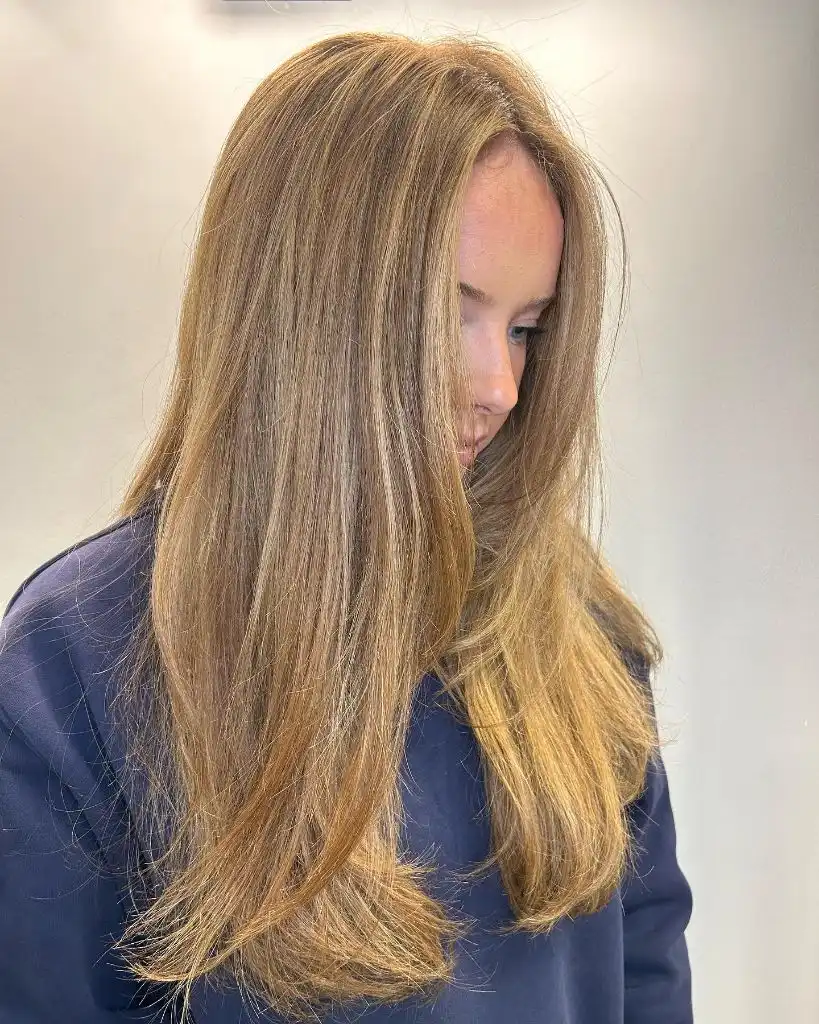
Restraint is the argument. With no contrast points anywhere, the eye reads the surface as a smooth continuous plane, and shine becomes the only source of dimension. That is why the finish matters so much here: any texture or frizz would register immediately, since there are no light sections to distract from it. The single tone also makes the perimeter of the cut extremely visible, so the layers do the shaping work.
The most useful thing to know is that this approach depends on the level being close to the natural base. Anyone drawn to honey brown hair in a single tone should stay within one or two levels of their own, so regrowth reads as continuation rather than a line.
15. Bright Auburn Red Down Full Length
The full back of the head is centered, showing long hair falling to the mid-back with a slight center part. The color is a vivid auburn red, warmer and brighter at the surface and deepening toward a cooler burgundy underneath. Texture is loosely waved with piecey ends. Behind, light wooden shelving holds rows of product bottles against a white wall, all softly out of focus.
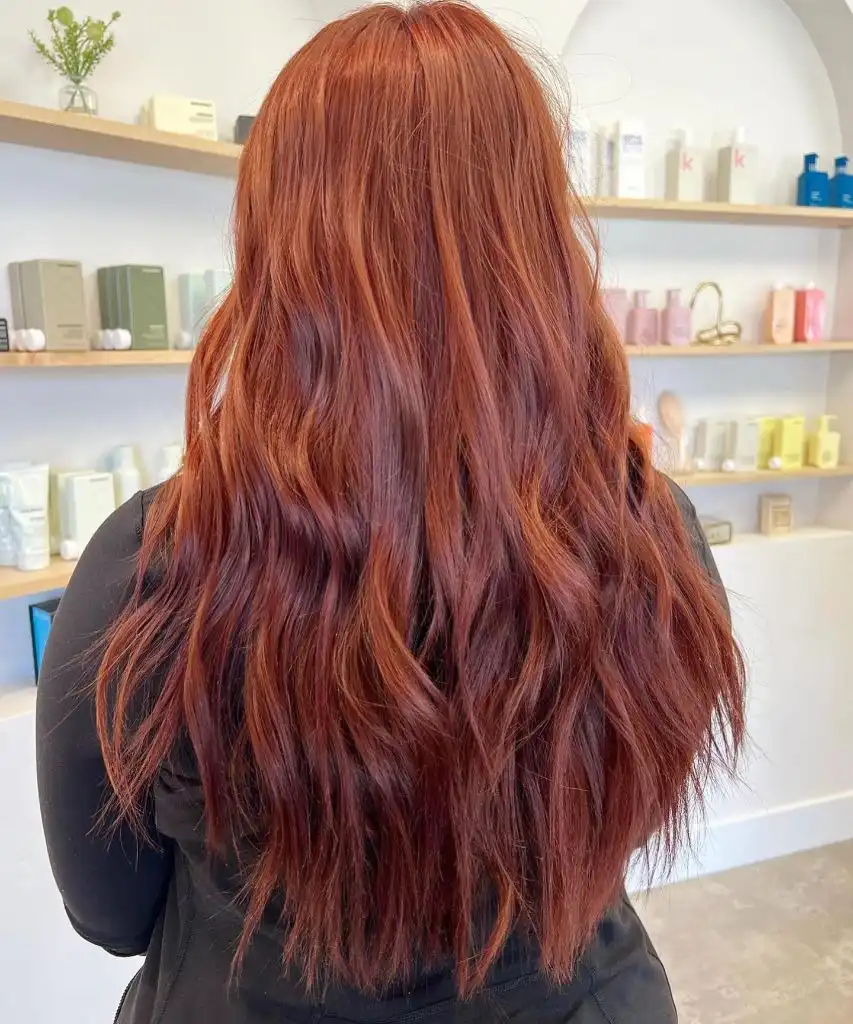
Saturation carries this instead of value contrast. Every tone belongs to the same red family, so nothing separates into stripes; the variation comes from the difference between surface and underlayer. Bold winter hair colors work best on exactly this logic, where one highly saturated shade covers the whole head and depth is created by making the interior a shade cooler and deeper than the top.
The detail worth taking is the deeper underlayer, which keeps a bright red from looking like a flat wig. Ask for the base beneath the surface to sit a level darker with more blue in it. To dial the intensity down, keep the same structure but move both tones toward brick, which reduces vibrancy without losing the two-layer depth.
16. Cool Bronde Money Piece On Black
Shot from the front with the head lowered, the crown and part read as a solid blue-black, while the sections immediately beside the face lift into cool bronde and beige. Those front pieces continue as light ribbons through long waves that fall past the chest. A dark brown zip-up hoodie with lettering sits below, and a bright open salon interior blurs behind.
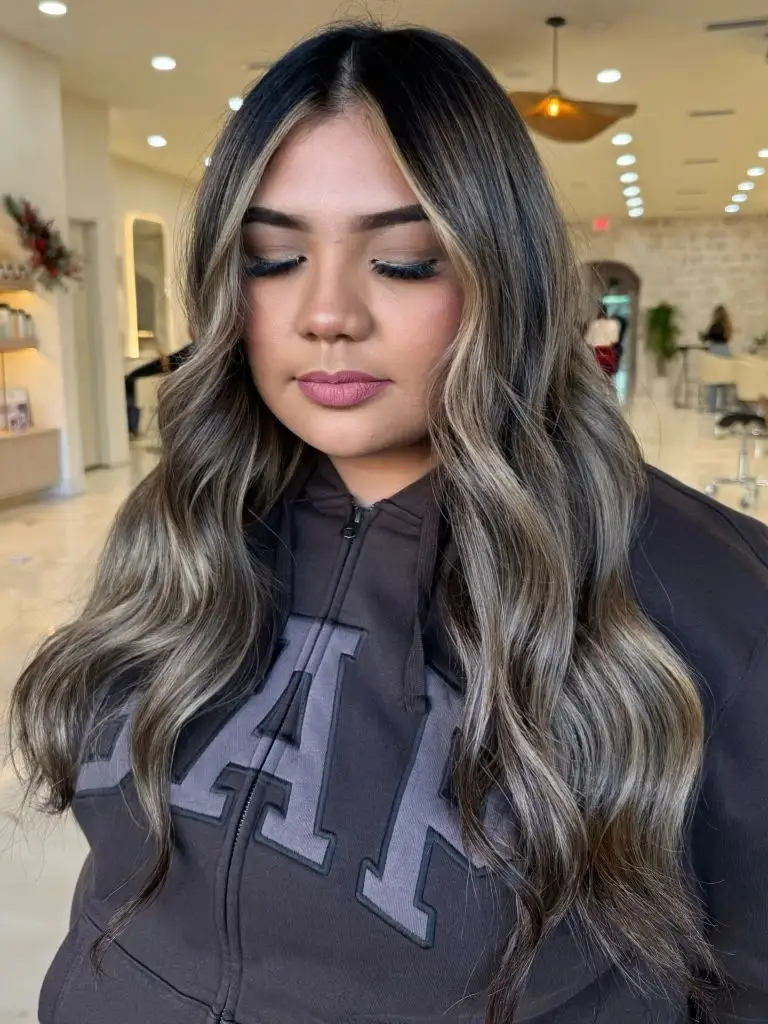
Zoning explains the effect. The lightest tone is restricted to a defined block at the front hairline and then repeated in thinner amounts through the lengths, so it functions as one bright area with a faint trail rather than as scattered highlights. The untouched blue-black crown gives that block a hard boundary. Because the boundary is vertical and sits at the temples, it draws a clean line down each side of the face.
The most useful control is where the front block starts. Beginning it right at the hairline gives maximum brightness near the face; dropping it an inch lower reads far softer while keeping the same shape. On shorter hair, run the block only to the jaw and skip the trailing ribbons entirely.
17. Soft Mocha Sweeping Through Blue Black
The back view shows a very dark, cool-toned black-brown base across the crown and upper length, falling into large loose curls that finish below the shoulder blades. Faint mocha and light brown sweeps appear low, mostly on the outer surface of the curls and near the ends. A white and black patterned top sits at the lower edge, with blurred retail shelving behind.
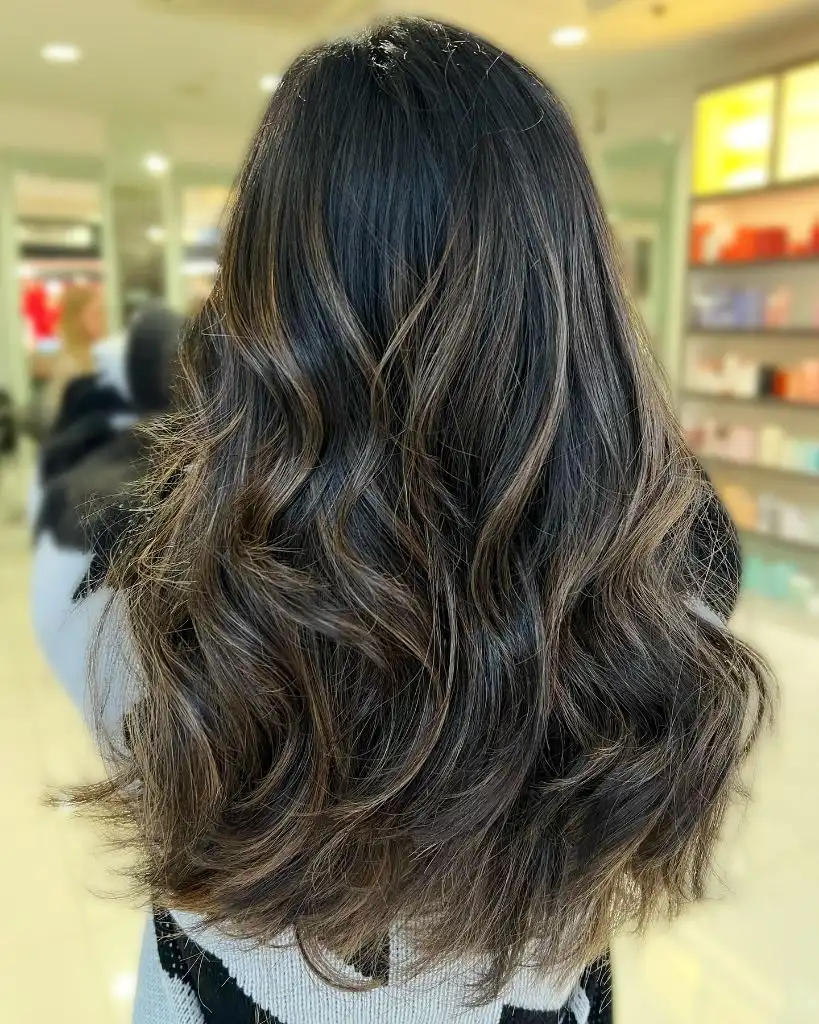
Negative space is doing more than the color. Most of the surface is left completely dark, so the handful of lighter sweeps register as light hitting the curl rather than as applied highlights. Keeping the lift to two levels and placing it only where the curl turns outward means the base still reads as solid black-brown from a distance while showing movement up close.
The practical note is that this survives regrowth almost indefinitely, since nothing lightened comes near the scalp. For anyone weighing dark brown hair with highlights at the lowest possible commitment, this is the minimum viable version. Push it slightly bolder by adding two or three sweeps to the front sections only.
18. Burgundy And Caramel Ribbons Side By Side
A back angle shows shoulder-length hair with a small twisted section pinned across the back. The base is a dark brown, and beneath it sit distinct vertical bands of burgundy, brick red, and pale caramel, each occupying its own section. Curls are loose and separated toward the ends, letting the individual color bands stay visible. A camel-toned top and a plain wall complete the frame.
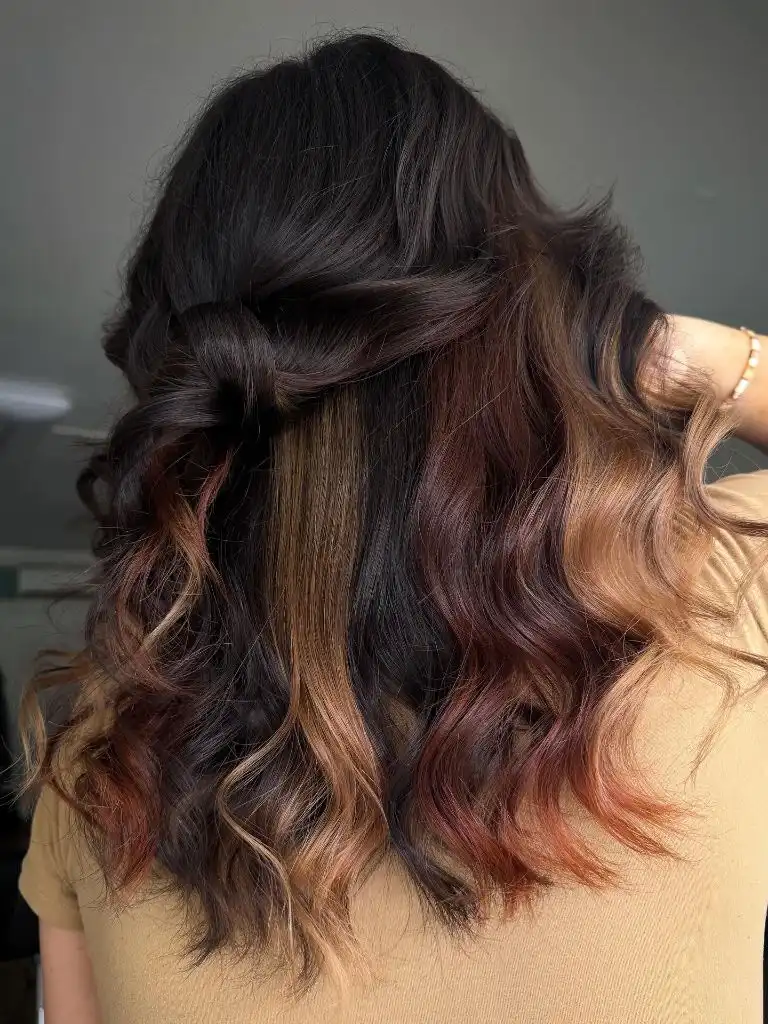
Echo across a family of tones keeps this from fragmenting. Burgundy, brick, and caramel all share a red base, so three separate colors still read as one warm scheme. The dark brown between them acts as a divider, giving each band a clean edge and preventing them from bleeding into a single muddy tone. This is where winter hair colors with several shades stay coherent, through shared undertone rather than shared value.
The strongest lever is the width of the dark separation between bands. Keep it at least as wide as the colored sections themselves. For a quieter version, use two of the three tones instead of all three, and place them under the top layer so they show only when the hair moves.
19. Deep Cherry Red Behind Soft Fringe
A three-quarter view shows a deep cherry red running uniformly from root to end, with a soft full fringe falling to the brows and long layers below. The lengths reach past the chest in loose bends, and the darkest values sit in the interior while the surface catches a brighter wine tone. A white collared shirt with dark piping sits below, against a pale mural wall.
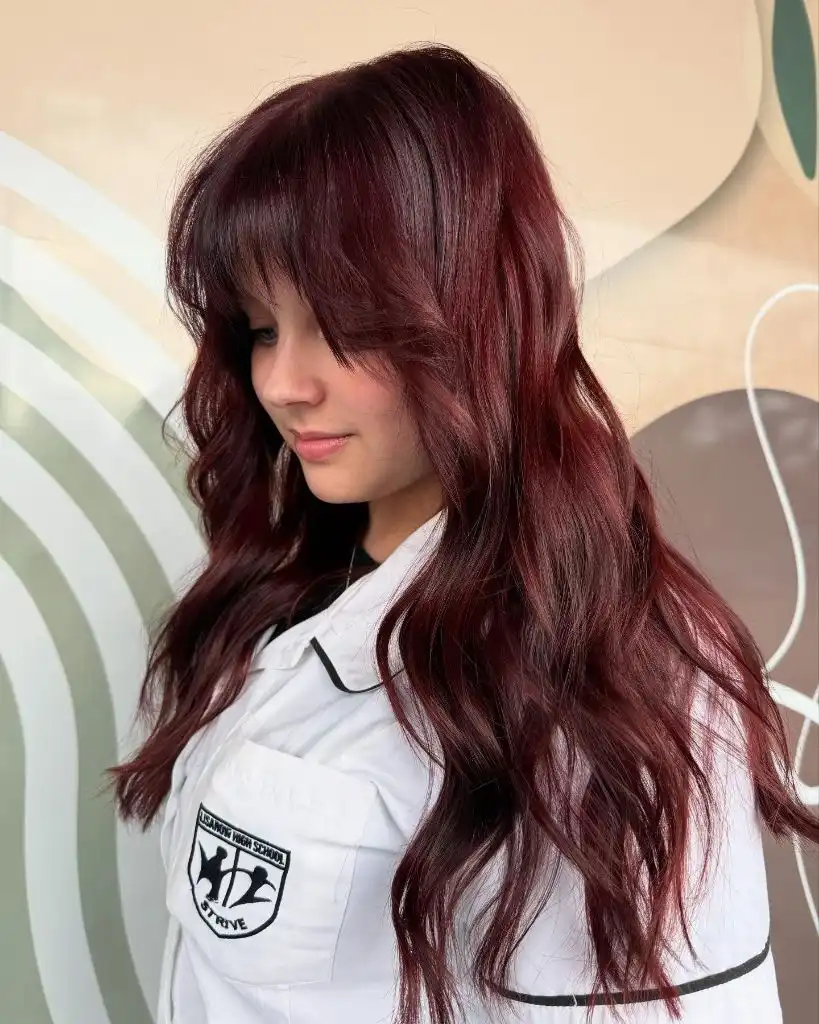
Proportion between the fringe and the length is what organises this. A wide, soft fringe creates a horizontal band of color right at the top of the face, and the long vertical lengths on either side balance it. Because the shade is a single saturated tone, that structural relationship becomes the main thing the eye reads. Any highlighting inside the fringe would break the band and weaken it.
The detail that matters is keeping the fringe the same depth as the rest, with no lightening at all. On shorter hair, the same balance holds if the length reaches at least the collarbone. To reduce the intensity, shift the red toward a deeper mahogany, which keeps the fringe-to-length structure fully intact.
20. One Platinum Panel On Jet Black
From a downward three-quarter angle, a jet black base falls in long straight layers to the shoulder. A single wide platinum white panel runs from the front hairline down past the cheek, sitting entirely on one side. A black patterned face covering, a black knit-like V-neck, and a thin silver necklace appear below, with a textured white wall behind.
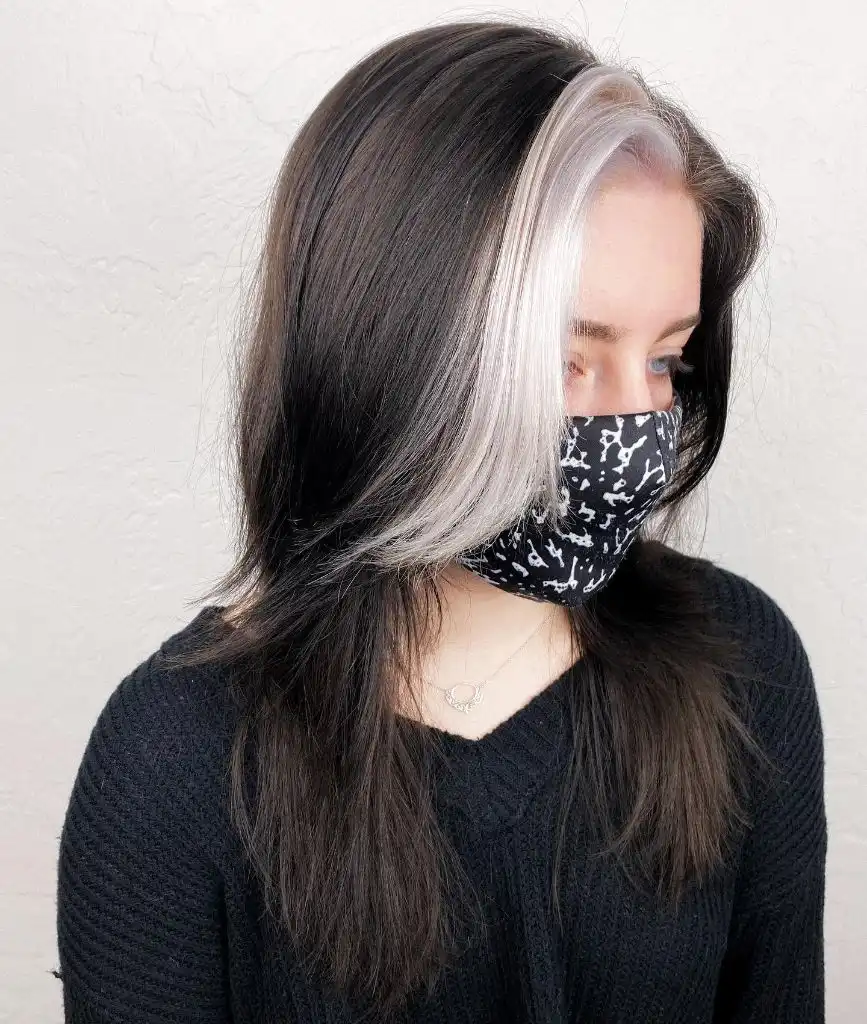
One accent against a completely uniform ground is the entire structure. Because nothing else in the hair is lightened, the platinum panel carries all the contrast and reads almost as a graphic element laid over black. Its width matters more than its length; narrow enough to stay a defined shape, wide enough not to disappear into the surrounding dark. The straight finish keeps its edges crisp.
The adjustment worth knowing is asymmetry. Placing the panel on one side only keeps it deliberate, while mirroring it on both sides shifts the effect toward money piece highlights and reads much softer. For a less severe version, tone the panel to a pale beige instead of white so the jump from black is smaller.
21. Auburn Glow Under Dark Brown Waves
Turned toward the side, dark brown hair falls in wide barrel waves to just below the shoulder, with volume concentrated through the mid-lengths. Fine auburn and warm copper ribbons run through the waves, strongest on the surface and around the front sections. The crown stays deep and unbroken. A charcoal gray top sits below, and a bright white salon interior with lettering blurs behind.
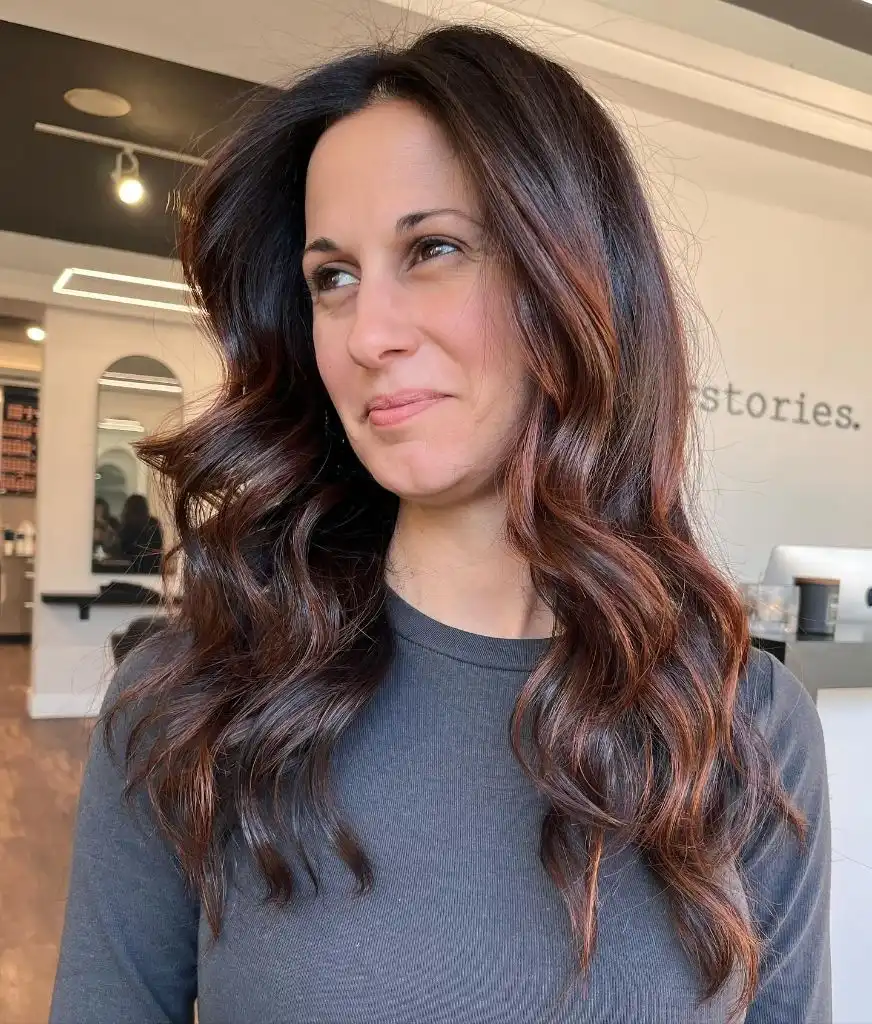
The contrast point is heat, not lightness. These ribbons sit at nearly the same value as the base and differ mainly in tone, so they show up as a red glow across the curve of each wave rather than as visible highlights. That is a quiet way to run winter hair colors on a dark base, since the depth stays fully intact and only the undertone shifts toward warm.
The most useful takeaway is that fine ribbons of a warmer tone need a smooth, well-defined wave to be seen at all. Set the waves in the same direction on each side and the ribbons line up along the crests. Adapt this darker by keeping the auburn out of the front sections and confining it to the back and interior.

Hi, I’m Zoey Mitchell, the creator of ChicStyle Blog.
I share simple, wearable outfit ideas, hairstyles, nail trends, and beauty tips that feel natural and easy to recreate.
This blog is where I explore everything that makes a woman feel put together and confident every day. I’m not an expert — just a woman who genuinely loves style, mixing looks, and discovering what works.
If you love effortless fashion with a personal touch, you’ll feel at home here.