
There is a particular stillness to a well-shaped a-line bob, the way the hair falls forward in a single clean diagonal and stops. It reads less like a haircut and more like a decision, a visible line drawn from the back of the head to the jaw that carries intention in every angle. The weight sits low and deliberate, and the shortest point at the nape pulls attention toward the longer front pieces without any noise.
A-line bob haircuts work as a kind of architectural language rather than a single silhouette. The variables that separate one from another are not dramatic on their own, but together they define the entire character of the cut. Throughout this collection, the things worth watching are the degree of angle from back to front, the bluntness or softness of the perimeter line, the role color plays in reinforcing or softening the shape, and the distribution of volume across the crown, mid-lengths, and ends. Some versions keep the geometry sharp and visible from every direction, while others let texture or tonal variation do the quieter work of creating depth. What connects all of them is that the line itself carries the structure, and every other detail either supports or gently complicates that line. The differences between a steep angle and a subtle one, between a razor-straight hem and one that feathers slightly, are the differences that make each version distinct.
1. Dark Angled Bob With Forward-Falling Length
The hair is cut into a steep a-line shape, with the back sitting well above the nape and the front pieces extending past the jawline to nearly collarbone length. The color is a deep, uniform black with a slight blue-cool sheen under the light. A side part sends the bulk of the weight to one side, and the ends are blunt and clean. The person wears a soft pink knit sweater and a small round gold pendant.
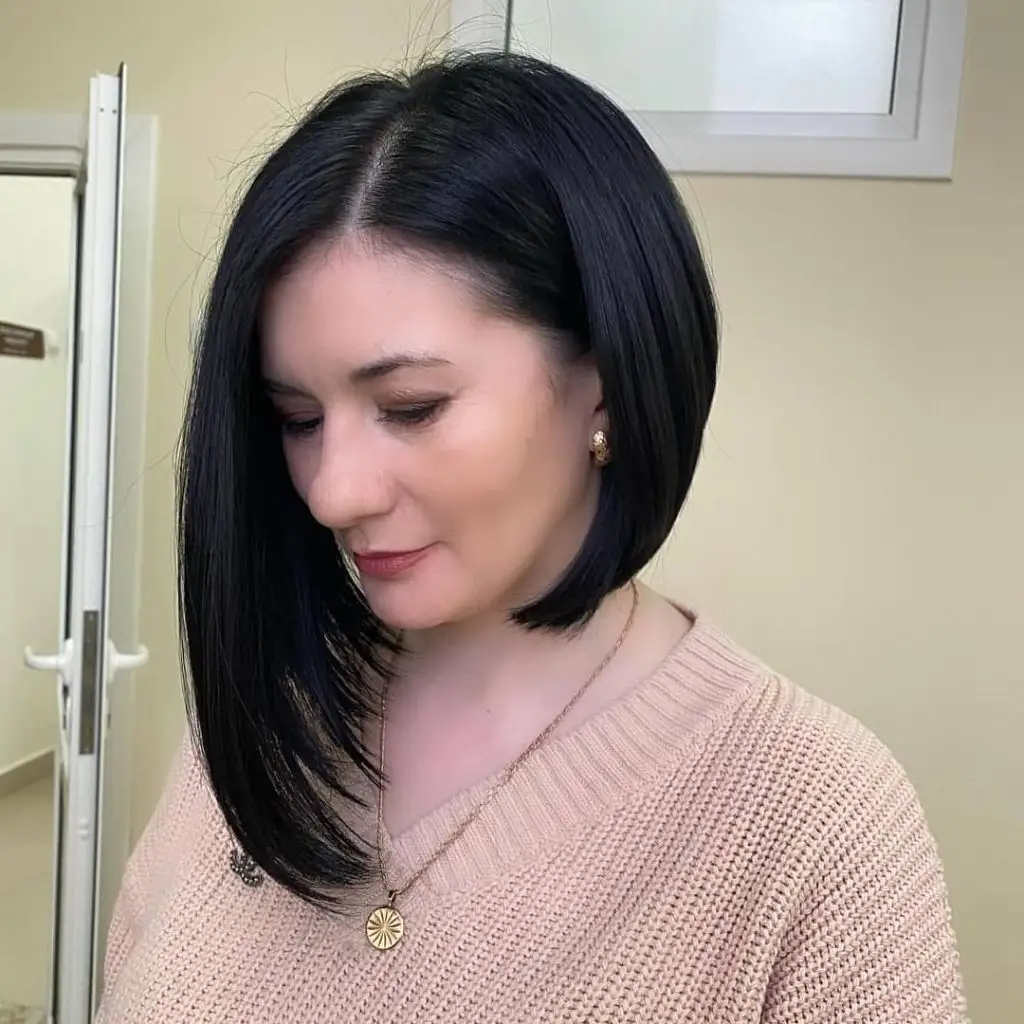
Photo via Instagram
The steep graduation from back to front is the dominant structural move here, and the uniform black color sharpens that diagonal line rather than softening it. Without highlights or texture to interrupt the surface, the eye follows the angle from the crown straight to the longest point at the front. The gold pendant sits right at the base of that line, functioning almost as an anchor point where the hair and the neckline converge. The pink sweater introduces warmth without competing with the geometry of the cut.
The reader takeaway is that a single strong angle can carry an entire cut when the color stays uniform and unbroken. The steeper the graduation, the more the shape speaks for itself, and keeping everything else quiet, no layers, no texture, no tonal shifts, lets that one structural decision do all the work.
2. Straight Shoulder-Length Bob With Center Weight
The hair falls to just past the shoulders in a long, straight silhouette with a center part. The color is a rich, dark brown, smooth and consistent from root to tip. The ends are blunt and sit at a uniform length all the way around. The person is seated in a salon chair wearing a white graphic tee, and the hair frames the face symmetrically on both sides.
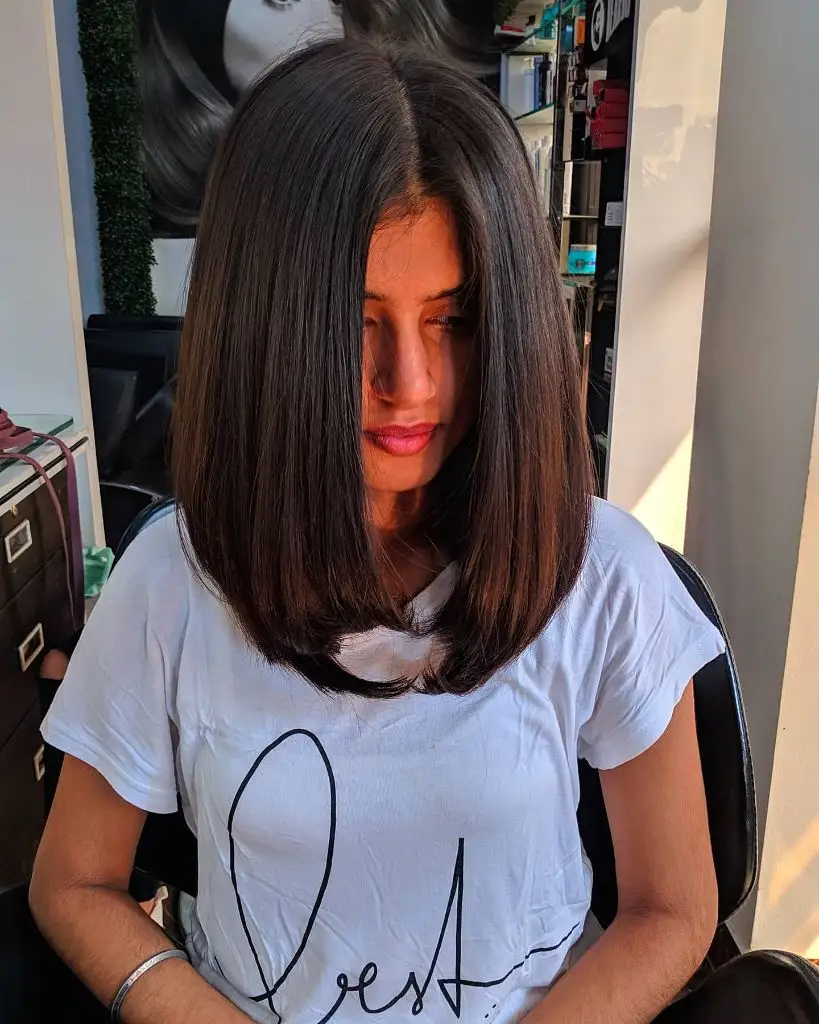
Photo via Instagram
This version sits at the longer end of the a-line spectrum, and the angle from back to front is subtle enough that the cut reads almost as a one-length bob from the front. The center part distributes the weight evenly, which removes the asymmetry that steeper versions rely on. What holds the shape together is the blunt perimeter, a clean horizontal line at the ends that gives the cut its quiet authority. The dark brown tone has no visible highlights, so the surface stays flat and reflective, and the shape is communicated purely through the silhouette.
The useful move here is the restraint in the graduation. A gentle angle still creates forward movement and frames the face, but it does so without the dramatic diagonal of a steeper cut. That subtlety makes the shape feel more adaptable while still keeping the clean perimeter that defines the form.
3. Stacked Back With Rounded Volume
The hair is cut short at the nape with visible stacking that builds volume through the back of the head, then extends forward to chin length. The color is a warm dark brown, smooth and glossy. The person is viewed from a three-quarter angle, showing the rounded shape at the crown and the way the layers compress at the back. A dark tee with pink lettering is partially visible.
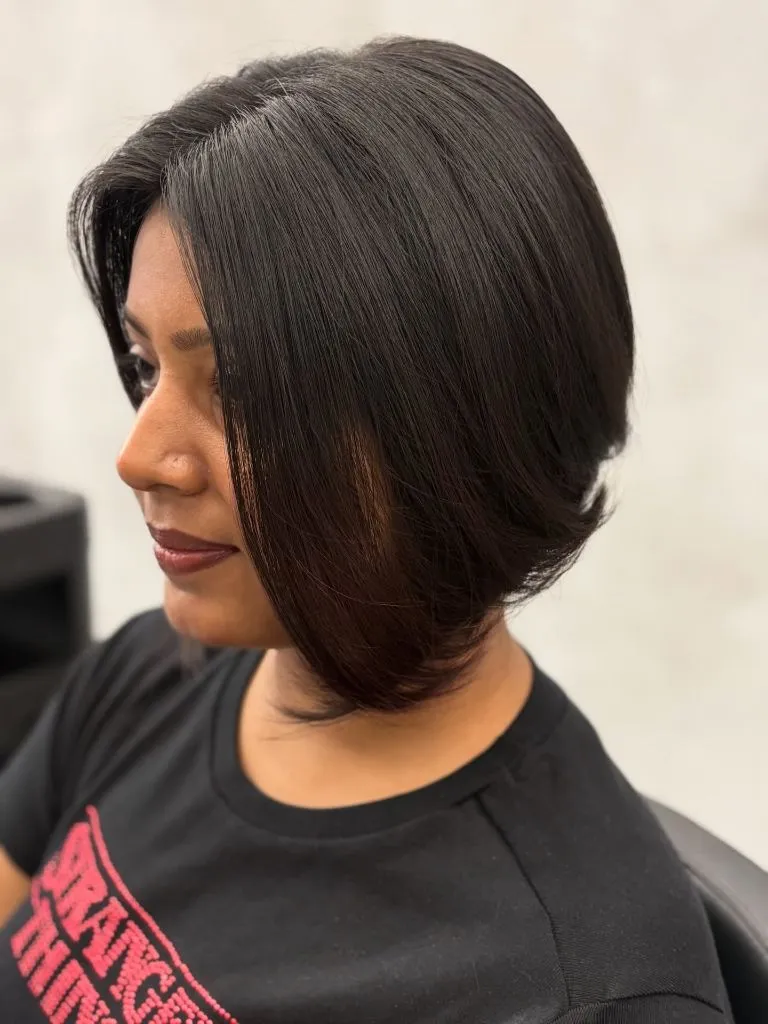
Photo via Instagram
The stacking at the nape is the technical heart of this cut, and it creates a rounded, almost domed silhouette through the back that the longer front pieces then extend from. That curvature at the crown gives the shape a sense of lift and fullness without relying on volume products or styling tricks. The graduation from short back to longer front is moderate, not extreme, which keeps the overall shape compact and controlled. The warm brown tone catches the light across that rounded surface and reinforces the three-dimensional quality of the form.
The strongest lesson is that internal layering at the back can build shape from within, creating volume that feels structural rather than styled. The stacked back gives the cut its architecture, and the smooth front pieces provide the contrast of a clean, flat surface against that built-up form.
4. Layered Bob With Soft Fringe and Movement
The hair is cut into a chin-length bob with visible layering throughout, creating a feathered, textured silhouette. A soft fringe sweeps across the forehead and blends into the side pieces. The color is a medium-warm brown with natural tonal variation, slightly lighter at the ends. The person wears a black sleeveless top, and the cut is shown from a three-quarter front view.
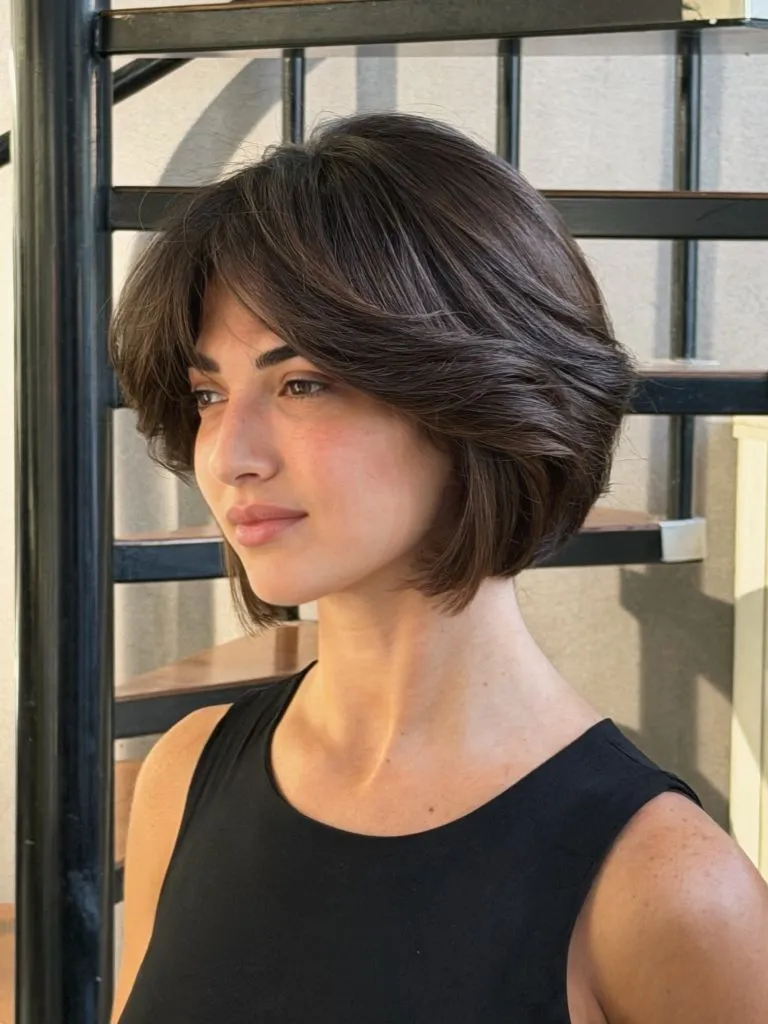
Photo via Instagram
This cut introduces movement as a primary element, which distinguishes it from the cleaner, blunter versions elsewhere in this collection. The layers create a series of curved edges rather than a single straight perimeter, and the fringe softens the top of the frame by breaking the hard line of the forehead. The tonal variation in the brown, slightly warmer and lighter toward the tips, accentuates each layer by giving it a slightly different surface quality. The overall effect reads as relaxed rather than architectural, though the underlying a-line graduation from back to front still holds the shape together.
What stands out most is how layering and fringe can shift an a-line silhouette from geometric to organic without losing the fundamental structure. The angle is still there, but it reads through movement and texture rather than through a single clean line, and the fringe extends that softening into the face-framing zone.
5. Classic Chin-Length Bob With Soft Inward Curve
The hair sits at chin length with a slight inward curve at the ends, creating a gently rounded shape. The color is a deep, cool black, uniform from root to tip. The part falls slightly off-center, and the hair tucks behind one ear. The person smiles directly at the camera wearing a black top with a small visible logo and a crossbody strap.
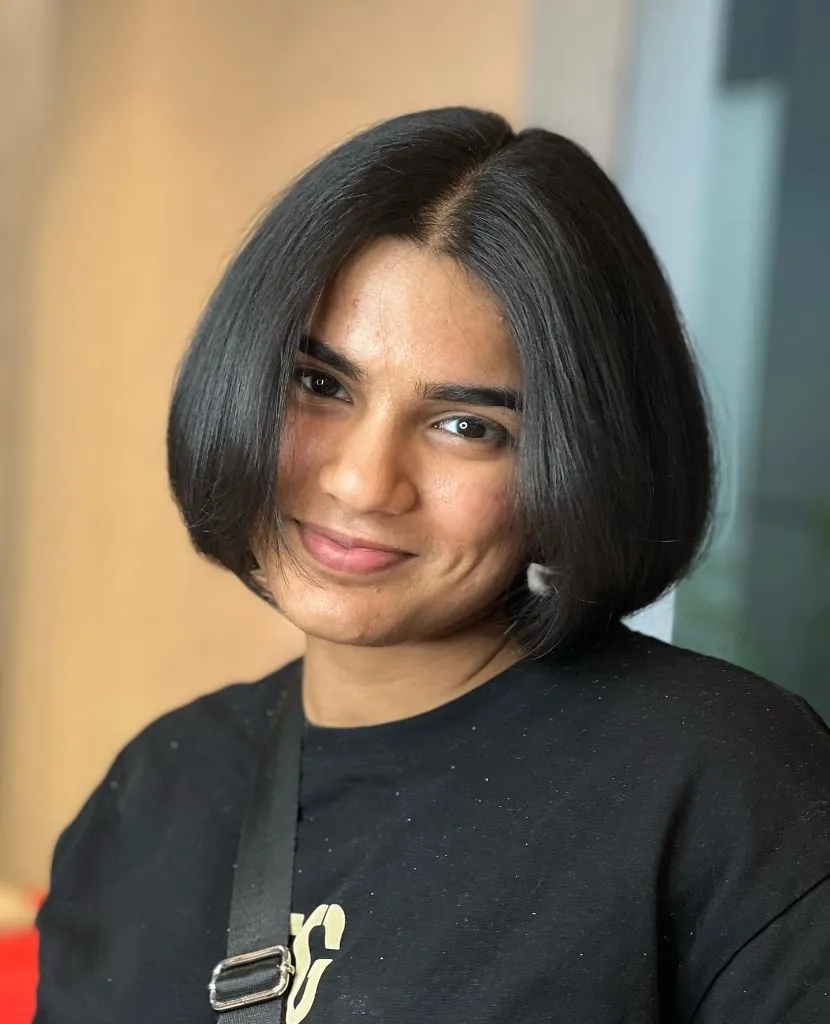
Photo via Instagram
The inward curve at the ends is the defining gesture here, turning what could be a blunt bob into something with a softer, more contained silhouette. The ends tuck slightly toward the neck rather than falling straight, and that subtle curl gives the shape a rounded quality that frames the face closely. The deep black color keeps the surface smooth and reflective, and the off-center part introduces just enough asymmetry to prevent the shape from feeling too symmetrical or static. The ear tuck on one side opens up the face and shows the jawline on that side, creating a deliberate imbalance.
The best move here is the inward curl at the perimeter, a small adjustment that changes the entire feeling of the cut. It gives the bob a sense of containment and polish without requiring stacking or dramatic graduation, and it demonstrates that the end behavior of the hair can define shape as much as the cut line itself.
6. Neat Chin-Length Bob From the Back
The hair is cut to a uniform chin length and viewed from behind, showing a clean, slightly rounded perimeter line. The color is a dark, warm brown, smooth and flat across the back. The person sits in a salon chair draped in a green cape, and the background shows a modern salon interior with a green moss wall and styling stations.
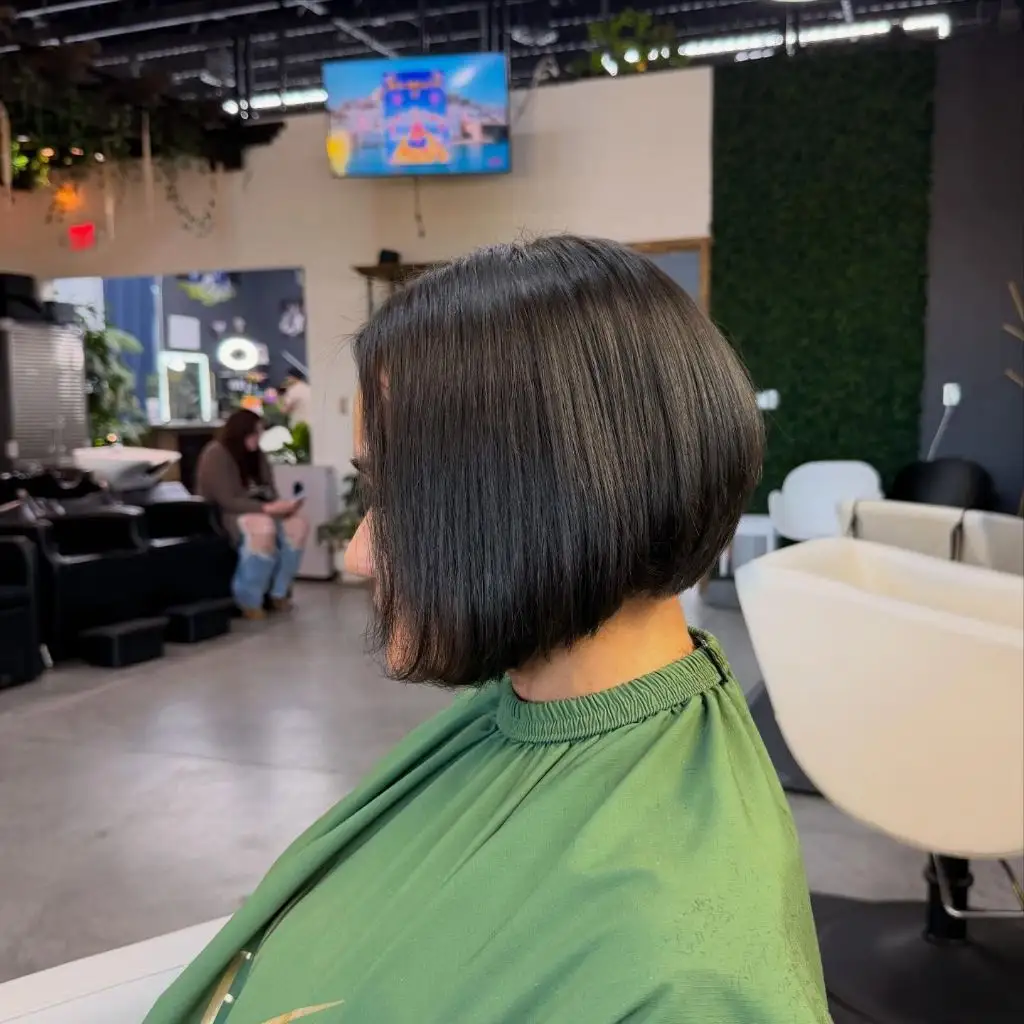
Photo via Instagram
Seeing the cut from behind reveals how much work the perimeter line does on its own. The hem is not perfectly straight but slightly rounded, following the curve of the head, and that gentle arc gives the shape a natural, organic quality. The flat, uniform color removes any distraction from the line itself, and the smoothness of the surface shows there is no internal layering breaking up the weight. The green cape creates a strong color contrast that isolates the hair and makes the shape easy to read. This is the cut at its most structurally transparent, with nothing obscuring the architecture.
The useful idea is that checking the back view reveals the real geometry of any bob. The perimeter line, whether straight, curved, or angled, is the foundation of the shape, and how it sits against the neck determines whether the cut reads as sharp, soft, or somewhere between. The back is where the structure lives.
7. Blunt One-Length Bob With Precise Hem
The hair is cut to a single length that sits just above the shoulders, viewed from behind. The color is a very dark brown or black with a subtle cool undertone. The perimeter line is razor-straight, perfectly horizontal, with no graduation or stacking. The person wears a black sleeveless top, and a green plant is visible in the background against a light wall.
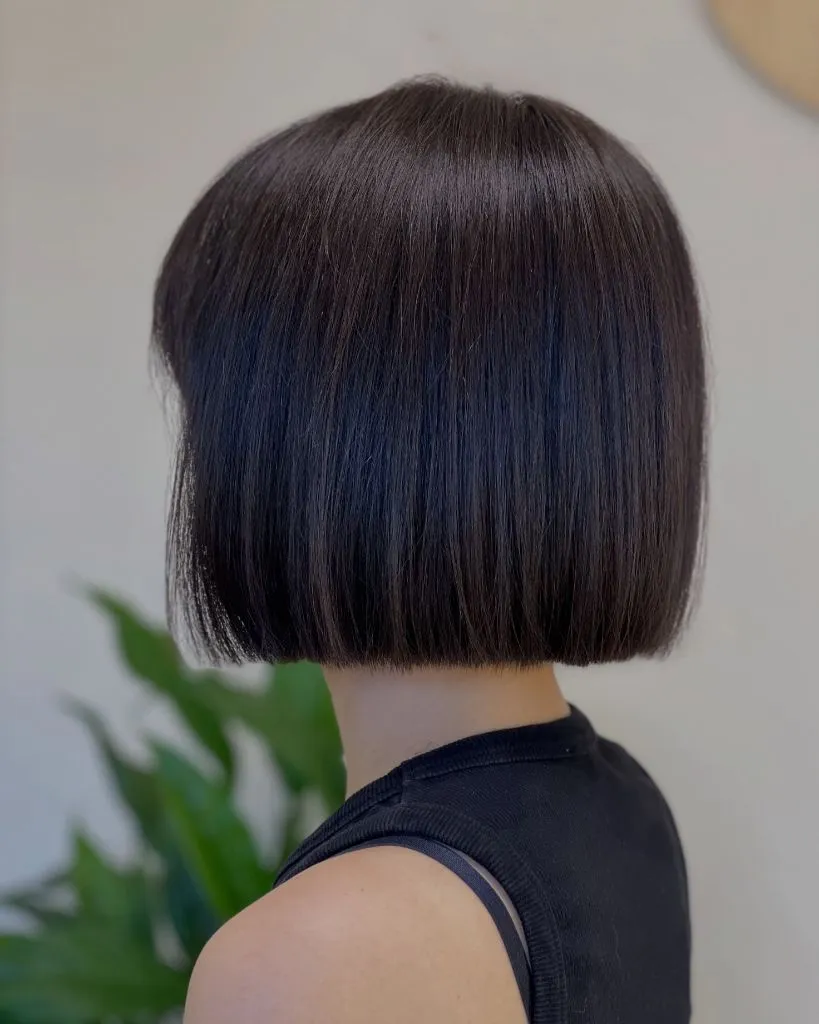
Photo via Instagram
The precision of the bottom line is the single most striking element. It cuts across the back of the head in a perfectly flat horizontal, and that straightness creates a graphic, almost architectural quality. There is no angle, no rounding, and no softening at the corners, just a clean edge that the hair falls to and stops. The dark, cool color reinforces that sense of sharpness, because the uniform surface allows no tonal variation to distract from the geometry. The cut carries its entire identity in that one deliberate line, and the lack of internal layering keeps the weight heavy and low.
The reader takeaway is that a perfectly straight perimeter line is itself a design choice with real visual impact. When the hem is that clean, it creates a sense of intention and control that reads as considered even in the simplest version of the cut. Precision at the edge communicates structure without needing any other complexity.
8. Platinum Stacked Bob With Graduated Nape
The hair is a bright platinum blonde, viewed from behind, showing a short, graduated nape that builds volume through the crown and rounds outward. The back is closely cut and stacked, then the hair extends forward. The surface is smooth and reflective, with no visible roots or tonal variation in the platinum. The person wears a black top with a gold chain necklace, and salon product shelves are visible behind.
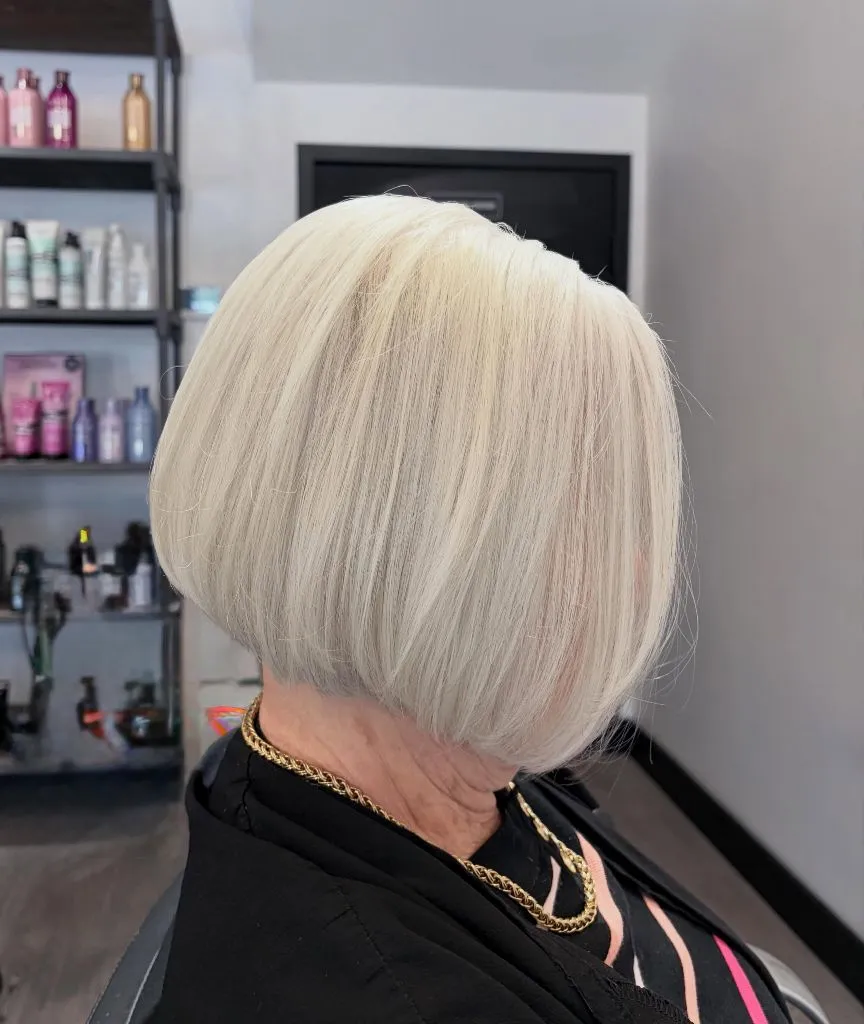
Photo via Instagram
The platinum color amplifies every curve and angle in the stacked shape because the light-reflective surface makes the graduation extremely visible. Each layer at the nape catches light at a slightly different angle, and the result is a three-dimensional map of the cut’s architecture. The rounded volume at the crown is pronounced, creating a dome-like silhouette that reads as deliberately sculpted. The gold chain at the nape draws a horizontal line across the base of the cut, anchoring the bottom of the shape. I like how the absence of any shadow or depth in the color forces the shape alone to create visual interest.
The strongest lesson is that very light, uniform color acts like a spotlight on the cut’s structure. Every graduation, every layer, every angle becomes more visible against a platinum surface, so the shape needs to be technically precise because there is nowhere for imperfection to hide.
9. Highlighted Bob With Textured Ends
The hair is a dark brown base with warm caramel and honey-toned highlights woven throughout, viewed from behind. The ends show slight movement and texture, with a few pieces separating and curling softly. The length sits just above the shoulders. The person wears a cream or off-white top, and the setting appears to be a salon with styling stations in the background.
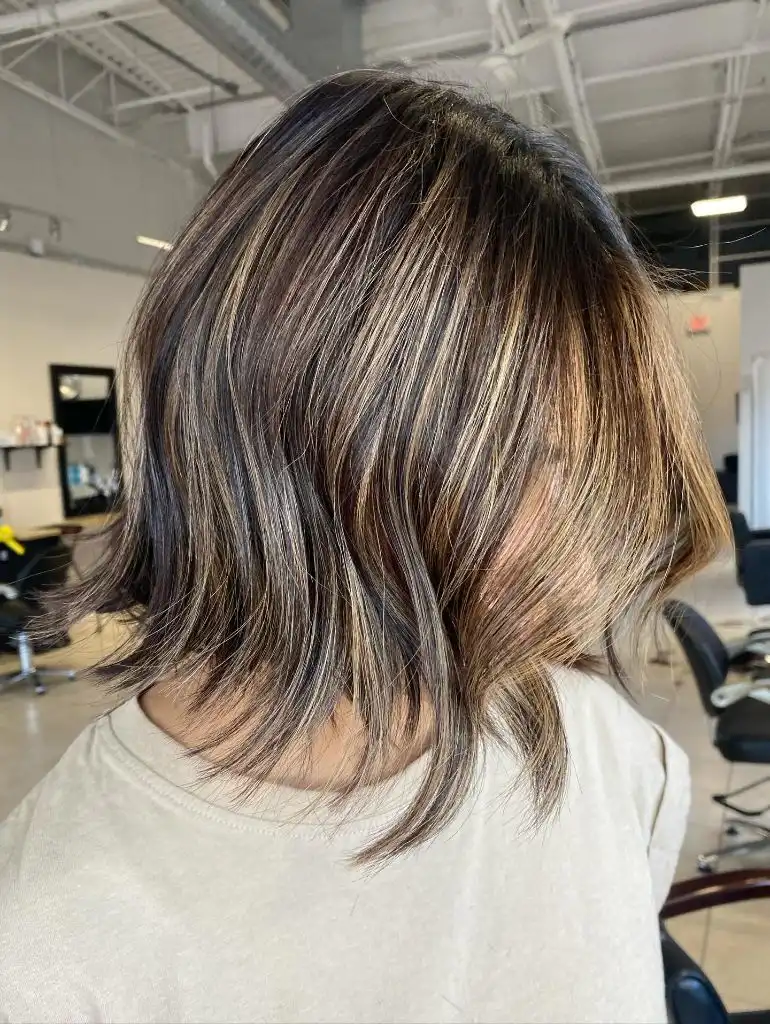
Photo via Instagram
The highlights change the visual logic of this bob entirely. Instead of a single smooth surface that communicates shape through its silhouette alone, the alternating dark and light strands create depth and dimension within the body of the hair. The slightly textured ends reinforce that sense of movement, breaking the perimeter into an irregular edge rather than a clean line. The warm tones of the highlights sit against the cooler dark base in a way that reads as natural variation rather than heavy contrast. The overall effect is softer and less geometric than the solid-color versions, though the underlying length and angle remain similar.
The beauty of this is the way color can redistribute visual weight within the same cut. Highlights pull the eye into the mid-lengths and ends rather than letting it follow the silhouette alone, and textured ends soften the perimeter so the shape feels lived-in rather than freshly sculpted. Color becomes a second structural layer.
10. Sleek Brunette Bob With Sharp Blunt Line
The hair is a rich, warm medium brown, cut to a blunt line that falls just below the jaw. It is viewed from a three-quarter angle showing the side profile. The surface is very smooth and straight, and the ends are cut to a precise, clean edge. A side part sends the hair forward, and the person wears a black button-up shirt with a small gold pendant necklace.
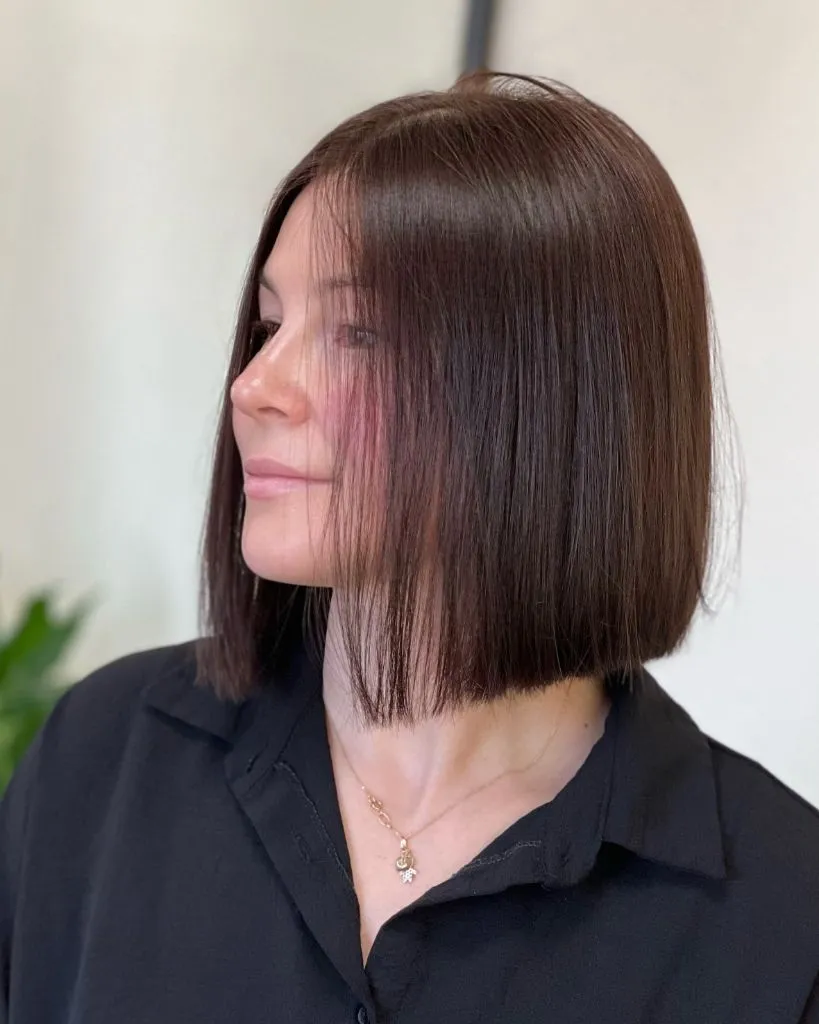
Photo via Instagram
The smoothness of the surface is doing as much work as the cut line itself. The hair lies flat against the head with no visible layering or texture, and that flatness turns the entire shape into a single plane that the eye can read instantly. The blunt line at the jaw creates a clean horizontal that intersects with the vertical line of the neck, and the sharpness of that corner gives the cut its graphic quality. The warm brown reflects light evenly, and the dark shirt below creates enough contrast to make the perimeter line visible and defined. The small pendant draws the eye just below where the hair ends.
What stands out most is the relationship between surface smoothness and perimeter sharpness. When the hair lies perfectly flat, the bottom edge becomes the most important element, and a truly blunt cut line reads as a deliberate architectural decision. That flatness and that edge work together to create a clean, considered shape.
11. Angled Bob With Clean Back Diagonal
The hair is viewed from behind at an angle, showing a clear diagonal line that runs from shorter at the nape to longer toward the front. The color is a very dark brown, nearly black, and the surface is smooth and straight. The cut appears slightly graduated at the back for subtle fullness. The person wears a cream lace-trimmed tank top, and a silver chain necklace is visible at the back of the neck.
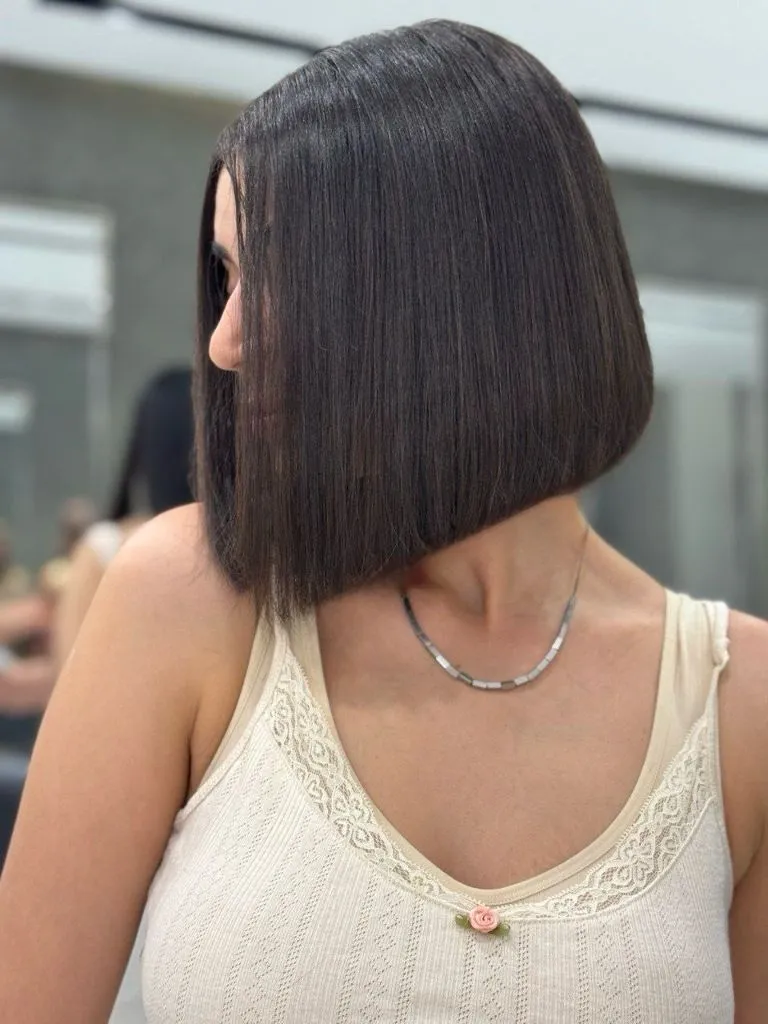
Photo via Instagram
The angle is moderate, not extreme, which gives the cut a sense of structure without pushing it into dramatic territory. The diagonal line from nape to front is clean and uninterrupted, and the dark color makes that line easy to track. There is slight graduation at the very back that adds a whisper of volume without creating the full rounded shape of a stacked bob, and that subtle fullness keeps the back from looking flat or thin. The lace trim on the tank top introduces a delicate texture right at the neckline, which plays against the hard precision of the cut line above it.
The useful move here is keeping the angle moderate and the graduation minimal. The cut reads as sharp and intentional, but it does not rely on an extreme diagonal to make its point. That measured approach means the shape works from multiple angles without any single view dominating the overall impression.
12. Dark Graduated Bob With Dense Back Volume
The hair is cut into a graduated bob with noticeable volume and density through the back, viewed from behind. The color is a very dark, cool-toned brown or soft black. The back sits just above the nape with stacked layers, and the sides extend forward past the jaw. The person wears an olive-green thermal top, and the background shows a brick-walled salon interior with shelving.
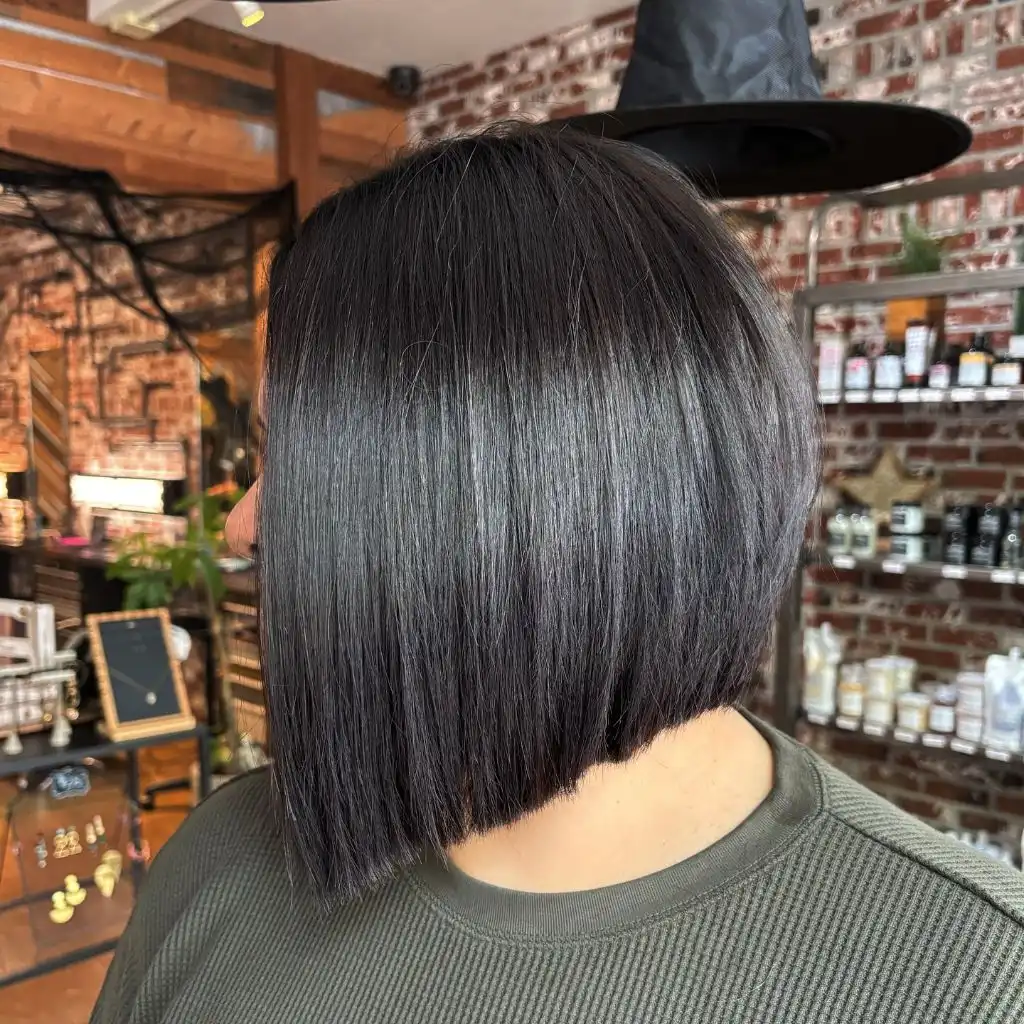
Photo via Instagram
The density of the back is the most noticeable quality here. The stacked layers create a thick, full shape that pushes outward from the head, and the short length at the nape gives the bottom edge a clean, compact finish. The forward extension to past the jaw provides the angle, but the real visual weight sits in the back where all that volume is concentrated. The dark color absorbs light and makes the shape read as a solid mass rather than a collection of individual layers. The olive-green top and the warm brick behind create an earthy palette that keeps the mood understated.
The best move here is letting the stacking do the volumetric work rather than relying on styling or product. The density at the back is built into the cut itself, which means the shape holds its form through structure rather than effort. A well-stacked back is its own support system, and it gives the a-line angle something substantial to extend from.
13. Warm Strawberry Blonde Bob With Even Length
The hair is a warm strawberry blonde or light copper tone, cut to a single length that sits just above the shoulders. Viewed from behind, the perimeter line is clean and straight. The color is even from root to tip with a soft warmth throughout. The person wears what appears to be a black vest over a white or light shirt, and the background is softly blurred with green foliage visible.
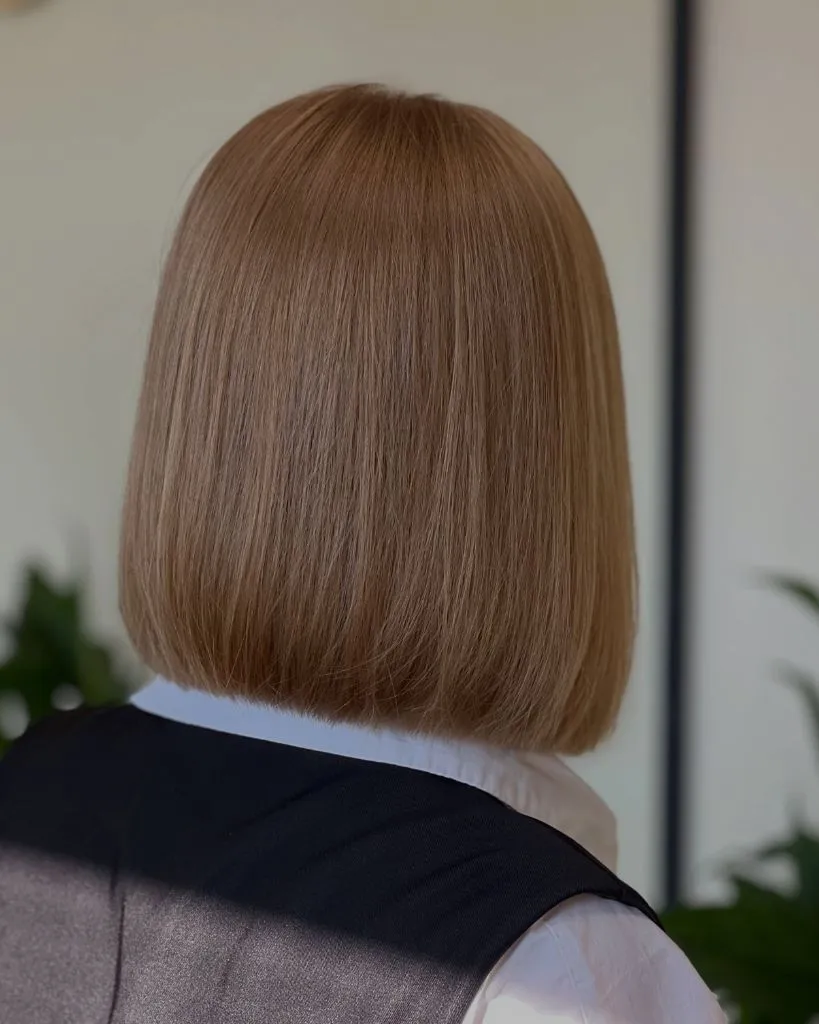
Photo via Instagram
The color is doing the most interesting work in this image because the warm, coppery tone creates a sense of softness and approachability that a darker version of the same cut would not have. The even application from root to tip keeps the surface uniform, and the straight perimeter line provides clean structure. But the warmth of the blonde diffuses the sharpness of that line, making the overall effect feel gentle rather than graphic. The black vest introduces contrast at the shoulders that helps define where the hair ends and the clothing begins, framing the color effectively.
The reader takeaway is that color temperature fundamentally changes how the same structural cut is perceived. A warm, light tone softens every edge and angle, while a dark, cool tone sharpens them. Choosing a color is choosing how much of the cut’s geometry to reveal and how much to gently obscure, and that choice shapes the entire mood of the result.
14. Platinum A-Line Bob With Steep Forward Angle
The hair is a bright platinum blonde with a subtle pink-lavender tone at the root area, cut into a steep a-line that is very short at the back and extends well past the chin at the front. The angle is dramatic and clearly visible from this three-quarter back view. The person wears a dark gray off-shoulder top, and a small tattoo is visible at the back of the neck. The setting appears to be outside a storefront.
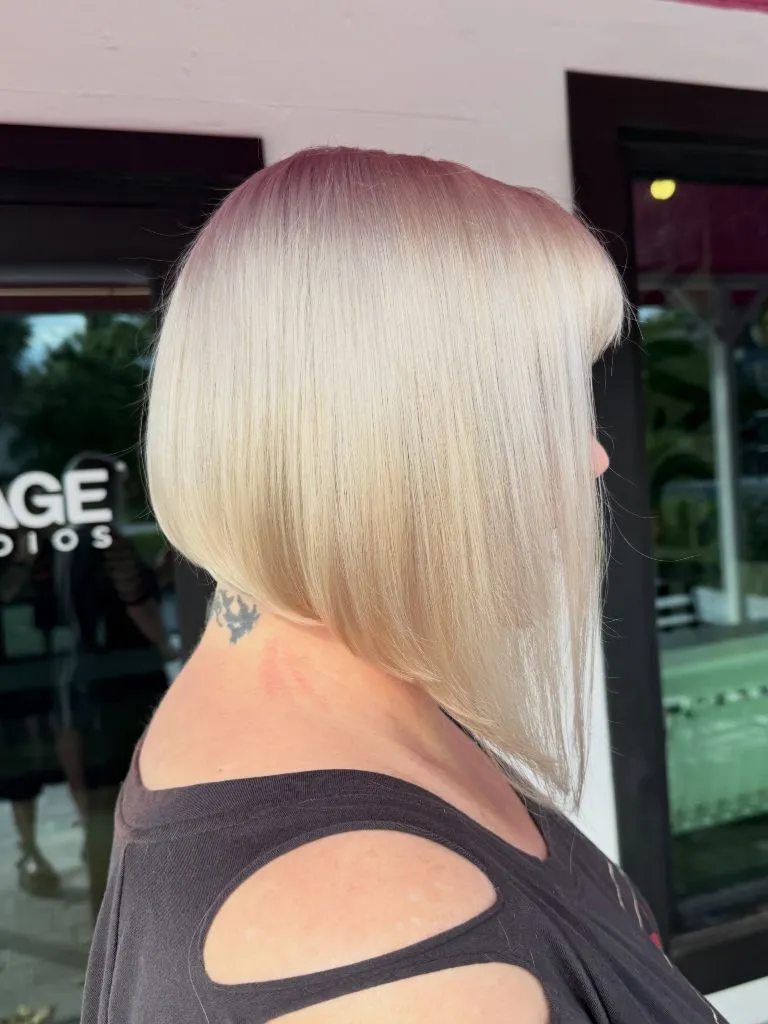
Photo via Instagram
This is one of the most extreme angles in the collection, and the platinum color makes that dramatic diagonal impossible to miss. The short back and long front create a slope that the eye follows rapidly downward, and the bright, reflective surface eliminates any shadow or depth that might soften the line. The pink-lavender cast at the roots adds a slight tonal interruption at the crown, a quiet detail that keeps the top of the head from blending entirely into the lengths. The exposed neck and the small tattoo create visual interest at the shortest point of the cut, where the hair first lifts away from the skin.
The strongest lesson is that a steep angle paired with a light, reflective color produces the most visually dramatic version of this cut. The longer the front extends relative to the back, the more the diagonal becomes the defining feature, and bright color ensures that line is always fully visible from every angle.
15. Icy Blonde Bob With Precise Rounded Hem
The hair is an icy, cool-toned platinum blonde, viewed from directly behind. The cut sits at chin length with a rounded perimeter that curves inward slightly at the corners. The surface is extremely smooth and straight, and the color is uniform from crown to ends. The person wears a leopard-print top with floral details and a black accent, and a tattoo is partially visible at the nape.
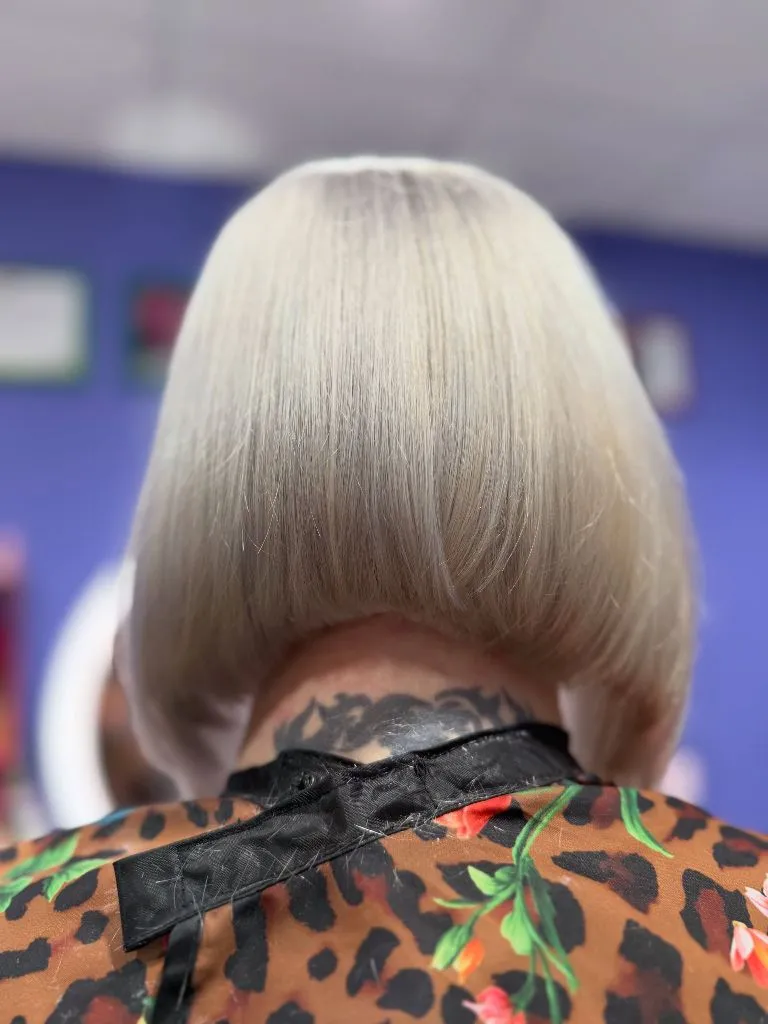
Photo via Instagram
The rounding of the perimeter creates a shape that reads as deliberate and sculpted, like a helmet or a cap that sits perfectly against the head. The inward curve at the corners tucks the ends slightly toward the neck, which prevents the silhouette from looking boxy or squared off. The icy blonde color, even cooler than the platinum in other images, gives the surface an almost metallic quality, and the smoothness of the hair means every strand lies flat against its neighbor. The bold pattern of the top below provides a strong visual floor, making the clean simplicity of the hair above feel even more deliberate by contrast.
What stands out most is the inward curve at the perimeter corners, a subtle adjustment that transforms the silhouette from angular to softly architectural. That curve gives the shape a sense of completion, as though the hair is wrapping around a form rather than simply hanging from it. It is a small detail with an outsized effect on the overall reading of the cut.
16. Brunette A-Line With Warm Highlights and Side Angle
The hair is a dark brunette base with warm, golden-caramel highlights concentrated through the mid-lengths and ends. The cut is viewed from the side, showing a clear a-line graduation from shorter at the back to longer at the front. The surface is smooth and the ends are blunt. The person wears a light gray sweatshirt with dark lettering and a small gold pendant necklace.
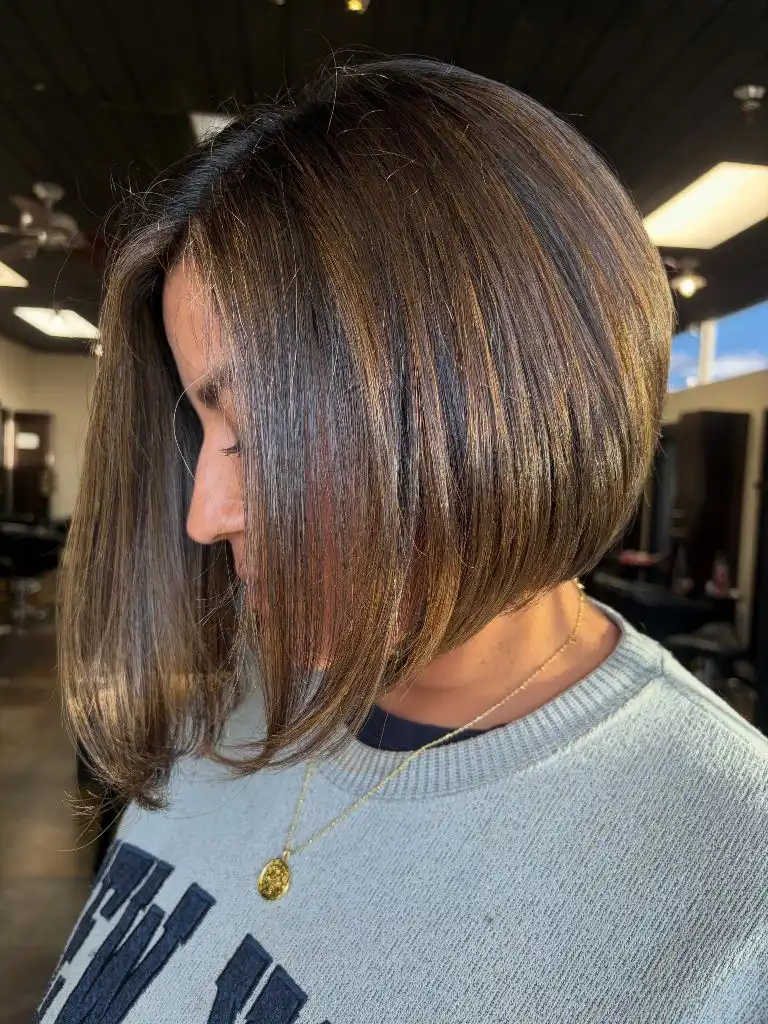
Photo via Instagram
The highlights act as a visual tracer along the a-line angle, because the lighter strands catch light most where the hair is longest and most exposed. This means the eye is drawn along the diagonal from back to front, following the golden tones as they brighten toward the ends. The dark base at the crown provides weight and grounding, while the warmer mid-lengths add dimension and forward pull. The blunt ends keep the bottom edge sharp despite the color variation, and the gold pendant echoes the warmth of the highlights without being heavy enough to compete with the hair.
The useful idea is that strategic highlight placement can reinforce the directional movement of an a-line cut. When the lightest tones sit at the longest point, they emphasize the forward angle and draw the eye along the intended line. The highlights become part of the architecture rather than a separate color decision.
17. Short Stacked Bob With Layered Crown
The hair is cut into a short stacked bob with textured layering through the crown and back, viewed from behind. The color is a warm brown with subtle lighter strands, possibly from natural lightening. The layers create a rounded, full shape that tapers to the nape, and the overall length is quite short, sitting above the jawline. The person wears an orange-strapped top, and a fine gold chain is visible at the nape. A small tattoo appears on the upper back.
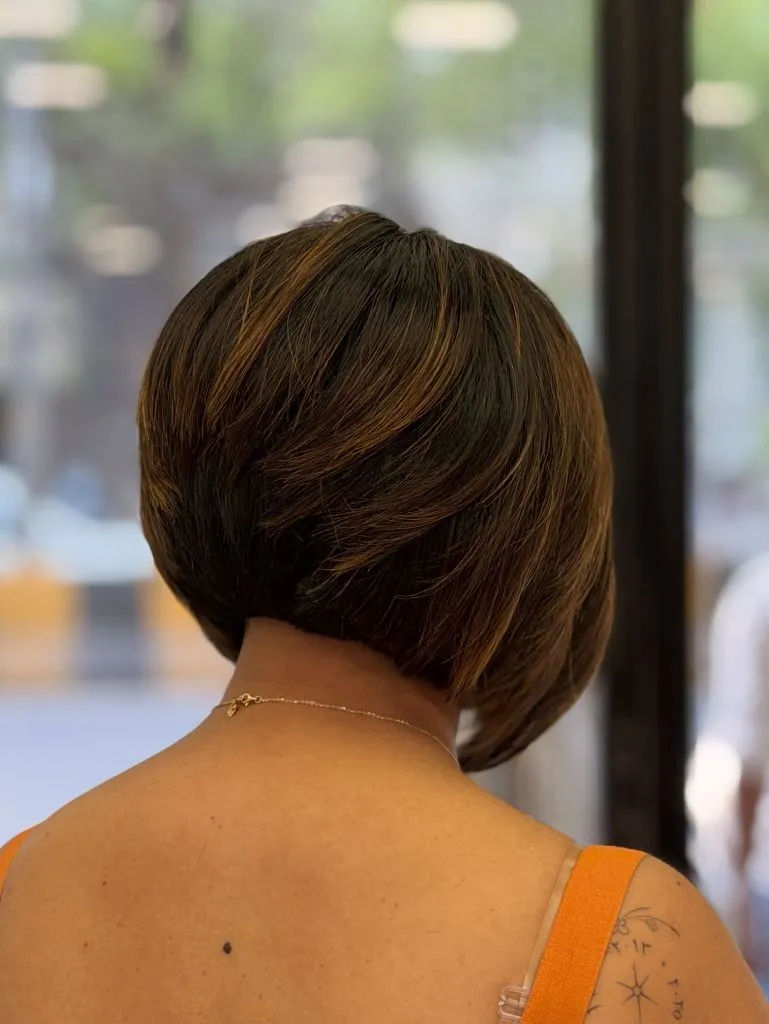
Photo via Instagram
This is the shortest and most compact version in the collection, and the layering at the crown creates a sense of movement and lift that the longer, flatter versions do not attempt. The textured top transitions into a cleaner, closer-cut nape, and that contrast between soft upper layers and a tighter bottom edge gives the shape its energy. The warm brown with slightly lighter strands adds just enough tonal variation to reveal the layer structure without creating obvious highlights. The fine gold chain at the nape introduces a thin horizontal line that echoes the clean base of the cut, and the orange strap provides a bright accent below.
The beauty of this is how layering and tapering can create the illusion of volume and density in a very short cut. The layers give the crown its fullness, and the tapered nape provides the clean edge that keeps the shape from feeling shapeless. Together they create a bob that reads as both soft and structured in a compact form.
18. Medium Brown Bob With Soft Shoulder-Length Fall
The hair is a natural-looking medium brown, cut to just past the shoulders with a subtle angle from back to front. Viewed from behind, the surface is smooth and straight with slight natural movement at the ends. The color is even, without highlights or lowlights, and appears to be a natural shade. The person wears a cream or off-white top, and the background is a warm-toned salon interior.
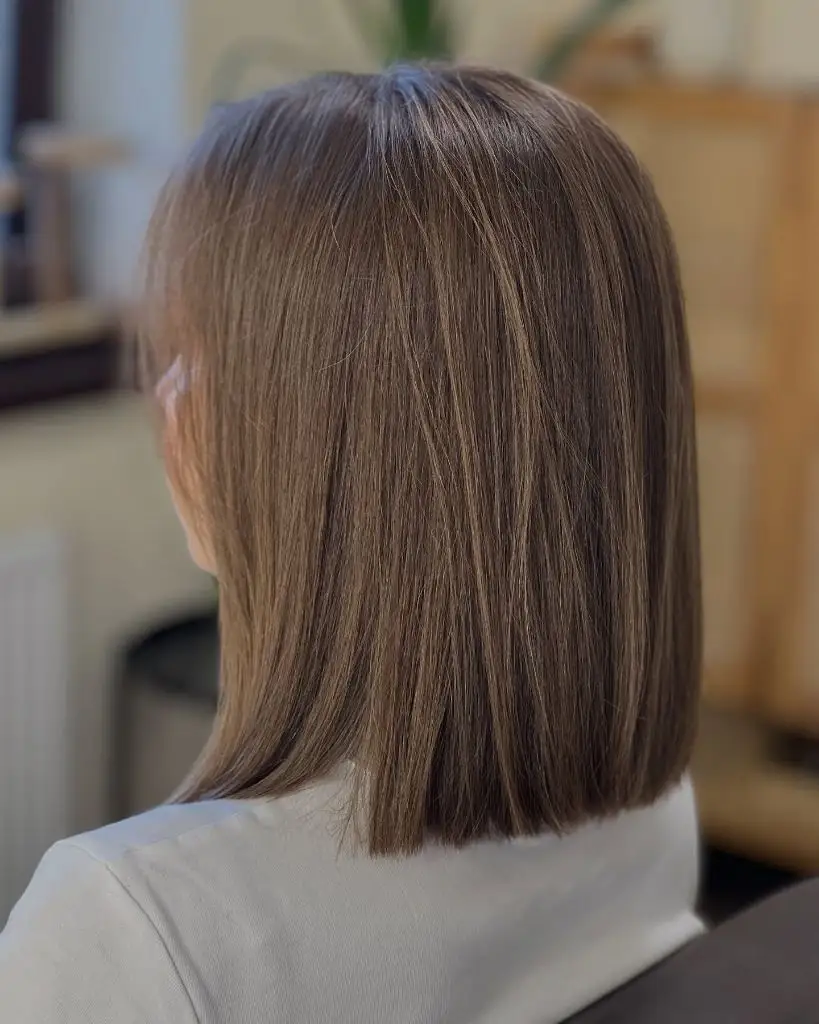
Photo via Instagram
The simplicity of this cut is its defining quality. There are no highlights to create depth, no stacking to build volume, and no dramatic angle to create a diagonal. Instead, the shape is carried entirely by the natural weight and fall of the hair, and the slight angle from back to front is so subtle it could almost be a one-length cut. The smooth, even surface in this natural brown tone reads as unprocessed and effortless, and the slight movement at the very ends is the only texture visible. I like how the understated quality of the whole composition allows the clean shape to speak without any supporting elements.
The reader takeaway is that the quietest version of an a-line bob can be the most versatile. When the angle is minimal, the color is natural, and the surface is smooth, the cut adapts to context rather than defining it. There is a strength in that kind of restraint, and it demonstrates that sometimes the best structural choice is the one that stays nearly invisible.
19. Ash Brown Bob With Natural Center Part
The hair is an ash-toned medium brown, cut to just below the chin with a center part. The person faces the camera at a slight angle, showing how the hair falls evenly on both sides. The surface has a natural, soft quality with very slight wave. The color reads as cool and muted, without warmth or highlights. The person wears a plain white crewneck tee, and the background is softly blurred in neutral tones.
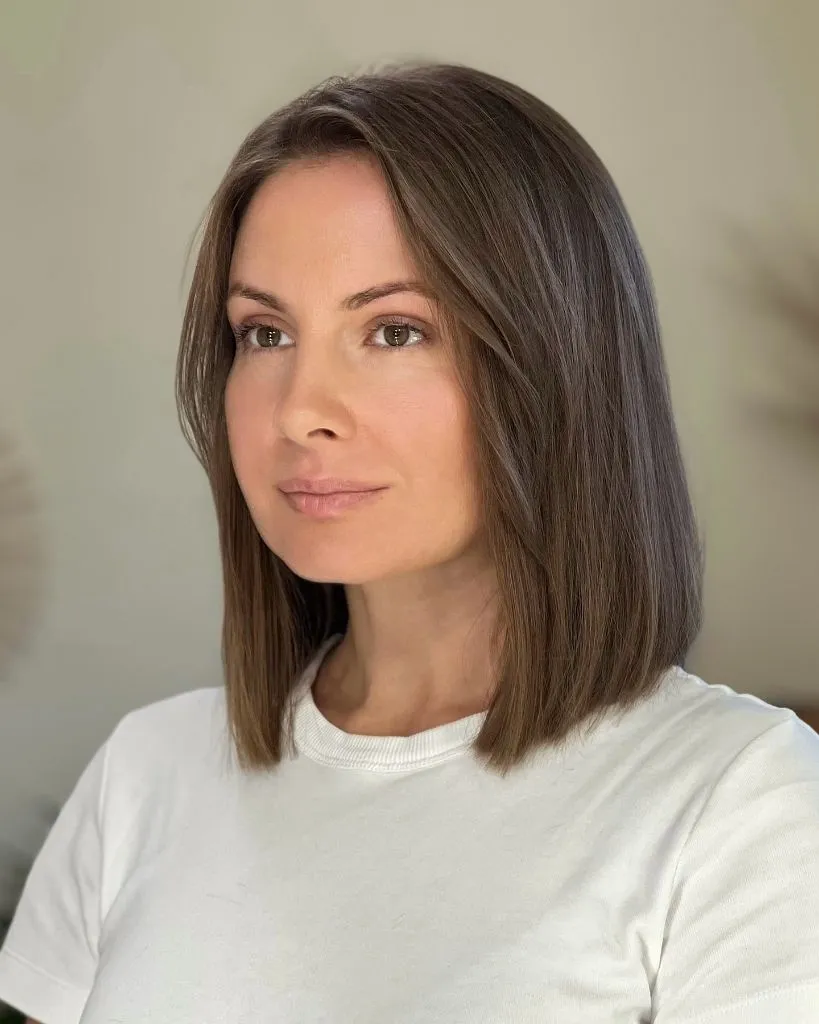
Photo via Instagram
The cool, ash tone gives this bob a modern, understated quality that warmer shades do not achieve. The center part creates perfect symmetry, and the even length on both sides frames the face in two matching curtains of hair. There is no angle visible from this view, which suggests the graduation is very subtle or that the cut approaches a one-length construction. The slight natural movement in the hair adds life to the surface without creating defined texture or waves, and the muted color keeps the overall mood restrained and calm. The white tee and neutral background create a minimal palette that lets the hair tone define the image.
The best move here is the use of a cool, ashy color tone to shift the entire mood of a simple bob shape. Where warm tones create approachability and softness, cool tones introduce a sense of deliberateness and quiet sophistication. The color choice here demonstrates that tone can be as much of a structural decision as the cut itself, shaping how the whole form is perceived.
20. Dark Base With Warm Caramel Peekaboo Highlights
The hair is a dark brown or near-black base with rich, warm caramel highlights running through the mid-lengths and concentrated at the ends. The cut shows a clear a-line angle from back to front. The surface is very smooth and the ends are blunt. Viewed from the side-back angle, the highlights create visible streaks of warmth against the dark base. The person wears a dark gray graphic tee, and a pink floral backdrop is partially visible.
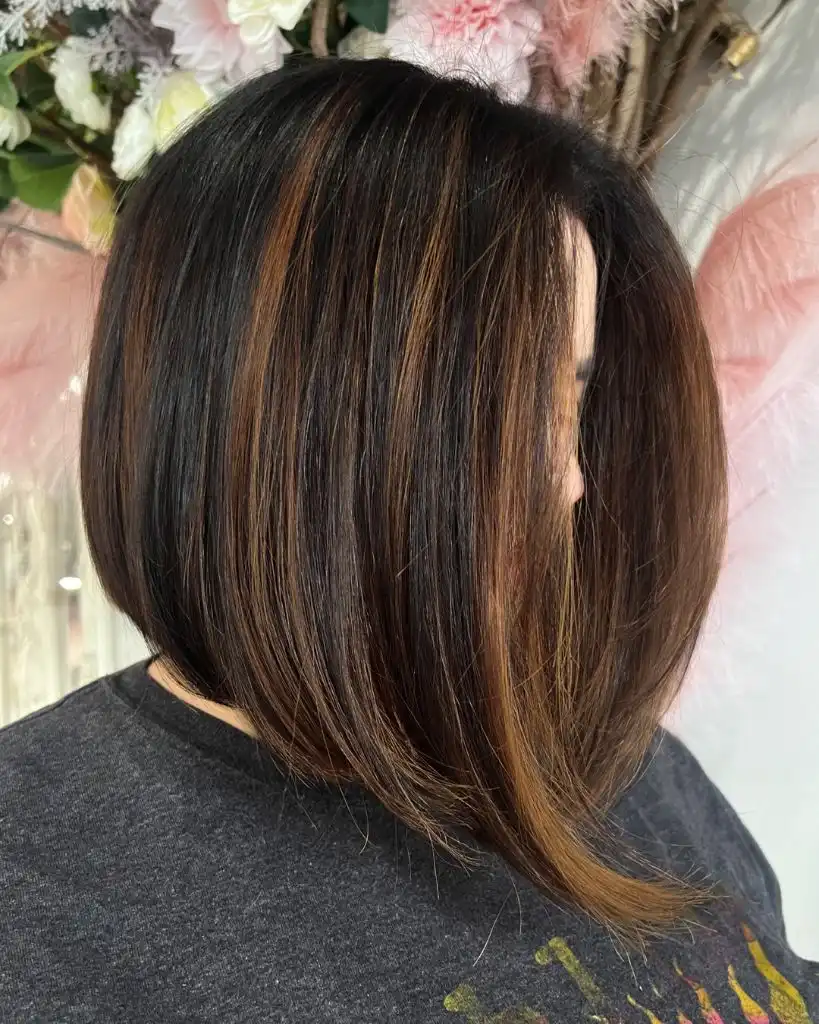
Photo via Instagram
The contrast between the dark base and the warm highlights creates a visual rhythm of alternating tones that runs along the a-line angle. The caramel strands catch light and pull forward, drawing the eye along the slope from back to front, while the dark base provides weight and depth between them. The blunt ends keep the bottom edge clean despite the tonal complexity above, and the smooth surface ensures each highlight reads as a distinct line rather than blending into a wash. The warmth of the caramel against the near-black base creates a high-contrast pairing that gives the cut more visual energy than a solid color would.
The useful move here is the way the highlight placement follows the cut’s directional movement. Instead of sitting randomly throughout the hair, the warm tones flow along the same diagonal as the a-line angle, which turns the color into a tool that reinforces the shape rather than working independently of it.
21. Long Angled Bob With Dramatic Forward Extension
The hair is cut into a steep a-line bob with a very short back and front pieces that extend well past the chin toward the collarbone. The color is a natural, very dark brown or black. The surface is straight and smooth. The person looks downward, and the hair falls forward in a single sheet, showing the full extent of the angle. A white sleeveless top and a concrete or gray textured wall are visible in the background.
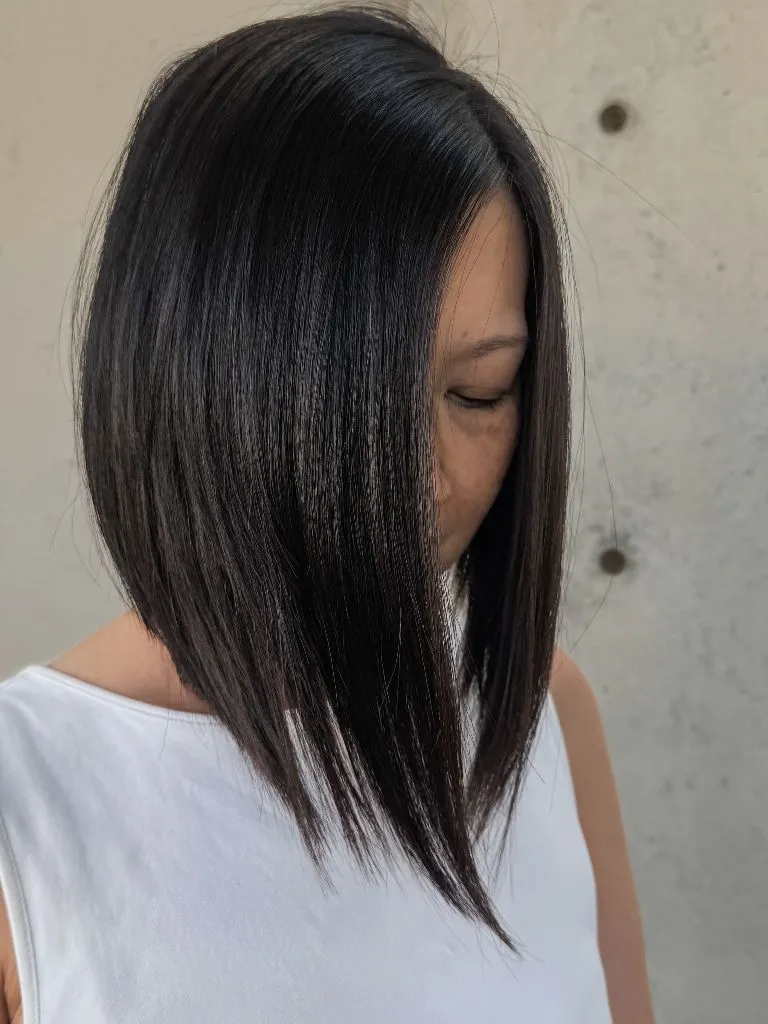
Photo via Instagram
The forward extension is the most dramatic in the collection, and the downward angle of the head amplifies that length difference between back and front. The hair falls like a curtain from the crown to the longest point, and the dark, uniform color turns that curtain into a single unbroken surface where the only interesting line is the diagonal hem. The white top provides a clean backdrop that makes the dark hair stand out sharply, and the concrete wall behind adds a raw, textural element that contrasts with the sleekness of the hair. The overall composition feels deliberate and quiet, with the angle of the cut and the tilt of the head working together to create a single descending line.
The strongest lesson is that the most dramatic a-line angles require the simplest treatment everywhere else. When the front pieces are this much longer than the back, the angle itself becomes the entire statement, and any additional color, texture, or layering would compete with that one powerful line rather than supporting it.

Hi, I’m Zoey Mitchell, the creator of ChicStyle Blog.
I share simple, wearable outfit ideas, hairstyles, nail trends, and beauty tips that feel natural and easy to recreate.
This blog is where I explore everything that makes a woman feel put together and confident every day. I’m not an expert — just a woman who genuinely loves style, mixing looks, and discovering what works.
If you love effortless fashion with a personal touch, you’ll feel at home here.