
Trendy coats 2027 present a quiet problem: how to build an outfit around a single dominant outer layer without letting everything else disappear. The answer almost always lives in proportion. A long coat needs a visible break at the waist, ankle, or neckline to stay readable. A short coat needs enough visual weight below it to avoid looking unfinished. Every pairing here comes back to where the coat ends and what the eye finds next.
Think of trendy coats 2027 less as a shopping category and more as a set of relationships between length, volume, texture, and the sliver of clothing visible underneath. The coats in this collection range from ankle-length wraps to cropped jackets, and each one changes meaning depending on what sits above, below, or against it. Compare where the belt falls relative to the hemline. Compare how much of the layer underneath is allowed to show. That ratio is the outfit.
1. Pale Wrap Coat Over Dark Base
A long, plush-looking wrap coat in a warm off-white reaches past the knee, cinched at the waist with a matching fabric belt. Underneath, a dark top is barely visible at the neckline. The sleeves show ribbed detailing at the cuffs. The coat is photographed from a slightly angled front view against an ornate stone facade with carved floral medallions.
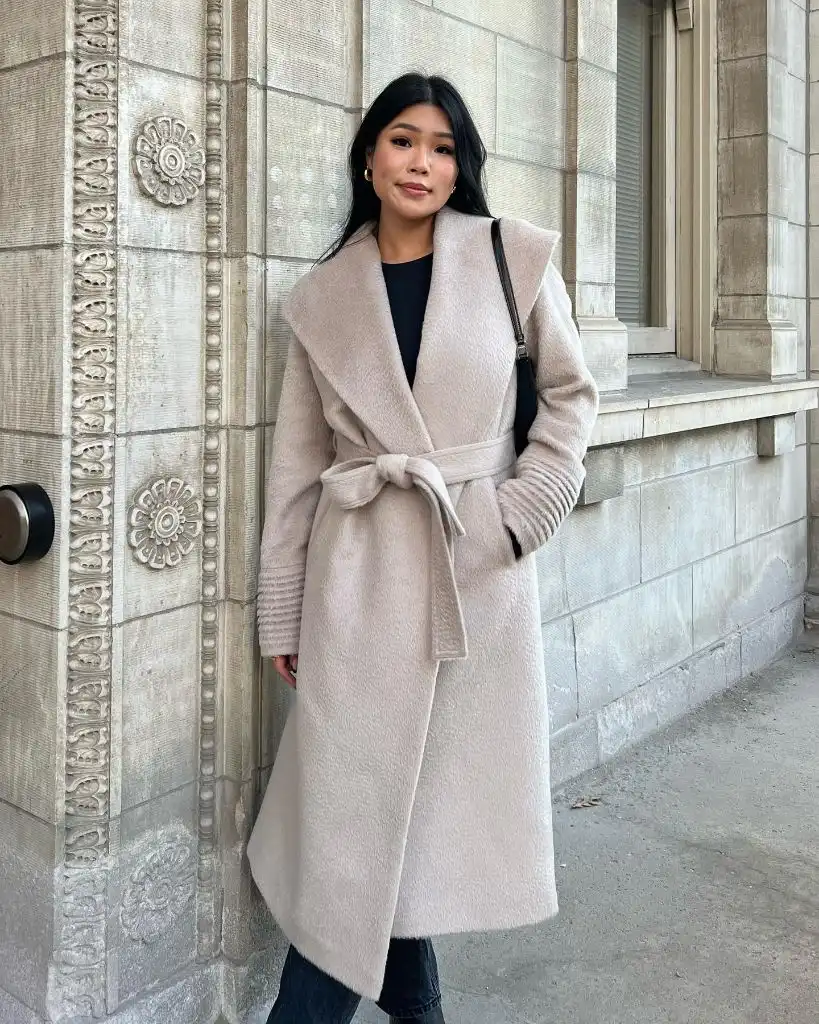
The mechanism here is value contrast concentrated at two narrow zones: the neckline and the very bottom hem where dark jeans peek out. Everything between those zones is one unbroken column of pale fabric, which is what gives the coat its visual authority. The belt creates a horizontal interruption that keeps the column from reading as a blanket. Without that single cinch point, the silhouette would lose its waist entirely and flatten.
The strongest proportion here is the ratio of visible coat to visible everything else, roughly ninety percent coat. If you want to push this further, keep the base layer even darker and let the cuff detail be the only texture shift. If you want to soften it, replace the dark base with a tone one shade deeper than the coat itself, so the contrast quiets down.
2. Dusty Mauve Trench Over Wide Jeans
A floor-length trench-style coat in a muted dusty mauve hangs open, revealing a fitted white top tucked into light-wash wide-leg jeans. The coat has large buttons and a belt left untied. A small brown leather-looking bucket bag is held at the side. The full-length view is taken on a sidewalk in front of a storefront with white columns and dark-framed windows.
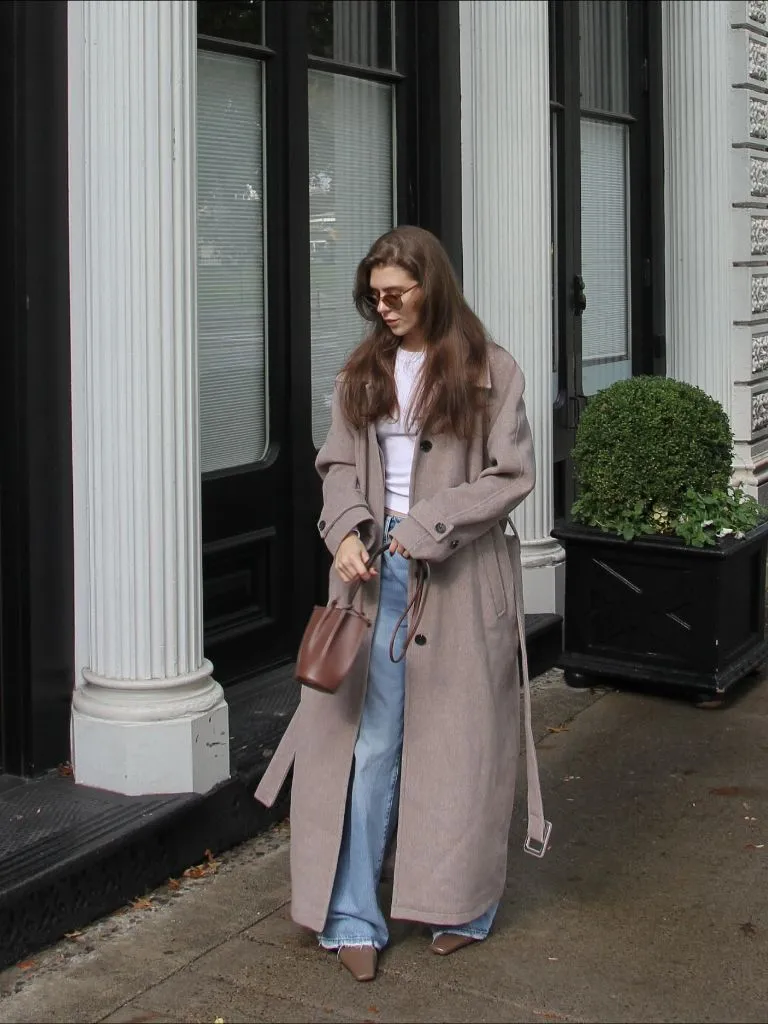
This outfit works through a clean vertical split. The open coat creates two long panels framing the center column of white and pale blue. That center column is where the eye travels, top to bottom, and the coat panels act as a border on either side. The proportions read as almost architectural because the jeans are wide enough to echo the coat’s volume rather than contrast it. The result is a relaxed silhouette that still holds structure.
The adaptation worth noting is the shoe. A pointed toe in a color that matches the coat’s warmth pulls the mauve tone all the way to the ground, connecting the top and bottom of the frame. Without that color echo at the ankle, the coat and the jeans would split into two separate outfits. Keep the shoe within the same tonal family as the coat whenever the coat is left open like this.
3. Dusty Mauve Trench Cropped to Mid-Torso
This is the same coat seen closer, cropped to show the mid-section. The white top is tucked into high-waisted light-wash jeans with a visible button closure. The coat’s large patch pockets sit at hip level. A brown leather-looking bag hangs from one hand. The framing cuts off above the chest and just below the knee.
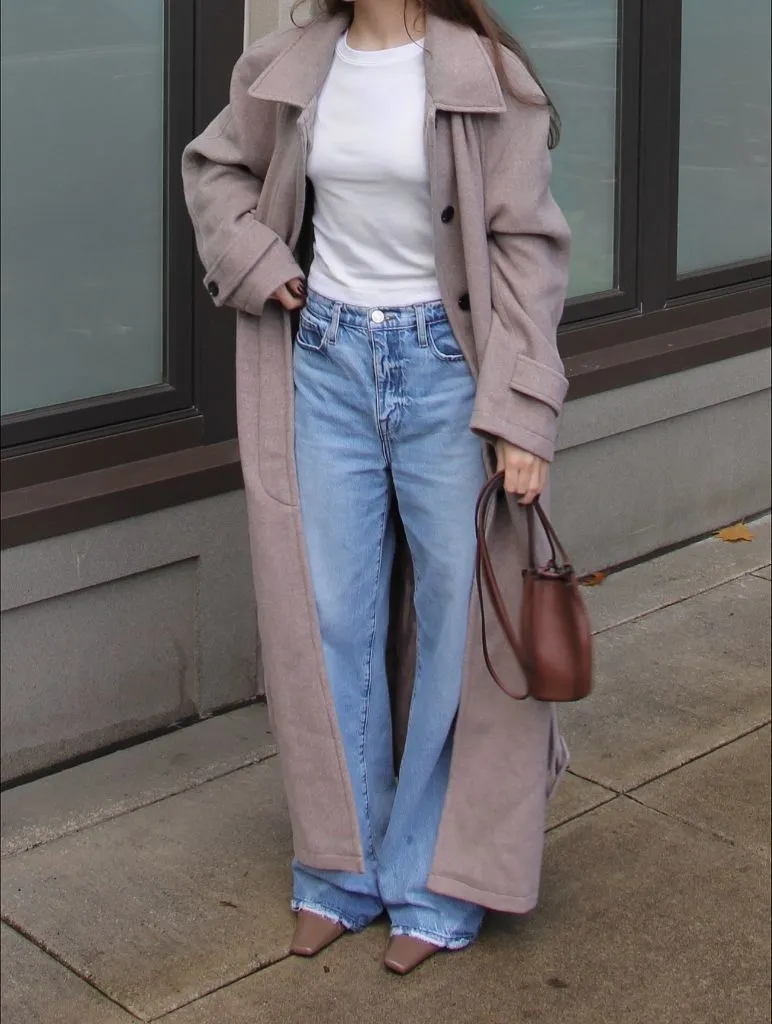
Seen at this scale, the placement of the coat’s pockets becomes the dominant detail. They sit exactly at the widest point of the hip, and because the jeans are high-waisted, the pocket flaps mark the boundary between the structured top half and the relaxed bottom half. This zoning is what keeps a large, open coat from looking shapeless. The white top acts as a bright anchor in the center of the frame, drawing attention inward.
If you want to recreate this proportion, the key measurement is where the coat’s pocket lands relative to your waistband. It should sit at or just below the waist, not at mid-thigh. When the pocket drops too low, the eye follows it down and the midsection loses definition. Keep the top fitted and light-colored to hold the center of the composition.
4. Cropped Charcoal Jacket From Behind
A short, boxy jacket in a charcoal textured-looking fabric is seen from the back in a mirror selfie. The jacket has a wide collar, rolled-back cuffs, and a belt detail at the lower back. Below, dark fitted jeans are partially visible. The background is a clean white closet with paneled doors and gold hardware.
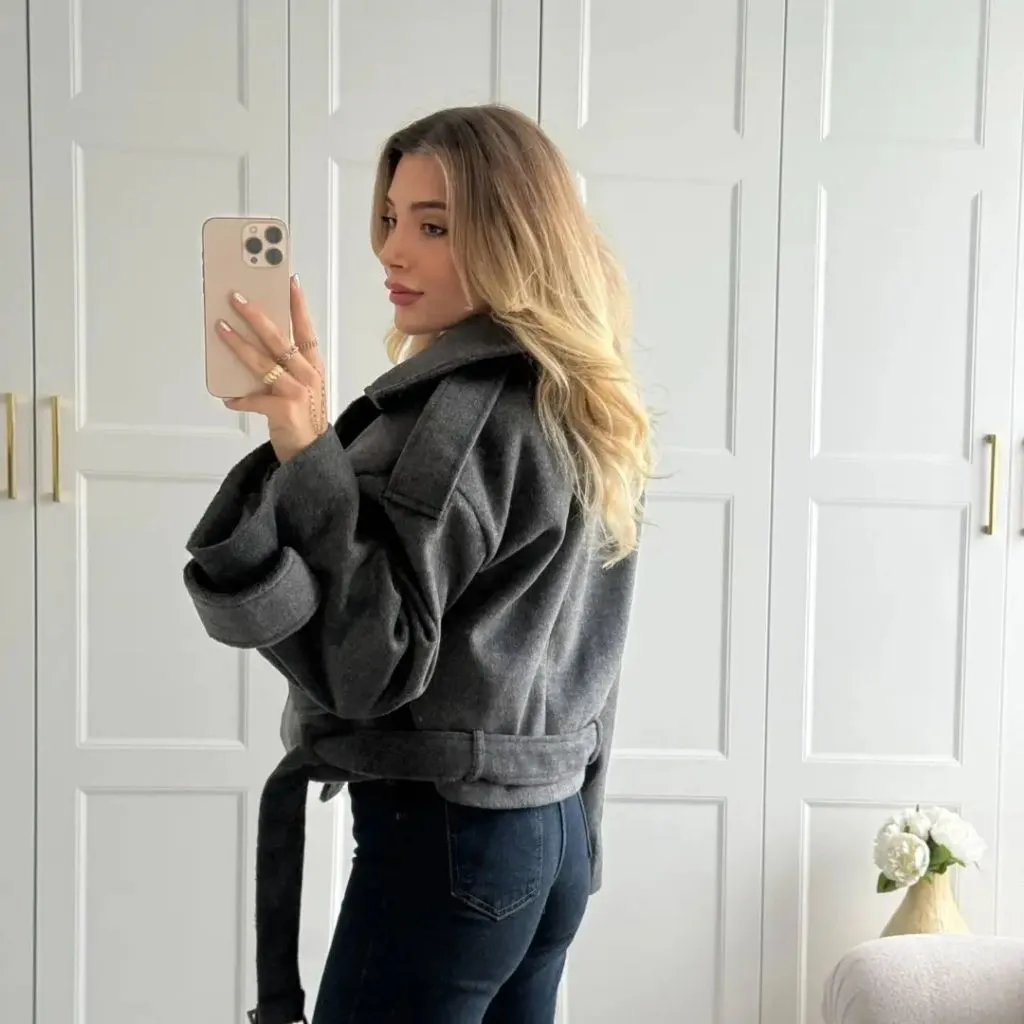
The back view reveals something the front would not: the belt sits higher than expected, almost at the natural waist, which shortens the jacket visually and makes the torso look compact. This is a proportion trick. A jacket that hits at the low hip often elongates but also widens. Pulling the belt up tightens the silhouette and transfers all the volume into the shoulders and upper sleeves. The result is a triangular shape that narrows downward.
The strongest detail is the cuff roll. It shortens the sleeve to three-quarter length, which exposes the wrist and creates a visual break between the heavy jacket and the hand. For trendy coats 2027, this small adjustment separates a boxy shape that looks intentional from one that looks too large. Roll the cuff once, not twice, to keep the proportion clean.
5. Camel Fur-Collar Coat in Snow
A mid-calf camel coat with a large fur-like collar is tied at the waist with a matching belt. The coat is worn with sheer black tights and logo-printed lace-up boots. A gold bracelet or clutch is visible at one wrist. The scene includes a snowy landscape with snow-covered evergreen trees and building edges in the background. The view is a full-length side profile.
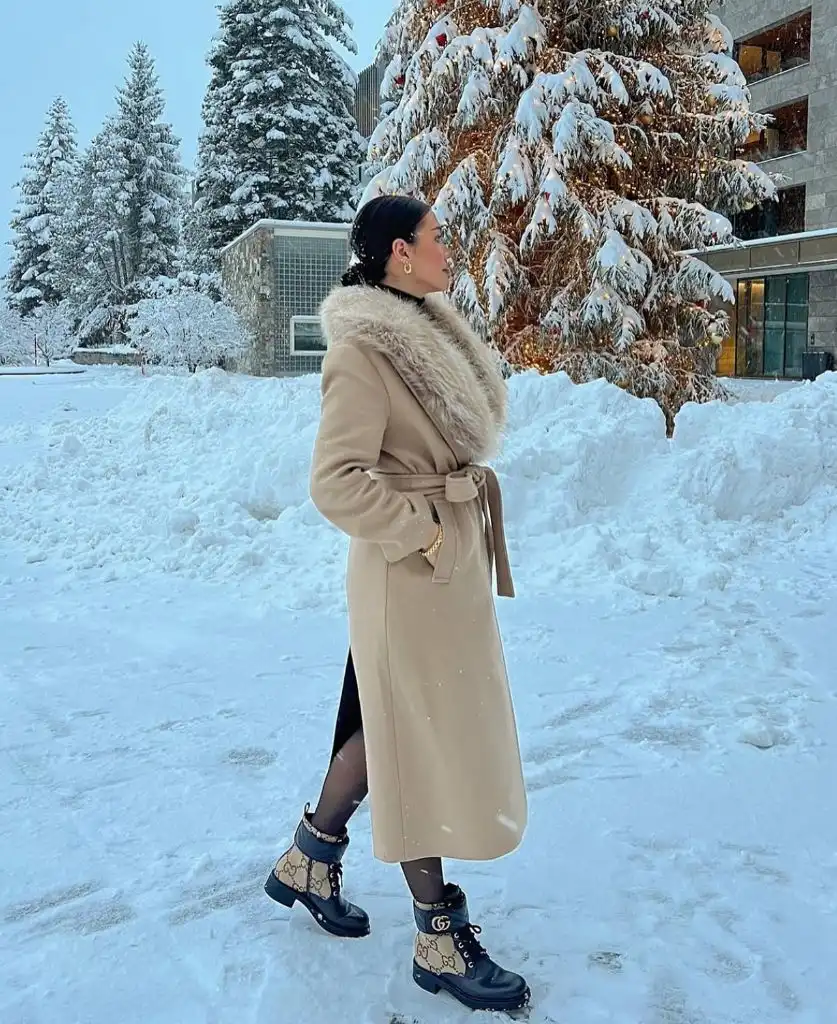
The fur-like collar is the single largest texture shift in the outfit, and it works because it is confined to one zone. Everything from the collar down is smooth and uniform in surface. That restraint is what makes the collar read as intentional rather than overwhelming. The boots introduce a second texture, but because they sit at the opposite end of the body, the two texture zones frame the smooth center without competing with each other.
The proportion to protect is the gap between the coat hem and the boot top. Here, several inches of sheer-covered leg are visible, and that sliver of transparency is doing most of the work. It prevents the outfit from becoming one solid block of opaque fabric. If the coat were two inches longer or the boots two inches taller, the break would vanish and the silhouette would read heavier. Keep that gap narrow but present.
6. Tan Trench Draped Over Layered Navy
A long tan trench coat is worn open and draped over the shoulders, almost like a cape. Underneath, a navy button-front shirt is layered over a gray turtleneck. White trousers and dark shoes complete the lower half. A large black bag with a visible brand strap is held in one hand. The photo is taken from the front against a light wall with soft diagonal shadows.
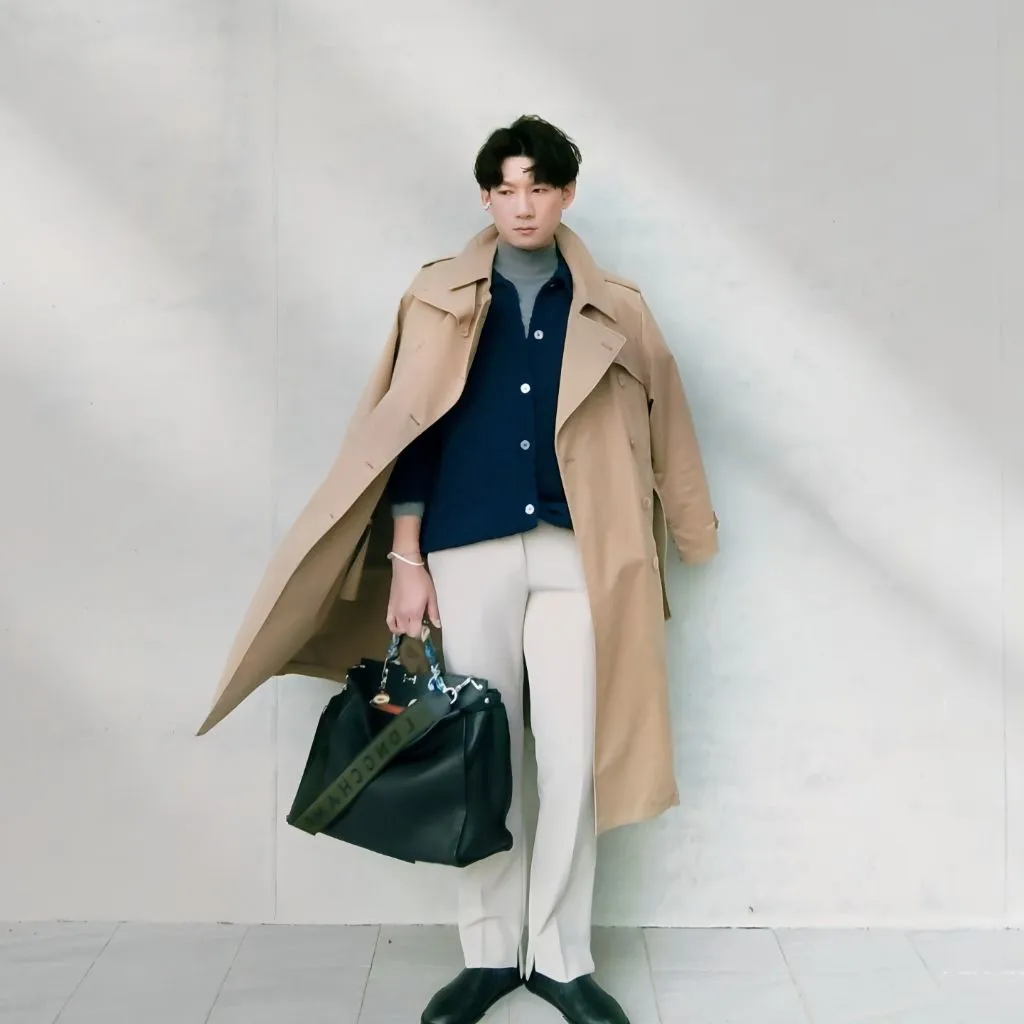
This outfit stacks four distinct layers, each in a different value: light tan, dark navy, medium gray, and white. What keeps four layers from looking cluttered is that each one occupies a clearly defined horizontal zone. The trench frames the shoulders, the navy shirt covers the torso, the gray turtleneck peeks out only at the neck, and the white trousers anchor the bottom half. The eye reads them in sequence rather than all at once, which is the definition of tonal layering done with discipline.
The adaptation here is about the drape. Wearing a trench off the shoulders only works when the coat is long enough to still reach past the knee even while pulled back. A shorter coat worn this way would bunch at the elbows and lose the vertical line. If your coat hits above mid-thigh, wear it normally and leave it unbuttoned instead to achieve a similar openness without the cape effect.
7. Light Gray Belted Wrap With Wide Trousers
A hip-length coat in pale gray with a dramatic shawl collar wraps across the body and ties with a matching belt. Below, wide-leg gray trousers extend to the floor over silver-toned pointed shoes. A black textured-looking rounded bag is held in one hand. The other hand adjusts sunglasses. The setting is a doorway with dark mullioned glass and a light stone wall.
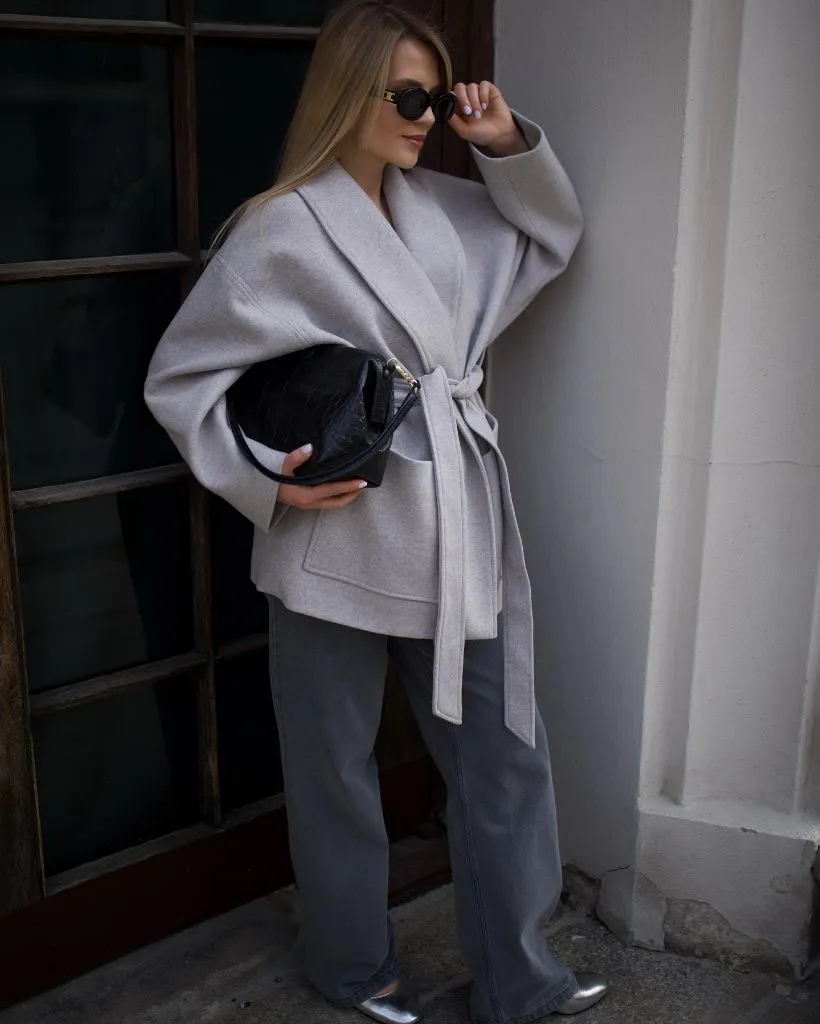
The entire outfit lives within a two-shade range of gray, and that narrow tonal window is the point. When every piece shares a color family, the eye stops sorting by color and starts reading by shape instead. The shawl collar becomes the loudest element because its curved volume contrasts with the straight vertical fall of the trousers. This is how you build visual interest inside a monochrome frame: through silhouette variation, not color.
The silver shoes are the only metallic surface visible, and they work because they sit at the very bottom of the frame where they catch attention without interrupting the column above. For anyone building a tonal gray outfit, the strongest move from this example is to keep the coat shorter than the trousers. The coat ends at the hip, so the trousers carry the full vertical line below. That handoff is what keeps the look from reading as a bathrobe.
8. Cream Cape Coat With Contrast Piping
A cream cape-like coat with black contrast piping along the edges is draped heavily over the shoulders, wrapping across the chest. Underneath, a beige or tan top is partially visible. A structured taupe bag with hardware details hangs at the elbow. The frame is cropped close, showing only the torso and upper arms, shot from a three-quarter front angle against a dark background.
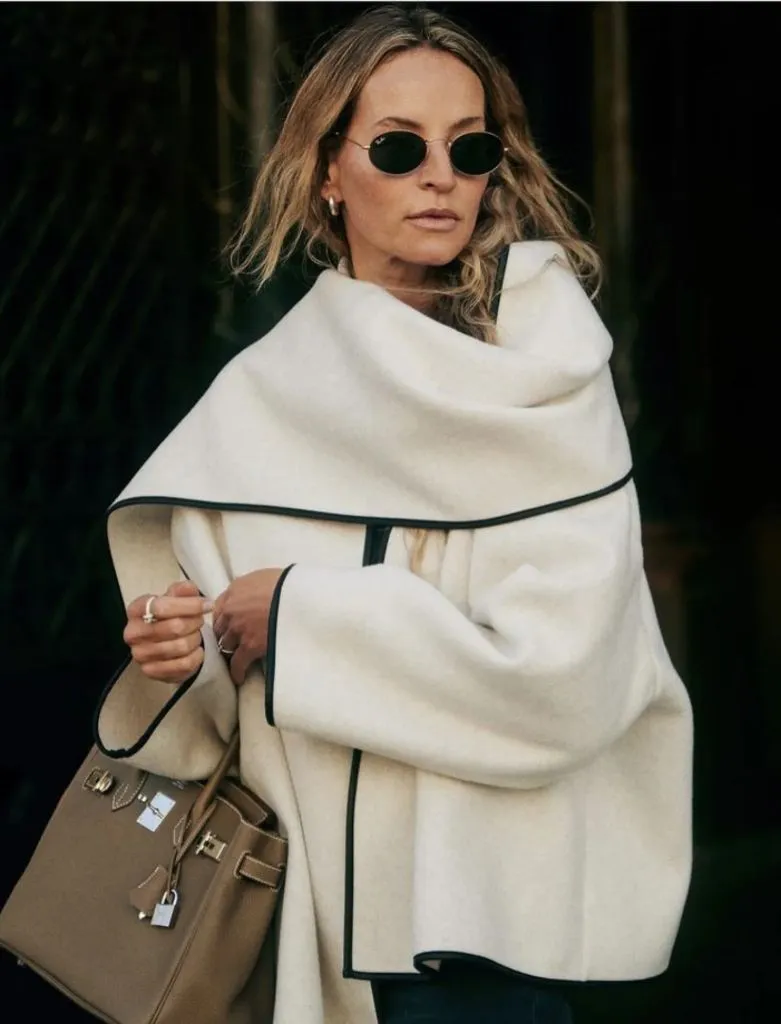
The black piping does something precise: it draws a visible outline around the coat’s edges, turning an otherwise soft, drapey shape into something architecturally defined. Without the piping, this coat would read as a blanket wrap. With it, every fold and overlap is traced by a thin dark line that gives the eye a path to follow. This is contrast used not for drama but for legibility, making a soft garment readable from a distance.
The close crop of this image hides the lower half entirely, which means the coat has to work as a complete composition on its own. That is a useful test for any outerwear piece. If the coat looks finished when you can only see it from the waist up, the proportions and details are strong enough to carry an outfit. The piping here passes that test because it provides structure that does not depend on what is happening below the frame.
9. Black Faux-Fur Coat With Leather-Looking Panels
A black coat combining plush fur-like panels with smooth leather-looking sections is worn with arms crossed. The fur-like texture dominates the front and sleeves while the leather-looking material appears along the sides and inner arms. A white top is barely visible at the neckline. The setting is an indoor mirror selfie with gray curtains and a framed print partially visible in the background.
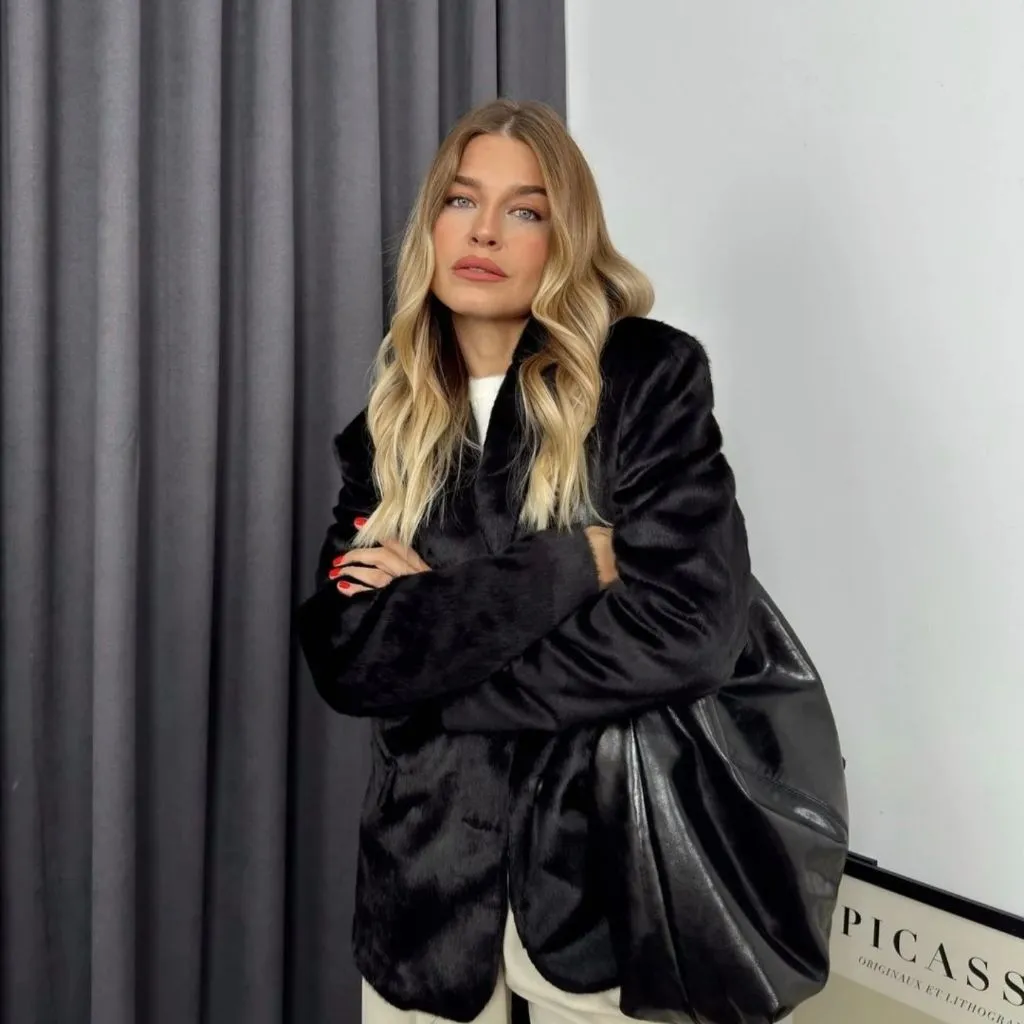
Two textures in the same color create a conversation that color contrast cannot. The fur-like sections absorb light and look matte, while the leather-looking panels reflect it and look slick. This means the coat reads as visually complex even though it is entirely black. The crossed-arm pose compresses both textures into the center of the frame, which makes the contrast more obvious than it would be with arms at the sides.
If you want to work with a single-color, dual-texture coat like this, the key is to let the coat be the only complex surface in the outfit. The white neckline here is flat and plain, and the background is neutral. Adding a textured scarf or a patterned bag would compete with the coat’s built-in texture story. Simplify everything else and let the material contrast do the talking.
10. Dusty Rose Short Coat Over White
A short, slightly oversized coat in a dusty rose plush-looking fabric has two large buttons and a notched collar. It is worn open over a white fitted top and white wide-leg trousers. A small dark chain-strap bag is held in one hand. This is a full-length mirror selfie in a bright interior with light wood floors and white-framed glass doors.
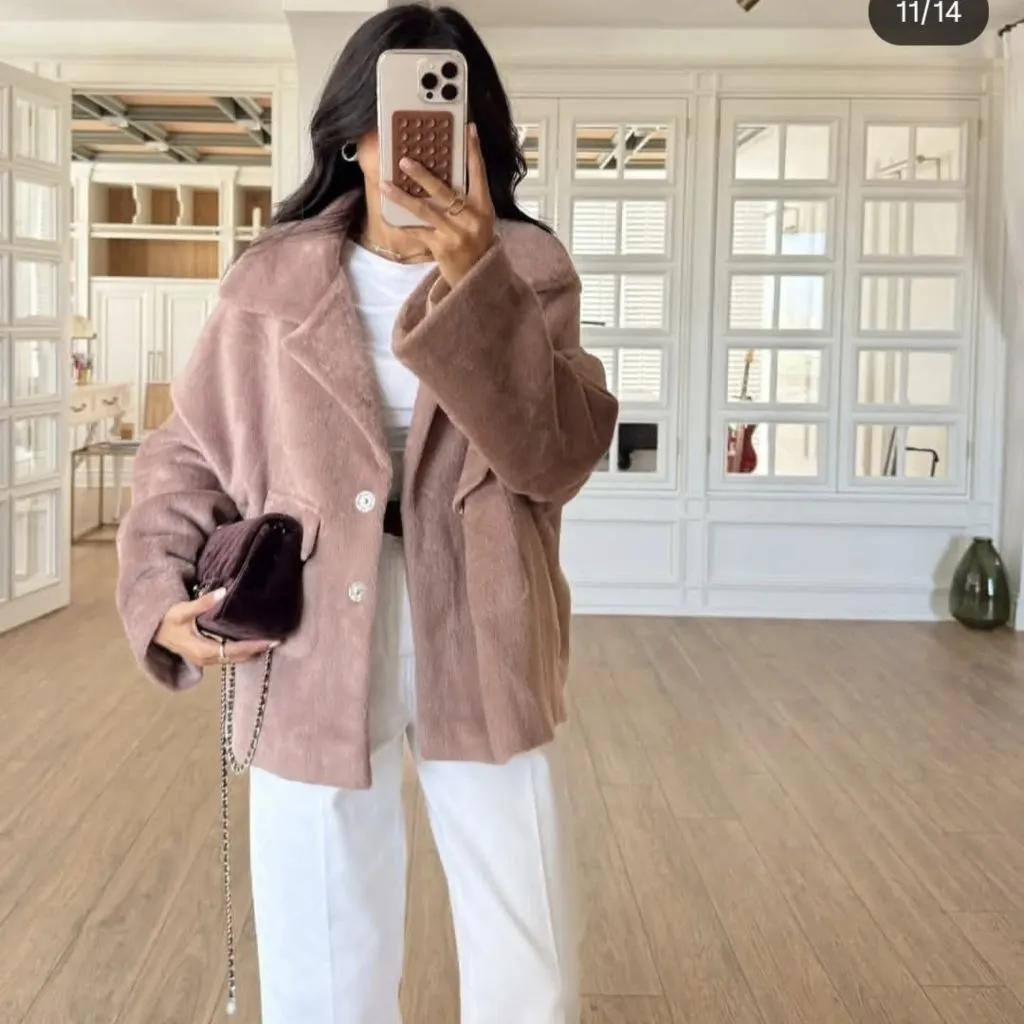
The coat is the only colored element in an otherwise all-white outfit, which makes it function as a single accent block. This is negative space applied to color: the white surrounding the coat gives it room to register fully. If the trousers or top were also colored, the coat would share attention and lose its dominance. The plush-looking texture adds warmth to the dusty rose tone, making it appear softer than the same color would in a smooth fabric.
The length of this coat stops right at the hip, and that is where trendy coats 2027 get interesting in shorter formats. A hip-length coat over wide trousers creates a T-shaped silhouette: broad at the top, straight and wide at the bottom. That shape reads as relaxed and modern. To keep it from looking sloppy, the coat needs to maintain structure in the shoulder, which this one does through its notched collar and visible button placket.
11. Dark Charcoal Belted Coat With Wide Trousers
A long, dark charcoal coat with an oversized notched collar is belted tightly at the waist with a tied fabric sash. Wide-leg trousers in a similar dark tone extend below, and a quilted-looking black clutch is held in both hands at waist level. The full-length front view is taken on a cobblestone street in front of a cafe with wooden chairs and a sign reading “Hazzo Pulo.”
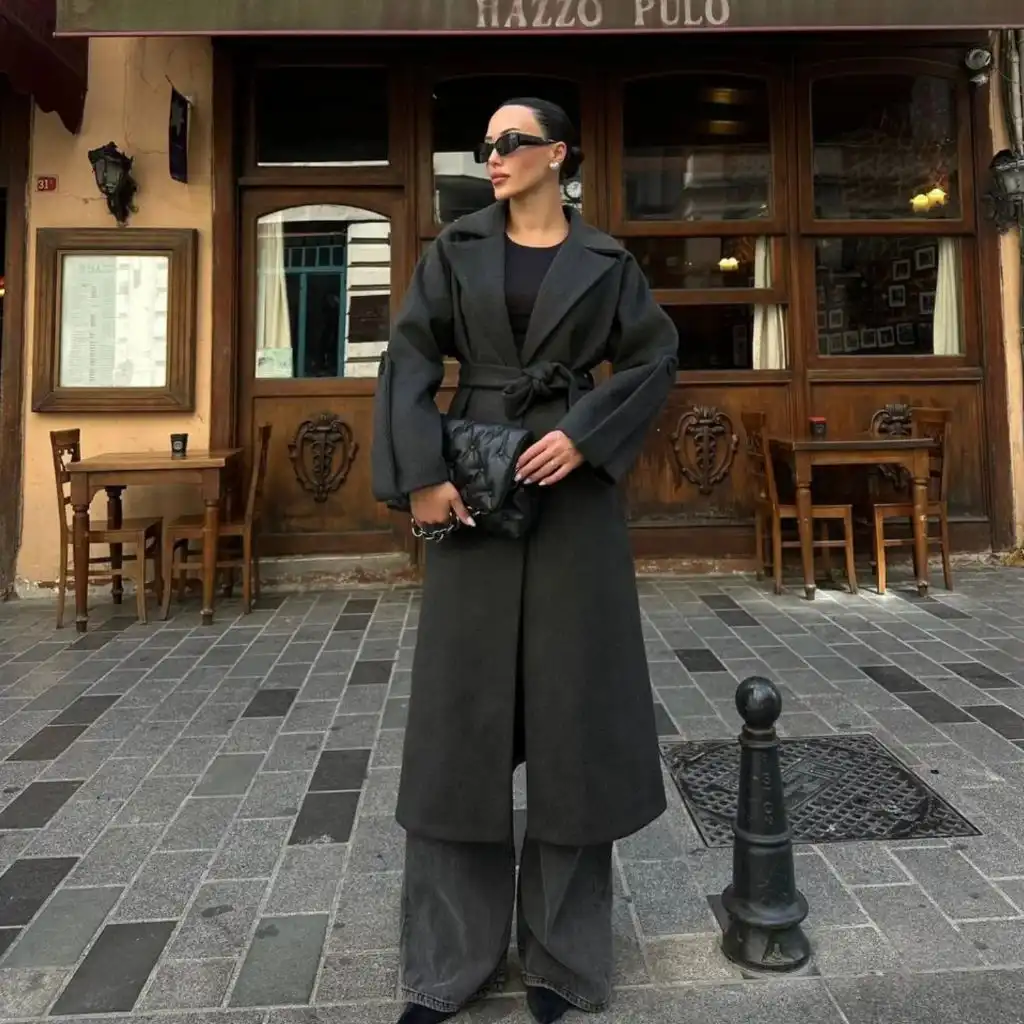
The belt is doing the heaviest structural work in this outfit. Without it, the long coat and wide trousers would merge into one undifferentiated dark column. The belt creates a defined waist point that splits the silhouette into an upper and lower half, and because both halves are voluminous, the cinched middle provides the necessary visual relief. This is proportion management through a single horizontal line, and it is the oldest trick in coat styling for a reason.
The quilted-looking clutch adds a small-scale texture at the exact center of the frame, right where the belt draws the eye. That placement is not accidental. When a bag sits at the waist of a belted coat, it reinforces the focal point that the belt already created. For anyone working with a monochrome dark outfit, place the most interesting texture at the waist to give the eye somewhere specific to land. Check out chicstyleblog.com for more on building monochrome silhouettes with strategic detail.
12. Black Double-Breasted Coat With Zebra Knit
A long black double-breasted coat with a notched collar falls past the knee, worn over a high-neck zebra-print knit-looking top. The lower half shows sheer dark tights and tan suede-looking boots with white socks visible above them. A small brown monogram-print bag is held at one side. The full-length front view is captured in front of ornate marble and bronze cathedral doors.
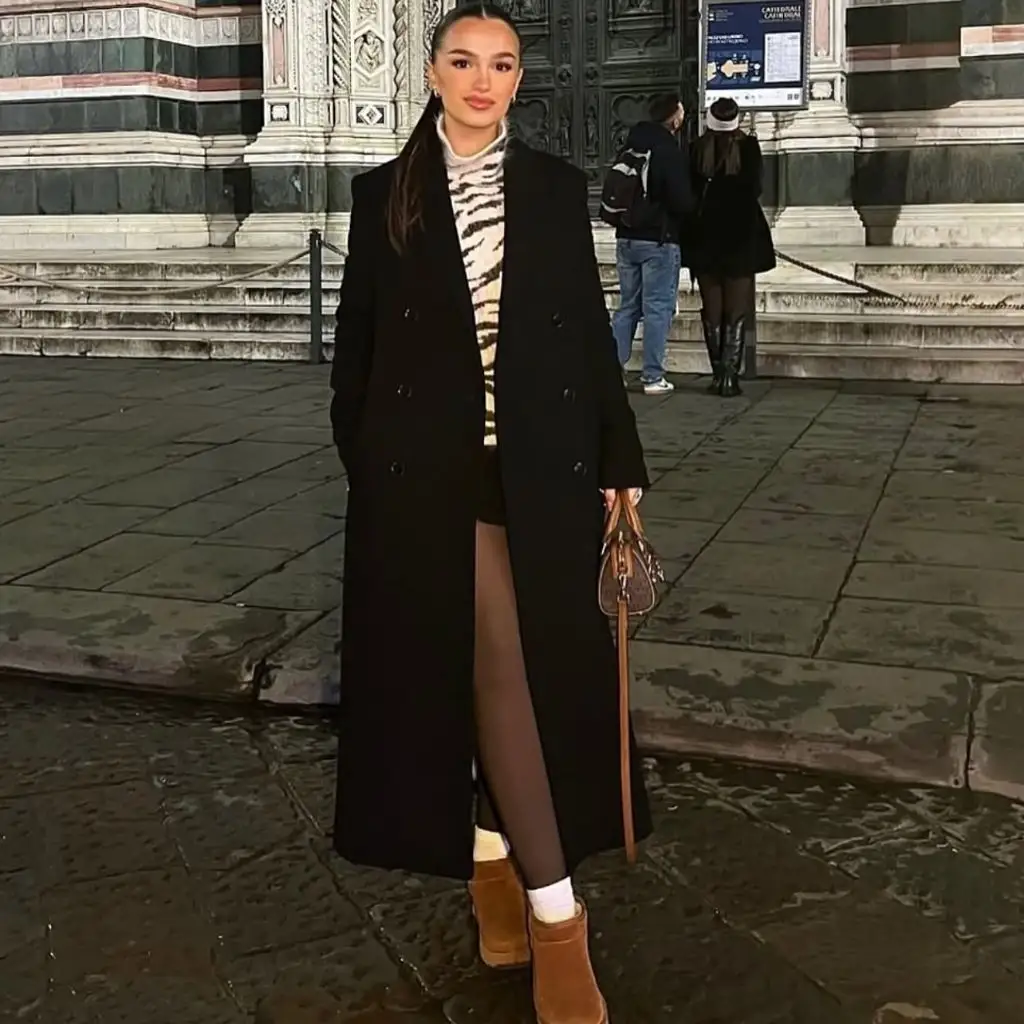
The zebra-print knit at the neckline is the one pattern in an otherwise solid-color outfit, and its placement matters. Sitting inside the coat’s open collar, the pattern is framed and contained. It does not compete with the coat’s clean lines because it only occupies a narrow vertical strip between the lapels. This is how to introduce pattern under a structured coat: keep it visible but bounded, so the coat still reads as the primary garment.
The tan boots and brown bag create a secondary color story at the extremities. They do not match the black coat, and that mismatch is deliberate. The warm tones at the bottom and side pull the outfit away from severity and toward something more approachable. If the boots were also black, the outfit would read as one dark wall with a stripe of print. The warm contrast at the edges opens the composition up.
13. Camel Fringe Coat Over Black Turtleneck
A mid-calf camel coat with fringe trim along the front placket and hem hangs open over a black turtleneck tucked into medium-wash straight-leg jeans. A brown belt is visible at the waist. Black pointed boots and a dark quilted-looking shoulder bag complete the accessories. The full-length front view is shot on a city sidewalk at night with a dark storefront behind.
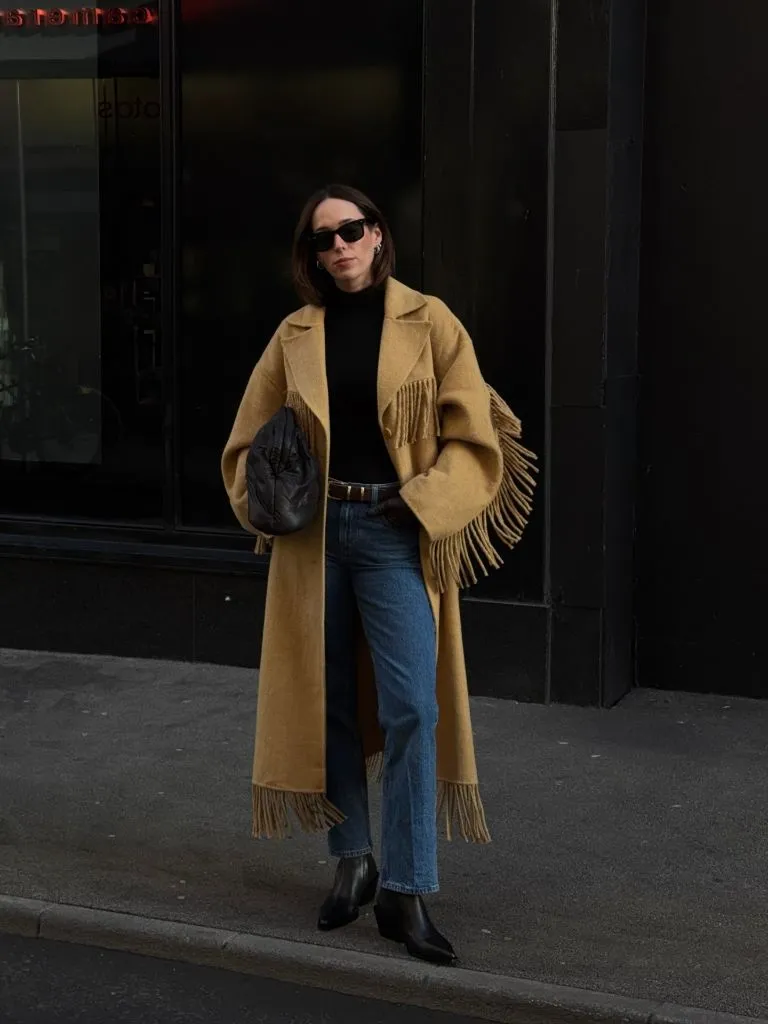
The fringe creates a rhythm along the coat’s vertical edges, a repeating pattern of short, evenly spaced strands that softens what would otherwise be a clean straight line. This is texture used to interrupt a silhouette without changing its overall shape. The coat still reads as a long, straight column, but the edges vibrate slightly because of the fringe. That vibration is what separates this coat from a plain camel overcoat hanging in a similar way.
The outfit underneath is a classic dark-top-plus-jeans combination, and the coat adds the entire personality. This is a useful framework for trendy coats 2027 with strong details: keep the base generic and let the coat carry the visual argument. If the turtleneck had a pattern or the jeans had heavy distressing, the fringe would have to compete. Plain foundations let textured coats perform at full volume.
14. Dark Brown Blazer Coat With Knee Boots
An oversized single-button blazer-style coat in a deep brown falls to mid-thigh. Underneath, a dark sweater in a nearly matching brown is layered over what appears to be a short bottom, with black leather-looking knee-high boots rising to just below the knee. A layered gold necklace sits at the chest. A dark structured bag is held at the side. The image is cropped from the neck to just below the knee.
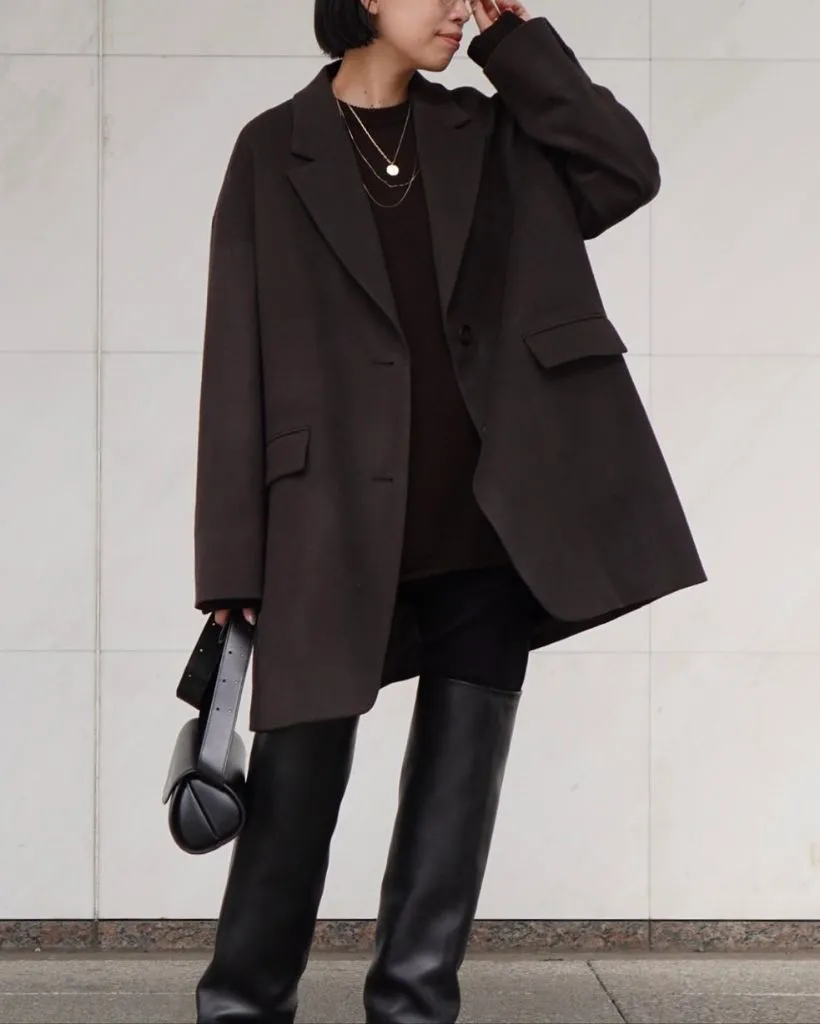
The tonal matching between the coat and the sweater underneath creates an extended torso block. Because both are nearly the same dark brown, the eye does not separate them, and the entire upper body reads as one continuous zone. The black boots then create a sharp value shift at the knee, splitting the composition into two distinct halves: warm brown above, cool black below. That clean division at the knee is the structural spine of the outfit.
The gold necklace is the only metallic element and the only warm-toned accent above the waist. Positioned at the chest, it sits right where the coat lapels open, drawing attention to the one spot where the sweater and coat separate. This kind of small, bright detail works best when the surrounding tones are dark and uniform, because it has no competition. One chain does more here than three would.
15. Dark Fur-Like Bomber Jacket Mirror Selfie
A short, voluminous fur-like jacket in a deep brown or black-brown shade is worn over dark trousers. The jacket has a round collar and appears to reach just below the waist. A price tag is still attached at the hem, suggesting this is a fitting room moment. The image is a full-length mirror selfie in a changing room with warm wood paneling and tan curtains.
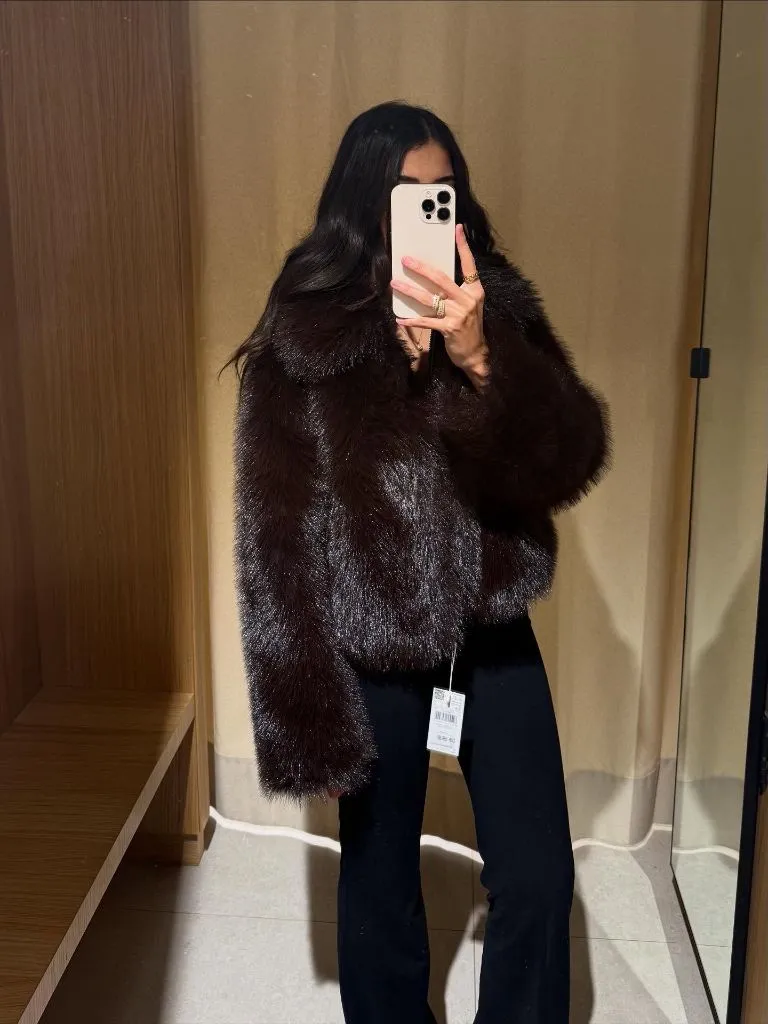
Volume is concentrated entirely in the upper body here, and the dark, dense fur-like texture absorbs light so completely that the jacket almost looks solid. The trousers below are slim and dark, which makes the contrast in volume even more pronounced. This is a deliberate top-heavy silhouette, and it works because the lower half is narrow enough to anchor the proportions without adding competing width. The scale difference between the jacket and the trousers is the entire argument.
When wearing a voluminous short jacket, the most critical proportion is the width of the pants at the ankle. Slim or straight cuts keep the silhouette clean by tapering downward. Wide trousers under a voluminous jacket would create equal width everywhere, which removes the proportional contrast that makes the jacket interesting. Keep the lower half narrow and let the jacket do all the expanding.
16. Brown Suede-Looking Trench Seated View
A short double-breasted trench coat in a rich brown suede-looking fabric is seen from above at a three-quarter angle, with the wearer seated on curved stone steps. The coat’s belt is tied at the waist. Below, sheer dark tights and black pointed-toe knee-high boots are visible. A black patent-looking structured bag sits on the step. Sunglasses with a tortoise-colored frame complete the accessories.
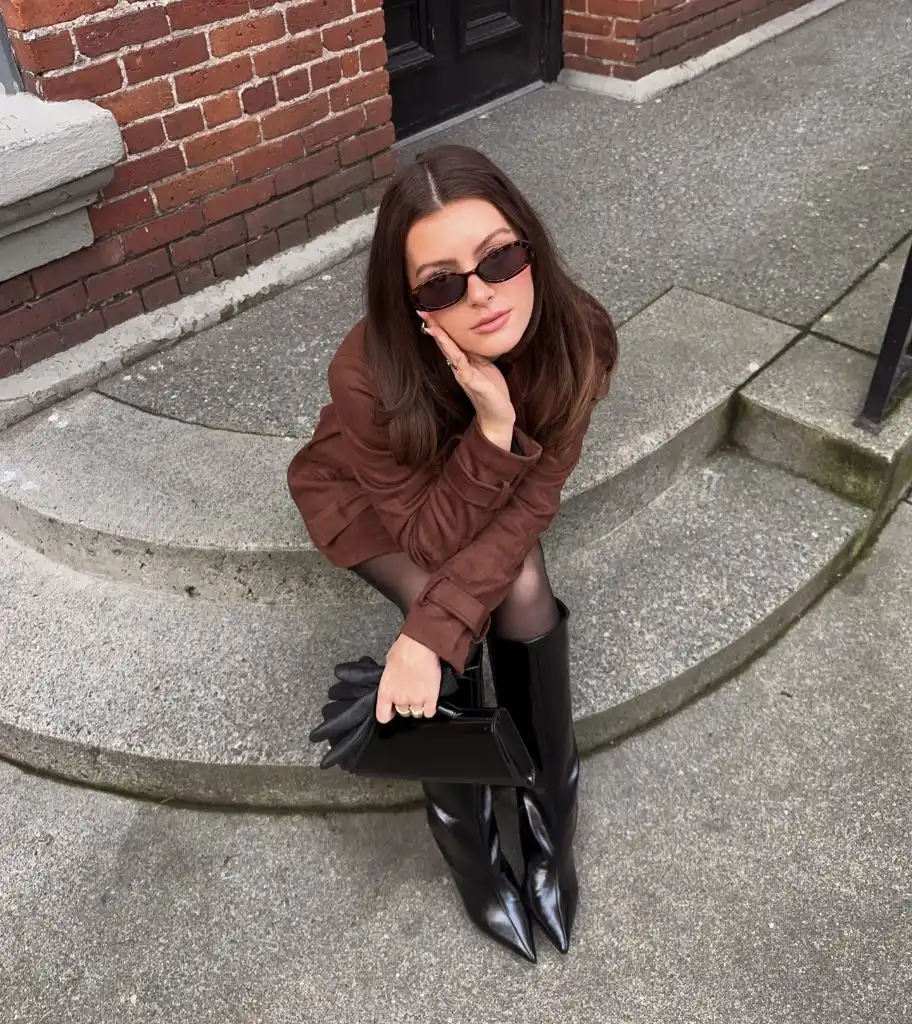
The elevated camera angle compresses the vertical line and emphasizes the coat’s surface area, making the suede-looking texture more prominent than it would be in a standard standing shot. This angle also turns the boots into a strong foreground element, their glossy black surface contrasting sharply with the matte brown coat. The diagonal of the legs against the curved steps adds a compositional energy that a straight-on photo would not have, and it is a reminder that how an outfit is photographed changes how its elements relate to each other.
The brown-and-black pairing here avoids looking heavy because the sheer tights introduce transparency between the two opaque surfaces. That thin strip of sheer fabric between the coat hem and the boot top breaks up the visual weight. For those exploring coat outfit ideas on chicstyleblog.com, notice how a small gap of skin or sheer fabric prevents two dark pieces from merging into one block.
17. Brown Suede-Looking Trench Standing View
The same brown suede-looking double-breasted trench coat is now seen from the front at eye level, standing against a wooden bench flanked by black iron posts. The gold buttons are visible, and the belt is tied. A black ribbed top or sweater is partially visible at the neckline. A black patent-looking clutch is held at the side. The brick building and street context fill the background.
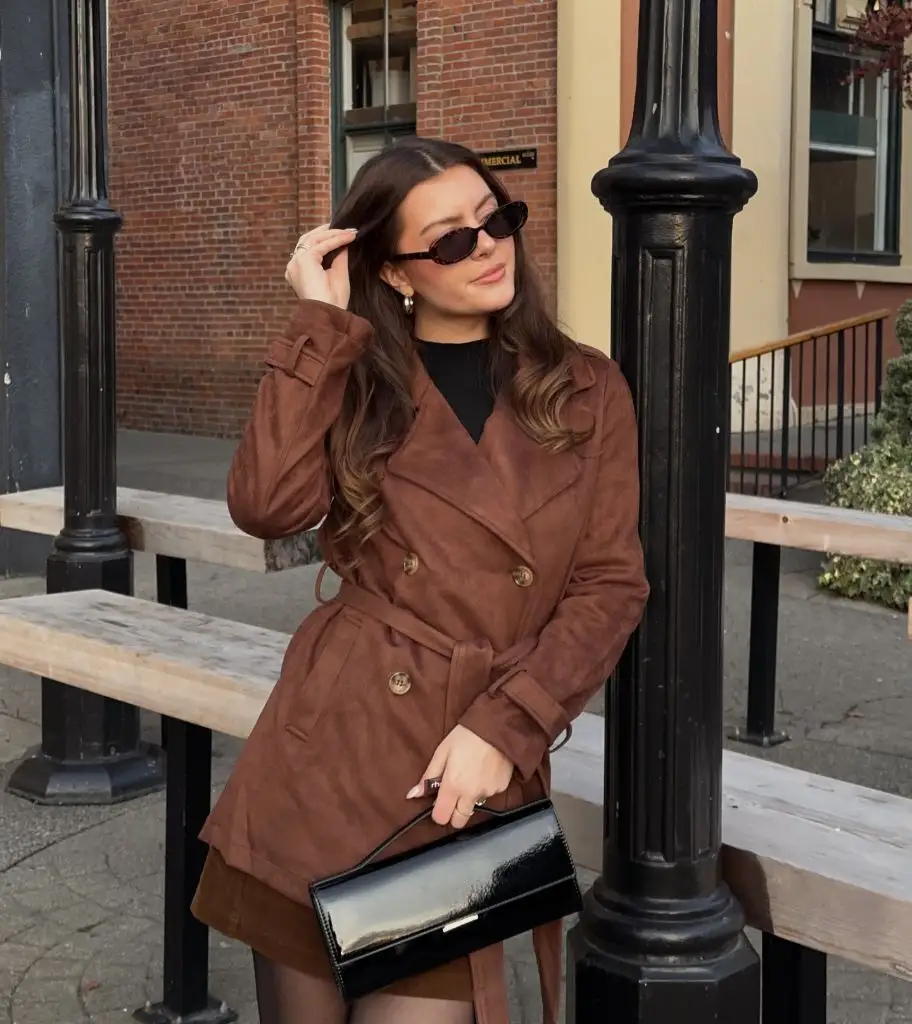
Standing upright, the coat’s proportions read differently than in the seated view. The waist tie pulls in tightly, creating an hourglass silhouette that the seated version obscured. The gold buttons add small bright interruptions along the center front, and because they are evenly spaced, they create a vertical rhythm that guides the eye downward. This is how buttons function as a design element rather than just hardware: through repetition along a line.
The most useful takeaway here is the neckline ratio. The black top is visible only as a narrow V inside the coat collar, and that small slice of dark fabric is enough to ground the entire upper body. You do not need a high-contrast layer showing in large amounts to make it register. A thumbnail of dark fabric at the neckline can anchor a lighter coat just as effectively as a fully visible contrasting sweater.
18. Gray and Burgundy Long Coats Together
Two long coats are seen side by side from behind and in three-quarter profile. One is a light gray textured-looking belted coat reaching the ankle, and the other is a deep burgundy coat of similar length. Both are worn over trousers. Gray boots are visible below one coat. The setting is a cafe exterior with a gilded wooden door frame and wooden bistro chairs.
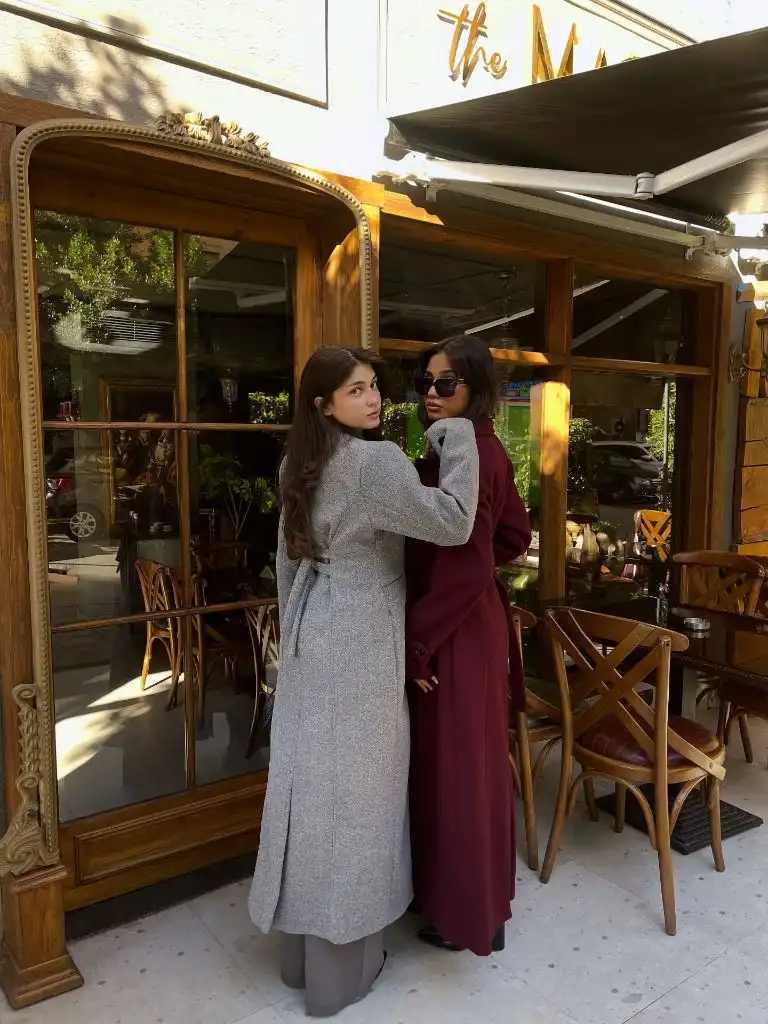
Placing two coats in one frame turns the image into a color comparison. The light gray and deep burgundy are near-complementary in value: one is high on the lightness scale, the other is low. That value gap is what makes both coats look more vivid than either would alone. The gray coat benefits from the warmth next to it, reading cooler and more neutral. The burgundy coat benefits from the lightness next to it, reading richer and deeper. This is simultaneous contrast at work.
For anyone building a coat wardrobe around trendy coats 2027, this pairing illustrates a practical principle. Two coats that differ in both color temperature and value will cover the widest range of outfits. A cool light coat and a warm dark coat create maximum versatility because they occupy opposite corners of the color-value grid. You rarely need two coats in the same quadrant.
19. Cream Sherpa Bomber With Baggy Jeans
A cropped sherpa-looking bomber jacket in cream with black piping and a front zip is worn over a cream or off-white knit sweater. Below, light-wash baggy jeans pool slightly at the ankle over beige sneakers. A black soft leather-looking bag is tucked under one arm. Sunglasses are adjusted with one hand. The full-length shot is taken on a city sidewalk against a weathered stone wall.
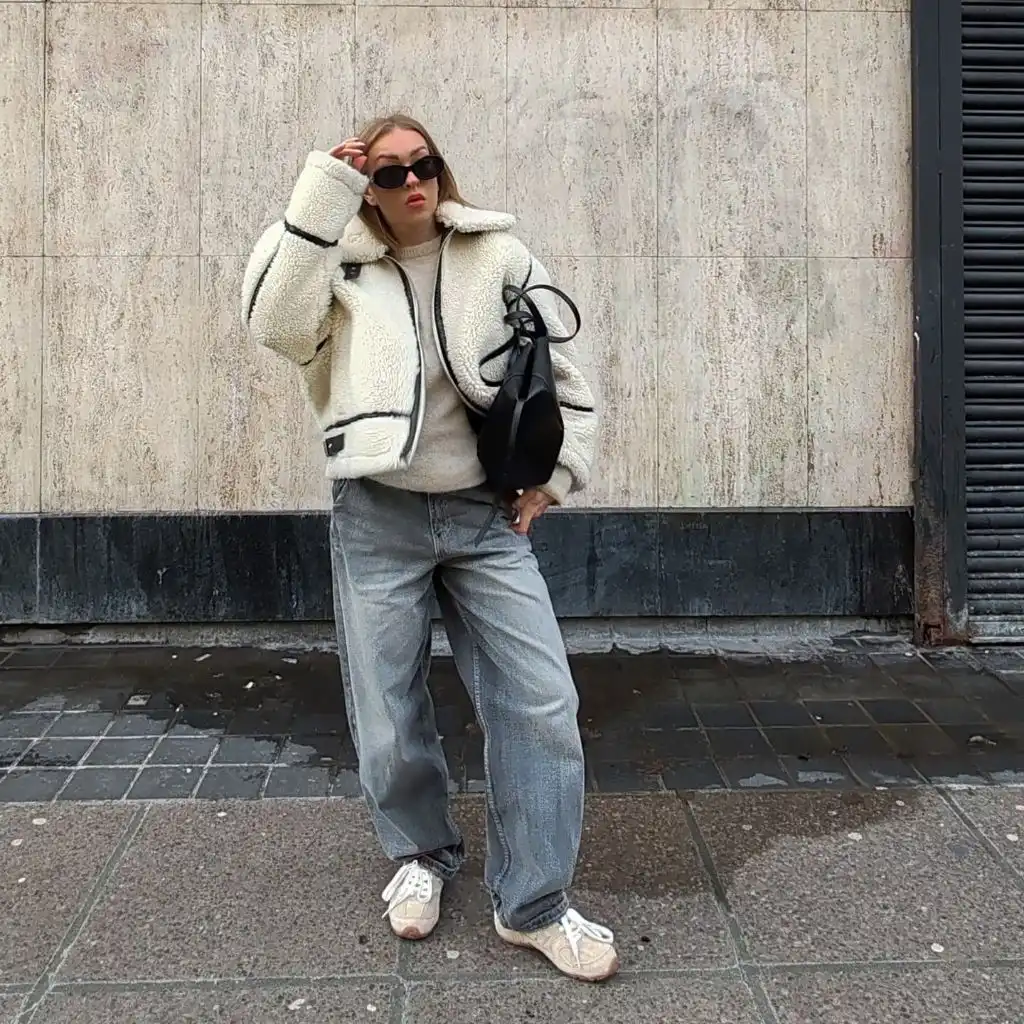
The sherpa-looking texture of the jacket is the densest visual surface in the frame, and it sits right at the top, which gives the outfit a top-down hierarchy of texture. The sweater underneath is smoother, the jeans are even smoother, and the sneakers are the flattest surface. This graduating texture scale from rough to smooth, top to bottom, is a subtle organizing principle that keeps four casual pieces from looking random. Each layer gets quieter as it descends.
The baggy fit of the jeans balances the jacket’s bulk. Both the jacket and the jeans are relaxed in volume, which creates a consistent casualness throughout the silhouette. If the jeans were skinny, the outfit would feel split between a relaxed top and a tight bottom. Matching the volume across the entire outfit is one of the simplest ways to make a casual look read as deliberate rather than thrown together. Visit chicstyleblog.com for more on balancing volume across layered outfits.
20. Brown Shearling-Lined Long Coat
A long coat with a dark brown leather-looking exterior and a thick cream shearling-like lining visible at the collar, front opening, and cuffs reaches below the knee. A white turtleneck is visible beneath. Black trousers and light-toned platform boots complete the lower half. A small dark structured bag is held in one hand, and round sunglasses sit above the nose. The full-length view is taken on a stone staircase in front of a glass storefront.
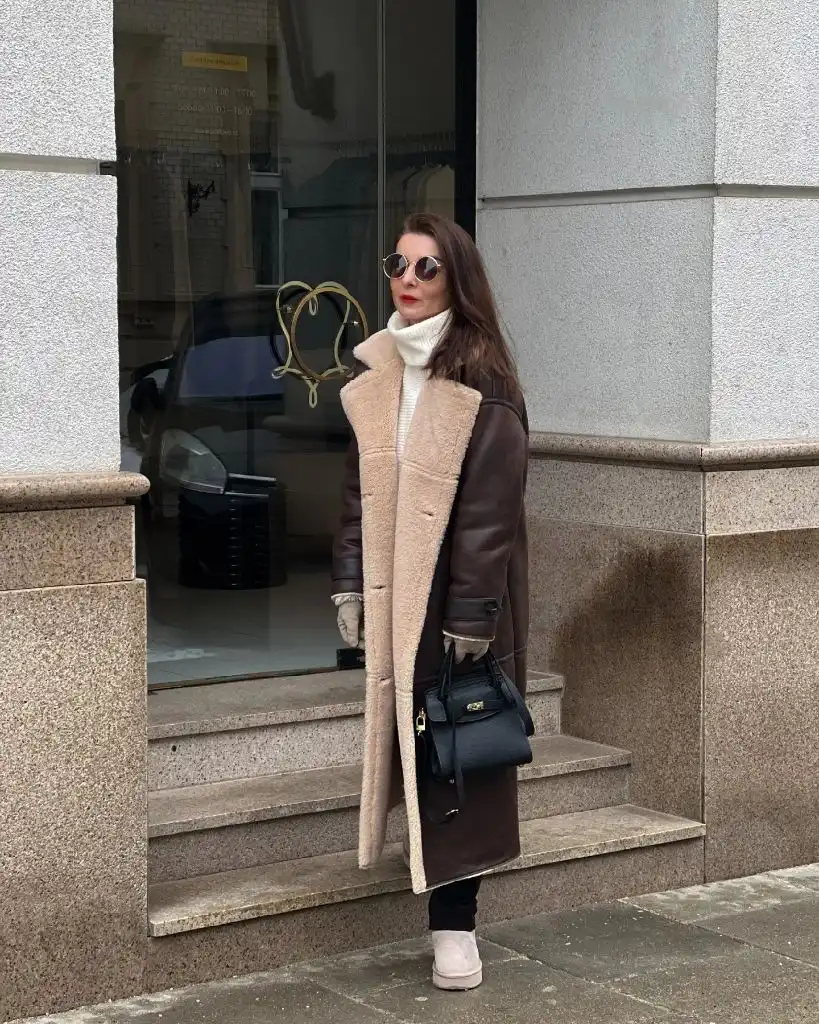
The shearling-like lining creates a visible inner border of cream against the dark brown exterior, and that contrast reads like a built-in accent. Every edge of the coat where it opens or folds back reveals the lighter lining, which means the coat generates its own visual interest without relying on what is worn underneath. The white turtleneck echoes the cream lining, reinforcing the light tone so it appears intentional rather than incidental.
The platform boots at the bottom add height and a visual block of lighter color that mirrors the coat’s cream lining at the top. This creates a frame: light tones at the top edge and the bottom edge, with dark tones in the center. That framing effect is a strong compositional tool for long coats because it prevents the dark exterior from dominating the entire silhouette. Even a small light anchor at the feet can shift the balance.
21. Gray Wrap Coat on Paris Cobblestones
A long, plush-looking gray wrap coat is tied at the waist with a wide matching belt. The coat falls to mid-calf and appears to have no visible collar, wrapping directly from the shoulders. Black ankle boots are the only other visible element. The coat is seen from the back at a slight three-quarter turn. The cobblestone street and a dark SUV in the background suggest a Parisian-looking street setting.
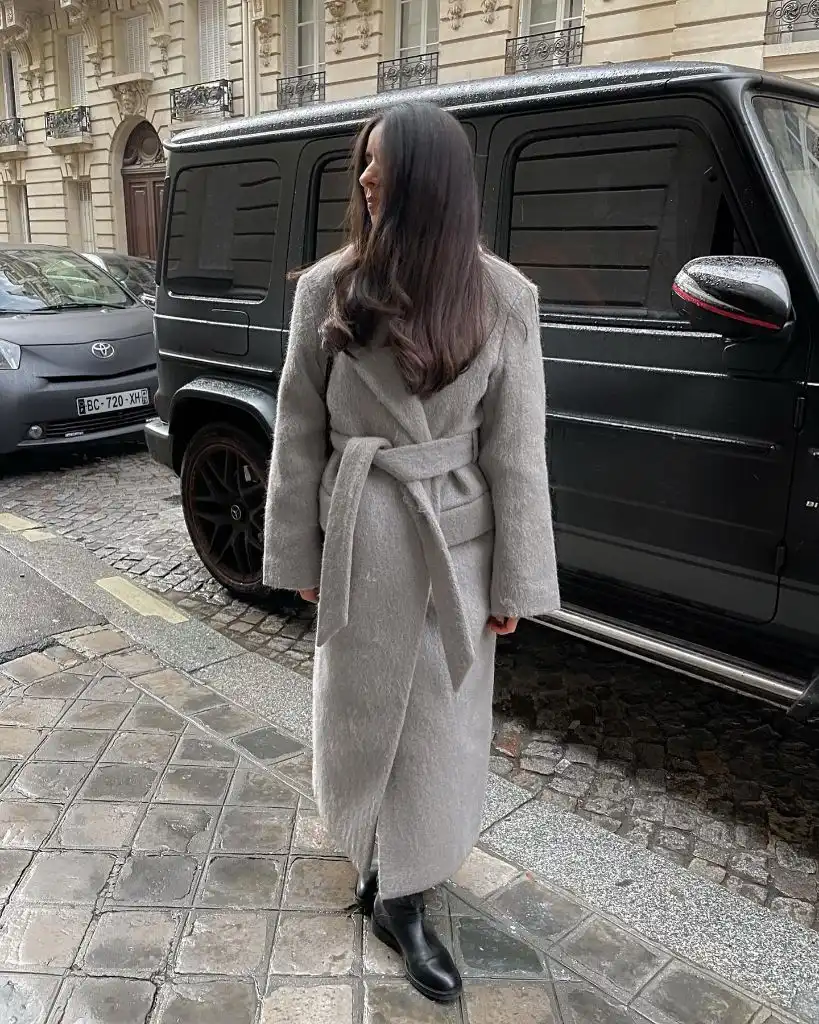
From the back, the belt’s wide knot becomes the central focal point of the composition. The plush-looking fabric falls in a clean A-line from the shoulders, widening gradually, and the belt at the natural waist creates the narrowest point. This hourglass outline is entirely the coat’s doing. No inner layer, no accessory, and no bottom garment contribute to the shape. The coat is the silhouette, which is a hallmark of trendy coats 2027 that function as complete outfits on their own.
The collarless design means the neckline transitions directly from hair to coat fabric with no interruption. This gives the back view a smooth, unbroken curve from the neck to the shoulders, and it reads as cleaner than a coat with a collar or lapel would. If you want to explore collarless coat styling on chicstyleblog.com, the trade-off is clear: you gain a seamless back silhouette but lose the framing that a collar provides at the front.
22. Gray Floor-Length Coat With Matching Knit
A floor-length gray coat with a wide collar and no visible buttons hangs open over a matching gray crewneck knit. Below, dark wide-leg trousers extend to the ground over white chunky sneakers. A dark woven-looking bag is held in one hand. The full-length shot is taken on a London-looking street in front of a fine furniture shop with large display windows.
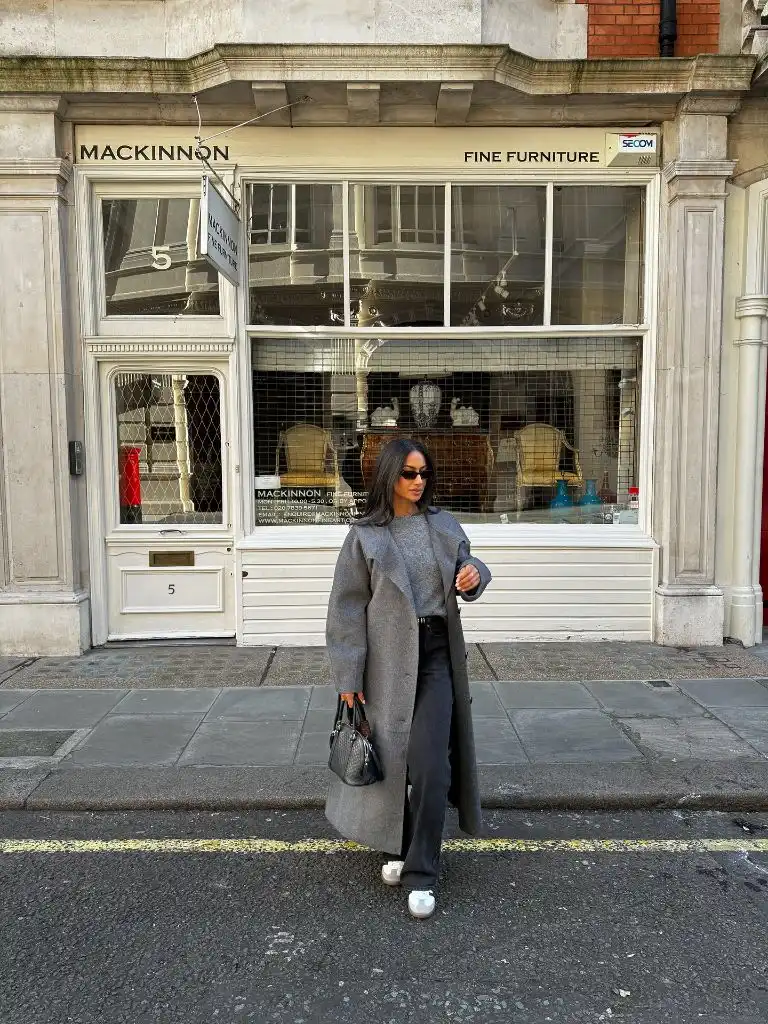
The coat and the sweater share the same gray, which dissolves the boundary between outerwear and inner layer. From a distance, the entire upper body reads as one extended gray zone, and only the coat’s open front reveals the sweater beneath as a separate piece. This tonal merging is a deliberate strategy: by removing color contrast between layers, the silhouette becomes the only story. The coat’s extreme length, grazing the ground, dominates the vertical frame.
The white sneakers at the bottom serve as the single high-contrast accent in the entire outfit. Against the dark trousers and the long gray coat, that flash of white at the feet creates an anchor point that prevents the silhouette from fading into the dark pavement. This is trendy coats 2027 in its quietest form: one coat, one matching layer, one dark trouser, and one bright punctuation mark at the very end. The restraint is the point, and the sneaker is the release valve that keeps restraint from becoming invisibility. More ideas for anchoring monochrome coat outfits are available at chicstyleblog.com.

Hi, I’m Zoey Mitchell, the creator of ChicStyle Blog.
I share simple, wearable outfit ideas, hairstyles, nail trends, and beauty tips that feel natural and easy to recreate.
This blog is where I explore everything that makes a woman feel put together and confident every day. I’m not an expert — just a woman who genuinely loves style, mixing looks, and discovering what works.
If you love effortless fashion with a personal touch, you’ll feel at home here.
1 thought on “Trendy Coats 2027 Chic, and Polished Looks”